Although I run many carer groups focused on those caring for someone with a mental illness. I also facilitate the London Cancer carer forum. The group is based online to allow caregivers a chance to network, share ideas and be informed.
The are several reasons for such a group. The first is a platform to be heard or at least to reduce isolation.
It is not easy when you find out that someone close to you have developed cancer. There is shock, disbelief and confusion. How could this happen? Why them? Why me? Why now?
You are not sure where to turn, but for sure you will certainly listen to the health professionals. You will also do your best to be there for then person diagnoised with cancer. Still in the back of your mind, you might feel powerless. You are almost dependant on how hard the person you care for will fight.
So in the end you must remain confident, but the waves of emotions can keep flooding back. It is as if your life is put on hold because you are unsure about the future. Yet, you will try your best to plan as it is perhaps the best way forward. You do your best to listen to the fears your loved one might express, you will try and be there for them.
Still, deep down you dare not express your fears, concerns or worries to the person you care for. So who do you express them to? Who could understand? Would the health professional have the time to listen to you? How about counselling? There is excellent counselling out there, but it is not forever and you need to belong somewhere quickly. Even if it is just for a moment.
For carers who feel vulnerable there should be a platform where they can feel connected and to express their experience. There should be a place to learn from others and feel less isolated. As carers there should be a chance to try to share our journey because caring for someone can be a maze of complications and difficult emotions.
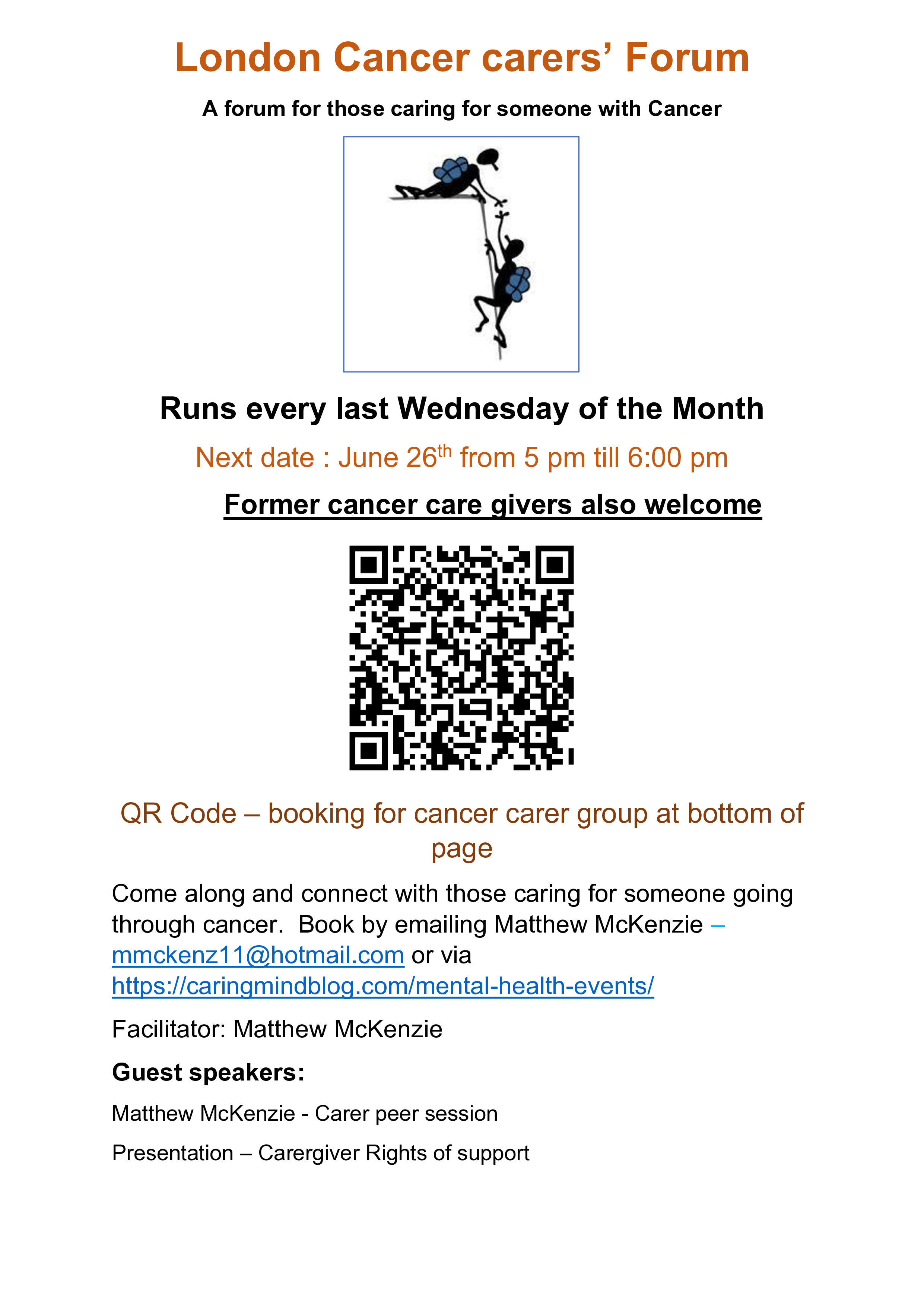
Since Carers Week 2024 takes place from Monday 10th June until Sunday 16th June 2024, The London cancer carer forum will focus on what support carers should seek for 26th of June – 5 pm till 6 pm.
Here is the brief update of my London Cancer caregiver forum. This is the only group I run aimed at those caring for someone with a physical illness. Cancer can strike at any time and it not only affects the patient, but also the family, friend or unpaid carer.
The London Cancer carer forum gets support from Macmillan Cancer Support and also the hospitals in London. A number of the hospitals have been helpful to advertise a carer led community group, which I run voluntarly.
The speakers for the January London Cancer caregiver group were as follows.
Rachel Waddon – Macmillian community updates
Professor Sue Later – Supporting carers to manage pain medication in cancer patients
Caitlin Spooner RN – How does receiving a survival estimate affect the general health and wellbeing of people living with terminal cancer and their carers
Rachel from Macmillian Cancer Support presents
Rachel Waddon who is the new Macmillian Communities Manager for London and South East Regions has been very supportive for community groups. Rachel has provided engagement support and also helped support my cancer carer stall for front line engagement.
With the cancer carergiver network developing, it was great to have Rachel engage with the group. Rachel provided and summary of Macmillians Cancer Support services.
She took the group through the following support and information services.
Macmillan Website and Online Community
Macmillan Support Line (Nurses and Advisers)
Email campaign
Volunteer Services
Information from professionals
Information Centres
Wellbeing Coaches
Rachel also spoke about the impact of Money and Work when someone develops cancer, she mentioned what support is provided and also included the importance of Care Planning and Navigation, End of Life Care and Emotional and Practical support.
Rachel talked about Why there is a need to evolve Macmillan and how people will not settle for anything other than the best possible support for people living with cancer. As a charity, they can’t afford to stand still. Now more than ever, Macmillian need to evolve, taking every chance to make a difference.
If you are someone in London or the South-East of England who is living with or whose life is affected by cancer then please consider joining the Macmillan London Cancer Community. You’ll have opportunities to feed into cancer support services if you would like to and receive updates on information and cancer support in your local area. Join the Macmillan Cancer Networks.
Professor Sue Later from University of Southampton presents
There are lots of research into the experiences of patients, but did you know there is research which involves the experiences of those caring for someone with cancer?
Prof Sue Later presented her paper on “A community nurse-led intervention to support carers to manage pain medication in cancer patients at end of life” She spoke about what was known about unpaid carers.
Carers Play an important role in managing patients’ pain medicines at end of life.
Evidence suggests carers have concerns about pain medicines, and they feel they lack information and support.
Structured support for carers have not been adequately developed or tested for effectiveness.
Professor Sue paper presents what supports carers in managing medications at the end of life. The paper looks to raise the importance of intervention, which is acceptable, feasible and beneficial for patients and their carers. There is also identification of aspects of research design that could be tried on a larger scale.
The context of the paper looked at
How pain affects most people at end of life and can be severe for some.
Many patients at end of life report their preferred place of care.
Unpaid carers can be critical to medicines management and help patients to stay at home. This is done through knowledge and skills, monitoring and interpreting symptoms and also selecting, administering medicines effectiveness.
Prof Sue presented the objective of the research, which also led to a pathway of Cancer carer’s Medicines Management (CCMM) that is aimed at nurses.
Consent: Explain purpose, your role and consent from patient to discuss pain management with carer. Assess: Explore beliefs & previous experiences, assess support and prioritise skills needs. Review: Prescribe and review medicines chart Education: Provide coaching for educational and information Review: Make plans for review and provide resources Support: Naming of what has been learnt.
All in all, the purpose was to equip carers to support their loved ones at end of life.
Caitlin Spooner RN from University College London (Marie Curie Palliative Care Research Department) Presents
The next presenter to speak was Caitlin on the impact of diagnosis when someone is told how long to end of life. This is called Prognostication. Caitlin wanted to measure the outcomes and develop standards.
She also wanted to compare other studies, but also wanted to involve patients and their caregivers and what was important to them. When comparing previous studies, this had to be done through online databases. Caitlin used 5 online databases that included
Patients with advanced cancer or those caring for someone with advanced cancer
Different definitions of Prognostication “Estimating length of survival”
Quantitive studies reported outcomes of prognostication
From searching the online databases Caitlin extracted the following outcomes and grouped into 5 key areas.
Death
Physiological/clinical outcomes
Life Impact
Resource use
Adverse events
Through a systematic review the most common outcomes of prognostication were
Treatment preferences
prognostic awareness
Quality of life
Depression.
It is important to note diagnosis of cancer especially length of survival not only affects the patient, but those supporting the patient especially the carer. It is important to note the impact of diagnosis on the carer.





 A Caring Mind