By Matthew McKenzie – Carer activist, poet and author
Welcome to a brief update of my ethnic mental health carer group, held monthly.
The meeting began with introductions and technical discussions on connecting to zoom, followed by presentations on research related to mental health care and carer support, particularly focusing on minority communities and paranoia. The group discussed various initiatives including a community intervention study, a carer experience questionnaire, and progress updates on Patient Carer Race Equality Framework reporting across different NHS regions. The conversation ended with discussions on challenges faced by minority carers, including access to mental health services and the need for better support systems, with calls for national collaboration and improved respite services.
Summary
Carer Support Network Expansion Discussion
The meeting began with Matthew introducing the session and addressing technical issues faced by some participants, including a participants video problems, which were resolved. Matthew explained his recent laptop issues and mentioned his involvement with Carers Trust regarding Triangle of Care. The group discussed the expansion of their focus with minority carers and the importance of connecting and networking across the UK. Juliana, a researcher, provided an overview of her work, and participants introduced themselves, sharing their roles and experiences related to mental health care and carer support. The conversation ended with a brief overview of upcoming presentations and discussions.
Supporting Minoritized Mental Health Carers
Juliana, a clinical academic and researcher, discussed her work focusing on supporting families and carers affected by mental health problems, particularly those from racially minoritized backgrounds. She highlighted the need for research and support around paranoia, which can affect both individuals with mental health conditions and their carers. Matthew shared a recent research paper on Black and informal carers of those with psychosis, which you can view below.
The group discussed the importance of understanding paranoia as a complex experience that can have legitimate roots, while also acknowledging its impact on quality of life. They agreed to follow up on sharing the research and potentially organizing a longer discussion in the future.
Mental Health Discharge Safety Study
Dr Natasha from Manchester University presented a research study focused on improving patient safety and care pathways in mental health services, particularly around hospital discharge processes. She outlined a new community intervention called the SAFER-MH Bundle, which includes online workshops to gather perspectives from carers and patients on post-discharge care.

The study will involve three workshops, with participants receiving £100 in vouchers for their time, and Natasha addressed questions about inclusivity, translation services, and recognition of carers in the final research publication.
Carers’ Survey on Mental Health
A carer presented who has provided unpaid care for 25 years, shared insights from a recent conference in Sussex where she presented on carers’ experiences and discussed a questionnaire being distributed to 70,000 carers in Sussex to gather data on issues faced by both carers and their loved ones. The survey, supported by Care for Carers charity, aims to monitor the implementation of mental health services’ intentions and will be used to inform the Mental Health Foundation Trust’s 5-year plan. Another carer inquired about the inclusion of dementia and cultural issues in the survey, to which the presenter confirmed these topics are covered, emphasizing the need to address communication difficulties and ethnic minority concerns in mental health services.
Carer Questionnaire and Data Sharing
The group discussed sharing a questionnaire about carer experiences, with the carer involved in Sussex Partnership NHS offered to send Matthew a copy for potential distribution beyond Sussex. A PCREF carer lead from west London NHS trust suggested sharing it with the Carers Trust for wider distribution across London and the UK. Another carer involved at NSFT NHS provided an update on PCREF work in Norfolk and Suffolk, including progress on the carers charter, anti-racism training, and ethnic reporting initiatives. The group also discussed the importance of improving ethnicity data recording and monitoring, particularly in forensic units.
PCREF Implementation and Awareness Challenges
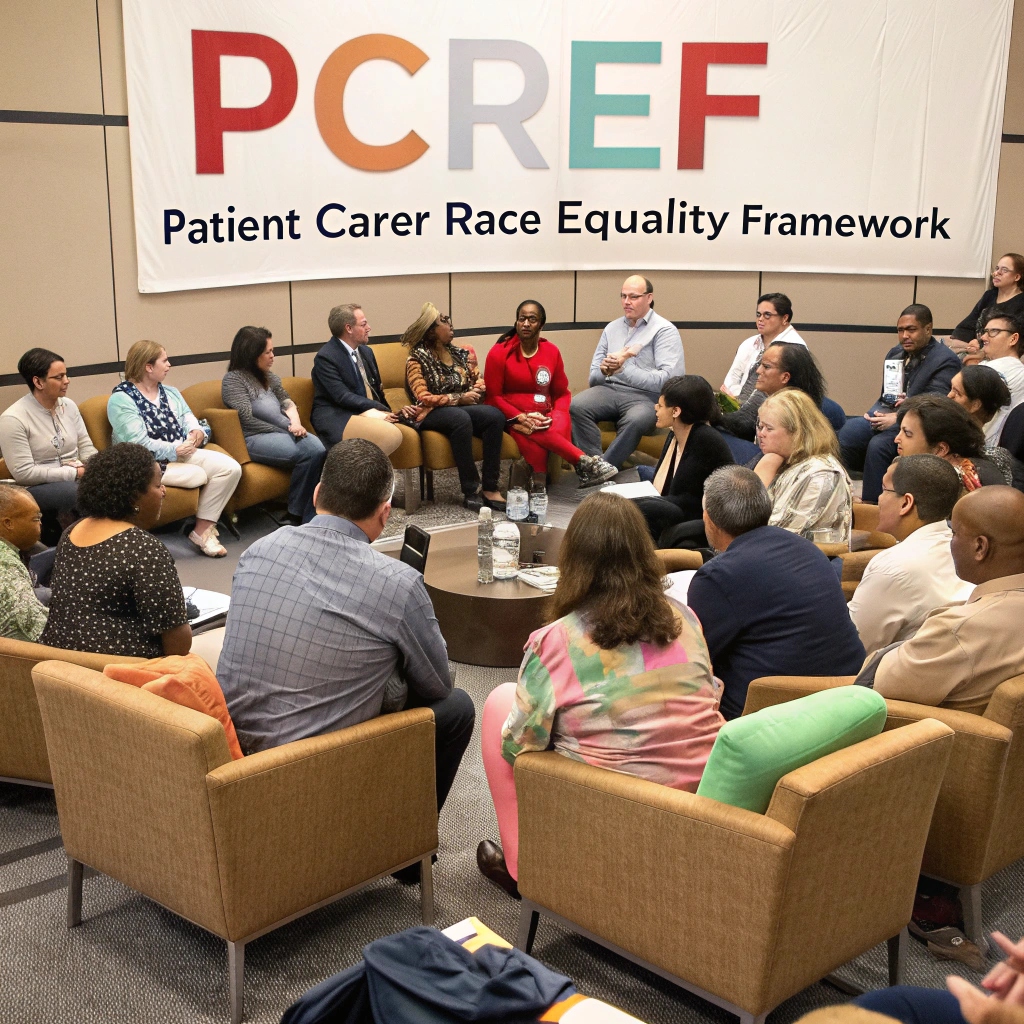
A carer raised concerns about low awareness of PCREF among carers and frontline staff, emphasizing the need for better education and engagement at the ground level. West London NHS Trust discussed the PCREF report submission process, with Linda explaining that West London’s trust is preparing a comprehensive report covering leadership, cultural competency, and patient/carer involvement, which will be reviewed by the PCREF steering group. The discussion highlighted that while some areas were slow starters in implementing PCREF, NHS England understands this is a work in progress and is not expecting immediate perfection.
PCREF Implementation and Community Engagement
The group discussed the exclusion of PCREF from the Mental Health Act Bill, with Debbie noting that the Equalities Act was deemed sufficient to cover it. A carer representative from Leicestershire partnership NHS Trust emphasized the importance of involving community mental health teams and neighborhoods in PCREF initiatives, highlighting ongoing pilot research in Leicester to address disparities in service access. Another involved carer shared her trust’s progress in improving carer involvement and communication, while others stressed the need to educate frontline staff and promote PCREF across urgent care systems. The conversation ended with plans to share information on different trusts’ PCREF reports and continue discussions on implementation strategies.
PCREF Implementation and Progress Updates
The group discussed challenges in implementing PCREF (Patient and Carer Experience) initiatives, particularly the need to reach psychiatrists who are the ultimate decision-makers. Debbie and Linda provided updates on PCREF progress at West London Health Trust, including the development of service line action plans, a planned PCREF launch in September, and the creation of a new identity and logo inspired by Kelvin and the South London & Maudsley team. The discussion concluded with Debbie mentioning a useful accountability table tracking different service lines’ responsibilities and a newly formed data group focused on gathering information over the past four weeks.
Mental Health Data Access Challenges
The group discussed challenges in accessing and sharing mental health data across different NHS regions, with Debbie and Linda highlighting progress in West London where new data analysis has been completed. Matthew then introduced another carer involved in PCREF at Kent & Medway NHS trust, they felt that Kent County’s mainly white population lacks understanding of PCREF’s relevance, while another carer emphasized the importance of providing staff access to dashboards to support implementation. Cambridge and peterborough nhs foundation trust carer involvement introduced herself as a mixed-race clinical research nurse working on inclusion initiatives, particularly focusing on Afro-Caribbean and South Asian communities, and agreed to bring involved carers to future meetings for networking and updates on PCREF.
Addressing Racial Trauma in Caregiving
Matthew the chair of the national carer group then presented on the impact of racial trauma and care fatigue on minority mental health carers, highlighting systemic racism, cultural stigma, and barriers in healthcare and social services.

He discussed the unique challenges faced by minority carers, including financial insecurity, language barriers, and lack of culturally appropriate support. Matthew emphasized the need for leadership, education, and policy changes to address these issues and validate carers’ experiences.
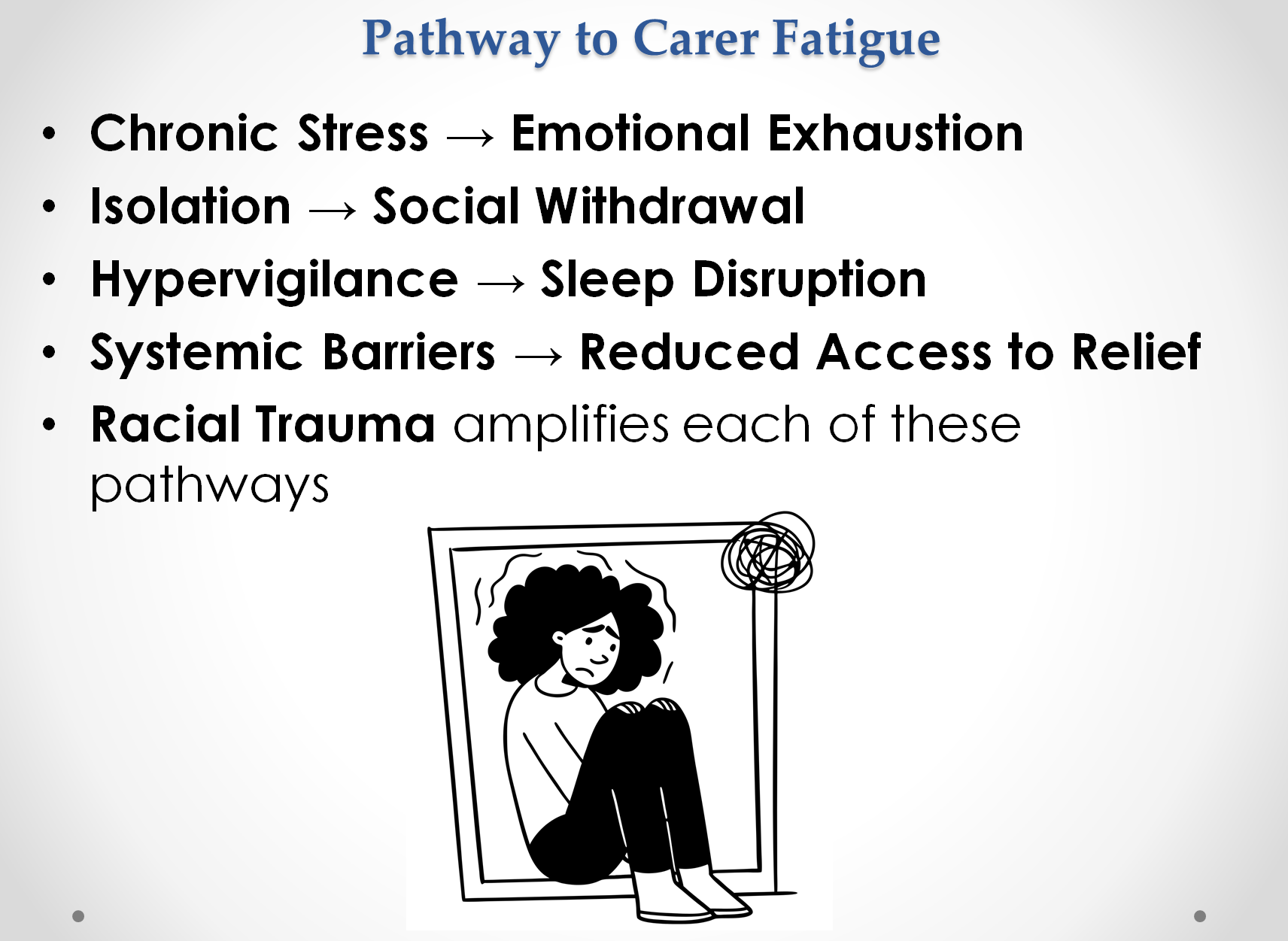
He concluded that racial trauma and care fatigue are interconnected and must be addressed together to support minority carers effectively.
Improving Carer Mental Health Support
The meeting focused on the challenges faced by carers, particularly in accessing appropriate mental health services and medication for those with mental health conditions. Matthew presented on the ongoing work to improve care coordination and support for carers, highlighting the need for better integration of services across different trusts and regions. A Carer shared her experience of struggling to access specialist mental health services for her son, particularly highlighting the lack of black clinical psychologists in her area. The group discussed the potential of mental health hubs to address some of these issues and the importance of involving ethnic minority communities in their development. The conversation ended with a call for carers to come together nationally to have a stronger voice and for better support and respite services for carers.
The next group is for : Friday 25th July – 10:30 till 12:00 noon
Speaker : Debbie Hustings and Triangle of Care
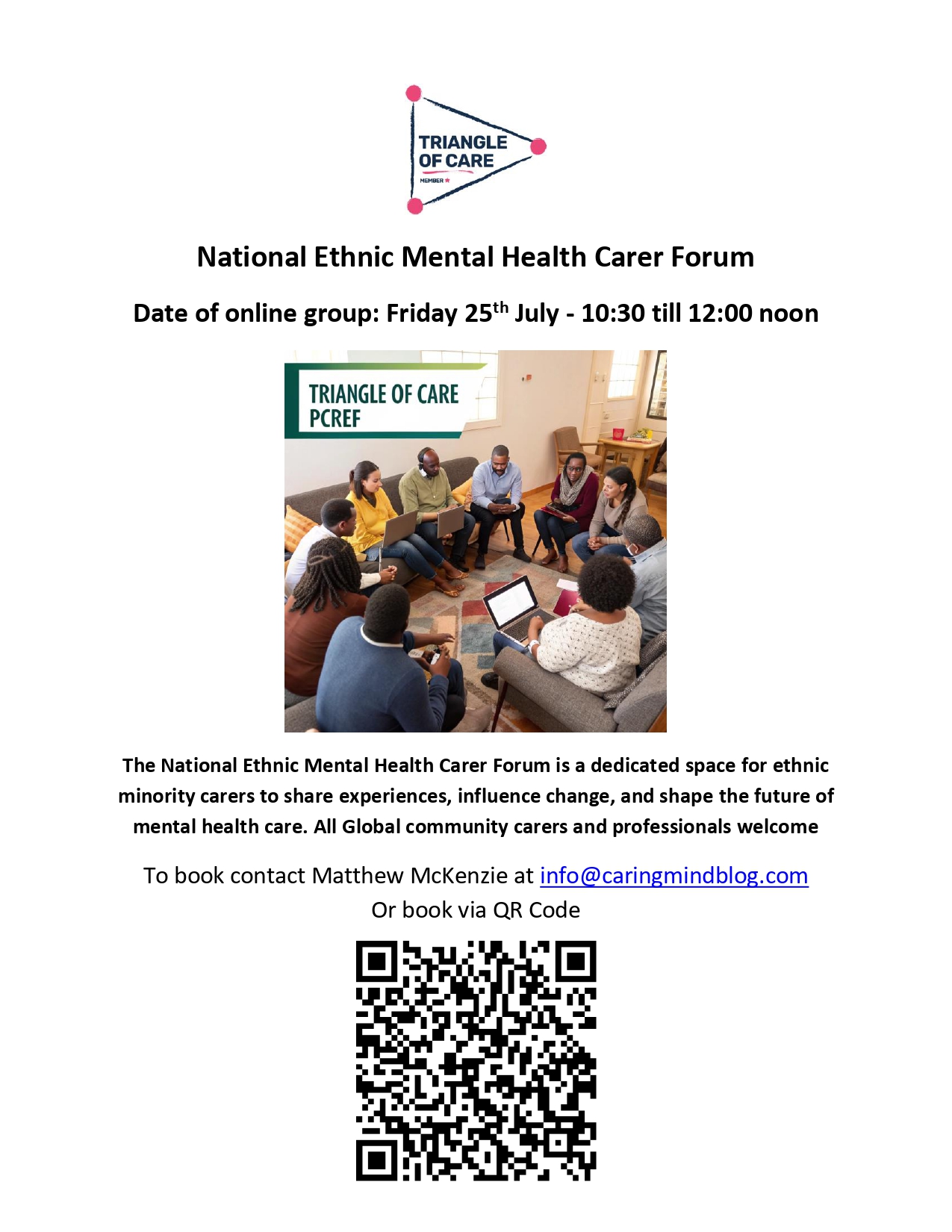
If you are caring for someone with mental illness You can book below.
 A Caring Mind