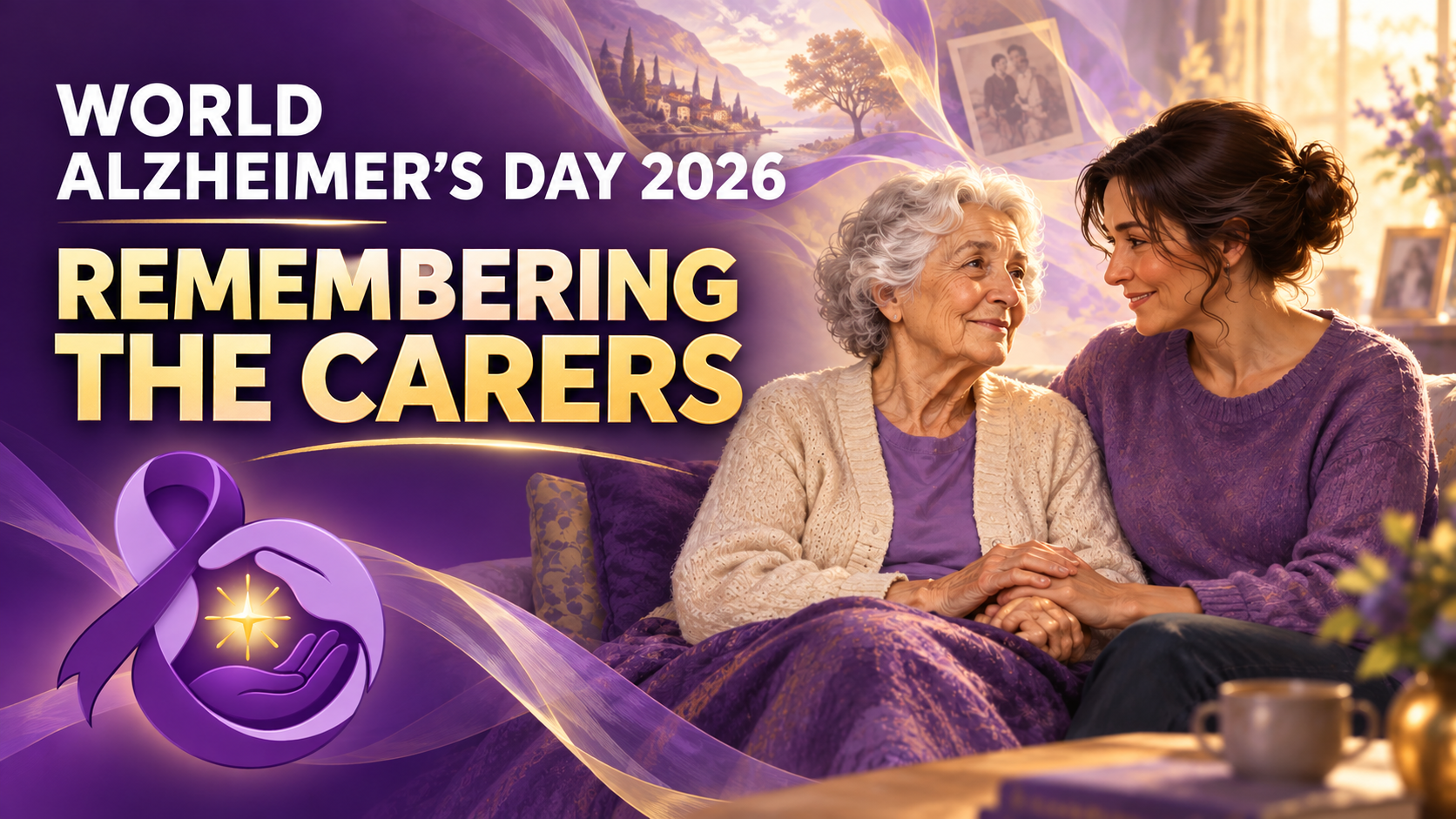
To mark World Alzheimer’s Day, I have produced a new A Caring Mind video focusing on the unpaid carers supporting relatives and friends living with Alzheimer’s disease and other forms of dementia.
Alzheimer’s is a progressive neurological disease rather than a mental illness. However, its emotional and psychological impact can be profound—not only for the person diagnosed, but also for those caring beside them.
The video explores the importance of earlier diagnosis, including carers in decisions, recognising anticipatory grief and connecting families with appropriate support. It also highlights organisations such as Alzheimer’s Society, Dementia UK, Carers UK and Carers Trust.
Carers may manage appointments, medication, personal care, changing behaviour and difficult decisions, often without enough information or support for their own wellbeing.
World Alzheimer’s Day gives us an opportunity to challenge stigma, listen to people affected by dementia and recognise the contribution of unpaid carers.
Neither the person living with dementia nor the carer walking beside them should be forgotten.
By Matthew McKenzie – Triangle of Care – Community group chair
Putting Carers at the Centre of Care
The latest Triangle of Care Community Group brought together carers, professionals and partner organisations from across England to share learning, celebrate progress and identify where further improvements are needed. The meeting highlighted the growing influence of the Triangle of Care across mental health and acute services, whilst reinforcing that there is still much work to do to ensure carers are consistently recognised, valued and supported.
One of the most powerful aspects of the meeting was hearing directly from carers about their experiences. Whilst many spoke positively about the progress that has been made over recent years, there was a shared view that carer involvement remains inconsistent across services. Carers described feeling more included than ever before, with greater awareness of the Triangle of Care principles and more opportunities to participate in steering groups, service developments and community discussions. However, concerns remain around automatic carer identification, information sharing and ensuring that carers are genuinely recognised as partners in care.
Several carers reflected on the importance of having their voices heard early in a patient’s care journey. Examples were shared of services introducing carer contribution templates that ensure family members are involved within 72 hours of admission, whilst others highlighted improvements to confidentiality processes that allow patients to determine what information can be shared with carers at different stages of their recovery. These practical changes demonstrate how relatively small adjustments can have a significant impact on relationships between carers, patients and professionals.
Progress Across the Triangle of Care Programme
Mary Patel, Triangle of Care Programme Lead at Carers Trust, provided an update on developments across the national programme. The Triangle of Care continues to grow, with a number of organisations progressing through the STAR accreditation process and demonstrating their commitment to embedding carer-inclusive practice across services.
Importantly, members were reminded that the STAR awards are not designed to rank organisations, but instead reflect the breadth of implementation across different service areas. STAR I focuses primarily on inpatient and crisis services, STAR II expands into community services, whilst STAR III recognises organisations delivering integrated services across multiple clinical areas.
Several trusts have recently achieved STAR awards, whilst others are progressing through the assessment process over the coming months. The programme’s peer review approach continues to ensure that carers remain central to the assessment process, with carers actively involved in reviewing evidence, identifying good practice and making recommendations for future development.
The Triangle of Care Member Hub continues to provide valuable opportunities for peer learning, resource sharing and collaborative working. Upcoming webinars will include sessions exploring Open Dialogue approaches developed by Devon Partnership NHS Trust, providing members with further opportunities to learn about therapeutic models that place families and carers at the heart of care planning.
Advancing Equality Through the Patient and Carer Race Equality Framework
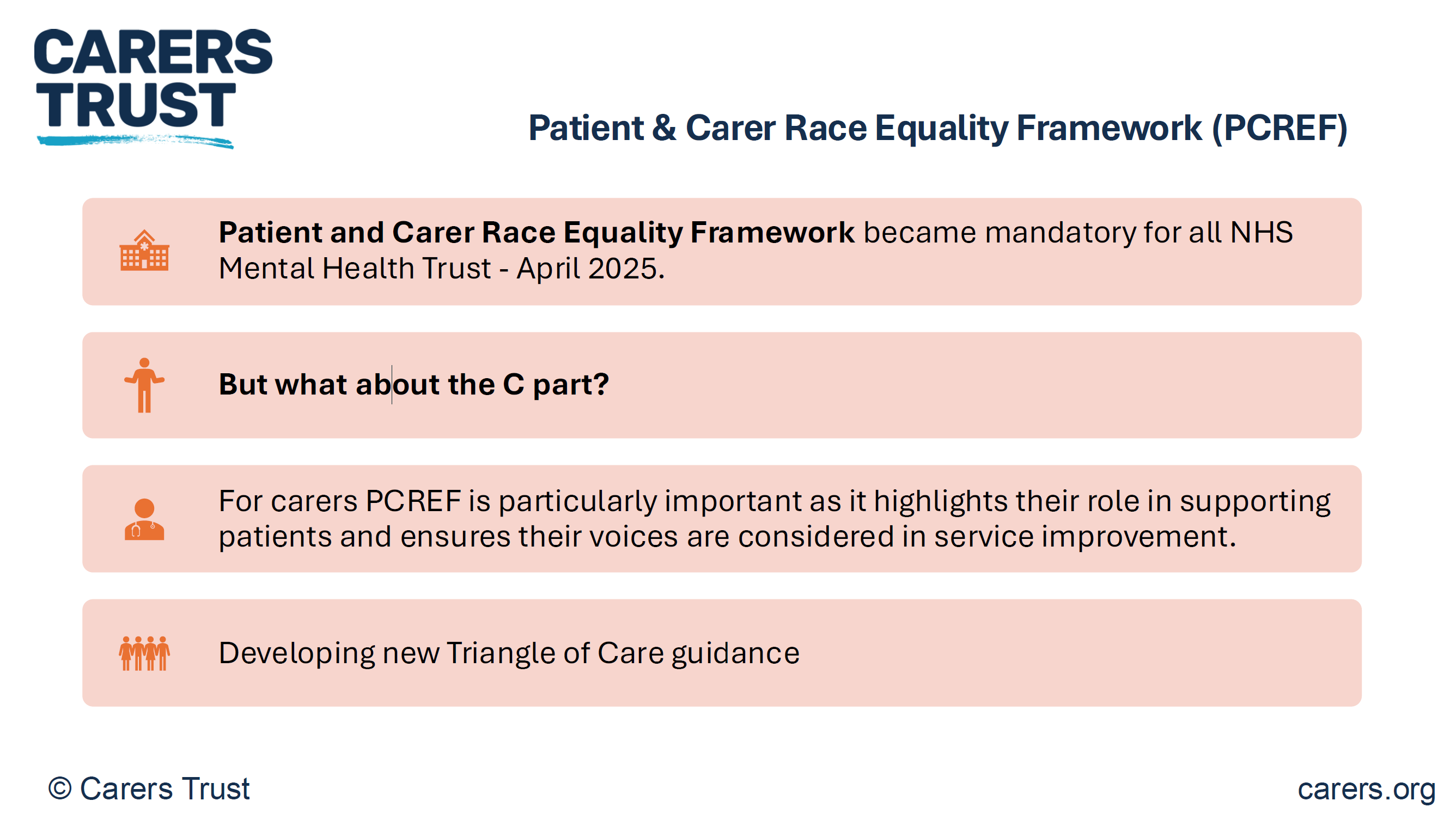
A significant development announced during the meeting was the launch of Phase Two of the Triangle of Care and Patient and Carer Race Equality Framework (PCREF) project.
PCREF represents the first mandatory anti-racism framework within mental health services in England. Recognising that carers from racially marginalised communities often experience poorer outcomes and face additional barriers when accessing support, the Triangle of Care programme has been working collaboratively with carers and mental health providers to strengthen the way services assess and respond to carers’ needs.
The revised self-assessment framework encourages services to move beyond assumptions and adopt a more professionally curious approach to understanding carers’ individual experiences. Rather than viewing carers as a homogenous group, the framework recognises that caring experiences are shaped by culture, identity, language, personal circumstances and wider health inequalities.
Pilot sites from across England are now testing the revised guidance, with learning being shared nationally throughout the project. Importantly, organisations do not need to be participating in the pilot to begin implementing the principles and learning that emerge from this work.
Alongside PCREF, Carers Trust continues to contribute to national policy developments, including the Modern Service Framework for Severe Mental Illness and the forthcoming Mental Health Strategy for England. Throughout these discussions, there has been a consistent message that carers must be recognised as partners in care and have access to appropriate support in their own right.
Confidentiality, Information Sharing and Carer Inclusion
Confidentiality remained one of the most prominent themes throughout the meeting. Whilst participants acknowledged the importance of protecting patients’ rights and preferences, carers highlighted that confidentiality can sometimes become a barrier to meaningful engagement.
Several contributors reflected that confidentiality should never prevent professionals from listening to carers’ concerns or receiving valuable information that may support a patient’s care. Others spoke about the importance of revisiting conversations around consent over time, recognising that patients’ preferences may change as their circumstances and wellbeing improve.
Practical examples of good practice included breaking confidentiality discussions down into specific areas, allowing patients to decide what information can be shared about medication, activities, wellbeing and treatment plans, rather than relying on simple ‘yes or no’ decisions. There was also discussion around the importance of staff training to improve confidence when navigating complex conversations around confidentiality and information sharing.
Participants agreed that carers should never be expected to provide significant levels of support without receiving the information necessary to do so safely and effectively. Achieving the right balance between confidentiality and partnership working remains an important priority for the Triangle of Care community.
Triangle of Care Principles Within Acute Services
The meeting concluded with an inspiring presentation from Wendy Doyle, Head of Patient Experience at St George’s University Hospitals NHS Foundation Trust and Epsom and St Helier Hospitals, exploring how Triangle of Care principles can be successfully implemented within acute hospital settings.
Whilst the Triangle of Care originated within mental health services, Wendy demonstrated that its principles are equally applicable across acute care environments. Her organisation supports approximately 19,000 members of staff across multiple hospital sites and has developed a comprehensive approach to identifying, recording and supporting unpaid carers.
Staff are encouraged to identify carers at the earliest possible opportunity, with this information recorded within patient records to ensure continuity throughout the patient’s hospital journey. Comprehensive carer awareness training is delivered through virtual sessions, ward-based education and e-learning resources, helping staff understand both the practical and emotional importance of recognising carers.
Importantly, identifying carers is only the beginning of the process. Every carer recorded within the hospital system receives a follow-up wellbeing check from the Patient Experience Team to discuss their own support needs, identify any challenges and facilitate referrals to local carers’ organisations where appropriate.
Partnership working sits at the heart of this approach, with close collaboration between acute services and local carers’ centres ensuring carers can access a broad range of practical and emotional support. Adult and Young Carers’ Charters have also been co-produced with carers themselves, helping to shape organisational commitments around kindness, inclusion and meaningful engagement.
Perhaps most importantly, Wendy highlighted that supporting carers improves outcomes for everyone. Better communication strengthens discharge planning, reduces avoidable hospital admissions and readmissions, improves patient safety and helps prevent carer burnout. Acute hospital stays can provide valuable opportunities to identify carers who may previously have remained invisible and connect them with longer-term support.
Looking Ahead
The discussions throughout the meeting demonstrated both the progress that has been made and the challenges that remain. There is increasing recognition that carers are essential partners in delivering high-quality care across both mental health and acute services. However, meaningful involvement cannot rely upon individual goodwill alone; it requires consistent systems, robust policies and a genuine commitment to partnership working.
Looking ahead, the Triangle of Care programme will continue to expand opportunities for peer learning, influence national policy developments and support organisations to embed carer-inclusive practices across services. The ongoing work around PCREF and wider mental health policy developments provide important opportunities to ensure that carers’ voices remain central to future service transformation.
Above all, the meeting reinforced a simple but powerful message: carers must not be viewed as an afterthought or an optional addition to care planning. They are experts through experience, invaluable partners in care and individuals with support needs of their own. When carers are identified early, listened to meaningfully and supported appropriately, outcomes improve not only for carers themselves, but for patients, families and services alike.
The Triangle of Care Community Group continues to provide an important space where carers and professionals can learn from one another, challenge existing practices and work collectively towards more compassionate, inclusive and effective care.
By Matthew McKenzie – Carer UK ambassador and volunteer
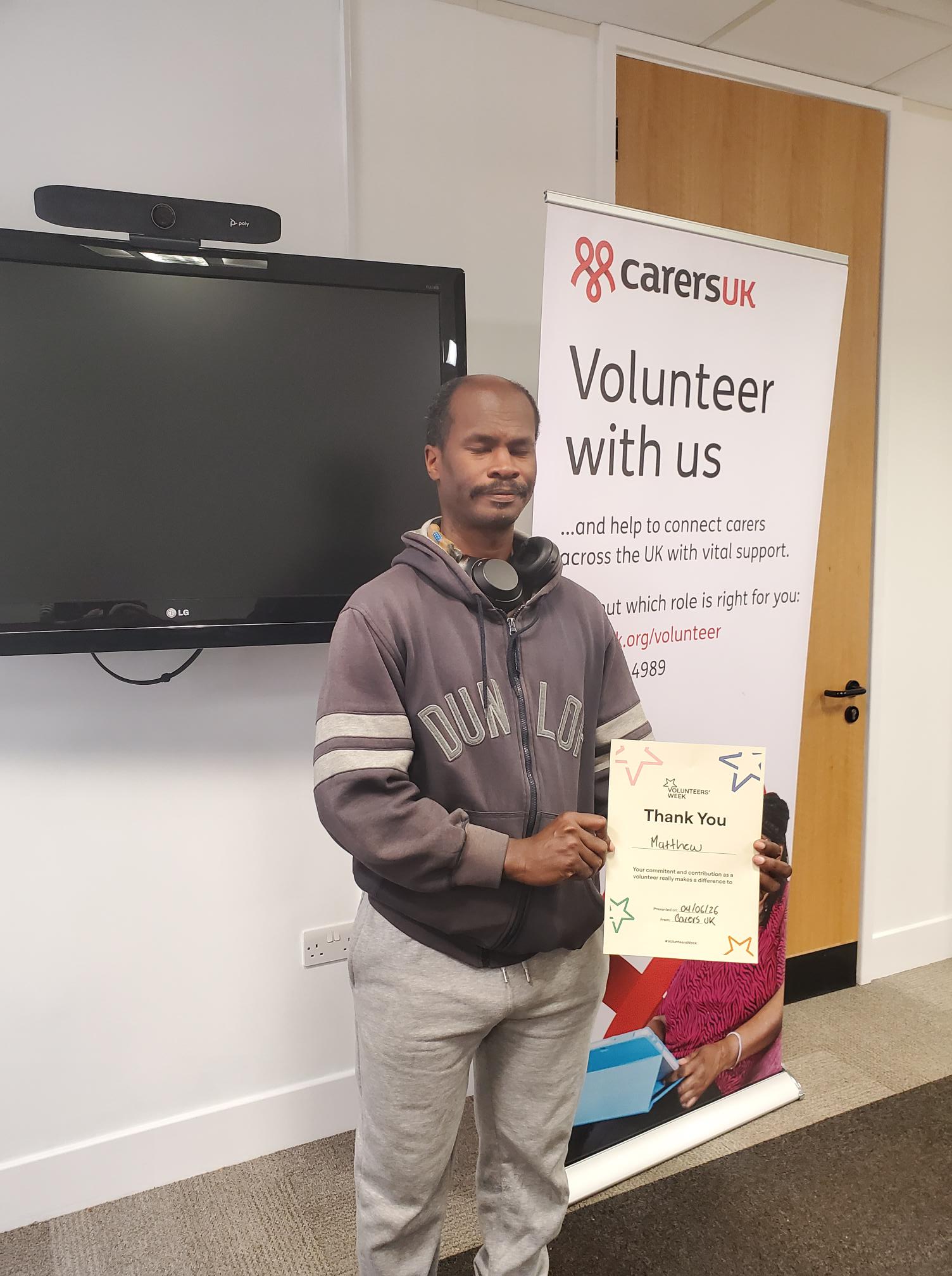
As proud volunteer with Carers UK and Carers Trust, and alongside healthcare teams in hospitals supporting unpaid carers and families. I want to take a moment to recognise the incredible contribution volunteers make every single day.
As we celebrate Volunteers’ Week 2026, across our communities, volunteers give their time, skills, compassion, and energy to help others, often without seeking recognition. Their impact is immeasurable.
For me, volunteering is about making a difference, no matter how small. Sometimes it is providing information and advice to a carer who feels overwhelmed. Sometimes it is speaking up for those whose voices are not being heard. Sometimes it is simply listening. These acts of kindness can change lives.
As carers, many of us already give so much of ourselves to support loved ones. Yet volunteering can also be a powerful way to create change, build connections, and strengthen our communities. It reminds us that we are not alone and that together we can make a positive impact.
Our final Triangle of Care (ToC) Community Group meeting of the year brought together carers, professionals, and ToC members from across the UK to share updates, raise concerns, and discuss priorities for 2026 and beyond. Although Microsoft Teams provided some surprises, we made it work, thanks to teamwork and patience. The conversation was rich, heartfelt, and often very moving.
1. Opening & Agenda
As chair of the meeting, I acknowledged technical teething problems as the group used Teams for the first time in this format. Mary (ToC Programme Lead) welcomed attendees and explained the privacy-driven decision to hide email addresses, which also unfortunately hid attendees’ names. A fix will be implemented before the January meeting.
The agenda included:
Triangle of Care national updates (Mary)
Carer co-production and lived experience input (Matthew)
Surrey & Borders’ co-production example (postponed)
Research priority-setting presentation (Richard, University of Manchester)
Carer questions and discussion
2. Triangle of Care National Update (Mary)
Mary provided a comprehensive end-of-year update structured around ToC’s three priority areas for 2024–25.
2.1 Embedding the Relaunched Triangle of Care Framework
Growth & progress
16 new members have joined the scheme since April, bringing ToC membership to over 80.
The first Welsh hospital achieved a ToC Star Award, prompting the creation of a new Welsh-language logo and Welsh materials.
A social care pilot is underway with Livewell South West, with West Hertfordshire Teaching Hospital reviewing ToC criteria for an acute setting.
Nine Star Awards have been achieved this year, with a further 12 annual reviews approved. Many more annual reports are pending review before year-end.
Standardising data Mary emphasised the push for consistent reporting across Trusts, including:
numbers of carers identified
uptake of carer awareness training
numbers of carer champions
This will help build a national picture of impact.
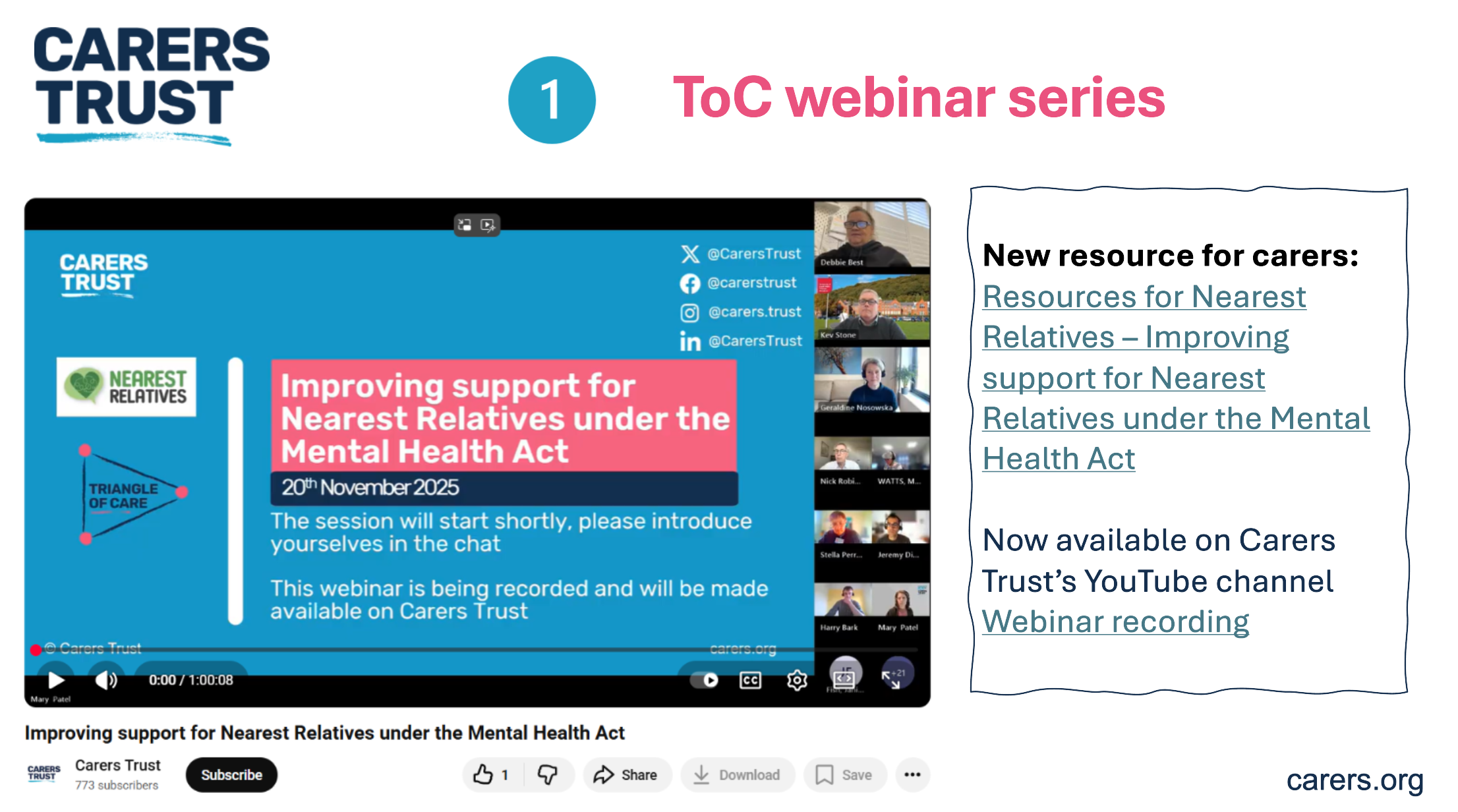
Webinars ToC’s Lunch & Learn series continues, with the recent Carers Rights Day webinar (in partnership with University of Bristol) focusing on the Nearest Relative role under the Mental Health Act (MHA). Resources are available via Carers Trust’s YouTube channel.
2.2 Young Carers: Identification & Support
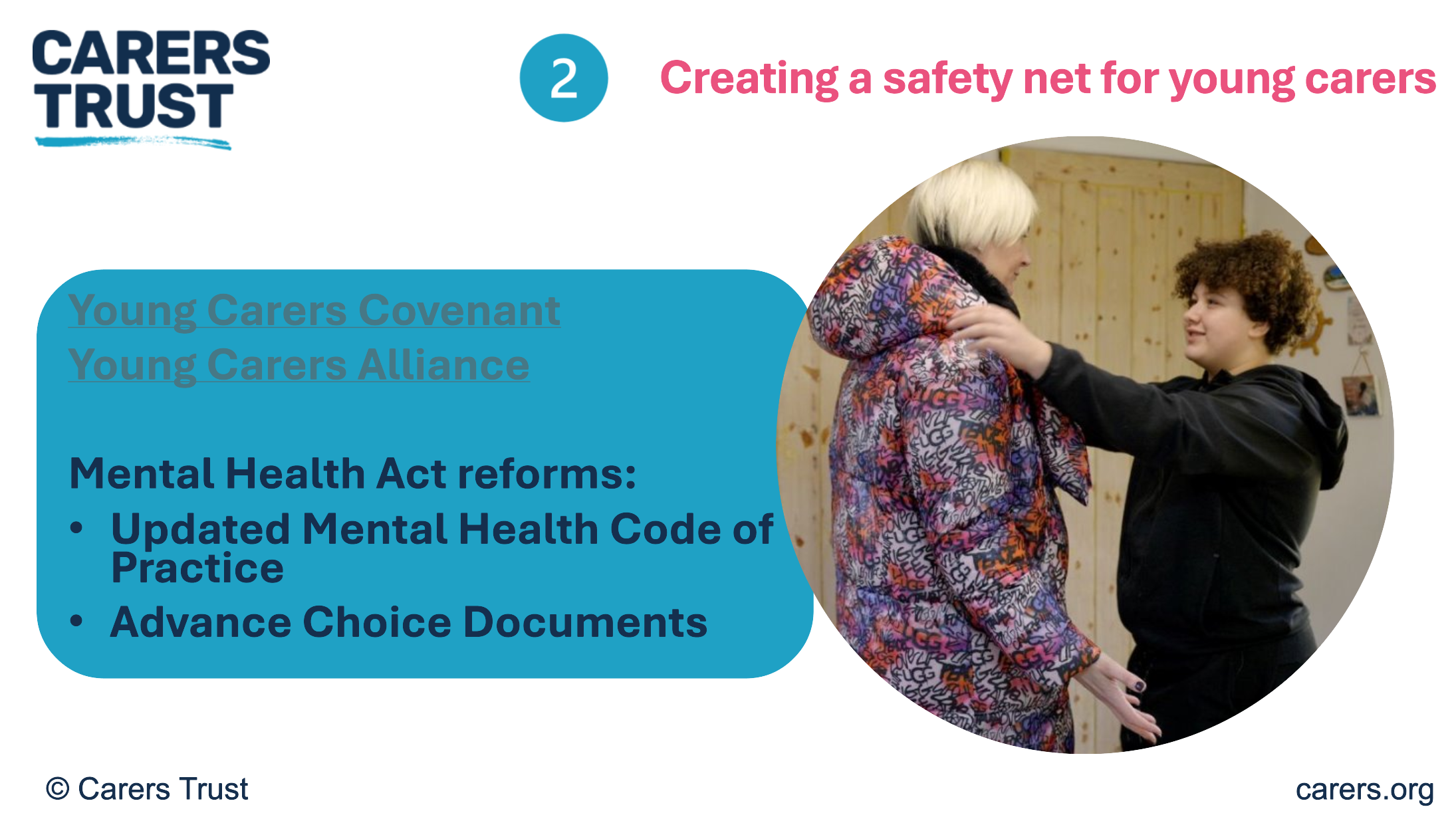
A major update was the successful national policy win relating to young carers and the Mental Health Act.
Mental Health Act Reform – Safety Net for Young Carers
Following campaigning by Carers Trust, the Young Carers Alliance, and ToC members who wrote to MPs:
Government has agreed to update the MHA Code of Practice to require:
identification of children when an adult is detained
sharing of information about available support
referrals for young carer needs assessments
Updates to advance choice documents will require practitioners to ask about dependent children.
Expected implementation: Summer 2026.
This win was warmly welcomed by the group.
2.3 Racially Minoritised Carers & PCREF
Mary updated members on ToC’s work to ensure carers are fully represented in the Patient & Carer Race Equality Framework (PCREF).
Key updates
A national Task & Finish Group has now completed its review of the first four ToC standards; the final standard is underway.
Piloting of new culturally sensitive criteria is planned with 10 NHS Trusts beginning April 2026.
Example of early good practice: Livewell South West is implementing a new “essential data template” that includes carers, enabling services to better identify and support racially minoritised carers.
Carers Trust is calling for a statutory duty for NHS mental health providers to implement PCREF in full, including community governance.
2.4 Changing the Narrative on Care – New Research
Mary introduced new research (supported by the Health Foundation and Oxfam GB) titled Changing the Narrative on Care, highlighting:
Although 80% of the public value unpaid care, this does not translate into policy action or investment.
Three recommended reframes:
Care is a universal experience, not a niche issue.
No care without support, make support visible and tangible.
Care is a partnership between families, communities and systems—not something families must do alone.
The full report is available on Carers Trust’s website.
I then presented an in-depth reflection on the value of authentic carer involvement, drawing on his lived experience and his role working with multiple NHS organisations.
Key points included:
Carers are not passive observers, they hold critical lived knowledge that improves services.
Real co-production goes beyond consultation; carers must be equal partners in shaping policy, documentation, training, and strategic decisions.
Examples Matthew gave from his own involvement:
redesigning welcome packs and leaflets
addressing confidentiality misapplication
involvement in recruitment panels
delivering training to staff at induction
reviewing complaints and compliments themes
advising on discharge processes and family-inclusive safety protocols
participating in research steering groups
Carers’ insight is especially essential in safeguarding, quality boards, and identifying service gaps often invisible to professionals.
4. Surrey & Borders Co-Production Example
A planned presentation from Surrey & Borders was postponed, as the relevant colleague could not attend with materials. They hope to present at a future meeting.
5. Research Priority Setting in Secure & Forensic Mental Health (Richard Kears)
Richard introduced a national project with the James Lind Alliance (JLA) aiming to identify the top 10 research priorities for secure and forensic mental health services across England, Scotland and Wales.
Who is the survey for?
Carers
People with lived experience of secure/forensic services
Staff working in these services
Anyone indirectly connected (victims, families)
Purpose
To ensure future mental health research is led by the real concerns of those most affected, not only by academics or pharmaceutical interests.
Process
National survey gathering research questions.
Analysis to identify common themes.
Second, more focused survey to refine priorities.
National workshops with carers, staff and people with lived experience to finalise the top 10.
A QR code and flyer were shared for distribution. The group expressed strong support.
6. Attendee Discussion & Questions
This was the richest section of the meeting, with many heartfelt contributions. The themes below reflect the key concerns raised.
6.1 Scotland & UK-wide ToC Alignment
A carer asked why Scotland’s ToC framework is separate and not integrated into the UK ToC accreditation model. Mary explained:
Scotland currently uses ToC only as a free policy framework.
Implementing the accreditation model in Scotland would require groundwork to assess willingness and ability of providers to fund membership.
Integration is being discussed but is not imminent.
6.2 Clarity on Co-Production
Several carers voiced concerns that:
“Co-production” is often used as a buzzword.
Some NHS Trusts label work as co-produced after completing it.
Carers need clarity on what ToC means when using the term.
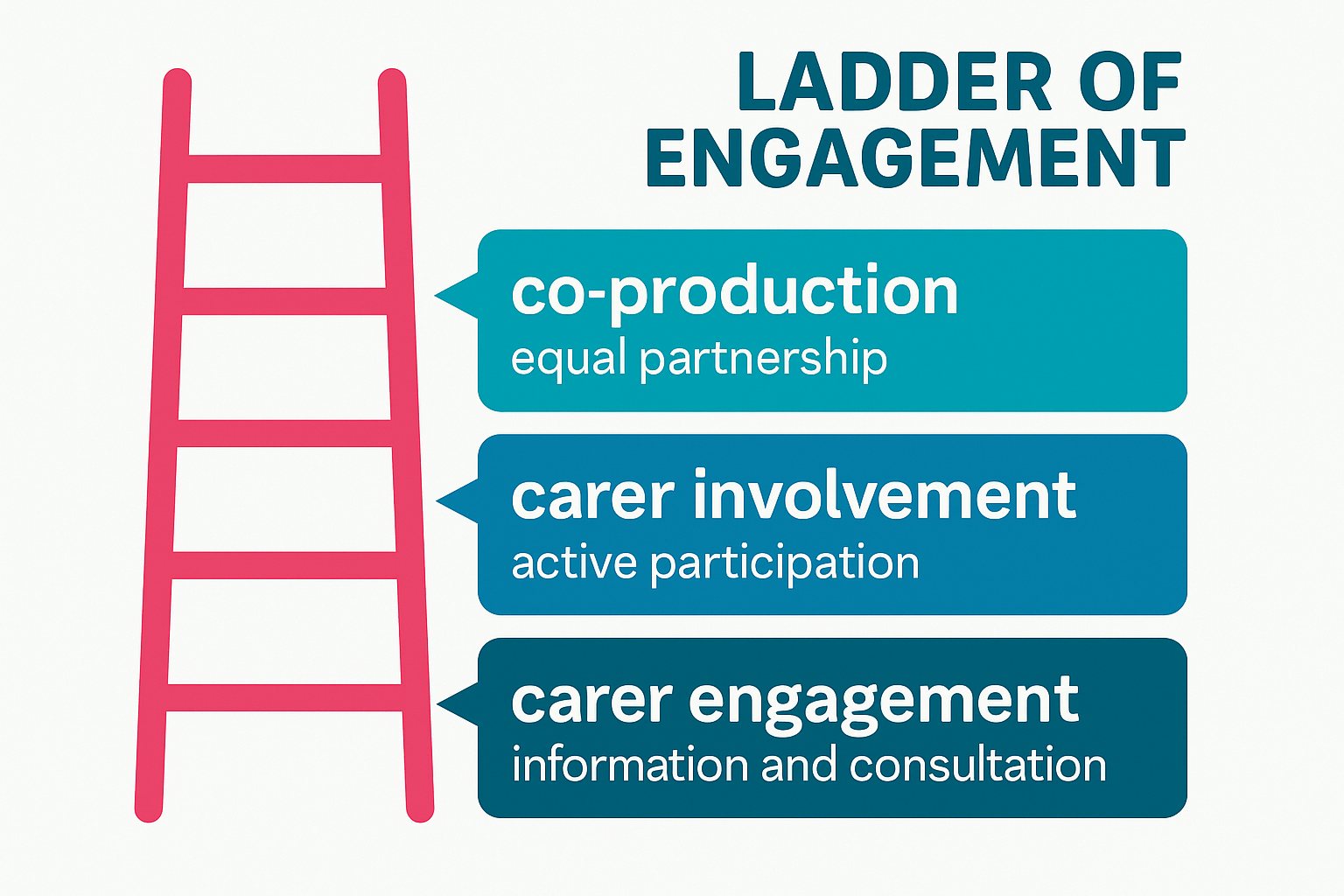
Mary responded that ToC uses a ladder of engagement, distinguishing:
carer engagement
carer involvement
full co-production
Carers Trust is developing a formal principles-based statement on involvement for future meetings.
6.3 Older Carers: Visibility, Support & Inequalities
The majority of carer questions focused on the unmet needs of older adult carers, many of whom are supporting people with severe mental illness—not dementia—and often have been caring 20–40 years.
Attendees reported:
Feeling “invisible” within both policy and services.
Being incorrectly grouped under “older carers = dementia”.
Their own poor health affecting their caring ability.
Increasing struggle to get responses from professionals.
Serious concerns about who will care for their loved ones when they die.
Feeling less heard as they age, compared with younger carers or newer voices.
One carer (age 78) shared:
“I can’t retire from caring. Benefits stop at 65, but the caring doesn’t.”
Another said:
“We have to shout louder as older women to be heard—and still we aren’t.”
Mary acknowledged the seriousness of these issues and committed to:
bringing older carers’ concerns into ongoing ToC work
exploring dedicated guidance and better mainstreaming within the ToC standards
sharing good practice on carer contingency planning in upcoming meetings
I also reiterated the group’s role in surfacing policy gaps and influencing future national lobbying.
6.4 Carer Registration & Meeting Access
Several carers raised issues with:
The length of the ToC sign-up form
Not receiving meeting links despite signing up
Verification barriers when joining Teams
Mary agreed to:
review and shorten the form
clarify which fields are optional
address email deliverability issues
adjust MS Teams settings to reduce joining friction while maintaining security
6.5 Concerns About Confidentiality Misuse
One carer reported that in a CQC meeting at an NHS Trust, raising questions about communication was dismissed as “confidentiality”, preventing meaningful dialogue. I then encouraged carers to bring such examples into:
ToC Star peer reviews
Carer involvement forums
Local advocacy routes
He noted that misuse of confidentiality is a common and unacceptable barrier and must be challenged.
6.6 Petition on Antipsychotic Medication Research
Carers highlighted concerns about:
long-term prescribing of antipsychotics
lack of regular medication review
inadequate research into long-term effects
A carer shared a petition calling for investigation of psychiatric medications. Richard noted that he had signed and shared it previously.
7. Closing Remarks
Matthew thanked all attendees for their honesty, passion and persistence:
“Carers’ voices shape policies and improve care. That is exactly what this group is here to do.”
Mary acknowledged:
the importance of every concern raised
the need to better support older carers
improvements to ToC communications and meeting accessibility
that the next meeting will be in January (provisionally 19th)
The meeting closed with gratitude from carers who said they felt heard, supported, and connected.
By Matthew McKenzie FRSA BEM, Chair, Triangle of Care Community Group
This week’s Triangle of Care Member Webinar, hosted by Carers Trust, which focused on a vital question: What makes for meaningful carer involvement?
We heard from across the Triangle of Care network, these being carers, professionals, and trust representatives coming together to share what genuine involvement looks like in practice.
I spoke about my own lived experience as a carer, supporting two non-verbal brothers with autism and my late mother with mental health challenges and how this journey has shaped my advocacy for stronger partnerships between carers and professionals.
Over the years, through the Triangle of Care, I’ve seen how much difference early and equal involvement can make.
by Matthew McKenzie – National Ethnic Mental Health Carer Forum Chair
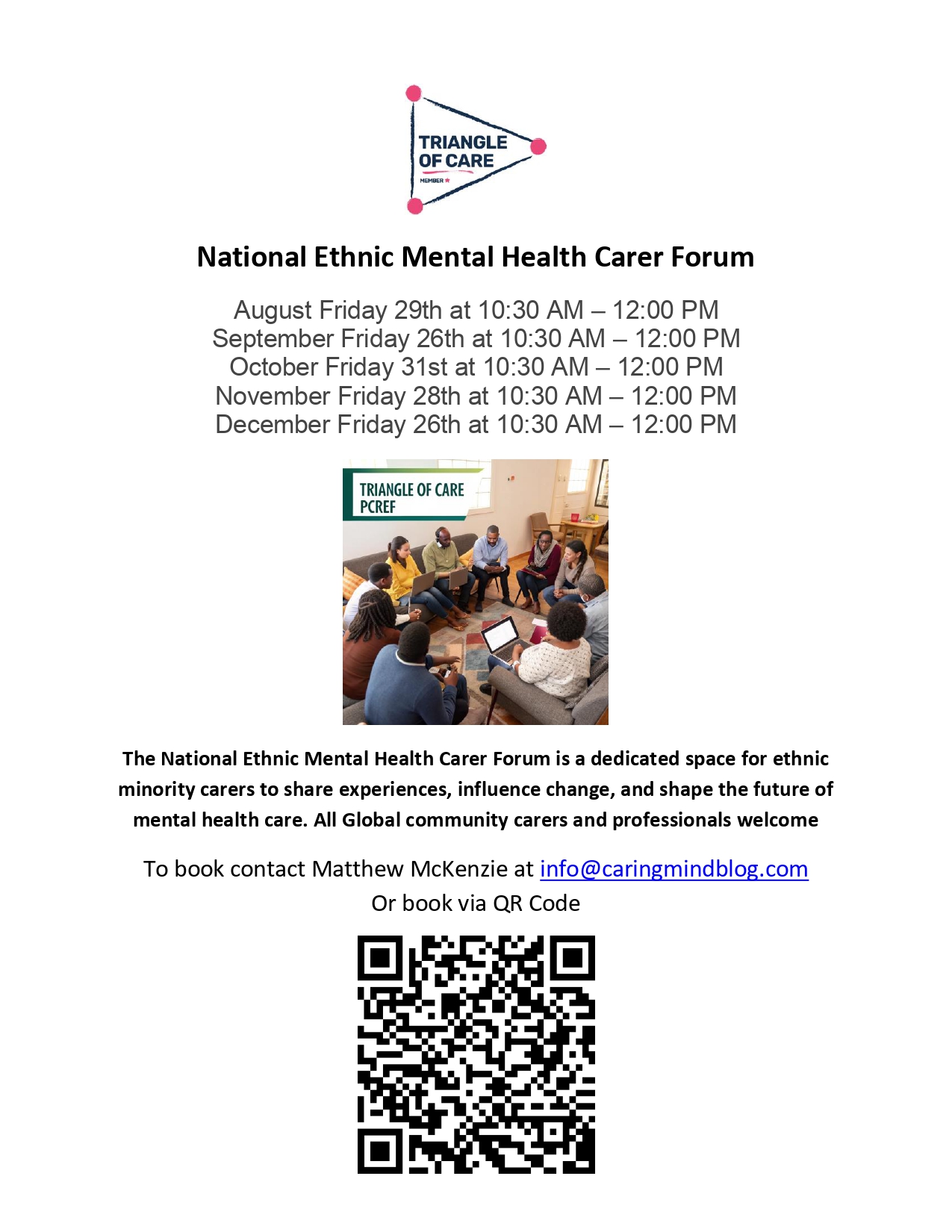
In August, the online National Ethnic Mental Health Carer Forum came together once again to confront difficult but necessary conversations about systemic racism, discrimination, and the experiences of ethnic minority carers within health and social care. The forum, hosted by Matthew McKenzie, provided a platform for carers, professionals, and researchers to share insights, frustrations, and plans for change.
Focus on Racism and Discrimination
This month’s forum was unflinching in its focus: racism in health and mental health systems. Attendees shared powerful testimonies of racial abuse and discrimination, highlighting how these experiences undermine trust in services and affect both carers and those they support. There was a clear call for honesty – participants stressed the importance of naming racism directly, rather than disguising it behind euphemisms.
The group also discussed the overrepresentation of Black and brown people in prisons, the lack of tailored initiatives for older Black carers, and the persistent inequalities faced by ethnic minority families trying to navigate mental health and social care support.
Research and Evidence from Carers Trust
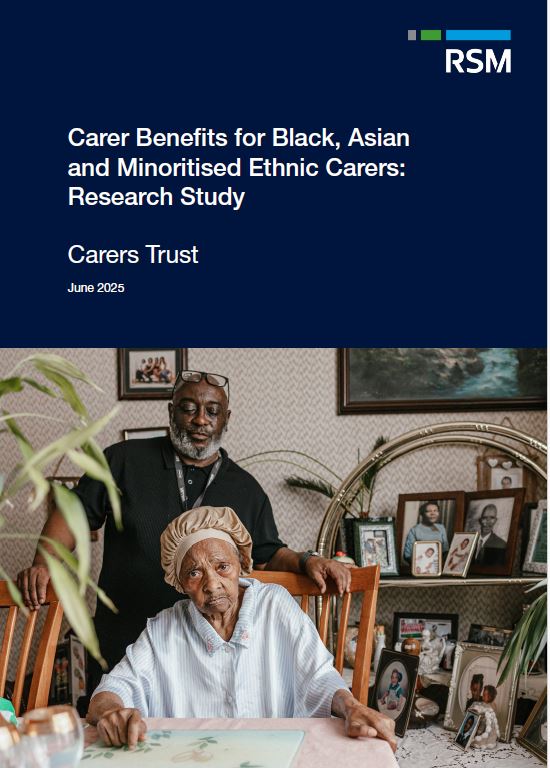
A key presentation came from Andrew of Carers Trust, who shared research into the barriers faced by Black, Asian, and minoritised ethnic carers. The findings highlighted widespread issues: discrimination, language barriers, lack of cultural competence, and difficulties in accessing benefits. Andrew emphasised the need for culturally inclusive services and stronger outreach strategies, while acknowledging feedback from the forum that research and advocacy must be explicit about racism rather than avoiding the term.
Andrew expanded on the importance of equity in benefit advice, pointing out that many carers miss out on their entitlements because information is inaccessible, overly complex, or not communicated in culturally relevant ways. He called for dedicated advice services that are not only multilingual but also sensitive to carers who may not self-identify as such.
He also spoke about the impact of social isolation on carers from ethnic minority backgrounds, who often have fewer support networks and face stigma within their own communities. Addressing this requires building trust with local organisations and ensuring carer support is visible in spaces where communities already gather, such as faith centres or community hubs.
Finally, Andrew outlined the Carers Trust’s national strategy, which involves working more closely with local carer organisations, producing research that amplifies marginalised voices, and lobbying for systemic reforms. He highlighted how this forum’s feedback directly shapes their advocacy, showing a real commitment to partnership.
Questions raised during Carers Trust’s presentation:
How can Carers Trust ensure its research explicitly names racism rather than using softer language?
What specific support can be offered to carers who do not self-identify as carers and miss out on benefits?
How can Carers Trust improve its complaints handling processes, particularly for carers facing racism and discrimination?
What role can MPs and lobbying groups play in supporting Carers Trust’s advocacy for ethnic minority carers?
How will Carers Trust ensure its multilingual materials are distributed widely enough to reach isolated communities?
Hampshire & Isle of Wight NHS Anti-Racism Initiatives
Usually NHS Mental Health trust representatives update on anti-racism initiatives at the forum. This time Hampshire and Isle of Wight engaged with minority carers.
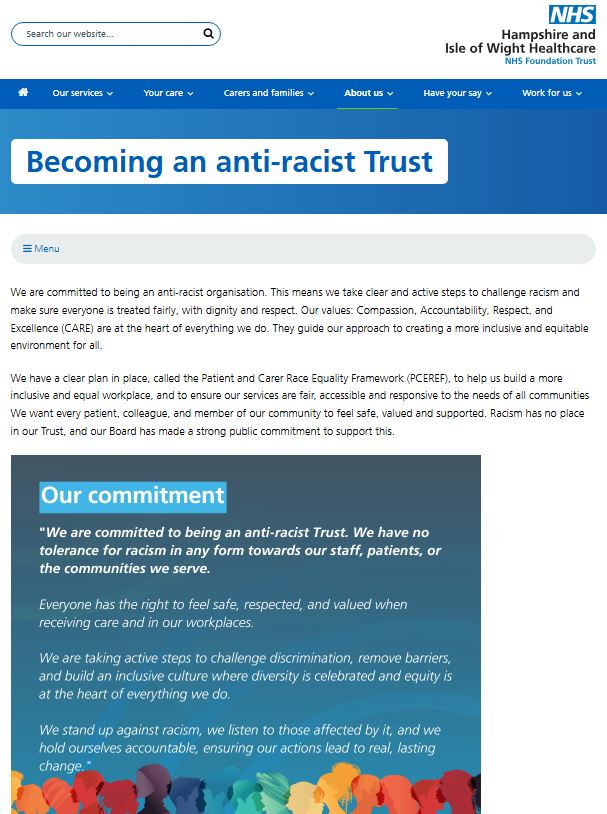
Elton who is the Diversity and Inclusion Partner from Hampshire and Isle of Wight NHS Trust provided an update on their anti-racist programmes, including the rollout of the Patient and Carer Race Equality Framework (PCREF). The trust has begun implementing cultural competence training, engaging with local communities, and embedding anti-racism into its wider mental health services. While early in its journey, the trust is already seeing changes in communication and engagement across different wards and services.
Elton shared that the trust is actively developing training modules on implicit bias, with the aim of reaching every staff member across its services. This training is intended not as a one-off exercise but as part of a sustained culture change programme. Early feedback from staff has been encouraging, with more frontline workers recognising how unconscious bias can influence treatment decisions.
He also described the trust’s efforts to engage directly with service users and carers, ensuring that their lived experiences feed into decision-making. Listening events, surveys, and advisory panels are being used to capture diverse perspectives, with a particular focus on groups who historically felt excluded from consultation.
In addition, Elton emphasised the need for transparency and accountability. The trust will publish regular updates on its PCREF action plan, allowing communities and stakeholders to scrutinise progress. He acknowledged that this is just the beginning, but stressed that embedding anti-racism into healthcare systems requires openness, humility, and sustained commitment.
Participants raised questions about how these initiatives address specific groups, such as older Black carers and prisoners’ families, as well as concerns about public misconceptions of anti-racism work. Elton acknowledged these challenges and committed to following up with colleagues on gaps raised during the discussion.
Questions raised during NHS Trust’s presentation:
How will PCREF specifically address the needs of older Black adults who often feel invisible in services?
What is being done to support the mental health of prisoners (e.g. Albany and Parkhurst prisons) and their families within this anti-racist framework?
How will the trust prevent the public misconception that PCREF “excludes” white people?
What mechanisms are in place to ensure transparency and accountability in publishing progress updates?
How will the trust measure the long-term impact of cultural competence and implicit bias training?
Academic Research Contributions
The forum also heard from Shylet, a PhD researcher from University of Glasgow, who is focusing on learning disabilities. She presented her work on the lived experiences of Black African families caring for adults with learning disabilities, and invited participants to take part in interviews. Their contributions highlighted the importance of academic research in documenting and amplifying carers’ lived realities.
Another important theme was the financial challenges facing carers. The group discussed the complexity of benefits like Carer’s Allowance and how misinformation or fear of losing other entitlements often deters carers from claiming support. A carer expressed reluctance to claim due to concerns about how it might affect their relative’s benefits, while another highlighted the importance of valuing one’s own contribution and recognising caring work. There was frustration with bureaucratic systems that seem designed to exclude, particularly when layered with the additional barriers of language, culture, and discrimination.
Carers also highlighted the immense value of unpaid care, with estimates placing its worth at over £180 billion per year if it were to be paid for by the NHS. This figure underscored the urgent need for better recognition and support of carers’ contributions.
Strengthening Complaints and Accountability
There was a debate around how carers can raise complaints when faced with racism or poor treatment. Many participants expressed a lack of trust in formal systems like the CQC or Ombudsman, feeling that complaints disappear into bureaucracy without change. Suggestions included working with MPs, lobbying groups, or the media to ensure voices are heard.
Final Reflections
The August forum showed once again how necessary it is to hold these difficult conversations. Carers spoke bravely about racism and exclusion, professionals shared updates on anti-racist strategies, and researchers sought to bring lived experience into policy. Yet the message was clear: systemic change requires more than frameworks and research reports. It requires honesty, collaboration, and persistence.
As host, I was encouraged by the passion and determination in the room. The forum continues to grow as a national voice for ethnic minority carers, and our commitment to addressing racism head-on remains at the heart of this work.
The Urgent Need for Digital Skills Among Unpaid Carers
Unpaid carers who provide support to family members, friends, or neighbors with long-term health conditions are the backbone of many communities. Their work is often invisible, yet it is essential for the well-being of countless individuals. As healthcare systems rapidly digitize, the landscape of caregiving is undergoing a profound transformation. Unpaid carers now face the challenge of adapting to new technologies, digital platforms, and online resources that are becoming integral to the delivery of care.
This blog explores why technical and digital skills are no longer just optional for unpaid carers. The blog is also a transcript of matthew’s video below.
Drawing on insights from matthew’s experience as an unpaid carer & IT professional and advocate for carers, we delve into the practical reasons behind this shift, the opportunities and challenges it presents, and the future trends that will shape caregiving in the years to come.
The Changing Face of Caregiving
Digitization in Healthcare
Healthcare is moving online at an unprecedented pace. Electronic health records, telehealth platforms, wearable health devices, and digital prescriptions are becoming the norm. The reasons are clear: digitization streamlines processes, reduces costs, and enables real-time access to critical health data. For unpaid carers, this means that many aspects of their role now require interaction with digital tools.
The Role of Carer Centers
Local carer centers have traditionally been the first point of contact for those seeking support. As these centers will play a crucial role in helping carers acquire the skills needed to navigate the new landscape. Online training, virtual support groups, and digital resource libraries are just some of the ways carer centers are evolving.
Overcoming Barriers to Digital Inclusion
Challenges Faced by Carers
Not all carers are comfortable with digital environments. Some may lack the means to access technology, while others face disabilities that make using digital platforms difficult. For example, visual impairments can pose significant challenges. It’s important for carer centers and support organizations to recognize these barriers and provide alternative solutions where possible.
The NHS 10-Year Plan
Digitization is at the heart of the NHS’s long-term strategy. Unfortunately, unpaid Carers who fail to meet the demand for digital skills may find themselves excluded from essential services and support. Embracing technology is not just about keeping up, it’s about empowering carers to meet the needs of those they support with confidence and efficiency.
Conclusion
The digitization of healthcare is transforming the role of unpaid carers. Technical and digital skills are now essential for accessing resources, coordinating care, and advocating for loved ones. While the transition may be challenging, it offers opportunities for greater efficiency, independence, and empowerment.
If you are an unpaid carer, now is the time to invest in your digital skills. Seek out training, connect with support networks, and take advantage of the tools available. Your role is vital, and with technology on your side, you can continue to make a difference in the lives of those you care for.
Building Stronger Voices: A Powerful July Gathering of the National Ethnic Mental Health Carer Forum
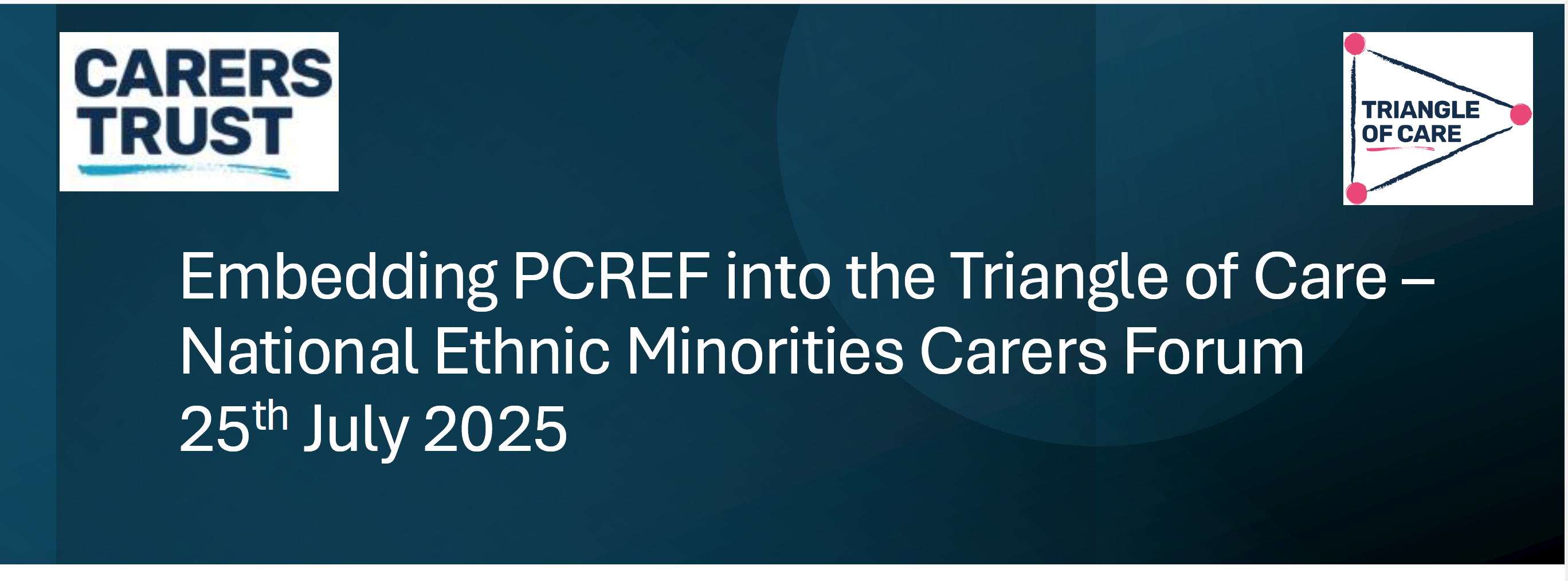
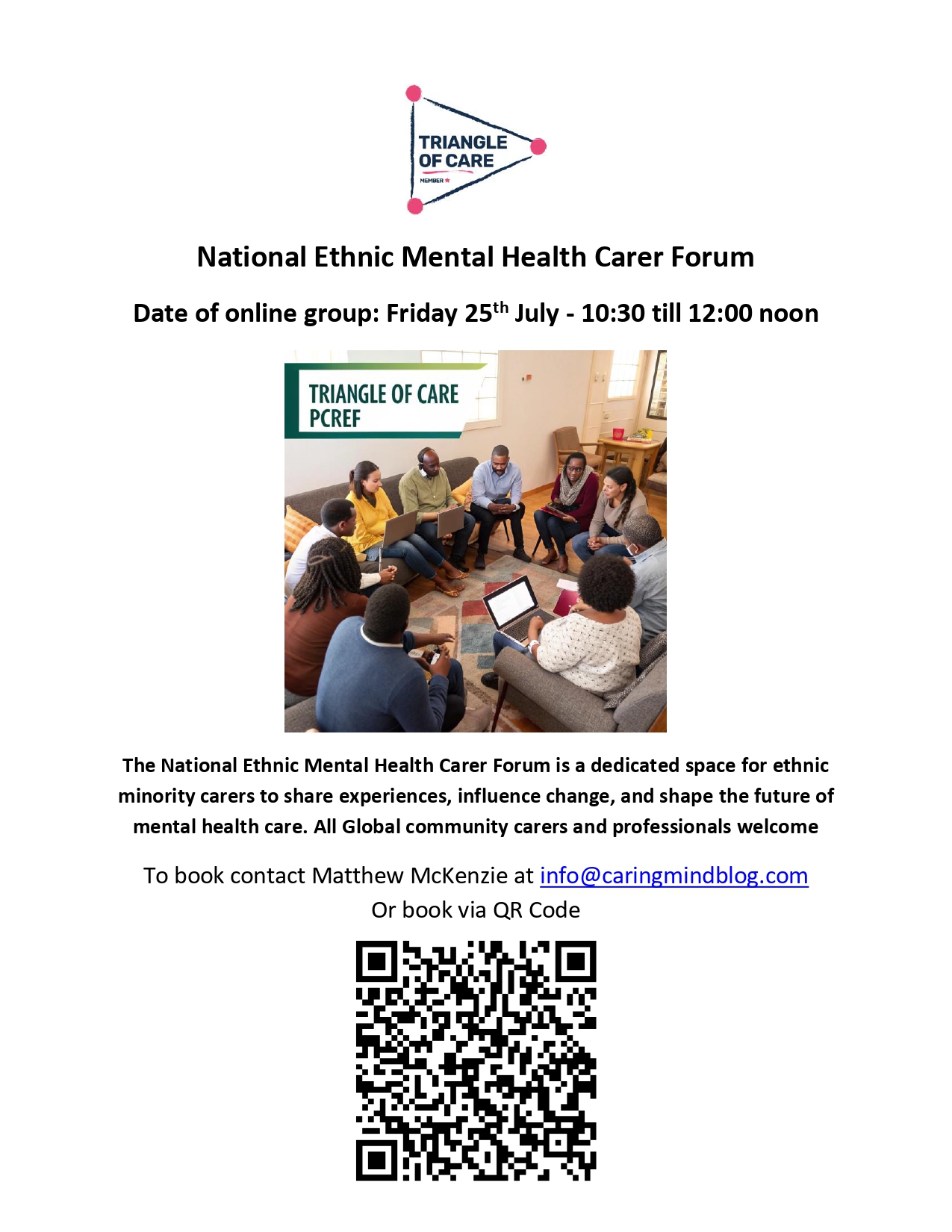
On Friday, July 25th, the National Ethnic Mental Health Carer Forum held another online session, continuing our work in empowering diverse carers and influencing meaningful change across mental health services. With participation from community champions, NHS professionals, experienced unpaid minority carers. The discussion was on the Triangle of Care (ToC) and PCREF (Patient Carer Race Equality Framework) stakeholders.
This forum exists to elevate the voices of ethnically diverse carers, bringing their lived experiences to the forefront of service transformation. Whether it’s holding systems to account or shaping policy guidance, this space remains vital in creating inclusive, anti-racist care across the UK.
Highlights from July’s Forum
🔵 Debbie Hustings’ Presentation on Triangle of Care & PCREF Integration Debbie, a long-standing Triangle of Care Programme Lead and carer herself, gave an in-depth presentation on reviewing the Triangle of Care through a PCREF (Patient and Carer Race Equality Framework) lens. Her talk provided an honest look at institutional challenges and offered solutions for embedding racial equity into carer support standards. A key takeaway was how crucial lived experience is in driving real policy change not just warm words. She emphasized the importance of re-examining existing standards through a racial equity lens, stating that “beyond warm words,” carers need frameworks that are operational, measurable, and locally adaptable.
🟣 Powerful Feedback from Carers Contributors shared difficult yet necessary truths. Carers spoke about the lack of involvement in care planning, systemic racism, the need for meaningful co-production (not “faux-production”), and experiences of isolation when navigating majority environments. One carer reflected, “In 28 years of caring for my son, I have never been involved in his care planning.”
Several carers shared their painful, sometimes shocking, experiences navigating mental health services, especially in areas with limited diversity. One participant remarked, “Even after decades of caring, I’ve never been included in a care plan.” Others spoke of staff who misunderstood or dismissed cultural nuances, the misuse of confidentiality rules to exclude carers, and the silencing of Black and Asian voices. Concerns were also raised about immigration-related fears, lack of access for non-English speakers, and a troubling rise in racism in predominantly white areas. These reflections painted a vivid picture of systemic inequality but also made clear the power of collective advocacywhen carers come together, change begins.
These testimonies highlighted how far we still need to go.
🟡 Inclusive Language & Representation There was a passionate discussion around terminology whether to use “global majority” or “ethnically and racially diverse.” While some feared backlash from certain communities, the group leaned toward inclusivity and accountability over appeasement. This sensitivity around language underlines the forum’s thoughtful and intersectional approach.
🟢 The Work Ahead Debbie shared the next steps in developing Standard 2 of the Triangle of Care through the PCREF lens: staff training. The goal? Mandatory, culturally safe, anti-racist care awareness education co-produced with carers from diverse backgrounds. By April 2026, the guidance will be finalized, field-tested, and launched nationally.
A Forum of Global Carers, Local Action
This month’s session proved again that our forum is more than discussion as it’s a driving force for equity. Participants from Southampton, Lewisham, Pennine, Norfolk, Leicester, South West London, Kent & Medway and beyond all shared insights into their local efforts, including cultural awareness training, community storytelling projects, and carer-led involvement initiatives.
One key message? Change is possible when carers are part of the conversation—not as guests, but as co-leaders.
Want to Get Involved?
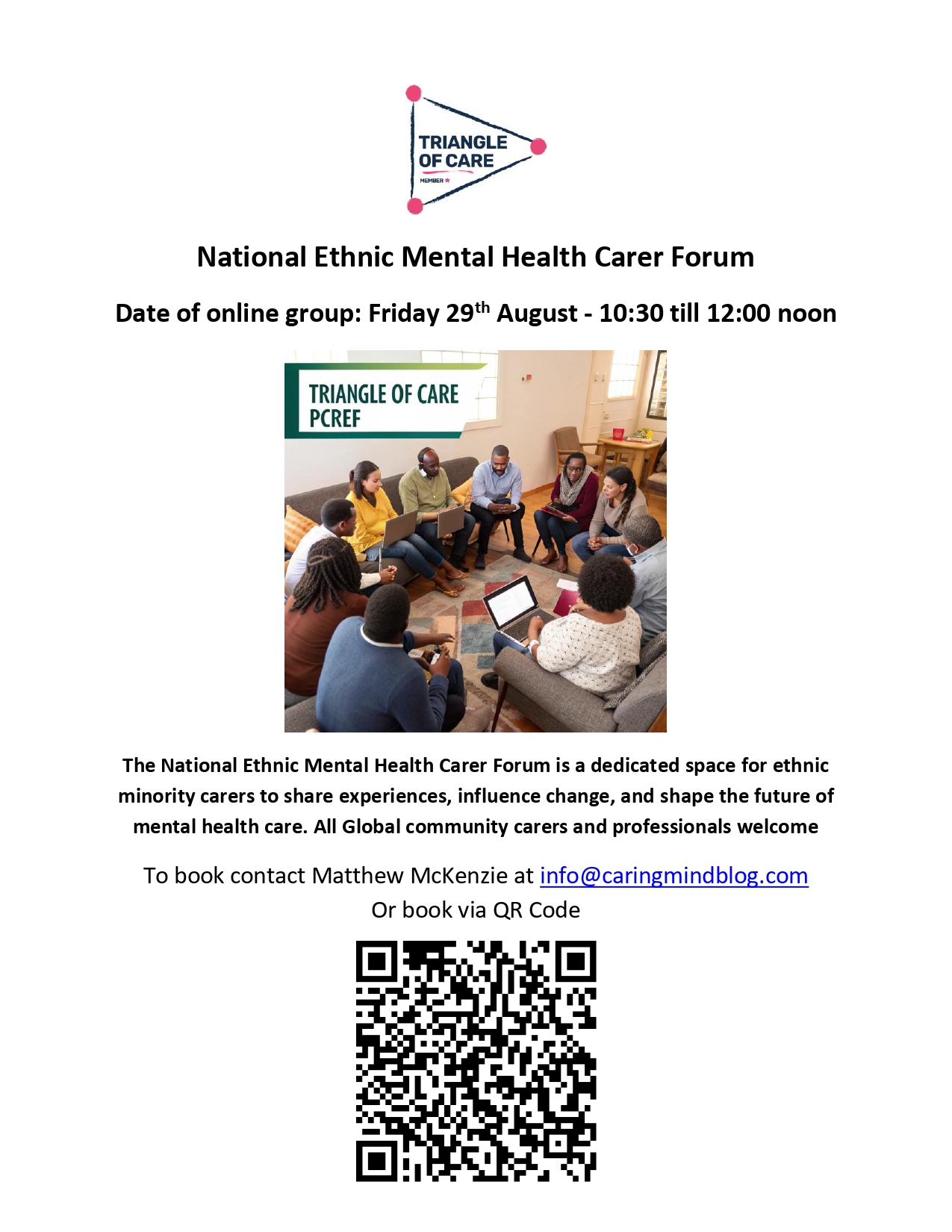
The forum is open to carers and professionals across the UK and beyond. We meet monthly online, and everyone is welcome to join, contribute, or simply listen.
For bookings or questions, contact me at info@caringmindblog.com 📱 Or download and scan the QR code in the flyer above
Together, minority mental health carers can shape a mental health system that sees, hears, and supports all carers—ethnically, culturally, and fully.
Next National MH carer forum in August 29th 10:30 am Matthew McKenzie Founder – Caring Mind Blog Facilitator – National Ethnic Mental Health Carer Forum
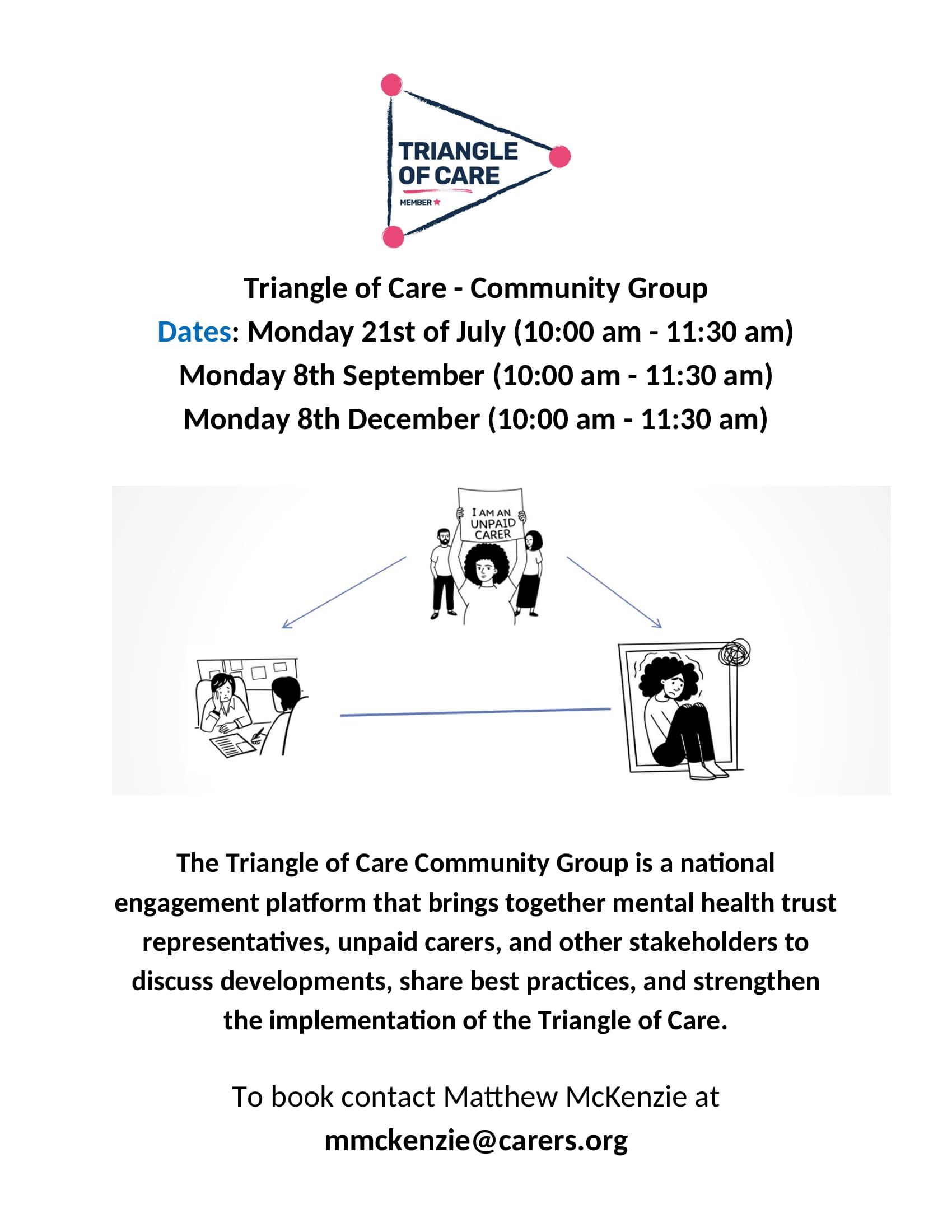
On 21st of July 2025, carers, professionals, and stakeholders from across the UK gathered virtually for the latest Triangle of Care (ToC) Community Meeting. Chaired by Matthew McKenzie, this session was packed with insight, action points, and open dialogue. Whether you were new to the group or a long-time contributor, there was something valuable for everyone.
This meeting was particularly significant as it marked a turning point for carer participation. The formal recognition of the community group in ToC’s national governance structure. It affirmed that carer lived experience should not be sidelined, and that carers must continue to shape mental health services from the inside out.
If you weren’t able to attend, this blog will bring you up to speed. As the ToC community group covered a wide range of topics, from updates on national strategy and governance, to inclusive language, carer-led training, and advocacy for better research funding. At the heart of it all was a single message: when carers unite, systems must listen.
Official Recognition and Governance Progress
We are delighted to announce that the Triangle of Care Community Group is now formally integrated into the Triangle of Care governance structure. This gives the group a direct route to influence national decisions. The community will now sit alongside steering and regional groups in shaping policy, reviewing practices, and helping determine what carer inclusion should look like across all participating trusts.
What this means practically is improved alignment and visibility. For years, many carers and grassroots contributors have worked tirelessly behind the scenes, often without formal platforms. This change allows community voices to be heard before decisions are made not just consulted afterwards. Matthew described this shift as “a recognition of the years of unpaid care, leadership, and advocacy carers have always provided.”
It also means that our meetings will align with national timelines and decisions, ensuring a timely flow of updates between local groups, regional networks, and national forums. This is a pivotal opportunity to embed carers more meaningfully into NHS structures and accountability.
New Mailing List & Sign-Up System
Mary Patel from Carers Trust announced the launch of a new centralised mailing list for Triangle of Care community members. This will make sure everyone receives meeting invites, resources, and updates reliably. Participants will soon be asked to complete a Microsoft sign-up form, which will securely transfer contact details onto the Carers Trust system for ongoing communications.
The form will include a few demographic questions to help build a picture of the diversity within the ToC community. These questions are entirely optional but are designed to help Carers Trust identify who is engaging, and where gaps might exist—ensuring outreach strategies reflect real needs. For example, better regional balance, or increased visibility for underrepresented carer groups.
There was also discussion about moving from Zoom to Microsoft Teams for future meetings. Teams offers benefits like attendance tracking, secure file sharing, and easier scheduling. However, this won’t be a forced change, Matthew and Mary invited feedback, emphasising that any transition would be made collaboratively with community input.
Stronger Carer Involvement
Carer involvement was at the heart of the meeting. Matthew shared a passionate update on the need for carers particularly those from minority backgrounds or marginalised communities to step forward and engage in all aspects of the Triangle of Care. This includes involvement in peer reviews, shaping surveys, and suggesting new training or webinar content that reflects their lived experience.
The community was reminded that leading change doesn’t require a title or formal position. Sharing your story, participating in surveys, or simply raising your hand during a meeting is a form of leadership. Matthew emphasised that carers hold the kind of insight that no policy or textbook can replicate. As he put it, “This community is only as strong as the carers who show up.”
Peer reviewing was especially encouraged. Carers can play a vital role in reviewing mental health trust practices and making sure those trusts aren’t just ticking boxes but are genuinely improving the carer experience. Anyone interested in joining these review panels was invited to contact Mary Patel directly. The experience is meaningful and empowering and it places carers right where they should be: in positions of influence.
CQC Expectations and Carer Experiences
A powerful part of the meeting focused on the role of the Care Quality Commission (CQC) and how effectively it monitors carer inclusion in mental health services. Several carers and professionals shared their experiences some positive, others deeply concerning about how the CQC engages (or fails to engage) with carers during inspections.
A senior experience lead from an acute trust, explained that when CQC inspectors review services, they typically look for a clear carers policy, systems for identifying and supporting carers, and evidence of staff training. However, the level of scrutiny and the quality of carer-related feedback can vary significantly between inspections. The experience lead noted that while policy is important, it’s the systems around those policies that really matter, things like whether staff actually follow them, and whether carers know where to go for help.
Carers in the meeting shared contrasting experiences. A carer described a disappointing CQC visit where the inspector seemed dismissive, rushed, and uninformed about carers’ rights. Her feedback about lack of communication and exclusion was barely acknowledged, leaving her feeling invalidated. In contrast, Another carer spoke of a more recent inspection where the CQC officer seemed empathetic, asked thoughtful questions, and even disclosed their own possible caring experience. These differing accounts highlighted a common theme: carers’ confidence in the CQC is mixed, and their approach to carers can sometimes feel inconsistent.
There was strong consensus that CQC needs better training in carer engagement and not just understanding legal frameworks like the Care Act 2014, but also how to meaningfully include carers in service reviews. Kelvin added that cultural competence should also be part of the equation, noting that carers from minority backgrounds are too often left out of consultations. Matthew urged carers not to wait for trusts to invite them to speak during inspections ask to be involved, request to meet inspectors, and use carers’ councils or governors to raise visibility. It was clear from this session that carers want the CQC to be more than a compliance body, they want it to be a true advocate for accountability and equity in care.
Confidentiality Roadshow by Donna Bradford
A standout session was led by Donna Bradford, who presented her team’s work on the Confidentiality Roadshow a training programme developed by Lincolnshire Partnership NHS Foundation Trust. Designed to upskill staff on consent, confidentiality, and communication, the roadshow is tailored around carer inclusion and co-produced with the Carers Council.
The training helps staff understand not only what they can share legally, but also how to navigate nuanced emotional and ethical situations with carers. Donna reminded attendees that sharing basic, non-confidential information, such as medication side effects, is not only lawful but essential. “If you can Google it, you can say it,” she noted, driving home the importance of clarity over confusion.
Over 550 staff have already received the training, with 100% reporting that it improved their confidence. The programme includes real-life carer scenarios, emotional video testimonials, and interactive quizzes to help reinforce learning.
Beyond the training content itself, what makes the Confidentiality Roadshow so impactful is its co-production with carers. Donna highlighted that every scenario used in the sessions came from real-life examples shared by carers and families. This ensures the training isn’t theoretical so it’s grounded in lived experience. The emotional and practical realities of caring for someone with mental health needs are at the heart of the learning, helping staff understand why clear, compassionate communication is so essential. The training also underscores the importance of listening to carers, not just as bystanders but as active contributors to a person’s care journey.
Several attendees raised the idea of incorporating this training into broader staff induction and continuing professional development programmes. Others asked about adapting it for use in different trust settings, such as acute hospitals or community services. Donna encouraged trusts to reach out if they’d like to adopt or customise the resource. The message was clear: confidentiality shouldn’t be a barrier, it should be a bridge, and with the right training and tools, staff can navigate those conversations with confidence, legality, and humanity.
Mental Health Research Petition
Irene Harris spoke passionately about a new parliamentary petition calling for improved research funding into serious mental illnesses (SMIs) like psychosis. The petition aims to shine a spotlight on how outdated treatments and under-researched conditions continue to place carers and their loved ones in difficult, often heartbreaking positions.
Here is the video about Psychosis medication and its impact by the Stockport carers forum.
She shared how mental health medications for SMIs haven’t evolved as rapidly as physical health treatments, and how this results in long-term side effects and compromised quality of life. Research is desperately needed, not only to improve diagnosis and treatment, but also to create support structures that ease the burden on unpaid carers.
Irene asked attendees to sign and circulate the petition widely, with a goal of hitting 10,000 signatures by November 15th.
She also announced plans to launch new social media channels to raise awareness. This initiative is about more than funding it’s about giving carers and service users a louder voice in national healthcare priorities.
or contact Irene on irene@mhcarersgroupstockport.co.uk
Language, Inclusivity, PCREF & the ‘Global Majority’ Debate
Language and inclusivity were major themes of the meeting, particularly around the term “global majority.” Some attendees expressed concern that the phrase could be divisive or misinterpreted, particularly by politically sensitive audiences or media outlets. A carer shared a personal anecdote illustrating how words can carry unintended consequences.
Others responded by highlighting the intention behind the term to emphasise that those historically described as “minorities” are, in fact, the global majority in population terms. They called for continued use of the phrase in contexts that promote empowerment, equity, and lived experience.
The discussion didn’t produce a consensus, but it modelled what respectful disagreement and co-learning should look like. Matthew reinforced that ToC should be a space for constructive dialogue, not debate for its own sake. Ultimately, we are united in our aim to ensure no carer is left behind regardless of background, heritage, or identity.
Next Steps & Community Actions
The session wrapped up with a summary of action points and responsibilities. Carers Trust will soon circulate the new mailing list sign-up form. Matthew will share updated meeting dates for 2026 once confirmed, and he will continue to distribute posters for the upcoming National Ethnic Carers Group, taking place on the last Friday of each month.
There will be support the rollout of the Confidentiality Roadshow materials and follow up with those interested in joining peer review panels. A reminder was issued for everyone to contribute to current surveys, share their feedback, and suggest future topics for community meetings.
Finally, participants were encouraged to stay connected beyond the meetings. Whether through peer networks, local carers centres, or email updates, the message was clear: carers must stay visible, vocal, and valued. You are the change-makers, and this group is your platform.
Final Thoughts: “Carers Are Not Just a Cog in the Wheel”
Matthew ended the session with a rallying call to action: “We’re not just a cog in the wheel as we are the energy behind it.” His words served as a reminder that carers are not passive recipients of services. They are drivers of quality, advocates for change, and protectors of dignity in the mental health system.
He also reminded everyone that systems often change slowly, but they do change when people keep showing up, keep speaking up, and keep sharing their truths. “This isn’t just about the Triangle of Care,” he said. “It’s about reshaping the whole narrative around mental health and care.”
If you missed the meeting and would like to receive the slides, recordings, or further resources, feel free to contact Matthew McKenzie directly: 📧 mmckenzie@carers.org
Thanks to to all who attended, contributed, and championed carers’ voices. The next meeting should in September where we hope to see you there.
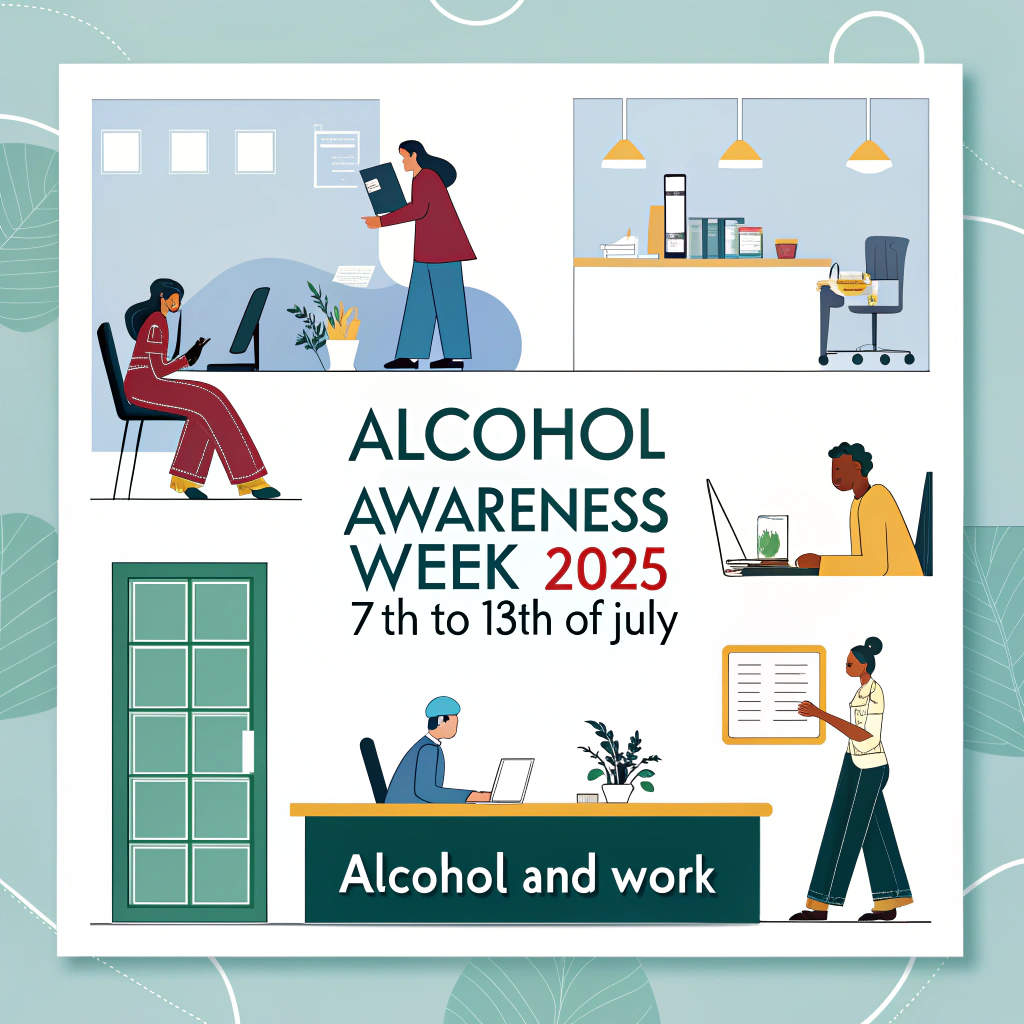
Alcohol Awareness Week is an annual event dedicated to raising awareness about the impact of alcohol on individuals, families, workplaces, and society at large. In 2025, the event will run from the 7th to the 13th of July, spearheaded by the charity Alcohol Change UK.
To watch the video version of my blog, see below. The blog is a transcript of the video.
This year’s theme, “Alcohol and Work,” brings a crucial focus to how alcohol consumption affects not just personal health, but also professional performance, workplace relationships, and overall well-being.
The Broader Impact of Alcohol
Alcohol is often viewed through the lens of personal choice and individual health. However, its effects ripple far beyond the person consuming it. The consequences of harmful drinking habits can be seen in diminished work performance, strained relationships, compromised safety, and a decline in mental health. Behind every statistic lies a human story on one that often includes addiction, isolation, and the silent struggles of those who care for someone affected by alcohol dependency.
Alcohol and the Workplace: A Hidden Challenge
The Unseen Effects on Performance and Safety
Alcohol’s impact on the workplace is multifaceted. It can lead to decreased productivity, increased absenteeism, and even safety risks, especially in roles that require high levels of attention and responsibility. The pressure to perform, long working hours, and high-stress environments can sometimes drive individuals to use alcohol as a coping mechanism. This, in turn, can create a cycle where alcohol use further impairs work performance, leading to more stress and potentially more drinking.
The Human Stories Behind the Statistics
It’s easy to overlook the personal narratives behind the numbers. In the UK, approximately one in four people drink in ways that could be harmful to their health. For some, this escalates into dependency, isolation, and crisis. The journey into alcohol dependency is rarely straightforward or visible. It can be masked by a smile, hidden behind long hours at the office, or dismissed with a casual “I’m fine.” The reality is often much more complex and painful.
The Ripple Effect: Unpaid Carers and Their Silent Struggles
The Burden on Unpaid Carers
One of the most overlooked aspects of alcohol-related harm is its impact on unpaid carers. These are the partners, parents, siblings, friends, and even colleagues who quietly support someone struggling with alcohol dependency. Unpaid carers often juggle their own work and family responsibilities while shouldering the emotional and practical burdens of caring for someone else.
The challenges faced by unpaid carers are immense. Many carry this burden alone, with little support or recognition. They may sacrifice sleep, income, and their own mental health in the process. The emotional strain can be overwhelming, and the lack of support can lead to feelings of isolation and helplessness.
The Need for Recognition and Support
It’s time to shine a light on the pressure, pain, and silence that unpaid carers endure. Their contributions are invaluable, yet they often go unnoticed. Recognizing their struggles and providing them with the support they need is essential, not just for their well-being, but for the well-being of those they care for.
Breaking the Silence: The Power of Conversation
Starting the Conversation
One of the most effective ways to address alcohol-related harm is to start a conversation. Breaking the stigma surrounding alcohol dependency begins with open, honest dialogue. If you’re concerned about someone’s drinking habits, reaching out and expressing your concern can be a powerful first step. Sometimes, simply asking, “How are you doing?” can make a world of difference.
Sharing Resources and Support
In addition to conversation, sharing resources is crucial. Organizations like Alcohol Change UK provide valuable information, helplines, and support services for those affected by alcohol dependency. Sharing these resources, whether it’s a helpful video, a website, or a helpline number which can offer much-needed support to someone in need.
Supporting Unpaid Carers
For those who focus on supporting unpaid carers, it’s important to acknowledge their unique challenges. Offering a listening ear, practical assistance, or simply checking in can provide much-needed relief. Carers often feel invisible, so small gestures of support can have a significant impact.
Raising Awareness: Everyone Has a Role
Online, at Work, and in the Community
Raising awareness about the harms of alcohol and the support available is a collective responsibility. Whether it’s through online campaigns, workplace initiatives, or community events, every effort counts. The more we talk about these issues, the less people will suffer in silence.
Building a Culture of Care
Ultimately, the goal is to foster a culture of care, one where no one has to face addiction or the challenges of caring for someone with addiction alone. By working together, we can reduce the harm caused by alcohol, support one another, and create a more compassionate society.
Practical Steps for Getting Involved
1. Educate Yourself and Others
Understanding the facts about alcohol and its effects is the first step. Visit reputable sources like Alcohol Change UK to learn more about the risks associated with alcohol consumption, the signs of dependency, and the support available.
2. Start Conversations
Don’t be afraid to talk about alcohol and its impact. Whether it’s with friends, family, or colleagues, open dialogue can help break down stigma and encourage those struggling to seek help.
3. Share Resources
Distribute information about support services, helplines, and educational materials. The more accessible these resources are, the more likely people are to use them.
4. Support Unpaid Carers
If you know someone who is caring for a person with alcohol dependency, offer your support. This could be as simple as checking in regularly, offering to help with practical tasks, or encouraging them to seek support for themselves.
5. Advocate for Change
Encourage your workplace or community to participate in Alcohol Awareness Week. Organize events, share information, and promote policies that support those affected by alcohol-related harm.
The Importance of Compassion and Understanding
Recognizing the Human Element
Behind every case of alcohol dependency is a person with a unique story. Compassion and understanding are essential in supporting those affected. Avoid judgment and focus on offering support and encouragement.
The Role of Empathy in Recovery
Empathy can be a powerful tool in helping someone change their relationship with alcohol. Listening without judgment, offering encouragement, and being patient can make a significant difference in someone’s journey to recovery.
The Role of Workplaces in Addressing Alcohol-Related Harm
Creating Supportive Environments
Workplaces have a unique opportunity to support employees affected by alcohol-related harm. This can include providing access to counseling services, promoting work-life balance, and fostering a culture where employees feel comfortable seeking help.
Implementing Policies and Training
Employers can implement policies that address alcohol use in the workplace, provide training for managers on how to support employees, and ensure that support services are readily available.
Encouraging Peer Support
Peer support programs can be effective in helping employees feel less isolated and more supported. Encouraging open dialogue and creating safe spaces for discussion can help break down barriers to seeking help.
The Ongoing Challenge: Reducing Stigma
video from Alcohol Change UK
Why Stigma Persists
Stigma remains one of the biggest barriers to seeking help for alcohol dependency. Many people fear judgment or discrimination, which can prevent them from reaching out for support.
How to Combat Stigma
Education and awareness are key to reducing stigma. By sharing stories, promoting understanding, and challenging misconceptions, we can create a more supportive environment for those affected by alcohol-related harm.
Looking Ahead: Building a Supportive Future
The Importance of Continued Awareness
Alcohol Awareness Week is an important opportunity to shine a light on the challenges associated with alcohol use. However, the work doesn’t end when the week is over. Continued awareness, education, and support are essential in creating lasting change.
Working Together for Change
Change is possible when we work together. By supporting one another, raising awareness, and advocating for better support systems, we can reduce the harm caused by alcohol and build a more compassionate society.
Resources for Support
Alcohol Change UK: alcoholchange.org.uk – A leading charity providing information, support, and resources for those affected by alcohol-related harm.
Helplines and Support Services: Many organizations offer confidential helplines and support services for individuals and carers.
Workplace Support: Check with your employer about available support services, employee assistance programs, and mental health resources.
Conclusion: A Call to Action
Alcohol Awareness Week 2025 is a vital opportunity to reflect on the impact of alcohol in our lives, workplaces, and communities. By starting conversations, sharing resources, supporting unpaid carers, and raising awareness, we can make a real difference. Let’s work together to understand the harm that alcohol can cause, support one another, and build a culture of care, because no one should have to face addiction or care for someone with addiction alone.
Let’s make this Alcohol Awareness Week a turning point for greater understanding, compassion, and support.