By Matthew McKenzie BEM FRSA, Chair of the Carers Hospital Discharge Group
Thanks to Carer Centre representatives, Hospital reps and Local authorites who joined our September Hospital Carer Discharge Meeting. The group brings together unpaid carers, NHS staff, councils and carers organisations to share practical work and improve how carers are recognised and involved when someone leaves hospital.
Our guest speaker was Melanie Crew, Research and Policy Manager at Carers UK. Her presentation gave us a national picture of carers’ experiences, followed by a discussion that brought the issue back to what happens on wards and in local communities.
What carers are telling Carers UK
Melanie explained that Carers UK has asked about hospital discharge in its annual State of Caring survey for several years. The results show little improvement. In its 2025 survey, only 14% of carers said they had been asked about their ability and willingness to provide care when the person they supported was discharged. Melanie also reported that 38% said they had been involved in discharge decisions.
Those figures should concern everyone involved in discharge planning. A carer may be expected to help with medication, mobility, appointments or personal care once someone gets home. Staff need to ask what that person can do, what they feel able to do, and what support they will need. They cannot assume that a family member is available or willing to take on new tasks.
Melanie also highlighted findings from the Care Quality Commission’s inpatient survey: 23% of patients said their family member or carer was not at all involved in discussions about leaving hospital, while a further 19% said they were involved not very much.
Behind these figures are carers trying to prepare for life after discharge, sometimes without enough information about a condition, the equipment needed at home or the care they may be expected to provide. Poor communication can leave both the carer and the person returning home in a difficult position.
Why does good work in hospitals fail to reach some carers?
One of the strongest questions in the discussion came from Richmond Borough Mind. The described hearing from carers who received no discharge information, despite attending meetings where NHS teams reported substantial work on carer identification and support. Why is there such a gap between the initiatives being developed and what carers experience?
There was no single answer. A hospital may have a policy, a carers champion or information packs, but these only help if staff identify the carer, make contact and provide information that fits their situation. A referral to support is valuable, yet it may not meet an immediate need if there is a long wait for a carer’s assessment.
Melanie suggested that services need to look more closely at what happens after identification. Was the carer given information they could use? Did they understand what help was available? Were their concerns addressed before discharge? Could they get advice later as the person’s needs changed?
This is an important distinction for our group. We should measure whether carers receive useful support, as well as whether a process or referral exists.
Identifying carers early and hearing their own feedback
Carers UK would like hospitals to identify carers early, ideally from admission. Some people will have been caring for years; others may have become carers suddenly after an illness or accident. Many will not use the term “unpaid carer” to describe themselves. Staff therefore need to ask clear questions about who provides support and what that support involves.
Melanie also described work examining how the NHS collects and uses feedback from patients, service users and carers. Carers UK is contributing to a project involving the King’s Fund, National Voices, The Foundation and Edge Health. Its message is that carers should be able to describe their own experience as carers, rather than speak only on behalf of the patient.
For example, were they identified? Did they receive enough advice? Were they treated as a partner in care? And when they raised concerns, did anything change? These questions could tell us much more about where a discharge pathway succeeds or breaks down.
National policy and work ahead
Melanie outlined Carers UK’s campaigning on the Health Bill 2026. Carers UK proposed duties for Integrated Care Boards to identify and record unpaid carers and to promote their health and wellbeing, alongside other proposals concerning breaks from caring and access to the Single Patient Record. The proposed duties on identification and wellbeing were not adopted, although Melanie noted support for them across parties. Carers UK intends to continue making the case for stronger action.
The discussion reflected the difficulty local projects can face when carer identification depends heavily on individual staff members or teams. Eleanor, from the North Central London Carer Support Project, described the effort involved in building partnerships with hospital trusts and asked whether a mandatory duty might help make this work more consistent.
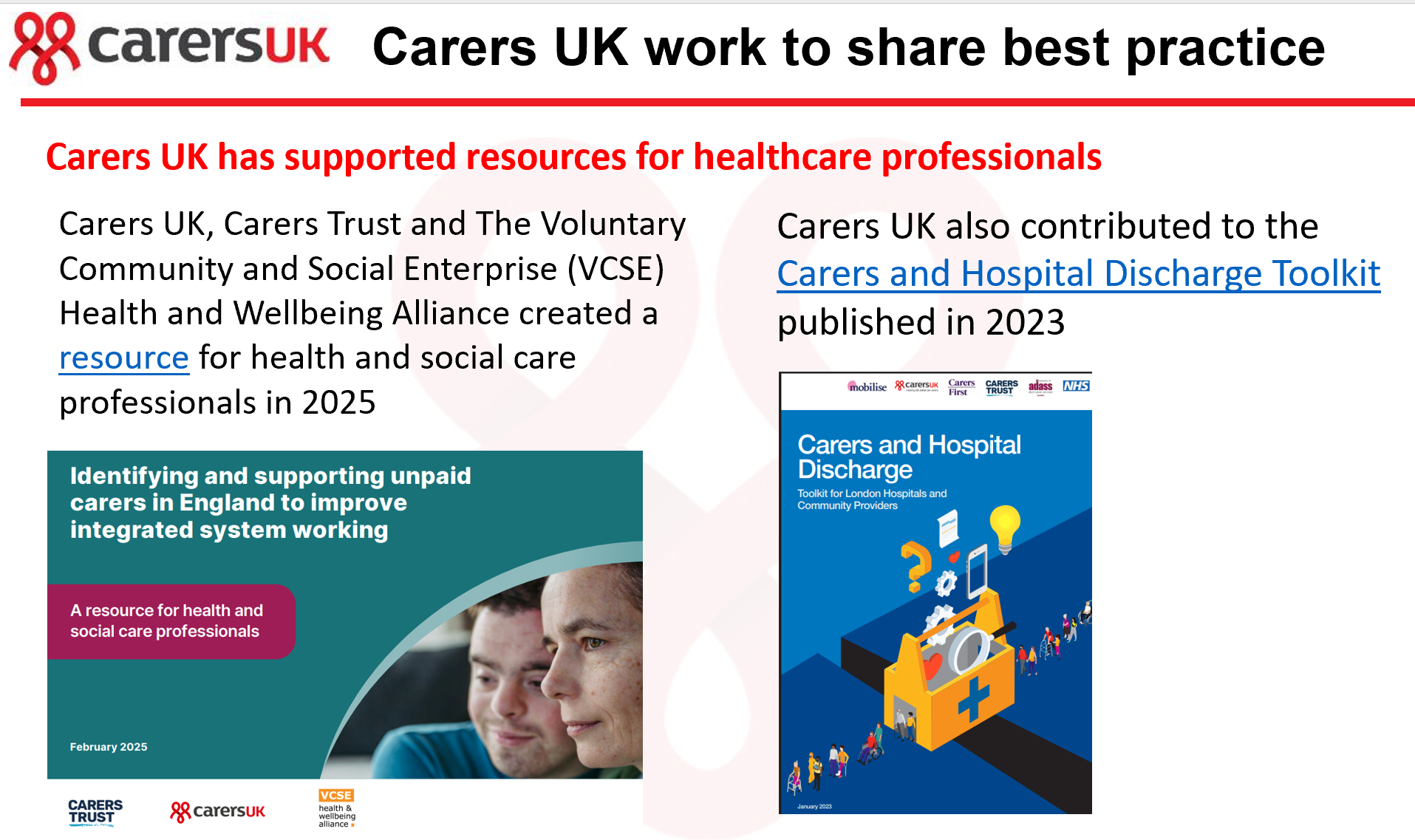
Carers UK is also contributing to communities of practice on hospital discharge, supported through the Better Care Fund. Thirty areas are taking part, with Carers UK working with half and Carers Trust with the other half. NHS, council and voluntary sector representatives will share challenges, examples of good practice and possible improvements. Wider webinars are planned so others can learn from the work.
Looking ahead to Carers Rights Day on 19 November, Carers UK plans to publish a report on carer identification across healthcare, councils and employers. Melanie stressed that being recognised as a carer must lead to meaningful information and support.

A practical idea from St George’s, Epsom and St Helier
Wendy shared work underway across St George’s, Epsom and St Helier hospitals. The hospitals have a carers charter, information packs and follow-up calls for identified carers, but Wendy acknowledged that some carers still miss out. Identification on wards remains a challenge.
One proposed response is to develop volunteer roles that can help recognise carers, speak with them and connect them with staff and information. The plan also includes support around discharge. Wendy explained that the teams are working with Helpforce as they develop and recruit for the roles.
The conversation also covered accessibility and reasonable adjustments. For some patients, having their carer alongside them throughout their hospital journey may be essential to communication and care. Wendy described work with safeguarding, learning disability and dementia teams to strengthen this approach, alongside activity concerning Martha’s Rule and John’s Campaign.
Others noted that carers organisations can also be willing to work directly on wards, but need workable routes into hospitals. This is an area where better partnership arrangements could make existing support much easier for carers to reach.
Lewisham and Greenwich: charter, training and support on site
An update from the patient experience team at Lewisham and Greenwich NHS Trust, said the trust plans to review its carers charter with carers and support organisations across Greenwich, Bexley and Lewisham. The aim is to understand different needs and use that feedback to make changes in the hospitals.
They also reported that Queen Elizabeth Hospital has approved catering for carers who are staying in hospital with the person they support. It may sound like a small change, but for someone spending long hours beside a loved one, practical support matters.
Staff training on identifying and supporting carers is also developing at Lewisham Hospital and Queen Elizabeth Hospital, with local carers organisations involved. I welcomed this update and offered to contribute the questions and experiences I hear when I run carer information stalls at Lewisham Hospital.
Southwark Council carers strategy and new service
Representatives from Southwark Council updated the group on their four-year carers strategy, which was approaching sign-off. They plan to develop a delivery group for its action plan and continue involving carers in how the strategy is put into practice.
Sarah also described progress on Southwark’s new carers service. At the time of our meeting, the contract award was going through final internal governance, with a planned contract start date of 1 March and a period for the provider to prepare the service before launch. The proposed model would have a base at Southwark Resource Centre and activities in other community locations. Further launch details will follow from the council.
The discussion prompted a useful commitment to strengthen links between the future carers service, GP practices, social prescribers and other health contacts. Southwark representatives also reflected on the need to explain carers’ assessments in a way that makes their purpose and possible benefits clear to each carer, rather than simply handing out more information.
Lambeth and Richmond updates
Carers’ Hub Lambeth shared difficult news: its funded hospital discharge project was due to end in September because continued funding was unavailable. The team intends to maintain its relationships with King’s College Hospital and Guy’s and St Thomas’, continue carers awareness training, and extend its work with GPs and social prescribers where possible. Its monthly emergency planning workshops will also continue.
This was a reminder that valuable partnerships need sustained support. The learning and relationships built through a project should not disappear when its funding ends.
Richmond Borough Mind described work on a handbook for mental health carers. It will include information about mental health conditions and what happens when the person they support goes into hospital, including discharge. Richmond Borough Mind is also planning a Carers Rights Day gathering that combines support, information and an opportunity for carers to come together.
What I took from the meeting
September’s discussion returned repeatedly to a simple test: does the carer actually know what is happening, what may be expected of them, and where they can get help?
Policies, charters, digital plans, volunteers and training can all contribute. Their value lies in what happens during a real hospital stay: whether someone notices the carer early, listens to their knowledge and concerns, asks about their own capacity, and makes sure they have support before and after discharge.
I was grateful to Melanie for sharing Carers UK’s research and campaigning work, and to every organisation and carer who contributed openly to the discussion. At our next meeting in November, I hope we can hear more about how these local initiatives are progressing and continue learning from carers who have experienced discharge themselves.
Thank you to everyone helping to make this group a place where we can share challenges honestly and work together on practical improvements.

