Welcome back to another blog by carer activist Matthew McKenzie. I often blog about raising awareness for those caring for someone with mental illness. If I am not raising awareness, then I am more likely speaking at events or conferences.
I am helping to promote a carer’s network with Cygnet Healthcare who are taking on the challenge of applying Triangle of Care into their services. So far I have opened several carer events at some of the Cynet hospitals around the country along with other speakers who are invested in raising the profile of unpaid carers.
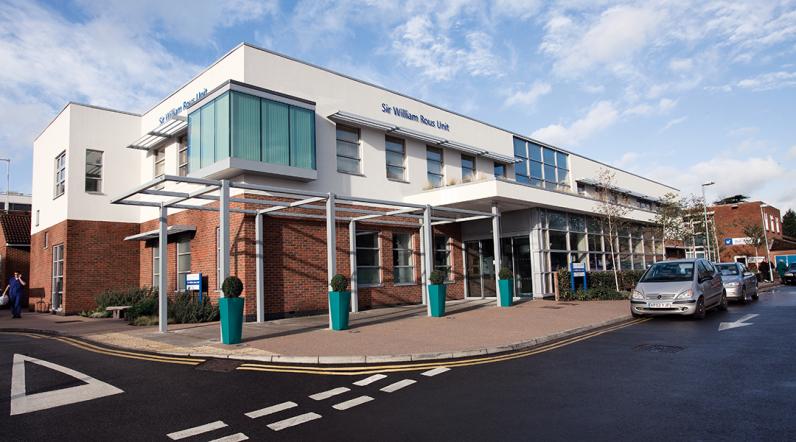
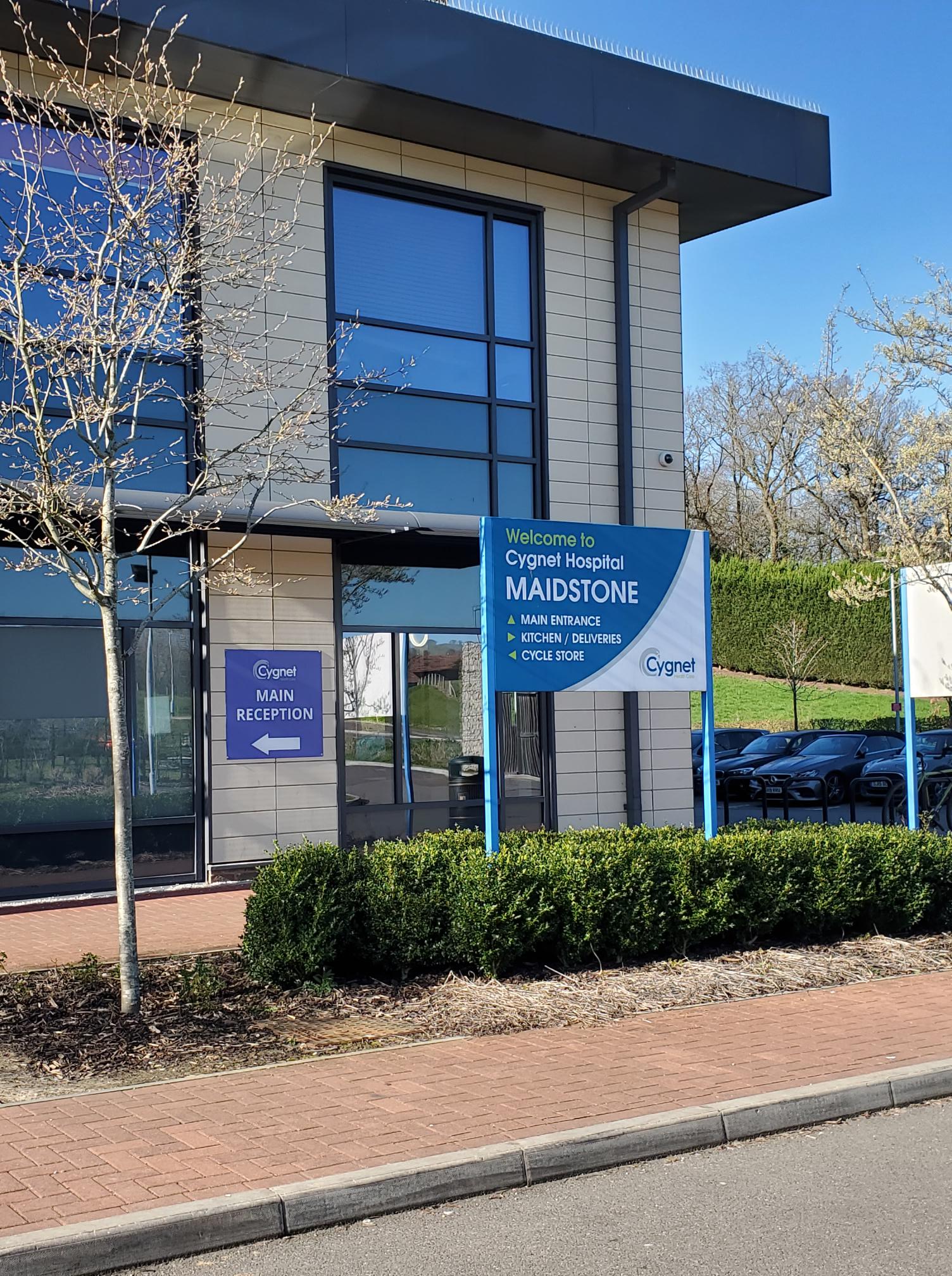
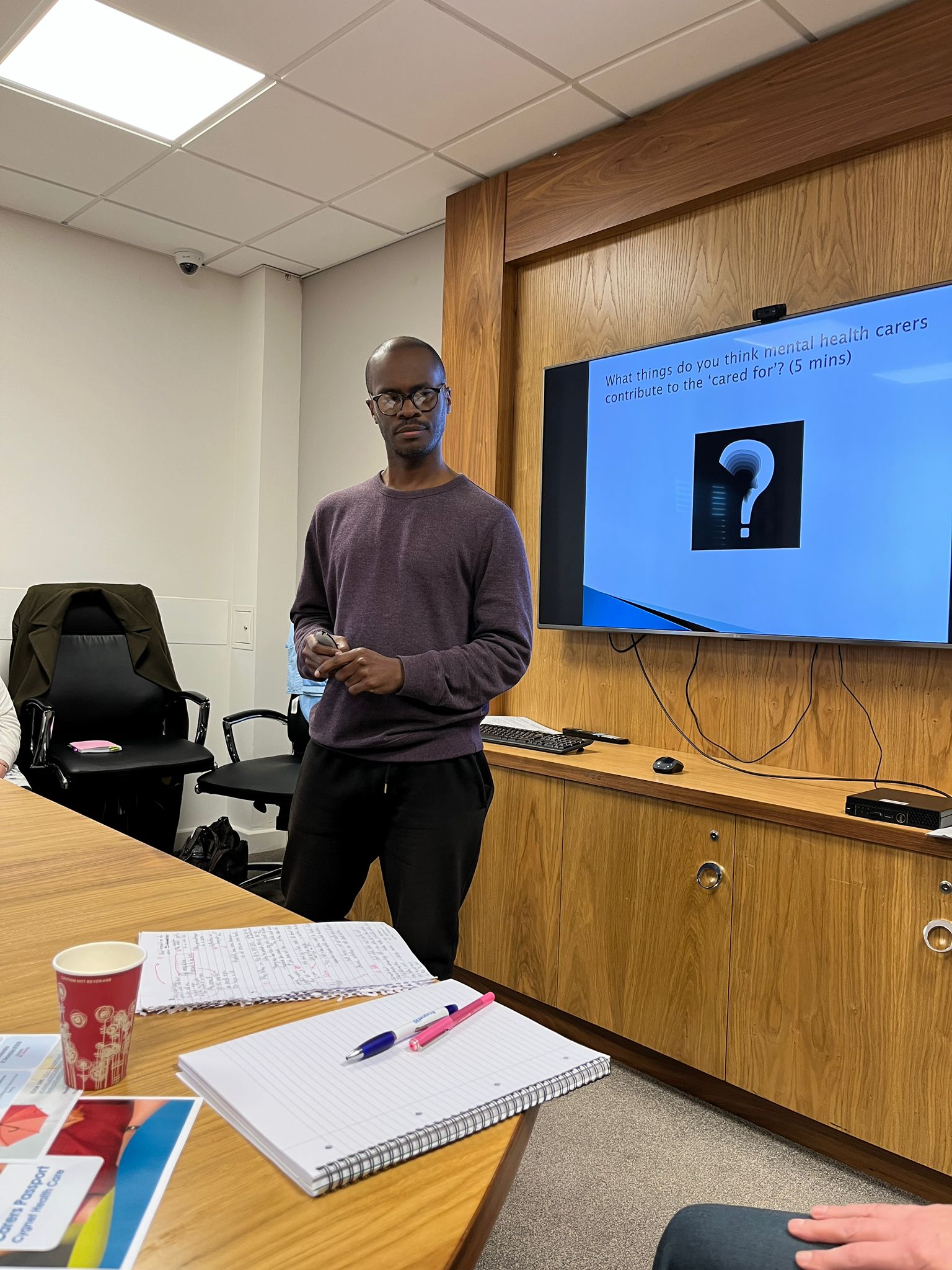
For this event, I attended Cygnet Hospital over in Maidstone for another regional carer event. This was an opportunity to engage with carers from the area of Kent, especially since I am involved with Kent and Medway NHS Partnership Trust. So I was keen to travel to Maidstone and talk to carers.
We had a packed room of carers and professionals interested to hear talks about the importance of supporting carers.
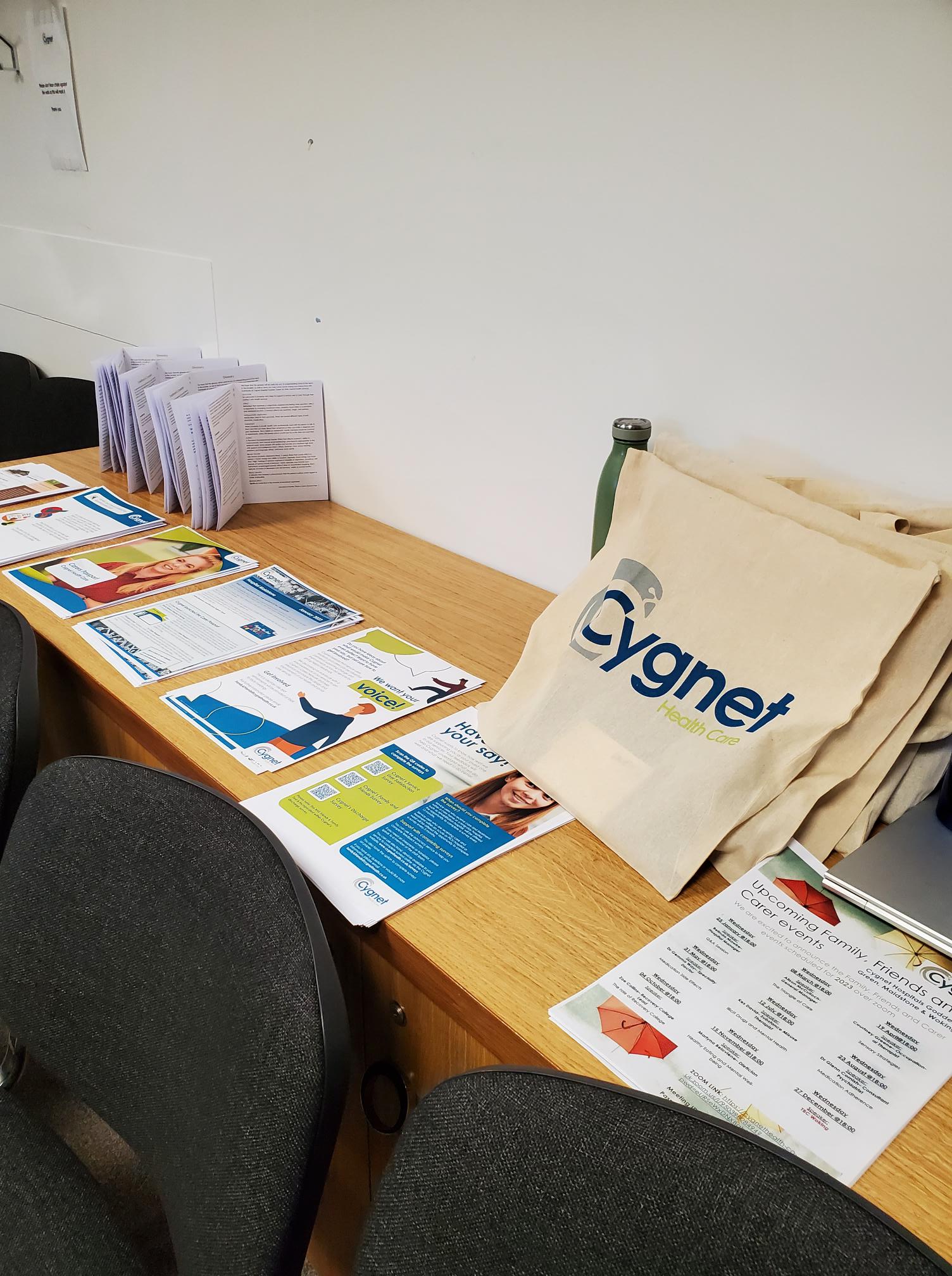
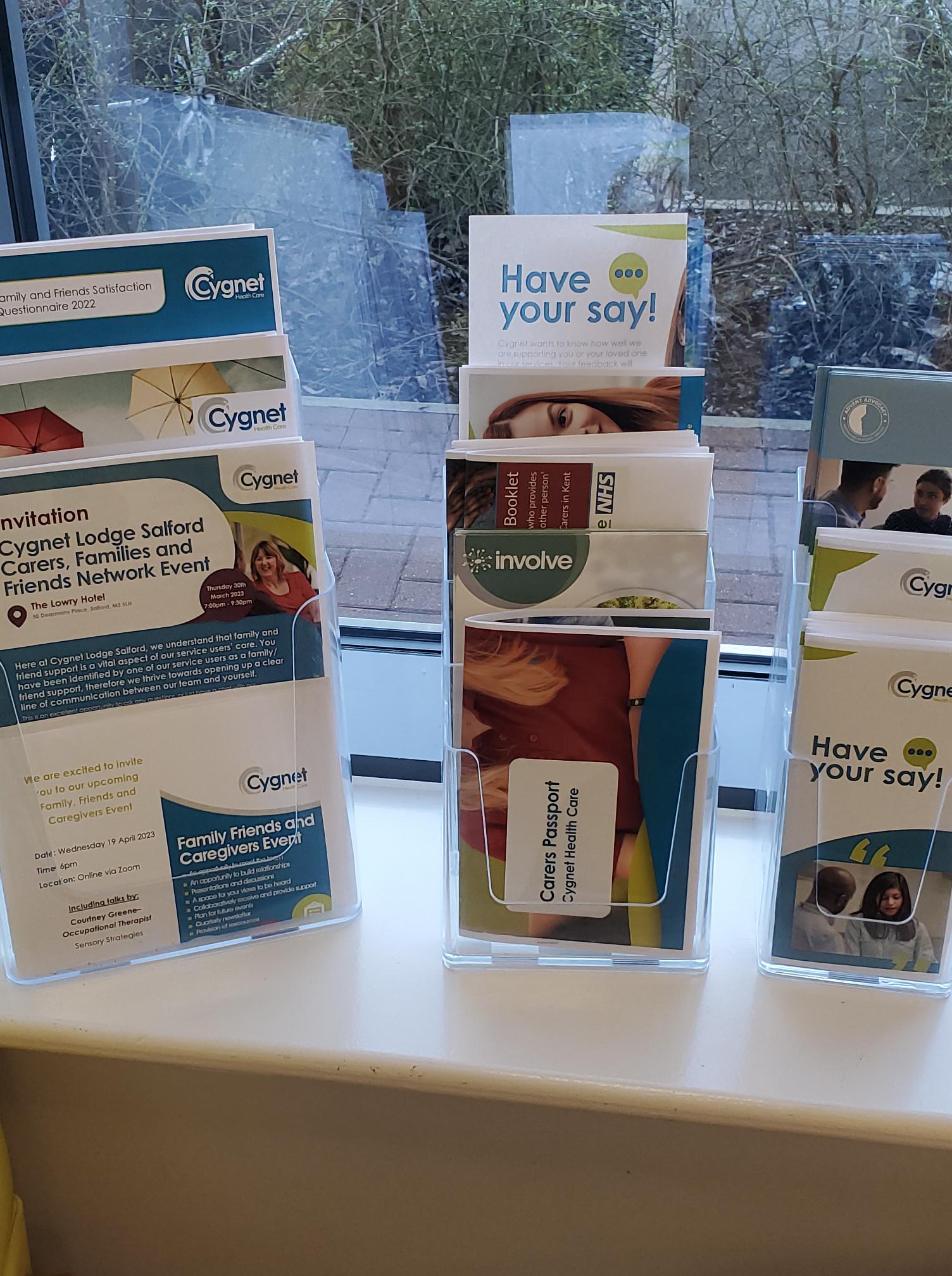
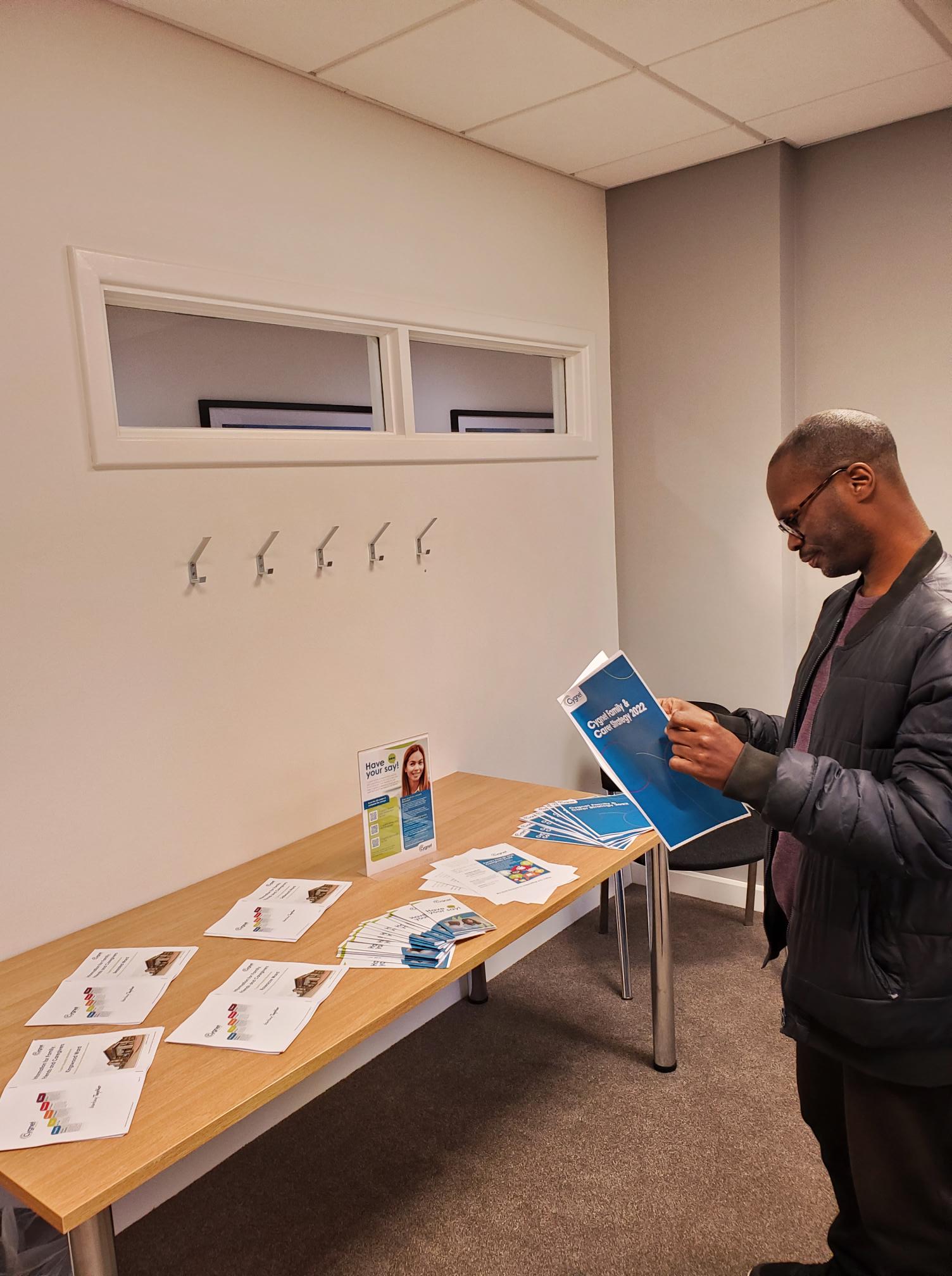
There were certain things I was looking for at the hospital, especially the effort staff had put into promoting the carer event. I noticed lots of leaflets introducing what Cygnet can do for unpaid carers. Other information was on Cygnet’s carers strategy, carers passport and a chance for people to feedback about services.
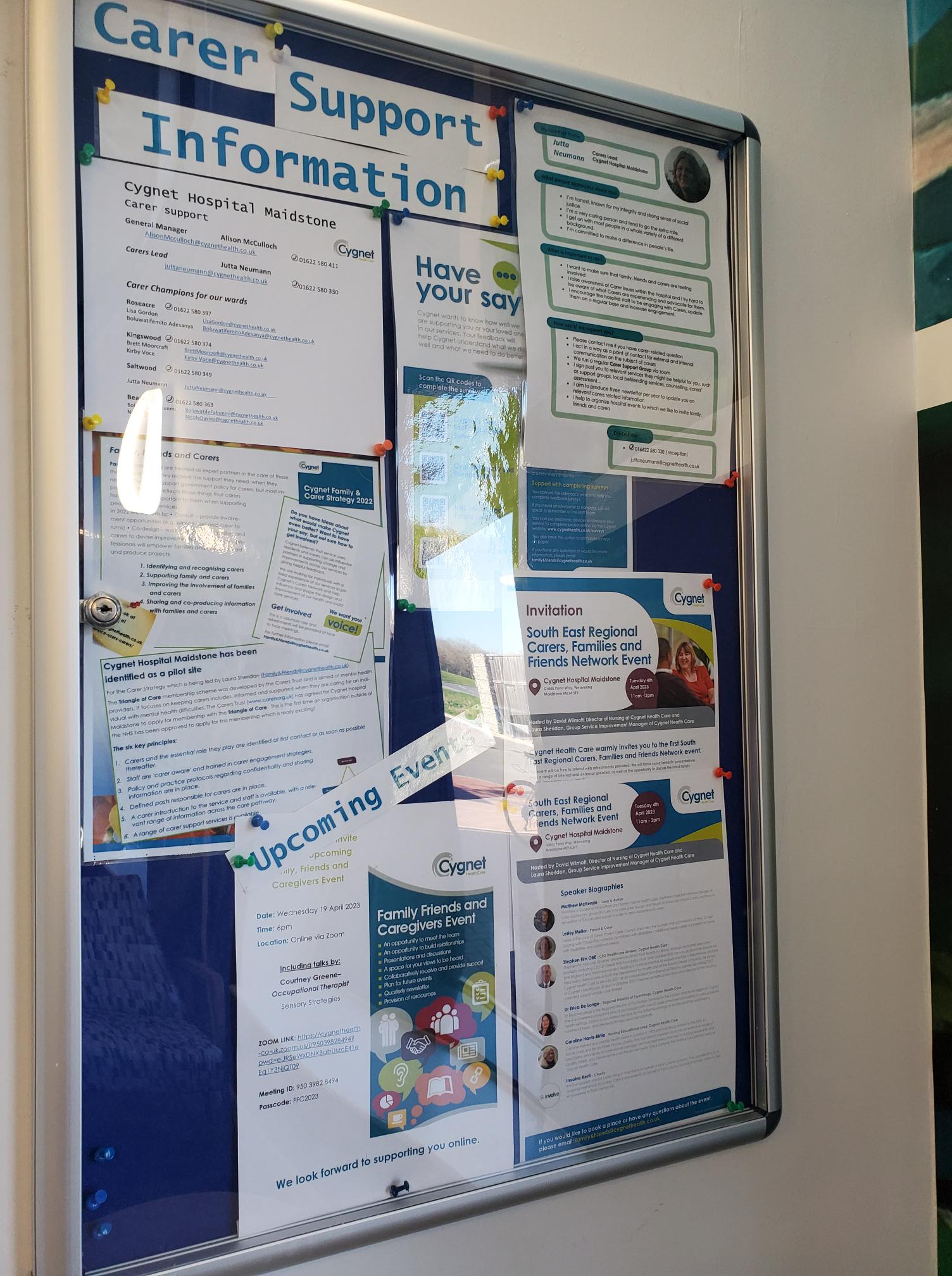
I even managed to view the carer’s board.
We had some excellent speakers at the event. Plus it was great to see David Wilmott who is Cgynet’s Director of Nursing open the event. We also had a powerful talk from Lesley Mellor who told her story as a carer and the importance of carer empowerment.
Other speakers were Stephen Firn OBE who is Cygnet’s CEO for Healthcare division. Stephen spoke about his mission to make sure cygnet hospitals have a high focus of carer awareness. During my talk, I reminded attendees that when senior staff attend such events, it shows how the organisation values unpaid carers.
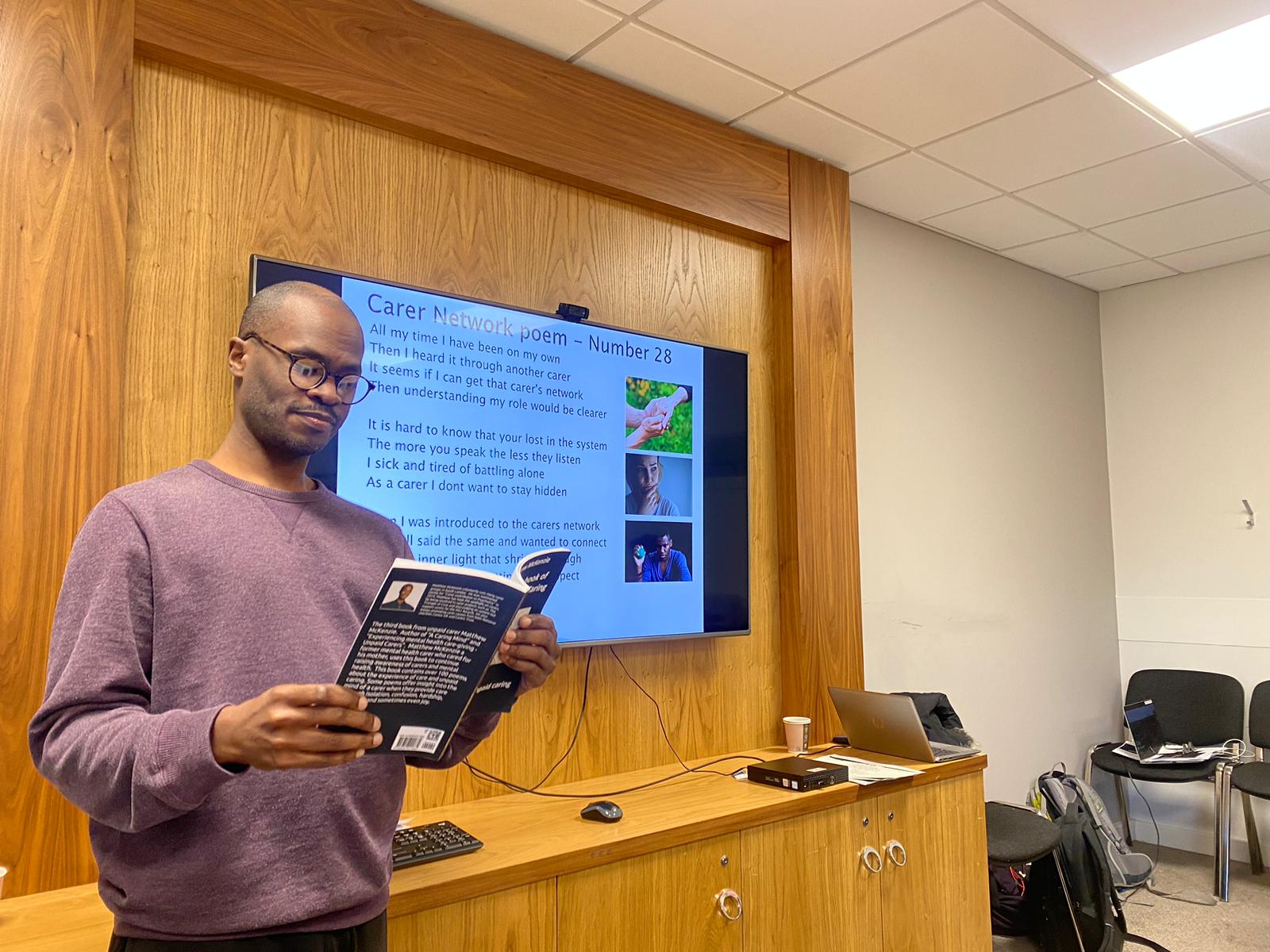
For my talk, I read poem number 28 on the importance of a carer’s network. Often carers do their role in isolation and behind closed doors.
The nature of the illness makes it difficult for mental health carers to connect due to stigma of caring,, being unsure of their role and also the stigma of mental illness.
I asked both professionals and carers their thoughts on the importance of providing care and the importance of connecting to a network.
I was proud that the healthcare professionals were knowledgable about the importance of including carers when providing services. This is done within the spirit of the Triangle of care.
We also had talks and presentations from Dr Erica De Lange who is Cygnet’s Regional director of Psychology. Plus Caroline Harris-Birtles who is Head of Nurse Education at Cygnet Healthcare. She educated carers about the importance of the nursing profession and how nurses can help unpaid carers.
Lastly we had a talk from Jennifer Vincent who works at Involve Kent. Jennifer is the team Lead in the Community for Carers. Involve is an organisation that focuses on Healthy, connected people and communities. Jennifer talked about how Involve empowers and support Carers, enabling them to care well for others and improve their own health and wellbeing.
I again have to thank Laura Sheridan who looked after both Lesley, myself and attendees at the carer event. I look forward to more events in future.
Bromley Carers Strategy Survey 2023 – Bromley Council is developing its Carers Strategy and want the views and experiences of unpaid carers to inform the content of the strategy.
Cost of cancer is damaging mental health – A new survey has found that 83% of people with cancer say unexpected expenses since their cancer diagnosis are impacting their mental health.
Welcome to my March update of most of my carer forums. These forums are for those caring for someone with mental illness. The idea of the groups is to allow unpaid carers a chance to find out about mental health services. The forums also allow researchers from universities and hospitals to update carers on current trends affecting carers and mental illness.
Lewisham Mental Health carers forum
For this carers forum we were delighted to have Bobby Pratap from South London and Maudsley NHS attend. Bobby is the Director of Implementation for the borough of Lewisham. This means in laymen’s terms that a large investment I guessing around 100 million will be focused on changes to mental health services in the borough.
With that kind of investment, it is vital for patient, carer and public engagement. Bobby comes with a wealth of experience straight from NHS England’s as the Deputy head of Mental health.
Bobby presented the challenges that mental health services face in the borough of Lewisham. He also presented some feedback from engagement events under South London & Maudsley. Bobby was certainly tested by the members of the forum who grilled him on NHS trust resources.
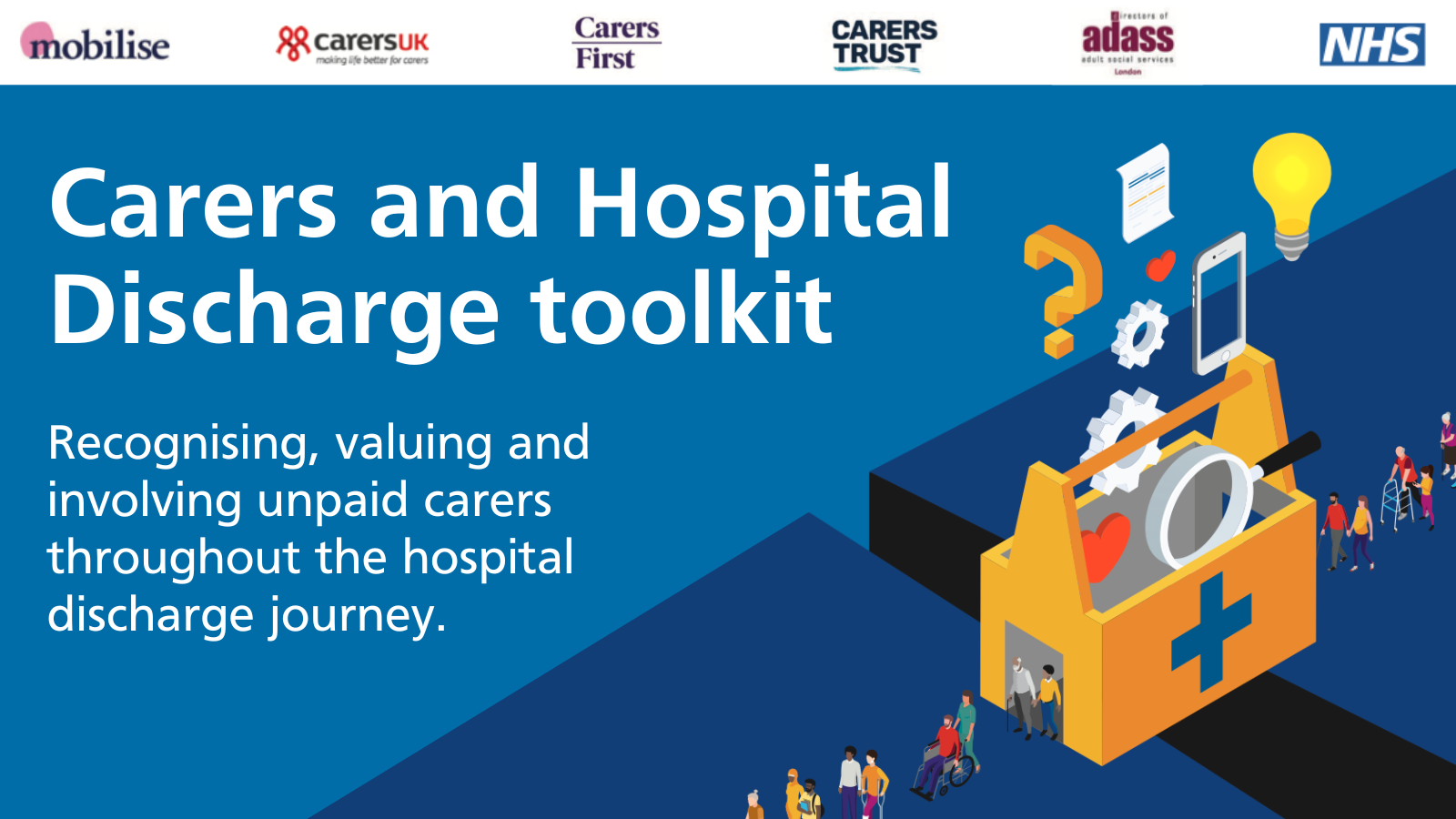
I also presented the new NHS London Hospital discharge toolkit. Since the Carers UK 2021 report, it has been widely known that unpaid carers feel uninvolved in hospital discharge. Carers complain that they are invisible to the NHS. So NHS London carer leads have come up with a hospital discharge checklist
The benefits to involving carers in hospital discharge are
Some Benefits
Reduced carer strain and breakdown Patients less likely to re-admitted. Caring situation is more sustainable Better health outcomes for both patient and carer Reduced overall cost to system
With some Accute hospitals taking the lead, there is hope other hospital will become carer friendly and see unpaid carers as part of the team.
The resource can be downloaded from below via Carers Trust Website
This forum is facilitated by myself and Ava who is a mental health and carer campaigner. The forum covers the boroughs of Kingston, Merton, Wandsworth, Richmond and Sutton. As a group focusing on mental health carers, we get support from the carer centres and from local Mind and Rethink organisations.
There was no speakers for the group this month, so I presented the hospital discharge carer toolkit. I also covered updates regarding the Triangle of Care.
Joint Southwark & Lambeth MH carers forum
For this group. Carers had a chance to find out what a Mental Health Solicitor does. We were joined by Burke Niazi Solicitors. The solicitor who represented my late mother had engaged with our group to answer queries, issues and questions. The forum was well attended and even some had attended from my other forums.
We were also joined by Lee Roach who is Lambeth’s carers lead for Maudsley adult services. Lee is also the Head Occupational Therapist for Lambeth Operational Directorate. Lee updated carers from Lambeth on services related to triangle of care. I was also interested in how Southwark carer leads were engaging with carers. It might take a while for them to drop by our group since Guys & St Thomas NHS are due to attend next month to speak about their carer’s strategy.
Lastly the group was joined by Guy Swindle who is the Deputy Director of Lambeth Living Well Network Alliance.
Greenwich Mental Health Carers forum
I only run this group Bi-monthly and Greenwich carers heavily supports the group. We get great support from Oxleas NHS and the Royal Borough of Greenwich often attends when they can. For this group we had engagement from Lisa Moylan who is Oxleas head of Mental Health Legislation.
The main reason I asked for Lisa to engage with the forum is to allow carers to understand what the department does, but also get an idea of how the Law department will deal with the new changes to the Mental Health Act. The MP will also chat with carers about their thoughts about proposed bill.
At the group, I updated members on updates regarding Greenwich Carers Strategy.
Some of the updates were
Raising awareness of caring with local employers Developing a carers self-assessment app Research with carers from ethnic communities Further development of the Mobilise digital platform Exploring feasibility of a Carers Card
There are plans Greenwich carers partnership board to Engage with local GPs and Engage with hospitals. Talking about hospitals, I also presented the London hospital carers discharge toolkit.
Ethnic Mental Health carers forum
This is the only forum that I run that focuses on carers from ethnic communities. It is also a forum that can actually reach out via several mental health trusts as sometimes we get attendees from SWLSTG, West London Health trust, Kent & Medway and CNWL, but the main focus is what South London & Maudsley or Oxleas are focusing on. The group also engages with speakers from universities and researchers. We also can get updates from the local authority or Healthwatch.
The speaker for March was Natalie Creay who is Founder of Liberating Knowledge, she is also on the advisory board of The Lancet Psychiatry magazine and a trustee of The London Community Foundation.
Yes, she does a lot. Natalie spoke to us regarding health inequalities of Black and Asian people. Her research looked at Closing gaps in patient data for Black and South Asian communities.
Through the focus groups and interviews they conducted with healthcare staff. It was found that
Staff were less confident about describing why data is collected or how it is used
Staff felt that a lack of people in leadership roles who are committed to tackling bullying, institutional racism and health inequalities
Some staff also referred to a concern from Black and South Asian communities about whether they can trust the NHS given past harms
There were innovative ideas proposed such as the NHS being more radical in how it thinks about data ownership and giving more control to people and their communities over their data and the insights generated from them.
It was found that The burden of tackling health inequalities rests on people with lived experience.
There were several recommendations regarding the research, some listed below.
Create the conditions for systemic change to enable the following recommendations to be delivered by accelerating efforts to eradicate racism within the NHS. This should include developing the cultural and racial capability of the workforce.
Consider developing a race equity framework for physical health services that draws on the approach used for the Patient and Carer Race Equality Framework in Mental Health services.
Secure the support and commitment of senior leaders to improve data practices, embed inequalities work and create space for staff to innovate within the NHS.
Actively challenge ‘hard to reach’ narratives that encourage the perception Black, Asian and minoritised communities are disengaged or unwilling to share their patient data.
Equip healthcare workers with the tools to hold meaningful conversations about data: explore more innovative approaches that provide engaging ‘bite-size’ learning material targeted at healthcare workers.
This led on to one of our members Brenda who is a member of the Patient Carer Race Equality Framework to report back how Maudsley is using the framework to increase health equality and reduce racism. We also got updates from the Public Health Training and Development Manager for Lewisham who have been working hard to reduce health inequalities within ethnic communities. This was emulated on projects from Bromley, Lewisham and Greenwich Mind Updates.
Welcome back to another carers blog by Matthew McKenzie. It recently was World Social Work Day, which took place on the 21st March 2023. The theme for 2023 World Social work day was ‘Respecting diversity through joint social action. Social workers are very important if you are caring for someone. It helps to get that extra support regarding your role as an unpaid carer.
Social workers are becoming a rare resource these days, so it is important to raise awareness of social workers. It is also important to value them. World Social Work day allows social workers worldwide stand together to send the common message of relieving people’s suffering, fight for social justice, and improve lives and communities.
Social works help people with health, psychological or social problems. This in turn builds healthier communities. It was fortunate I was allowed to present at South London and Maudsley NHS Foundation Trust World Social work day event.
The event took place at Maudsley’s conference centre “Ortus”
The event organisers used the theme on learning from the voices of service users and carers in mental health social work.
We had some great speakers from that event. A special mention to Jo Lambert and her mental health focus. You can check out her books in the link below.
I started off my presentation on what I feel was the importance of world social work day. Of course I asked the audience what they thought about the awareness day. I then read a poem from my book “The Poetry book of mental health caring”
You can see my presentation from my video below.
The poem I read was called “My Story”
I then told how my carer’s journey unfolded and how Social workers worked with carer and service user.
How did Social workers helped my role as a carer?
I explained to the audience that it was important that social workers are knowledgeable of the services and explained them to my mother and myself.
Some social workers saw me as an asset. Some social workers saw me as part of a support network helping to support my mother.
It is important social workers use psychology to help heal. Some social workers talked about what can be done, rather than what could not be done, so constantly providing a positive focus.
One of the most important roles of a social worker is explaining about carers assessment. The carer’s assessment is an important tool for a carer to learn more about their needs.
Lastly referring me on to carer support was invaluable
All in all the NHS Maudsley gave me a powerful voice to promote my voice as a former mental health carer. I hope awareness of social workers continue to grow
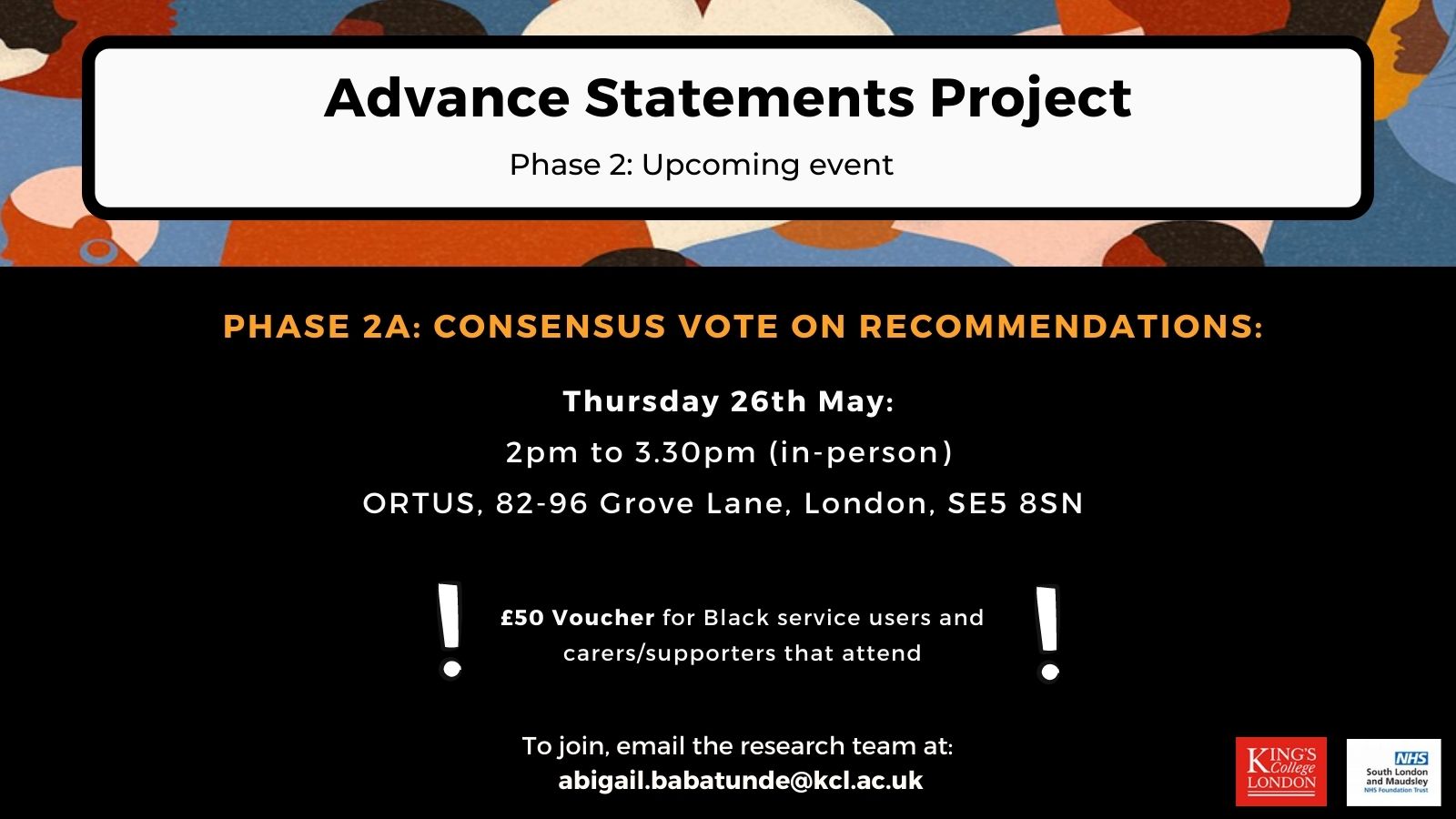
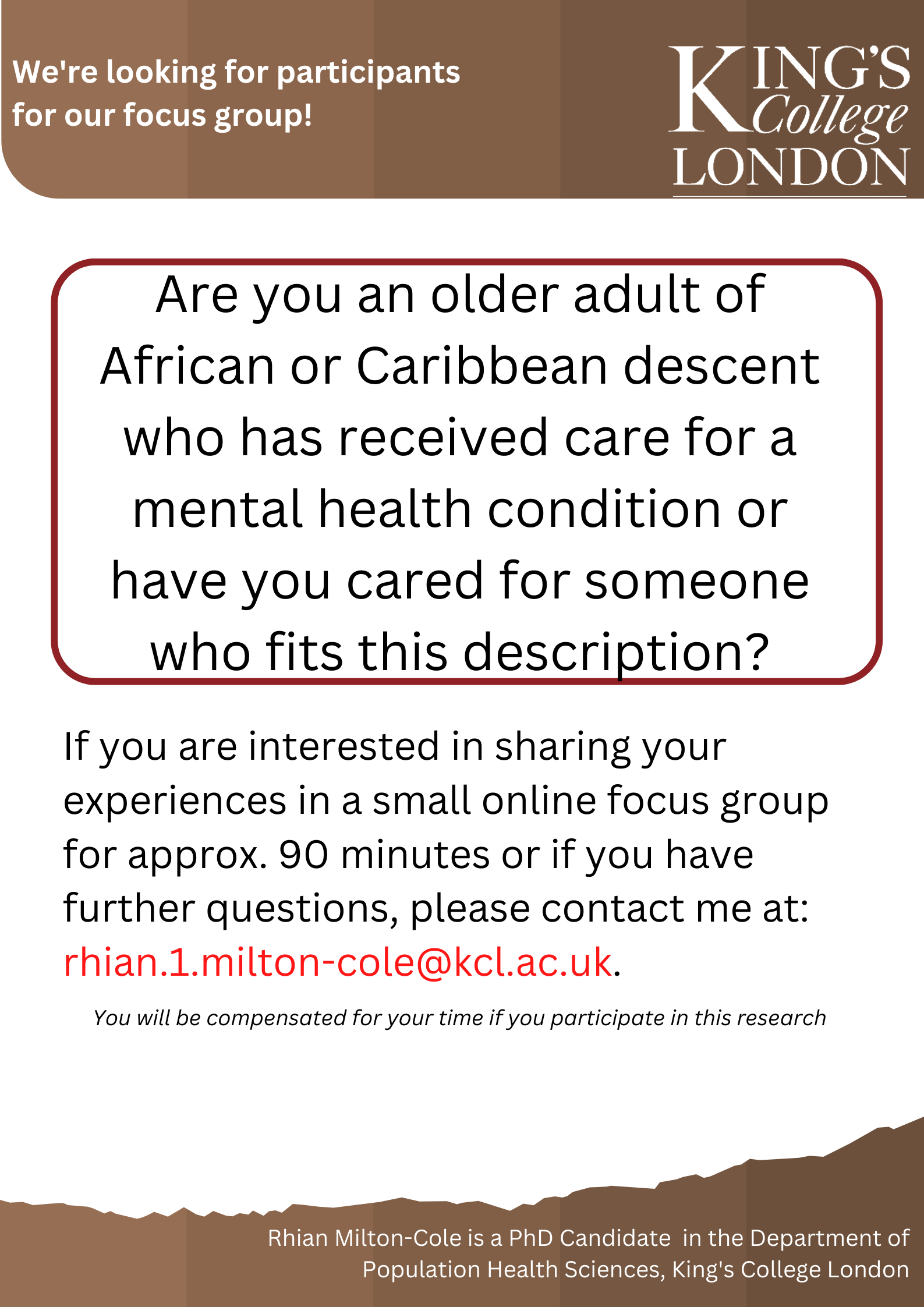
Depression is up to 60% higher in people from ethnic minorities than white people. There is also variation in the healthcare management of mental health conditions according to an individual’s ethnic background. The extent to which variation in access to treatment options for mental health conditions impacts on quality of life is not well understood. Therefore, the aim of the focus group is to explore the perspectives of Afro-Caribbean people with a mental health diagnosis on access and delivery of care.
There is research looking to recruit 10 people of African or Caribbean descent with a mental health diagnosis (and carers of those with a mental health diagnosis (who themselves are Afro-Caribbean)) and are over the age of 50 to explore their perspectives on the care and access they received.
Participants will be involved in a 90-minute online focus group via Microsoft teams and will be reimbursed for their time. See poster below.
The group will be facilitated by Rhian Milton-Cole, a PhD Candidate at King’s College London. During the session she will ask questions relating to the patient’s experience of seeking support for their mental health conditions and any barriers they faced. Rhian will also ask about which treatment options were offered to them and if they found these acceptable and lastly if they believe the care offered to and received by Afro-Caribbean people is the same as the care given to and received by Caucasian people.
Hello carers, here is another update from most of my carer forums. Usually I try to update on each of the forums, but due to spending time writing books and raising carer awareness, it is not always possible to update each forum page.
Lewisham Mental Health Carer forum update
For my Lewisham group, South London & Maudsley want to engage with the London borough of Lewisham to explain new ideas for mental health services. There will possibly be a revamp of the Ladywell Unit that is based at Lewisham Hospital.
The speakers who looked to engage with carers were Sir Norman Lamb and Bobby Pretap, but unfortunately the meeting had to be cancelled.
The other speaker Angela Brient who is a PhD Researcher in Public Health spoke about the Impact of trauma. Angela spoke about her lived experience, which comes from caring for her husband who sustained a spinal injury whilst on deployment with the Australian Air Force in the Middle East. She was his primary carer for over a year, but ultimately, her husband took his own life.
The carer’s group were grateful for Angela’s insight and we learnt more of the Impact of Trauma course that Dr Julie Langan Martin mentioned to me a while back. Dr Julie is the Senior Lecturer in Psychiatry at the University of Glasgow. We are hoping to hear more updates on the Impact of Trauma course at a later date.
Joint Southwark & Lambeth Carer forum update
For my joint mental health carer forum over in Southwark and Lambeth. Carers were delighted to get engagement from Helen Hayes MP for Dulwich and West Norwood. Carers spoke about their past experiences of providing unpaid care, but the main topic was the progress of the new Mental Health Act. Members of the group are very keen to observe the debate in Parliment.
Other carers were interested to speak to Richard Okolo on how a mental health solicitor could help someone who has been sectioned. Richard could not make the forum, but we hope to hear from him in March.
Ethnic Mental Health Carers forum Update
This carers forum specifically focuses on the experience of ethnic and diverse carers. Our first speaker was a carer on involvement at South London & Maudsley. Currently Maudsley NHS is an anti-racist organisation and seeks to increase health equity. South London & Maudsley NHS is signed up to the Patient Carer Race Equality Framework (PCREF). PCREF exists to eliminate the unacceptable racial disparity in the Access, Experience and Outcomes of Black communities and significantly improve their trust and confidence in our mental health services.
Annette Davis who is the Chair of the PCREF Service Users and Carers Group then gave updates to members. Annette mentioned that PCREF is a UK wide NHS initiative and South London and Maudsley are one of the first Trusts in the country to address institutionalised racism in the NHS. We heard updates on new flyers to advertise to the community on how they can hear updates or get involved in being an activist.
The next speaker Dr Brenda Hayanga spoke about her new research “Ethnic inequalities in multiple long-term health conditions in the United Kingdom: a systematic review and narrative synthesis”. Yes, I know it is a long title, but I do not know many research papers that have short titles.
Still, the importance of this research cannot be underestimated as I had just published my 4th book regarding health inequalities.
Dr Brenda will be speaking at an exciting event in april. The event focuses on Ethnic inequalities in healthcare for people with multiple conditions.
At the event there will be the following speakers
Katherine Merrifield from the Health Foundation
Dr Habib Naqvi who is Chief Executive of the NHS Race and Health Observatory
Dr Jayati Das Munshi who is a Clinical Reader in Social and Psychiatric Epidemiology at KCL.
Eve Riley who is based at Macmillan Cancer Support
Jabeer Butt OBE whose work looks into tackling discrimination and disadvantage.
Dr Brenda Hayanga who is a Research Fellow at the Department of Global Health and Social Medicine, King’s College London
The final update at the ethnic MH carers group was from Carers UK Melanie Crew. Melanie is the Senior Policy and Research Officer at Carers UK. Melanie talked about the new initiative on Good practice guide on supporting ethnic minority carers. The briefing follows Carers UK’s landmark report examining Black, Asian and minority ethnic carers’ experiences of the pandemic.
Obviously my 3rd biggest group, which covers 5 london boroughs. The group is co-facilitated by Ava who is involved at Kingston Carers Network and SWLSTG. The group is getting lots of support from the 5 carer centres.
We had a visit from Kirsty McLachlan who is based at Richmond Borough Mind. Kirsty is the Carers and Parents in Mind Manager and is very keen to promote the forum in our Carers in Mind monthly newsletter. It is great to see support and promotion about unpaid carers.
Our 2nd speaker was Chloe Smith who is the Healthy Communities Builder from Kingston Voluntary Action. She was joined by BBC MultiAward winning Poet, Michael Groce. They are working on a set of poetry workshops aimed Black, African and Caribbean Communities over in Kingston. There will be guest poets that will come and inspire people’s work throughout the weeks ahead by sharing their own stories and work. I was the guest poet for week 2 (more on that later).
You can watch a promotional video below
The third speaker was Wendy Doyle who is the Head of Patient Experience St Georges university hospital. This is one of the hospitals were I run a carer’s stall. Wendy updated our group on the carer’s focus the hospital is planning. Wendy also updated us on a healthwatch report.
Welcome readers and those who care for someone. As you might already know, not only am I an author raising awareness of carers, but I am also a poet. I find poetry an excellent way to raise awareness of social causes. A good poem can reach the hearts and minds of those trying to understand caring.
I am sure many out there are aware that carers can often remain hidden. The world of unpaid care is often carried out behind closed doors. This might not be a problem, but when the role of caring becomes stressful then we need raise awareness of the plight of unpaid carers.
I feel even when someone becomes uninvolved in caring for someone close to them, they are still in the background somewhere inquiring about the person health and wellbeing. I feel a lot of carers can be a link in that chain.
So in my 3rd book on using poetry to raise awareness of those caring for someone with mental illness, I wrote a poem called “The Hidden Link”.
Feel free to listen to the poem below. I would love to get people’s views on what they think about the poem.
You can also get my poetry book from the Amazon link below.
Welcome back to my website. I have been busy working on my latest projects. I am raising awareness of unpaid carers. My speciality focuses on those caring for someone with mental illness.
As a poet and author I have several books on amazon that focus on the lived experience of unpaid carers.
I have just released my latest story, which can be difficult to listen to. Still, it is important to tell things how people experience them. My latest carer story called “Angry” focuses on a young mother thrown trying to fight for the right to care for her daughter. The struggle is made difficult because the mother is angry at the world, but the system is so cruel that her daughter is now at risk. Can her mother provide care in time?
So far I have produced 4 other carer stories which you can watch below. These carer stories are all taken from the audiobook that I am working on. The audiobook will be called “Providing Care & Other short stories”. As usual the audiobook will raise awareness of those caring for someone with mental illness.
The next carer story is titled “Never thought it could be me”. This story explores what it is like to become a first time carer. We all think we might provide care when someone gets old, but life can change at any moment.
Below is another story about providing care. There are those thrown into providing unpaid care because family members feel they are not obligated to care. This story below explores the world of a young girl trying to provide care for her mother, but does her family understand why she is providing care?
The next story below “Digging out of a hole” explores the role of a male carer or what his understanding of a male carer is. The problem is that the young man is doing his role out of concern for his sister. No one else is there to help, so he feels he has no choice. The last thing he is concerned about is being thought of as a carer.
Below is my first carer story which is the main theme of the book. The story below is called “Providing Care”. This story explores the situation of a first time mental health carer. I feel the story below does rush things a little since as I believe the process of discovering mental illness can be a slow painful journey. If you wish to view the story, click on the video below.