Category Archives: Psychology

Reviews of lectures or audios on psychology

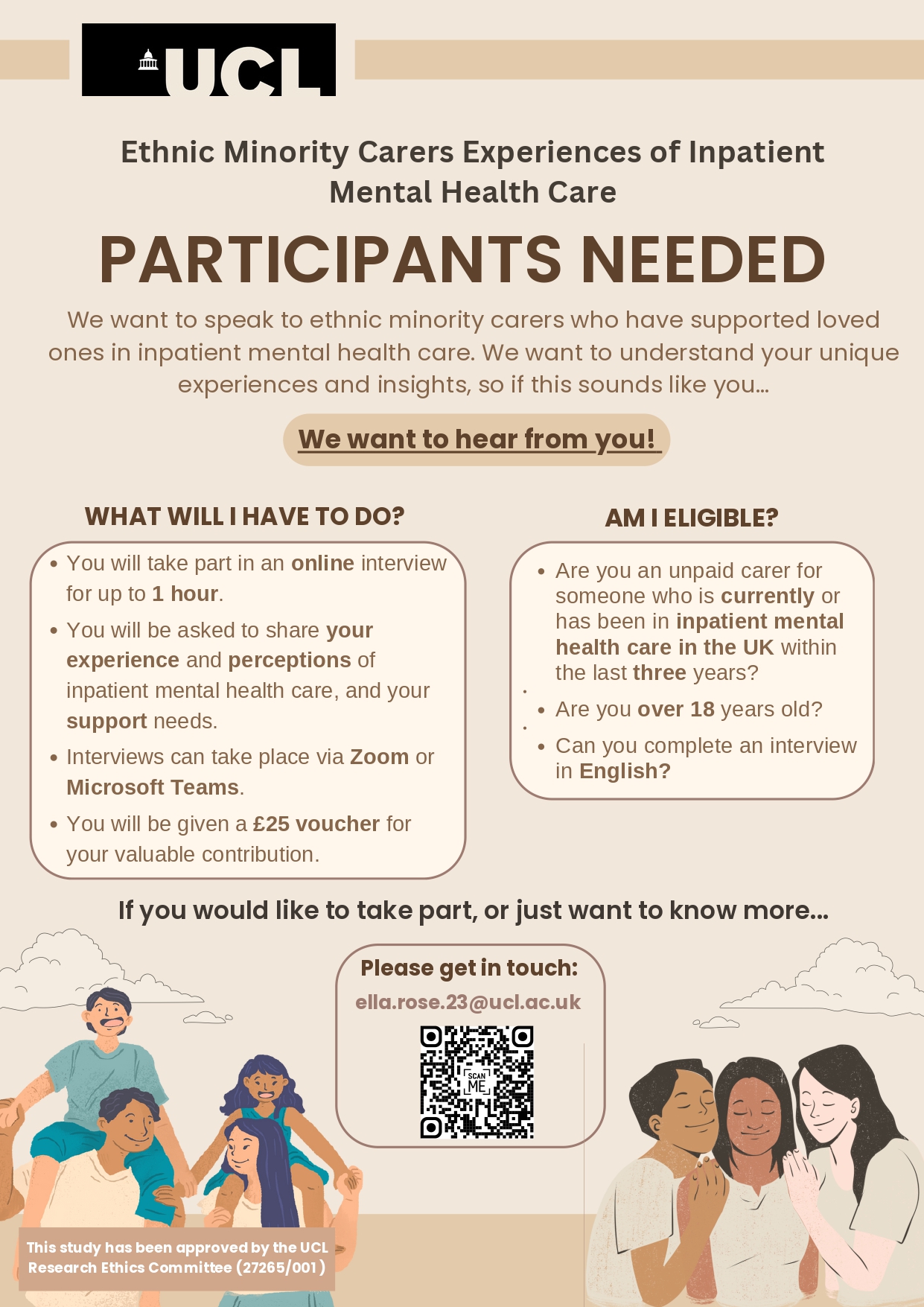
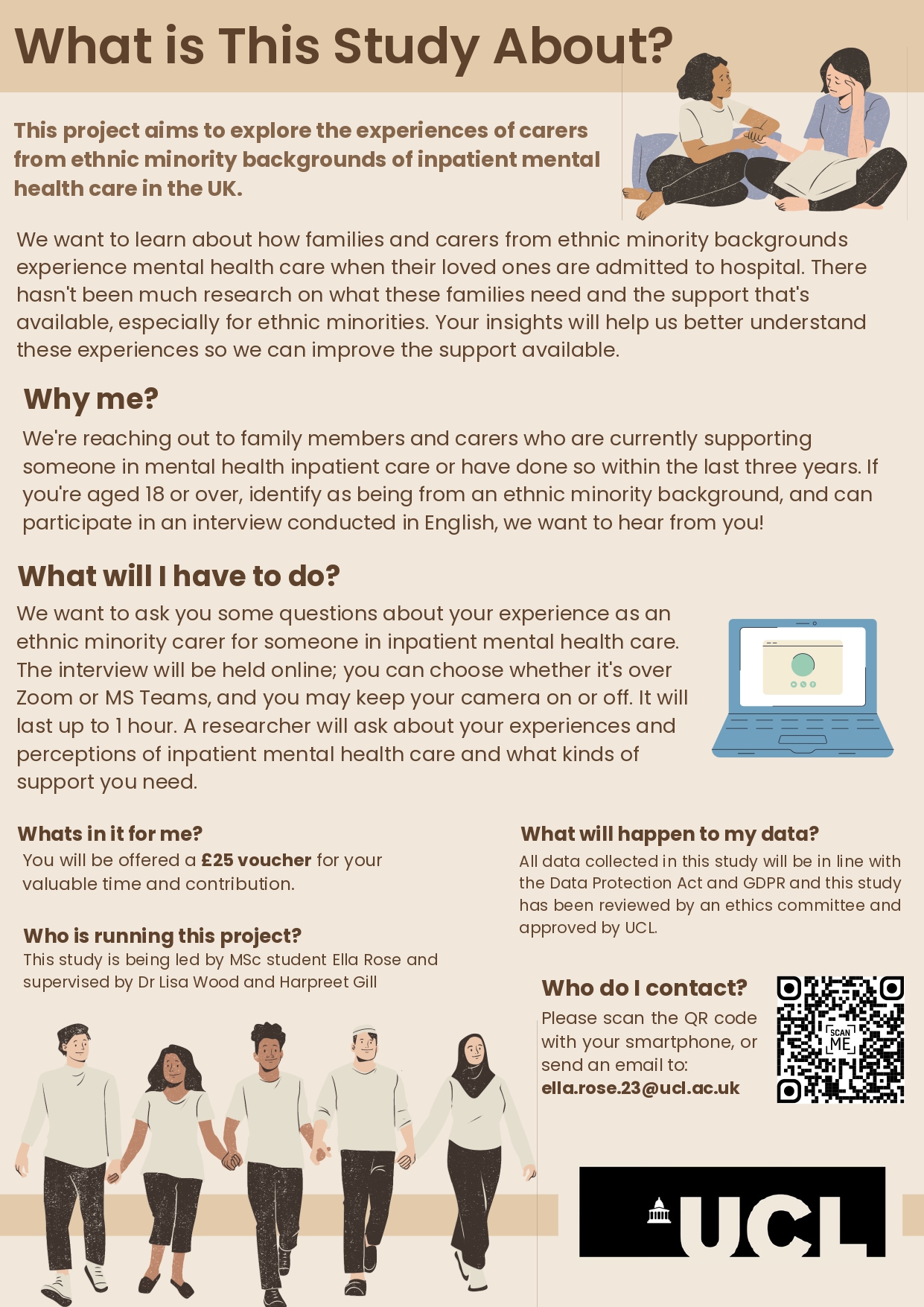
Ethnic Minority Carers Experiences of Inpatient Care

Welcome back to another update from Carer activist Matthew McKenzie. I have some exciting research in which carers can feedback their experiences.

Ella Rose a researcher from University College London is conducting a study focusing on the experiences of carers from ethnic minority backgrounds of inpatient mental health care in the UK. There are currently very few studies documenting the experiences of ethnic minority carers of mental health services. She hopes this study will fill an important gap in current research and help identify the specific needs of ethnic minority carers, and how services can best support them.

Participation in this study will involve a one-hour interview to discuss their experiences as carers of a loved one receiving inpatient mental health care in the UK, their views, and their support needs. She is recruiting individuals over 18 who identify as being from an ethnic minority background and who are carers for someone currently or previously admitted to inpatient mental health care within the last three years. As a thank you for their time, she will offer participants a £25 voucher.

To take part in the study please see the poster below or email Ella at ella.rose.23@ucl.ac.uk

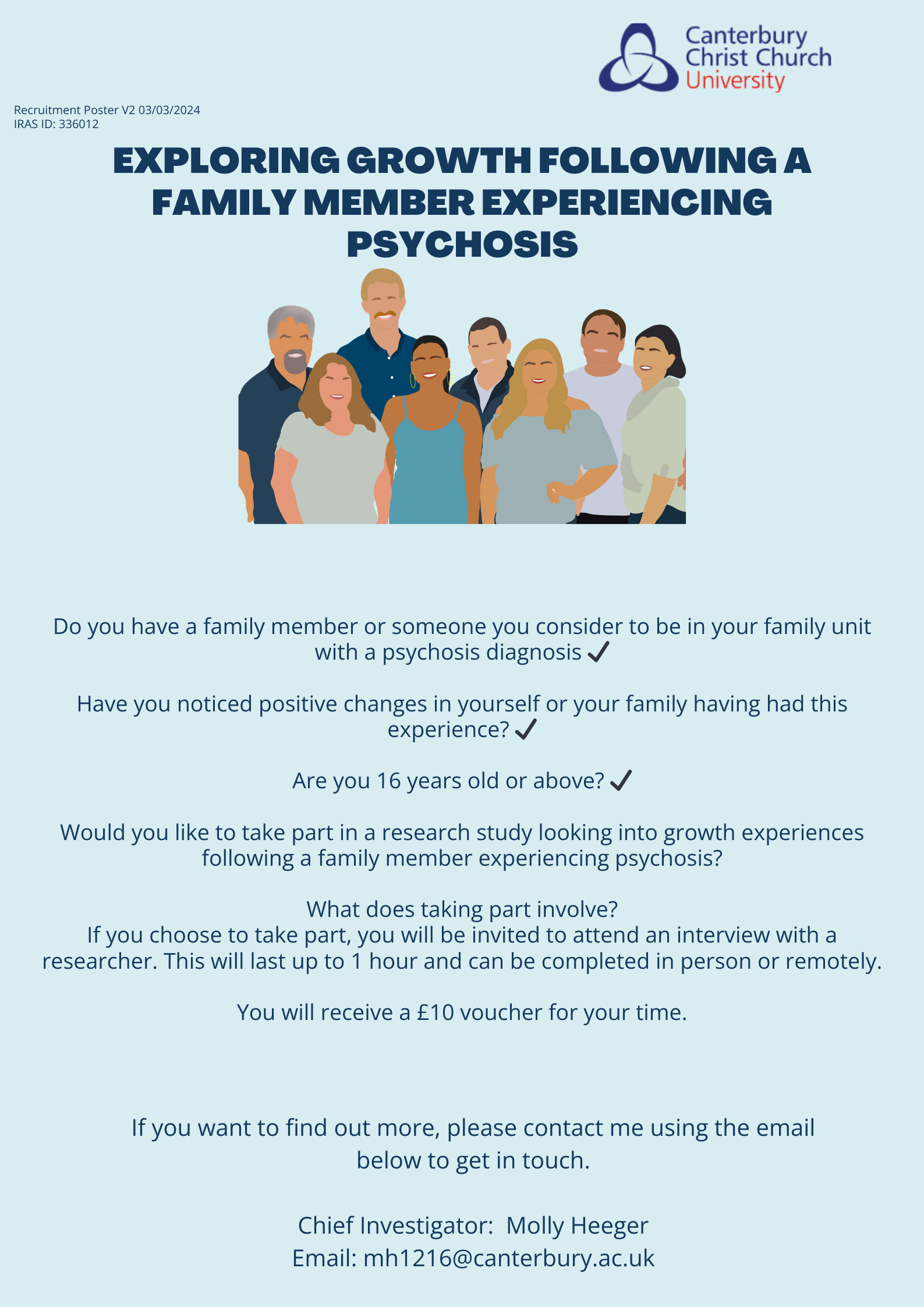
Exploring experiences of carers for someone with psychosis

Latest blog post by Matthew McKenzie on this exciting new research study from Molly Heeger who is a Trainee Clinical Psychologist from the Salomons Institute for Applied Psychology.

She is recruiting for her research project exploring family members experiences of supporting someone with psychosis. If you are caring for someone suffering from psychosis and would like to be involved in the study, please see poster below.

You can contact Molly through the following email : mh1216@canterbury.ac.uk

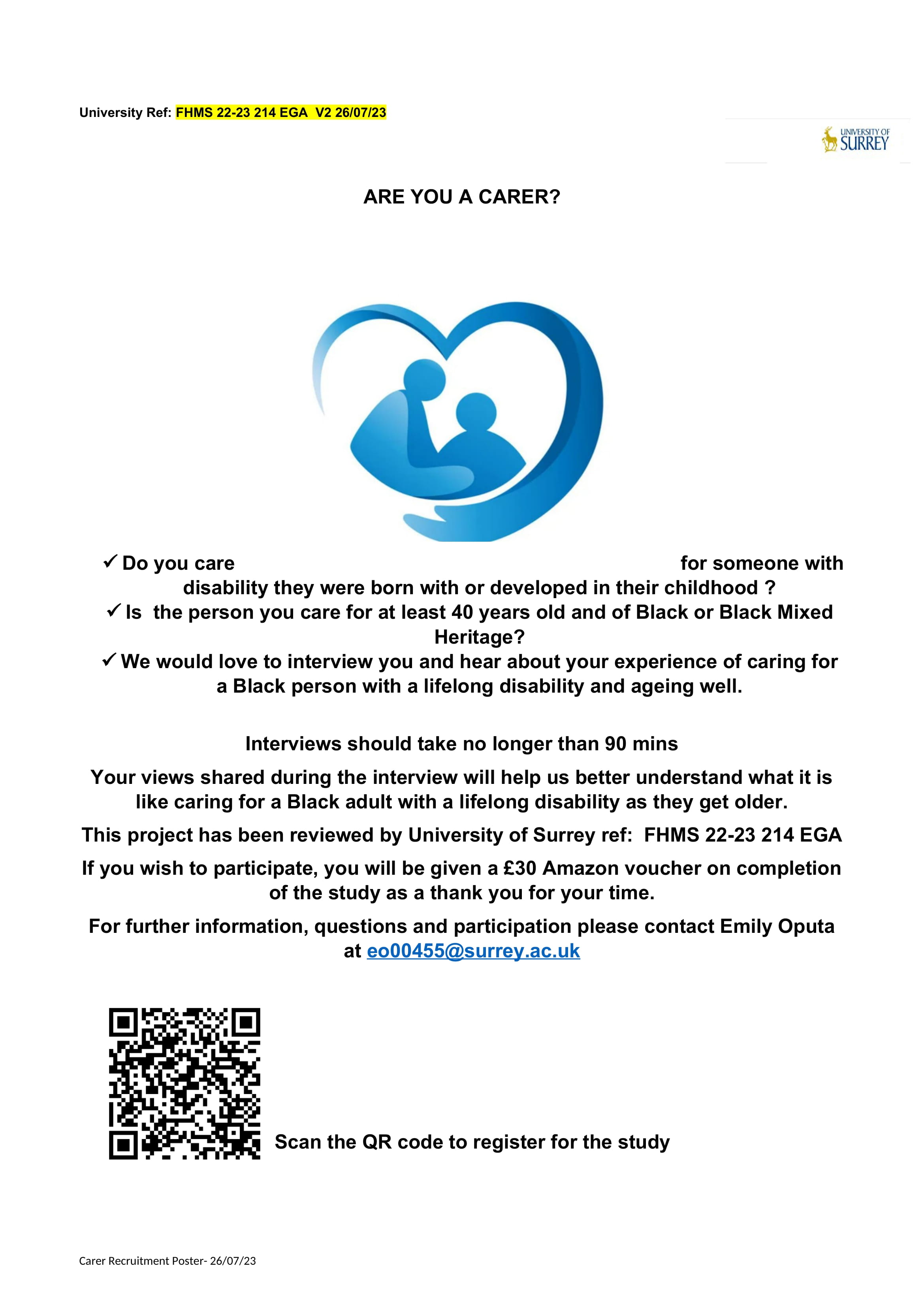
Experiences of caring for a black person with disabilities

Welcome carers. Another new research project for unpaid carers to get involved and feedback their lived experience. This research is from Emily Oputa who is doing her Postgraduate Research in Psychology. She is studying at the University of Surrey.

Emily would like to interview carers and hear about their experience of caring for a Black person with a lifelong disability including ageing.

If you want to give your views please contact Emily Oputa at eo00455@surrey.ac.uk

See poster below for details.

VR training for informal carers of those with psychosis

Welcome to another blog post by Matthew McKenzie promoting research from psychiatry and psychology.

There is new research taking place at the institute of Psychiatry, Psychology and Neuroscience. They are working on a new way of Virtual training for unpaid mental health carers.

People with lived experiences of mental health problems, such as psychosis, can have a range of experiences that might include worrying or unusual beliefs about other people, themselves and events. These experiences can sometimes influence their styles of communication with other people, including close friends and relatives. Families and friends (sometimes collectively described as carers) are an important source of support to people living with psychosis. This caring role can be challenging, especially when communication might feel confusing and difficult. As such, carers understandably often want their own help on how best to provide support particularly in terms of identifying helpful communication styles.

In the study the IOPPN will look at whether it is possible to use a new virtual reality (VR) training programme designed specifically for carers of people with lived experiences of psychosis. By carrying out a smaller study, the research will want to see if a larger study would work in the future. The training will aim to guide a carer’s development and use of helpful communication styles with their relative with psychosis.

For more details see poster below.

If interested please contact

Laurence Rogers (Trainee Clinical Psychologist; Laurence.p.rogers@kcl.ac.uk)
Department of Psychology, King’s College London
Institute of Psychiatry, Psychology and Neuroscience
De Crespigny Park
Denmark Hill
London SE5 8A

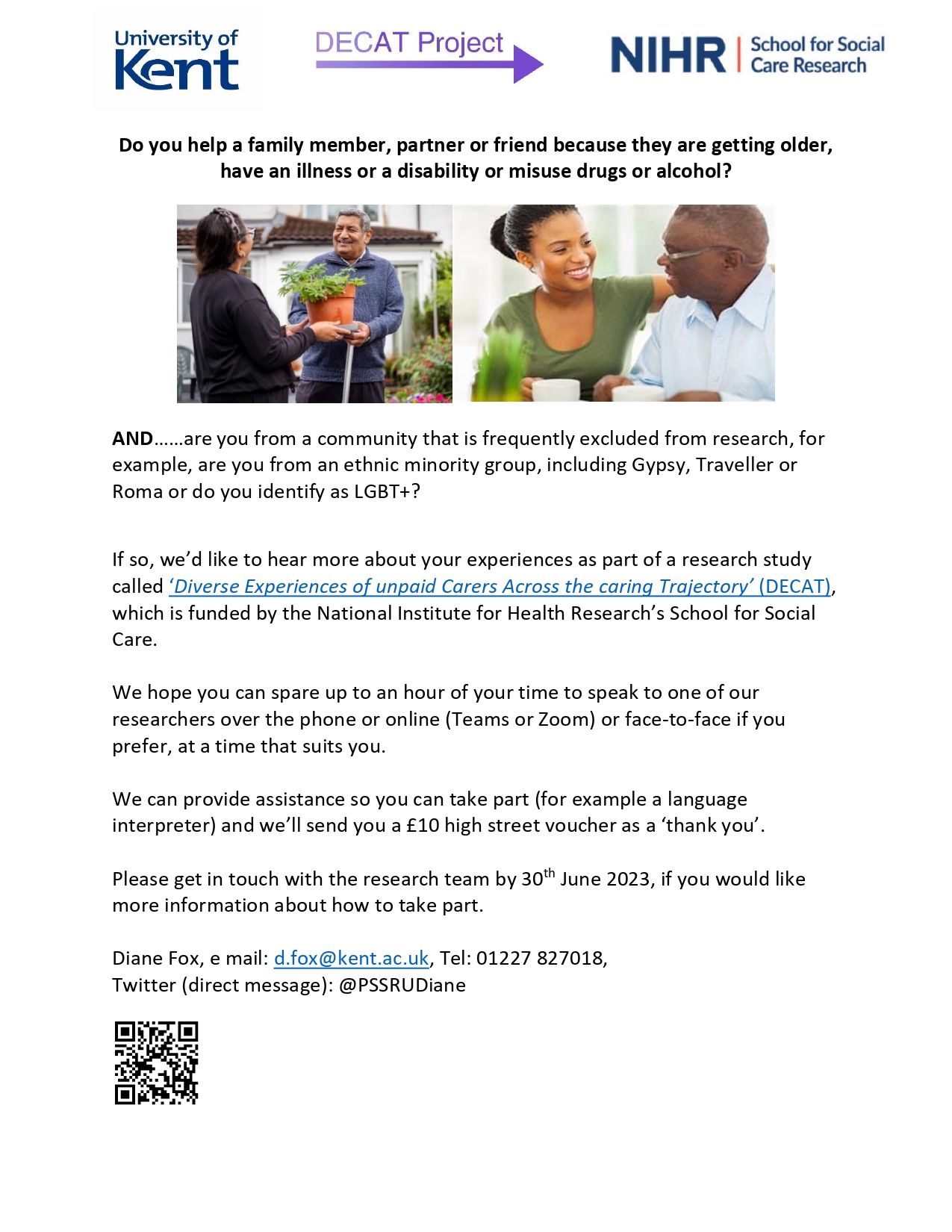
Diverse Experiences of unpaid Carers Across the caring Trajectory

A new research project is underway at the University of Kent. The research is called Diverse Experiences of unpaid Carers Across the caring Trajectory (DECAT). DECAT is looking for carers to take part in a telephone interview about their experience of being a carer. Currently, Black and Asian carers and carers who are LGBT+ are under-represented within our participants.

The main aim of this study is to understand the factors linked to carers’ satisfaction with social services and quality of life over time.

A questionnaire will be sent to a sample of carers recruited via four local authorities containing questions previously collected in the 2018/19 Personal Social Survey for Adult Carers in England, plus additional questions. The degree to which carers’ satisfaction and quality of life scores differ from scores collected in 2018/19 will be examined. Factors associated with changes will be explored and the scores of subgroups of carers will be compared.

You can contact Dr Diane Fox

Contact

Diane Fox
University of Kent
Personal Social Services Research Unit
Cornwallis Central
Canterbury
Kent
CT2 7NF

Email

d.fox@kent.ac.uk

See poster for details

What are the Occupational experiences of BAME unpaid mental health carers for people with a mental health diagnosis?

Hello fellow carers. New blog from Matthew McKenzie

I have a new research project for those from ethnic backgrounds to get involved in.

This research study is to understand the occupational experiences of unpaid BAME unpaid mental health carers. Occupation refers to the purposeful activities that ensure individuals have a sense of identity and live independently.

What is the purpose of the study?

Using the OPHI-II semi-structured interview will provide an exploration of the occupational choices, critical life events, daily routine, occupational roles and environment of the BAME mental health caregivers. This will provide insight into the respective communities’ occupational experiences.

For more details you can contact Halima Ali Email: 2051364@brunel.ac.uk or see poster below.

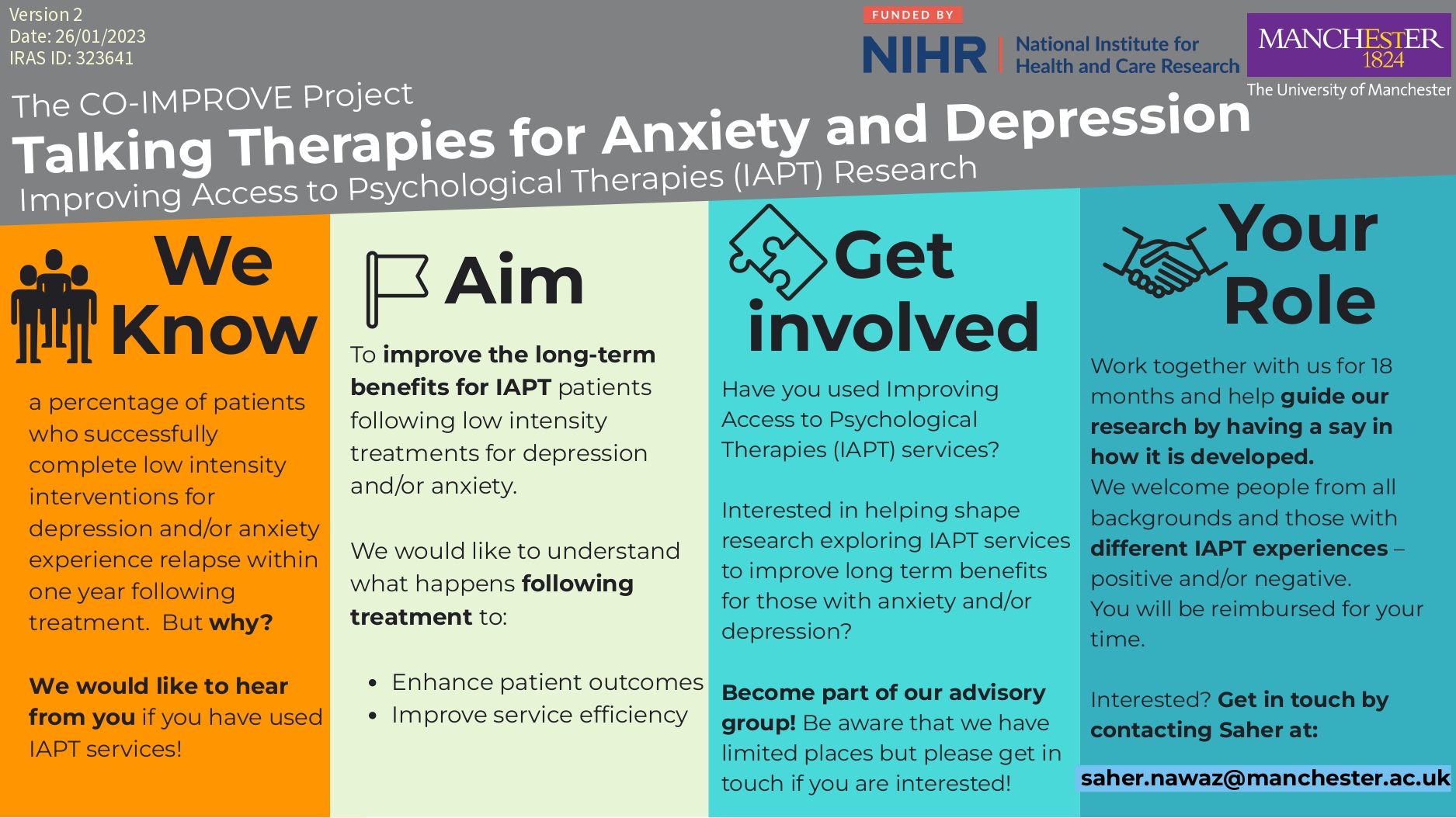
Improving Access to Psychological Therapies research – University of Manchester

There is an exciting opportunity for mental health carers and those who have used Increasing Access to Psychological therapies.

Have you used Improving Access to Psychological Therapies (IAPT) services?

If so, you might be interested in helping shape research exploring IAPT services to improve long term benefits for those with anxiety and/or depression. A new Advisory group is forming, but there are limited places.

Please see poster below.

For more information please contact saher.nawaz@manchester.ac.uk

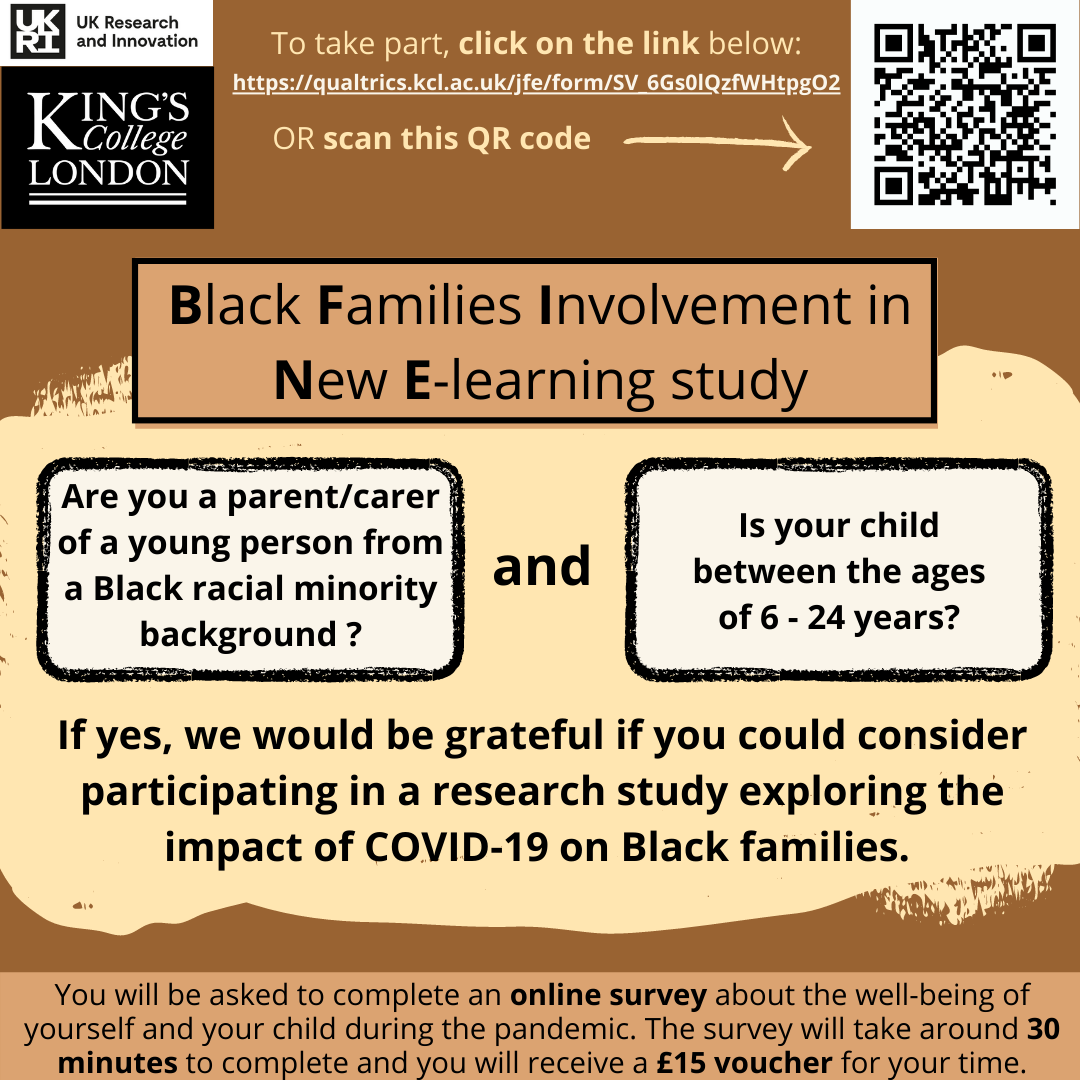
Black Families Involvement in New E-learning (Be FINE) Project

Welcome back to another blog by former mental health carer Matthew McKenzie. I have an exciting project which black families could be interested in.

Black Families Involvement in New E-learning (Be FINE), is a new study funded by the Economic and Social Research Council, as part of UK Research and Innovation’s rapid response to COVID-19 and is led by Dr Valentina Cardi and Dr Juliana Onwumere at King’s College London.

The study has two aims. Firstly, to understand the experiences and impact of the COVID-19 pandemic on the carers of children and young people (6-24 years) from Black minority ethnic communities in the UK. The second aim is to explore with carers of children and young people from Black minority ethnic communities, the type of information they would find helpful to include in an online course that aims to offer carers skills to support children and young people with their mental health and wellbeing. The Be FINE study will employ a mixed methods design, using both online surveys and individual and group-based interviews.

The study has two parts; an online survey and focus groups. To participate, individuals have to be parents or carer of a young person from a Black racial minority and the child has to be aged between 6 – 24 years. We then ask that the participant fills out the online survey, this should take around half an hour. The participant will receive £15 amazon voucher for participating. Following this, the participant will have the chance to also sign up to the focus groups. These will last around an hour and the participant will receive a further £15 amazon voucher for this.

Black communities have been disproportionately impacted by COVID-19. We hope the study findings will aid the development of a more in-depth understanding of the experiences of Black minority families during the pandemic, and of what type of help, delivered online, might be perceived as beneficial in empowering carers to support the psychological wellbeing of children and young adults.

Below is the Link to the survey people can take part in.

https://qualtrics.kcl.ac.uk/jfe/form/SV_6Gs0lQzfWHtpgO2

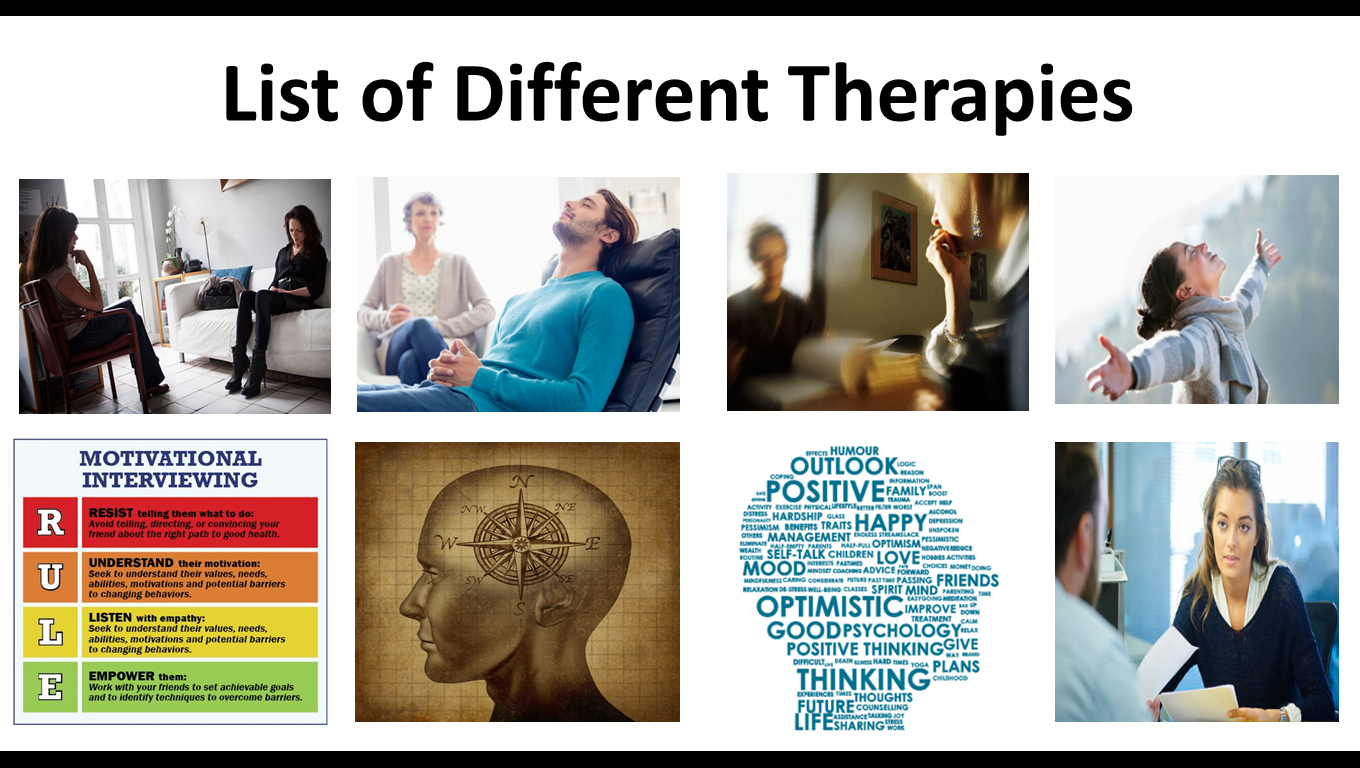
Top 100 psychotherapies

cover

Welcome back. I have always mentioned to fellow unpaid carers who care for someone using mental health services to have an interest in psychology. In order to help develop an interest I have spent some months producing the video below.

This video lists and describes over 100 different forms of psychotherapies. Most mental health carers actually may have come into contact with at least 3 or 4 types of therapy. One being CBT, the other could be family counselling sessions and the most common would be group therapy, especially if attending a carer’s group. It is important carers have access to a therapeutic setting and are not treated as information retainers.

Carers often have to go through difficult and trumatic incidents and giving a carer a leaflet and telling them to get on with it is a lazy way of doing psychotherapy. Anyway, I am getting off my soap box and hope the video helps raise some interest of the vast world of psychology.

The video covers many therapies from Interpersonal psychotherapy (IPT), Drama therapy and Art therapy all the way to CBT and DBT. I would have continued on with the video and done a list of 200 psychotheraphies, but this has taken a lot of time and I felt I should just get on and release the video already.

Hope you enjoy!!

Consciousness and the end of mental life – Lecture Review and summary

Daniel_Robinson

Prof Daniel N Robinson

Hello again. Hope that after reading this blog, you have time to check out my site. I do more than just the awareness series on mental illness.  I also do a series of lecture reviews, mainly on psychology, psychiatry, sociology and ethics.  Why on earth should a carer spend time on humanities and psychology? Well for a start it is interesting and fairly related in the mental health area.Hello again. Hope that after reading this blog, you have time to check out my site. I do more than just the awareness series on mental illness.  I also do a series of lecture reviews, mainly on psychology, psychiatry, sociology and ethics.  Why on earth should a carer spend time on humanities and psychology? Well for a start it is interesting and fairly related in the mental health area.

This particular review looks at one of the psychological greats lecture on his course “consciousness and its implications”.  The lecturer is Daniel N Robinson who is a philosopher who is Distinguished Professor Emeritus of Philosophy at Georgetown University and a Fellow of the Faculty of Philosophy, Oxford University.

Unfortunately the course can be a little challenging to get into at first, but there is nothing wrong with replaying the lecture in order to get to grips with the subject material.  The course has 12 lectures and as you can tell Prof Daniel spends time examining the mystery of what is consciousness.

As a carer, all the years I have been trying to support someone close to me struggling through mental illness, I found myself asking deep and profound questions.  The most common question i would ask myself is “Where is the person that I used to know?”.  How far has this mental illness taken from the person I used to know.

As of this blog post, the lecture I will focus on is lecture 12 titled “Consciousness and the end of mental life”.  I did have some reservations playing the final lecture, because as you may have guessed there is this overwhelming fear of deep dark questions probing me on the challenges I will have to face.

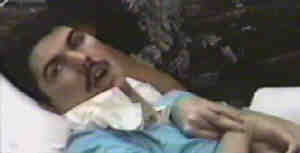
The lecture begins off looking as several startling cases of patients trapped years in a coma only to slowly come out of a coma from severe brain trauma.   One incredible story was of Terry Wallis – The man who slept for 19 years. Terry Wallis emerged from a 19 year coma and regained the power of speech.
terry-wallis

Medical professionals were astounded and started to examine the changes in his brain, it had always been the case that neurons were non-regenerative, but in the Wallis case there seemed to be strange activity in his neurons. How!?!?
Prof Daniel starts to talk about the Coma Recovery Association and how the association offered advice on how comatose patients can recover, but it is risky.  Within the lecture we look at further cases where there was one woman who recovered from a coma only to complain that unconsciously she kept hearing the doctor by her bedside talking.

Another startling case was of was of Brian Kastler, neurosurgeon’s in this case were astounded at his slow, but gradual recover from devastating brain trauma. The lecture looks at many other cases and examples, but Daniel is quick to point out that these cases are not often the expect outcome.

Embed from Getty Images

Prof Daniel reminds us that the brain is not like skin or bones, if affected by trauma then the cells more likely will die. Still the regeneration is a lot greater in childhood, depending on the damage.  However if the cerebral cortex is damaged then the greater the damage. The lecture points out that each patient case is unique and throws light into neuroscience. What was the deciding factors in each of the cases?

The lecture then moves on to the Terri Schiavo case, where a patient “Terri Schiavo” was a right-to-die legal case in the United States from 1990 to 2005, involving Theresa Marie “Terri” Schiavo, a woman in an irreversible persistent vegetative state. The lecture examines the problem of PVS (persistent vegetative state) cases and looks into cases where there has been misdiagnoses. This then shows the dilemma faced by doctors with several startling questions “When to turn off the life support system?”, “where are there signs of life?”, “What are the other possibilities?”.

Can you begin to see how the lecture is slowly moving into ethics?  There is no mistake why I have added a link into ethics off my blog site because when practicing medicine, you are dealing with people’s lives and if doing that then ethics is not far away.

Embed from Getty Images

Prof Daniel lecture looks into more philosophical areas on American philosopher Thomas nagel’s question “what is it like to be a bat?”. Prof Daniel wants to raise the implications of consciousness.  Prof Daniel also talks about Arestole’s work on the biological studies on sensation.  Eventually the lecture gets into deeper questions on what is consciousness as he queries if someone dreaming is conscious regarding if they are aware of sensations. A good example is given on how we determine our own consciousness, which is down to epistemic justification (part of epistemology that attempts to understand the justification of propositions and beliefs).  If no one believes that we are conscious, then we can only hope to share our experience with that person so they experience the same thing. e.g. pointing to an object in the room as validation.

Embed from Getty Images

The lecture then takes a greater step towards ethics and moral thought. With examining questions on.

  • Our duty to others, our rights to others.
  • They have a rights to be treated even though unwell, but how?
  • We have a duty not to exploit the vulnerabilities of others.
  • What are our duty to others whose rights cannot be protect by themselves?

Prof Daniel then throws up a dilemma not only for health professionals, but for carers or caretakers. Remember the question I asked myself at the beginning of this blog?  So this is why I often say to mental health carers that they should take an interest in psychology and psychiatry.  Do not be put off by its deep complex field, we all have something to contribute.

Friendly male doctor's hands holding female patient's hand