Category Archives: Aimed at Carers

Blog posts aimed at non paid carers caring for someone unwell.

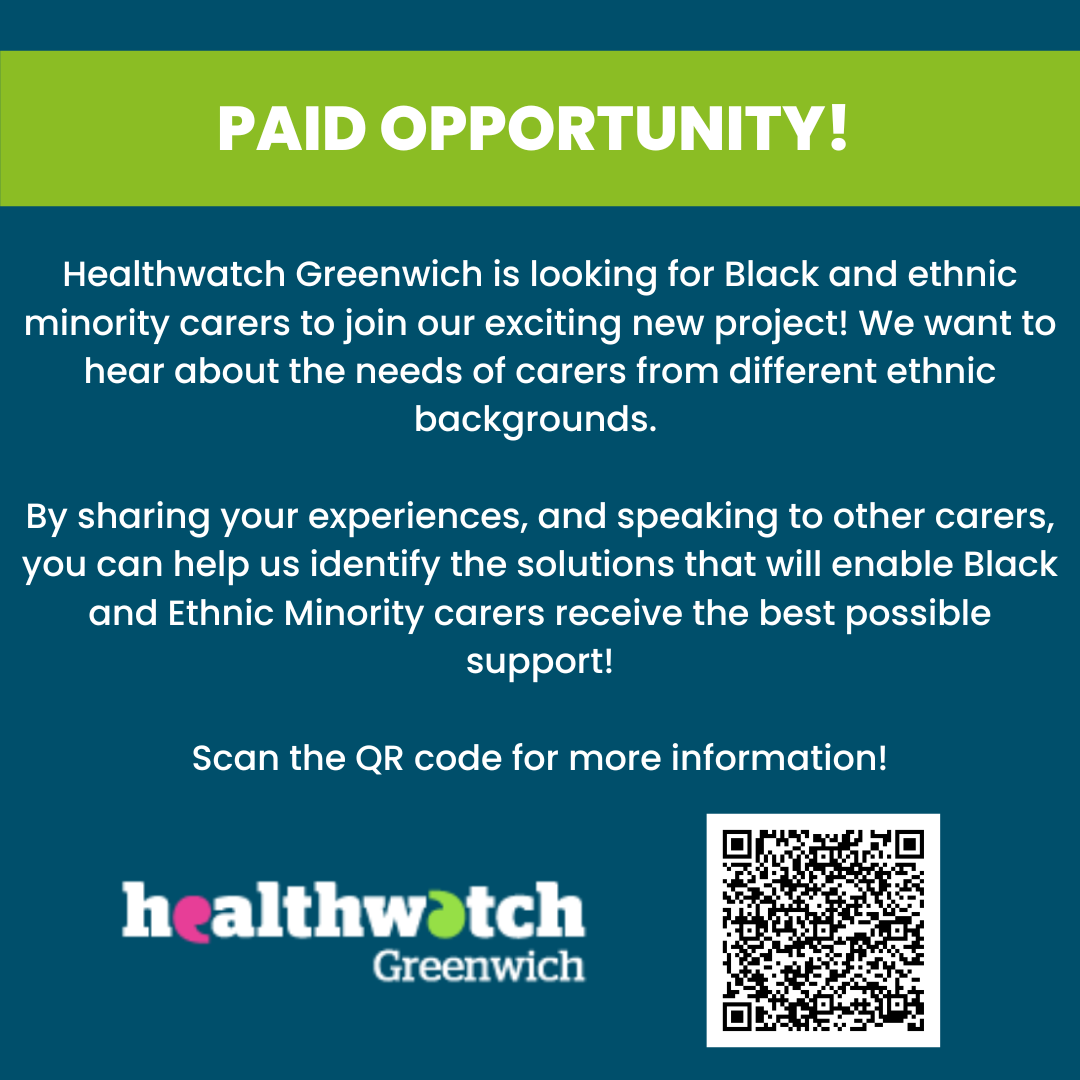
Greenwich Healthwatch BAME carer co-researchers

What is this project about?

Healthwatch Greenwich project wants to uncover experiences and understand
access to carer support, information, and services for Black and Ethnic Minority carers. By sharing your experiences, and speaking to other carers, you can help Healthwatch Greenwich identify the strategies and solutions that will enable Black and Ethnic
Minority carers receive the best possible support.

How will we carry out this project?

Healthwatch Greenwich are excited to partner with Black and Ethnic Minority carers as paid co-researchers in this project. As experts by experience, you’ll bring unique perspectives that are essential to its success.

Who can be a co-researcher?

  • An adult carer: Someone who looks after or gives any
    help or support to a family member, friend or
    neighbour because of long term physical disability,
    mental ill-health or problems related to old age. The
    care they give is unpaid.
  • From a Black or ethnic minority background
    What will co-researchers do?
  • Contribute to the design of the project.
  • Find and speak to other Black and ethnic minority
    carers
  • Contribute to the analysis and presentations of the
    findings.
  • Take part in training and support sessions.
    How much will co-researchers be paid?
    Co-researchers will receive £15/hour. Hourly payment
    includes all additional expenses involved in taking part in this
    project, such as care costs, childcare payments, telephone,
    and travel costs.
    Co-researchers will take part in up to 8 days of involvement
    work spread across a number of days between June and
    September 2023.

How do I apply?
If you’re interested, Healthwatch Greenwich ask you to complete a short
application and have a friendly interview. Please contact Jahan at jahan@healthwatchgreenwich.co.uk or on 07498 851 221.

Why we care

Welcome to another carer blog by carer activist, champion and author Matthew McKenzie. If I am not speaking at events or conferences, I am busy writing or minding my own carer stall at NHS Hospitals. I certainly get into a lot of interesting conversations at the stall. Just to note, the reason for my stall is to focus on unpaid carers to get help and support. Not many people know they are even carers, they just end up coping. This is not always a bad thing, we do not have to use the label carer for everyone. Still, if you continue to just cope for a long length of time, they can have a bad effect on the person’s health and wellbeling.

So what’s with this blog? Well I got into an conversation when someone mentioned people only care because they can get benefits or compensation. I want to put out that there is more to caring than just getting ahead. It might mean different for others, but for myself when I provided a form of unpaid care, I did this out of duty and love.

Embed from Getty Images

I suspect many others provided care for someone close out of duty and love. When I was providing care for my mother, I knew how she was when she became ill. It was a tragedy to see how she became mentally unwell over the years. I fought very hard to give her the same quality of life I felt she could have. This might be different for those caring through other forms of illness of disease. Those caring for someone with cancer (depending on the stage of the disease) might struggle to improve their loved ones quality of life, but they will still care and probably care till the very end.

Those providing care will certainly want some kind of benefit that helps aid their caring role, but most will provide care even if benefits were almost non-existant. If carers are to value something, it would be knowledge of the condition the person is going through. If you knew what you are caring for and how to provide such care, then this would save so much trouble in future.

Embed from Getty Images

For mental health carers, it is important to keep that relationship going with the person they are caring for. It is important to develop good communication skills and develop trust because when those things break down, it will be harder to maintain a relationship.

Providing unpaid care can actually strengthen’s relationships, because if the ‘carerd for’ recognises the person is providing help and support, they are usually grateful for this. I remember the look my mother gave me as she lay on the hospital bed. She knew through all the years I had tried to be there for her. I admit I made plenty of mistakes, but she knew in the end, the relationship was strengthened. This unfortunately is not always the case for some unpaid carers. Many relationships have ended due to the impact of mental illness or being unable to cope, which can often push the carer away.

Lower down the list of why people care for someone is usually down to developing our own character and skill set. As a carer, the person does not want to give up their caring role. They want to prove to themselves that they will see things through. They want to develop courage and face those challenges head on as they advocate for the person they are caring for. To be honest carers will have to be brave and even advocate for themselves. This is not an easy thing to do as the services can often be patient centric.

Embed from Getty Images

Some character traits of carers already exist on the reasons they care. Some people already considerate, patient and understanding plus generous. When providing unpaid care, those character traits just go stronger each day. It is important carers must understand the stigmas they face. People will judge unpaid carers as if they have no skillset, but this is wrong and it is discriminatory. Carers need to also be vulnerable and ask for help. Especially if suffering from fatigue, isolation, anxiety or just needing someone to talk to.

It is important carers take time out for themselves, but with the pressures on health & social care, it can be understandable why carers put themselves on the line.

Thanks for reading

Involving carers in co-production

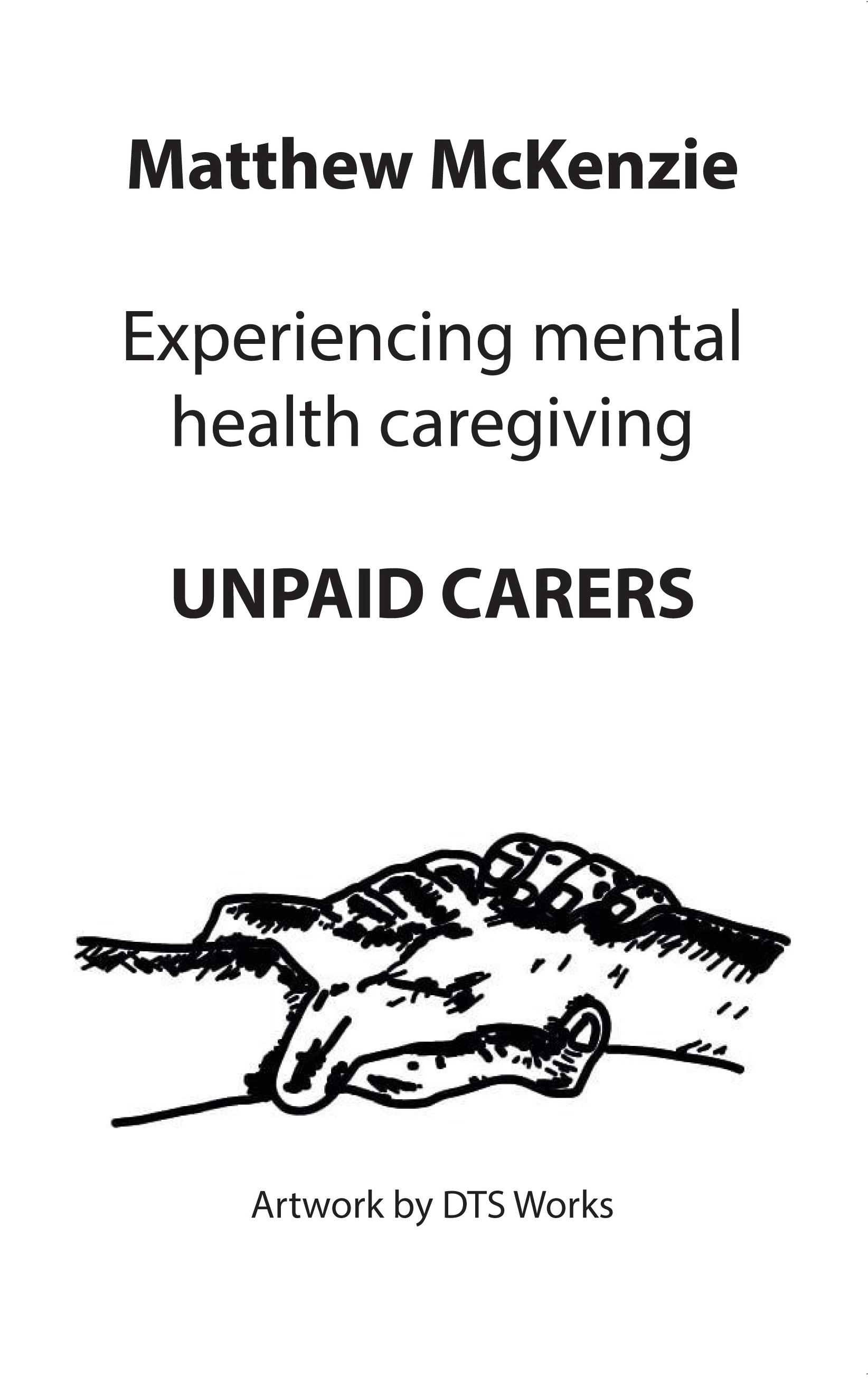
Welcome to another carer blog by Matthew McKenzie. You might already know, I am an author raising awareness of unpaid carers. One of the books I wrote touches on the subject of co-production. The book I wrote titled “Experiencing mental health caregiving – unpaid carers” had several chapters regarding co-production.

However, why have unpaid carers be involved in designing health and social care services? Lets first look at the problems and challenges.

The problems

Health and social care sometimes do not meet eye to eye with unpaid carers, there are a lot of assumptions made about carers, there are also a lot of biases on the needs of unpaid carers. We can certainly champion the good works of health and social care, but to be realistic there are plenty of problems as well.

  • One shoe fits all policy, different carers have different needs
  • patient centred to the point of ignoring the carer
  • Limited resources means carers just cope
  • Co-production on a complex service might put people off being involved in design
  • The leader in co-production might still have “I know what is best” attitude, this can also put people of being involved.
  • History of bad results damages reputation, so carers feel they have heard it all before.

These are some of the challenges and problems health & social care services will have if they want carers to be involved in co-production.

Some solutions

So we have just touched on the bad news regarding co-production, but there is also good news, there are some solutions that are floating around.

We just cannot rule out co-production even though it has been around a long time. In fact co-production has been around so long, that it might have been watered down. The word “co-produce” can be almost a throw away term to get people excited.

Embed from Getty Images

There might be a lot of asumptions made about the uses of co-production. If we want coproduced and co-promoted services, we have to put those involved first. Those services will have to be flexible enough to offer solutions tailored to individual carers. It is not an easy task since those services need to recognise carers as a protected characteristic. Carers are vulnerable and they do need guidence, support and care for themselves. If carers are not valued, then they will struggle in their role providing unpaid care.

Co-production should raise the voices of those involved. This means we avoid the “One shoe fits all policy”. It means better service delivery that benefits as many as possible.

What next?

Those involved in inclusive service design need to be skilled, they also need to know there are issues within those services and those carers need to be confident in challenging those issues. This is not easy as health & social care are very complex entities. We have organisations like Healthwatch monitoring and collecting feedback from health services. Some things concerning the running of health & social care services are complex by design. So to expect carers to challenge those services is a tall ask.

Even before including carers in designing a fair health and social care service, carers need to knock on the door to request co-production. To make matters more difficult, not everything is actually co-production, due to time restraints on service delivery, co-production activities may be rushed or brushed aside towards tokenism. It is a big problem, but to be realistic sometimes it cannot always be avoided.

Earlier on in this blog I have mentioned time as a cost, carers can usually use their own expert of experience to express their needs, but transmitting that experience into services will mean carers will have to be trained to champion co-production.

Conclusions and findings

From my 2nd book “Experiencing mental health caregiving – unpaid carers”

I wrote upon the subject of inclusiveness within several chapters, one of them was Chapter 6 – Co-production and involvement.

I asked several questions, this question asked “What do you think co-production means to unpaid carers?”

With the answers provided from unpaid carers, activists and researchers one response was interesting regarding co-production.

“Co-production means that a carer is involved in service improvements, support groups and forums, because their lived experiences can be more valuable than the academic research. Co-production can help a carer to interact with other people in a similar situation to them. The carer can feel valued when their contributions have been used wisely. – Annette Davis – Carer and carer peer activist”

As mentioned earlier there are important keywords e.g. lived experiences, groups and forums, feeling valued and contributions.

Embed from Getty Images

For Chapter 30 – Co-producing in health and social care. I touched again on services. I was interested in the challenges as mentioned earlier in this blog

The question asked “What are the challenges of co-production?”

A carer responded with the following.

“Money, I think the challenge is it can cost so much money, you can’t just sort of say to a professional to just go ahead and co-produce things. You’ve got to fit this round everything else and go to a meeting, because you see, these professional meetings are beginning to end. They go through an agenda and with Co-production, you can’t really do that. Not at the early stages. If you are actually coproducing, then you actually have to sit down and think of ways of facilitating and carefully plan coproducing. This requires time and unfortunately time is expensive in terms of the professional’s time. If you want it, you have to pay for it. The people e.g. patients/carers who are co-producing should be paid as well. So we have got a commitment. However, from the professional side, you’ve got to pay for their time as well. Its expensive. – (Ann – Unpaid carer)”

What can we take away from her response?

Inclusive service design will need some form of co-production, but will definately need resources. It is not always about money, it is about time and commitment. Things have to be planned carefully, interest must be kept up for those involved. Co-production can also be expensive, but if done right it does not have to be so costly, but it certainly should value those involved.

The importance of carer forums

Welcome to another carer blog post from Matthew McKenzie

Ever thought why carer centres run carer forums? If you are a carer then you know that you are putting others first. The more unwell that person is, the more care and support you give. There will be times of course that you become isolated, tired and wondering if you are ignored.

Well the things I have mentioned are some of the reasons why carer centres run carer forums. Those very centres usually also run carer peer groups. It gives carers a chance to be listened to and also be heard. Carer peer groups and support groups do not really give carers a chance to be empowered, but they do provide support.

If you are lucky enough to belong to a carer centre that runs a carer forum, then you have a chance to become empowered. You might be wondering what Matthew is on about. Well give me a moment and I will get to the reasons why it is so important to attend and support your local carer forum.

Embed from Getty Images

Ever heard the saying “Nothing about us without us?”. The very quote came from disability rights activist James Charlton. If you are caring for someone, then services provided for them will be decided if you are involved or not. This goes double if you are using carer support services.

It is all fine that carers scramble to use support services to reduce isolation, be given guidence and join in carer activities. There does come a time when carers get a little bit tired of being told what suits them. So carer forums give carers a chance to request what services would be useful. It is so important that unpaid carers be empowered to use their voice, not only to update and tell their carer’s story, but also to give input regarding the services they use.

If you are providing unpaid care then these services could be carer assessments, carer hubs, access to skill development, learning about upcoming events and a whole lot more.

Embed from Getty Images

A healthy service is one that includes the user’s voice and this is the same when it comes to unpaid carers who use carer centre services. If you are providing unpaid care, you do not have to be an expert to attend and support your local carer forum. It can be fine to just attend and listen to updates. It takes a long time to become an empowered carer and many carer services can be complex, especially if your carer centre is involved at your local authority carer strategy.

Without a carer forum running from a carer’s centre then the risk is carer services will take guess work in what carers want. So it is so crucial that carer members new or veteran attend their carer forums.

Remember Nothing about us without us!!

Carers and learning about online resources

Welcome to my online site that focuses on unpaid carers. The site usually focuses on those caring for someone with a mental illness. This particular blog is on access to online learning resources.

The world is changing, since the 2019 pandemic, many more online learning resources e.g. access to help and advice, benefit info, event info and even carer groups have all most online. What if the carer struggles with the computer? what if the carer does not know how to join online groups?

It was a struggle to access online resources before the pandemic, but it still is a challenge. Some good news, Lewisham Carers Hub have received funding to allow carers to learn about computers and accessing online information. Please see the poster below

Top 10 things unpaid carers struggle with

Welcome back to another carer blog post by Matthew McKenzie carer activist and author in London.

I thought to try promote carer causes and focus on things that I reckon carers struggle with. As usual when I am talking about carers, I am talking about caring for someone in the family or as a friend.

Embed from Getty Images

Whether a person is caring out in the community or visiting the person they care for in hospital, there are challenges people need to take note of.

Here is a list down below

  1. Isolation – Caregivers can often feel cut off from the outside world, especially if caring, hard to understand
  2. Emotionl strain – Taking care of a loved one and being responsible for their health can be very stressful. depression, guilt, sleep loss.
  3. Financial situation – This struggle can cause all sorts of stress, the financial burden felt by caregivers should not be overlooked.
  4. How Caring can impact on opportunities – if your caring, then you are not earning or developing other skill bases. Still caring can develop it’s own skill base.
  5. identification as a carer – people do not always see themselves as a carer, but can lose out on support
  6. Getting access to support – respite, advocacy, emotional support, planning for the future
  7. Strains on Relationships – caring can be a joyful experience, but also stressful, lack of time for friends or family
  8. Being involved in care – confidentiality, jargon in NHS, relationship breakdowns, sometimes being missed in identification. These things can cause the carer to be uninvolved.
  9. Advocating for the cared for – need to deal with GPs, social workers, pharmacists, care agencies, receptionists and so on.
  10. Not being able to Focus on themselves – most of the previous things mentioned focus on the struggles carers face when caring, but too much focus can cause the carer to loose sight of their own well being. It is important to take time out, sleep, talk to a friend. Not easy if caring in crisis.

If you want a more detailed explanation I have also made a video below.

Wellbeing skills for Carers, Families & Friends – Kingston

For carers over in the London borough of Kingston. There are sessions aimed at unpaid carers which are informal and friendly. The sessions give practical ideas and tips, based on the latest scientific research to increase resilience, improve wellbeing and manage stress and anxiety levels better.

Please see poster below for more information or contact communitylearningkae@kingston.gov.uk

There is also a link below and the scan code

https://bit.ly/KAE-CLcrc2223

New online Carers rights course by Matthew McKenzie

Hello Fellow carers. I have now practically finished developing my online course for those caring for someone.

This course can be accessed via the courses section off my website.

The third course is on Carer’s Rights, which is such an important topic to millions of unpaid carers out there.

The online course covers the following with over 4 HOURS of content!!!

  • Your rights as a carer
  • Human rights
  • What things carers usually complain about
  • How to complain as a carer
  • Whose is responsible for carer’s rights
  • Support from employers when caring
  • Carer wellbeing under carer’s rights
  • List of different acts and laws
  • Complaint escalation ladder
  • Carer’s Assessment
  • Tackling confidentiality.

If you are a caring for somebody and do not know what your rights are, then this is the course for you. Only £2!! Or just email me

Watch out for more online courses, which I will be developing very soon.

New carer identity course by Matthew McKenzie

Welcome carers. I am soon about to launch my first online learning course aimed at carers. I thought to try challenge myself to work towards the field of lecturing online and it had to be a course aimed at carers.

The course “Carer Identity” covers the following

  • What is a carer?
  • Why be identified
  • Stigma and labels
  • Holding to account
  • Whose job is it to identify carers
  • Types of carer identification systems
  • What happens after Identification and more

The course can be accessed by clicking on the course section off my website.

Carers Week 2022 – Being Valued and supported.

Welcome one and all, especially fellow carers.

So it is now the start of Carer’s week 2022. A week I have been waiting for all year and I hope you have as well. What is so special about Carer’s Week? It is a chance to use your experience of providing unpaid care to stand up and be counted for your efforts.

Carer’s Week is a collaboration of many charitable organistions seeking to make life easier for millions of carers around the country. The UK has been through difficult challenges over the years with the COVID-19 situation and now recently the cost of living. We also have the revamp of the mental health act and the new health and social care bill, which seeks to make the systems fairer to carers and those they care for.

However many carers around the country are wary of new laws and bills and to be honest unpaid carers have not come well off from past laws. It is so important the government, local authority and health providers seek engagement from unpaid carers regarding new bills and policies.

Going back to carers week, there are many themes and campaigns taking place. The latest one is on the “A Recovery and espite Plan for Unpaid Carers” There is an open letter to the prime minister signed by seven CEOs of major national charities.

  • Helen Walker, Chief Executive, Carers UK
  • Caroline Abrahams, Charity Director, Age UK
  • Kirsty McHugh, Chief Executive, Carers Trust
  • Sally Light, Chief Executive, MND Association
  • Danny Sriskandarajah, Chief Executive, Oxfam GB
  • Mark Winstanley, Chief Executive, Rethink Mental Illness
  • Jacqui Cannon, Chief Executive, The Lewy Body Society

The theme for carers week 2022

Each year, carers week has a theme to highlight the importance of unpaid carers and the challenges they go through. This year is no different and the theme for this year is “Making caring visible, valued and supported”. So why such a theme this year?

Personally it is well known that carers can end up being hidden because they are caring behind closed doors, but there are other reasons for carers to be hidden. Not many people think they are caring and just get on with it, some feel that caring carries stigma and to make matters difficult, health and social care systems often fail to identify carers. It is known that even if a carer is identified then there is always a risk that the carer can slip through the net. The reason for this is caring heavily relies on the relationship to the “cared for”, especially caring for mental illness. If that relationship fails then caring can be at risk and the carer could be at risk.

What about being valued? Is caring valued in society? Is caring valued in the community? To be really blunt about it, I am afraid caring suffers from being valued. Society does not deem the sacrifices others have to pay to care a worthwhile endeavour. It could be that people are compelled to care and that in itself could be the reward, but that reward is countered by the harsh challenges carers have to face, especially financial. Unpaid carers put so much on the line that they themselves risk their own health and wellbeing. It is so important we not only value carers but the importance of caring itself.

What about being supported as a carer? Many carers complain health and social care systems fail to support them. The risk is if the support for the carer is lacking, then this can cause a trickle down effect to the patient or “cared for”. The risk is the patient suffers at the end of the day because the carer is not getting that vital support.

I call for ALL carers to use this week as an opportunity to stand up and be counted, be diplomatic in your efforts, but make yourself known and be proud you have been there all this time to give a care. We are not asking much, just only to be identified, valued and supported.

Just to note, I will be doing a Share & Learn session at Carers UK. I wish to share my knowledge of the experience of care regarding ethnicity, mental health and carer wellbeing using my poetry. If you are a carer, see the link below to book

https://www.carersuk.org/help-and-advice/get-support/share-and-learn-online-sessions