Welcome fellow carers. As of writing this blog post, it is still the start of Black History month 2023. There are many exciting events taking place. I will try my best to help promote ethnic carer events.
Luckily we have an event aimed at unpaid carers from Black communities. We have to explore and acknowledge that not all carers experiences are the same. Just like I often say not all carer journeys are the same.
As part of Black History Month, Dr Juliana Onwumere from the Institute of Psychiatry, Psychology & Neuroscience at King’s and South London and Maudsley NHS Foundation Trust will facilitate an online panel discussion focussing on the experiences, wellbeing and unmet needs of carers from Black communities in the UK, including young carers.
This event is open to anyone including members of Black communities across the UK.
Panel members:
Tim Banks, Research & Engagement Manager, Carers Trust
Peter Alleyne, Director of Equity, Inclusion and Involvement, Rethink Mental Illness
Angela Anwah, Founder & Director: Mental Health and the Arts
Welcome to another blog post by Matthew McKenzie carer activist and one of the carer network ambassdors for Cygnet.
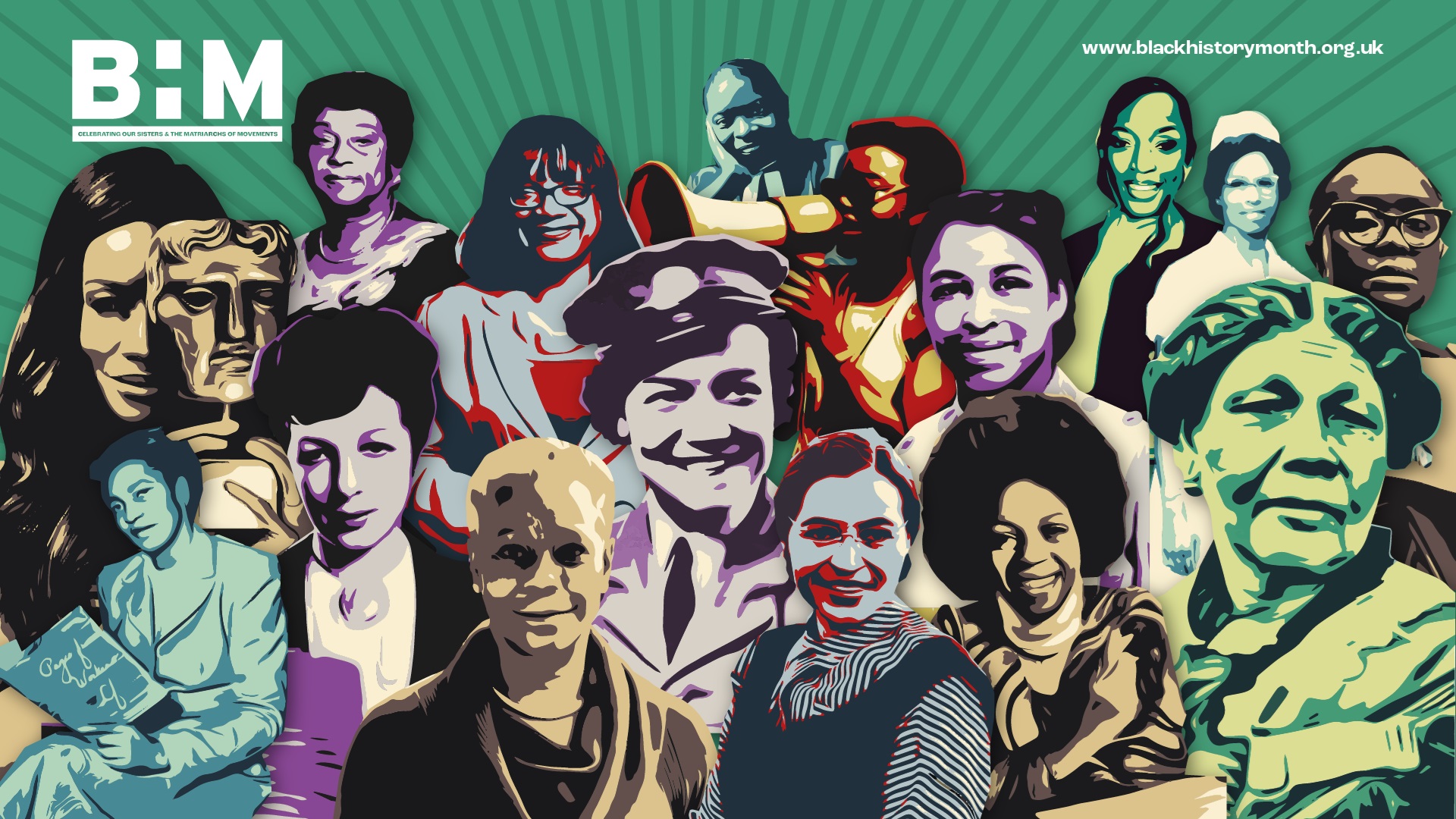
As of this month for October 2023 it is Black History month. This month is a special theme for me since the theme is ‘Saluting our Sisters’. The theme highlights the crucial role Black women have played throughout history.
There are so many famous black women throughout history
Rosa Parks – for her courageous participation in the Montgomery Bus Boycott to push forward the civil rights movement against racial segregation on public transport.
Maya Angelou – who was famous for poetry and also a civil rights activist.
Mary Seacole – Contributing to medicine and nursing where she even helped British soldiers being injured in the Crimean war while fighting discrimination.
There are of course many more famous black sisters who are far too numerous to mention, but the above have shows the importance history plays in shaping our lives.
Still, I want to focus on someone very special and dear to me as she has not only shaped my life, but in a strange way inspired many others. Around 2019 during the pandemic the country was fighting an unknown and dangerous virus. That virus turned out to be COVID-19 and the outcome changed my life. My mother struggled with her mental illness in her later years, which in turn led her to also struggle with her physical health. With resources running low in the health service my mother was the unfortunate casualty of dwindling health resources during the pandemic.
Like so many other vulnerable groups. My mother did not actually die of virus, but just could not access emergency healthcare as resources were focused on covid victims.
The impact left me wondering what could I learn from my many years of caring for my mother. I had a choice either to share my story to other carers or completely move in another direction of my life. I made the former choice, because it helped me heal and also pay rememberance not only to my mother, but to myself.
So around 2020 I wrote my first book about my experiences as a mental health carer. The book was called “A caring Mind”, which was named after my blogsite which was born raising carer awareness after writing blogs for South London & Maudsley NHS trust.
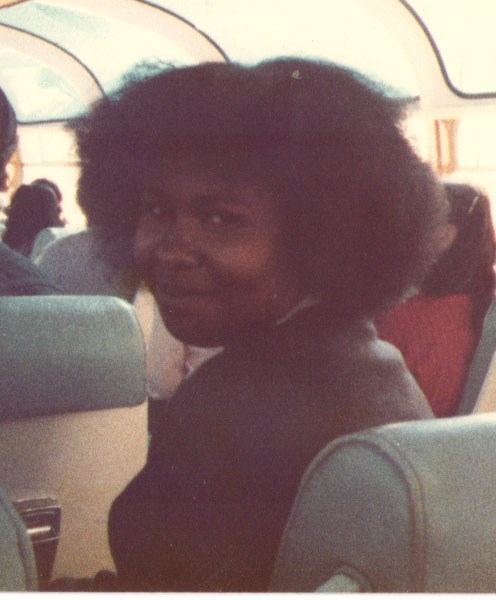
Even when caring for my mother, I was also helping to care for an old friend who also inspired me to write. However it was my mother Rosemarie McKenzie who spent so much time writing poetry. My mother also wrote stories and even managed to get a story published in a magazine while she was struggling with mental illness.
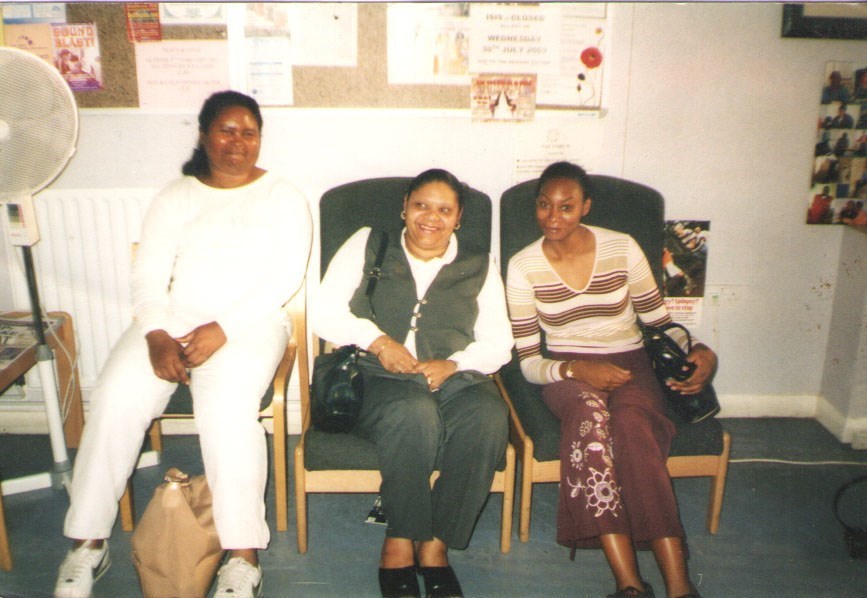
My mother enjoyed singing and used to sing at our local African/Carribean community centre (family Health ISIS) that catered for those struggling with mental illnes.
Rosemarie McKenzie to the left dressed in white
My mother inspired many other clients at the community centre to be creative with poetry, singing and writing. It did not matter the mental struggle other clients was going through at the centre. They saw my mothers, as long as they could be creative, it helped them express traumatic feelings in a positive way. This was one of my mother’s strengths. No matter how many times she was would suffer with her health, she always found strength to be more than her illness. She made me find cause in highlighting awareness for vulnerable groups. This in turn led me to continue writing and using creative ways to express my lived experience.
Of course I could never fully understand my mother’s illness and could only express my mothers creativity as a dutiful son and a mental health carer. In the end I feel we cannot always look to the famous and fortunate of our black sisters. We all contribute to history in our own way. My mother used her own creativity to tell her story and I will continue that story hoping to contribute to black history.
Welcome fellow unpaid carers. This blog focuses on those caring for someone suffering through mental illness. I chair the Triangle of Care community meeting. You might have already heard about Triangle of Care from national carers charity Carers Trust.
Basically the Triangle of Care describes a therapeutic relationship between the patient, staff member and carer that promotes safety, supports communication and sustains wellbeing. Many NHS Mental health trusts across the country have taken up the challenge and signed up to the scheme.
However if you are a carer, knowing about the triangle of care is not enough. You should try work out what your NHS trust is doing with triangle of care policy.
Some questions you could ask
Have you as an NHS organisation signed up to the triangle of care?
What are your plans to get feedback from carers to help shape triangle of care at your organisation?
How do you promote triangle of care to unpaid carers?
How is triangle of care helping to change the experiences of carers at your NHS organisation?
There are many more questions to ask senior NHS staff at your local mental health trust, but it is so important carers do not just blindly accept carer policies without some scrutiny.
We have our next Triangle of Care community meeting for 21st of september. See below.
Remember, unpaid carers also use services and it is their right influence or feedback experiences of health care.
Hello fellow carers, another blog from carer activist Matthew McKenzie. A lot of my groups focus on those caring for someone with mental ill health or caring for someone going through the stages of cancer. As you probably know, caring for someone should be a role that we look towards. This does come with challenges, but most carers can even expect to go through tough times. These challenges could mean adapting to a role that could be isolating, difficult to understand and emotionally as well as physically taxing.
Being an unpaid carer means you doing what you do because you love and care for the persons health and wellbeing. It is unfortunate that the cost of living has made the unpaid caring role an increasing challenge. With reports from National carer organisations like Carers Trust and Carers UK, the cost of living has pushed carers towards a more vulnerable position. Struggling financially to make ends meet could be the last straw that breaks the back of many carers.
We all know the sad desperate story. We want a society that emphasis the importance of caring for one another. It should not be left to someone else. Health and social care are under resourced and are under increased pressure, this means the role of the carer is a crucial cog in the wheel. The NHS cannot expect to care for us all and we will have to face the fact that carers will have to be supported as a vital part of the health and social care system.
Awareness of the carer role is not enough as more discussion, debate and finally action should be taken up at the highest level. A lot of the awareness is down to education. As in educating others that they should not have to cope in caring for a difficult role. There needs to be education and research on what could make life easier for carers. Policies will need careful consideration to serve the ever increasing society of carers.
Fortunately we have a high quality platform looking to provide a debate on this issue.
Public Policy Exchange produces and delivers high quality conferences and interactive seminars which provide an invaluable interface for policy discussion, debate and networking.
Their speakers are unrivalled in calibre, ranging from Government Ministers and Senior Whitehall Officials to leading Local Authority figures and Voluntary Sector representatives.
For August the 17th they have an exciting event titled “Informal Carers: Providing Critical Support to Carers During a Cost-of-Living Crisis and Beyond”.
There will be the following speakers, where some are from my carers network
Key Speakers
Wendy Chamberlain MP, Liberal Democrat Spokesperson for Work and Pensions & Sponsor of the Carer’s Leave Bill, now the Carer’s Leave Act 2023
Krista Sharp, Chief Executive of MYTIME Young Carers
Professor Michele Peters, Associate Professor at the Health Services Research Unit, University of Oxford (Event Chair)
Dr Sally Wilson, Principal Research Fellow at the Institute for Employment Studies (IES)
Dr Siobhan O’Dwyer, Associate Professor in Adult Social Care at the University of Birmingham
Richard Meade, Director of Carers Scotland and Northern Ireland
Zarina Camal, Carer
Faith Smith, Carer
With such a high range of speakers, it is a shame I cannot be present to hear thoughts and views that affect the caring role. So I am hoping those in attendance feedback to our carer network. I am glad that those who are to present at the webinar speak highly of the caring role.
If you want to hear more about this important debate affecting unpaid carers. See the link below.
Welcome to another carer blogpost by carer activist and chair of Carers Uk ethnic advisory group. I have been meaning to blog about the new State of Caring survey, but before I do. I want to give a little introduction to Carers UK. If you are new to the caring role as in caring for someone unpaid like a family member or friend, then Carers UK can help with advice and information.
Carers UK is a national membership charity for carers, Carers UK is both a supportive community and a movement for change. Still, with over 5 to 6 million carers in the UK, it is hard to know the challenges carers face. This is why Carers UK launches its “State of Caring” survey to hear what carers face.
I suspect I can hear groans and moans from carers thinking “Oh no! Not another survey!”. However hold for just a moment. The UK has been hit with a cost of living crisis, recovering from a pandemic it was not fully prepared for. This in turn has led to an impact on the most vulnerable where carers are isolated and services are struggling. Despite health and social care resources facing challenges, there have been new problems affecting carers, but without carers feeding back then it is difficult for Carers UK to lobby.
Some people tend to think they are not carers and that is fine. I know some out there feel they are just doing their duty caring for someone affected by long term illness. Some people provide care out of love and concern. These reasons are all important, but is it fair that people have to struggle when there is help out there? Especially being identified as a carer and having that extra useful carer awareness.
Providing unpaid care can be a most isolating and private affair, but should it be so private that no one knows when that carer of the person being cared for is suffering needlessly?
I ask carers especially those from minority groups to take just a few minutes to fill in the “State of Caring” Survey. The more information provided, the more carers do not have to cope alone. You might feel you will not get anything out of it, but letting those who make important decisions regarding the nation should be aware that carers need that extra support.
You can access the State of Caring survey in the link below
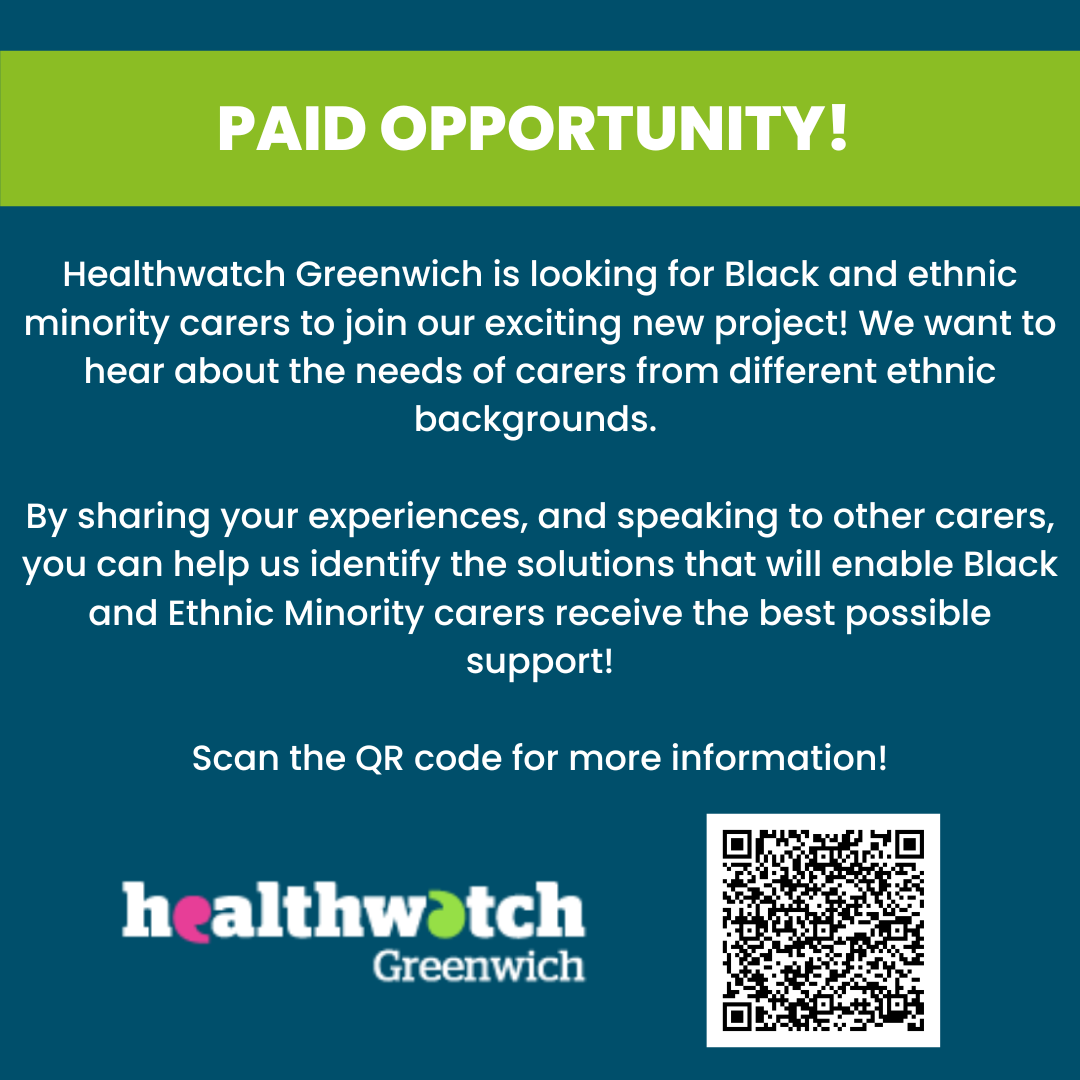
Healthwatch Greenwich project wants to uncover experiences and understand access to carer support, information, and services for Black and Ethnic Minority carers. By sharing your experiences, and speaking to other carers, you can help Healthwatch Greenwich identify the strategies and solutions that will enable Black and Ethnic Minority carers receive the best possible support.
How will we carry out this project?
Healthwatch Greenwich are excited to partner with Black and Ethnic Minority carers as paid co-researchers in this project. As experts by experience, you’ll bring unique perspectives that are essential to its success.
Who can be a co-researcher?
An adult carer: Someone who looks after or gives any help or support to a family member, friend or neighbour because of long term physical disability, mental ill-health or problems related to old age. The care they give is unpaid.
From a Black or ethnic minority background What will co-researchers do?
Contribute to the design of the project.
Find and speak to other Black and ethnic minority carers
Contribute to the analysis and presentations of the findings.
Take part in training and support sessions. How much will co-researchers be paid? Co-researchers will receive £15/hour. Hourly payment includes all additional expenses involved in taking part in this project, such as care costs, childcare payments, telephone, and travel costs. Co-researchers will take part in up to 8 days of involvement work spread across a number of days between June and September 2023.
How do I apply? If you’re interested, Healthwatch Greenwich ask you to complete a short application and have a friendly interview. Please contact Jahan at jahan@healthwatchgreenwich.co.uk or on 07498 851 221.
Welcome to another carer blog by carer activist, champion and author Matthew McKenzie. If I am not speaking at events or conferences, I am busy writing or minding my own carer stall at NHS Hospitals. I certainly get into a lot of interesting conversations at the stall. Just to note, the reason for my stall is to focus on unpaid carers to get help and support. Not many people know they are even carers, they just end up coping. This is not always a bad thing, we do not have to use the label carer for everyone. Still, if you continue to just cope for a long length of time, they can have a bad effect on the person’s health and wellbeling.
So what’s with this blog? Well I got into an conversation when someone mentioned people only care because they can get benefits or compensation. I want to put out that there is more to caring than just getting ahead. It might mean different for others, but for myself when I provided a form of unpaid care, I did this out of duty and love.
I suspect many others provided care for someone close out of duty and love. When I was providing care for my mother, I knew how she was when she became ill. It was a tragedy to see how she became mentally unwell over the years. I fought very hard to give her the same quality of life I felt she could have. This might be different for those caring through other forms of illness of disease. Those caring for someone with cancer (depending on the stage of the disease) might struggle to improve their loved ones quality of life, but they will still care and probably care till the very end.
Those providing care will certainly want some kind of benefit that helps aid their caring role, but most will provide care even if benefits were almost non-existant. If carers are to value something, it would be knowledge of the condition the person is going through. If you knew what you are caring for and how to provide such care, then this would save so much trouble in future.
For mental health carers, it is important to keep that relationship going with the person they are caring for. It is important to develop good communication skills and develop trust because when those things break down, it will be harder to maintain a relationship.
Providing unpaid care can actually strengthen’s relationships, because if the ‘carerd for’ recognises the person is providing help and support, they are usually grateful for this. I remember the look my mother gave me as she lay on the hospital bed. She knew through all the years I had tried to be there for her. I admit I made plenty of mistakes, but she knew in the end, the relationship was strengthened. This unfortunately is not always the case for some unpaid carers. Many relationships have ended due to the impact of mental illness or being unable to cope, which can often push the carer away.
Lower down the list of why people care for someone is usually down to developing our own character and skill set. As a carer, the person does not want to give up their caring role. They want to prove to themselves that they will see things through. They want to develop courage and face those challenges head on as they advocate for the person they are caring for. To be honest carers will have to be brave and even advocate for themselves. This is not an easy thing to do as the services can often be patient centric.
Some character traits of carers already exist on the reasons they care. Some people already considerate, patient and understanding plus generous. When providing unpaid care, those character traits just go stronger each day. It is important carers must understand the stigmas they face. People will judge unpaid carers as if they have no skillset, but this is wrong and it is discriminatory. Carers need to also be vulnerable and ask for help. Especially if suffering from fatigue, isolation, anxiety or just needing someone to talk to.
It is important carers take time out for themselves, but with the pressures on health & social care, it can be understandable why carers put themselves on the line.
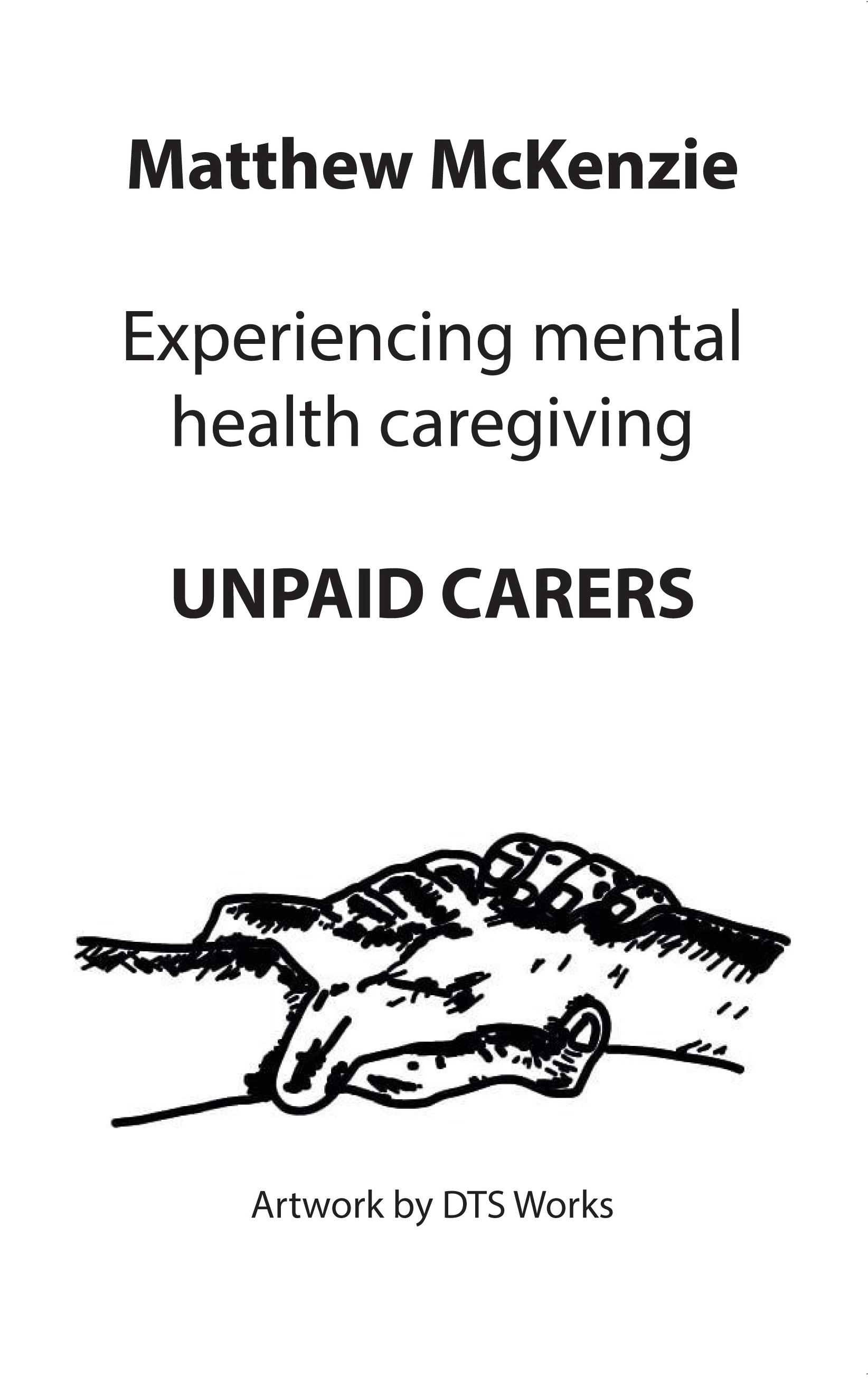
Welcome to another carer blog by Matthew McKenzie. You might already know, I am an author raising awareness of unpaid carers. One of the books I wrote touches on the subject of co-production. The book I wrote titled “Experiencing mental health caregiving – unpaid carers” had several chapters regarding co-production.
However, why have unpaid carers be involved in designing health and social care services? Lets first look at the problems and challenges.
The problems
Health and social care sometimes do not meet eye to eye with unpaid carers, there are a lot of assumptions made about carers, there are also a lot of biases on the needs of unpaid carers. We can certainly champion the good works of health and social care, but to be realistic there are plenty of problems as well.
One shoe fits all policy, different carers have different needs
patient centred to the point of ignoring the carer
Limited resources means carers just cope
Co-production on a complex service might put people off being involved in design
The leader in co-production might still have “I know what is best” attitude, this can also put people of being involved.
History of bad results damages reputation, so carers feel they have heard it all before.
These are some of the challenges and problems health & social care services will have if they want carers to be involved in co-production.
Some solutions
So we have just touched on the bad news regarding co-production, but there is also good news, there are some solutions that are floating around.
We just cannot rule out co-production even though it has been around a long time. In fact co-production has been around so long, that it might have been watered down. The word “co-produce” can be almost a throw away term to get people excited.
There might be a lot of asumptions made about the uses of co-production. If we want coproduced and co-promoted services, we have to put those involved first. Those services will have to be flexible enough to offer solutions tailored to individual carers. It is not an easy task since those services need to recognise carers as a protected characteristic. Carers are vulnerable and they do need guidence, support and care for themselves. If carers are not valued, then they will struggle in their role providing unpaid care.
Co-production should raise the voices of those involved. This means we avoid the “One shoe fits all policy”. It means better service delivery that benefits as many as possible.
What next?
Those involved in inclusive service design need to be skilled, they also need to know there are issues within those services and those carers need to be confident in challenging those issues. This is not easy as health & social care are very complex entities. We have organisations like Healthwatch monitoring and collecting feedback from health services. Some things concerning the running of health & social care services are complex by design. So to expect carers to challenge those services is a tall ask.
Even before including carers in designing a fair health and social care service, carers need to knock on the door to request co-production. To make matters more difficult, not everything is actually co-production, due to time restraints on service delivery, co-production activities may be rushed or brushed aside towards tokenism. It is a big problem, but to be realistic sometimes it cannot always be avoided.
Earlier on in this blog I have mentioned time as a cost, carers can usually use their own expert of experience to express their needs, but transmitting that experience into services will mean carers will have to be trained to champion co-production.
Conclusions and findings
From my 2nd book “Experiencing mental health caregiving – unpaid carers”
I wrote upon the subject of inclusiveness within several chapters, one of them was Chapter 6 – Co-production and involvement.
I asked several questions, this question asked “What do you think co-production means to unpaid carers?”
With the answers provided from unpaid carers, activists and researchers one response was interesting regarding co-production.
“Co-production means that a carer is involved in service improvements, support groups and forums, because their lived experiences can be more valuable than the academic research. Co-production can help a carer to interact with other people in a similar situation to them. The carer can feel valued when their contributions have been used wisely. – Annette Davis – Carer and carer peer activist”
As mentioned earlier there are important keywords e.g. lived experiences, groups and forums, feeling valued and contributions.
For Chapter 30 – Co-producing in health and social care. I touched again on services. I was interested in the challenges as mentioned earlier in this blog
The question asked “What are the challenges of co-production?”
A carer responded with the following.
“Money, I think the challenge is it can cost so much money, you can’t just sort of say to a professional to just go ahead and co-produce things. You’ve got to fit this round everything else and go to a meeting, because you see, these professional meetings are beginning to end. They go through an agenda and with Co-production, you can’t really do that. Not at the early stages. If you are actually coproducing, then you actually have to sit down and think of ways of facilitating and carefully plan coproducing. This requires time and unfortunately time is expensive in terms of the professional’s time. If you want it, you have to pay for it. The people e.g. patients/carers who are co-producing should be paid as well. So we have got a commitment. However, from the professional side, you’ve got to pay for their time as well. Its expensive. – (Ann – Unpaid carer)”
What can we take away from her response?
Inclusive service design will need some form of co-production, but will definately need resources. It is not always about money, it is about time and commitment. Things have to be planned carefully, interest must be kept up for those involved. Co-production can also be expensive, but if done right it does not have to be so costly, but it certainly should value those involved.
Welcome to another carer blog post from Matthew McKenzie
Ever thought why carer centres run carer forums? If you are a carer then you know that you are putting others first. The more unwell that person is, the more care and support you give. There will be times of course that you become isolated, tired and wondering if you are ignored.
Well the things I have mentioned are some of the reasons why carer centres run carer forums. Those very centres usually also run carer peer groups. It gives carers a chance to be listened to and also be heard. Carer peer groups and support groups do not really give carers a chance to be empowered, but they do provide support.
If you are lucky enough to belong to a carer centre that runs a carer forum, then you have a chance to become empowered. You might be wondering what Matthew is on about. Well give me a moment and I will get to the reasons why it is so important to attend and support your local carer forum.
Ever heard the saying “Nothing about us without us?”. The very quote came from disability rights activist James Charlton. If you are caring for someone, then services provided for them will be decided if you are involved or not. This goes double if you are using carer support services.
It is all fine that carers scramble to use support services to reduce isolation, be given guidence and join in carer activities. There does come a time when carers get a little bit tired of being told what suits them. So carer forums give carers a chance to request what services would be useful. It is so important that unpaid carers be empowered to use their voice, not only to update and tell their carer’s story, but also to give input regarding the services they use.
If you are providing unpaid care then these services could be carer assessments, carer hubs, access to skill development, learning about upcoming events and a whole lot more.
A healthy service is one that includes the user’s voice and this is the same when it comes to unpaid carers who use carer centre services. If you are providing unpaid care, you do not have to be an expert to attend and support your local carer forum. It can be fine to just attend and listen to updates. It takes a long time to become an empowered carer and many carer services can be complex, especially if your carer centre is involved at your local authority carer strategy.
Without a carer forum running from a carer’s centre then the risk is carer services will take guess work in what carers want. So it is so crucial that carer members new or veteran attend their carer forums.
Welcome to my online site that focuses on unpaid carers. The site usually focuses on those caring for someone with a mental illness. This particular blog is on access to online learning resources.
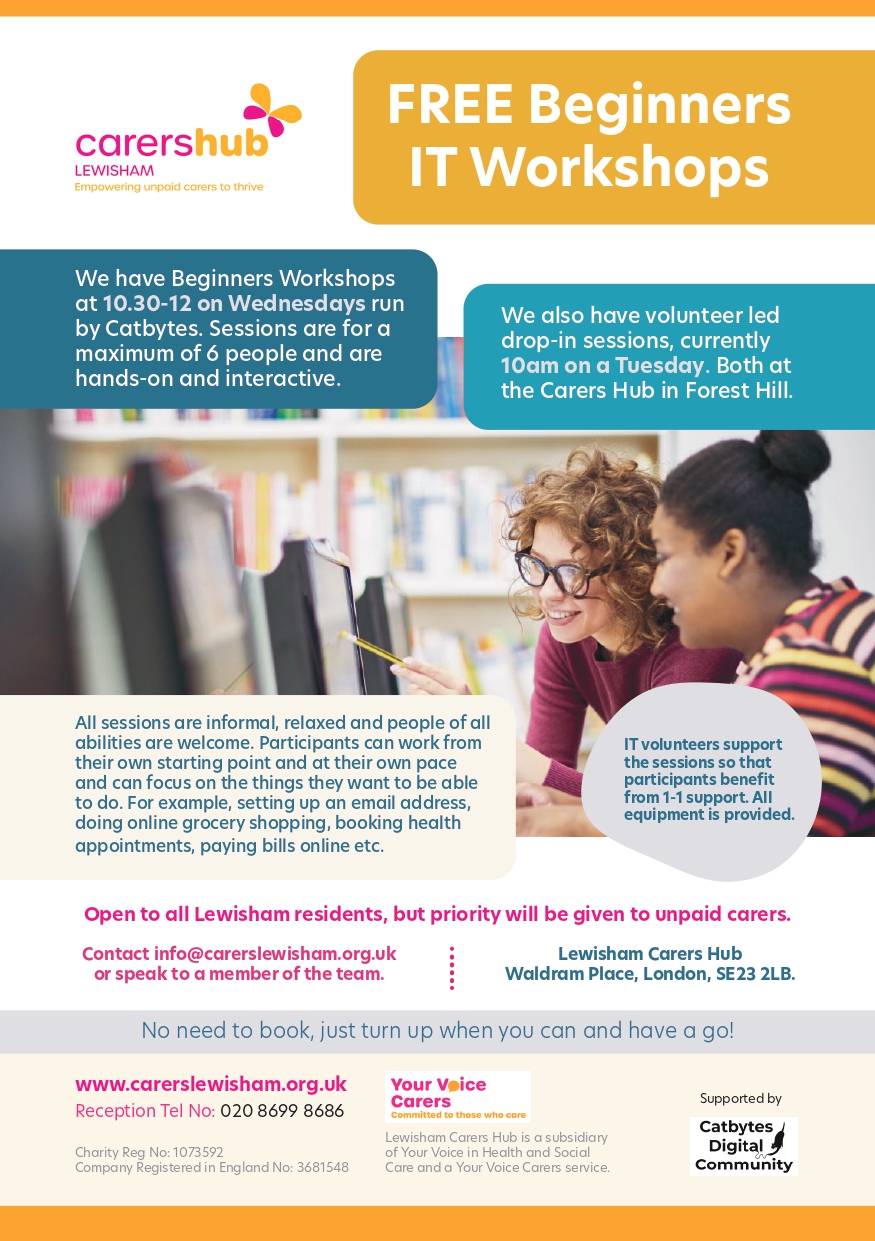
The world is changing, since the 2019 pandemic, many more online learning resources e.g. access to help and advice, benefit info, event info and even carer groups have all most online. What if the carer struggles with the computer? what if the carer does not know how to join online groups?
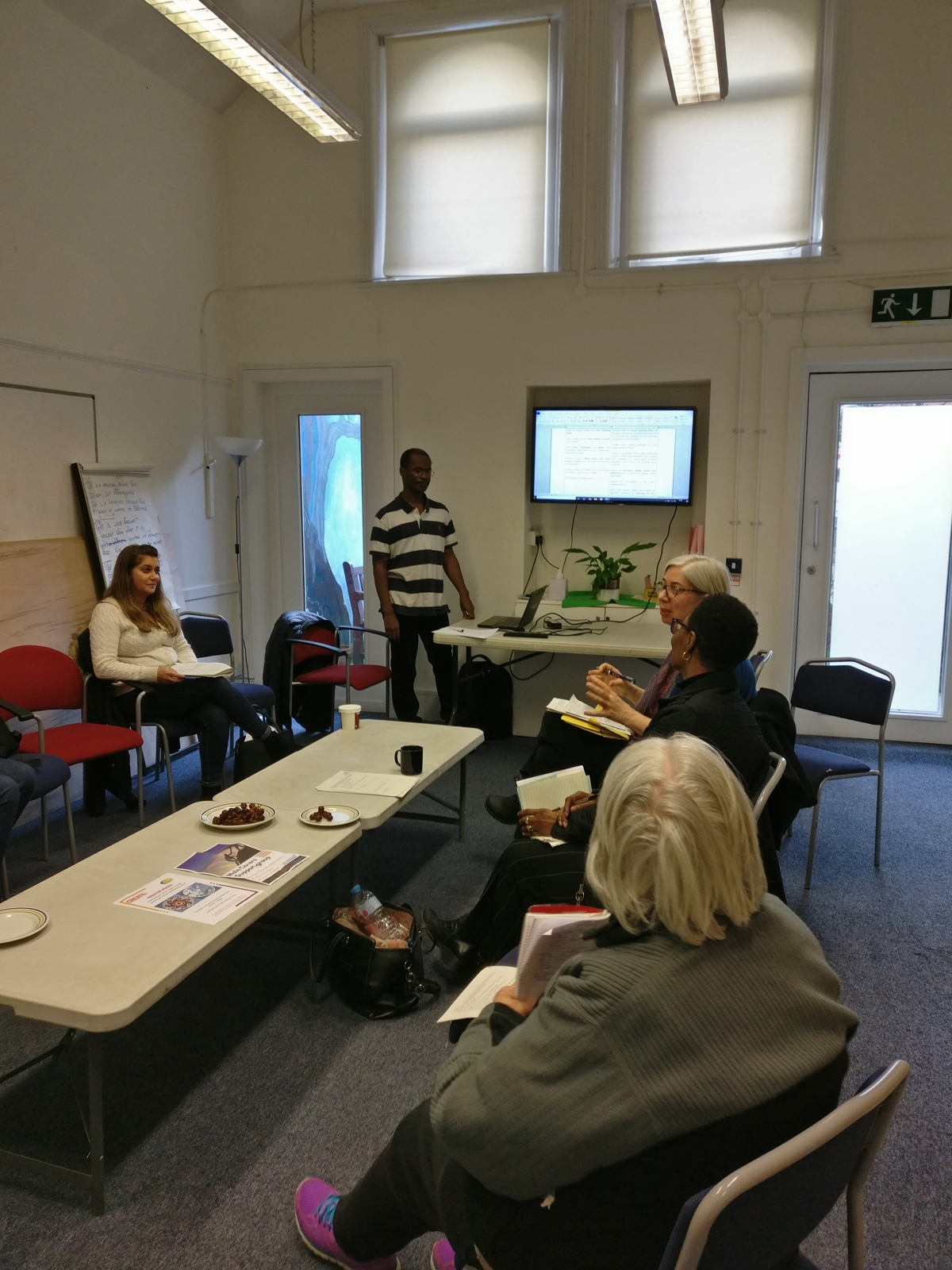
It was a struggle to access online resources before the pandemic, but it still is a challenge. Some good news, Lewisham Carers Hub have received funding to allow carers to learn about computers and accessing online information. Please see the poster below













 A Caring Mind