Welcome to my latest poem off my poetry project for 2022. My focus is on unpaid carers who look after someone suffering mental illness. Many unpaid mental health carers up and down the country sometimes get frustrated when it comes to being heard. I myself have experienced this, although do not get me wrong. There are times when those in the mental health services can actually support and listen to families, friends and carers.
It is not always the problem of not being listen to or not being heard. Many carers can be confused about what their carer’s rights are. If mental health services are under strain then there will be situations when mental health professionals will not have time for carers and will not often remind carers of their rights.
Sometimes carers are aware that there is nothing the professional can do, but they would still like to be heard on the situation, there might even be a slight chance that something mentioned from the carer can give some hope.
Feel free to check out my poem off my YouTube channel below.
Welcome to a brief update of my South West London Mental Health carers peer group. The carers group covers the 5 boroughs of mental health trust South West London & St George and seeks to empower unpaid carers with engagement, information and a peer environment.
Speakers for the October forum 2021 were
Tristan Brice – London ADASS
Christian Sestier – On involvement of open dialogue at SWLSTG
Alison Crane & Yasmin Phillips (NELFT NHS) – Open dialogue
Tristan Brice presents on London ADASS carer focus
Taken off their website “LondonADASS is an Unincorporated Association that brings together the London based Directors of Adult Social Services (DASSs) to enhance the quality of adult social care across the Capital. Working in partnership with adult social service providers through Proud to Care London, they are committed to improving the recruitment and retention of the adult social care workforce across London.”
Tristan Brice who chairs the carer group at London ADASS was at the forum to speak on what priorites the organisation has for carers. One of the things Tristan presented on was the discounts for carers project, which gives carers a discount on shopping and other necessities. An interesting project is how ADASS will focus on NHS staff retention and how to improve retention. They want to do three things. London ADASS want to promote the sector as a as a place staff want to work. London ADASS also have a project on providing carer lanyards, just like what NHS staff have. There is a focus on raising the identity of unpaid carers as a way to say they should be valued as working for the same team.
When Tristan mentioned this, a lot of the carers eyes lit up as they wondered what the Lanyards would look like.
Tristan also spoke about the online carer groups that London ADASS are hosting, these usually being singing and dancing groups to reduce isolation and increase fun with creativity. Other priorities were on commissioning in regards to safeguarding, developing the workforce, particularly practitioners. The other priority is supporting integration with health colleagues.
You can see the safeguarding video below.
The big focus is trying to not see carers through a social care lens, but through the lens of them as doing an amazing task of looking after someone close to them.
The last presentation was on the success of the carer’s festival, which was online until things change regarding the pandemic. You can see the video below.
Open dialogue presentation
I am fairly well known for promoting the Triangle of care project for carers nationally, but there are other national projects which mental health trusts try to incorporate into their services. One of them is Open dialogue and with a request from carer members, I got support from North East London NHS Foundation trust to speak about how they are incorporating Open dialogue into their services.
First to speak was Yasmin Phillips who is a Community Mental Health Nurse and was the first full time psychiatric nurse using an Open Dialogue approach. Yasmin explained that she works in the dialogue first service at NELFT, and she trained in open dialog in 2014. The Open dialogue is now taking referrals all over England. Yasmin then moved on to explain what Open dialogue is about, which is a reflective approach in increasing dialogue.
Open Dialogue was pioneered in Finland and has since has since been taken up in a number of countries around the world, including much of the rest of Scandinavia, Germany and several states in America.
Some of the results so far from nonrandomised trials are striking. For example, 72 per cent of those with first episode psychosis treated via an Open Dialogue approach returned to work or study within two years, despite significantly lower rates of medication and hospitalisation compared to treatment as usual.
Next to speak a patient involved in Open dialogue in which he mentioned that discussions about the patient on ward rounds is a recipe for disaster, if the patient was not included. He referred to the phrase “Nothing about you without you”. So that just the idea that the patient is involved in that the conversation and it should not be done without them.
So when the involved parties come together, it might just be starting off saying “how do you want to use the time today?”, as non directive as that. And then wherever it goes, it could be lively, all sorts of things. But at a certain point, what one of us might say could be a reflection where they basically press pause on the meeting, and they just turn to each other and share just whatever’s coming up.
This concludes the brief update of my SW London MH carers forum for October 2021
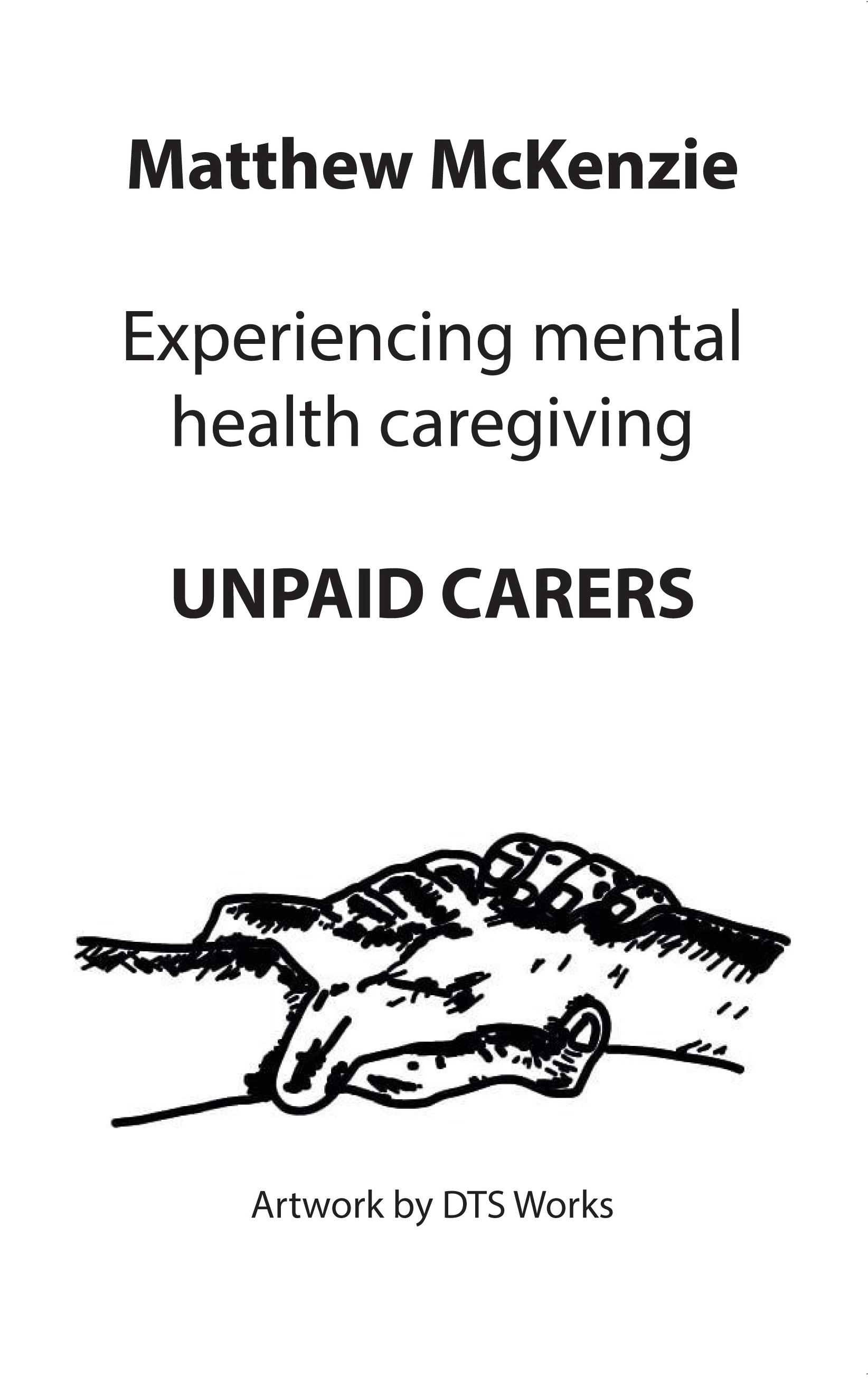
Welcome to my latest blog about my new book. My name is Matthew Mckenzie a former mental health carer who cared for his mother who suffered from a form of schizophrenia.
I have decided to highlight chapter one of my book “Experiencing mental health caregiving”
The first chapter explores what unpaid mental health carers feel about their identity. Each chapter of my book asks several intriging questions about mental health caring, which of course focuses on unpaid carers e.g. families and friends caring for someone close suffering mental ill health.
Carer Identity
The first question I asked carers on chapter one, which is “Carer Identity” was “What does it mean to be a mental health carer?”
You can see the video of this below below
The reason I asked such a question is that those who suddenly find themselves providing care might find some of the answers useful. Perhaps even NHS professionals or social workers might find the answers important.
I will pick out a few responses that I found highlighted the importance of carer identity.
One carer responded as
“I think that it’s difficult. Often nobody other than the carer can see the disability with the person that you’re caring for. And so, they go unnoticed. Plus with mental health, it fluctuates and dramatically as well.“
Another carer felt
“For me to be a carer of a mental health patient has turned my world upside down completely. This is different when you caring for somebody outside your family, but when it is someone in your family then it is an application of emotional attachment.“
Another carer summed up “My own identity disappeared in the beginning of my caring journey. It also means getting acknowledgement from healthcare professionals that I am an important person in my loved one’s care“
What I thought was interesting is how difficult it was starting out caring for someone suffering mental illness, notice the responses all mentioned how tough it was when they first started out caring. Although certainly take note, I have only shown some of the responses here as others in the book might be different. One thing to note is some carers might find the role gets easier depending on their knowledge of the illness or the support they may get from services, community or other members of their family. This might not be the case for all unpaid carers.
For chapter one I asked around 8 other questions regarding carer identity and if you are interested about mental health carers, you can buy my book on the video link description.
Happy new year to visitors of my mental health carer blog site. As mentioned in my earlier blog posts, I am working on promoting awareness of caring for someone suffering mental ill health.
I created a number of carer poems, quite a few are on this site, but are subject to being edited as I am often fine tuning poems.
I am also adding a couple of my poems on to my YouTube platform and will blog them every so often.
The poem I want to introduce here is titled “On Alert” as it highlights the struggle unpaid carers go through in prompting medication. A lot of carers hate doing such a task, but when the experience the person’s mental health crisis, they want to try avoid the situation again and take resort to being on alert.
Watch my 2 minute poem “On Alert” off my video link below.
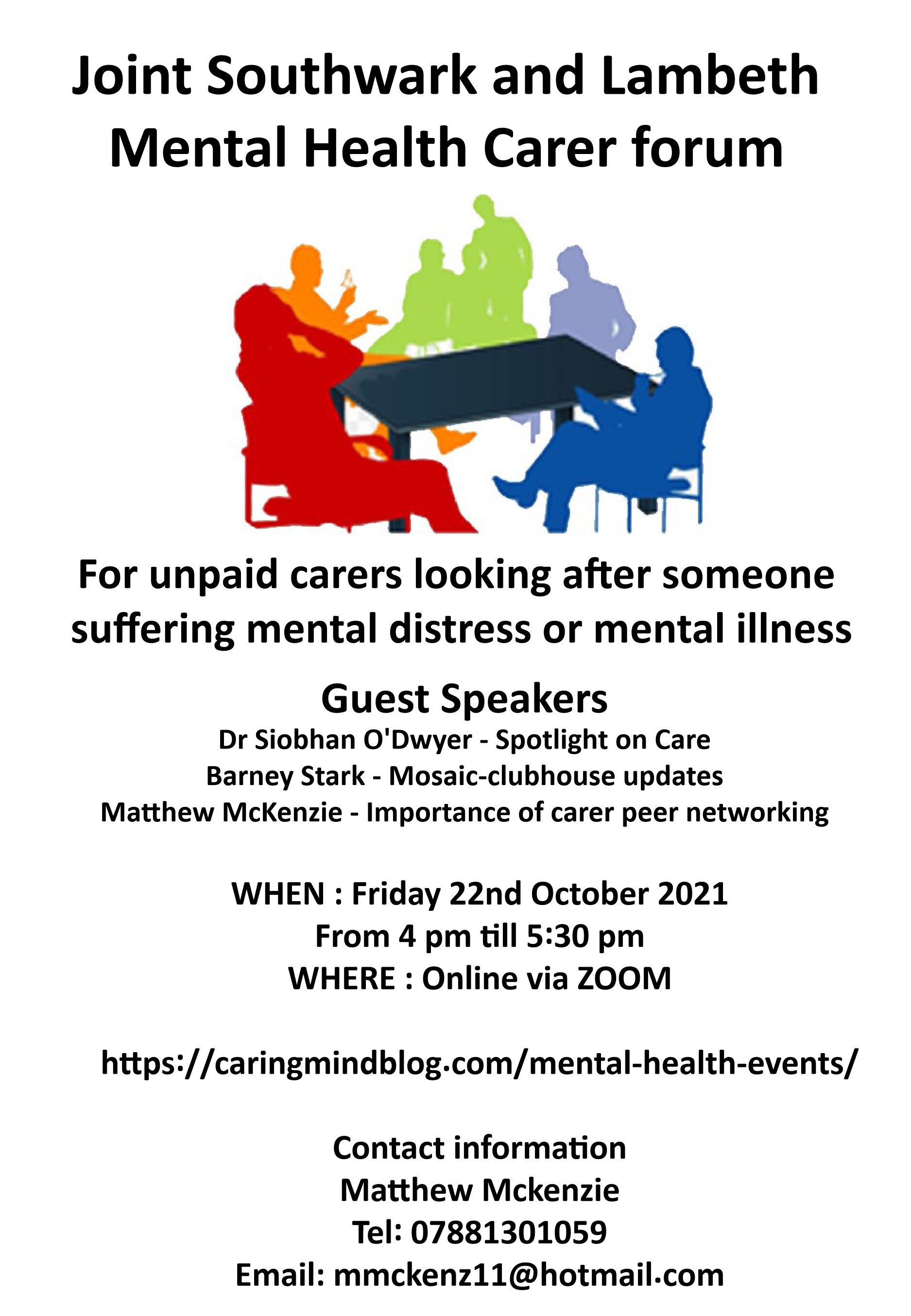
Welcome to my brief update of my joint Southwark & Lambeth mental health carer forum for October 2021. As with my other carer forums, this forum runs once a month and provides a platform for health & social care organisations to engage with those who care for someone suffering mental ill health. The primary focus for engagement is obviously South London & Maudsley who heavily support the carer forums, however a fair bit of the time the forum gets engagement from other parties, this could include Kings College NHS trust or Guys & St Thomas who also advertise the carer forum.
Speakers for October were
Dr Siobhan O’Dwyer – Spotlight on Care
Danny McDonagh – Employment & Education Engagement Worker (Mosaic Clubhouse)
Welcome to the October update of my Greenwich Mental Health carer forum. As with my other carer forums, this one focuses on engagement from the local mental health NHS trust that covers greenwich, that being Oxleas MH NHS trust. I run this forum with heavy support from Greenwich carers who fight and advocate for the needs of unpaid carers in the Royal borough of Greenwich.
Speakers for the October Greenwich MH carer forum were
Peter Ley (Oxleas NHS) – Service Manager Sue Horbury (Oxleas NHS) – Online Patient system Laurelle Morgan Bruce (Oxleas NHS) – Oxcare
Welcome to a brief update of my South West London mental health carer peer forum. This group is a mixture of carer peer support and mostly engagements from health & social carer organisations, especially the local mental health trust South West London & St Georges. This carer’s group cover’s 5 boroughs as all 5 carer centres including the mental health trust work hard to promote it.
South West London & St George NHS
An extra bonus of this group is I do open it up to national speakers so the following speakers for September
Welcome to another brief update of my BAME mental health carers forum for October 2021. I have not been reporting off my carer forums that much due to finishing up my latest book about mental health carer experiences.
You can by my latest book on the link below.
You can also find an overview of chapter 1 from my YouTube channel below.
I am now working on my 3rd book which will be a large number of poems also on the carer experiences. It is not set for release until 2022, although I have been reading out my poems at carer groups for preparation.
The carers forum usually runs once a month and its focus is on ethnic diverse carers who are caring for someone with a mental health issue, although the forum started in Lewisham, it has expanded with the support of mental health services of Oxleas, so it has extended to Bromley, Greenwich and Bexley.
Speakers for September 2021
George Hosking OBE CEO of Wave Trust – Wave Trust on Young black wellbeing
Dr Tim Ojo – Psychiatrist on Black History Month Reflections
Doreen McKenzie – Black History month Poetry
Emilie Wildeman – Patient Research project at Institute of Psychology, Psychiatry and Neuroscience
Lara Sengupte – Breakfast Clubs again Racism.
This particular forum focused a lot on Black History month which ran for October 2021. One of the speakers from NHS England & Improvement could not make it, but they did attend my BAME carers group for Novemeber, which I will blog about soon.
George Hosking OBE presents on his project for youth mental health
George Hosking CEO of Wave Trust spoke about his charity, which helps to prevent children suffering child abuse, neglect, and those witnessing domestic violence in their homes. Over a number of years, the charity has become very aware of the impact on mental health, which has led to people suffering childhood trauma in some kind or other. George mentioned a huge number of mental health problems can be traced back to childhood experiences in that way. George stated the charity has experts on trauma. He himself is a clinical criminologists, psychologist, and traumatic stress counselor, his charity supports organizations and individuals to learn how to support people who have suffered trauma in their lives.
George included that one of the things they do is they help set up trauma informed communities around the UK. These are communities which really try and provide the best possible support to people who have suffered some form of trauma in their lives. This includes a lot of people with with mental health issues and these communities can be of two types. They can either be created top down by working with the NHS and local authorities and police to create a rather statutory based organization, or else it can be created from the grassroots working away from individuals in the community. They have been working now for about two years with the Black and ethnic Community where the charity is based, leading to creating a trauma informed community.
George was thinking about the possibility of doing some trauma informed community work in Lewisham, due to Lewisham Council recently inviting organizations to make an application to provide emotional health and well-being training to those working with young people in leadership.
What his charity is looking for is people who will help young people to spot the signs of poor mental health, and guide those young people towards mental health support especially in the black community. WAVE charity has got a background on this because of their knowledge of trauma and mental health, that they can provide that kind of guidance and support. They have got the facilities to train people to be more adept at doing this sort of thing. Unfortunately what they don’t have is the links in Lewisham to people who are working with young people, particularly people who are working with young people with an interest in mental health. George did realize that our forum’s focus is very much on carers rather than supporting young people. He did do a Google search to look for an organizations in Lewisham with interest in mental health and thus Matthew’s forums came up.
So George contacted Matthew who kindly invited him along today just in case, someone from within carers forum is aware of or are even interested in what that charity could potentially allow involvement in.
Lara Sengupte presents on Breakfast Clubs again Racism in Lewisham
It was Lara’s turn to speak about her project and how it came about. They are currently in the pilot scheme phase. So they have been running projects since July, and the piloting finishes in December. By then they are going to be analyzing the results of the clubs. They run two breakfast clubs, one in Catford, and one in Peckham (Southwark). The goal is basically to educate young people on racism, how it shows up in society, and how to combat it. This particularly on internal racism.
Lara knows for a lot of young people of color, which relates to mental health, that can carry around a lot of negative self talk and negativity, all the negativity that we see in the media, and through like school exclusions there is a lot of racism against young people of color. The big challenge is that young people and children don’t exactly know how to process it. So that’s one thing that our clubs want to tackle. So they are running educational Saturday breakfast clubs for young people throughout autumn term. This is not just for Black History Month since they have been running them since September, and will finish them in December. Our clubs have got about 10 weeks with the kids where the purpose of the breakfast clubs is to teach young people about racism, how to challenge it in a safe space surrounded by like minded peers.
So all the kids that are signing up to the Breakfast Club all care about racism, and all care about combating it. So they can share ideas in a safe space, that perhaps in a school it would be different. The clubs don’t just cover personal racism, they also look at deep institutional racism, and internal racism that is often carried around by young people of color. This can show up as negative self talk or self destructive behavior. So the clubs give the students an understanding of the societal problems that we have in this country. The clubs also work on self confidence and leadership skills to empower the young people and children to take action where they can.
The breakfast clubs next session was in October where the clubs work with young people from around like 10 to 14, but they are also quite flexible and ages.
A while ago Dr Tim a psychiatrist wrote a piece for the Royal College of Psychiarists regarding the importance of Black History Month, which you can see below.
Dr Tim has been very busy promoting equality through the power of psychiatry and I felt it important to invite him to engage with BAME carers and even NHS staff.
Dr Tim felt it was a pleasure and a surprise for Matthew to connect. Dr Tim spoke about the piece he wrote for Black History Month in 2019. He is a psychiatrist by background of British born, But his heritage is in southwestern Nigeria and as part of the Royal college of Psychiarists celebration of Black History Month, which became something only a few years ago, he was invited to write a blog. Dr Tim is an associate Registrar for policy support the college. That means the things around the Royal College of Psychiatry led to reports and statements that they make, in addition to supporting people with mental illness, their families, and communities. This includes Improving the mental wellness of society in private colleges, professional body for all qualified psychologists.
Dr Tim felt what was the important facets for Black History Month is a special where we come to terms with the fact of needing to understand history from the perspective of recent events. This has happened after his blog has shown that reflection point where it’s absolutely necessary, where people of color and their white allies think about history from a different perspective, because for too long, it’s been written from the perspective of one vantage point, that vantage point unfortunately positions, people of color, black folk, particularly at a disadvantage in producing narratives that arent helpful, realistic, and are incomplete. So what he thought Black History Month now takes upon an additional layer of importance, because first of all, it is about a celebration, about the fact that across the world cultures, black people have come together even in the face of suffering, can celebrate on resilience and psychological robustness that is happening through the facets of our history, and throughout our communities. Dr Tim felt we can find people, individuals and communities doing great things where it reminds us that we have a history of a human or a connected global trajectories of history that we assume we have music culture, we have literature is important for all of us as human beings to function make no apologies for our issues about how do we use structural position to address questions of inequity and problems inclusivity in society. Dr Tim feels as carers we can speak to a very important aspect of the black community in terms of inadequacy of access narrative support.
Dr Tim also thinks having four electives is important to come together to illustrate actually, every month, although Black History Month appears once a year. it’s important for people to focus on sharing stories, not as a disadvantage, but through the use of positivity. Dr Tim mentioned where his blog gave a historical link between psychiatry in Nigeria, where the Western world in how we have trained psychiatrists who took it upon themselves to negate the negative picture over history in psychiatry, and came up with a very good book, which is called “black skin, white coats” by Matthew M. Heaton.
The book is a legend and looks at psychiatrist colonization, and the globalization of psychiatry, this led to an informed decision of him becoming a psychiatrist.
Dr Tim thinks it’s important also to recognize people like African Caribbean senior psychiatrists, who retired, but stood firm in the face of strong opposition to actually question what was happening, vision and mental services of color in this country. Dr Tim spoke more about Matthew M. Heaton on his work since the 60s and 70s, which was very important in shaping the new agenda around a shared understanding of how history is restricted, which is advantageous, specifically why he was talking about Black History Month being symbolic.
Doreen McKenzie poet and author on Black History Month poem.
I invited my aunt Doreen to read a poem for my carer group. She had two poems that she wanted to read to us. Doreen read the shorter one first. The poem was called “Proud to be black”
This woman is so darn proud to be back. Despite the fact that she’s very aware that her color is constantly under attack. Black is the color achievers with pride. Nothing will ever entice her, her beautiful black skin to hide.
She was born black, and will die the same color. And she knows many people whose thoughts are similar. She hears people talk about the blonde bombshell. But she repairs the curvaceous black hair.
Black skin really wrinkles with age. Therefore, the age of a black person can hardly be gauged. It is a mystery how many elderly people look so good, despite the fact that they are plagued with a magnitude of challenging evidences.
And when it comes to her hair, please don’t even bother to go there. It is so unique and versatile. That in just one day, it can be crafted into a variety of magnificent styles.
The Bible says that man is made from clay. So claiming to be made in God’s own image is nothing outrageous to say. Claim your blackness with gladness and pride. Because the beauty of blackness, one must never tried to hide.
You can check out Doreen’s book “The Purpose of My Life: Now, Then, and in the Future”
Emilie Wildeman presents on her Research project
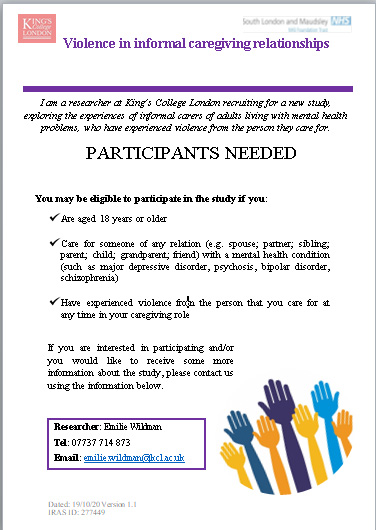
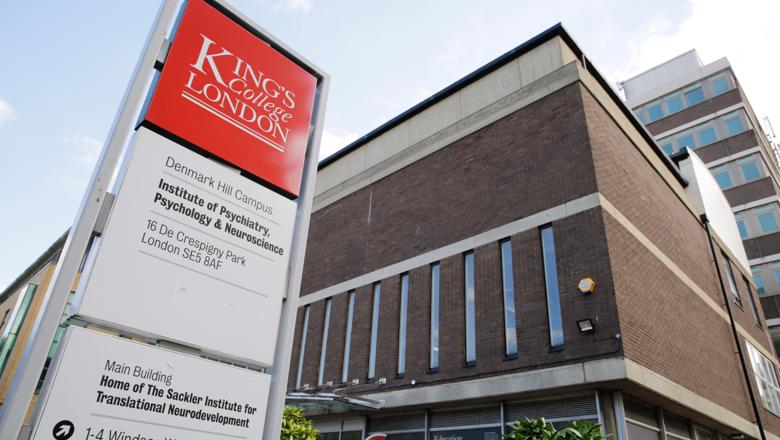
Last to present was Emilie on her research project. She usually attends my groups a couple of times over the past year. She was here today to push for recruitment and to raise a bit of awareness about her study that she is conducting as part of her PhD project. Emilie is a PhD student at King’s College London. Her research is all about informal family carers for people living with severe mental illness. Emilie gave us a bit of background to the study, in many health conditions, including mental health, we know that people living with these conditions will often live with or be supported by a close family member or friend, who mental health services refer to as informal or unpaid carers.
Emilie continued to mentioend that they also know that in some relationships, there can be difficult periods that might include sort of episodes of disagreement, and in some cases, can include active aggressive behavior from one person towards another. Her research is focused on carers of relatives living with severe mental health conditions and for her study, she is looking to speak with family carers who have experienced any type of aggressive behavior from the relative that they care for. So that could include sort of episodes of verbal disagreement and verbal conflict, conflict, verbal aggression, emotional and psychological. It could be physical, it could be some sort of destruction to a property. It’s very broad. She knows that this can be a very sensitive topic, and that there can be a lot of stigma around mental illness as well as aggressive behavior. So she really want to emphasize that this project is not about passing any judgment or making any assumptions about relationships. she is just interested in exploring carers lived experiences.
Emilie hopes that through doing this research, they can help to reduce that stigma. Participation is on carers completing an interview with herself. This is around giving carers the opportunity to voice their experiences and their opinions about what impact these experiences can have on themselves personally, on their relationship with the relative to their care and also for the family.
She is also really interested to learn about “What support families and carers have received in relation to dealing with experiences of aggression”. So that could be from personal support networks, but also professional services because she wants to identify what aspects have been helpful, but also maybe where support might be lacking.
This concludes my brief update of a special Black History Month special for October 2021.
Welcome to the brief september update of my BAME mental health carers forum. The forum focuses on updates, information and queries regarding mental health services and how they impact on ethnically diverse carers who are caring for someone suffering mental ill health.
The speakers for September were
Mushtaq kahin – Her projects reaching out to the community Macius Kurowski – South London & Maudsley NHS Equality Manager on Equality updates Dr Stephen Goggins – South London & Maudsley NHS on carer’s strategy
A new research study by Cassie Lovelock will be looking into the identity of those who support someone in their life with a mental illness. Cassie is PhD student at the London School of Economics; before that she was a carer for her sister who lived with schizoaffective disorder.
The aim of her study is to learn in what ways supporting a person impacts a carer and their identity. As well as what their day to day supporting that person looks like. This will be done via an hour(ish) long interview with her via zoom or teams (or telephone if that is easier for the carer). It will take part at a time convenient for unpaid carers.
To take part the carer must be over the age of 18 and able to give informed consent. Unpaid Carers will be paid £30 for the interview – or thy can request a voucher to the same value.
If any carer other there is willing to make part – or would like more information before deciding please email Cassie on c.lovelock@lse.ac.uk or you can text/whatsapp her on 07429428992.









 A Caring Mind