By Matthew McKenzie – Triangle of Care Community Group Chair
Turning carer involvement into meaningful change
On Monday 12 October, I chaired the latest Triangle of Care Community Group meeting, bringing together unpaid carers, mental health professionals and partner organisations to share experiences and learning.
Our discussions explored what meaningful carer involvement looks like, developments within the Triangle of Care programme, and the support carers should be able to access. We heard encouraging examples of co-production, alongside honest accounts of gaps that continue to affect families.
For me, this is why the community group matters. It provides a space where carers can question, contribute and help shape the work.
Learning from Cumbria, Northumberland, Tyne and Wear
We welcomed Kerry Jackson, Involvement Facilitator at Cumbria, Northumberland, Tyne and Wear NHS Foundation Trust, alongside carer contributor.
They introduced the trust’s Involvement Bank, which connects people with lived experience to opportunities to improve services. Contributors take part in staff training, recruitment, research, working groups, ward visits and the development of information for families.

A carer connected to the NHS Trust shared how his experience as a young carer had helped shape carer awareness training, including a dedicated focus on young carers. He also described returning to a ward where his partner had received care and using his experience to help staff understand the needs of families.
What stood out was the opportunity to turn difficult experiences into improvements for the next person coming through services. Having that contribution recognised can be deeply meaningful.
The presentation also showed the support needed to make involvement work: clear information about activities, preparation beforehand, feedback afterwards, recognition payments and flexibility around caring responsibilities. Contributors can choose their activities and take a break when needed.
Being involved from the beginning
One important discussion concerned the difference between co-production and being asked to approve something already completed.
The involved carer described why carers need to help develop resources from the beginning. If a leaflet has already been written and designed before carers see it, their ability to shape it is limited.
We also heard about the trust’s “Connect Sessions”, where carers and service users help review Triangle of Care self-assessments. This allows teams to consider whether their assessment of good practice matches people’s actual experiences.

Carers raised wider questions about influence. Are opportunities addressing the issues families want to change? Can involvement help tackle stigma and improve life for people with long-term serious mental illness?
These questions remind us to look beyond participation numbers and ask what difference involvement makes.
Triangle of Care programme updates
Mary shared an update on the programme, reporting that the Triangle of Care scheme now had more than 100 members across public, voluntary and independent sector services.
North London NHS Foundation Trust was welcomed as a new member. We also heard about recent star awards, forthcoming assessment panels and the annual reporting process.

Annual reports give providers an opportunity to demonstrate progress, identify challenges and receive feedback on areas requiring further work.
For carers, the central question remains how that work improves everyday experiences: being recognised, receiving information, having concerns heard and being included appropriately in care.
Keeping carers central to PCREF
The Patient and Carer Race Equality Framework, or PCREF, was another important part of the update.
Mary explained how the Triangle of Care pilot is strengthening attention to the carer element of the framework. Its first phase reviewed the standards and criteria with carers and professionals. The second phase is testing revised guidance and self-assessment materials with participating providers.
Examples shared included work at Mersey Care to understand who accesses carer support, and work at West London to help staff have more culturally sensitive conversations with families.

There are still challenges in collecting and using carer information, including ethnicity data. Conversations about this need trust, clarity and sensitivity.

The messages highlight the importance of listening to young carers, addressing inequalities and recognising each carer as an individual. For me, the emphasis on accountability is particularly important: listening to carers must lead to action, with families able to see how their contributions help improve services.
As someone involved in both PCREF and carer engagement, I welcome this work. Families need opportunities to explain their experiences, cultural needs and concerns without assumptions being made about them.
The meeting heard that the pilot is due to finish in June 2027, with final guidance and a revised self-assessment framework planned for autumn 2027.
Recognising young carers
Young carers remained a clear priority throughout the meeting.
The carer Contributor involved at the NHS Trust contribution demonstrated how easily young people’s responsibilities can be overlooked. Mary also highlighted work to strengthen recognition of children affected by a parent’s serious mental illness.
We heard about young carer videos developed through early intervention work at Tees, Esk and Wear Valleys NHS Foundation Trust, alongside encouragement for members to support Young Carers Action Day and the Young Carers Covenant.
You can watch the other video’s below.
On the series of videos sharing young carers’ experiences in their own voices: watch Sloth and Benny, Ryan, Monica, and Poppy and Rae.
A whole-family approach means asking who else is affected, including children and young people whose needs may otherwise remain unseen.
Standard 6: Can carers access the support they need?
Our breakout discussions focused on Standard 6, which concerns the range of carer support services available.
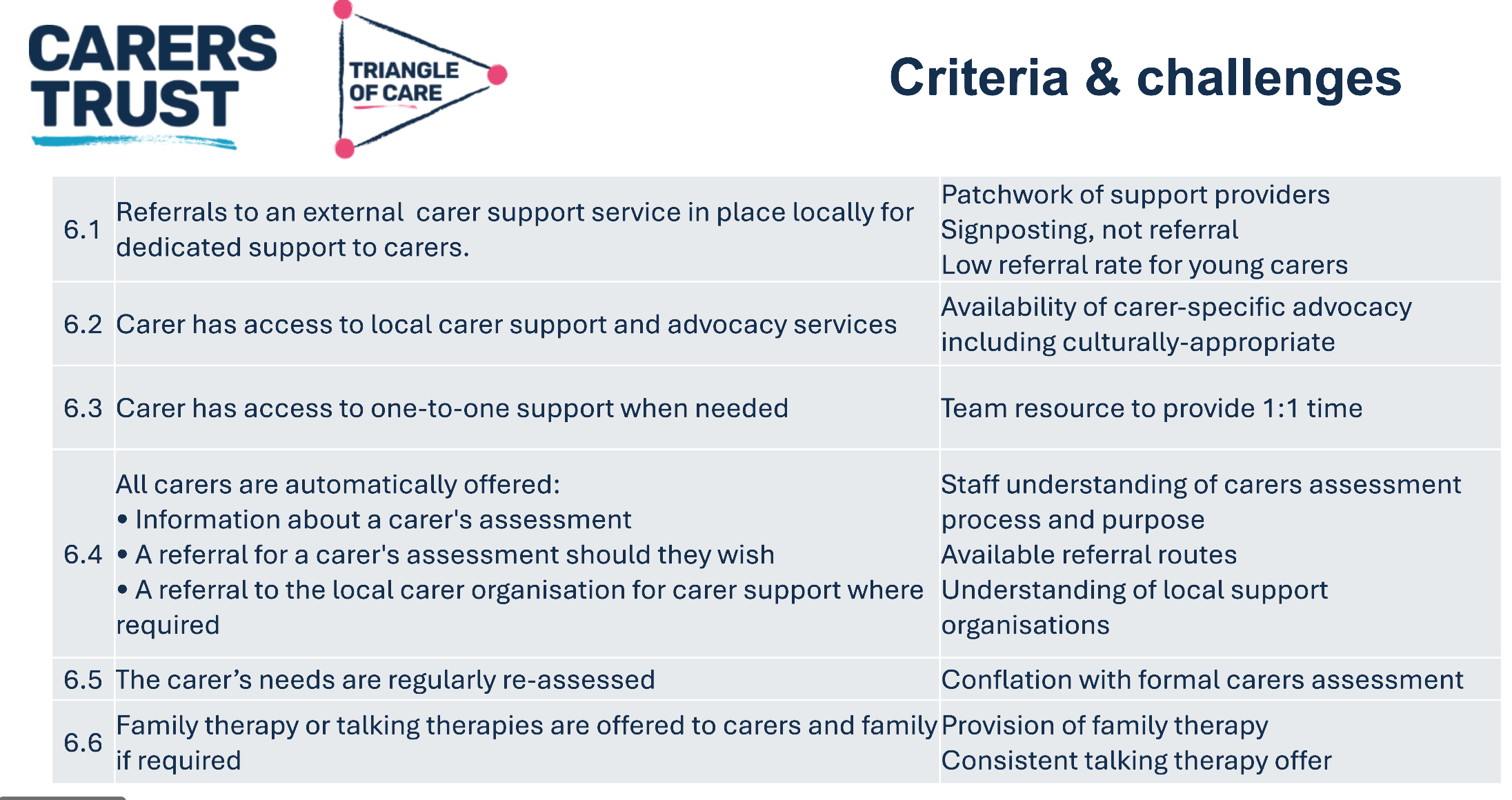
Examples shared during the meeting included direct referral arrangements, peer support, partnerships with carer centres, recovery colleges and family interventions.
A particularly useful question was whether services know what happens after a referral. Giving someone a telephone number does not tell us whether they received support.
Participants discussed the value of better information between trusts and carer organisations, so services can understand whether referrals lead to help.
In my group, carers raised concerns about the availability of specialist mental health carer support, access to assessments and the need for follow-up. One participant described difficulties associated with telephone assessments in their area. Others wanted clearer information about the current Standard 6 criteria.
These were carers’ reported experiences, and they showed why local feedback is essential. An assessment needs to lead to practical support and review. Carers also need to understand who is responsible for helping them and what they can expect.
Across the groups, peer support was recognised as a valuable source of understanding and connection.
An opportunity for carer leadership
The meeting also included an invitation for a carer to express interest in becoming Deputy Chair of the community group.
Carers Trust explained that a role description and expression-of-interest form would be circulated to the mailing list.
I have valued the support I have received as Chair. This role offers an opportunity to help guide discussions, connect experiences and bring carers’ concerns into wider conversations about improvement.
I would encourage interested carers to consider the opportunity.
Looking ahead
Thank you to Kerry and the Carer Contributor for sharing their work, also thanks Mary and Nada for supporting the meeting, and to everyone who contributed.
The discussions showed both the possibilities of meaningful involvement and the work still needed to make support accessible. Carers need to see how their contributions influence decisions and improve experiences for families.
The next Triangle of Care Community Group meeting is scheduled for Monday 11 January 2027, from 10:00 am to 11:30 am.
For information about joining the group, contact triangleofcare@carers.org.

