Welcome to the first Greenwich MH carers forum for January 2022. This is a forum aimed at unpaid carers in Greenwich to get engagement from their local mental health NHS trust, as well as Queen Elizabeth Hospital based in Woolwich and other providers of health & social care.
It might seem kind slow how I am updating my blog site, but I have been so busy working on my poetry. I am hoping to release my third book close the end of the year. It will be a book of poems regarding experiences of care, especially providing unpaid care for someone suffering mental illness.
Speakers for my Greenwich Mental Health carers forum were
Marcianne Coggins from Oxleas PALs and Complaints Jo Mant Oxleas NHS trust stakeholder lead
Jo Mant presents on engagement at Oxleas
It was requested that Oxleas Patient Advice & Liason engage with carers. There were some technical hitches, so PALs and Complaints had to engage with the forum in February. Jo Mant also attended and she was glad to see members she knew from many years ago.
Jo Mant talked about the opportunities for engagement within the NHS trust, because there are some new developments coming forward with involvement and the Oxleas involvement registry. Jo who is the stakeholder engagement lead at Oxleas NHS FT talked how people can have a voice within Oxleas. Jo talked about how Oxleas is a Foundation Trust, and all foundation trusts are accountable to local communities, and are accountable through membership. Oxleas have members who are members of the public that live in Bexley, Bromley, Greenwich, or more widely in the rest of England, and they have some work to do with carer members. This means they are accountable to them. These members are invited to events and are also invited to have their say, to help Oxleas develop services.
Jo mentioned Oxleas used to have annual focus groups to sort of develop their strategic direction for the following year, that has shifted slightly when Oxleas started a piece of work just before the pandemic hit. Oxleas was trying to work on a big massive engagement program which will involve members, this being the public and carer’s groups to help shape a new strategy for the NHS trust.
Jo moved on to talk more about the membership, which is a great opportunity for carers to get involved with the NHS trust. Jo kindly shared the link of involvement and engagement oppertunities to our forum members, where she mentioned we can look at them after the meeting. Jo continued to mention that by becoming a member, you receive updates from Oxleas NHS FT and you will receive emails of involvement oppertunities and up to date news.
Jo finished up by talking about Oxleas NHS big priorities for their new five year strategy. One of them is around patient rights, and the other one is about creating great ‘out of hospital’ care to both Oxleas mental health agenda and also their physical community health agenda. Jo reminded us that Oxleas is a mental health and physical health community provider. So they have worked on a wide range of service perspectives in Greenwich and they’re different in each borough as in Bexley and Bromley. Oxleas Membership has been invited to focus groups, and that is to help Oxleas develop what that looks like what they’ve been particularly looking at at the moment. One query is how long people do have to wait for treatment, and what does it translate to put in place to help people to recover? As in what support do people need? Plus What information do people need?
The presentation showed what things Oxleas were testing out and are trying to co-produce regarding service improvements to take the NHS trust forward. The other project is about how Oxleas has been a great place to work, which is more of a staff focus. So lots of work around the trust providing great opportunities for people to get involved.
The other thing that’s being developed and gathering momentum is the involvement hub or an involvement register. The trust has been involved with register, it’s run by someone who is head of service user involvement. She’s also head of the lived experience Practitioner program for Oxleas. Plus she is also head of volunteering, which has got a very wide remit around engagement and involvement.
What Oxleas want is to see people join the involvement hub and people who are in that involvement register will receive training To help them undertake some roles, like a big part of Oxleas recruitment processes, but also they’ll be involved in workstreams to help co-produce work through to develop the strategic direction of the NHS trust.
Welcome to the first joint Southwark & Lambeth mental health carer forum. As usual the forum brings together unpaid carers from both London boroughs and beyond to seek engagement from mental health, health & social care services. There will at times be national speakers or I might talk about carer empowerment or carer awareness from my books.
Speakers for January were
Cristina Clarke – Non Regulated Staff Code of Conduct Project Lee Roach – Lambeth reflections on carer focus Alice Glover – SLaM involvement structure breakdown
Cristina Clarke presents
Cristina explained a little bit about her role and work that she is doing to support the nursing Directorate. The project is specifically on unregulated staff code of conduct that they are currently reviewing. Cristina is a nurse by background where she is supporting the Deputy Chief Nurse for the trust to look at the policies and the clinical policies across the Maudsley NHS Foundation trust. Cristina is also working on safer staffing. One of the things that they have done recently, is set up a service user and carer review group looking into such policies. It is true that in the past policies can often be quite dry, quite long, lengthy, and at times don’t always have the voice of people using the services and haven’t always been scrutinized appropriately. So they have had to set up a group where service users and carers get involved, unfortunately they are low on carers, in fact, most of the people in the policy review group are service users, so they really want more voices from carers to help review clinical policy going forwards.
The thing is it’s not only policy regulation, but it’s related to staffing. They have got a code of conduct for the NHS trust, which is for those who aren’t sort of governed by a statutory agency. For example where the nursing workforce are governed by the National Nursing Midwifery Council, or medics are usually members of the GMC. SLaM have recognized that there’s a huge proportion of the workforce, including peer support workers, and psychologists, clinicians that don’t have a code of conduct. Still the Trust has regulation policy but it’s quite old. So they have been reviewing it and wanting to bring it up to date with national guidance. They are looking at aligning the policy with the trust strategy that was reviewed recently. Cristina mentioned that they are really keen to get some feedback from service users and carers, because it effects such a huge part of The workforce who are providing care day in and day out.
Cristina reminded us if anyone was interested in getting involved in policy review they actually have got some focus groups coming up. If they want to just have a read a bit and get some feedback, whether it be in a quite a structured way, or if it’s just informally just having a chance to read and feedback is all that is needed.
Alice Glover presents on involvement at South London & Maudsley
It was now Alice Glover turn to present. She is one of Muadsley’s Patient & public involvement leads. Alice actually attends my forums from time to time, and she wanted to talk about encouraging people to get involved at the NHS trust if the can. Alice and SLaM are really keen to get more carers / family carers to be involved in some of the NHS trust improvement work. Alice mentioned it was quite timely hearing what Christina had just talked about, because that’s a really good example of how people can get involved in helping improve the services. Alice moved to talk a bit about what the involvement register and how it works in terms of opportunities for people to review the policies.
The involvement register is literally a list of people who have experience of the SLaM services, either as a service user, or as a family member or carer, once you’re on this list, you can be paid for your time, if you help Maudsley services with service improvements. So the people that are in the group that Christina talked about are actually members of the involvement register, they may come together and meet once every six weeks. People can be paid for their time during the meetings, but they are also paid for their time if they’re reviewing documents.
Alice mentioned she understands that there maybe challenges around they’re carrying responsibilities but also people may be working. So for carers, it may be really important to have opportunities to comment on documents in their own time when it’s convenient for them. If they are able to get on the involvement, register, then there are differences that people can be paid for their time. And the payment rates are 10 pounds an hour for reading documents outside of meetings, if you’re on a Zoom meeting or a team’s meeting, and you might be using your data, then the payment rate currently is 15 pounds an hour. And you can do up to 30 hours a month. On the involvement register, it’s a very ad hoc, most people don’t do anywhere near 30 hours is completely up to you. Most people would do maybe a couple of hours a week before that.
I produced a list of involvement operations which Alice started talking about at length. Alice mentioned the list is quite a broad list. Each of the departments have collated a list of the sorts of things that people are involved in. Alice mainly covers Lambeth and Southwark. In those boroughs there are advisory groups. This is were there are a group of people with lived experience who meet every month and discuss service improvements.
Alice finished up her talk stating that a staff member or manager might come along to the advisory groups and say what projects they are thinking of doing, it could be thinking of making a change to the inpatient services and they want to know what the group thinks about it. As a carer, or family member, they can bring their own perspective and say, “Well, that might work. But have you thought of this?”
Alice feels that when people are designing services, historically, there have been times when the carers perspective hasn’t been included, and Maudsley NHS are trying to work harder to make sure that does happen. So advisory groups meet every month and basically they are a group of people giving advice around their lived experience.
Lee Roach presents on how Lambeth MH services have been engaging with carers
Lee Roach who has been supporting the forum wanted to run through some of the support that Lambeth MH services have been providing to carers. SLam now have a dedicated carer support service. There is carer support service for psychosis and bipolar. They predominantly have been operating their meetings by phone during the during the pandemic, plus they have a monthly support group where they run over teams a bit like matthew’s carer forums, which are kind of moderately well attended. It seems people have contacted by phone rather than using using online technology for groups. The Lambeth services usually have around 100 contacts a month with carers.
There are other means of carer support in the form of ward carer champions. Lee mentioned that the carer champions are individual staff members who are either based in one of their teams. So either at the ward or in one of the community mental health teams. They have been able to maintain a register of carer champions in all of their community mental health settings. So for the short term, their Lambeth support services the focus within the home treatment teams and all of the wards in the hospital who have got carer champions.
Lee continued stating that the way that they support them is that they have a forum every two months, which they share with Southwark support staff. So Southwark & Lambeth carer champions tend to meet and update. They have also been running these online groups, which have been reconfigured a number of occasions, around dates and times and things. Although online meetings are quite successful with community carer champions from the Lambeth community teams, there are not so successful with the impatient carer champions. So Lee is looking at probably running inpatient face to face groups as soon as possible with the carer champions.
The idea of these meetings is that they can share good practice. So some of the things that weren’t on the wards might not be working as effectively on those mental health teams. Some of the issues might come up against, and also just an opportunity for for those of us dealing with carer’s role in Southwark or Lambeth to kind of update them on changes across the trust new initiatives. These things could be like what will have an impact on carers. As mentioned Lee has been running a Lambeth inpatient family and carers group. These run every two weeks. Where it is a virtual meeting where they use the Microsoft Team’s platform. Lee has to request carer details from the impatient team managers and the carer champions where he gets in contact with carers and then he explains about the meeting, and then invites them along.
Lee also talked about support from matrons at the hospital who come along to the online carer support groups. They are joined by the community pharmacist to answer questions about medication that carers might have. Lee is also involved with Carer’s Lambeth Hub, where he attends a number of different meetings that they run carers collaboration. These groups usually discuss carers strategy where to make sure South London and Maudsley are finding out what’s going on with other carer organizations.
So that we can make sure that our people we’re working with about that, and also that we’re involved in black thrive, Lambeth wide initiatives around carers and Lee attends Matthew’s National triangle of care meetings, this is where South London & Maudsley is working on there triangle of care audit. There are going for their first star.
One week in… – Carers Trust – Carers Trust’s new CEO Kirsty McHugh writes a blog on what she has learned so far regarding unpaid carers. She also talks about Carers Trust recent survey, which I have also included in my newsletter.
I also have news updates from CQC’s response to new chair, Liberal Democrats carer campaigns, Joint Committee meeting on Human Rights and mental health, Black Health Matters – Psychosis, Therapy and Black Communities discussion and many more.
You can learn about the above and more by clicking on the link below.
Did you know it is Valentine’s day for Feb the 14th 2022? I am sure you have not forgotten and if I just reminded all those men out there…….better get those gifts quickly.
On a serious note, when we think of valentine’s day, we think of partners or those in a relationship buying gifts for each other. We think of those who are close spending time out at the cinema, restaurant or some place special. We think of those who want to rekindle they love for each other.
Now thats a keyword ‘Love’.
I am going add something to valentines day. As you already might know, I raise awareness for those who are having to care for someone suffering mental ill health. I often think of those, even though I am not providing that sort of care anymore.
I feel, that it is not only out of love that a person is providing that care. As if it was out of duty or out of concern, but a lot of it relates to love and care.
I want valentine’s day be a reminder for those battling to keep someone here for not only valentine’s but the days, weeks, months and more so that they can one day hope the person they care for is recovering.
So valentine’s day is not always a day that we buy gifts, show off our love and feel special. Just like Christmas or other religious holidays, that valentines does have a serious deeper meaning.
Here is a very brief update of my South West London Mental Health carer peer group. It is one of the 5 carer forums I do, but is a hybrid of a peer group and an engagement forum. As with all carer forums that I run, the forum seeks engagement from mental health services, since most members are carers of someone with mental health needs.
You might find it wierd that I am doing a november 2021 update at the begining of february 2022, but I have been so busy running carer groups, working on my poetry and helping out engaging with mental health trusts.
The SW london carers forum was packed with speakers including myself
Joy Hibbins – CEO of Suicide Crisis Rachel Nethercott – Carers UK – State of Caring Report 2021 Diane Fox – University of Kent on experiences of unpaid carers Matthew McKenzie – Carer Rep and Author – carers and poetry project
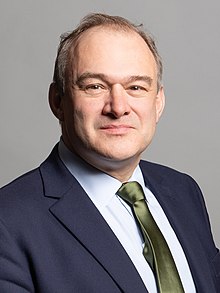
We were also joined by Sir Ed Davy’s team who plan to attend when they can to gain some insight into things affecting unpaid carers.
Sir Ed Davey
Joy Hibbins presents on the importance of suicide prevention.
Joy Hibbins an author, runs a charity called suicide crisis, which provides suicide crisis services and trauma services. The reason why Joy wanted to set up a suicide crisis center was because of her own experience of suicidal crisis in 2012, after a traumatic experience. It led to her being referred to the mental health crisis team for the first time. She found that the services didn’t work for her and she could see very clearly why they weren’t working for her. She started to think that what was needed was a suicide crisis center, where people could come every day when they’re in crisis. Except if they were at imminent risk that they could be supported over a period of several hours. She started to think about the ethos and the methods she wanted to use because she felt that they needed to be different from those of psychiatric services.
Joy experienced a huge amount of skepticism and doubt that someone like her could even set up a suicide crisis center. Not only did she want to set up a crisis center she also wanted to set up a center, which would be about early intervention in order to try help prevent descent into crisis. So it was seen as a very ambitious project, particularly for someone like herself, who was a psychiatric patient that had recently been in crisis.
So with the suicide crisis center, people can either self refer or be referred. The referrals are from NHS, police charities, and all kinds of other agencies as well. From 2012 there was huge doubt and skepticism to where things are, plus it has been an extraordinary journey for the team in a very unexpected journey. where the work is having an impact in countries like New Zealand, where the Ministry of Health in New Zealand contacted Joy’s team, as they were devising their new national suicide prevention strategy to find out what they could learn and how they could use some of the learning that they took from Joy’s team in their strategy.
Some of the points about their suicide crisis center is that it’s in a central location, easily accessible, it’s not a drop in center, but they can see people at very short notice. So sometimes they state to people not to think of them as an emergency service. Altough Joy thinks there are times where they have to be and that there is a need to be able to see people within half an hour, whether that’s them coming for the service or the service going out to them.
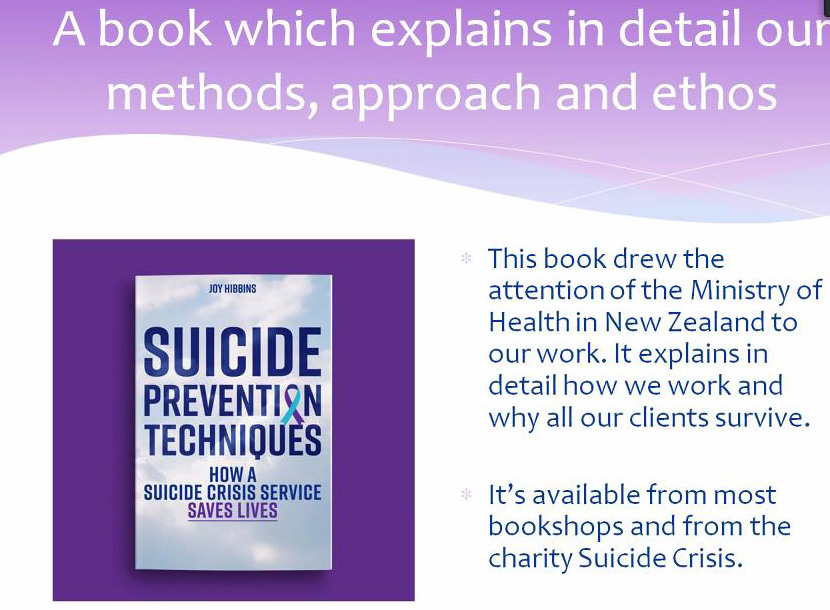
Very recently Joy has published this 40 Is the suicide prevention pocket guide book. There’s a slight irony that it’s called a pocket guide book because she thinks When they planned the book with a publisher, it was going to be a pocket guide book. But in the end she wanted to also make it a really comprehensive, detailed book that would be full of relevant information.
Eventually it became 220 pages. So it’s much more of a comprehensive handbook. But she liked the idea of a pocket guide book because one of their clients made this wonderful quote a few years ago, and he said that he carries us in his pocket with him at all times. Joy thinks that really highlights the strong connection that they build with their clients so that even when they are not with them, they feel connected with the team. Joy always has kept this in mind.
Joy Hibbens will be engaging more with our SW London group members regarding suicide prevention workshops and talking to families and carers for 2022
Rachel Nethercott – Carers UK – State of Caring Report 2021
The next speaker was from Carers UK and Rachel has been very helpful engaging with my carer forums to update us on what Carers UK has been doing.
This section was probably an interesting section for Sir Ed Davy’s team as they want to report back on the groups findings plus questions that were raised.
Rachel is the Senior Research and Policy Officer with carers UK. She was at the group to present some key findings from Carer’s UK annual State of caring survey, and also how these findings inform Carers UK practice, and policy. Rachel mentioned that some of us actually may well have completed the survey, in which she thanked us. She felt that our time added to the kind of painting a picture of the key findings.
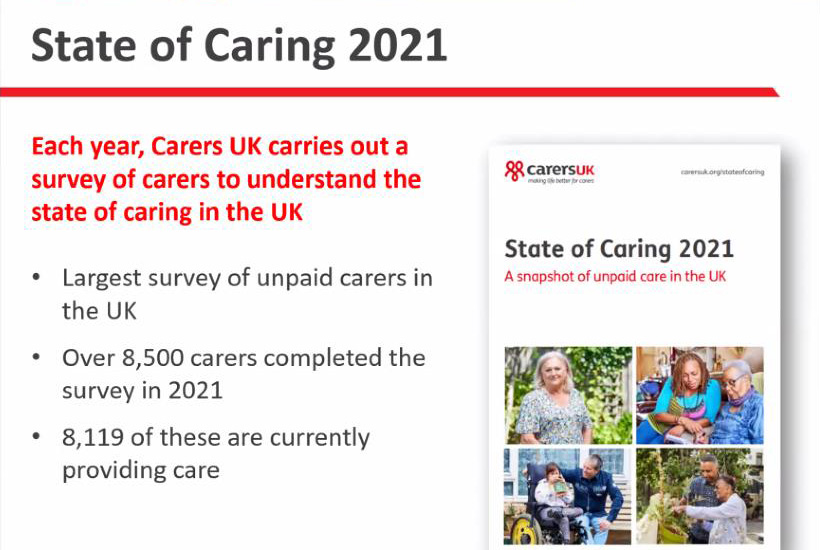
She recommended if we have time that we go and read up the report. Rachel then gave us a quick overview of the report. It’s actually the largest survey of unpaid carers in the UK. Carer’s UK conduct this every year, except for 2020 due to the pandemic. Carers UK did another research instead. But normally, they do this every year. So for the year 2021 it was completed by over 8500 carers, the vast majority of them are currently providing care. The kind of stats she showed in the presentation are for people who are currently caring.
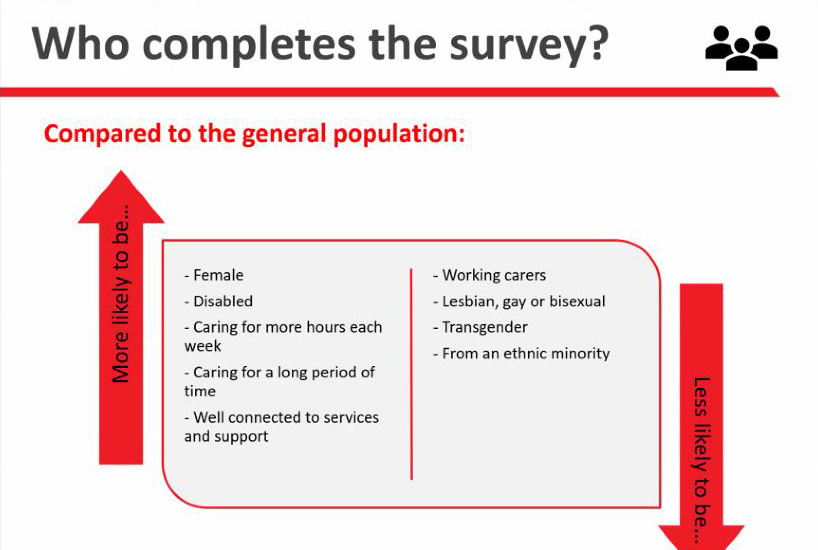
The people who complete the state of caring survey are more likely to be female, more likely to be women, more likely to be disabled. than the general population, and also likely to be at the heavy end of proving care than the average carer. Almost half of everyone that responded to this survey have over 90 hours a week.
Some people who completed the survey were also generally well connected to services and support, they identify as a carer in where they knew their rights and the support that they were entitled to. Unfortunately some carers who filled out the survey were less likely to be working, which can be your average carer. So only around a third of the people completing the survey are either in full or part time work, which is less than what Carers UK had expected to see. The average person who goes filling out the survey were British women. It’s still interesting findings, and it tells us a lot about carers as Carers UK would love carers from all backgrounds to fill in future surveys.
Diane Fox – University of Kent on experiences of unpaid carers
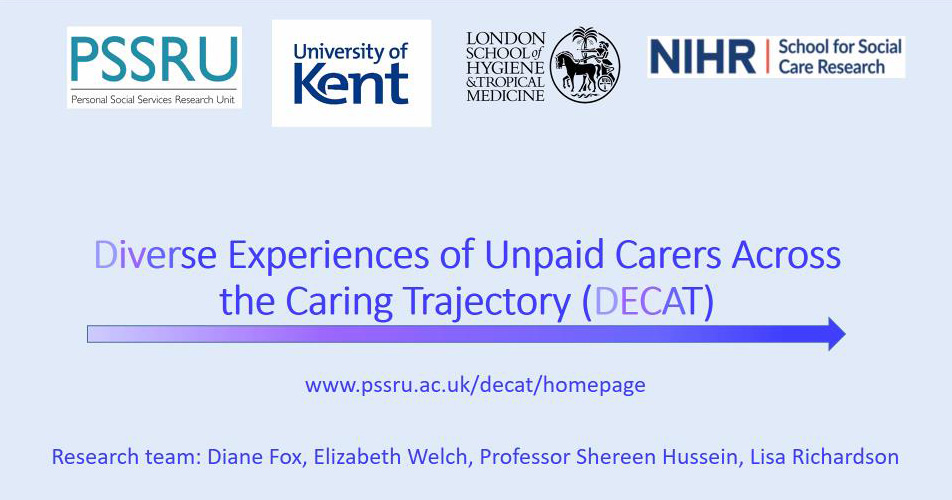
Diane Fox works at the University of Kent at the Persons Social Services Research Unit. She is working with a colleague from the London School of Hygiene, or medicine, on a project regarding diverse experiences of unpaid carers across the caring projectory, this being CCAP short.
Diane came her to give us a bit of background knowledge about the projects, and then hopefully get some of our input.
Diane mentioned that the research often doesn’t follow the same carers over time, and doesn’t often look at differences between subgroups, which ties in with what she is presenting. It’s a question about not just looking at White British carers that are female but strengthing the design to include other carers.
For this study, they are trying to look at how or why some carers maintain a good quality of life over time, and how or why others do not. The reason they want to do this research is to inform the support services for carers, because we know that people’s experiences of caring can vary quite widely. For instance, someone with a degenerative condition is likely to be very different to caring for someone who’s got a relapsing mental illness, caring for a spouse or a partner is likely to be very different caring for your adult child, or your aging parent. So it’s got four research questions.
Diane’s researchers looked at what’s associated with unpaid carers quality of life over time. Does this differ between subgroups of carers? What support services or other things enable carers to optimize their quality of life? What barriers to frequently excluded care space in accessing services? How can these be overcome?
So that, again, ties in to what Rachel was talking about that some groups are less likely to identify themselves as a carer or access services. So there’s five stages to research that feed into one another.
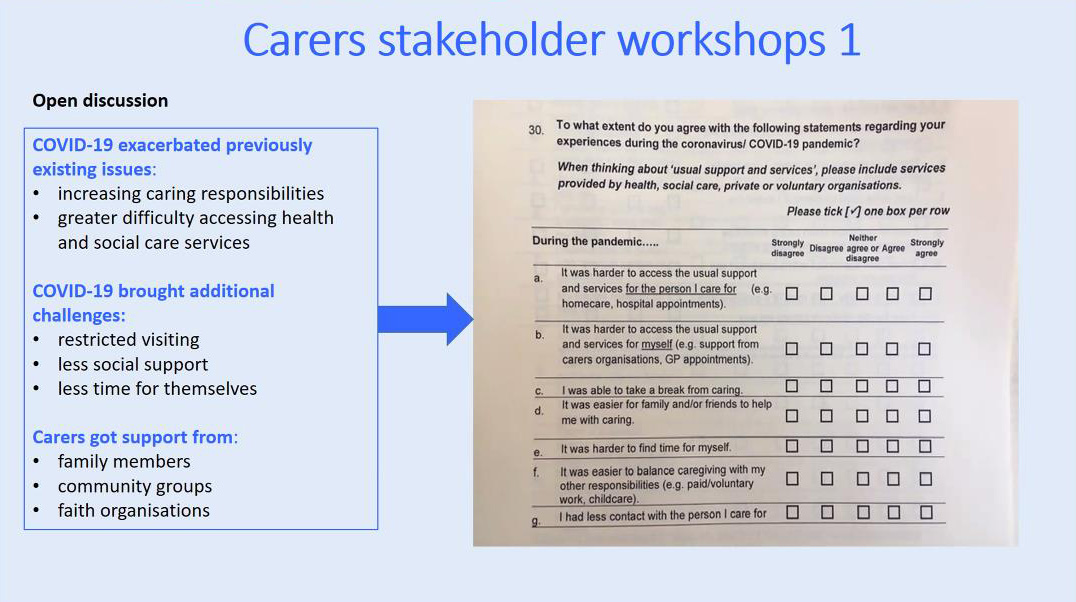
So first of all, the researchers did a scoping review to look at previous research and identify what’s associated with quality of life over time, they found that so many things are in that research that they needed to narrow down the scope of the project to keep it manageable. So for the second stage, they held a series of stakeholder workshops, which they invited a nationwide group of parents and service users, local authority commissioners, service providers, and community and voluntary organizations. At the workshops some of the things that they said in the open discussion where people would firstly outline their caring circumstance, identify it, identify areas of difficulty, and the sources of support that they found helpful.
So in the open discussion, the attendees spoke about particular issues but they were facing particularly related to the pandemic because that was very pertinent at the time just come out of one of the lockdowns. Diane presented how their input fed into the content of the questionnaire. So this is what the researchers got from the first bit of discussion they had with people.
Next, they asked carers to rank topics in order of importance, which was shown on a graph that shows what their preferences were. So more than half of carers said social support was the most helpful. Diane spent quite a bit of time presenting more of the research where we had a Q&A session to help inform Diane our experiences.
Matthew Mckenzie’s Poetry Project
As I have mentioned already, I am working on my poetry phase regarding the experience of care. I read out one of my poems call “On Alert” at my carers peer group and you can view the video of my poem below.
This concludes my November update of my SW London carers peer group
Welcome to a brief november 2021 update for my Lewisham mental health carers forum. The forum is an online forum and provides engagement for those caring for someone suffering mental illness. The speakers for November 2021
Li-ying Huang – South London & maudsley Pharmacist Raymond McGrath – Lead Nurse : Integrating our Mental and Physical Healthcare Systems (IMPHS) for Mind & Body Programme
Li-Ying Haung presents on the importance of medication.
As we all known medication and mental health can go hand in hand, there are times when patients struggle with medication and unpaid families and carers feel there is a lack of information and engagement regarding medication.
Hello everyone. As you can probably tell from my website. I focus on the experience of providing unpaid care, especially regarding those suffering mental ill health. I am in my poetry phase and am to get a large number of poems off my YouTube channel.
My latest poem, which is rather short looks into how mental illness can be catching, perhaps not as bad as what the poor patient is going through, but unpaid carers are not signing and jumping for joy.
You can view my latest poem by playing the video below.
Here is another brief update from my Joint Southwark & Lambeth Mental Health carer forum. One of the carer forums where those who care for someone suffering mental ill health can network and get engagement, info and support from health & social care services.
My carer forums do not just seek engagement from mental health services, every so often carer members request information from accute services.
Speakers for November were
Verinder Mander – CEO of Southwark Carers – Southwark’s carers strategy
Kieran Quirke – Kings College Hospital Mental health lead
Did you know that I run a monthly online carers newsletter? Although most of my focus is on mental health carers, the newsletter focuses on all unpaid carers. The rest of the carer news focuses on Mental health updates, ethnic mental health news and items relating to NHS and national organisations responsible for health & social care.
mind word cloud gradient blue sky background only
For January update we have the following news items
Welcome to my November update of my ethnic carer forum. I am slowly changing it from BAME to ethnic although most members who have attended over the years are not that fussed with the title, it is the discussion, focus and engagement regarding the challenges many minority ethnic carers face. The forum covers a large area mainly Lewisham, Greenwich, Bromley and Bexley due to my other carer groups in Greenwich and carer forums in Lewisham. The forum seeks engagement from South London & Maudsley NHS trust and Oxleas NHS trust half the time, but the carer group gets education and empowerment from national speakers regarding race, racism, complexities in mental health and so on.
For the November BAME carers forum the following speakers were
Brenda Onatade – Her Patient Carer Race Equality involvement and update
Samantha Hosten – Importance of Black History month mental health
Lauren Obie – Blacks MindS Matter UK
Lily and Jemma – Maudsley NHS Patient Research ambassadors




 A Caring Mind