Hello again and welcome to another blog post from Mental Health Carer Matthew Mckenzie. As of this blog post, today is Carers Rights day 2015. The theme for carers rights day 2015 is “Looking after someone”.
However what is Carers Rights day all about?
Basically a carer is someone who is looking after someone and I mean not a professional paid carer, but those who are unpaid and are not always receiving the support that can be so desperately needed.
For those who are caring for someone suffering mental health problems, be it addictions, a form of psychosis, Compulsive disorders, serve depression and so on. This blog post is mainly for you.
As mental health carers we are often on the border line. If you are a mental health carer, you want to do what is right for whoever you care for. Sometimes Mental Health carers can find themselves being pushed out. Sometimes mental health carers are left being isolated. Sometimes mental health carers are ignored or bullied.
As a mental health carer I feel this is one of the most important things that can help build up a stronger relationship between a carer and whoever they help support, although I have not blogged in a while. I having been thinking about this issue and felt the need to post about it.
Ever since the Time To Change campaign on tackling mental health stigma. I have realised how important it is to talk to your caree. I am sure many carers out there do this and try to spend time with who they support or care for, but I feel perhaps it might not be as widespread as I initially thought.
I was at a Time To Talk event yesterday where we heard from Time To Change Champions. Now a Time To Change Champion is a sort of volunteer, but they also do talks, promote events and have gone through or are still going through the mental ill health. I found out several startling facts from the speakers who pointed out that many men under 45 are high on the list of taking their own lives. They almost stated that the south east of London has a very high rate of mental ill health cases, but what most took my attention is a lot of these points could be tackled by just talking about mental health issues.
I am not saying that its going to be easy, because mental health can be a personal issue, but I feel so much can be done by talking about the following
What is mental health
What is stigma and discrimination in mental health
Talking about our mental health to those we trust
Letting who we care for know we are there for them
Working together with mental health professionals to tackle the high rate of mental health cases
Raising awareness in all settings
Schools
Workplace
Community
Health industry
Working towards increasing the social capital of those suffering mental health stigma.
Being honest with ourselves about our mental health.
Mental health and honesty
I am sure I could add more to the list above and some of these mentioned would need some funding, although I have seen so many volunteers working hard to raise awareness. It is also important to mention there are many other mental health and carer organisations working hard to break the stigma by not only talking, but also providing support. I guess what I am trying to say is we are all doing our bit, but there is always more work to be done.
Living in London and realising that mental ill health is so high makes me wonder how many of us are honest about our own mental health. Perhaps it is good to be aware that mental health needs to be tackled, but the problem how we can do what we can in our own way. We need to lessen the rate of mental health problems in London and practically the UK, obviously more will need to be done and the problems of deprivation, social isolation and building stronger communities have to be addressed.
Hearing that young men have a high rate of using the mental health system and also being 3 times more likely to take their own lives states that I should also be honest about my mental health as well as many men out there. We need to know that its ok to talk to someone and being vulnerable is not a weakness. I will point out though that society needs to do their bit as well, because I also feel many young men are not supported enough and many issues are swept under the carpet.
A carers role
As a carer its important to remind those we look after that we care for them. I know this is not going to be easy or even possible for many carers out there, but if we try it can make a lot of difference. The hardest thing I have noticed is that sometimes those suffering mental ill health may not have the capacity or energy to recognise friends and families trying to care. Mental ill health can easily destroy those precious relationships, it breaks bonds, isolates the sufferer and can turn people against each other.
Carer’s, those with lived experience and health professionals can all play their part working together to strengthen the ties of support and recovery. A carer has to try talk to their caree and at the same time avoid labelling their loved one, we can all do our bit.
As of this blog post, today is valentine’s day. This is the day where people share their appreciation of each other. Where there is a chance to express your love interest or rekindle the flame of love on your current partner. Of course there will be many others there who do not have anyone to share the special day with, but maybe there will come a time when it is there turn.
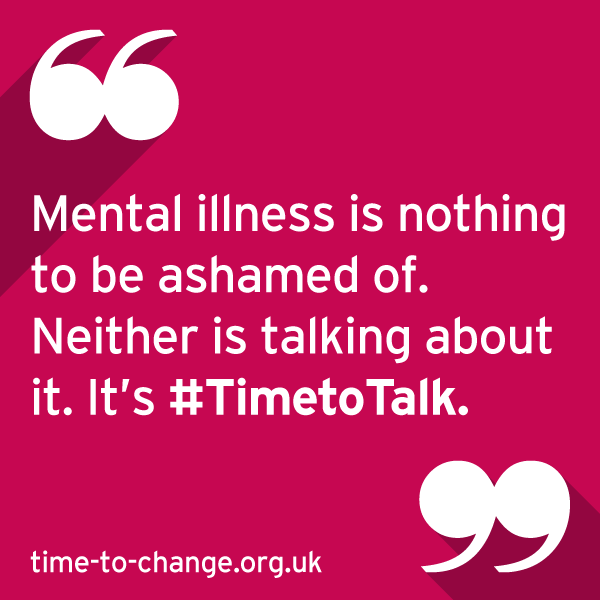
As of this blog post. It is Time to Talk dayover in the UK, which falls on the 5th of February. It has been a while since my last blog post and to be honest, I have been fairly busy with work and mental health involvement, but going back to the subject at hand. What is “Time To Talk” day all about?
Time To Talk day focuses on the point that we should at least try to spend 5 minutes of that day talking to someone about our health, especially mental health. In fact I would go so far to state we should try to open up a bit more about ourselves, especially with a close friend or someone you trust.
Time To Talk day is support by Time To Change, who are Led by Mind and Rethink Mental Illness which is England’s biggest programme to challenge mental health stigma and discrimination.
You see the problem is mental health discrimination and stigma are still prevalent in today’s society. There are so many cases of people falling into mental ill health, because they do not get the support. Some who develop mental health problems might have stigma or shame about their symptoms and may often refuse to talk about it or refuse to seek help. For those who do not open up about what is bothering them, this situation can be risky because if they do not talk about their health or seek help, then its highly likely their mental health situation may get worse.
There can be a large number of mental health cases that could be reduced if we all took the step to at least phone a friend. The emphasis need not be on the sufferer, but we as friends, helpers or carers can phone others who we are worried about.
Unfortunately so many of us know deep down that someone is developing a mental health issue or are struggling. It could be stress, depression, compulsive disorder or many others mental health problems.
The sad thing is that people often sit back and feel it is not their problem to check up on someone. Perhaps the person feels that they are being nosey or are imposing themselves on others. Maybe a lot of us do not have time to check up on others, but the situation is that if we do not check up on those who might be suffering in silence, then its quite likely someone may deteriorate in their mental health.
It is so important to talk to others on what is worrying or brother in us, but also on the other hand it can be important to check up with our friends on how they are feeling. Its not like we have to say much, but at least listen to them.
Being a carer myself of someone using the services, I know only too well what other carers may go through. Over the 12 years of caring, I have spoken and listened to so many carers in carers groups, networks, forums and events. I hear time and time again how carers have been isolated and brought to their wits end, because they had no one to turn to or no one acknowledge their situation. We carers need to step up and support not only ourselves, but each other.
The thing is mental ill health does not discriminate, if you are a carer or support of someone who unfortunately has developed mental ill health, I am sure at times that you have been upset, depressed, anxious, worried and guilty. Taking these feelings to the next level, there is always a risk that carers themselves can develop mental health problems if not supported or listened to.
To counter act such problems, its important carers talk to those who we trust about how we are coping. A carer does not always need someone to wave a magic wand to solve our problems. A carer can just have someone acknowledge what carers have or still are going through.
So I hope that I have pointed out some of the reasons I think “Time To Talk” day is important. We need to push back on a society that feels that its good to be busy. As a society its good to take time out and spend it with a friend. It is good as a society we open up about mental health issues and combat the stigma and discrimination. As a society we need to change and there is no better time than to do this now.
I was so chuffed to be asked by Matthew to do a guest blog. Matthew is such a star raising awareness about carers’ issues that I feel honoured that he has asked for my views!
I regularly do a slot at Corporate Induction for South London and Maudlsey NHS – “What it feels like to be a carer?” . It is great to have a “captive audience” to get the message across about the valuable work that carers do and how involving them has a real potential to make the medical professionals’ job easier – not more complicated as is often believed to be the case.
If you are a carer or have recently been one, I guess you are at least aware of some of the difficulties carers can face. If you are a new to the caring world then feel free to wander around my blog site, which is usually dedicated to carers helping to support those suffering mental health difficulties. My site also touches on other subjects like awareness, events and learning more about mental health and psychology, but for now I want to delve into a topic on what defines a carer.
Are you caring for someone? maybe a close relative or friend? Perhaps a neighbour or maybe you are keeping an eye on your work colleague, but what if you have been caring for someone suffering mental health problems? What I mean is if you are being there for someone suffering addiction problems, psychosis disorders, bipolar, chronic stress or others that I have not mentioned.
Welcome to another of my blog posts. Did you know that caring for someone can come with some difficulties? There are many difficulties in providing care, but one of those difficulties is stress. Did you also know that the date of this blog post is written on National Stress Awareness day 2014?
National Stress Awareness day 2014 is promoted by many organisations, but the one that initially pushes the awareness campaign is The International Stress Management Association which is a registered charity dedicated to Promoting Wellbeing and Performance.
Well hopefully you have managed to attend some events about stress awareness or perhaps you have read up on what stress can do to people, especially workers or carers. However what exactly is stress?
Basically our thought processes control our body and this can be done at such speed, that our body quickly reacts to our thoughts. The thing is Stress happens when we feel that we can’t cope with pressure and this pressure comes in many shapes and forms, and triggers physiological responses. What are these things called pressure? How can pressure affect how much stress a person can take?
Pressures come in many form, basically the idea that we should set out to achieve a specific task or number of tasks, but what happens if those tasks become increasingly difficult to do?
Let me go back to the world of carers, many carers find out they have to set themselves a task to provide care with almost next to no support. Of course this is depending on what care is expected from a carer, but unfortunately the tougher the aliment of the caree (person receiving care) then the tougher the caring role.
If the task of caring seems never ending or other tasks get in the way, then the pressure increases, if a specific carer cannot cope with the pressure, then stress increases, if the carer cannot find a way to cope with the stress or no support is available to cope with the stress then the carer can suffer many difficult symptoms.
What are the symptoms of stress?
Stress can affect people differently and this can also boil down to the level of stress. Below is a small list of how stress can affect some people.
Inability to concentrate – If a person worries all the time due to stress, they can find it hard to concentrate. Seeing only the negative – Stress can cause people to lack confidence, especially if they fail at a task. Many carers often blame themselves when faced with the difficult task of providing care. Anxious thoughts – One of the most common symptoms of stress, we become so anxious that we cannot decide what task to achieve. Constant worrying – Some stress can become a roundabout, we want to rid of stress, but worry about stress and eventually it can lead to worrying about worrying about stress. Moodiness – Some people can become short tempered of moody if feeling stress. Agitation, inability to relax – Since the body may be in ‘fight or flight’ mode, it can be very difficult to sit still. Feeling overwhelmed – Another common symptom of stress, especially if a carer is multi-tasking, a carer would feel overwhelmed Depression or general unhappiness – One of the most common psychological traits that can unhappiness Aches and pains – constant stress can lead to physical problems Chest pain, rapid heartbeat – Stress can also affect people physically. Loss of sex drive – Things that people enjoy can also be affected, too much stress can stop us relaxing or having an interest in many things. Frequent colds – One of the most common symptoms of stress, which affects workforce heavily, constant stress can affect our immune system, where it becomes harder to fight off infections. Trouble Sleeping – Stress can keep the body in flight or fight mode that it can be difficult to sleep due to constant worrying.
So can you imagine some of the situations a carer may find themselves in if they take on too much within their role. It might not be so bad for carers coming from larger families, since a another member of the family might take over, but if a carer is on their own then the stress can affect a carer till they feel they can no longer carer any more. Plus coming back to larger families, I have heard some families leave a single member caring for someone because the family refuses to get involved.
Well what can be done about this? What should a carer seek to do?
The first thing would be to understand when stress can become a problem for themselves. Here is a video I have made to explain more about National Stress Awareness day.
Other things a carer can try to get done is get a carers assessment, especially in the UK a carer can get assessed to see if their caring duties are are risk of overwhelming the carer.
The next task is for carers to try get themselves respite or a break away from the stress of caring, usually the assessment can indicate when respites are needed, a break might not solve the problems of caring but it at least it is a start.
The video I listed above can also be an educating factor for carers experiencing stress, there are steps where carers can look out for the signs of stress. The best steps are the following
– Take time out to do the things you enjoy
– Watch carefully for how you breathe, try slow down breathing during stressful situations
– Exercise whenever you can get the time
– Connect with friends, family or even other carers
– Try to stay positive.
Stress is such a huge problem for society, no wonder there are awareness days dedicated to stress problems. Stress also is a major problem for the workplace especially the NHS and organisations need to take notice to protect their staff. Even if the stress awareness opportunity was missed, let it not be a one time event, but a nudge to implement stress awareness into policies and protect staff.
Thanks for dropping by to read another of my blog posts, these posts are usually on mental health from a carer’s perspective. I am currently caring for a close relative suffering from mental ill health, so I have set up this blog as a form of expression, updates and support for myself and others.
Well ok lets get to this, I have been hearing lots of stories, news and thoughts on the new Samaritans RADAR app, for those who do not know. Let me briefly explain what the Samaritans do.

 As of this blog post, today is valentine’s day. This is the day where people share their appreciation of each other. Where there is a chance to express your love interest or rekindle the flame of love on your current partner. Of course there will be many others there who do not have anyone to share the special day with, but maybe there will come a time when it is there turn.



 A Caring Mind