Tag Archives: mental health

Southwark Mental Health Carers Forum August 2017

IMG_20170831_102430

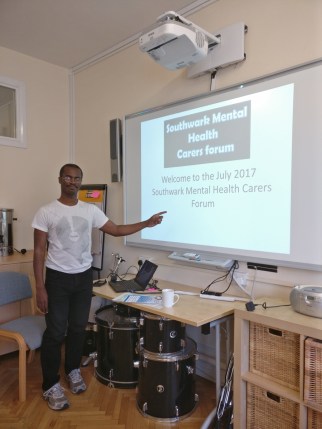
This is a update from the new Southwark Mental Health Carers forum for July. The Southwark Mental Health Carers forum took place on August the 31st over at Southwark Carers. Yes, the forum has moved from the Maudsely hospital to down the road where Southwark Carers is based.

This is the Second mental health carers forum to take place for Southwark and we had some interest carers attend this forum who also attended the carers support group. Since the forum was fairly new, I presented on updates which occurred the previous month, that being July.


To see the video of the forum report, click below

We are looking to run the forum every last Friday of the month. I presented what the forum is about, regarding that

  • It can be difficult for Carers in Southwark have an idea on Mental Health services and influencing them.
  • There has not been a Mental Health forum for some years, although there are Mental Health carer support groups.
  • Mental Health carers need some empowerment in their role.
  • Services have suffered from cuts, carers need to act in order to support everyone.

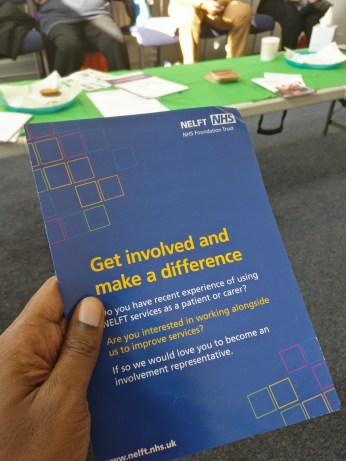
Mental Health Foundation are working to develop a series of pilot programmes on with The aim is to improve mental health wellbeing for all.

Mental Health and Wellbeing – Strategy patient engagement event where Southwark Clinical Commissioning Group (CCG) and Southwark Council wish to improve mental health and wellbeing across the borough

Plus talking about the upcoming CarersUK AGM and the South London & Maudsley AGM.

ana

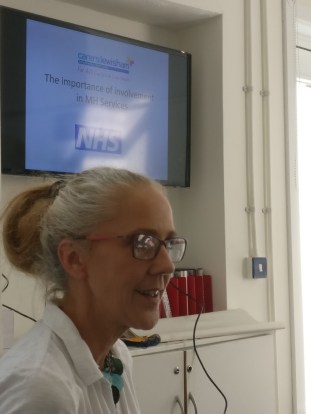
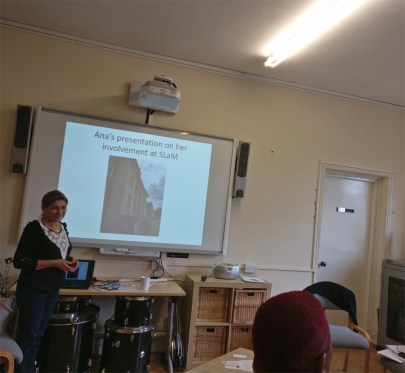
Next we had a presentation from Ana who is the co-chair of the forum about her involvement at South London & Maudsley. We also discussed the importance of attending carers support groups

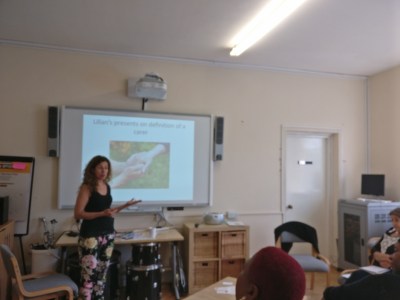
Lastly, Carer support worker Lillian spoke about the definition of a carer.

IMG_20170831_114837

The next Southwark MH Carers forum will be on 29th of September.

Lewisham Mental Health Carers forum August 2017

Here is the update for the Lewisham Mental Health Carers forum for August 2017. This is one of the older mental health carer forums in south London, the carers forum has been running for more than a year. Of course, When I say “Mental Health Carer”, I mean someone who is caring unpaid for a relative, friend or neighbour suffering from some form of mental illness.

Continue reading

Top 100 psychotherapies

cover

Welcome back. I have always mentioned to fellow unpaid carers who care for someone using mental health services to have an interest in psychology. In order to help develop an interest I have spent some months producing the video below.

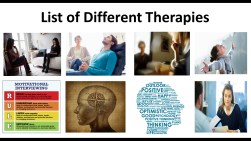
This video lists and describes over 100 different forms of psychotherapies. Most mental health carers actually may have come into contact with at least 3 or 4 types of therapy. One being CBT, the other could be family counselling sessions and the most common would be group therapy, especially if attending a carer’s group. It is important carers have access to a therapeutic setting and are not treated as information retainers.

Carers often have to go through difficult and trumatic incidents and giving a carer a leaflet and telling them to get on with it is a lazy way of doing psychotherapy. Anyway, I am getting off my soap box and hope the video helps raise some interest of the vast world of psychology.

The video covers many therapies from Interpersonal psychotherapy (IPT), Drama therapy and Art therapy all the way to CBT and DBT. I would have continued on with the video and done a list of 200 psychotheraphies, but this has taken a lot of time and I felt I should just get on and release the video already.

Hope you enjoy!!

Tips from mental health survivor on caring

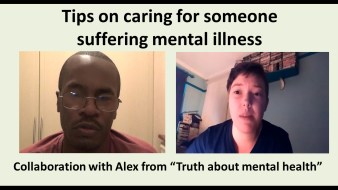
coverWelcome everyone and I am hoping you have had a good weekend. Today’s topic is another collaboration. This collaboration is with Alex from her Youtube channel “The truth about mental illness”. We decided to present on the importance of caring for someone suffering mental ill health.
There are situations where those with lived experience do not get support from a close relative or carer. There are those who feel carers are not essential. Each situation is complex and there is not often a right answer, but if someone suffering mental ill heath can get support from a carer (e.g. someone in the family or friend), then the outcomes usually tend to be better.

Living with mental illness can be challenging enough and having to go through mental ill health by oneself can be overwhelming. So I was glad to hear that Alex who is a mental health survivor wanted to present on how her mother provided support for her.

Alex promotes mental health experiences and well-being off her Youtube channel, it is worth a look to get her views, but before you check out her videos. I hope you could view the video we collaborated with below.

Alex spoke about important caring and support tips regarding how carers may have to judge the situation by gut feelings. There will be times when a carer has to assess how to provide care and support. It can be almost walking like eggshells if a carer crowds the “caree”. Alex explains this well in the video.

The collaborated video also looks into how a carer’s experiences can be vital in providing care and support, plus we look at some other tips which could be important to both the and service user or carer’s journey.

Embed from Getty Images

I hope you enjoy the video and blog and hope to see you next time when I take on an immense project in which I examine different types of therapies.

Southwark Mental Health Carers Forum 2017 July

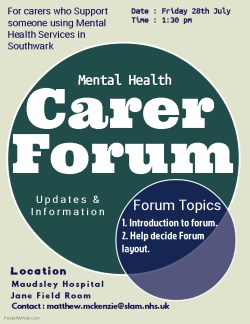
Southwark MH Carers forumThis is a update from the new Southwark Mental Health Carers forum for July. The Mental Health Carers forum for the London borough of Southwark, took place on the 28th of July 2017 over at the Jane field room at Maudsley hospital.

We had good attendance from carers, a representative of Southwark Carers and a researcher working on carers experiences. The first forum for carers caring for someone suffering mental health problems looked into how such a forum would be shaped.


Continue reading

Lewisham BME Mental Health Carers Forum July 2017

handsWelcome to the update for July 2017 of the Lewisham BME mental health carers forum. This is the first BME Mental Health forum for carers in this borough. The forum is run in conjunction with Family Health ISIS who provide community support for those in mental distress and also advocate for their unpaid carers.
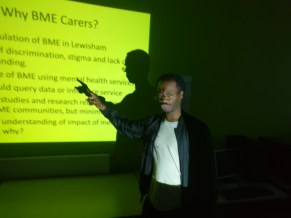

To watch the video update, please click on the video below.

The forum chaired by myself examined how the forum should take place and why such a forum should exist. In the discussion it was clear that we feel we have no idea how many BME Carers in Lewisham. We also feel that perhaps there is limited influence BME carers have on Mental Health services.

Mental Health BME carers need some empowerment in their role and hopefully the forum can be a physical platform to allow such carers to engage and empower themselves.

There of course is a large community BME in the London borough of Lewisham. Plus with a history of discrimination, stigma and lack of understanding of mental health, which BME communities can experience, the forum wishes to investigate what causes such issues and how could they be tackled.

IMG_20170728_110132

Other reasons for the creation of the BME carers forum is that a high rate of the BME community using the mental health services. We unfortunately do not know the number, so we should query data, which Healthwatch could provided some assistance.

The reasons for the forum are numerous, so I could not list them all down, however lastly there has been several studies and research requiring input from BME communities, but with minimal reach. Why?

Questions and issues

Some questions were raised during the forum e.g.

  • What is the quality improvement for BME carers?
  • Who is monitoring the data?
  • Plus there should be a breakdown of the data.

A Lot of the discussion focused on the stigma experienced by BME lived experienced and their carers. We all told stories of what it was like to be a BME Mental Health carer and stigma was a common theme.

We felt lack of education and information on what mental health means could be affecting the BME community. There also needs to be a range of mental health education for young BME groups, but the forum wondered how this is going to progress.

One thing, which the forum members felt was that there seems to be an issue with mental health jargon. The theme kept occurring when exploring BME mental health carer issues.

We looked at who should engaged with the forum and due to browsing through the “Meeting the public sector equality duty at SLaM 2014” – The Equality Manager, Organisation and Community SLaM was suggested.

Also the Senior Associate, Equality & Diversity at Lewisham CCG was suggested, but we also need to continue to grow the forum, which must feed for FHI carer support groups.

Lambeth Mental Health Carers Forum July 2017

20140710_143445Welcome back and here is the update for the Lambeth Mental Health carers forum for July 2017. This probably the second time the forum took place, since the last Lambeth Mental Health carers forum was more of a planning meeting to structure the forum.

As a form of carer empowerment, I chaired the forum and hope we can have a rotation of carers charing for the following months. Chairing a forum can give carers more confidence at meetings, leadership and being involved.

Continue reading

Lewisham mental health carers forum July 2017

coverHere is the update for the Lewisham Mental Health Carers forum for July 2017.  This is one of the older mental health carer forums in south London, the carers forum has been running for more than a year.  Of course, When I say “Mental Health Carer”, I mean someone who is caring unpaid for a relative, friend or neighbour suffering from some form of mental illness.

Continue reading

Consciousness and the end of mental life – Lecture Review and summary

Daniel_Robinson

Prof Daniel N Robinson

Hello again. Hope that after reading this blog, you have time to check out my site. I do more than just the awareness series on mental illness.  I also do a series of lecture reviews, mainly on psychology, psychiatry, sociology and ethics.  Why on earth should a carer spend time on humanities and psychology? Well for a start it is interesting and fairly related in the mental health area.Hello again. Hope that after reading this blog, you have time to check out my site. I do more than just the awareness series on mental illness.  I also do a series of lecture reviews, mainly on psychology, psychiatry, sociology and ethics.  Why on earth should a carer spend time on humanities and psychology? Well for a start it is interesting and fairly related in the mental health area.

This particular review looks at one of the psychological greats lecture on his course “consciousness and its implications”.  The lecturer is Daniel N Robinson who is a philosopher who is Distinguished Professor Emeritus of Philosophy at Georgetown University and a Fellow of the Faculty of Philosophy, Oxford University.

Unfortunately the course can be a little challenging to get into at first, but there is nothing wrong with replaying the lecture in order to get to grips with the subject material.  The course has 12 lectures and as you can tell Prof Daniel spends time examining the mystery of what is consciousness.

As a carer, all the years I have been trying to support someone close to me struggling through mental illness, I found myself asking deep and profound questions.  The most common question i would ask myself is “Where is the person that I used to know?”.  How far has this mental illness taken from the person I used to know.

As of this blog post, the lecture I will focus on is lecture 12 titled “Consciousness and the end of mental life”.  I did have some reservations playing the final lecture, because as you may have guessed there is this overwhelming fear of deep dark questions probing me on the challenges I will have to face.

The lecture begins off looking as several startling cases of patients trapped years in a coma only to slowly come out of a coma from severe brain trauma.   One incredible story was of Terry Wallis – The man who slept for 19 years. Terry Wallis emerged from a 19 year coma and regained the power of speech.

terry-wallis

Medical professionals were astounded and started to examine the changes in his brain, it had always been the case that neurons were non-regenerative, but in the Wallis case there seemed to be strange activity in his neurons. How!?!?
Prof Daniel starts to talk about the Coma Recovery Association and how the association offered advice on how comatose patients can recover, but it is risky.  Within the lecture we look at further cases where there was one woman who recovered from a coma only to complain that unconsciously she kept hearing the doctor by her bedside talking.

Another startling case was of was of Brian Kastler, neurosurgeon’s in this case were astounded at his slow, but gradual recover from devastating brain trauma. The lecture looks at many other cases and examples, but Daniel is quick to point out that these cases are not often the expect outcome.

Embed from Getty Images

Prof Daniel reminds us that the brain is not like skin or bones, if affected by trauma then the cells more likely will die. Still the regeneration is a lot greater in childhood, depending on the damage.  However if the cerebral cortex is damaged then the greater the damage. The lecture points out that each patient case is unique and throws light into neuroscience. What was the deciding factors in each of the cases?

The lecture then moves on to the Terri Schiavo case, where a patient “Terri Schiavo” was a right-to-die legal case in the United States from 1990 to 2005, involving Theresa Marie “Terri” Schiavo, a woman in an irreversible persistent vegetative state. The lecture examines the problem of PVS (persistent vegetative state) cases and looks into cases where there has been misdiagnoses. This then shows the dilemma faced by doctors with several startling questions “When to turn off the life support system?”, “where are there signs of life?”, “What are the other possibilities?”.

Can you begin to see how the lecture is slowly moving into ethics?  There is no mistake why I have added a link into ethics off my blog site because when practicing medicine, you are dealing with people’s lives and if doing that then ethics is not far away.

Embed from Getty Images

Prof Daniel lecture looks into more philosophical areas on American philosopher Thomas nagel’s question “what is it like to be a bat?”. Prof Daniel wants to raise the implications of consciousness.  Prof Daniel also talks about Arestole’s work on the biological studies on sensation.  Eventually the lecture gets into deeper questions on what is consciousness as he queries if someone dreaming is conscious regarding if they are aware of sensations. A good example is given on how we determine our own consciousness, which is down to epistemic justification (part of epistemology that attempts to understand the justification of propositions and beliefs).  If no one believes that we are conscious, then we can only hope to share our experience with that person so they experience the same thing. e.g. pointing to an object in the room as validation.

Embed from Getty Images

The lecture then takes a greater step towards ethics and moral thought. With examining questions on.

  • Our duty to others, our rights to others.
  • They have a rights to be treated even though unwell, but how?
  • We have a duty not to exploit the vulnerabilities of others.
  • What are our duty to others whose rights cannot be protect by themselves?

Prof Daniel then throws up a dilemma not only for health professionals, but for carers or caretakers. Remember the question I asked myself at the beginning of this blog?  So this is why I often say to mental health carers that they should take an interest in psychology and psychiatry.  Do not be put off by its deep complex field, we all have something to contribute.

Friendly male doctor's hands holding female patient's hand