Welcome to the first January Lewisham BAME carer forum for 2021. The BAME carer forum is one of the 6 carer forums I run once a month. The carer forum runs online to adhere to covid-19 restrictions and allows members to attend a lot more easily.
The BAME Mental Health carer forum is aimed at BAME carers who are caring for someone with a mental illness, especially for someone using the services of South London & Maudsley, although I am not super strict who attends the forum since carers from other forums and boroughs often attend.
On the January agenda were the following.
NHS England presenting on their National Patient Carer Race Equality Framework (PCREF)
SLaM presenting on their Local drives for PCREF
SLaM older adults diversity drive
We were joined by Staff from Oxleas as well as Manchester NHS Trust who are also seeking to engage and improve services for the BAME community.
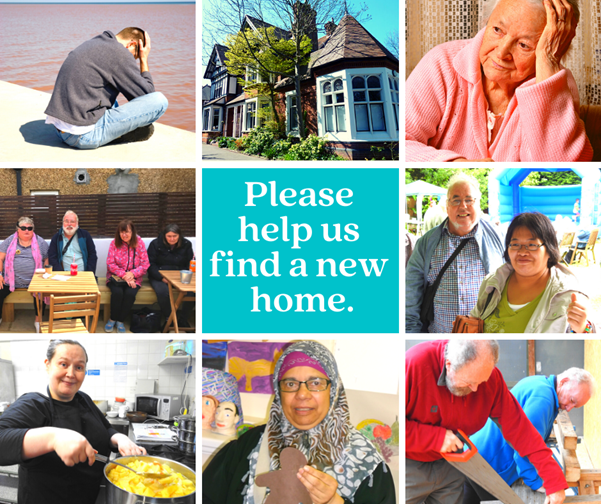
The Fircroft Trust are devastated to have been informed by RBK, without consultation or notice, to vacate our beloved Mental Health Resource Centre on Ditton Road.
The Fircroft Trust has leased this building for over 40 years and provide a haven for over 75 people who have varying degrees of mental health challenges. At a time when there is a national crisis in mental health, withdrawing this essential support system, which has not only been shown to improve quality of life for the individuals who accessed it, but also reduce hospital admissions and suicide rates, has been devastating for our local community.
The Fircroft Trust has worked hard to minimise the impact of the pandemic on the people who rely on their service and have continued to support the community by maintaining daily contact with their most vulnerable service-users, either via telephone, outside group activities or ‘COVID-friendly’ garden work and meet-ups. However, the impact of the pandemic has meant The Fircroft Trustfaced increasing demands for their service from vulnerable members of our community. This is something The Fircroft Trustcan’t ignore and they urgently need your help.
How you can help
Services needed by our community:
The Fircroft Trust are urgently seeking new premises in the Chessington, Surbiton or Tolworth area that would be suitable for us to resume the face-to-face support services that is so missed by our service users.
If you can help, or know of a local building, please contact Kay Harris on the details below. Please share this with your network and help us to continue supporting the people in our community who need us most.
Welcome to the first update of the first carer forum for January. These carer forums are aimed at those caring for someone with mental illness. The forums provided engagement from mental health services to educate and involve carers regarding services provided.
Carers can also network together and slowly build up empowerment. For the month of January we had Lewisham health commissioner Natalie Sutherland talk about the following.
Her role at the Clinical Commissioning Group
Why the CCGs merged
Their focus on mental health
Pressures on the health system due to corona virus
Initiatives for families and carers.
Also in attendance were carer members from Lewisham and some from other areas interested in mental health services. We also had a few researchers from universities wanted to speak to carers about their research.
Bridge Connections Coaching Consultancy are currently researching working carers and working parents experiences with employers when caring for dependants or loved ones with mental health challenges. My aim is to look at experiences and see where employers can increase wellbeing care, strategies and solutions to support the retainment of employee carers/parents whilst they are expected to show up for work, whether it be short-term or long-term.
It would start off with a questionnaire, then a short interview, to gather input.
From their experience, they feel there is an area where the working person providing care does not get enough individual wellbeing care, to continue to work effectively, this is an area that they are currently looking into.
You can contact Ceylan Thompson on coachingandmentoringlifeskills@gmail.com
Black Thrive is a partnership between communities, statutory bodies, voluntary organisations and the private sector. We work together to reduce the inequalities and injustices experienced by Black people in Lambeth.
According to the GSTC “One to Many” report, more than 1 in 5 residents in Lambeth live with at least one long-term condition. Over 19,000 live with multiple long-term conditions (three or more). Even though Black communities make up 18% of Lambeth’s adult population, they account for 27% of people with multiple long-term conditions. Furthermore,
in Lambeth, Black residents are four times more likely to be unemployed than white residents. When they are employed, they are disproportionately engaged in insecure, low-paid and dangerous work, which harms mental and physical health. In addition, Black people can face racism and discrimination in the workplace, which negatively impacts mental well-being.
Therefore, we know that people of African and African Caribbean descent in Lambeth are more likely to be unemployed and more likely to have poor health. One of the key drivers of these inequalities is structural racism and the fact that our current healthcare and employment systems prevent Black people from thriving.
As a result, in collaboration with Guy’s and St. Thomas’ Charity (GSTC), Black Thrive’s Employment Project is developing community-led solutions for improving employment outcomes for Black people with long-term conditions. Our goal is to ensure that Black people in Lambeth with long-term conditions are as likely to be in and sustain, meaningful employment as equivalent white people.
To do this, Black Thrive is partnering with community members, statutory bodies and local organisations to achieve justice for the Black community through radical systems change. In September 2020, we launched our £300,000 grant fund to pilot projects that consider the lived experience of Black people with long-term conditions and have the potential to create systemic change. Projects should test and pilot new ideas that have the potential to shift the dial on employment outcomes and improve the evidence base around what works for Black people in Lambeth with long-term conditions.
The fund was managed and distributed by our Employment Working Group; a group of local Black residents with lived experience of managing one or multiple long-term conditions. We believe that prioritising community-power and lived experience is a radical way of funding new and exciting initiatives that may be overlooked by the traditional system. After receiving 84 applications, the Employment Working Group decided to fund 8 projects – the vast majority of which are led by Black and disabled people.
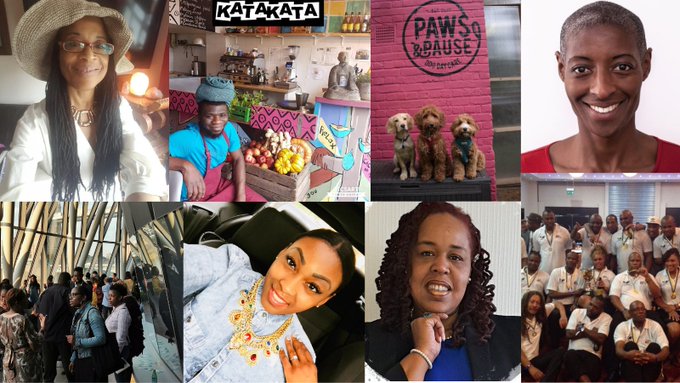
Funded projects include a radical self-care and wellness to work programme, the creation of a network of Black social entrepreneurs, supporting those recovering from mental illness and substance addiction back into employment through dog day-care traineeships and empowering Black people to develop employability skills through social action. To read more about all 8 projects please visit: https://employment.blackthrive.org.uk/our-grantees/
As the projects begin recruiting participants, it is important we ensure that the opportunities available reach the most marginalised people. This is a form of systems change in itself, as it will allow those people who fall outside of traditional referral pathways for services to still access support.
Given that carers have an intimate and trusting relationship with their loved ones based on an acute understanding of their needs, interests and goals, they are a vital network which cannot be overlooked! We strongly encourage all Lambeth-based Black carers to review the projects on offer, share them widely within your networks and follow the sign-up process if you, or someone you know, is interested in taking part.
The Royal College of Psychiatrists are collecting stories from people with lived experience of long term mental health conditions. These stories will support the work of the Royal College of Psychiatrist’s Faculty of Rehabilitation & Social Psychiatry. The Faculty is made up of psychiatrists, service users and carer representatives with experience of psychiatric rehabilitation services. The Royal College of Psychiatrist want to understand and represent such experiences.
You can download the Lived experienced submission form in the link below.
Some of the stories collected will be placed on the Royal College of Psychiatrist Faculty website. They may also use them in future reports and campaigns.
The Royal College of Psychiatrist appreciate that sharing your story with others can be difficult; you may need support from carers or the individual who has invited you to participate.
Taking part in their project is entirely voluntary, and stories will be anonymised.
Patients and carers with lived experience are leading on this project.
Any queries about the project please email stella.galea@rcpsych.ac.uk.
Welcome back and thanks for stopping by. Have you ever heard of PCREF? There was a blog about it in 2019 regarding mental health inequalities for black people. Mental Health outcomes for those from the Afro-Caribbean community has been very poor for a long time. So there has to be some form of change, but how can this go about? I think it starts with the community and a way for black people to come together and query how mental health services and support the community.
The blog about health inequalities from NHS England is below.
South London & Maudsley short for SLaM are one of the mental health trusts looking to work with the black community on ways to support wellbeing and close the inequalities gap.
I recently made a short video as an intro into black health inequalities, although its not going to be the only video I am working on.
They are looking for members of the Black community to attend a series of events SLaM call ‘Fit for Partnership’. These events well focus on four boroughs they run services.
Croydon’s Black Community: Tuesday 19 January, 6pm – 8pm: Register here
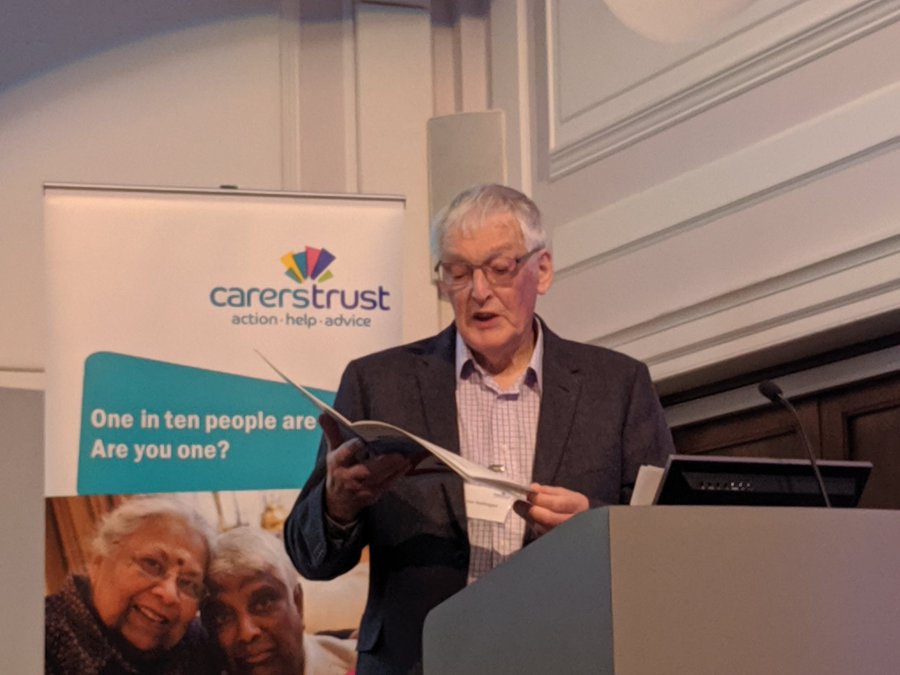
Welcome back to my first blog post of 2021 and I have exciting news. I have just heard some days ago carer Alan Worthington got an OBE from the New Years honours. When I found this out, I was overjoyed. If you do not know who Alan Worthington is. Alan was instrumental in the creation of The Triangle of Care.
Alan Worthington – Founder of Triangle of Care
The Triangle of Care has been around for some time, I believe 2010. The Triangle of Care is a set of policies to involve families and carers in the decisions and care of those suffering mental ill health, especially inpatient settings on mental health hospitals.
Triangle of Care Logo
With the support of national carer charity Carer’s Trust and National Mental Health Development Unit, Alan worked so hard to help implement the policy for mental health trusts.
When a mental health trust wants to sign up to the triangle of care, they need to self-assess how families and carers are involved and supported regarding mental health services. Once self assessment of services is complete then the trust can identify what needs to improve in comparison to the triangle of care’s six policies as in.
Carers and the essential role they play are identified at first contact or as soon as possible thereafter.
Staff are “carer aware” and trained in carer engagement strategies.
Policy and protocols re; confidentiality and sharing information are in place.
Defined post(s) responsible for carers are in place.
A carer introduction to the service and staff is available, with a relevant range of information across the acute care pathway.
A range of carer support services is available.
All too often carers can be shut out of the care for their loved ones as all too often Mental Health professionals get the last word. When things go wrong, people finally ask the question “What did you ask the carer about the situation”? It is like families and carers are screaming to be involved, but something is pushing them out.
The aim is to increase involvement and communication between patient, health professional and carer. As in the past all to often there has been an imbalance of communication. There have probably been dozen’s of involvement policies from a patient or MH professionals perspective, but with the triangle of care we get the family and carer influence.
Over the years many mental health trusts have rose up to the challenge and signed up for The Triangle of Care. Below is a list of some of the Mental Health NHS trusts who have signed up and are currently working with triangle of care.
Birmingham & Solihull Mental Health NHS Foundation Trust Bradford District Care Foundation Trust Devon Partnership NHS Trust Dorset Healthcare University NHS Foundation Trust Lancashire Care NHS Foundation Trust Leeds & York Partnership NHS Foundation Trust Livewell South West Pennine Care NHS Foundation Trust South Staffordshire & Shropshire Healthcare NHS Foundation Trust South West London and St George’s Mental Health NHS Trust Sussex Partnership NHS Trust West London Mental Health NHS Trust. Camden and Islington NHS Foundation Trust. Central and North West London NHS Foundation Trust. Coventry and Warwickshire Partnership NHS Trust. Cumbria Partnership NHS Foundation Trust. Southern Healthcare. Kent and Medway NHS and Social Care Partnership Trust Lincolnshire Partnership NHS Foundation Trust Mersey Care NHS Trust Norfolk & Suffolk NHS Foundation Trust Northumberland, Tyne and Wear NHS Foundation Trust Nottinghamshire Healthcare NHS Foundation Trust Oxford Health NHS Foundation Trust Somerset Partnership NHS Foundation Trust Surrey and Borders Partnership NHS Foundation Trust Tees Esk and Wear Valley NHS Foundation Trust.
It is with the hard work of Alan Worthington and Carer’s Trust that the triangle of care has made such a difference in families and carer’s lives. I myself as a carer activist got involved with the triangle of care because I felt so passionate about the cause. I certainly have to thank Ruth Hannan who inspired myself and others to make a difference and help shape the Triangle of care.
I would like to finish off stating that I am excited South London & Maudsley have taken the challenge to sign up to the Triangle of care and I look forward to see how they can set an example like other trusts currently on The Triangle of Care scheme. There is still much work to do and one should never fully rest on their laurels, but congratulations to Alan for all his achievements.
We can hope the triangle of care continues to work its magic for many across the country and that carers should always be counted.
Welcome to the November 2020 update of the Lewisham BAME carer forum. This forum is aimed at diverse carers in the borough of Lewisham, although carers and forum members from outside the borough are more than welcome to attend. When I am talking about carers, I mean unpaid carers who care for someone suffering mental illness.
For the Novemeber 2020 forum update the presenters were the following.
Professor Frank Keating – BAME community experience with the mental health system. Dr Emily West – The challenges on Dementia, Palliative and end of life Dr Laura Cole – Care home research Sherone phillips – NHS England Palliative and End of Life Care
Usually all of my carer forums tend to have speakers or those who engage with carers attend locally, however due to the corona virus and social distancing, the option is now available to increase networks to wider regions. The BAME carer forum for November had a dementia and end of life theme to it.
Dr Emily West presents
First to speak was Dr Emily West from UCL Division of Psychiatry. She spoke about a project called DeCoDe-H – Improving dementia care in acute hospitals.
Emily mentioned that they are looking at ways to basically make it easier to recognize and treat discomfort in people with dementia who can’t communicate, and then work a little bit on nutrient, which is one of the studies on caring for with people with dementia. The project also looks into how can they can best support family carers. Dr Emily also spoke about another project called Endemic, which was their COVID specific project, which kind of brings the two projects together.
Dr Emily mentioned to the forum that she inherited the project from a fellow researcher I think her name is Nuriye Kupeli. Dr Emily gave credit on the amount of work researcher Nuriye did. Dr Emily has also been working with Dr Nathan Davis, who’s a senior research fellow and is also was very interested in dementia, palliative care, and decision making, which together is called “Rule of thumb interventions”.
The most well known version of this is the “stroke intervention” and how it helps you to recognize and remember a very easy way of recognizing a stroke and getting help.
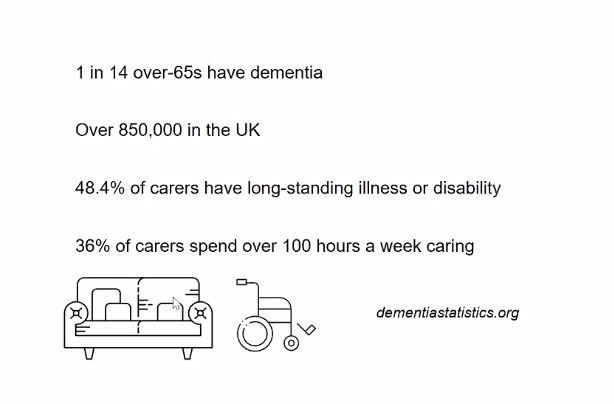
Dr Emily mentioned that Dr Nathan’s work is very carer focused and he’s looked at supporting family carers of people with dementia who are at the end of life, as well as helping dementia sufferers own decision making abilities. One in 14 people over the age of 65 have dementia, which is over 850,000 people in the UK, and almost half of carers have a long standing illness or disability themselves. So you have to be particularly aware of the needs of the people that are looking after the people that have dementia.
Dr Emily mentioned 36% of carers spend over 100 hours a week caring. And as well as this general context, they have been looking at how it affects BAME community specifically. So about 3% of people with dementia, which is about 25,000 people are from BAME communities and this number is expected to double by 2026. It’s predicted at the moment that South Asian communities are going to have the highest increase in the total number of people with dementia and current research tells us that BAME communities have a lot of challenges in dealing with dementia, almost every step of the process.
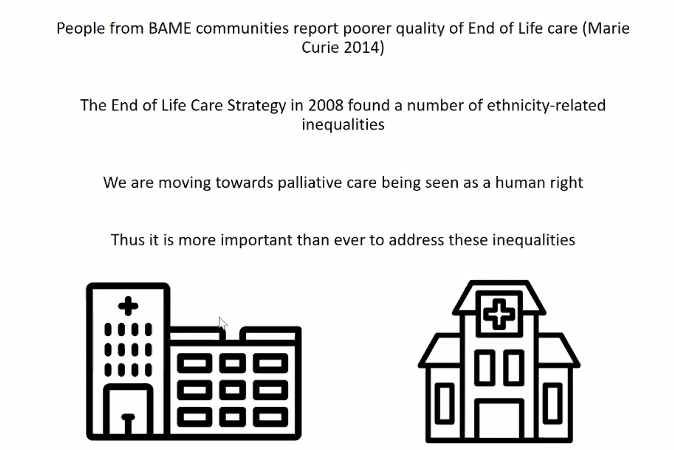
It was also mentioned that there can be delays in getting diagnosed with dementia and that sometimes this can be difficult to access. We know that BAME communities find it harder to access the services and we know that people from BAME communities report poorer quality in end of life care and as found in theMarie Curie report in 2014.
A big national drive on the end of life care strategy study in 2008, found a number of related inequalities and there’s a general feeling within policy or aim within palliative care that the UCL researchers are working towards that palliative care be seen as a human rights. Its also something that’s really enshrined everyone who has the right to have a good and well provided for death and dying process. It was stressed that it’s more important than ever to address the kind of base inequalities stopping a part of the population.
Dr Emily continued that it’s also increasingly recognized that the role of families and carers and members of the public in medical and health research is invaluable. Emilies research use a lot of what are called PPI panels. So public and patient involvement. And so PPI panels helped us throughout the research process to make sure that the way that we’re communicating is appropriate, and at the right level for the people that need to access the information. And they help us to design research processes, so that we’re not asking too much, or on the other side, we’re not assuming that people can’t do things aren’t willing to do things, but they are.
Those affected on those illnesses are usually involved in steering groups, so they help to shape the research agendas. This is something that’s open to everyone. Dr Emily did point out that if anyone’s interested, she can show people how to register for these kind of things. Dr Emily was happy that people are more widely being involved regarding dementia and end of life. This is especially on those with direct knowledge of certain illnesses and situations, they can help researchers develop more knowledge on such situations, and also knowledge how things have been across the span of weeks or months or years regarding those illnesses.
Dr Emily was aware that as researchers people can inform them and maybe tell us when things are okay and when they’re not. It was mentioned that the people that carers spend every day will observe what has previously been seen as an observable and can help facilitate voices of diverse populations. Researchers can’t reach everyone but they do try to reach and involve carers, patients and networks of people. So their aim is to represent all of the voices that should be heard, when researchers doing things like making clinical guidelines, or policy decisions.
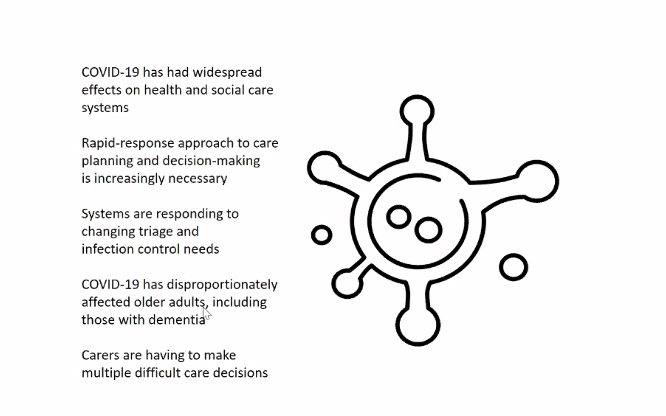
Dr Emily West moved on to talk a little bit about a recent study that they have been doing. It’s a kind of case study, that she would be really interested to hear the kind of themes that they found when they talked to people. Emily resonated with people’s experience here. she knew that there’s a lot of experience in this group, and caring for people with lots of different illnesses, lots of different social setup, social challenges. Dr Emily was really interested to hear if this kind of applies the situation that members have been living in recently, too. COVID-19 is of course has a huge effect on health and social care systems.
Dr Emily continued by saying that they have had to do some rapid response approach to care planning and decision making because hospitals have been overrun regarding the virus and GP surgeries have been locked down and everything that people relied upon as normal has changed. So systems are having to respond to changing needs all the time, just as everyone else is responding to change in government guidelines, changes in where we can and can’t go and what we can do. COVID-19 has affected older adults much more seriously and a lot of these older adults have dementia, thus carers are having to make multiple very different care decisions in this situation.
Dr Emily said that they developed a decision aid and which in practice was kind of a little booklet, and just 20 sheets of a4. They wanted to do this to help carers of people with dementia to make decisions in these very difficult and very uncertain circumstances. We know that helping people make good decisions when things are unclear, can help grief after bereavement. It can also help people to feel like they know the situation more and it can even have an effect on things like arguing with your family about Which decisions are made and which decisions are being made. So there’s a good kind of basis for why we should help people make decisions.
Researchers have looked at doing this from a combination of different data sources, they wanted to hear as many voices as possible. So they interviewed helpline staff from from assignments UK and from Marie Curie, we looked at academic literature and newspapers and things for things that have been written about already. The researchers also looked at the online forums for as long as UK as well, where people kind of go online and talk to each other. The forums are not professionally led at all, it’s just people with a common interest talking about this. Dr Emily told us about what they found from looking at the literature the publisher already exists. So this review was looking at place of care in place of death and older adults.
Dr Emily then talked about things that specifically related to BAME experiences in what exists already. So they found the decision making seemed to be key, particularly within the role of the family. It was found that generic planning initiatives didn’t work well at all and that there was a much more positive response to truly tailored decision making schemes that took into account the way that people, for example, practice religion, or day centers, or community centers or festivals and things that people went to.
In an American study that the UCL researchers looked at as part of this, there weren’t any differences between ethnic or racial groups, in terms of how much they wanted to discuss end of life options with their doctors with hospital staff, but there was a difference in how much they ended up doing. So the problem is clearly on the side of the medical world here, because people want to discuss this, but for whatever reason, they’re not getting the opportunity to do So. As well as these general findings, they found some specific things that related to people with dementia and carers. One of these was the involvement of proxy carers and decision makers. Dr Emily mentioned a lot of people at the forum were familiar with this, that when a person lacks capacity, and they can appoint or can have appointed somebody who can make decisions on on their behalf.
Professor Frank Keating presents on his research
Professor Frank Keating was to present to the carers forum on social work and mental health in the Department of Social Work at Royal Holloway, University of London.
Prof Frank talked a little bit about some of some of the things the myths around stigma and the black community. Prof Frank perfers the term black because I don’t like the word BAME as it doesn’t sit with him. plus he wanted the audience to think a little bit about empowerment and think a little bit about the role of carers in supporting an individual who’s experiencing mental health issues.
Prof Frank’s research started mainly since 2000, and has focused on a very tricky relationship between the African and Caribbean communities and mental health services, which has been his concern to try and point that out and try and find out why this relationship is so intractable.
In the report that Prof Frank did in 2002 “Breaking circles of fear” they identified that there was fear on all sides fear from services, fear from communities fear from errors, hear from families. And and that sort of seems to drive a wedge between these various groups. So his work is trying to see how can we improve? That as he carried on his work, he became more acutely aware that there’s a group of people who are really significantly disadvantaged in this. So his work then shifted from looking at the African Caribbean communities in general, to specifically focused on black men.
He continued to focus on African and Caribbean men because he found that this is a group of men who were most significantly disadvantage, and also don’t see seem to have more difficulty in relation to the recovery and more and a difficult path in terms of recovery.
So his most recent project, where Prof Frank mentioned Estella from Community Wellbeing who was involved in the project, aimed at trying to talk to black men. Prof Frank wanted to know on his argument was that there must be men who are in recovery or have recovered from from mental health issues. So he wanted to talk to African and Caribbean men who self identify as being in recovery. This was not a definition imposed on them, the men had to identify themselves as being in recovery. So in the research they talked to 30 men, and these were men in London. They also used Leeds because the funder asked them to explore other areas as well as London, But basically, what they wanted to know from the men was, what, what’s their understanding of the recovery, and they also wanted to know what support covered recovery.
What was really interesting was what the men were talking to the researchers about, first and foremost the men wanted to talk about their mental health experience, and their early life experience and this was really important for the men. Some of the men Prof Frank talked to was actually out to the interviews and this has been empowering for them, although Prof Frank was just doing his research. The thing is Prof Frank mentioned we just don’t get a chance to talk about our stories and so his message to us as carers, is really to find ways of talking to the person about their story. Because sometimes we get so concerned about their medication, we get so concerned about their support in hospital. But oftentimes people don’t get their stories heard and their stories to listen to, and find ways of getting to documenting their stories.
Sherone Phillips – NHS England and NHS improvement palliative and end of life care program
Although Sherone works for NHS England and Improvement her main interest for engaging in the carers forum is because she is a carer. Sherone explained the difficulties of being a carer in which members were impressed and related straight away with her caring experience.
Sherone mentioned that we all know the figures, carers save the NHS and save the system a lot of money and energy, heaps of money, by the work that carers do, but carers do it because they love the people they care for and because they are there to support them.
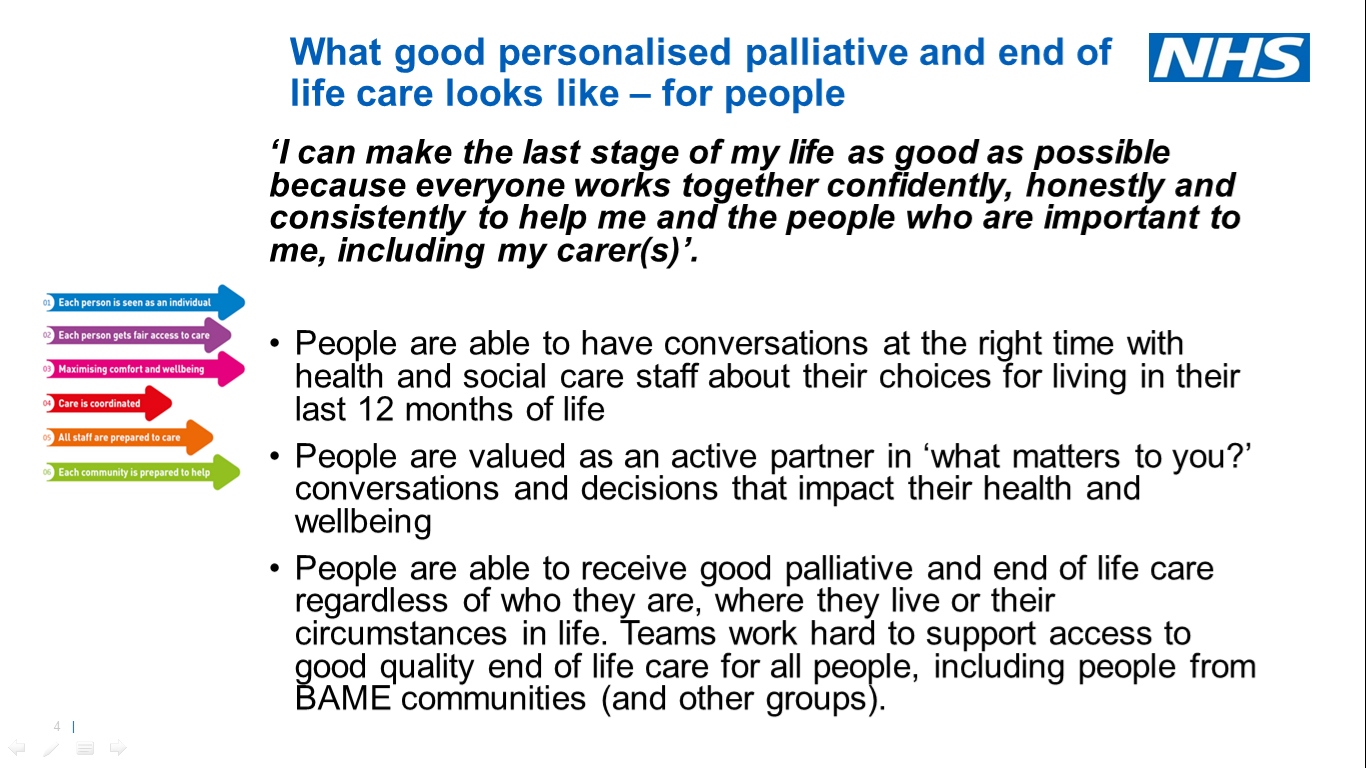
Due to the theme of the forum Sherone spoke to us about how palliative and end of life care in the NHS as a partnership picture fits across the whole of the country. This isn’t just about London specific. The program for palliative end of life care sits around six principles about people
1 – That each person is seen as an individual. 2- Each person gets fair access to care, that there’s 3- maximizing of comfort and well being for the person who’s at end of life. 4- Their care is coordinated. So everybody involved, knows what they’re doing, who they’re talking to. And information is flows freely. 5- That all staff involved prepared to care. 6- That each community is prepared to help.
So the above are the six points that come out of the ambitions framework on life care regarding the NHS long term plan, universal personalized care comprehensive model, they ought to be six points for people. Where we work together and it’s not just about one team.
Sherone pointed out that the program includes all ages, from children who are palatable ends of life to adults and older people, everybody. Sherone also talked about NHSI (short for NHS England & Improvement) about program, to make sure that people with lived experience, so carers, people who have got a condition, which means they’re going to die soon, people who are at the end of their life with just a few months or a few weeks to live, NHSI will try their best to involve those viewpoints in what their developing. NHSI are not doing it alone they want to make sure NHSI are talking about equality, and making sure there’s minimizing or reducing and removing discrimination from all the different groups of people they can think about.
NHSI wants to focus on health inequalities from people who have got the poorest outcomes, the poorest health experiences who die sooner than they should, because they’re not getting the right support. NHSI are making sure that they are championing and pushing those discussions of those conversations through as they continue.
However what does this mean for people? What does it mean for you? What does it mean? For the people you love, what does it mean reality?
NHSI are talking about what personalized palliative and end of life care looks like. So in other words, what does it mean, at the individual level? Then the ambitions about the person seen as an individual and all those points, the six points mentioned, that this is about making sure that every stage of life, e.g the last stage of life is as good as possible, because everyone works together confidently, honestly and consistently to help the people who were important to us, including their carers. So that’s the statement, or does that mean in reality? Well, that the staff and the people that work with you, and with us and with our loved ones, have conversations at the right time and they have conversations at the right time with us, as well as with the whole the health and social care staff involved in in their choices about what they want to do, that people, including the carers have valued as active partners in the conversations.
It was exactly their findings that people want to know about what matters to them to be seen as an individual and that you have people who have good access to care and treatment at the end of their life, no matter who they are, where they live, or what their circumstances are, they should be supported with dignity, with care with compassion, and not with someone looking down their nose at you, that is a standard NHSI want people to experience.
NHSI want people to get the specialist care they need when they need it, and that their views and their preferences, what they want about the future care is known. These principles apply to care generally and support generally. So that’s the overview. As an organization that is part of the ambitious partnership, lots of different health and social care organizations are part of the ambitious partnership together with NHS England and NHS improvement, it is everyone involved in health and care, that design and talk about and plan for the services that make a difference
Dr Laura Cole presents on Care home research
Dr Laura from Kings College London wanted to tell carers at the forum about a study that they are conducting at the moment. Dr Laura is looking at residential respite for people with dementia and their carers. Basically Dr Laura meant a short stay in a care home. So not when somebody lives at home, and then they just have a breaks and maybe they spend a week or two or maybe more, but they come back home so they don’t permanently stay in a residential respite in a care home.
So the researchers know that respite may be quite beneficial for some people, because it provides a change of scenery, it provides the carer with a little break, and then the hope is that with that brake, the carer can continue caring for longer, and obviously, they’re able to do the things that they want to do, they can go on holiday, but also it is kind of a way of building resilience and getting strength back. Sometimes it can be something to look forward to as well. So it’s case of, I’ve just got a few more weeks to go and then I’m gonna got this lovely thing to look forward to or a break. And, and it can be beneficial for people living with dementia as well and as they have a break.
That is the reason for what the researchers are trying to do as they know that many people with dementia and their carers don’t access this service. So what they would like to do is interview people who have had the service, and then interview people who also have declined the service so that the reseachers can marry the two up and see what the the pros and the cons of residential respite are. Dr Laura had planned to do all this pre COVID so they were going to interview people in their own homes, and from from these two groups, so obviously, they still continuing with that, but they are doing it using zoom, over the telephone, though. They want to interview people living with dementia, and family carers about their experiences.
When I was caring I felt that the services my mother used impacted on my caring experience. I feel its vital carers do the same and feedback about health and social care services.
Are you a Lewisham resident? Have you been using health and social care services during the pandemic, whether it’s digitally or face to face? Are you passionate about improving health and social care services for the community?
I encourage you to leave any feedback, positive or negative, about your experiences (it is ANONYMOUS). This can be about your local pharmacy, GP, hospital, optician, dentist or community health, mental health, and social care services.
You might also consider sharing it with one or two of your friends and family members?
More information:
At Healthwatch Lewisham they are continually wanting to hear and learn from patients, carers and relatives about their experiences with health and social care services in Lewisham. This has changed slightly during COVID-19, however, to ensure patients have a mechanism for leaving feedback and helping to improve services for the community, we have created a Patient Experience Survey.
Your feedback allows Healthwatch Lewisham to see what is going well for Lewisham residents and what can be improved.
To learn more about Healthwatch Lewisham’s current work or to leave feedback via their Digital Feedback Centre on their website, please visit www.healthwatchlewisham.co.uk


 A Caring Mind