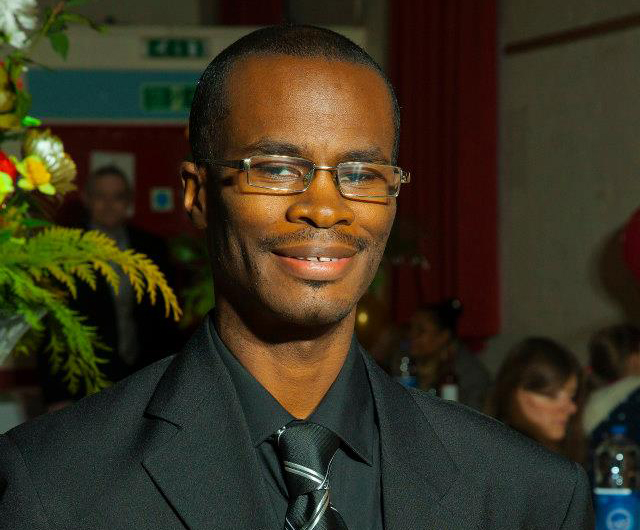
Hello, everyone!! Merry Christmas thanks for joining me here today to explain a bit more about future projects that I’m going to be working on. Some of them actually, almost practically finished. So yep, my name. As you can see from the title here, my name is Matthew McKenzie, Carer campaigner, Mental health carer activist who facilitates several carer groups around half of London.
what I want to do is just explain a few things regarding some books that I’m working on. I’m going to start developing audiobooks, I will of course continue to work on paperbacks, one of them is in draft at the moment. I’ll talk about that in a bit.
If you want to see the video version of this blog, please watch below.
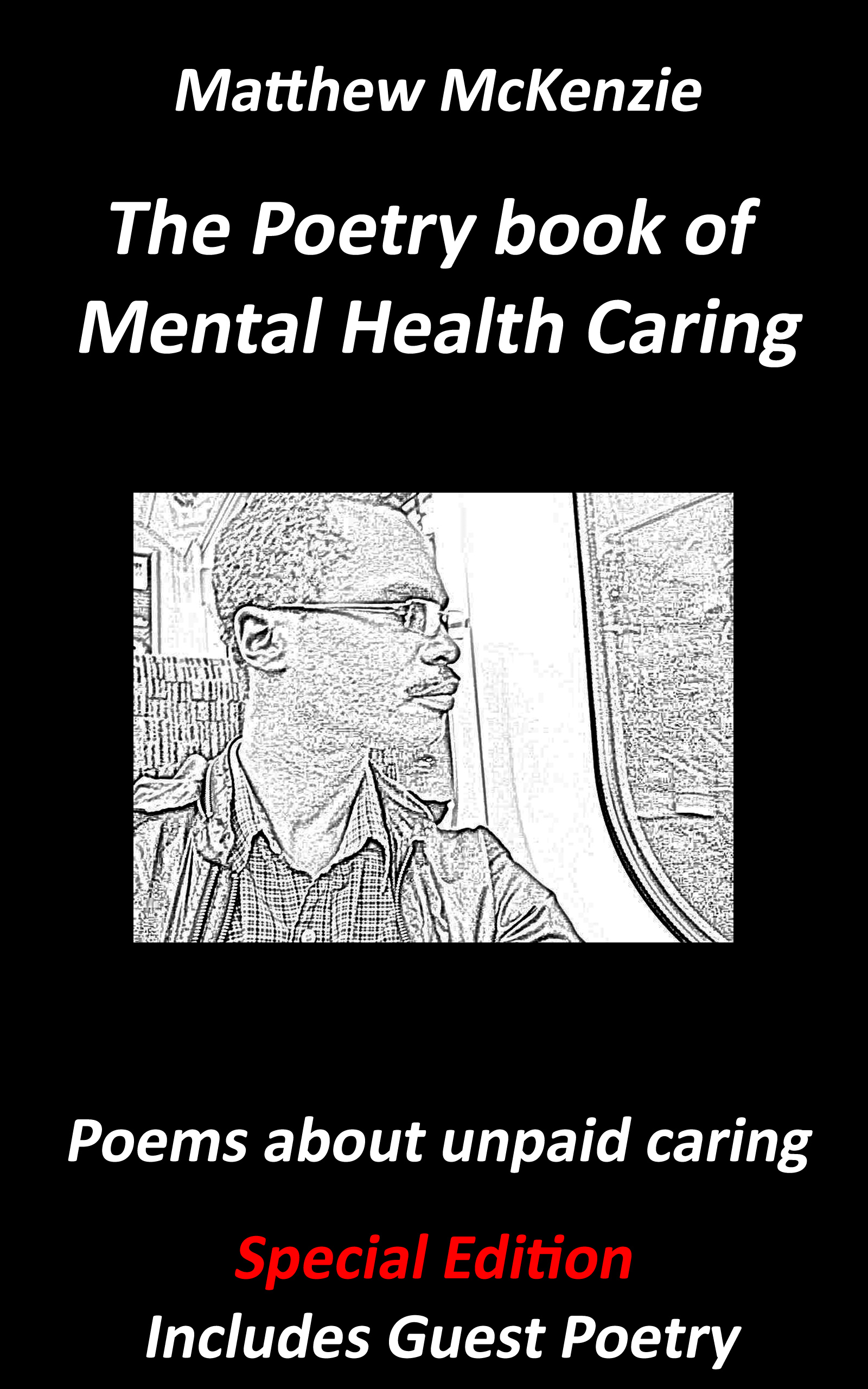
Special edition of my poetry Audio book – The Poetry book of mental health caring
So during summer 2022, I published my first poetry book. This was my first attempt at what I felt would be focusing on the experiences of providing mental health care. One of the reasons of doing poetry is that you don’t have to really read a whole book to just sort of reach out to those who perhaps understand, in a sense of what’s it like to provide care for someone with mental ill health. Plus to also reach out to those who’ve never experienced it.
So I’m doing an audiobook project on my poetry, but with the added benefit of contributions from other carers who are activists or are poets who want to produce poetry on the carers experiences. So I’m hoping to publish in early 2023, January, February, by that time, that audiobook will be coming out.
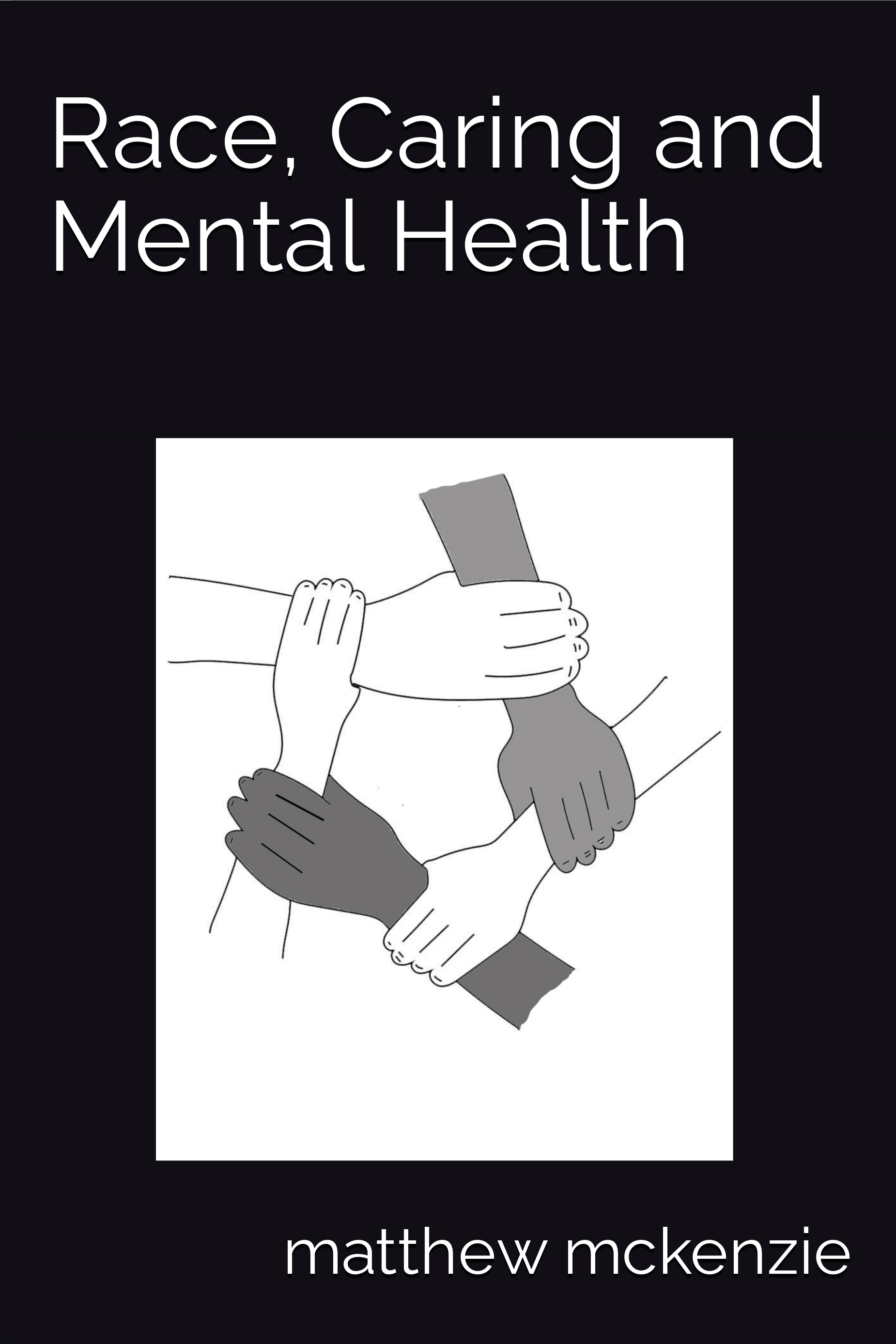
Race, caring and mental health
The next book, which is not an audio book, will be in paperback form. I felt it was due time to come out. This is because I have been writing books close to two years now. I have also been running as carer groups, but two of them focus on ethnic carers coming from ethnic minority background, so obviously, they are providing care and support to someone experiencing some form of mental illness.
I’ve been meaning to develop a book like this for some time looking at how mental illness can impact on the family, on friends, not from the patient side. Let’s look at this new book closely. The book titled “Race, Caring and Mental Health”. From it’s first chapter, I often say to many people that it’s important to tell your story. With this book, I felt it even more important due to some of the tragic consequences that can happen to ethnic minority groups providing unpaid care. This is it’s not just within the mental health system as the book’s second chapter will be looking at discrimination and racism, and links to mental health, for the other chapters, they will focus on health inequalities and the structures. The book will explore the deadly roundabout regarding the repeat situations of those going in and out of the mental health system. Why does this occur?
I don’t have the answers and can only share my ideas of what I’ve seen and what I’ve heard, but I know what I’m learning about. I’d be really interested on people’s views of my new book, which is in draft form at the moment and I will probably change a couple of pages in the hope to release this around January 2023.
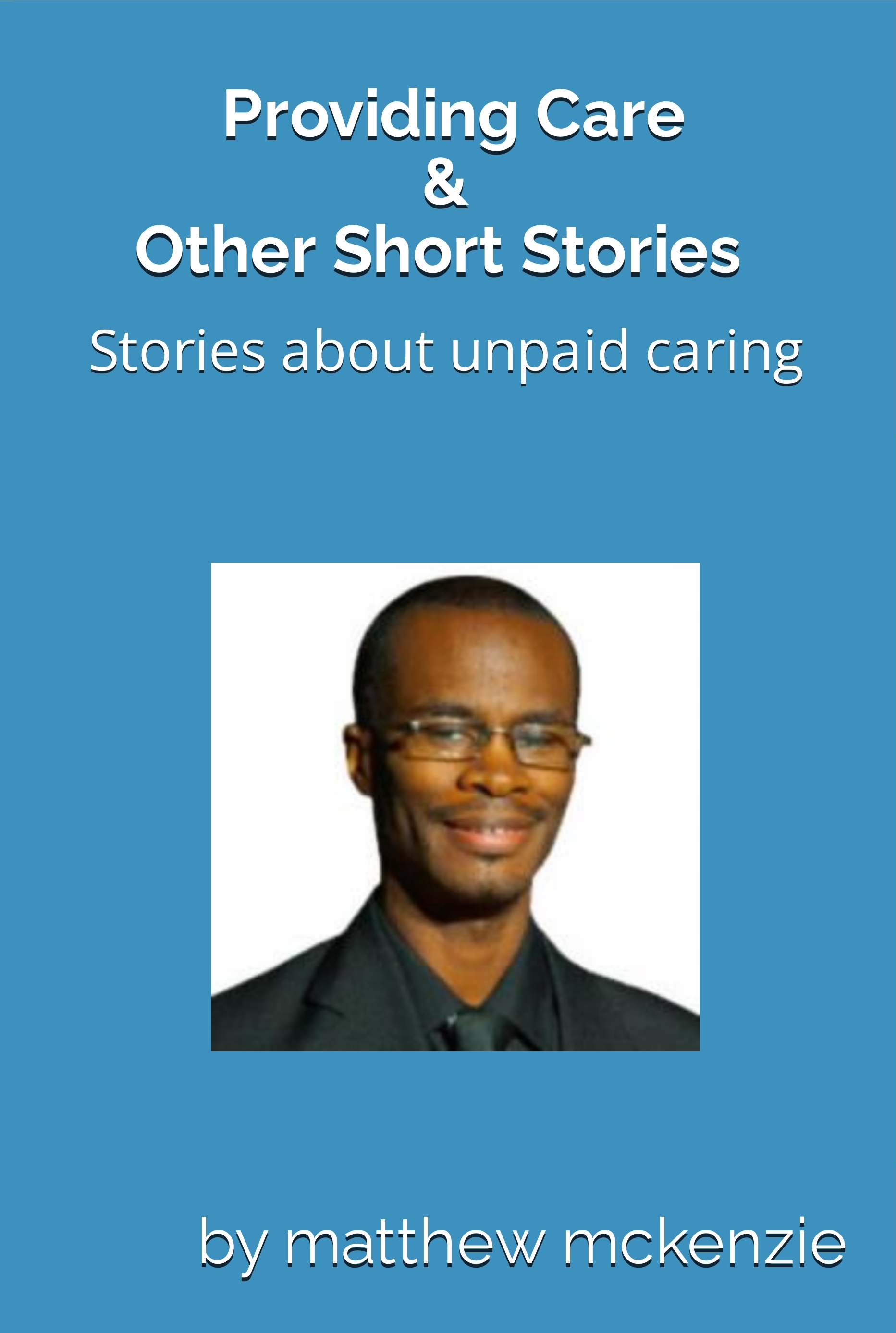
Providng Care and other Short Stories
Lastly my 6th piece of work will be an audiobook, similar to the project of the poetry audiobook. But this time I want to work towards fiction. Now, I’ve been writing two years now. Most of the books that I’ve been doing are not fiction at all. I mean, I suppose you could argue in some sense that poetry is looking at certain topics that may or may not happen. So this new audiobook will be my first attempt at fiction, including 20 short stories about unpaid care, here are some of the stories below.
This audio book will explore some of the following carer themes.
Providing Care Story about a woman finding out her husband has developed a form of mental illness, she now has to battle to become an unpaid carer.
Digging out of a hole A young man caring for his sister, but this time there are horrible things that make his life difficult.
A family Affair Story of a main carer feeling isolated by the family, everything is thrown at her and no one wants to help.
Never thought it would be me A female carer whose partner is caught in a serious accident, her life is turned upside down as she battles to provide care for him.
Angry A carer thrown into anger and despair as she is let down time and time again, leading her to becoming angry.
Just when I needed you A story of carer peer support and why it is needed, a story that is more hopeful than previous stories.
Anyway, thanks for stopping by. Hope you have a lovely holiday break.
Hello fellow unpaid carers. Here are some more poems from my book “The Poetry book of mental health caring”.
Every so often I tend to make videos of my poetry off my YouTube Channel.
The Long Wait – Poem by Matthew McKenzie
The Poem below describes my experiences in a hospital when trying to help my mother who was suffering mental and physical health problems at the time.
The unwanted role – by Matthew McKenzie
This poem below focuses on someone becoming an unpaid carer for the first time. The poem explains from their view that they are slightly aware of the difficulties they will face, but will have to face these challenges alone.
How do I say this? – by Matthew McKenzie
The Poem below explores the struggles a carer has in understanding mental illness. He is aware of the stigma when he is trying to communicate with his daughter, but he is dealt a blow regarding his own caring duties and also to fight to sustain a relationship with his daughter.
The Triangle – by Matthew McKenzie
The poem below explains a mental health policy aimed at NHS organisations to make sure carers are included in services. The Triangle of Care has a long history and is highly sought after by mental health NHS trusts to strengthen carer strategies.
To explore more carer/mental health poems from Matthew McKenzie, you can check out the book below on Amazon.
Welcome back to a summary of chapter 3 of my book “Experiencing mental health caregiving”
This blog focuses on my 2nd book – Experiencing mental health caregiving. The book helps raise awareness of unpaid carers providing care to someone close suffering mental illness. The book highlights the experiences of providing unpaid caring.
For Chapter 3 – “Carer befriending and peer support” I asked carers several questions, but this video will look at the first question that being “What does carer peer support mean to you?
The reason I asked such a question was down to how can carers relate to others when caring can be a private and personal experience. Do carers know they can get support from others to reduce stigma and increase carer knowledge?
Just like the videos I have done on my 2nd book, I will sum up a few responses from those regarding “Carer Befriending and peer support”.
To check out the video summary see link below
So going back to my book, chapter 3 got responses regarding carer peer support, you can see the responses below.
One carer Jacqui Darlington responded
“A carer peer is someone who can offer emotional and practical support to another carer by using their own lived experiences which may enable them to overcome barriers, challenges and fears to achieve whatever it is they may need. They may also be known as Experts by Experience .”
I not only asked knowledgeable carers, but also engaged with mental health trusts.
Nottinghamshire Healthcare NHS Foundation Trust rep responded
“We train people up as peer support workers or carer peer support workers. We are now employing them in the jobs at the NHS trust. I think as a carer peer support worker, the difference between that and pure peer support worker is that the carer peer has lived experience in caring. .”
One last point – Another carer responded
“To me, carer peer means supporting a carer who may be struggling with the sometimes overwhelming difficulties experienced when caring for a loved one with mental health issues. Being there for that carer, sharing personal experiences and showing an understanding of what they are going through”
I asked 8 other questions for Chapter 3,
Have you experienced carer befriending and what did it feel like?
Where should carer peer support be located?
Do you think there is enough education on carer peer support?
Would you befriend other carers?
Is there a line or boundary to carer peer support?
Is there a difference between carer peer support and service user peers?
Why is carer peer support lagging behind?
The responses I will cover in a later video, but to sum up What does carer peer support mean to you?
I noticed that lived experience was critical to becoming a peer carer. To share your understanding and knowledge of the caring role and help those new to caring is vital in forming a connection.
if you are interested about mental health carers, you can buy my book on the link below
Here is a very brief update of my South West London Mental Health carer peer group. It is one of the 5 carer forums I do, but is a hybrid of a peer group and an engagement forum. As with all carer forums that I run, the forum seeks engagement from mental health services, since most members are carers of someone with mental health needs.
You might find it wierd that I am doing a november 2021 update at the begining of february 2022, but I have been so busy running carer groups, working on my poetry and helping out engaging with mental health trusts.
The SW london carers forum was packed with speakers including myself
Joy Hibbins – CEO of Suicide Crisis Rachel Nethercott – Carers UK – State of Caring Report 2021 Diane Fox – University of Kent on experiences of unpaid carers Matthew McKenzie – Carer Rep and Author – carers and poetry project
We were also joined by Sir Ed Davy’s team who plan to attend when they can to gain some insight into things affecting unpaid carers.
Sir Ed Davey
Joy Hibbins presents on the importance of suicide prevention.
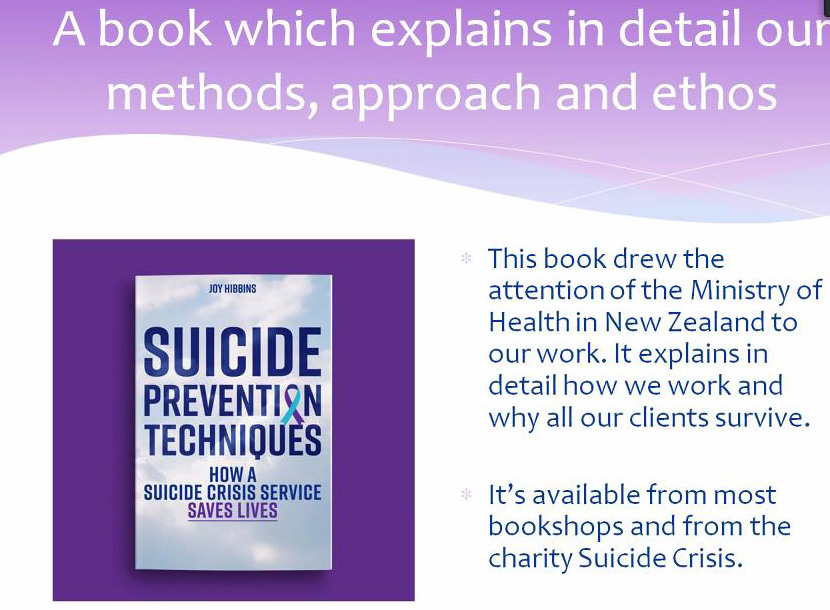
Joy Hibbins an author, runs a charity called suicide crisis, which provides suicide crisis services and trauma services. The reason why Joy wanted to set up a suicide crisis center was because of her own experience of suicidal crisis in 2012, after a traumatic experience. It led to her being referred to the mental health crisis team for the first time. She found that the services didn’t work for her and she could see very clearly why they weren’t working for her. She started to think that what was needed was a suicide crisis center, where people could come every day when they’re in crisis. Except if they were at imminent risk that they could be supported over a period of several hours. She started to think about the ethos and the methods she wanted to use because she felt that they needed to be different from those of psychiatric services.
Joy experienced a huge amount of skepticism and doubt that someone like her could even set up a suicide crisis center. Not only did she want to set up a crisis center she also wanted to set up a center, which would be about early intervention in order to try help prevent descent into crisis. So it was seen as a very ambitious project, particularly for someone like herself, who was a psychiatric patient that had recently been in crisis.
So with the suicide crisis center, people can either self refer or be referred. The referrals are from NHS, police charities, and all kinds of other agencies as well. From 2012 there was huge doubt and skepticism to where things are, plus it has been an extraordinary journey for the team in a very unexpected journey. where the work is having an impact in countries like New Zealand, where the Ministry of Health in New Zealand contacted Joy’s team, as they were devising their new national suicide prevention strategy to find out what they could learn and how they could use some of the learning that they took from Joy’s team in their strategy.
Some of the points about their suicide crisis center is that it’s in a central location, easily accessible, it’s not a drop in center, but they can see people at very short notice. So sometimes they state to people not to think of them as an emergency service. Altough Joy thinks there are times where they have to be and that there is a need to be able to see people within half an hour, whether that’s them coming for the service or the service going out to them.
Very recently Joy has published this 40 Is the suicide prevention pocket guide book. There’s a slight irony that it’s called a pocket guide book because she thinks When they planned the book with a publisher, it was going to be a pocket guide book. But in the end she wanted to also make it a really comprehensive, detailed book that would be full of relevant information.
Eventually it became 220 pages. So it’s much more of a comprehensive handbook. But she liked the idea of a pocket guide book because one of their clients made this wonderful quote a few years ago, and he said that he carries us in his pocket with him at all times. Joy thinks that really highlights the strong connection that they build with their clients so that even when they are not with them, they feel connected with the team. Joy always has kept this in mind.
Joy Hibbens will be engaging more with our SW London group members regarding suicide prevention workshops and talking to families and carers for 2022
Rachel Nethercott – Carers UK – State of Caring Report 2021
The next speaker was from Carers UK and Rachel has been very helpful engaging with my carer forums to update us on what Carers UK has been doing.
This section was probably an interesting section for Sir Ed Davy’s team as they want to report back on the groups findings plus questions that were raised.
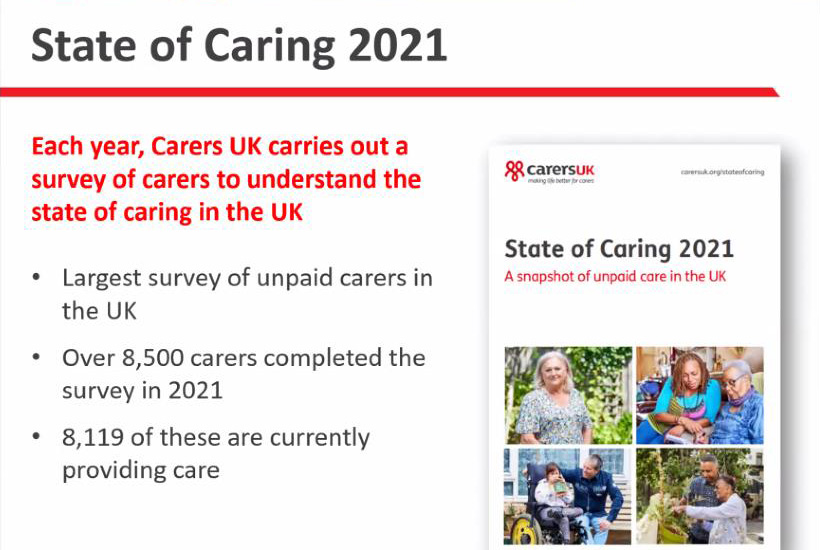
Rachel is the Senior Research and Policy Officer with carers UK. She was at the group to present some key findings from Carer’s UK annual State of caring survey, and also how these findings inform Carers UK practice, and policy. Rachel mentioned that some of us actually may well have completed the survey, in which she thanked us. She felt that our time added to the kind of painting a picture of the key findings.
She recommended if we have time that we go and read up the report. Rachel then gave us a quick overview of the report. It’s actually the largest survey of unpaid carers in the UK. Carer’s UK conduct this every year, except for 2020 due to the pandemic. Carers UK did another research instead. But normally, they do this every year. So for the year 2021 it was completed by over 8500 carers, the vast majority of them are currently providing care. The kind of stats she showed in the presentation are for people who are currently caring.
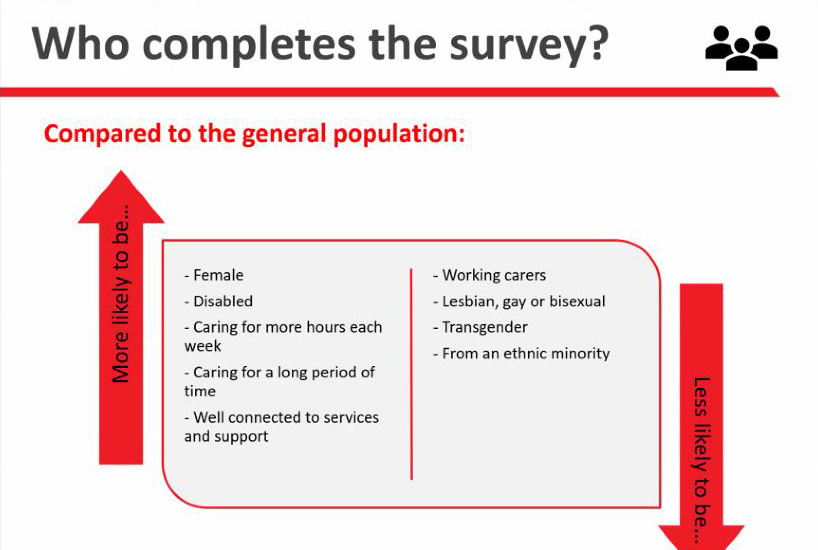
The people who complete the state of caring survey are more likely to be female, more likely to be women, more likely to be disabled. than the general population, and also likely to be at the heavy end of proving care than the average carer. Almost half of everyone that responded to this survey have over 90 hours a week.
Some people who completed the survey were also generally well connected to services and support, they identify as a carer in where they knew their rights and the support that they were entitled to. Unfortunately some carers who filled out the survey were less likely to be working, which can be your average carer. So only around a third of the people completing the survey are either in full or part time work, which is less than what Carers UK had expected to see. The average person who goes filling out the survey were British women. It’s still interesting findings, and it tells us a lot about carers as Carers UK would love carers from all backgrounds to fill in future surveys.
Diane Fox – University of Kent on experiences of unpaid carers
Diane Fox works at the University of Kent at the Persons Social Services Research Unit. She is working with a colleague from the London School of Hygiene, or medicine, on a project regarding diverse experiences of unpaid carers across the caring projectory, this being CCAP short.
Diane came her to give us a bit of background knowledge about the projects, and then hopefully get some of our input.
Diane mentioned that the research often doesn’t follow the same carers over time, and doesn’t often look at differences between subgroups, which ties in with what she is presenting. It’s a question about not just looking at White British carers that are female but strengthing the design to include other carers.
For this study, they are trying to look at how or why some carers maintain a good quality of life over time, and how or why others do not. The reason they want to do this research is to inform the support services for carers, because we know that people’s experiences of caring can vary quite widely. For instance, someone with a degenerative condition is likely to be very different to caring for someone who’s got a relapsing mental illness, caring for a spouse or a partner is likely to be very different caring for your adult child, or your aging parent. So it’s got four research questions.
Diane’s researchers looked at what’s associated with unpaid carers quality of life over time. Does this differ between subgroups of carers? What support services or other things enable carers to optimize their quality of life? What barriers to frequently excluded care space in accessing services? How can these be overcome?
So that, again, ties in to what Rachel was talking about that some groups are less likely to identify themselves as a carer or access services. So there’s five stages to research that feed into one another.
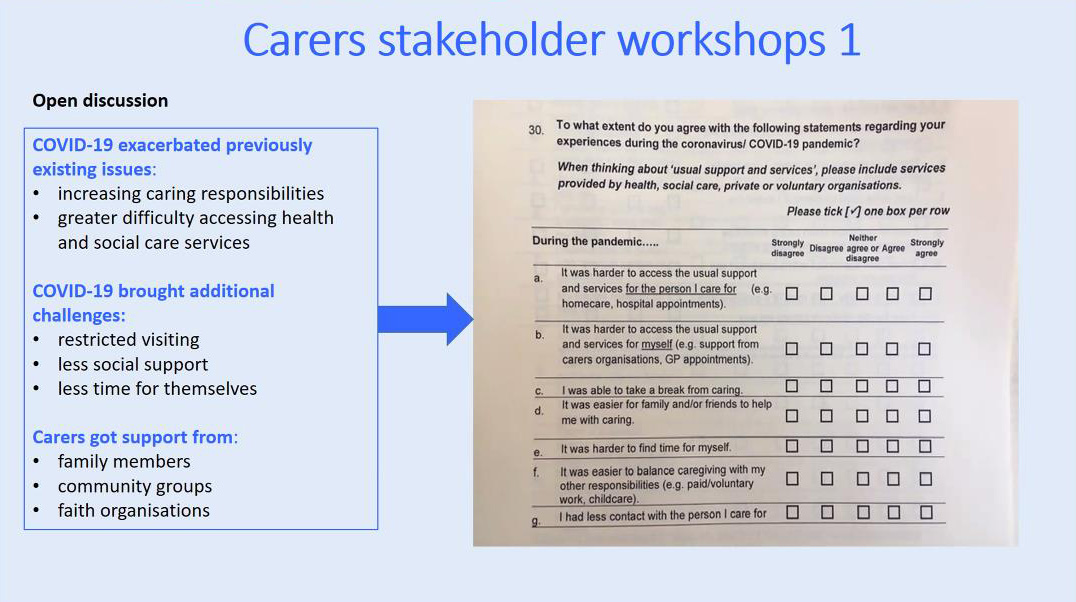
So first of all, the researchers did a scoping review to look at previous research and identify what’s associated with quality of life over time, they found that so many things are in that research that they needed to narrow down the scope of the project to keep it manageable. So for the second stage, they held a series of stakeholder workshops, which they invited a nationwide group of parents and service users, local authority commissioners, service providers, and community and voluntary organizations. At the workshops some of the things that they said in the open discussion where people would firstly outline their caring circumstance, identify it, identify areas of difficulty, and the sources of support that they found helpful.
So in the open discussion, the attendees spoke about particular issues but they were facing particularly related to the pandemic because that was very pertinent at the time just come out of one of the lockdowns. Diane presented how their input fed into the content of the questionnaire. So this is what the researchers got from the first bit of discussion they had with people.
Next, they asked carers to rank topics in order of importance, which was shown on a graph that shows what their preferences were. So more than half of carers said social support was the most helpful. Diane spent quite a bit of time presenting more of the research where we had a Q&A session to help inform Diane our experiences.
Matthew Mckenzie’s Poetry Project
As I have mentioned already, I am working on my poetry phase regarding the experience of care. I read out one of my poems call “On Alert” at my carers peer group and you can view the video of my poem below.
This concludes my November update of my SW London carers peer group
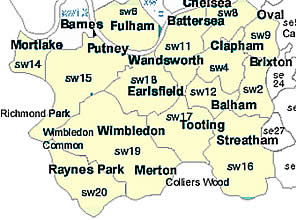
Welcome to my November update of my ethnic carer forum. I am slowly changing it from BAME to ethnic although most members who have attended over the years are not that fussed with the title, it is the discussion, focus and engagement regarding the challenges many minority ethnic carers face. The forum covers a large area mainly Lewisham, Greenwich, Bromley and Bexley due to my other carer groups in Greenwich and carer forums in Lewisham. The forum seeks engagement from South London & Maudsley NHS trust and Oxleas NHS trust half the time, but the carer group gets education and empowerment from national speakers regarding race, racism, complexities in mental health and so on.
For the November BAME carers forum the following speakers were
Brenda Onatade – Her Patient Carer Race Equality involvement and update
Samantha Hosten – Importance of Black History month mental health
Lauren Obie – Blacks MindS Matter UK
Lily and Jemma – Maudsley NHS Patient Research ambassadors
Welcome to my latest blog about my new book. My name is Matthew Mckenzie a former mental health carer who cared for his mother who suffered from a form of schizophrenia.
I have decided to highlight chapter one of my book “Experiencing mental health caregiving”
The first chapter explores what unpaid mental health carers feel about their identity. Each chapter of my book asks several intriging questions about mental health caring, which of course focuses on unpaid carers e.g. families and friends caring for someone close suffering mental ill health.
Carer Identity
The first question I asked carers on chapter one, which is “Carer Identity” was “What does it mean to be a mental health carer?”
You can see the video of this below below
The reason I asked such a question is that those who suddenly find themselves providing care might find some of the answers useful. Perhaps even NHS professionals or social workers might find the answers important.
I will pick out a few responses that I found highlighted the importance of carer identity.
One carer responded as
“I think that it’s difficult. Often nobody other than the carer can see the disability with the person that you’re caring for. And so, they go unnoticed. Plus with mental health, it fluctuates and dramatically as well.“
Another carer felt
“For me to be a carer of a mental health patient has turned my world upside down completely. This is different when you caring for somebody outside your family, but when it is someone in your family then it is an application of emotional attachment.“
Another carer summed up “My own identity disappeared in the beginning of my caring journey. It also means getting acknowledgement from healthcare professionals that I am an important person in my loved one’s care“
What I thought was interesting is how difficult it was starting out caring for someone suffering mental illness, notice the responses all mentioned how tough it was when they first started out caring. Although certainly take note, I have only shown some of the responses here as others in the book might be different. One thing to note is some carers might find the role gets easier depending on their knowledge of the illness or the support they may get from services, community or other members of their family. This might not be the case for all unpaid carers.
For chapter one I asked around 8 other questions regarding carer identity and if you are interested about mental health carers, you can buy my book on the video link description.
Happy new year to visitors of my mental health carer blog site. As mentioned in my earlier blog posts, I am working on promoting awareness of caring for someone suffering mental ill health.
I created a number of carer poems, quite a few are on this site, but are subject to being edited as I am often fine tuning poems.
I am also adding a couple of my poems on to my YouTube platform and will blog them every so often.
The poem I want to introduce here is titled “On Alert” as it highlights the struggle unpaid carers go through in prompting medication. A lot of carers hate doing such a task, but when the experience the person’s mental health crisis, they want to try avoid the situation again and take resort to being on alert.
Watch my 2 minute poem “On Alert” off my video link below.
Welcome back to another blog by unpaid carer Matthew McKenzie. I am slowly breaking into the world of becoming an author and I am pleased to announce my 2nd book on the experience of caring is out.
The title of the book is called : Experiencing mental health caregiving – Unpaid Carers
Obviously due to my previous role caring for my mother, this 2nd book focuses on mental health carers. What I mean by that is getting views, statements and comments from those who look after someone suffering mental ill health. The book is not to be taken as an audit, but a philosophical look at experience of care, I wanted those to be philosophical on their experiences of being a carer and anything mental health related. There will be comments that stated facts or sometimes seem like a pitch, plus some comments might offend some people, but it is very important to just get the voice out there and understand why someone would comment in such a way.
I am known for my networking to carers and this was the nature of this book. I wanted the book to be a link and connection to other unpaid carers, this is so that there is some form of identity for carers and a way to relate to the experience of care. The book is very large with over 300 pages and 33 chapters. The book however was quite challenging to compile experiences, because quite a few comments brought me back to when I was a mental health carer and some things hit hard.
To research the content for my book, I had to approach many mental health trusts and carer centres to promote my project and I thank those that have contributed.
Many thanks to CNWL, West London Health trust, Nottinghamshire Healthcare NHS Foundation Trust for their lovely newsletter, Cambridgeshire and Peterborough NHS Foundation Trust and many other mental health trusts allowing me to present about my project.
I also approach universities especially those who taught psychiatry, psychology or those who led on social care courses. I wanted their opinions as well, because if you want nurses, social workers, doctors and psychiatrists to work well with carers, you have to start where they are being taught their profession. I did want to include contacts from large organisations, but it was too difficult, although I do hope they support and promote the book. If anything is going to bring changes to the experience of care, it needs to be the voices of carers being amplified.
Next year, I certainly want to expand on the chapters I wrote in this book especially regarding the views given by those who contributed, however before I undertake my next project. I want to try my hand at poetry.