Chaired by Matthew McKenzie – Carer Activist
The March session of the National Ethnic Mental Health Carer Forum brought together carers, researchers, NHS professionals and community organisations for a conversation that felt both familiar and urgent.
Chaired by Matthew McKenzie, the forum stayed rooted in what it does best: creating a national grassroots space where lived experience meets systems, and where difficult truths are not avoided.
The agenda reflected that balance clearly:
- 10:35 – Professor Saffron Karlsen (University of Bristol)
- 11:20 – King’s College London (Phoebe Averill & team)
- 11:50 – Parliamentary and Health Service Ombudsman
- 12:00 – Thomas Ince – Universal Care Plan
Racism and Mental Health: Naming What We Already Know
Professor Saffron Karlsen opened the forum with a presentation that didn’t just describe inequality it explained how it is produced, sustained, and experienced in everyday life.
Drawing on over 30 years of research, Professor Saffron Karlsen is a sociologist at the University of Bristol whose research examines how racism and social inequality affect health, particularly within ethnic minority communities.

she spoke about racism not as a single act or incident, but as something woven into the fabric of society. It operates quietly and persistently, through institutions, through policies, through media narratives, and through the ways people interact with one another. The effect is cumulative. It builds over time, shaping not just opportunities, but health itself.
What made the presentation particularly powerful was how it connected these structural ideas to real human consequences. Racism was described as something that works on multiple levels at once: from overt abuse or violence, to the less visible but equally damaging experience of simply knowing that you live in a society where you may be treated unfairly. That awareness alone carrying the expectation of discrimination creates a constant undercurrent of stress and anxiety.
She explained how this stress doesn’t just sit in the mind. It translates into physical outcomes. People exposed to racism are more likely to experience anxiety, depression, and long-term distress, but also physical health inequalities such as cardiovascular disease. These outcomes are often misunderstood or misrepresented. Too frequently, they are explained away as lifestyle issues diet, exercise, personal choice without recognising the deeper social conditions that shape those behaviours in the first place.
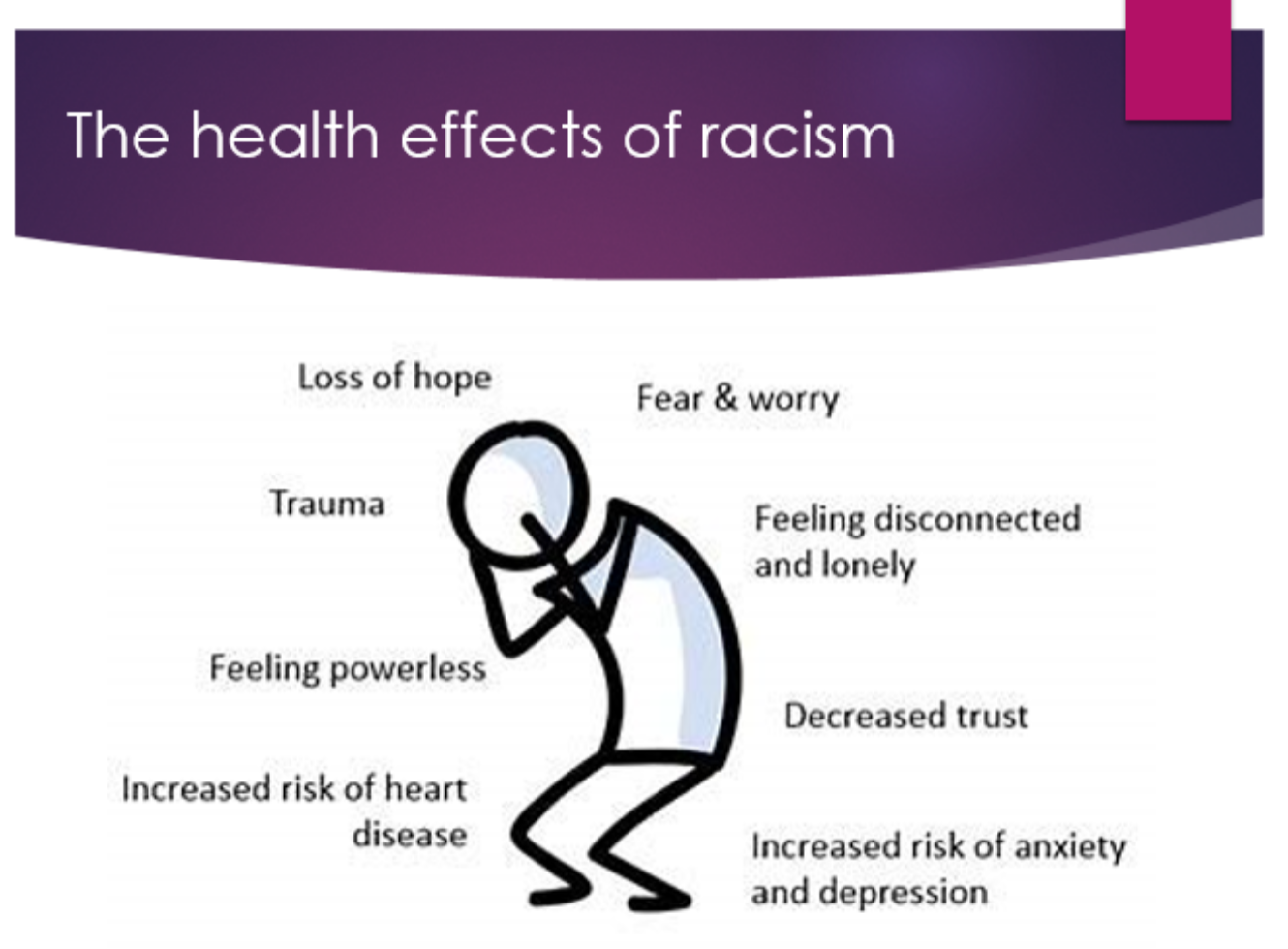
A particularly striking part of the presentation focused on how people respond to these pressures. When individuals feel powerless to change their circumstances, they may turn to coping mechanisms smoking, drinking, or withdrawing from services. These responses are then judged in isolation, rather than understood as part of a wider context. In this way, the system not only fails to address the root causes but can end up reinforcing blame on the individual.
Perhaps the most important insight came when the discussion turned to healthcare itself. Even when services are available, they are not always experienced as safe or trustworthy. Saffron shared research showing that people may avoid seeking help not necessarily because of direct negative experiences, but because of what they have seen and heard about racism more broadly. The perception of risk becomes enough to keep people away.
One example described a woman who, during the COVID period, chose to avoid hospital care entirely. Her decision was shaped by what she had seen in public discourse and online reactions to racial justice movements. It left her feeling that she could not trust how she would be treated. This kind of anticipatory fear of not being treated with dignity or fairness adds another layer of stress to an already difficult situation.
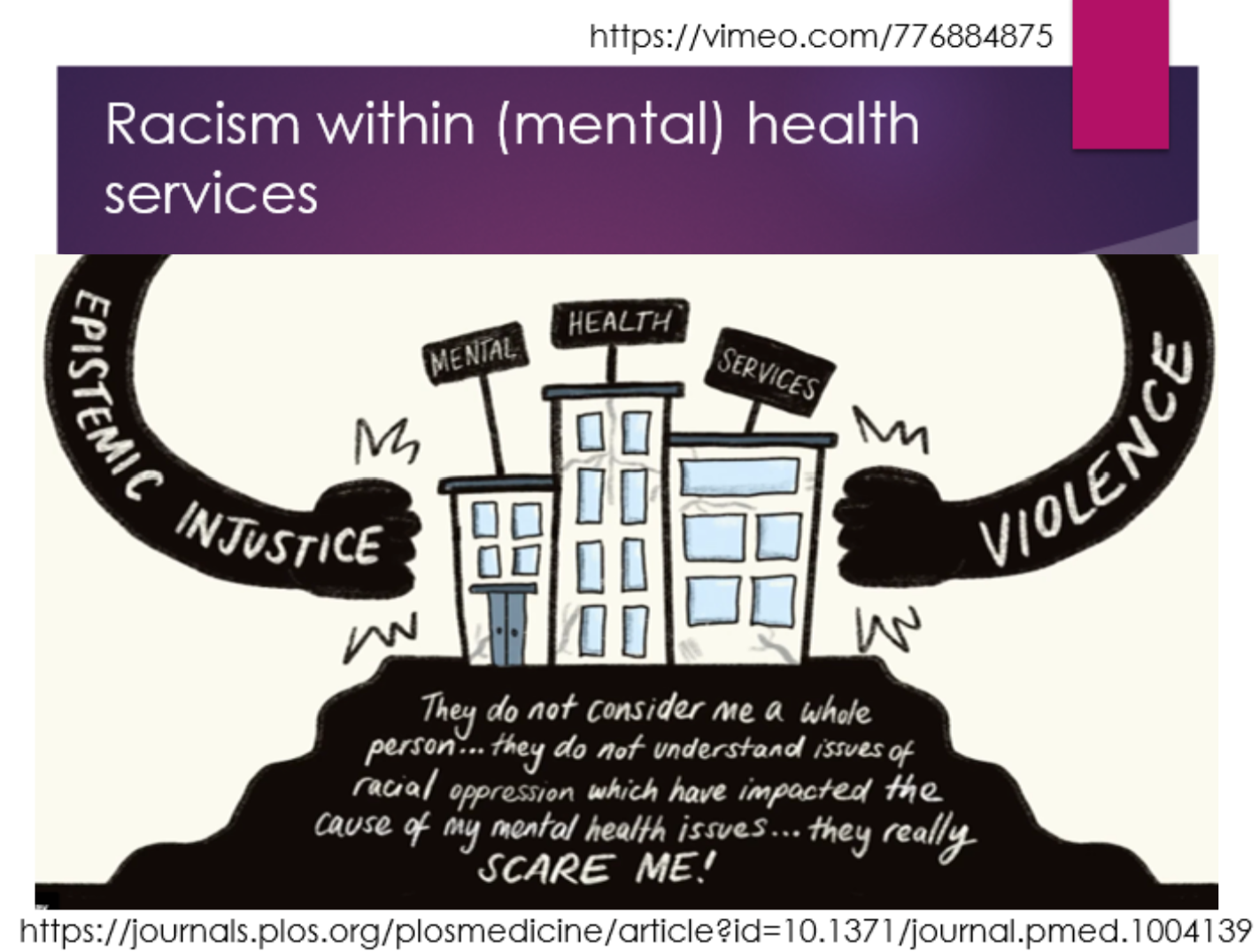
The presentation also challenged the way healthcare systems understand illness. Many services still operate within a narrow biomedical framework, focusing on symptoms and diagnoses while overlooking the social realities that contribute to them. For people from marginalised communities, this can lead to experiences where their perspectives are dismissed or misunderstood. They may try to explain how racism, housing, poverty, or life circumstances have shaped their health, only to find those explanations sidelined.
This is where the concept of “epistemic injustice” becomes important, although Saffron didn’t dwell on jargon, the meaning was clear. It is about whose knowledge counts. When patients and carers are not listened to, or when their experiences are not taken seriously, care becomes something done to them, rather than with them. For many, this is not just frustrating it is re-traumatising.
Professor Saffron also showed a video – Nilaari delivering hope A community mental health provider for people of colour, which you can watch below.
Q&A Section : From Evidence to Frustration
1. “You’ve explained the problems, but what are the solutions?”
Answer:
Saffron acknowledged that addressing racism at its root is complex and long-term, but highlighted practical steps:
- Services must be co-produced with people who have lived experience
- Communities need to be actively involved in decision-making spaces
- Grassroots and voluntary organisations should be:
- properly funded
- meaningfully included in policy and service design
She emphasised that change should be done with communities, not to them, and that learning from effective third-sector approaches is key.
2. “Do you look at drug and alcohol use as part of racism-related issues?”
Answer:
Yes, but not in the way systems often frame it.
Saffron explained that:
- Substance use is often a response to difficult life experiences, including racism and poverty
- Systems tend to treat it as an individual problem, rather than understanding the wider causes
- These behaviours can reflect a lack of:
- support
- options
- alternative coping mechanisms
She stressed the importance of shifting away from blame and towards understanding context.
3. “Is trauma-informed care part of the solution?”
Answer:
Trauma-informed care is important, but not sufficient on its own.
Saffron highlighted that:
- Current models of trauma-informed care can be too narrow
- They often fail to fully account for:
- systemic racism
- structural inequalities
- Services also need to recognise that they themselves can contribute to trauma
She suggested that trauma-informed approaches must be:
- culturally sensitive
- shaped by different communities’ understandings of trauma
4. “What do you mean by ‘racism is a virus’?”
Answer:
Saffron used this idea as a metaphor.
She explained that:
- Racism spreads and reproduces across society, much like a virus
- It moves through:
- institutions
- policies
- social interactions
- It grows and reinforces itself over time
At the same time, she used this idea to challenge overly individualised thinking—highlighting that racism is structural, not just personal.
King’s College London: When Crisis Care Comes Too Late presented by Phoebe Averill.
After the earlier discussion on racism and inequality, the presentation from King’s College London brought the conversation into something more immediate what actually happens when someone reaches crisis point and needs urgent mental health support.
Phoebe Averill and her team focused on pathways under the Mental Health Act, but what emerged wasn’t a technical discussion. It was a picture of a system that often struggles at the exact moment it is supposed to respond.
They began by looking at the period just before crisis. In many cases, there are early warning signs. Carers and families notice changes subtle at first, then more obvious. They often try to raise concerns early, hoping intervention might prevent things from escalating. But too often, those early signals are not acted on.
By the time the system responds, the situation has already deteriorated.
The research highlighted that delays are not caused by a single issue, but by a combination of pressures within the system. These include:
- shortages in hospital beds
- fragmented coordination between services
- breakdowns in communication across teams
While these explanations are familiar, the impact of them feels anything but routine. During the waiting period, people do not remain stable. They become more unwell, more distressed, and more at risk. What could have been addressed earlier becomes a crisis that is harder to manage.
One of the most striking parts of the presentation was the focus on what happens in that gap between “something is wrong” and “help arrives.” That space is where much of the pressure shifts onto carers.
Carers described being left to manage situations that are escalating in real time. They are expected to keep someone safe, to monitor behaviour, and to absorb the emotional weight of what is happening all while waiting for services to respond. In some cases, this can last days or even weeks.
This isn’t a formal role, and it’s not one carers are prepared for. It’s something they step into because there is no alternative.
The consequences of these delays don’t end when care finally arrives. By that point, the impact can already be significant. The research pointed to outcomes such as:
- worsening mental health leading to longer hospital stays
- increased risk of avoidable harm during the waiting period
- disruption to housing, employment, and relationships
In other words, the delay itself becomes part of the problem, shaping what happens next.
Another important thread running through the presentation was the role of carers’ knowledge. Carers are often the first to recognise when something is changing. They understand patterns, triggers, and early warning signs in a way that professionals may not see immediately. Yet this insight is not always taken seriously or acted upon.
The result is a system that tends to respond late rather than early intervening at crisis point, rather than preventing it.
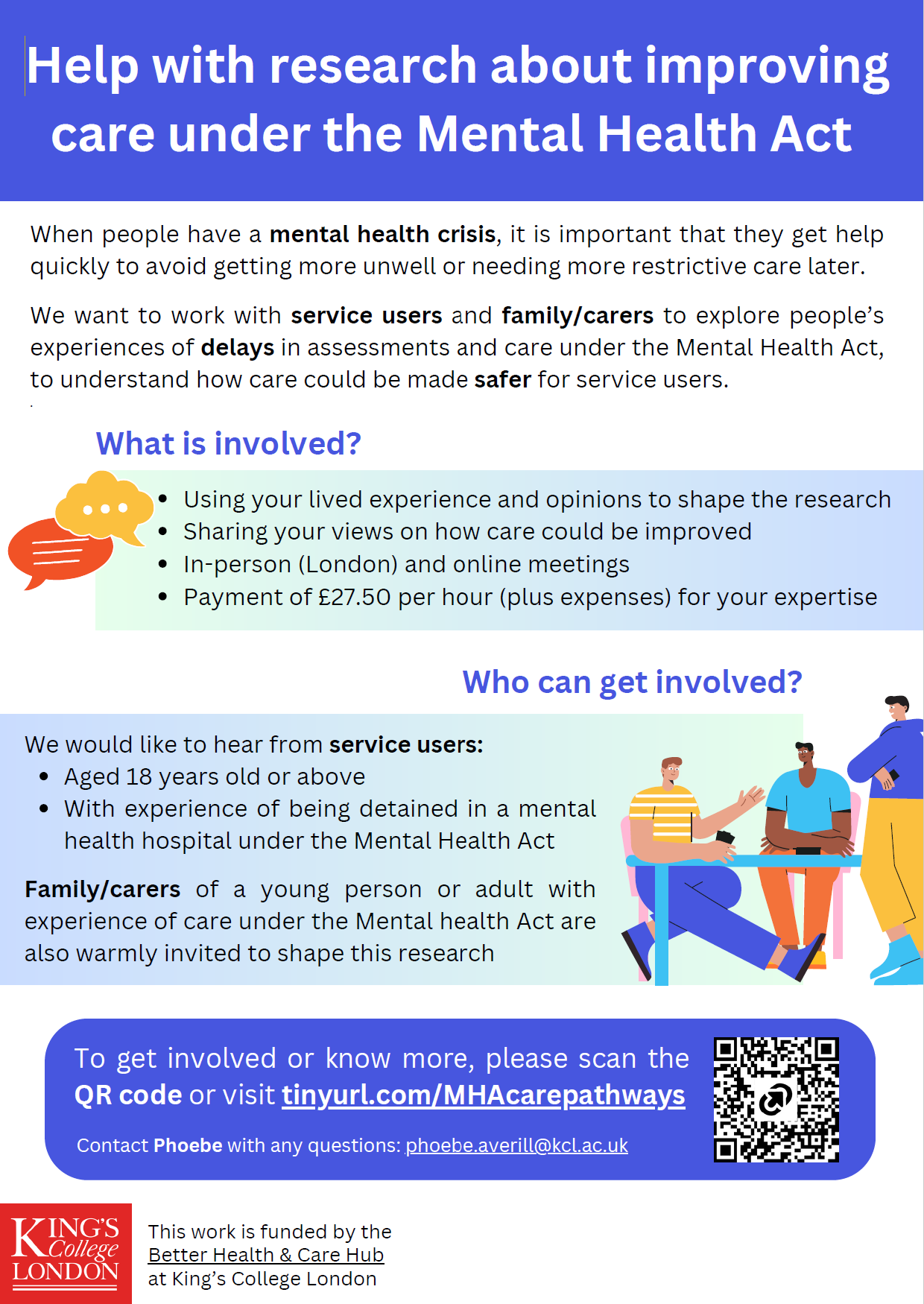
The KCL team were clear that their research is trying to address this gap. They spoke about building a lived experience advisory group and involving carers and service users directly in shaping the work. There was a clear intention to move beyond observation and towards something more collaborative, where lived experience informs how the research develops.
At the same time, there was a quiet recognition in the room that much of this is not new. Similar issues have been raised repeatedly over the years. The difference here was not the discovery of the problem, but the clarity of where it sits in that critical moment where response is needed, and the system is slow to act.
Placed alongside the earlier discussion on racism, this presentation added another layer of understanding. It showed how broader inequalities are not abstract—they play out in very real ways at the point of crisis. Where trust is already fragile, delays make it harder to engage. Where carers are already stretched, the system’s response can increase that pressure rather than relieve it.
By the end of the session, one idea stood out clearly: this is not just about whether care is available. It is about whether it comes at the right time, whether the right people are listened to, and whether the system is able to act before situations reach breaking point.
Parliamentary and Health Service Ombudsman: When Accountability Feels Out of Reach
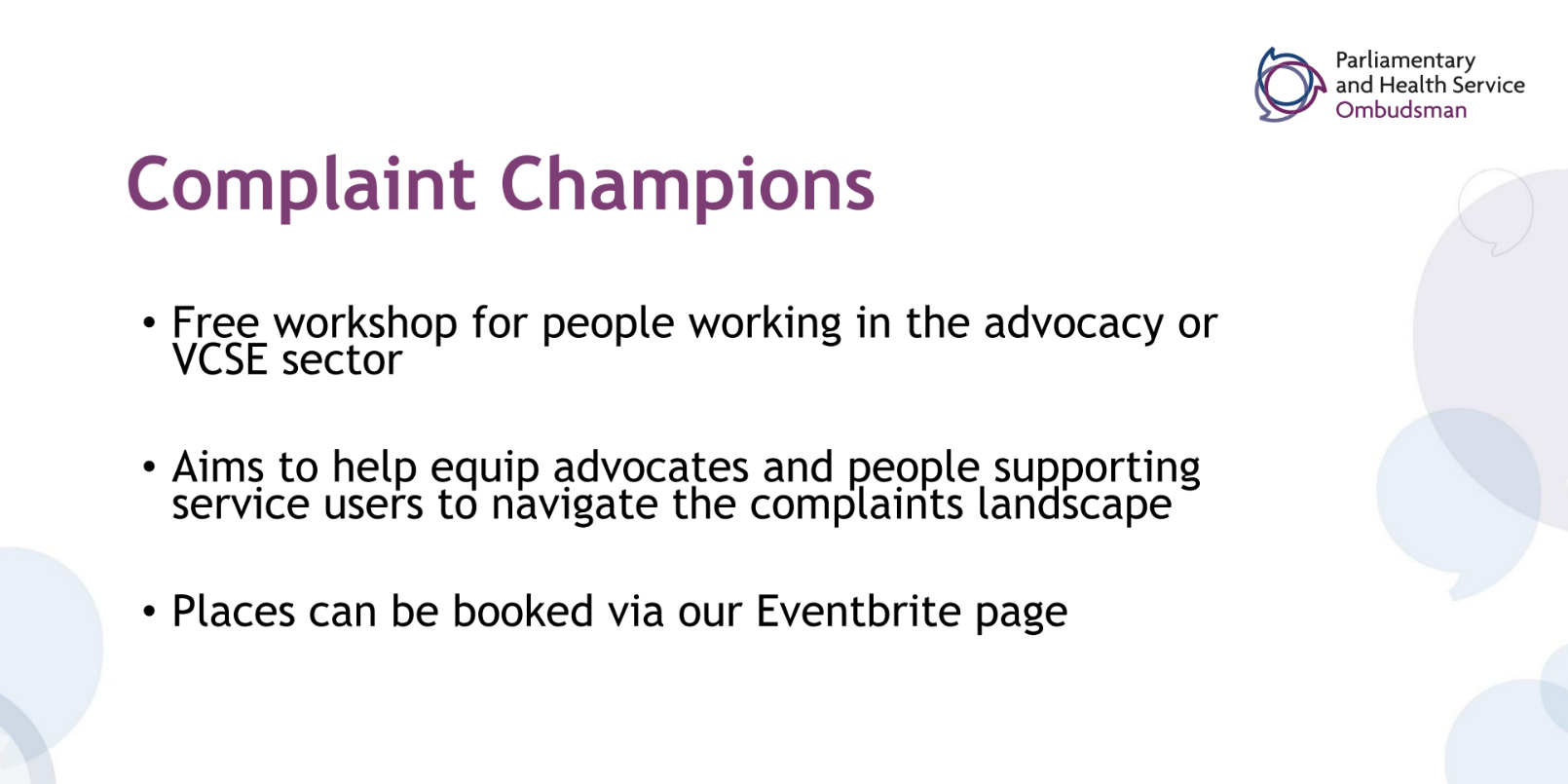
The next presentation of the forum came from the Parliamentary and Health Service Ombudsman team, who joined to explain how carers and families can raise concerns when NHS care goes wrong.
On the surface, this was a session about process how complaints move through the system and when the Ombudsman becomes involved. But as the discussion unfolded, it became clear that this was really about something deeper: whether accountability is genuinely accessible to carers in practice.
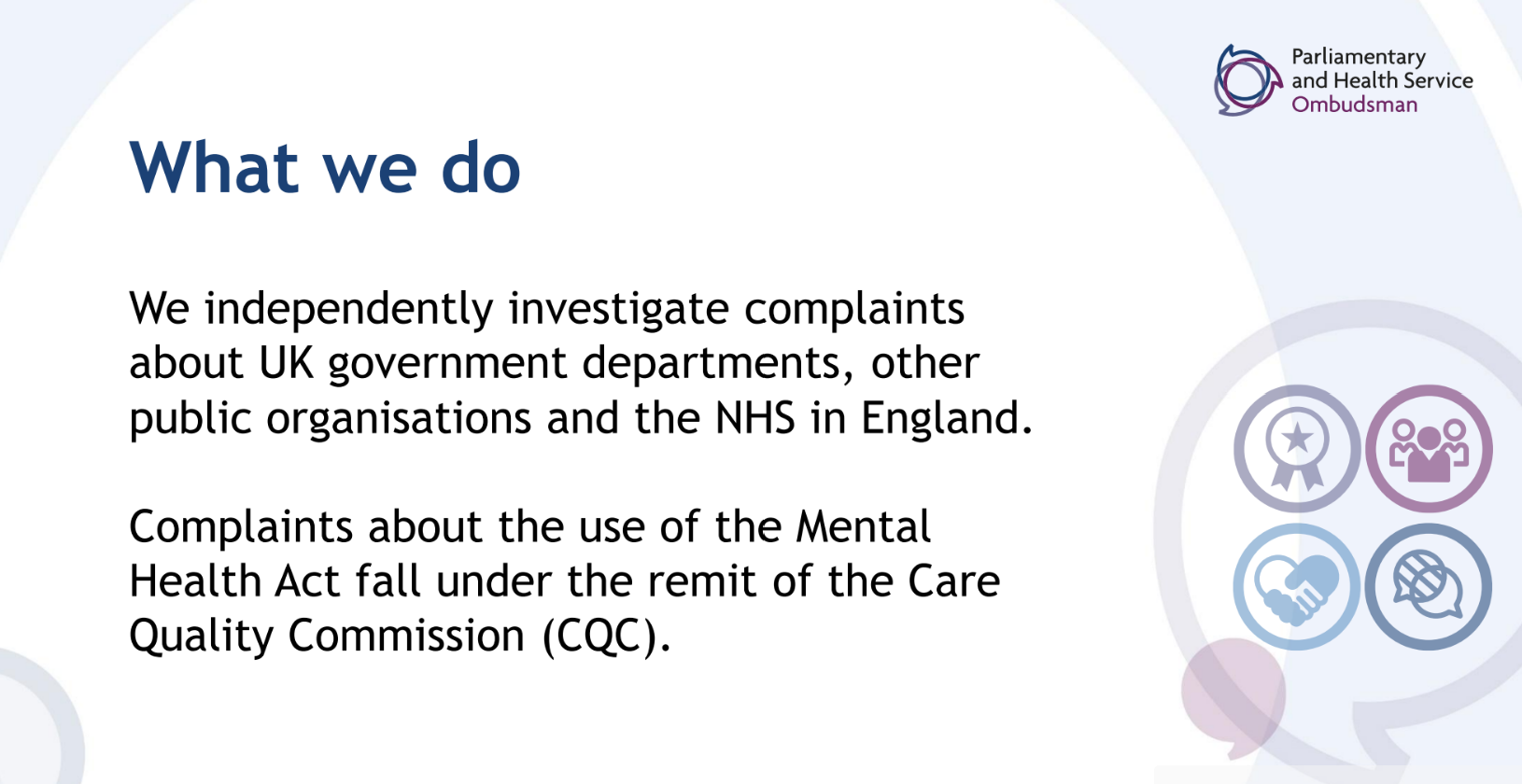
The team described their role as an independent body that steps in once local complaints processes have been completed. In theory, the pathway is clear. Before approaching the Ombudsman, people are expected to go through several stages:
- raise concerns with the service directly
- receive a formal response, often referred to as the “final response letter”
- only then escalate the complaint for independent review
What sounds straightforward on paper quickly became more complex when viewed through lived experience.
Carers shared how difficult it can be to even reach that final stage. The process can take months, sometimes longer, and often requires sustained effort just to keep it moving. Following up, chasing responses, and navigating unclear communication becomes part of the experience.
One comment in the chat captured this reality clearly:
“It can be hard to get to the point of getting a final outcome letter… the amount of advocacy and chasing that needs to happen…”
Another highlighted how far removed the process can feel from everyday awareness:
“It takes far more than 12 months to even come into awareness…”
In response, the Ombudsman team acknowledged that delays particularly at the final response stage are common. They explained that in some cases, where delays are extreme, they may contact organisations directly, and they encouraged people to use their helpline for guidance when processes stall.
But even with that support, there was a sense in the room that the system places a significant burden on those trying to access it. By the time someone considers making a complaint, they are often already dealing with the aftermath of a difficult experience. Adding a lengthy and sometimes frustrating process on top of that can feel overwhelming.
The conversation also turned to accessibility. Questions were raised about language, digital access, and the assumptions built into how information is shared. Not everyone engages with systems in the same way, and not everyone finds it easy to navigate written guidance or formal processes.
Participants pointed out that some communities may never reach the complaints stage at all—not because issues don’t exist, but because the pathway itself is difficult to access.
This was reflected in a simple but powerful comment:
“We are assuming that everyone reads…”
There were also wider reflections about how systems could better meet people where they are, including:
- making information available in more accessible formats and languages
- reaching people through community networks, not just formal channels
Even within this practical discussion, the themes from earlier in the forum remained present. Trust, accessibility, and lived experience all shaped how people understood the complaints process.
Placed alongside the earlier presentations, this session added an important dimension. If the system fails as described in the discussions on racism and crisis care—then the ability to challenge that failure becomes critical. But if the route to accountability is difficult to navigate, many experiences may never be formally recognised.
What emerged was not a rejection of the Ombudsman’s role, but a recognition of the gap between what exists and what is accessible.
Because accountability is not just about having a process in place.
It is about whether people can realistically use it especially at a time when they may already be stretched, exhausted, and navigating multiple pressures.
Universal Care Plan and Carer Contingency Planning: A System Trying to Catch Up
The final contribution to the forum came from Thomas Ince, introducing the Universal Care Plan often referred to as UCP. After the earlier discussions on racism, crisis care, and accountability, this felt like a shift towards something more practical: what the system is trying to build in response to the gaps carers have been describing.
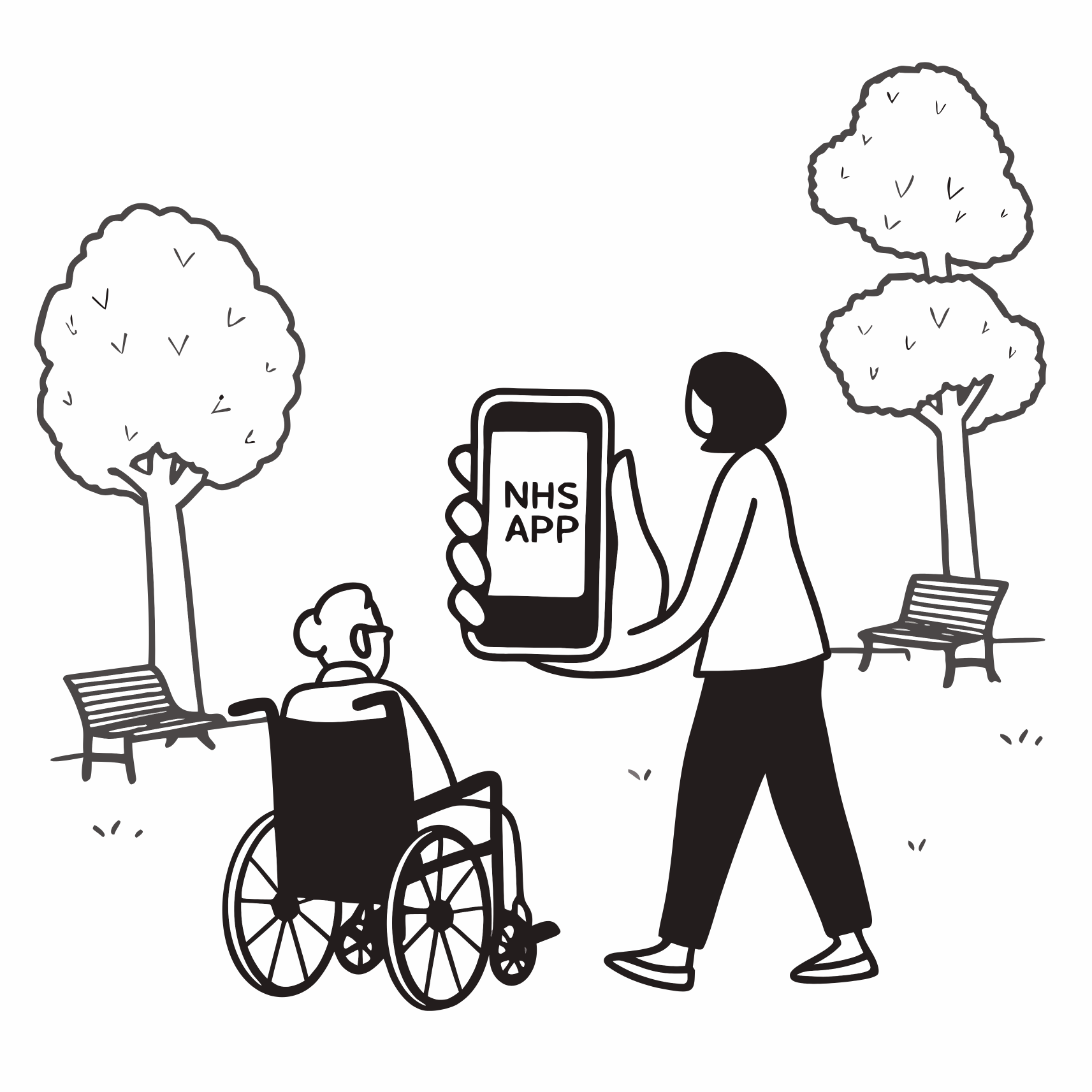
At its core, the Universal Care Plan is a digital tool designed to allow people to record and share information about their care. It sits within the NHS App and is intended to bring together health, social care, and voluntary services around a shared understanding of a person’s needs and preferences.
Thomas described how the system has evolved over time. It began with a focus on end-of-life care, making sure that a person’s wishes could be accessed quickly by professionals such as ambulance crews. It then expanded into areas like sickle cell crisis planning and is now being extended further to cover a wider range of conditions and situations.
The direction of travel is clear: moving from a professionally controlled system towards something more person-owned, where individuals can enter their own information and shape how their care is understood.
A Tool That Centres “What Matters to You”
One of the key features Thomas highlighted was a section within the plan that allows people to describe themselves in their own words. Rather than being defined only by diagnosis or clinical notes, individuals can record what matters to them information that can then be seen by anyone involved in their care.
In principle, this is a shift towards more personalised and human-centred care. It offers a way to capture context, preferences, and lived experience in a system that often reduces people to categories.
But for this forum, the most significant element was something more specific.
The Carer Contingency Plan
Thomas introduced a feature that immediately resonated with the group: the carer contingency plan.
This allows carers to record what should happen if they are suddenly unable to provide care. For example:
- if they become unwell or need urgent medical attention
- if there is a sudden change in their circumstances
In those situations, the system can alert professionals to the fact that someone is dependent on that carer and provide information about what support is needed.
For many carers, this addressed a very real and often unspoken concern:
what happens to the person they care for if something happens to them?
The idea that this information could be visible across services—rather than held informally or not at all felt like a meaningful step.
From Concept to Reality: The Challenge of Engagement
While the tool itself was broadly welcomed, the discussion quickly moved beyond what it does to how it will actually be used.
Thomas was open about the current stage of development. Although the system is available, it remains largely driven by professionals, with limited public awareness. One of the key aims now is to shift towards wider engagement encouraging people to take ownership of their care plans and input their own information.
This raised an important question in the room: how do you introduce a digital solution into communities where trust in services is already fragile?
Participants pointed out that many people particularly from ethnic minority backgrounds—do not engage easily with primary care systems. If the entry point to the Universal Care Plan is through those same systems, there is a risk that the people who could benefit most may not use it at all.
Suggestions began to emerge organically from the group, reflecting a more community-led approach:
- working through carer centres, peer groups, and local networks
- engaging cultural organisations and community leaders
- using spaces where trust already exists, rather than relying solely on formal channels
There was a clear sense that communication could not be an afterthought. It needed to be built into the design of how the tool is introduced.
Language and Accessibility: A Tension Exposed
One of the most striking moments in this section came when language accessibility was discussed.
At present, the NHS App and therefore the Universal Care Plan is only available in English (and Welsh). Thomas acknowledged that this is a limitation and that while there are conversations about future solutions, no immediate changes are in place.
This prompted a strong reaction from participants. There was frustration that a tool described as “universal” could exclude large sections of the population from the outset. For some, this was not just a technical issue but a reflection of a wider pattern—systems being designed without fully considering the diversity of the communities they serve.
It brought the discussion back to a familiar theme from earlier in the forum:
inclusion cannot be added later, it has to be built in from the beginning.
A Step Forward With Conditions
Despite these concerns, there was recognition that the Universal Care Plan has real potential.
The idea of having:
- shared, accessible information across services
- visibility of carers and their responsibilities
- a contingency plan that reduces risk in emergencies
addresses issues that carers have been raising for years.
But the conversation made it clear that the success of the tool will depend on more than its functionality. It will depend on whether people:
- know about it
- trust it
- can access it
- and feel that it reflects their needs and realities
Without that, there is a risk that it becomes another well-intentioned solution that doesn’t reach the people it was designed for.
Placing It in the Wider Conversation
Coming at the end of the forum, this presentation connected in an important way to everything that had been discussed earlier.
Where Saffron’s presentation explored the structural roots of inequality, and the KCL research showed how system delays affect people in crisis, the Universal Care Plan represented an attempt however early to respond to those issues in practice.
But it also revealed the ongoing challenge.
Because even when new tools are introduced, they are still shaped by the same system dynamics:
questions of trust, access, communication, and inclusion do not disappear they simply take new forms.








 A Caring Mind