By Matthew McKenzie FRSA BEM, Chair of the Greenwich Mental Health Carers Forum
Welcome to my November update from the Greenwich Mental Health Carers Forum, held on Tuesday 24 November 2026. We were joined by unpaid carers, Janice Williamson from Oxleas NHS Foundation Trust, Janice Walker from Greenwich Carers Centre, and Katie from Healthwatch Greenwich.
At our September forum, I asked what happens when a carer notices that the person they support is becoming more unwell. This month, we returned to that question in more detail. Who picks up the phone? Where does the concern get recorded? Who follows it up? And what happens if the carer is still waiting for an answer when things get worse? Read the September forum update. A Caring Mind
When a carer notices that something has changed
I opened with a short presentation about what unpaid carers can bring to a conversation with mental health services. If you support someone regularly, you may know what a good week usually looks like for them. You might know how often they call, whether they see friends, what they enjoy doing, or how their sleep changes when they are struggling.
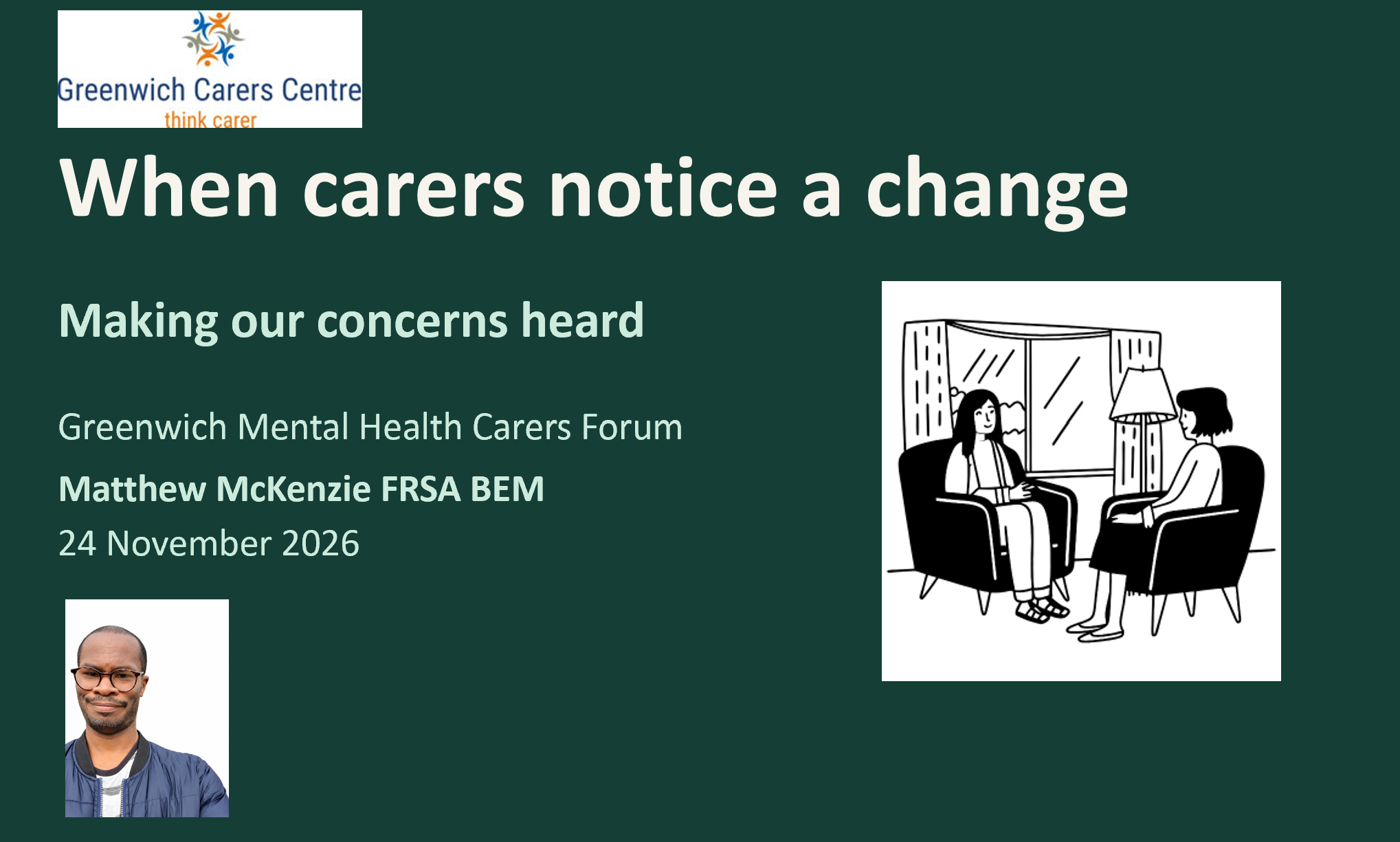
I used an example of a brother who had been awake for most of three nights and had stopped making his usual morning calls. The carer could explain when this started, how it differed from his usual routine, and why it reminded them of a previous period of illness. That gives the team something specific to follow up. Where possible, I encouraged carers to ask the person how things feel from their side and what they would like the team to know.
The other half of my presentation was about the response. A carer can describe a change very clearly and still finish the call wondering whether anyone has written it down. I suggested four questions that can help make the next step clearer.
- Can you record what I’ve told you and tell me who will review it?
- When should I expect to hear back?
- Who should I follow up with if I haven’t heard anything?
- Who should I contact if things get worse while we’re waiting?
Carers’ Rights Day had taken place the previous week. For me, one of the most practical things we can talk about after that day is how a carer gets heard when they have a genuine concern and only a few minutes to explain it.
Confidentiality, consent and listening to carers
Carers spoke about the frustration of trying to pass on a concern and having the conversation close down around consent. One described knowing from experience that something was seriously wrong and struggling to get professionals to hear why. Another recalled difficulties getting a care plan to the supported living staff who were involved in the person’s day-to-day support.
There are two questions worth asking in those situations. What information can the team share with a carer? And how will the team receive and act on information the carer brings? Even when a professional has to be careful about what they disclose, a carer still needs a way to explain what has changed and find out who will review the concern. Oxleas’ own Carers’ Charter recognises families and carers as an important source of information about the person they support. Read Oxleas’ information for carers. Oxleas NHS Foundation Trust
We also heard how easily services can focus on one part of a person’s situation. A carer may be trying to explain how several needs are affecting someone at the same time, while each service sees only the issue it deals with. That can leave the carer repeating the same story across health, social care and other services, with no clear sense of who is looking at the whole picture.
What Oxleas told us about raising and recording concerns
Janice Williamson, Carers and Families Lead in the Oxleas Involve team, explained that where someone already has an Oxleas care coordinator, the coordinator is the first point of contact. She acknowledged that carers have reported difficulty getting hold of staff. As part of the service redesign, she said teams plan to provide named contacts with phone numbers and email addresses so carers have someone to approach if they cannot reach the care coordinator. I would like us to hear how that works in practice once it is in place.
Janice also described how concerns can be recorded on RiO, the trust’s electronic record. The About Me form has a section for carers’ information. This gives staff a place to record what a carer has reported so colleagues can see it and, where appropriate, bring it to the multidisciplinary team. One question I want us to come back to is how the carer finds out what happened after the concern was entered.

We also heard about Oxleas’ initial family and friends meetings for people newly entering services. The person can choose whom they would like to bring. It is an opportunity to talk early about care planning, crisis planning, confidentiality and what the person is comfortable sharing if they become unwell. Having that discussion at the start gives everyone a chance to ask questions before they are trying to make decisions under pressure.
The question of where to go when someone is outside Oxleas services still deserves attention. The November presentation mentioned mental health hubs as a route for advice, while our September discussion described the Greenwich Mental Health Hub as appointment-based. I would welcome a clear explanation of which local services people can approach directly, which require an appointment or referral, and where carers can turn if they are unsure. Read the September discussion about the Greenwich Mental Health Hub. A Caring Mind
Support for carers and a say in how services develop
Janice talked us through ward-based carers’ groups, the Oxleas carers’ forum, support for people caring for someone with both mental health and addiction needs, and telephone befriending. I was glad to hear about befriending because it gives carers time to talk about how they themselves are doing. That can matter when someone is in hospital, when discharge is approaching, or when the carer is waiting for support.

The discussion about meeting times mattered too. A carer spoke about the pressure of holding down a full-time job alongside caring, and Janice explained that she schedules the groups she runs for early evening so working carers have a better chance of joining. Carers asked how to get involved, and Janice offered to share the details for wider circulation. She also agreed to put forward a request for a renewed drive to recruit buddies.
Through the Oxleas Involve team, carers can register their interest in helping develop services. Janice described paid involvement opportunities and a peer engagement programme through which people with lived experience can build skills and gain paid experience within the trust. It was good to hear carers asking how to take part. Services benefit when carers are invited in early enough to influence how a service is designed. Find out more through the Oxleas Involvement Hub. Oxleas NHS Foundation Trust
How will we know whether things are improving?
I asked what Oxleas measures and records through its carer work. Janice spoke about a recent survey asking carers what they think of services, how teams communicate with them and which groups they use. She also described work with staff on confidentiality and the need to find out whether staff now feel more confident speaking with carers. The trust is tracking offers and uptake of carers’ assessments and looking at what happens across teams.

I would like the forum to see what comes back from that work. How many carers are being identified? Are they being offered assessments, and what do carers say about the support that follows? Are people getting through to the right team more easily? If one team is doing particularly well, what could other teams learn from it?
These are questions I also bring to my Triangle of Care work. A carer may experience a strategy through something as ordinary as getting a call back when promised. That is one of the things I would like us to hear more about when Oxleas returns.
GP carer registers and care plans that reach the right people
One carer described a straightforward experience of getting registered as a carer at their GP practice. Others spoke about how much experiences can vary. I raised the role of primary care networks, which bring local GP practices together. Katie offered to share details of the Greenwich networks so we can explore inviting someone from primary care to a future forum.
I would like to ask how practices identify mental health carers, how they record that someone is a carer, and what difference registration makes to the person afterwards. Some people might come to a GP appointment thinking of themselves as a partner, parent, sibling or friend. The way a practice asks about caring responsibilities can influence whether those people are recognised and offered support.

We also discussed the London Universal Care Plan. Katie described how an electronic plan can make a person’s wishes and preferences available to relevant services when they need them. During the same discussion, a longstanding carer said they had never heard of it. That raised a practical question for Greenwich services. Who explains the plan, starts the conversation with the person and their support network, and makes sure the information can be found when it is needed?
Healthwatch Greenwich and the Carer Passport
Katie explained how Healthwatch Greenwich gathers residents’ experiences of local health and social care. The team shares anonymised themes with commissioners and service managers and feeds back to residents or groups where it can. If you have an experience you would prefer to share privately, you can contact Healthwatch directly. Contact Healthwatch Greenwich. Healthwatch Greenwich

One example Katie brought was the Carer Passport. Some carers at a recent discussion had heard of it and others had no idea how to get one. We heard that it may be possible to ask at hospital reception or A&E. We also heard an example of how a passport had supported visiting arrangements for carers of people with dementia at Queen Elizabeth Hospital. Janice Williamson agreed to come back with clearer information on the Oxleas arrangements.
I suggested that visible information for carers at the hospital could help. If someone arrives worried about the person they support, a clear notice about the passport and where to ask could make a difference. It would also give staff something clear to point carers towards.
Carers’ Rights Day and planning for hospital discharge
Janice Walker, Complex Cases Lead and Carer Support Officer at Greenwich Carers Centre, updated us on the centre’s Carers’ Rights Day event. The day focused on hospital discharge and brought together information about welfare rights, benefits, carers’ assessments and employment support. The discharge presentation covered planning for leaving hospital, referrals and what to expect from assessment after discharge. I also contributed a lived-experience perspective.

A question I keep bringing to my Hospital Carers Discharge Group is how early we speak to the people who may be asked to provide support at home. Has someone checked what the carer can manage? Do they know what help is being arranged and who to call if the situation changes after discharge? Those are conversations worth having while there is still time to change the plan.
Janice also updated us on the centre’s workshop on wills and disabled persons’ trusts, and its December programme. The centre provides tailored one-to-one practical and emotional support for unpaid carers in Greenwich. Visit Greenwich Carers Centre for support and upcoming activities. Greenwich Carers Centre
Looking ahead to the new year
I would like the forum to follow up on progress with named contacts in Oxleas teams, clearer information about Carer Passports, and what the trust is learning from its carer surveys and assessment figures. I would also like to bring someone from Greenwich primary care into the discussion, alongside colleagues from social care and acute hospital services. The forum is open to people supporting someone with mental health difficulties in Greenwich, including those whose loved one is outside Oxleas services.
Our final Greenwich carers’ peer group of the year is on Monday 30 November at 2 pm. The peer group gives carers time to talk with others who understand some of the day-to-day pressures that come with caring.
Thank you to everyone who joined us, especially the carers who shared what it feels like to make that call and wait for an answer. When you have taken the time to explain that someone you support is struggling, you should be able to finish the conversation knowing who will look at the concern and what happens next. That is something I want us to keep asking about in Greenwich.

