Tag Archives: carers

Top 10 reasons for carers to give views on healthcare

me_edited-1Welcome to another blog post by Matthew Mckenzie, a former carer and carer activist from South London. I usually focus on carers who care for someone with a mental illness, but at times I delve into health and mental health.


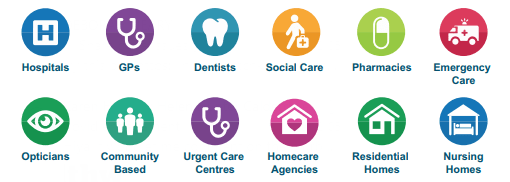
Never before has the healthcare system in the UK been under a spotlight due to the COVID-19 pandemic.

There are many organisations that request unpaid carers to share their opinions on healthcare. One of them being healthwatch.

download

You as a carer can experience what healthcare is like, when the person you care for receives that care from health or mental health services. If the patient’s care is poor from those services, then unpaid carers are forced to step in. If health services do well, then the burden on carers is lifted.

To watch a video blog of this post, click the video below.

It is so important carers of those using the health care system come together and submit their views on healthcare.

Top 10 reasons to put your views on healthcare as a carer

1. To provide feedback to improve health services.

– At Healthwatch engagement meetings, Healthwatch usually ask questions to participants on how do they think health services are doing? It is the best time for carers to report or feedback how services are affecting the person they care for. These views can go back to improving health and social carer services.

2. A fulfillment of changing something

– Although carers can get fed up of stating the obvious when health services continue to struggle. It can be a fulfilling experience to use the power of your voice to institute change.

Not many people have time for unpaid carers along with the ‘cared for’ to try and change things for the better. As a carer its a chance to change things, which is better than no chance at all.

3. A great way to network with like minded people

– At times, there might be other carers attending Healthwatch events or groups interested in how health and social care is affecting carers and their ‘loved ones’. The more you attend health engagement events, the more you can network with like minded people. It is in carer’s interests to network and understand the pressures on health systems.

4. Getting information on health services

– It is not always feeding back your opinion on health and social care. At Healthwatch events, there are often reports and updates to the community. As a carer you can get the chance to find out how services are doing.

You can even ask questions requesting reports and updates for particular services, it is your right to know and you should exercise that right.

5. Being part of the ‘health’ community

Without good health or good healthcare services then the community suffers. There are local and national drives to improve health for everyone and get people to understand the importance of health services. A community that is interested on how health services is performing is able to inspire others. It takes time, but it is worth it.

images

6. Making a change for the better

People can either wait around for health services to change or continue to complain. Carer’s can try to see the overall picture of what things could be like if they feedback on healthcare experiences.

Carers cannot always expect the person they are caring for to do this all the time, so carers must want to change things for the better. A better healthcare system supports everyone, health professional, patients and their carers.

7. The reward is greater than the risk

The risk of healthcare failing or not getting responses can be catastrophic for everyone. The more feedback a healthcare system gets, the more information that can be tailored to improve health services. If people do nothing then their is always that risk. The risk can cause health systems to not perform, causing more patients to be unwell and not get a good experience of care.

8. Know who is responsible for what

When attending Healthwatch meetings and engagement events, notice who also turns up. There might be health commissioners who are responsible for purchasing health services. There also might be those who run those health services. Just knowing who those people are can be a way of holding them to account on services. It is possible at these events to even ask them questions or queries.

Healthwatch

9. Meeting the challenges

The health and social care system is under increasing pressure. If it was not for increasing budget problems to services, then the COVID-19 crisis has increased the strain on services. All these are challenges for the 21st century and carers should try and rise to meet those challenges.

10. Helping other carers in your field

Information, reports and surveys from Healthwatch should not just stop at the carer attending such events. Carers can take the lead and spread information to other carers, especially at carer support groups or carer forums. Not every carer can be everywhere at once, so veteran unpaid carer can help others become more aware on how services are doing.

Lewisham MH Carers forum July 2020

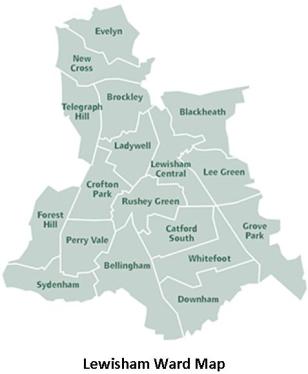
Lewisham Ward MapWelcome to the July edition of the Lewisham Mental Health carers forum. This is one of the carer forums I run in order to help families and carers understand, engage and query mental health services. This can help services become more carer aware and aides in a working relationship with carer’s.
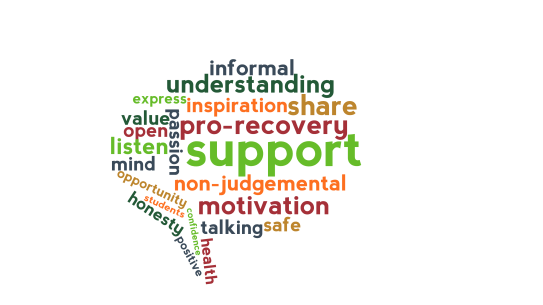

For the Lewisham MH carers forum we were joined by regular carer members, plus Damian Larkin a nurse working on clinical systems. The forum was also joined by Karen Machin a carer peer network campaigner and researcher, plus the communications rep from mental health organisation SANE, Public Health in Lewisham, Maudsley’s complaints department manager Edith Adijobi.

Also in attendance was Beth Brown who is SLaM’s Patient Experience and Quality Manager. We were also joined mental health lead of the Lewishmam & Greenwich hospital trust and lastly the involvement lead for Lewisham & Croydon from maudsley NHS trust.

The Lewisham carers forum runs every last Tuesday of the month and is usually run from Carers Lewisham, but due to the covid-19 outbreak the forum has been running online.

Public Health Lewisham research

First to speak and update carers in Lewisham was Lisa Fannon from Public health in Lewisham. Lisa gave us a brief update on the work that she talked about at another forum I run. Lewisham council is undertaking in a research partnership with Birmingham City Council where they are going to look into health inequalities faced by black, African and Caribbean communities within the borough. Public health Lewisham are part of this process and will be looking at the evidence which have been some of the key issues affecting the community.

Their intention is that they will provide some solution focused approaches which will enable us to tackle such health inequality issues wherever possible. Lisa also wanted to let us know that they are this week opening applications to people within the community to support an advisory board. Lisa mentioned it’s a unique volunteering opportunity to be part of a groundbreaking piece of research that will inform the work that Public health are doing within the local community.

Carer Peer Support

Next to present was on carer peer support networks. Karen who is a peer network speaker spoke about her personal experience of being a carer. She also spoke about the challenges she found on the mental health system and felt being able to sort of stand back and reflect on things.

She did value the networks that she had made when experiencing mental health systems be it locally, regionally and nationally, she had some networks where she could share them with people and hear about what other people have been up to. Karen found those networks really helpful.

wordle

The last 10 years or so, her interest has been around recovery and peer support in a way of focusing on healing and discovery. She mentioned that she doesn’t really like the word ‘recovery’ when compared to carers. Even though it is a word that everybody uses, but she is still interested in recovery because it’s always about the people that we support.

She felt that the focus on recovery is always about the person who’s using mental health services. It’s not necessarily about carers. So she did a write up some years ago about it, but she still think it’s a topic that signals whenever there’s recovery then it might not be for carers and everything could be patient focused.

Karen wants carers to query things by asking about the nature of carer support.  Questions like ‘What is it?’ What does that look like for carers? And how do we get current skills involved in that? Her main interest is around peer support, and that’s about people supporting each other.

Family

She feels that even with all these new initiatives around peer support, that carers sometimes still get ignored.  Around 20 years ago, we were asking for what would now be called a carer peer support worker. Unfortunately she does not see many carer support workers, although there’s lots of initiatives and resources and money going into developing peer support workers which are roles within mental health trusts and voluntary sector organisations.

This is not the same issue around carers. She always wanted to hear from somebody who’d been in a similar position when she was caring, who could kind of use their own lived experience to the listen and support carers. Perhaps somebody who was actually paid in such a role and also was valued and supported themselves.

It’s not just about peer support, it isn’t just about volunteers. It’s also about the resources going into paid roles. We in a situation today that we are trying to avoid the new pandemic. She feels that it has created a really abrupt change. It’s been a very serious and traumatic time for many of us carers. That means everybody even those not accessing mental health services. For the whole population it has been very difficult time. The pandemic certainly has highlighted places where there’s been poor services or poor access to services. Karen felt some criticism at the NHS, but she is usually very supportive of it, which has really highlighted some of the challenges in service provision within mental health.

download

Karen also wondered about bereavement services and support for carers among such services. She felt that people have looked for access and support, but Karen mentioned that people have also had to look to communities for support.

She does not think they’ve looked particularly to the NHS and because it has been so overwhelmed with other issues. So people have had to look for that mutual aid into communities.

She included in her talk the use of remote access on how communities now can be national and international, and that is certainly a community that she wants to be  involved with. She recently managed to speak to participants from around the world and heard from a lot of peer support groups where they’ve been questioned whether people can join them. There have been lots of people from the States and from Australia so networks and communities are getting bigger because of the opportunities of remote and virtual platforms coming from avoiding COVID-19.

Embed from Getty Images

Karen stated to the carers forum that perhaps maybe this is an opportunity to do things differently. She knows that commissioners and providers are all asking us those questions of how we’re going to provide things going forward. When she talked to them she keep repeating herself and saying we have to listen to people with lived experience and their carers. Karen felt that’s something that’s been high on the agenda for the last 10 to 20 years anyway and felt providers and commissioners know that they have to listen to communities, they know there’s a gap between what they commission and what people experience.

Lastly Karen spoke about how our communities can help us to get heard and questioned how do we build those communities? She felt it needs to go beyond local. She mentioned that those at the forum are in a great position in London because we have got opportunities that go beyond just our own Mental Health NHS trust into other mental health trusts. We have a chance to hear about how others are providing services and the different teams that are available.

She does wonder how we can expand this nationally because there aren’t any national networks of carers in the UK. She would like to hope in the future a way to develop national carer peer networks and once COVID-19 is over, then we can start to develop those networks ourselves.

Questions from the carer members

The carer members from the forum were inspired to ask questions to Karen. One member asked what was she doing for older carers in the role she is in at the moment, especially with ethnic minority cares? The forum member wanted to know who at the moment could explain the situation of suffering in silence because of stigma?

Karen mentioned that she has not got the expertise around older carers in her local area, But she has heard of lots of other organizations, not here, but around the country, where carers and communities are coming together to provide that support themselves. She understands about those worries about what happens if a loved one goes into a care home? And what’s that going to mean for us? And so people, it’s about, it’s what she has been hearing, it’s about communities doing that work. And that really worries her in many ways, partly because the sustainability of that, how do those local just groups of neighbors basically, and how do they sustain that effort? And how do we scale that up? How do you make sure that that continues?

Another question raised was from a carer who had read in The Guardian newspaper that Boris Johnson is considering amalgamating social care into the NHS. She felt in principle, I think it’s a good idea. But what what concerns her is that does that mean that’s another group getting that is going to push mental health out of the way? Because Health services has made mental health services a Cinderella service and now social care will make it even more irrelevant.

Karen responded that we got to keep an eye on such things and she felt it’s through networks and making sure that we’re all connected within that we can keep an eye on. Karen did agree with the carer and felt perhaps the change could potentially be fine. It could have potential. Still she thinks many will be worried about that gap between health care and social care.

SANE new campaign and project

Next we heard from Emma who is the media and communications officer at the mental health charities SANE. They are a national mental health charity. Emma felt it was a real privilege to hear from carers and to learn from us as well. She thanked us for having her in this space.

sane

Emma introduced herself as the media and communications officer for SANE and they are working on some exciting projects although she could not go into detail at this moment in time because it’s still in the planning stage. The campaign will be launched around autumn time and they are looking to collaborate and work with caregivers, mental health caregivers who care for someone with serious depression.

Emma continued that supporting mental health care givers is also a core campaigning area for the charity and she knows it’s something which SANE’s CEO Margie Wallace is really passionate about. So if there’s anything that SANE can do to support us or if we know if anyone’s interested in reaching out and working with SANE then please do get in contact.

Patient Experience and Quality Manager presentation

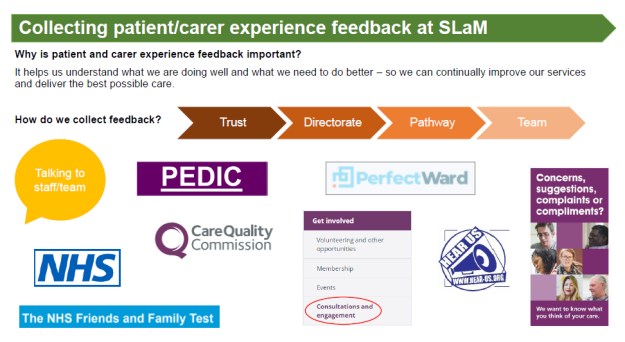
Next to speak at the forum was Beth Brown who is SLaM’s Patient Experience and Quality Manager thanked me for inviting her. She was here to talk a little bit about what she does as patient experience and Quality Manager. She then talked a little bit about one of her work streams, which is the patient and carer feedback surveys. She mentioned her role has kind of two main aspects to it. The first one is around patient experience, so she manages the trust wide patient care experience survey program, which some of the group might have heard of which is called PEDIC. Beth also look after the Trust’s participation in any national surveys which are run by the Care Quality Commission. So that’s the means that they participate regularly each year is the National Community Mental Health Survey.

It is her role to look at the themes that come out from all of these places and, and try and kind of track trust wide themes. And that can help inform our services, and to kind of look at their local improvement because the whole point of it is that we can improve services.

Beth moved on to talk about how she manages clinical audits and the effectiveness team. They look after a program called perfect Ward, which is a way of tracking clinical audits throughout the trust, which includes things around clinical safety, medicines, infection prevention control. They also have an audit around patient experience and staff experience. Plus they also have someone in the team look after NICE guidelines, so you can have best practice for trusts and national clinical audits which are run by the Royal College of psychiatrists.

Collecting data

At this moment Beth’s team are just preparing for a upcoming National Audit on early intervention in psychosis. Beth started showing the forum presentations from her slides. Where she showed how centrally important that audit team works with the patient and public involvement leads and on complaints.

Beth tends to have a large spread of different people to work with, she went on to why a patient care experience feedback is important, because so they can see what we’re doing well and what we need to do better so that we can improve the services and deliver the as possible care. Plus they need to collect feedback in a lot of ways.

They have kind of lots of more systematic and structured ways of collecting feedback, where Beth showed the data the team  collect it from a trust wide level right down to individual team level. From on the Ward and the NHS friends and family tests, through to kind of trust, consultations and engagement. The team also work through complaints, PALs, service formal and informal effective compliments, a kind of like individual project based feedback.

As Beth showed us her graph and she explained top left graph which is around on the friends and family test score in Lewisham. There was also the national indicator for patient experience. The aim of the graph is what extends as and so what this chart is it tracking the number of positive responses to that to the people that say they’re extremely likely or likely to recommend the service they’ve received.

And there’s tracking over time from April 2017. And you can see from around January 18, to may 2020, if you put a line through it, it’s a very gentle increase in performance. And that reflects trust wide performance. However there has been a significant change, due to this massive dip in June 2020. That is the impact of COVID-19 on our data collection. They had two of our data collection methods suspended due to infection infection control. And now got two out of three open and but we had a massive drop in response rate. So it’s the two that means that the fewer responses you have, the more the data is influenced by extreme responses.

So the forum was shown data for Lewisham over the past year and the members were told that the team had overwhelmingly positive responses, and those numbers of 1169 and 21015, their response rate, so that’s the proportion of positive in comparison. Beth reminded the forum that I was interested in hearing about the FFT school, by ethnicity and by ethnic group. So at the end of our PEDIC surveys, they asked a number of demographic questions and the purpose being that they could see whether any particular groups are reporting different experiences. And that can help inform different work streams.

So for example, there’s just been a piece of work that we found in Lambeth where LGBT patients were reporting poorer experiences. there’s also a trust wide quality reports, which you can get on SLaM site website, which talks about FFT scores.

A piece of work that Beth is doing at the moment, is to allow her to look at positive and negative test results by ethnic group over around 25,000 participants so that they can make more data and say something more about the database quickly to see what it is telling them.

Questions from the carers forum

One carer who is often interested on where mental health services get delivered queried the actual number of people accessing treatment. If it’s a positive outcome, obviously, it’s very good. But that doesn’t necessarily mean that mental health services are delivering good services. The carer felt that SLaM are missing delivering service to the people who struggle to access services via their GP. because sometimes there’s subjectivity as to who goes through and who doesn’t. And as we all know, there’s also financial constraints. And also people who, who don’t feel comfortable with a GPS, therefore can’t get a referral, even with their carer is trying to get their relative to access services.

Another carer agreed and felt it was one of the most stressful things that they found as a carer and that they belonged to several carers groups noticed several people have said this, that it’s it’s especially with children anyway, as well. It’s not so much having the child or the person with the mental illness.

Beth responded on member’s experience of their loved one’s difficulty accessing services and the impact that has been. She continued to mention that they are hearing about that in our patient surveys.

So even the people that are accessing our services are talking about the difficulty that they’ve had to get it and the impact that’s had on them. That is kind of growing in prominence as the you might have seen over the past couple of years. It is an issue and it’s it’s an issue that the trust is aware of, and there are lots of workstreams and programs going on across the trust to tackle access to services, not least Since COVID, so since since before that as well.

BETH application presentation for service user and carer input

Next speaker at the Mental Health carers forum was Damien who spoke about the revamped online patient system called BETH. BETH is an online app and what it does is connect patients or service users peers and staff, they can communicate, they can collaborate. And it’s not an app because it works through a web browser.

Still BETH does it look and behave like an app what’s known as a web app. To access BETH the address is beth.slam.nhs.uk . Since this is a new digital online platform it connects us and it supports the service user’s the treatment that SLaM provide. Damien mentioned that because of COVID-19 that we all have to try just try and communicate in different ways not because it just hasn’t been possible to do what we have done previously, its just BETH really supports this.

BETH-1

BETH takes its name from bethlem and which is the Bethlam hospital that SLaM have in new Beckenham and also the museum of the mind. SLaM’s vision is that BETH will support the care treatment that people receive. Damien then showed the forum some presentation slides of BETH in action. Damien showed the carers how it looks like on a mobile phone. BEETH can be used on a mobile phone, it can use on a tablet and it can used on any kind of device like a laptop, or a desktop.

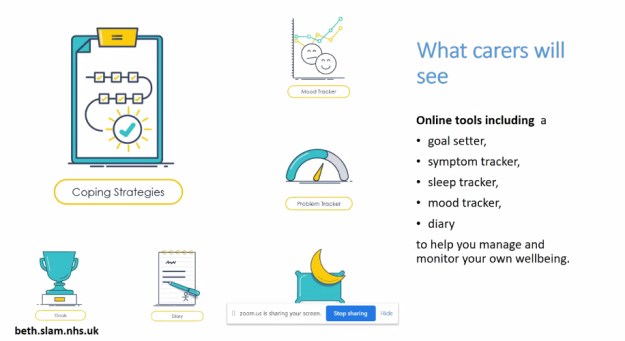
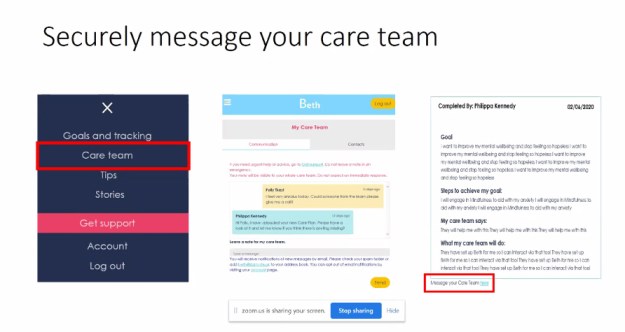
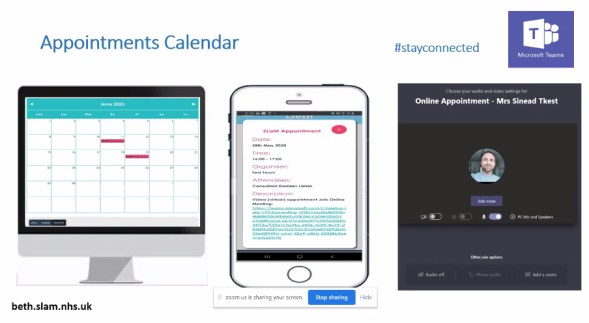
Damien also showed how service users or patients signup to BETH and how they can securely message the care team, they can also get access to their care plan or consider upcoming appointments. Patients can keep track of mood and sleep and they can use the free online resources that SLaM have included in the BETH online system.

BETH-2

Service users can choose to use certain functions and also carers can choose other BETH functions. There’s more in there for patients at the moment although SLaM want to do obviously develop on this. Damien then showed us how to register for the BETH system in instructing on where to sign in if your patient of services by you putting your first and last name as it appears on SLaMs records.

You would then just put in your email address and you create a password and that becomes your login details for everything. But then in the middle you see that red box there’s two tick boxes, one to indicate if you’re patient one to indicate if your carer, family or friend.

if you’re a patient, the two other boxes appear saying asking for date of birth and NHS number and then they accept the terms and conditions all of that and you get access. If you click on the second box there to be a carer or friend. Once you hit on create account, it’ll ask you if you want to connect the care team of the person that you care for. And you just need to put in the person’s name full name as It appears.

BETH-3
Complaints department Presentation

Next we had Edith Adijobi who is SLaM’s complaints manager to engage with carer members at the forum. When you think of complaint’s carers tend to grit their teeth, but I noticed the members were happy to get engagement from complaints because people feel complaints tend to hide away and defend services. Edith opened up her talk by stating that she genuinely love complaints. I noticed one or two carer’s laugh about this, but then they warmed to Edith.

Edith mentioned that she has been working in the field of complaints, panels, patient experience and bereavement services in the NHS for about 21 years. She is very passionate about complaints. So in the trust people sort of have to stop her talking. Edith mentioned that she is also known in the trust for a lot of pushback, because one of the things that frustrates her deeply is if she ever hears somebody say there’s nothing they can do, then Edith feels that carers have to complain.

Edith feels that people shouldn’t ever have to complain to feel heard, she feels people shouldn’t ever have to complain to feel that services are going to do something about something they flag to SLaM. That doesn’t mean services stop people complaining. But if we’re telling people that the only way we’ll hear their voice is if they complain then something’s gone very wrong, and that really frustrates Edith.

Edith does staff training on complaints, So one of the things when she does on training their staff is she is officially their worst nightmare at times. She mentions that officially she acts as a worst nightmare as a patient. Edith then took us through some brief data. She talked a little bit about why we take complaints as a trust and the approach that she finds

She feels it’s about really encouraging and supporting ourselves to think about doing the right thing at the right time, really reflecting on on the information we get. And how do we learn from mistakes, because she thinks the moment you say the C word, as she says complaints, people get their backs up, people get quite anxious. How about we split it into a concern and a complaint? what is actually happening there? What are people trying to tell us? And these are some of the ways in which we get information.

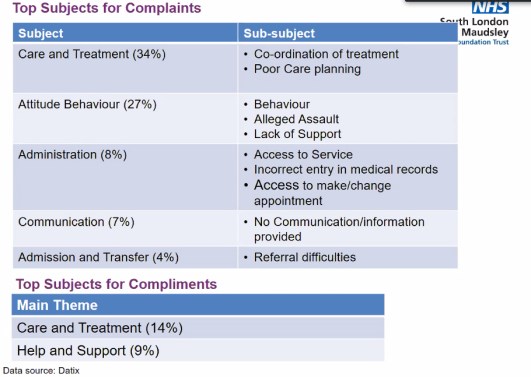
Edith talked to carers about the different organisations that are interested in the types of complaints the NHS Trust gets.  So they get reports from the Care Quality Commission, quite a lot of our patients will go direct to the CQC and to then pass them to us. We also get views from Health watches, SLaM’s CCG commissioners, we even get people tell us first What do we do and how do we did Last year.

complaints presentation -1

Edith spoke more about the charts on the presentation and showed how these are the complaints they got as a trust. Although in one month the figure obviously dropped really sharply because of COVID. Edith showed us a closer look at Lewisham complaint figures and noted if we could see my mouse just scrolling under the Lewisham accounted for 88 out of 558 complaints pulled up through the Directorate.

She then looked at complaint, which was commissioned by Lewisham. So that will go across SLaM’s oldest adults and their CAMHs service, but this was just to give us a trust wide look. Looking across the trust, if you have a look at the Reds or the complaints and the blues are compliments.

Edith moved on to mention that they have tried a new system since last October. They are encouraging people to record directly so that we can actually capture information. So just that was an April to make a March this year. This is this quarter, and you’ll see that a bit had a real impact on just SLaM’s organizational numbers they receive.

Edith mentioned that sometimes it’s just somebody picking up the phone and not being able to get hold of a doctor, not being able to get hold of a nurse, or, in some cases, people wanting access to a service. But the commissioners haven’t actually commissioned us to provide that service. So how do we as an organization feedback to the CCGs or how do we actually tell somebody that what they want is what we Provide that’s not being provided by a third sector partner, or the CCG has different arrangements.

Edith concluded that sometimes we’ve got those type of issues going on and sometimes someone is to blame. Sometimes when something is wrong, it is because of there is a reason. So one of the things maybe we want to look into is culture of the trust. Is it that we’re blaming that member of staff, and that member staff is the one who’s accountable because an appointment failed to be booked? Is that staff member under too much pressure or not supported? What is the cause?

complaints presentation -2

Carers from the forum were surprised, but happy to have a presentation from the complaints manager since the forum has existed for many years and the subject of complaints is often raised.

Joint Southwark & Lambeth MH Carers forum July 2020

Maudsley_Hospital_Main_BuildingWelcome to the July update of the MH carers forum.


The forum Encourages carers of those with mental health needs to get more engagement from services and to understand how mental health services work. Carers can also query them and compliment what they feel are going well. In attendance were Southwark Carers trustee, Lambeth carers hub mental health carer support. A few carers especially involved ones. The carer inpatient lead for Southwark and also the Carer lead and head of occupational service lead for Lambeth. The forum was also joined by staff and a governor from Guys and St Thomas to speak a bit about their mental health and carer’s strategy. We also had a young person demonstrate a new online application called “kooth”, aimed at young people.

Lee Roach from Lambeth Lambeth Hospital spoke about updates from Lambeth Hospital. He mentioned to the forum about staff who are carer champions over at the hospital. Staff work in a team effort, but not all of them are occupational therapist by background. Lee mentioned the different roles some of the staff do as some of them are running carers groups, some of them were maintaining carrier information boards.

Some events are being planned over at Lambeth hospital for carers. A recent event had a Junior psychiatrist, and occupational therapist and pharmacist talk to carers about questions that they had about medication and about diagnosis for their loved ones. Previously Lee wanted to establish a Carer champion in each of those six teams that were working out of the the Lambeth area. They made a little bit of progress and two or three members of staff were identified as carer champions with others who were keen to be involved.

lambeth-hospital

They even had a carer champion at community level, but unfortunately COVID-19 hit and services had to be put in lock down and what took place then was that the teams were reorganized and merged to cover services. Service leads were expecting a significant reduction in staff availability. So at the moment they are working to operational crisis levels.

Lee continued to state that for the 21st of August they plan to organize a meeting for carer champions. So they will get members of staff together alongside carers and aim to invite involvement from carers to update them on regarding the COVID period. The event will also share good practice and also to advise the new carer champions about what the expectations are for them.

The Lambeth hospital carer and services lead spoke how important that they make sure that the clinicians are thinking about carers and also to make sure that they are aware of all those people that are involved in that person’s life as much as possible.

It is also important that staff record carer’s details on SLaM’s patient record system so that should anything happen to the patient then the clinicians able to stay in contact with carers. Lee mentioned it is important carers are offered engagement and support plans for their needs, not just the need to services and talk about what some of the needs they might have.

Lee excitedly mentioned the that they are developing some exercise classes for carers. These exercise groups are being organized so that information can get to the clinicians and the carers in Lambeth as quickly as possible. On the 7th of September they are going to organize some events for the community mental health teams in Lambeth to raise the profile of carers and the needs of carers and I’m looking for volunteers and people who are on the involvement register. Lee felt the most effective way of communicating with clinicians about the needs of carers and the importance of involving carers, in the care of their loved ones, is for carers to tell their story and to hear that narrative of the carer’s experience.

The update impressed the chair of Southwark carers who was interested to know more about carer champions. I also raised the idea if Lambeth are looking to employ a Lambeth carers inpatient lead as for what Southwark have. I also wanted to know more about the role of Anna Penn-Carruthers who is a centre lead at Streatham living well centre, she was unable to attend the forum, but will come at a future date. I also wanted to know the situation with COVID-19 affecting Lambeth services.

For some time no carer is allowed on the Lambeth hospital site and that was the same for the Maudsley site as well. So no physical visits allowed. That’s now changed and carers are able to visit. But it needs to be by appointment now they have got rooms allocated on the Lambeth hospital site for the carer’s visits to take place. The thing is COVID-19 has made things much more restrictive. Lee feels the challenges for everyone over this period has been utilizing virtual meeting spaces and in how they are using the software mircrosoft teams. Things are moving back more to where they were before, but they are still very limited in terms of how staff visit people’s homes, organizing meetings and limiting the amount of unnecessary contact.

Kooth application

Next up for the Joint Southwark and Lambeth carer forum was Chanelle from XenZone to speak about Kooth which is an online mental wellbeing community. Kooth gives young people access to a community of peers and a team of experienced counsellors. Kooth is accessible for any young person who lives works or studies in Lambeth from the age of 10 to 26 years old.

download

The good thing about Kooth is that it is free mental health support, but obviously not a replacement for the NHS or any mental health services. Kooth also has a link of different services that young people can contact when they’re in a crisis, which would be national services, because Kooth is not a crisis service is also something that people can use alongside with those those resources.

Shanelle showed us a quick video about Kooth, which can be seen from below.

Video of Kooth demonstation

After the video Shanelle explained what it’s like to sign up to kooth via a demonstration. She mentioned that when you sign up to kooth that it is very simple. So as shown in the video, it is an anonymous service. So they don’t ask people for their names or their address or anything that identifies them. Kooth only asks for basic demographic data that’s taken such as their gender, their ethnicity and age. And the reason they ask for their age is that they can make the content appropriate to the age of that young person.

Kooth has many different links where one of them allows a young person to look into the different counselors, as they can see different biographies about them about whatever they’ve chosen to speak about. Kooth is available in the boroughs of Lambeth, Greenwich, Bromely, Bexley and Southwark for the ages of 10 to 25.

Staff from both South London & Maudsley and Guys & St Thomas were interested to developing links to Kooth for referring to it as an additional resource.

Guys and St Thomas Carers Strategy

Next up were staff from Guys and St Thomas regarding their carer and mental health strategies. I feel part of the aim of this forum is to allow carers what services, policies and strategies are being done to aid in supporting their role. We were joined by Jackie Waghorn who is their new Mental Health lead for that trust taking over Caroline Sweeney. We were also joined by Sarah Allen who is the Head of Patient Experience at Guys and St Thomas talking about their carer’s strategy.

Guys-Hospital

Guys and St Thomas also sent Nikki who is one of the dementia, clinical nurse specialist on dementia and delirium services and they are inpatient based who their main role is to provide care and support to patients and their carers and staff within the inpatient settings. Nikki spoke about how they support patients by ensuring that staff carry out the principles of the St Johns campaign such as ensuring that flexible working, flexible plans are committed. Other things done are getting out carer surveys out to carers so that they can really understand that they have a voice and staff can understand what carers needs are. The staff normally carry out these carer’s surveys when carers come into the wards to visit their loved ones, and then staff can go through the survey with them. Otherwise, they send out carer surveys via posts and staff collect them.

Next to update the forum was Sarah Allen who is Hear fo Patient experience, she came to talk about the NHS trusts carer’s strategy and carer’s policies that are under review. There are 3 priorities so far which the trust will be looking to review.

1. Providing carer’s network days which are for local residents in Lambeth and Southwark, plus GSTT staff who may also be carers. The aim of these network days is to develop carer’s skills further in sort of key areas is what’s known as key skill stations. So sort of little mini sessions on different aspects of caring for someone. So that ranges from things like providing personal care and mouth care, to things like on dementia and delirium.

2. The other priority is they have a carer’s passport at the trust, but it’s not quite as well embedded as they would like. But really the role of that document is to support staff in understanding and recognizing the role of carers and the part they have to play in terms of the care and sort of providing information and understanding on the condition needs and preferences of the patient.

3. The final priority really is around for GSTT staff. This being that some of their staff are carers and is pretty much recognizing that their own staff do you have caring responsibilities as well often in addition to being parents, for example, that may also have young children that may also have a responsibility. They’re looking after an older parent or somebody else within their extended family or Friendship Circle.

The chair of Southwark carers was interested to hear more about Guys & St Thomas’s carers passport. She was also interested in the networking days.

Next we had Jackie Waghorn speak about her role as the the new mental health lead at Thomas’s. Jackie has been in post for six weeks, so is pretty new and still trying to find her feet in the organization.

st thomas

She has has come from Croydon, where she was doing a very similar role running health services. Prior to that. she worked in offices and mental health trust for many years, managing crisis and mental health services and working in crisis and mental health services.

Guys and St Thomas Mental Health Strategy

Jackie spoke more about GSTT mental health strategy which was launced on Mental Health Day and the strategy lasts up till October 2022. In developing the strategy, this strategy was devised by her predecessor, Caroline Sweeney. And in devising this strategy, she did consult with a number of different stakeholders, including patients and carers. Jackie was not sure what any of the forum members were involved in that.

What the strategy does and in, in supporting carers is not quite specific, becaue it’s basically divided up into three sections which are patients, people and partnerships. And it really is just thinking about how they can involve carers and how they can support carers in each different section. Jackie is looking to basically develop a group which would oversee policies and things to make sure that mental health is considered in everything that GSTT do. Next we heard from Georgie Smith who has recently recruited into a new role which is Mental Health Improvement lead.

Her role is and the work that I’ll be doing is is carrying out several projects under the name of Lilly Sterner, who was a patient who left a legacy. In those projects she will focus around improving mental health awareness and improving mental health delivery within the trust of guys and St Thomas. Then Paula one of the governors from Guys and St Thomas NHS Trust. She was interested to hear if there was enough support within the community for mental health and also onthe strategies that the trust will be administering?

I was interested in how the trust engages with patients and the public and if there were staff at guys who has a focus on carers. Sarah mentioned that they try quite hard to actually involve patients and carers in sort of the redesign of pathways and redesign of services. This is done via the patient and public engagement team. It was also mentioned that there has been a number of staff trained up to become what’s known as mind and body champions, the Mind Body Program from kings health partnerships, has done a lot of training for keep just staff focused mental health awareness. So they have mental health champions and obviously part of mental health is care awareness. It will be good to see if GSTT can work with the joint Lambeth and Southwark MH carers forum as their new Mental Health lead continues her role, as the forum aims to raise the profile of mental health carers.

Southwark inpatient carers lead update

The last update was from David Meyrick who is the Southwark carers lead for inpatient wards. David reported that all the Southwark Wards are open, were wards that were moved to other boroughs are now back in Southwark. There is other good news that the carer champion roles are becoming more relevant and active. SLaM have also just finished a project on one of the Wards listening in action project. This has been a project to make the ward more family friendly. There has also been an improvement to the waiting area the visiting area.

The waiting room has been redesigned search cordoned off to give a bit more privacy and social distancing plus two families can to visit at once rather than a portable partition so it’s a bit more than welcoming and relaxing area and and also a lot of work on the leaflets and literature produced for carers and help make it more informative and more family friendly from that perspective.

We also had an update from carer peer supporter Annette on how she is co-facilitating carer support groups online and how the peer support role empowers her to support families and carers.

Lewisham BAME MH Carer Forum June 2020

10177241_747738765268892_5890142387668348507_nIt has been a busy month for July and I have been meaning to update on my Lewisham BAME Mental Health carers forum for June. I have to honestly say I have finally gotten around to do this, even though the July BAME forum is tomorrow. Lets first give a quick introduction of this forum.


I can feel it can be difficult for patients to know about what mental health services are in place in a certain area, it can be even more difficult for carer’s to get an idea what is out there, especially if there are forms of mental health stigma. but this move in BAME community, sometimes the BAME community can go through a hard time and that does increase mental health issues as opposed and also problems with services that can be seen that we need to make made aware of and how we can work together.

With these issues it helps to have a forum that allows engagement from services. That’s because services change often, especially health services, mental health services and Local authority services. The forum also allows a chance for carers to get some forms of education to learn from those services.

For the June forum we had my MP Janet Daby attend, along with Josephine Ocloo who is a Researcher, and also ‘Patients for Patient Safety Champion and also on the National Patient Safety Steering Committee for NHS England. We were also joined by Donna Hayward who is SLaM’s Service Director for Lewisham mental health services. We also had Sophie from Healthwatch Lewisham who is the patient experience officer, talked a bit about her role as in to listen to residents on their views about health and social care.

Official_portrait_of_Janet_Daby_MP

MP Janet Daby

Janet thanked us for the invite to the forum so that she can update members and hear from BAME carer members. She was happy to see lots of familiar faces on the forum. Plus she felt that the forum was important for carers from the BAME background to be supported through engagement from services.

Janet certainly agreed that there can be stigma in the BAME community when it comes to mental health sometimes there is an embarrassment or shame around stigma or sometimes even people don’t really recognize or or get a sense of how they will and and can be supported. Janet Daby updated the forum to also speak about the Coronavirus where Lewisham has provided any support. Janet mentioned that she recently met with the chairman of SLaM sir Norman lamb and is are going to have more ongoing conversations in futher meetings.

Janet feels there’s so many things that she has spoken to him about and but the main one that I spoke to about was the lack of of professionals in engagement with family members where somebody has a mental health problem. There is an issue regarding the lack of empowerment for family members to be involved with the care and the decisions of their loved ones where they’ve got mental health problems. She feels health professionals should be embracing that relationship, rather than being surprised it exists, and also rather than making decisions without having those conversations with those family members. There needs to be more training on getting health professionals to engage well.

She has lots of concerns around where people live in overcrowded situations or where people live in unsuitable conditions and how that will exacerbate the feelings of them being isolated, just as carers are isolated during the coronvirus infections. With all this problems it is no wonder that mental health issues are incresing. Janet mentioned she was also concerned how young people were coping during this difficult period. She felt hard for those people who are unable grieve for their loved ones when they haven’t been able to attend funerals or do their usual goodbyes.

She feels it is really important that when the government is looking at this and she will do her hardest to increase the voices of the BAME communities being heard. Especially in accessing the right type of therapeutic support. Janet mentioned about the £5000 application funding scheme, which was also advertised off her Twitter account where carer members asked her specific questions.

parliament

After a while, we got several excellent questions from the carer forum. Where one carer member asked about if the government understands the difference between a worker and an unpaid carer. He felt the reason why he had to ask was because he never hears anything from the government to say what they’re going to do for the unpaid carers who are suffering in silence at the moment. Janet did agree more could be done to raise awareness to the government about carer identification.

This is not only a problem with carer identification but also BAME as there has been so many reviews including the McGregory review, the Windrush scandal review and others. Janet queried when will the government get on and work on the recommendations of these reviews. She felt that we do not need people’s sweet words or their facial expressions of concern that they really care about the community, because if they cared about our community, then they will put these recommendations in place. She feels there is a lack of BAME people being at certain reviews and it is so important BAME communities keep telling their stories, but with these recommendations especially from MP David Lammy and others hardly any get passed.

Going back to my Lewisham BAME forum, I am open for patients and service users attend and we got a good question from a service user who does peer support on some of SLaM wards. She feels that patients get a bad deal when it comes to their ward rounds. A good example is there can be so many people at those ward rounds and that there is a misrepresentation of that service user needs. There is a lack of patient advocates to be there as a voice to represent them and not for other people to tell them.

Another carer talked about her mother from a different culture and background and felt that while her mother is in hospital, there is some difficultly visiting her. Some other carer also from a BAME background spoke about the reasons why she feels the BAME community gets so many mental health problems she was also unhappy about the levels of BAME community at the front line contracting COVID-19.

Janet responded to the forums queries and questions and agreeing that the BAME community should not be pigeonholed and stigmatized with labels. Plus the problems of PPE not fitting BAME staff and the problems of poverty, which can lead to lower immunities. She feels BAME communities need more access to education, housing and especially health. She also feels there needs to be prevention of the police racial profiling of our community and that there is also a problem with the rise of the far right in the UK.

One of the service user members of the forum stated that she was at another meeting yesterday and felt that we need to stop thinking as a separate unit. We need to think of us as a big community, and this is some of the things she find as a service user as well, is that there’s that separation of hospital care and community care. She would like to see those two come together as a whole and that the care that you can get to can be continuous and not separated.

josephine-ocloo

Dr Josephine Ocloo

We next had Josephine Ocloo speak about her research and then Donna Hayward from SLaM give the forum members service updates. Donna felt it would be appropriate to talk more on BAME cultural awareness. Donna mentioned that although SLaM knows that a lot of their patients, carers and staff. She feels like there could be more discussions on what what it’s like to be black, or from a BAME background.

She want people’s experience of mental health to be different, but Doona feels unless we have the conversation about diversity in a very open way, SLaM may be in a position of being defensive and still feels we are not getting it right for our community.

There is a problem in the NHS, that we revise strategies and that we talk about research, where lots of things that the forum raised she recognised. Donna mentioned she recently had a meeting with a commissioner who said that SLaM needed to do a research project. Donna felt that we do not need to do a research project. What SLaM needs is to know what the issues people tell us and how those issues start. We get don’t don’t spend 10 grand doing a research project and spending 10 grand putting something right.

Mental health tends to be thought of as it shouldn’t be. Mental health is across all SLaM’s services and sometimes SLaM don’t always get it right. Donna mentioned that she is one of those people who’s very vocal about that. She feels mental health is in our community across our community and across our services, including our GPS, including social care, including education

This is the update for June’s Lewisham BAME MH Carers forum

Caring through stigma


¿Îÿè!üTñùoõ‘}Æî½†¦`1® äVòoµwümkY×p

Hello fellow carers. Every so often during writing blogs off my carer forums, I tend to write about the carer experience. In this particular blog I want to write about stigma and make unpaid carers aware of what stigma is and the damage it can do.

Just to make things clear that when I talk about carers, I am not talking about NHS workers or nurses. I am talking about people who care for someone severely unwell in the family, or perhaps caring for a close friend. I am not saying that some in the NHS are not caring for someone in the family, but I want to cast the net out and bring in those whose identity is blurred away.

This blog site focuses a lot on mental health carers, so I do not want to stray too far from them. As a reminder a mental health carer is someone looking after a person with mental health needs. This could be a form of psychosis, bipolar, depression, Post-traumatic stress, OCD and so on.

Depressed woman sitting on stairs

Unfortunately with mental illness, stigma does strike at the heart of those affected. The stigma can affect both carer and ‘cared for’. Many may ask what is stigma?

The Shame

It does not take long to google the word ‘stigma’ and see it linked to mental illness. Stigma can involve many things, but often stigma is linked to mental illness.

Basically stigma is Fear and anxiety about a disease that can lead to negative attitudes and beliefs toward a person and their characteristics. This can be down to others not understanding mental illness be it a lack of education, awareness, fear or worst of all ridicule. With MH stigma, suffers of mental illness begin to lose friends, family support and can be ostracized from the community.

Embed from Getty Images

The stigma often can hit the sufferers family and close relationships. Some in the family may stay clear from the situation leaving the most concerned to take on the carer role. Some in that family might even actively practice stigma and even then the sufferer of the illness might be stigmatised through their own illness as they will not engage with health and social care services.

Unfortunately it can be that the mental illness itself can blur how the sufferer understands what is effecting them. It is as if the mental illness makes it harder for the person to come to terms with what they are going through.

When I was caring for my mother, I noticed over the years how many friends withered away, even some neighbours kept their distance. I myself experienced a lot of stigma as some laughed at me when they realised I was caring for someone with mental illness. During the early years my mother became sectioned often as she struggled to cope with medication and support. Many would see her taking to the hospital by the police or ambulance and would gossip.

The continued experiences of watching my mother go through the rotating door of the mental health inpatient ward took its toll and I got tired of trying to educate and explain to others on reducing negative views. At one point, even I kept away from my mother as she took out her frustrations on me.

With no where to turn, I withdrew into myself and battled stress, depression and anxiety and mental illness can be catching. With a strong carer focus, I managed to look after myself and spare enough energy to continue to look after my mother.

Would not have it any other way

Looking back at it, I can be proud as I would often hear many let that stigma drive away those close to them. I stood by my mother until the very end as a son should do, although I am aware that not all carers can do this and there is no shame in walking away, because sometimes health and social care cannot provide that support.

There was always a risk that the stigma and lack of support would push me to becoming the next mental health patient, but I had to be strong. I had to keep working to help in bills, providing care and support, holding the family together and setting an example to fellow MH carers.

Embed from Getty Images

I will not lie, the experience of care has worn me down and I do not get too close to others. There are some things I cannot explain as yet because it will bring painful memories to the surface. I can say this though that time and patience does help.

If I had to go through it all again, I probably would and I most likely would have done quite a few things differently.

There is no shame

As an educational part of this blog post, I would like to mention there is no shame in caring for someone with mental illness. It does of course depend how unwell they are and you as a carer will need support. It is advisable get as much support from health services, friends and family.

Embed from Getty Images

You of course will have to be strong when stigma comes your way, many just do not understand. Many do not realize that mental illness is very common as we all suffer from anxiety, stress, anger and depression. It does not take long to notice that a tip over the edge can lead the sufferer to severe mental illness.

I certainly have more patience with those who have mental illness and refuse to laugh and joke when I see someone in the street battling the illness. It can happen to any of us or those we are close to. There is no shame in mental illness and with the corona virus epidemic, society will have to get used to mental health because there will be a lot more to deal with.

Joint Southwark & Lambeth MH Carers forum June 2020

Maudsley_Hospital_Main_BuildingWelcome to the month of June joint Southwark and Lambeth MH carers forum.  I usually run this forum at the Maudsley hospital. As a reminder the carer forums are aimed at carers who care for someone with a mental health need. I run around 5 carer groups each month and most of the groups work towards engagement, co-production, involvement, education and querying about mental health and social care services.


The Joint Southwark and Lambeth carers forum runs online due to the corona virus. Carers from either Southwark or Lambeth will need a free application called Zoom either on their computer, laptop or mobile phone to attend the meeting.

For the June meeting we were Joined by Southwark Healthwatch, Lambeth Healthwatch, Lewisham Healthwatch and also Greenwich Healthwatch where they traded ideas about carer projects. We were also joined by the trustees of Southwark Carers, Southwark impatient carer lead and also a carer who is a carer peer supporter. Both SLaM Southwark and Lambeth advisory group carer members attended and we were also jointed by Cllr Jasmine Ali who is Southwark Council’s Cabinet Member for Children, Schools and Adult Care. In attendance was Cllr Danial Adilypour who is the Lambeth Cabinet Member for Health and Social Care and Finally the main speaker to engage with carers is MP Helen Hayes.

Coming off the back of carers week, the forum was interested to hear what Southwark and Lambeth council had been doing for carers in both boroughs. First we heard from Southwark Healthwatch from all the work they have been doing to highlight the situation unpaid carers face in the borough.

Southwark Healthwatch update on carers

Southwark Healthwatch spoke about listening to peoples experiences of health and social care and trying to make change to the wider community. Over the years Southwark Healthwatch spoke about the priority areas and one of them being unpaid carers. In 2019 their project on unpaid carers looked at surveys, focus groups and interviews with carers.

download

Results of the project looked at the daily life of carers with themes being on qualitative experiences. The project looked looked at the Impact of caring, which was reported to be very extensive, emotional and intense.

Other findings were

  • Carers felt they were going on beyond the roles of caring – especially on care coordination.
  • It was noted some carers were doing 69 hrs of unpaid care each week.
  • Stress levels, tiredness a strain on carers Mental Health.
  • Financial situation under strain due to multiple levels of care.

Southwark Healthwatch looked at the support carers were getting through social care services, this became an additional challenge for carers due to chasing people on the phone. Bureaucracy led to isolation of carers. Carers reported back that interaction with social workers or GP was not always a positive about the experience. Many felt the levels of service was inconsistent, lacking support and empathy, which led to distrust of council provision.

Embed from Getty Images

Carers did value one off support for benefits applications, carer assessments. Carers also felt activity groups were useful along with respite, but must be flexible. Counselling was hugely important for carers.

Carer members at the forum queried carer counselling services either from Southwark Carers, SLaM or Southwark council.

Southwark HW are going to raise this at Southwark Council’s “Carers Board”, hopefully the forum will get some feedback on this. The forum is worried about funding and accessiblity of counselling since Southwark carers lost their counselling service due to funding.

greenwich healthwatch

Greenwich Healthwatch fed back that on young carers awareness day they visited some schools and wrote a report on the experience of young carers, they felt that young carers are not heard in the borough and will be learning from others on what could be needed.

MP Helen Hayes engagement with forum

Helen gave overview of issues raised from when she the last attend our forum back in November 2019 . Helen updated the forum on how COVID-19 affected both Southwark and Lambeth boroughs. She noted that COVID-19 has shone a spotlight on inequalities in Health and social care. Corona virus has impacted the community’s mental health due to lose of income and difficulties accessing food and medicine. Helen’s email inbox is hitting over 1000 emails a week due to the coronavirus alone

Official_portrait_of_Helen_Hayes_MP_crop_2

MP Helen Hayes

She wants to take back views of Mental Health carers back to parliament and spoke how one of Labour’s previous election pledges was on increase of carer allowance. There is also a focus on the need for paid leave for carers, which they will continue to work on.

Helen spoke on how Carers assessments under carers act and how the Care Act a welcome reform, but was not supported by levels of funding. Helen mentioned that she is the Co-Chair of the All Party Parliament Group on Adult Social Care and they were working hard to reduce the fragmentation of the care sector.

APPG+Logo

She stressed that both Southwark and Lambeth council have been working very hard to address those needs and although she has been MP for Dulwich and Norwood for 5 years, she felt that MH issues will rise due to the problems corona virus has impacted on the communities.

The forum raised the issue of care homes especially the problem of how COVID impacted them as many carers have loved ones in support housing or care homes.

I also asked Helen about involvement for carers at the highest levels, where Helen phrased the importance of “Nothing about me without me”. She agrees that those who are expert by experience should be involved in policy or carers be allowed to co-design and co-produce.

Update from Cllr Jasmine Ali on Southwark Council commitment to carers

Jasmine thanked Helen Hayes for her support when COVID caused so much distress in the borough of Southwark.

Cllr Jasmine Ali

Cllr Jasmine Ali

Jasmine was not a fan of the work Matt Hancock has done so far, but at least we are slowly getting in a better place. Jasmine noted that adult social care and carers are a big priority in the borough. She reported that there are around 26,000 carers in Soutwark alone, but she was proud of the work that Southwark’s Wellbeing hub, Southwark carers and older peoples hub were doing. Jasmine talked to the forum about Southwark’s future plans and that there will be a strong emphasis on advocacy, guidence and signposting.

Embed from Getty Images

She spoke about the importance of SLaM’s recovery college and how a focus needs to look at increasing the caring relationship between cared for and carer. There are plans to Link carers with Universal services e.g. public health, learning and leisure and the developing work on Southwark’s Carers joint strategy, need assessments and the carers pathway board. She wanted to hear what are issues being raised from the forum.

Jasmine spoke on the importance and need for the Ethical care charter and carers charter, although a lot of work has stopped she fedback that by the end of June things will start up again.

Update from Cllr Danial Adilypour on Lambeth Council’s commitment to carers

Danial agreed with what both speakers raised at the forum and mentioned carers are a very important issue in the borough of Lambeth. There are big pieces of work from the boroughs “carers card” scheme which came out of Lambeth Carers Strategy. First part of the launch was actually off carers week 2020. The Second part of the ‘carers card’ launch will be at the end of the year, where businesses will provide a range of discounts to carers.

Cllr Danial Adilypour

Cllr Danial Adilypour

Daniel gave out stats and showed there are around 20,000 carers in Lambeth. He mentioned that the Lambeth carers card is not the end of what is being offered off Lambeth Carers strategy, there will be more to come.

Currently there is a helpline open during the corona crisis. Lambeth council will work on several strands being.

  • A&E services (the problem of people not accessing services due to MH), but will work with Lambeth’s ‘Living well network alliance’ to increase access to A&E.
  • The problem of Social isolation is another strand Lambeth is going to work on where they will develop a strategy.
  • Lastly Daniel stated that Mental Health will hit Lambeth due to the COVID situation, Lambeth will continue to engage with groups on this topic, especially the MH carers forum.

Carers from the forum were queried Cllr Danial regarding the SLaMs Lambeth hospital consultation. There will be wider plans over the coming years involved with Lambeth carers strategy to engage with forum.

Healthwatch Lambeth Update

The forum was joined by Lambeth’s Healthwatch Natalia Sali​​​​​​ who is their Engagement Manager. She Updated us on the 80 page report of Lambeth Hospital consultation recommendations.

lambeth healthwatch

She reported that over the month carers were fearful of using services. So because of this, Lambeth Healthwatch put on an webinar event where Speakers from Kings college hospital and a GP from a surgery presented what services are available for users.

Consultations are online at least and Lambeth HW will expect changes to face to face appointments, but this depends on virus

Lambeth Healthwatch will continue to speak to carers, older adults and young people regarding experiences in care packages during pandemic. As of this moment Lambeth HW are runing webinar’s every 2 weeks, the latest one on pregnancy, which did interest a member of the forum.

Updates from SLaM and forum carer members

David Meyrick SLaM’s carer inpatient rep fed back on how SLaM’s wards were

  • Allowing visitors back on ward, but visitors need to respect social distancing.
  • Developing a ‘missing in action’ project on female wards.
  • Looking into wards becoming more family friendly during visiting hours.
  • Carers strategy is in a draft.
  • Webinar course at SLaM recovery in July.
  • How the Peer support groups were continuing to run online.

The SLaM carer peer support runs every Wednesday from 6 till 7 online, where the carer peer support updated the forum on how the carers group was getting along.

We also had Updates from Southwark Advisory group members on

  • Producing a video for SLaM website on what Service user involvement does
  • What can be learnt from COVID-19
  • Qualification courses for patients

Updates from Lambeth Advisory group

  • Richie QI peer lead asked the group on what patients expect from services
  • Met with the Head of Lambeth Alliance chair on regarding how their Covid-19 strategy would be developing.

This concludes the update for June.

Lewisham MH Carers forum June 2020

133Welcome to the June update of the Lewisham mental health carers forum. A forum aimed at unpaid carers supporting someone close who has a mental illness. This is one of the 4 carer groups that I run per month. In attendance were our usual carer members along with representatives from Lewisham Healthwatch. The speakers from South London & Maudsley NHS trust being psychiatric Liaison staff and the lead from SLaM Patient Advice Liaison service. We were also joined by SLaMs involvement lead for Lewisham and Croydon, plus we were also joined by the Mental Health Lead of Lewisham and Greenwich Hospital trust.

Continue reading →

Making that difference

Silhouette of man showing his hand on sunset sky background, Successful business concept.Welcome to a blog site of former carer Matthew McKenzie from South London. I used to care for my mother who passed away this year. For close to 18 years I have been supporting her and my brothers who both have autism, but for my mother she had a difficult time with mental health. There was only so much I could do and a lot of support depended on health and social care services that were already struggling.

Continue reading →

Lewisham BAME MH Carer Forum May 2020

enteranceWelcome to the May update of my Lewisham BAME mental health carers forum. This is one of my 5 carer groups that focuses on the experiences of BAME carers and sometimes BAME groups suffering mental ill health.  I usually run this forum from the Lewisham Branch of Bromley, Lewisham & Greenwich MIND.  Due to CoronaVirus I have moved the forum online via ZOOM.

As a reminder the forum is not a support group, but a way to connect to health providers in the community. The forums focus is of course on mental health services so our local mental health trust (South London and Maudsley) engages with BAME families and carers at the forum.

Continue reading →

Beyond Carers Week 2020

smallerHello everyone and fellow carers. Just a quick blog post now that Carers Week has ended. For those who do not know about Carers Week, basically it is an awareness event that looks to raise the awareness of unpaid carers throughout the week of June 8th – 14th.

Carers Week is an annual awareness campaign to celebrate and recognise the vital contribution made by the UK’s 6.5 million carers.

My view on how Carers Week 2020 went

I am not sure if many people or blogs mention views on post events. I felt Carers Week 2020 really raised the bar for Carers week 2021 due to the amount of activities, events and awareness drives from people, charities and organisations. I have been involved in quite a few carer awareness events over that week.

Continue reading →