By Matthew McKenzie – Facilitator of Cancer Caregiver group
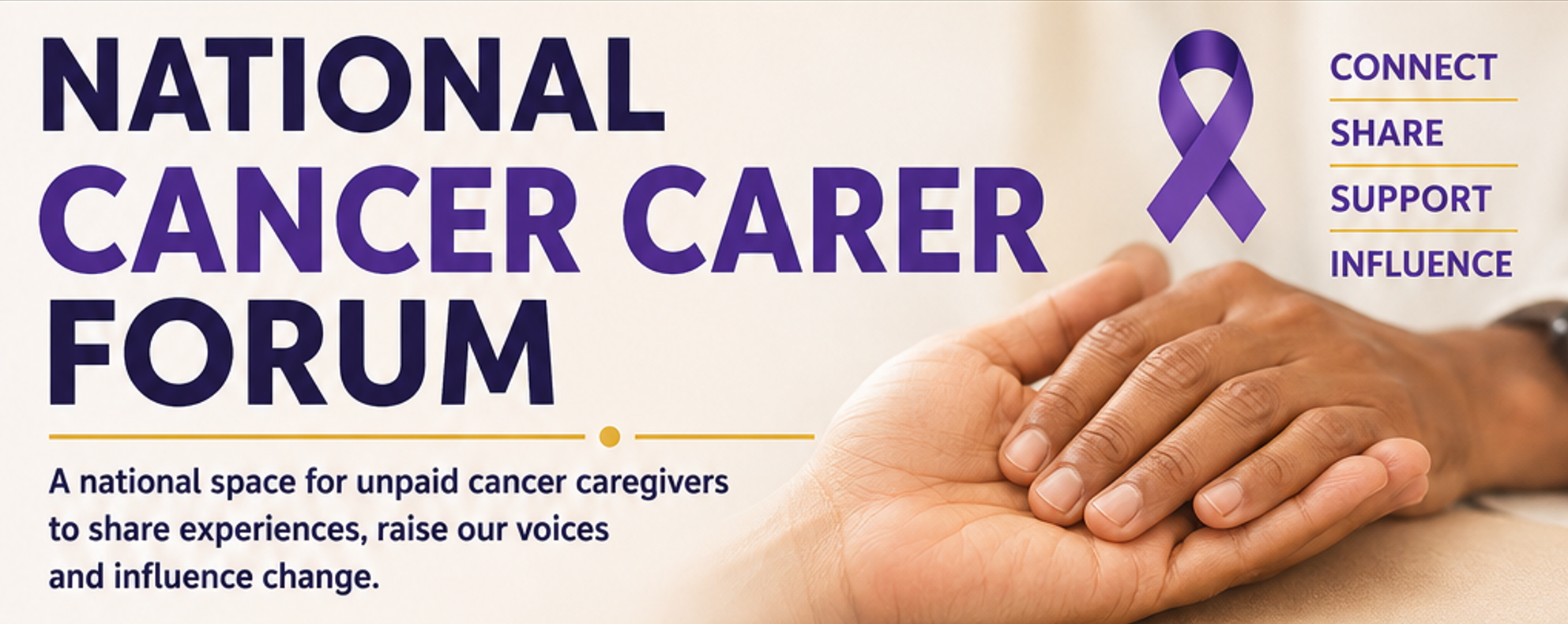
Welcome to the October update from my National Cancer Caregiver Forum, reflecting on our meeting held on 30 September.
I chair this forum to help bring greater attention to the experiences of people supporting someone living with cancer. Cancer care can involve a whirlwind of appointments, investigations, treatment decisions and changes at home. Behind all of this, family members, partners and friends often provide considerable practical and emotional support.
Yet their own needs can remain hidden.
Our latest meeting brought together carers, a representative from the South East London Cancer Alliance and trainee clinical psychologist Lara Pope. We explored how carers can navigate services, how their experiences can inform improvements, and why support for their own wellbeing needs to be more visible.
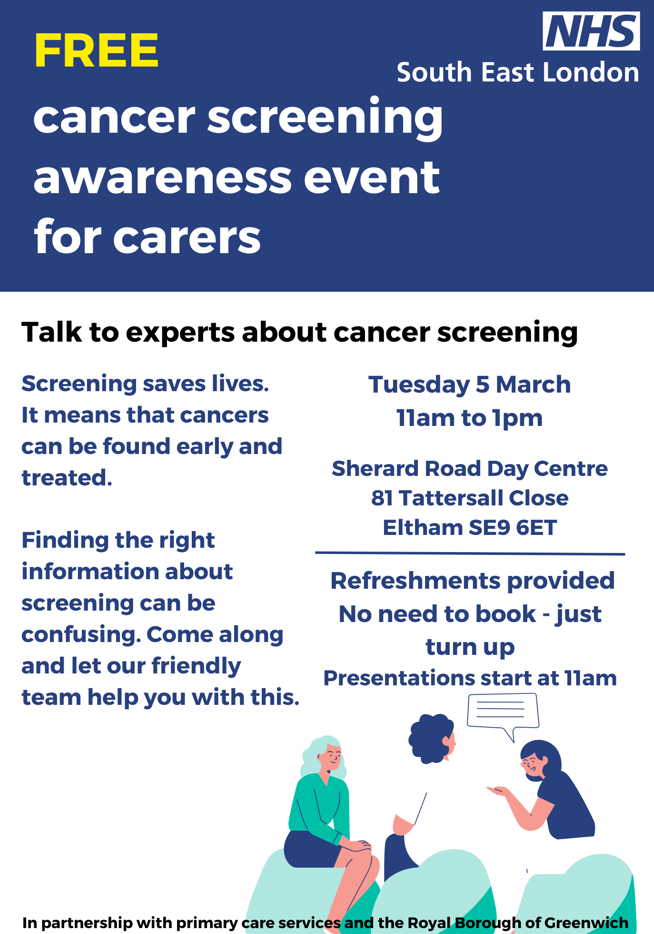
Hearing from the South East London Cancer Alliance
We welcomed a programme lead from the South East London Cancer Alliance, whose work includes patient experience, involvement and inequalities.
The discussion acknowledged an important gap: while services collect information about patients’ experiences of cancer care, there has been less information available about the experiences of those supporting them.
To help address this, colleagues from several Cancer Alliances worked with carers to develop a cancer carers survey. The aim is to understand the impact of caring, identify unmet needs and explore whether experiences differ between areas.

At the time of our meeting, approximately 150 responses had been received across the participating areas. We were told that the survey would remain open until the end of October.
Early responses were highlighting the emotional impact of caring, the pressure of managing appointments and responsibilities, and difficulties accessing support. These were emerging themes rather than final findings.
The Alliance also explained that the findings could help inform conversations with clinical teams and national colleagues. Some improvements might involve clearer communication or different ways of working, alongside identifying gaps in services.
For me, the important next step is ensuring that carers can see what happens after they contribute. Sharing experiences should lead to feedback, discussion and opportunities to influence change.
Cancer carers survey:
https://www.surveymonkey.com/r/8ZV8DN3
Reaching carers before they become overwhelmed
We discussed how hospitals, cancer information centres, clinical nurse specialists, hospices and community organisations could help people find support.
One challenge is that many people do not describe themselves as carers. They see themselves as a husband, wife, partner, daughter, son or friend doing what needs to be done.
That is understandable. However, it can mean they miss information or support advertised specifically for “carers”.
Services need to explain what support is available in language that people recognise. Asking someone whether they help a loved one with appointments, medication, daily activities or emotional support may open a conversation that the word “carer” alone does not.
The discussion also recognised that attending a forum is not always easy. Some people are exhausted, some are still processing a diagnosis, and others want their limited free time to offer a break from talking about cancer.
This makes it important to offer different ways to connect, including written updates, individual conversations and opportunities to contribute when people feel ready.
My presentation: navigating cancer services without being excluded
During the meeting, I gave a short presentation on “Navigating cancer services without being excluded.”
Drawing on my caring experiences and work with unpaid carers, I focused on some practical questions for people who may be new to the role.
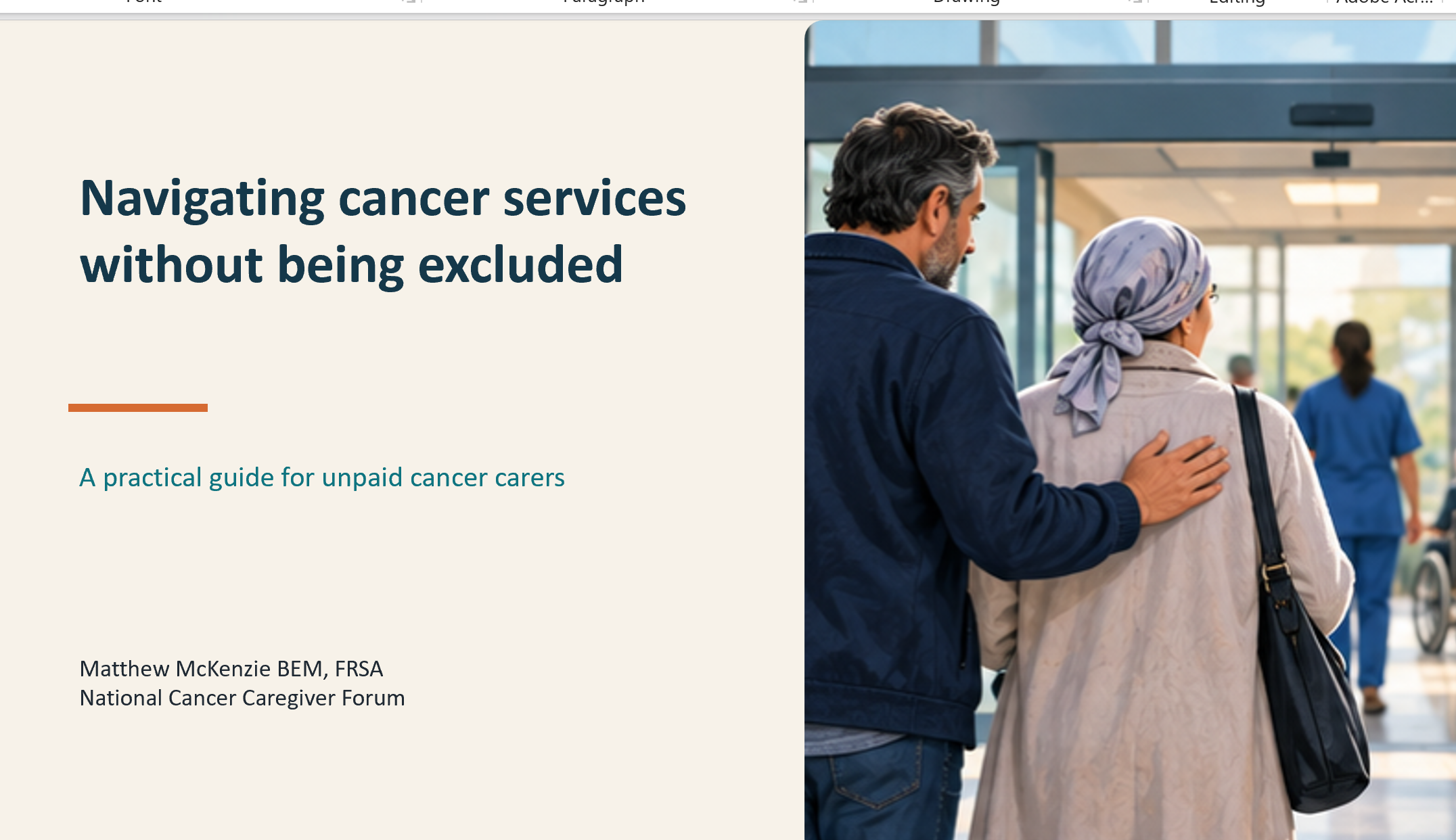
Exclusion can happen when the person providing care at home is overlooked, when information is difficult to understand, or when nobody explains who to contact next.
Carers may then find themselves trying to coordinate support without a clear picture of how the system works.
Five questions formed a central part of the presentation:
- Have you recorded me as the person providing support?
- What do I need to know to support care safely at home?
- Who should I contact if something changes?
- What information can be shared with me, with the patient’s consent?
- Where can I get support for my own wellbeing?
These questions will not resolve every difficulty, but they can help begin conversations about recognition, communication and support.
The final question matters especially. Carers’ health can easily slip down the list while they concentrate on the person they love.
When carers become the link between services
An important theme was the amount of coordination that can fall to families.
Carers described having to keep track of appointments, help explain medical histories, learn unfamiliar terminology and make sure information reaches the right professional.
One contribution highlighted how different record systems can leave families helping clinicians locate information from another hospital. Others described the strain of repeatedly explaining what had already happened.
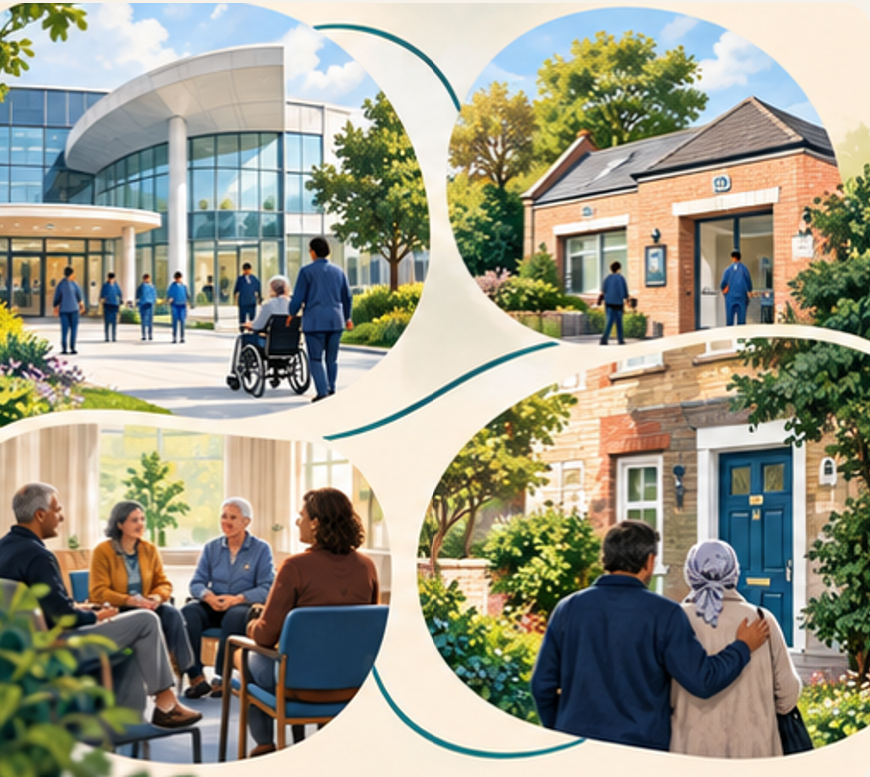
There were also positive experiences. Specialist cancer teams were described as listening to carers and including families in discussions. However, that sense of inclusion was not always consistent across other parts of the system.
This raises an important question: how can good carer involvement follow the person throughout their care, rather than depend on which service they happen to encounter?
Even someone familiar with health and social care can feel overwhelmed when supporting a loved one through cancer. Knowledge of the system does not remove the emotional pressure.
Hospital discharge and preparing for care at home
The move from hospital to home was another significant part of our discussion.
For a carer, discharge may bring new responsibilities around medication, side effects, appointments and knowing when to seek help. Coming home can be frightening if the family does not feel prepared.
We discussed the importance of clear explanations and knowing who is responsible for the next step.
A discharge plan needs to take account of the person who will provide support at home, including what they understand, what they feel able to do and what help they need.
Contributions also illustrated how delays and communication failures can create additional distress. Carers need opportunities to raise concerns and receive clear answers about what is happening.
Carers’ own health must remain part of the conversation
We heard how easily carers can put their own health needs on hold.
When someone is seriously unwell, it can feel impossible to step away for an appointment, treatment or rest. Carers may feel that nobody else can provide the same support, or worry about what will happen during their absence.
The discussion reminded us that exhaustion can remain hidden behind a person who appears organised and capable.
Supporting a carer means asking about their wellbeing and helping them think through practical arrangements. It also means recognising that a carer may have health conditions or treatment needs of their own.
Carers should not have to reach a crisis before their needs are noticed.
Peer support and advocacy
Peer support was described as a lifeline.
Speaking with people who understand caring can provide space to acknowledge the pressure, exchange practical ideas and feel less alone.

However, we also discussed the need for stronger advocacy. Sometimes a carer needs someone alongside them who understands services, can help them prepare questions and support them to raise concerns.
One practical suggestion was to keep a notebook containing appointments, contact details, questions and information given by professionals. When events move quickly, having a record can help carers return to something they need clarified.
Participants also highlighted positive experiences of support from St Christopher’s. This prompted discussion about possible future connections and how the forum could help organisations learn from one another.
Lara Pope’s request: please help share her research
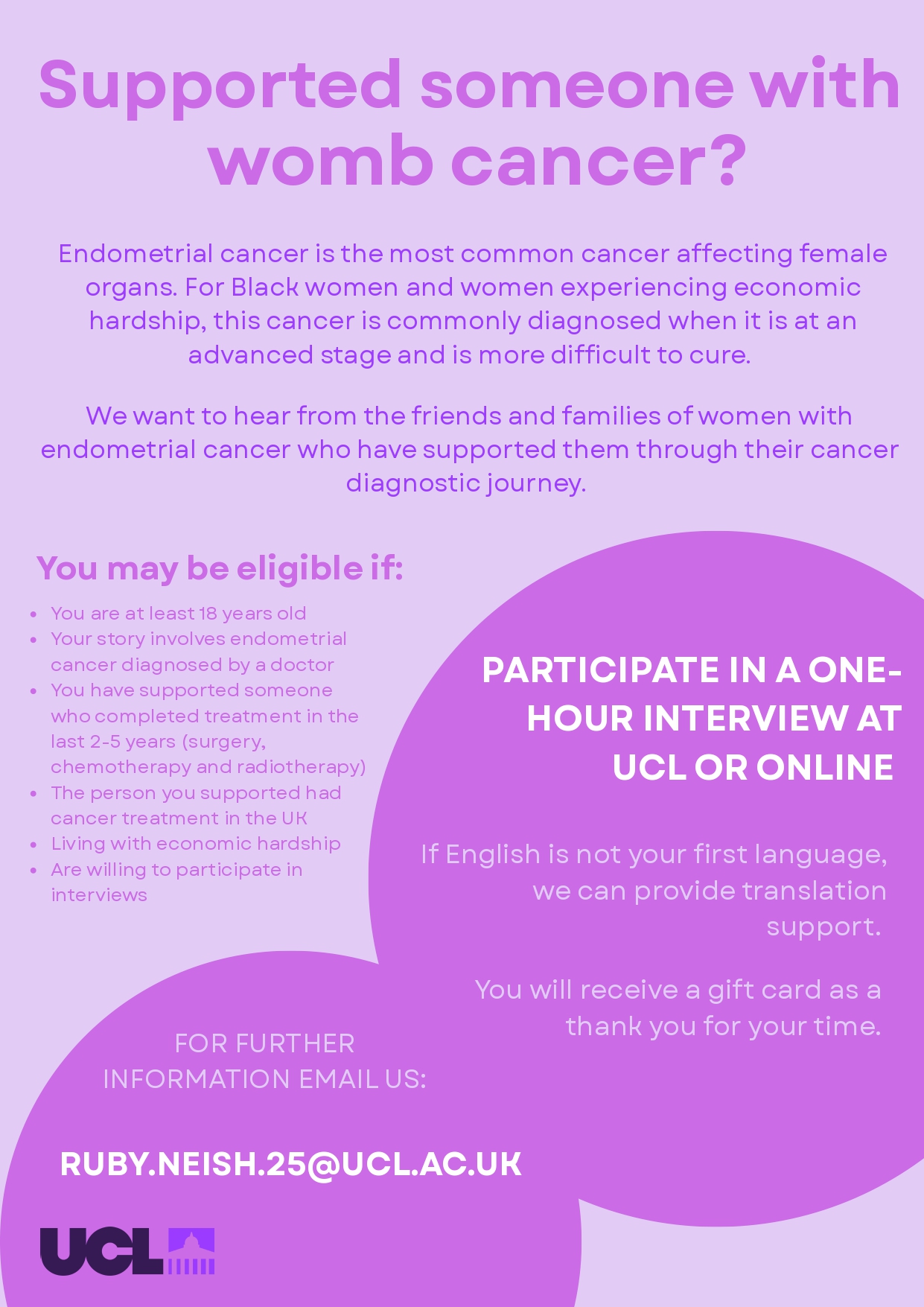
We also welcomed Lara Pope, a third-year trainee clinical psychologist at the University of Hertfordshire, who is undertaking research for her thesis.
Lara spoke about her research into partners’ experiences in the context of gynaecological cancer. She also described the difficulty of finding relevant support groups, which underlined our wider discussion about how hard it can be for families to locate support.
At the end of the meeting, Lara asked whether I could share her research again. She explained that she had made minor amendments to her ethics documentation and would be grateful for another opportunity to raise awareness.
Our meeting took place on the final day of Gynaecological Cancer Awareness Month. Lara hoped to build on that awareness and keep attention on experiences that may be difficult to discuss or remain overlooked.
Please see Lara’s latest research invitation below for the full eligibility criteria, what participation involves and how to contact her.
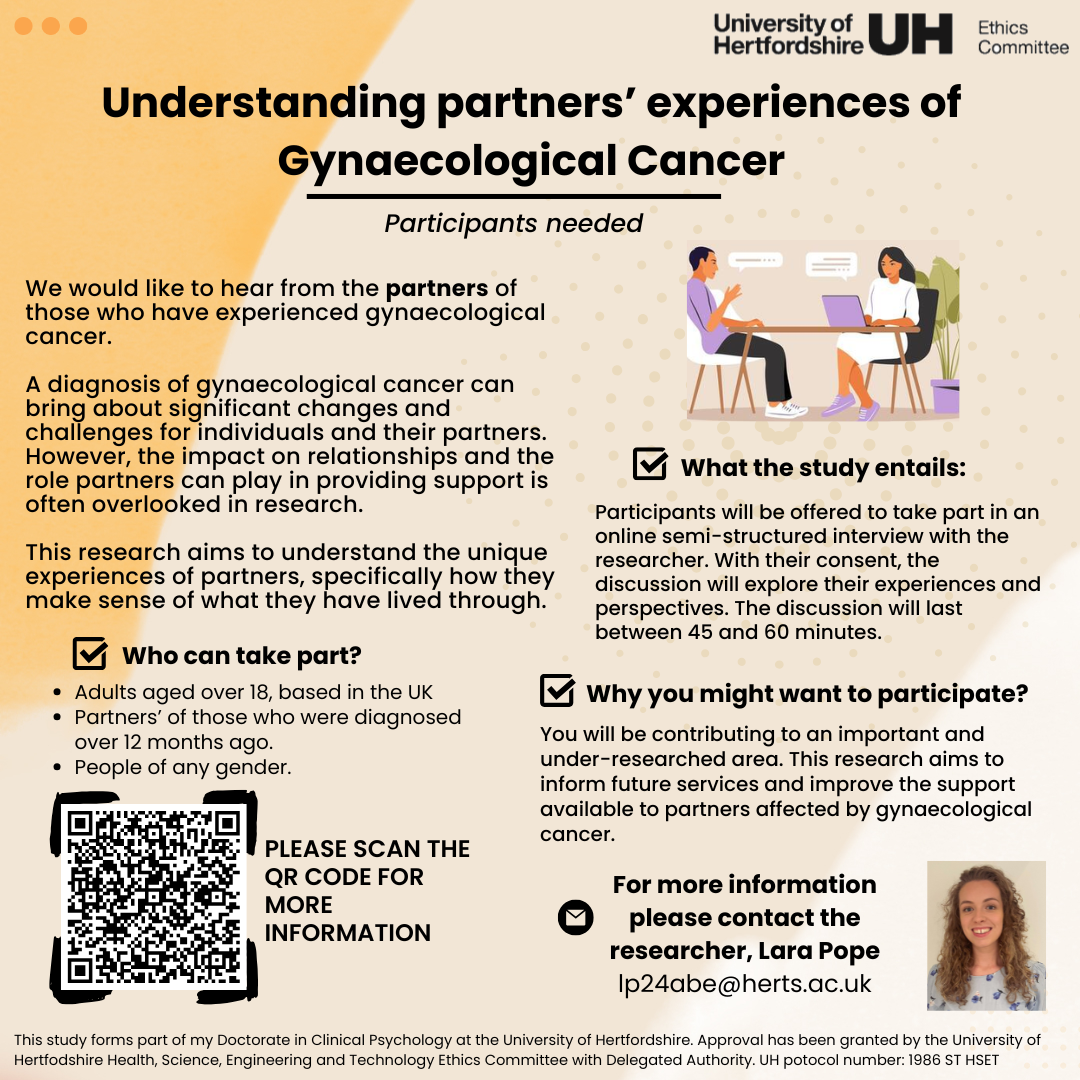
At our forum, Lara asked for help sharing the research again following minor amendments to her ethics documentation. Understanding partners’ experiences could help draw attention to needs that are often overlooked.
If you are interested in participating, please contact Lara for the latest eligibility criteria and information about what taking part involves:
Email: l.j.pope@herts.ac.uk
You can also read my earlier blog introducing Lara’s research.
If you work with a carers’ organisation, cancer support group or relevant community network, please consider sharing the updated invitation with people who may be interested. Anyone considering taking part should read the study information and contact Lara directly with questions.
Continuing to build the forum
This forum is still growing, but the discussion showed the value of bringing carers, researchers and services together.
It offers a space to exchange information, identify gaps and help carers contribute to conversations about how support could improve.
Future discussions could include hearing from other Cancer Alliances, hospice carer services, hospital teams and organisations supporting carers in the community. These were suggestions raised during the meeting, rather than confirmed speakers.
I would particularly like to strengthen the links that help people find the forum and ensure that carers’ experiences reach those responsible for developing services.
Join a future meeting
The National Cancer Caregiver Forum meets online on the last Wednesday of each month at 5 pm.
The next meeting is scheduled for Wednesday 28 October 2026 at 5 pm. Joining details and speaker information will be shared nearer the time.
Thank you to everyone who contributed to our September discussion, and to those helping raise awareness of the forum.
Cancer caregivers bring knowledge, commitment and experience that services need to hear. They also need recognition and support for themselves.