Category Archives: SW London Carers Group

SW London Carers Forum – November 2025 Update

By Matthew McKenzie, Co-Facilitator – SW London Carers Forum

About the South West London Carers Group

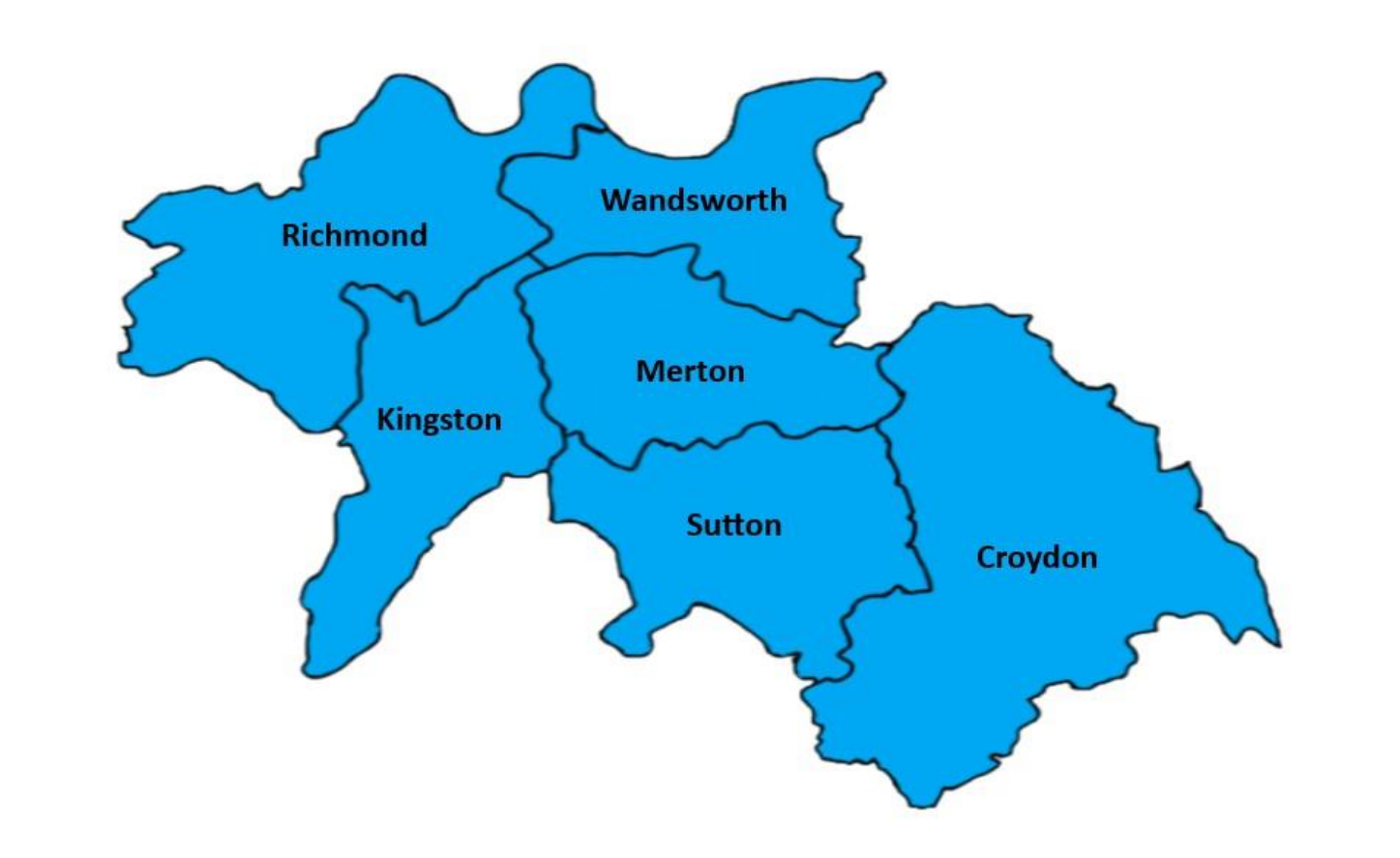
The South West London Carers Group brings together unpaid mental health carers from across the boroughs of Sutton, Merton, Wandsworth, Richmond and Kingston, to share experiences, gain peer support, and stay informed about local health and social care developments.
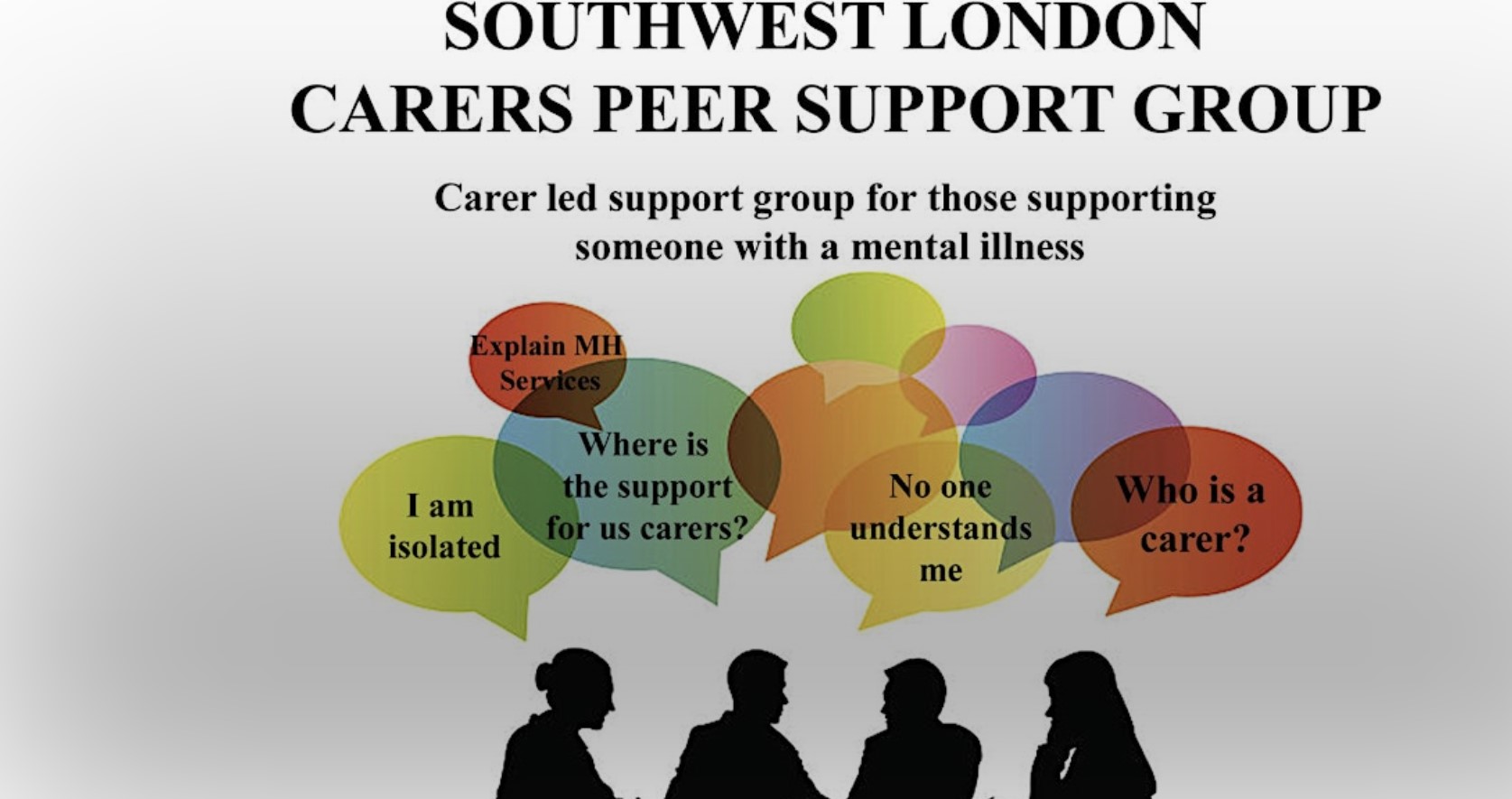
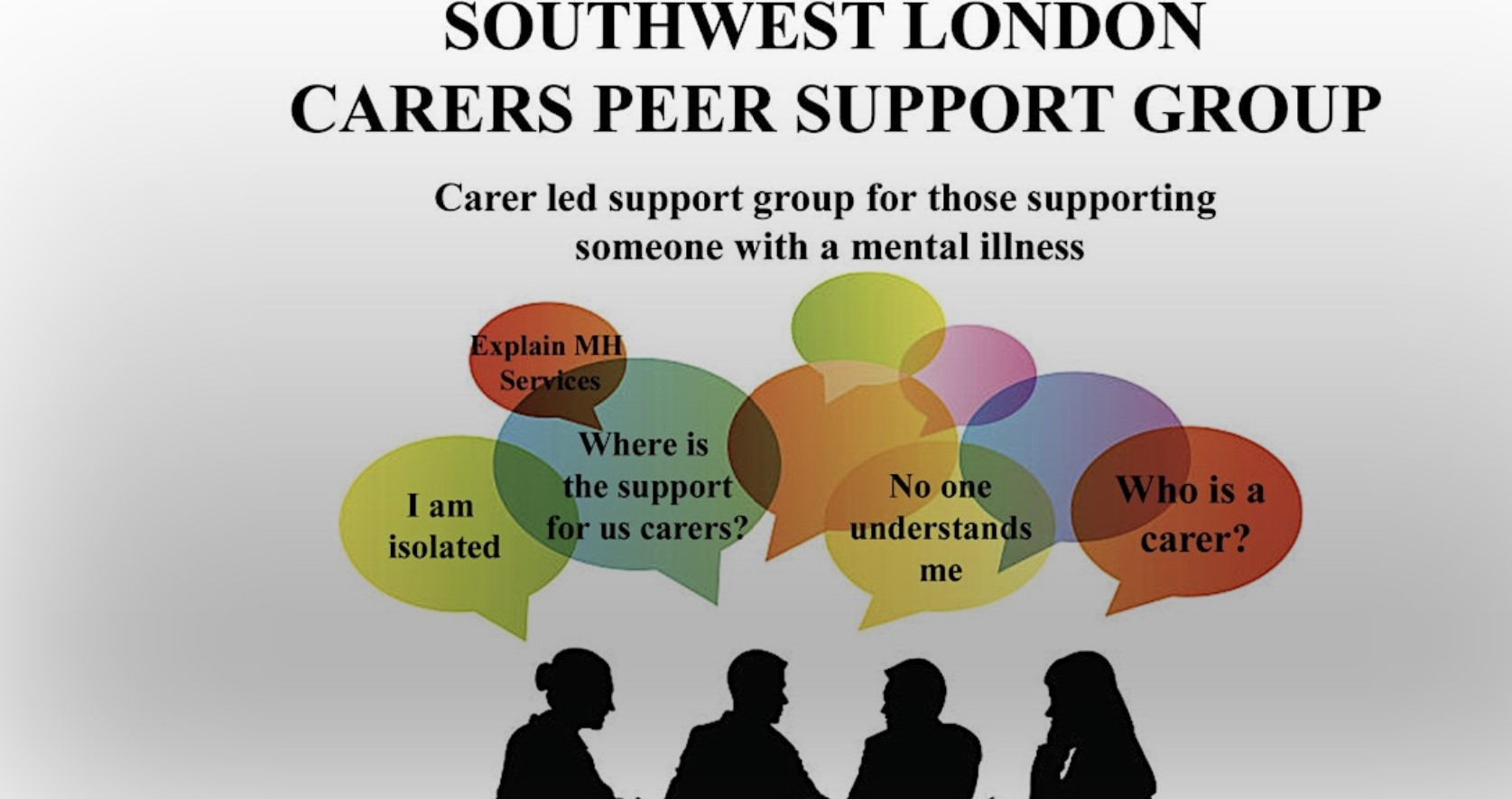
The group provides a safe and welcoming space where carers can discuss the challenges of supporting loved ones particularly those with long-term conditions or mental health needs while also learning from guest speakers, professionals, and each other. Co-facilitated by myself, the forum plays an important role in making carers’ voices heard and strengthening connections between carers and local NHS, mental health, and community services.
Our November South West London Carers Group meeting brought one of the most informative sessions we’ve had all year. We were joined by Dalvinder, the Patient Experience Lead for NHS 111, who provided a thorough and eye-opening look at how the 111 urgent care service really works, what carers can expect, and how the system is evolving.

Dal’s role involves reviewing patient feedback, monitoring the quality of calls, and ensuring that the service remains compassionate, safe, and responsive. He also regularly meets with community groups, like ours to raise awareness of what 111 can offer.

24/7 Telephone Assessments

Dal opened by reminding us that NHS 111 operates 24 hours a day, 365 days a year, and never closes. The telephone assessment is often the first point of contact, and callers speak to a trained health advisor who uses the NHS Pathways system to ask structured questions. This ensures the call handler can rule out serious issues and direct the caller to the right service quickly. Dal emphasised that while questions can feel detailed or repetitive, each answer opens or closes clinical “pathways,” helping the system determine the safest next step.


GP Home Visiting (Evenings, Overnights, Weekends)
One of the biggest surprises for many carers was learning that NHS 111 has a GP home visiting service, specifically for times when GP surgeries are closed weekday evenings, overnight, weekends, and bank holidays. This service is intended for people who cannot safely travel, including those with mobility issues, caring responsibilities, or urgent health needs that don’t require hospital care. If a home visit is determined to be appropriate, a GP working for 111 can visit in a dedicated GP car and may provide medication on the spot or issue prescriptions if needed.


Primary Care Clinics (PCCs) – Same-Day Appointments via 111

Dal also explained the role of Primary Care Clinics (PCCs) located across South West London. These clinics operate outside normal GP hours and can see patients the same day—but crucially, access is by 111 referral only. If 111 decides that someone needs to see a GP face-to-face and can travel, they may be booked into a PCC appointment. Carers learned that you cannot walk into these clinics directly; 111 must assess the situation and confirm the appointment. This helps manage demand and ensures that appointments go to those who need them most urgently.


The Expanding Role of Pharmacies and “Pharmacy First”
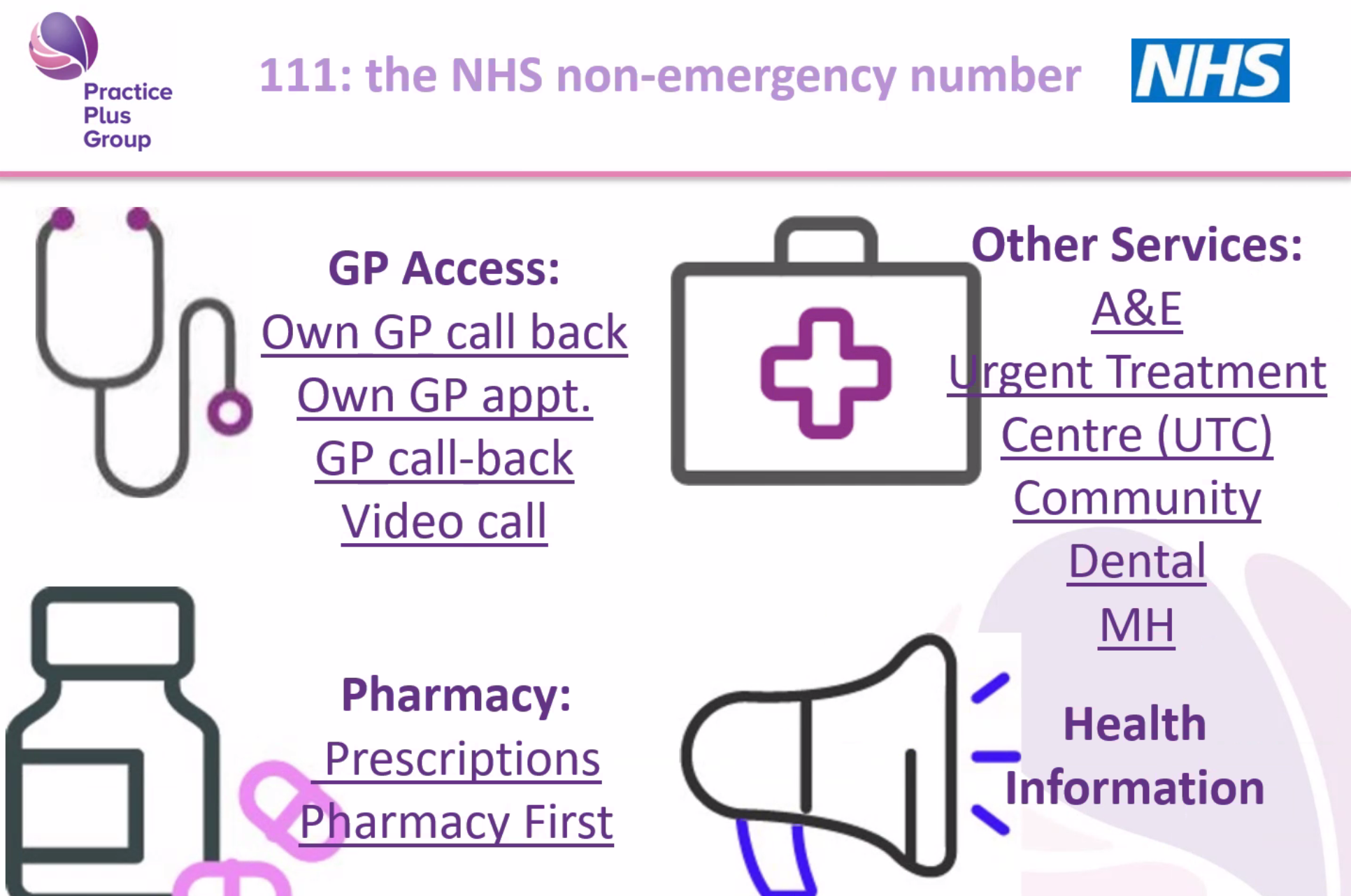
Another major theme was the evolving role of pharmacies in urgent care. Dal explained that pharmacists are highly trained professionals—more trained than many realise—and 111 can now direct callers to pharmacists for assessments, repeat prescriptions, and urgent medication needs. The Pharmacy First scheme allows some pharmacies to provide consultations and treatment in private rooms for a range of minor illnesses. 111 can also arrange emergency prescription access if someone runs out of routine medication while travelling, provided the medication is part of their regular treatment.


Arranging Call-Backs From Your Own GP

In certain situations, NHS 111 can request that your own GP practice contacts you, especially for non-face-to-face issues such as renewal of regular medication, questions about paperwork, or administrative needs. While GP appointment slots reserved for 111 are limited and fill quickly, the service can still send urgent notifications to GP surgeries when clinically necessary. Dal encouraged carers to mention when the need is time-sensitive so the system can prioritise appropriately.


Mental Health Support via 111 Option 2

One of the most important updates for mental health carers was the introduction of 111 Option 2, currently being trialled across London. When callers choose this option, the call is diverted away from standard 111 and straight to local specialist mental health teams, who can assess issues such as relapse, agitation, distress, changes in behaviour, or crises at home. Dal emphasised that while 111 is not a specialist mental health service, Option 2 ensures that people with mental health needs receive expert support. Data from the pilot is expected next year, and Dal offered to return to share the outcomes.


What We Learned About NHS 111
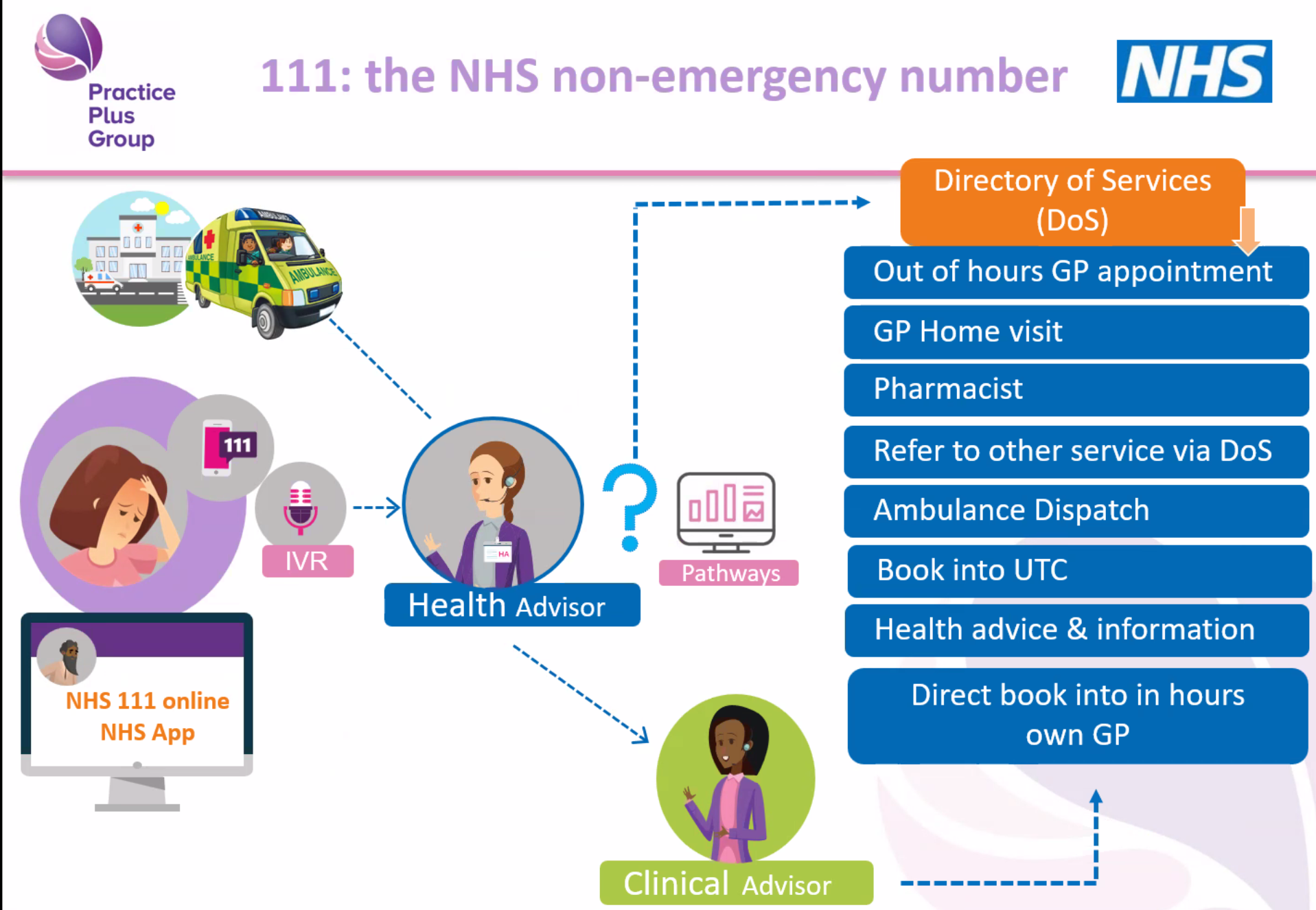
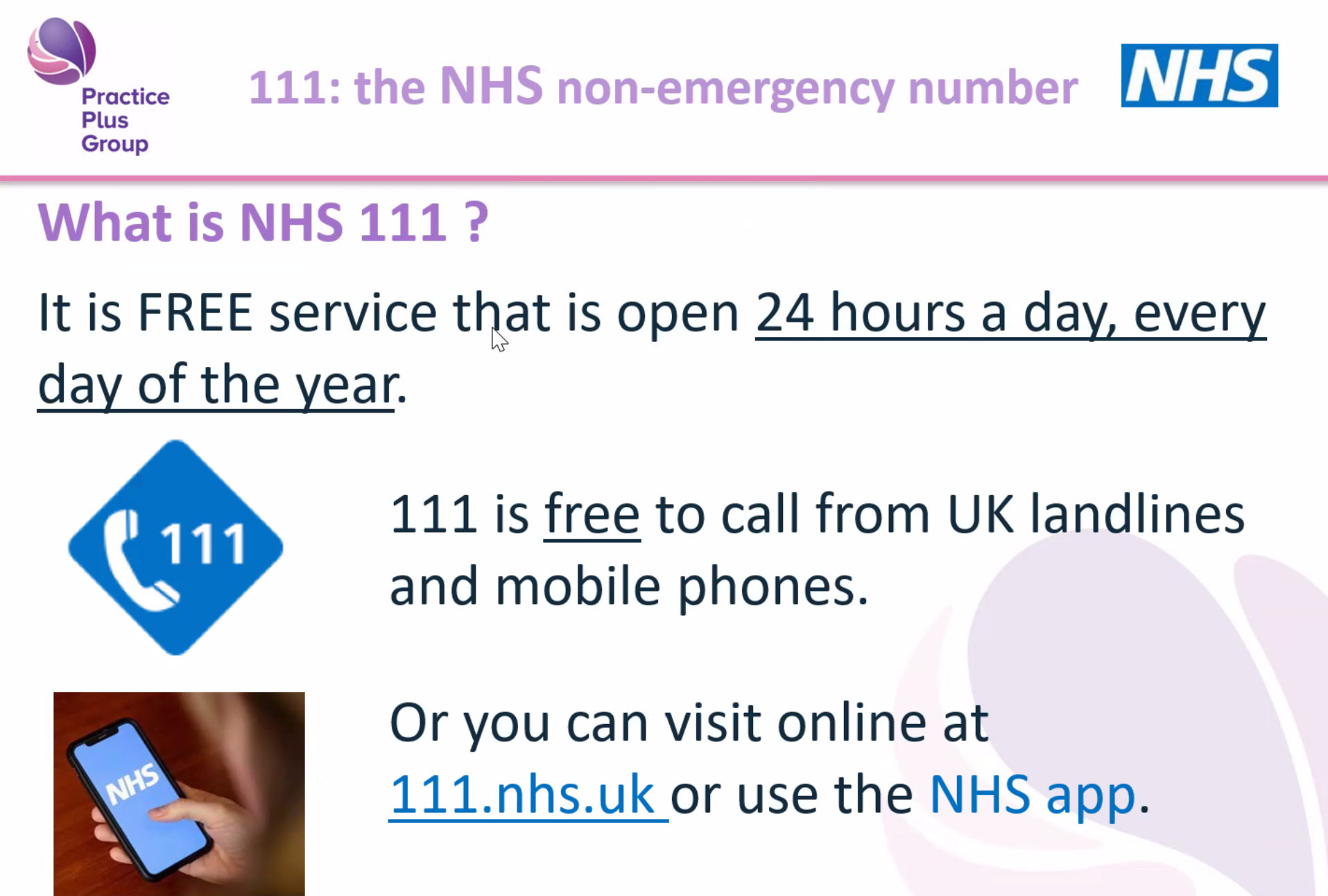
Many carers know the NHS 111 number exists, but few realise the range of services behind it. Dal explained that 111 is a free, 24/7 service (including weekends and holidays) designed for urgent health concerns that are not life-threatening.

Many carers commented that they had no idea 111 provided such a broad range of services.


Questions From Carers

Carers asked many thoughtful and practical questions during the session, including:

1. Mental Health Crises

A carer asked how 111 responds to mental health emergencies, particularly when someone becomes distressed, unwell, or difficult to support at home.

Dal explained that 111 itself is a generic urgent care service, but Option 2 sends callers straight to trained mental health professionals, who can triage cases such as relapse, agitation, or risk concerns in a more specialist way.

2. Access to Medical Records

A question was raised about whether 111’s clinicians can view a patient’s medical history.

Dal clarified that clinicians have access to the Summary Care Record, containing essential medical information, medications, conditions, and recent interactions—if the caller gives consent.

3. Home Visiting Times and Coverage
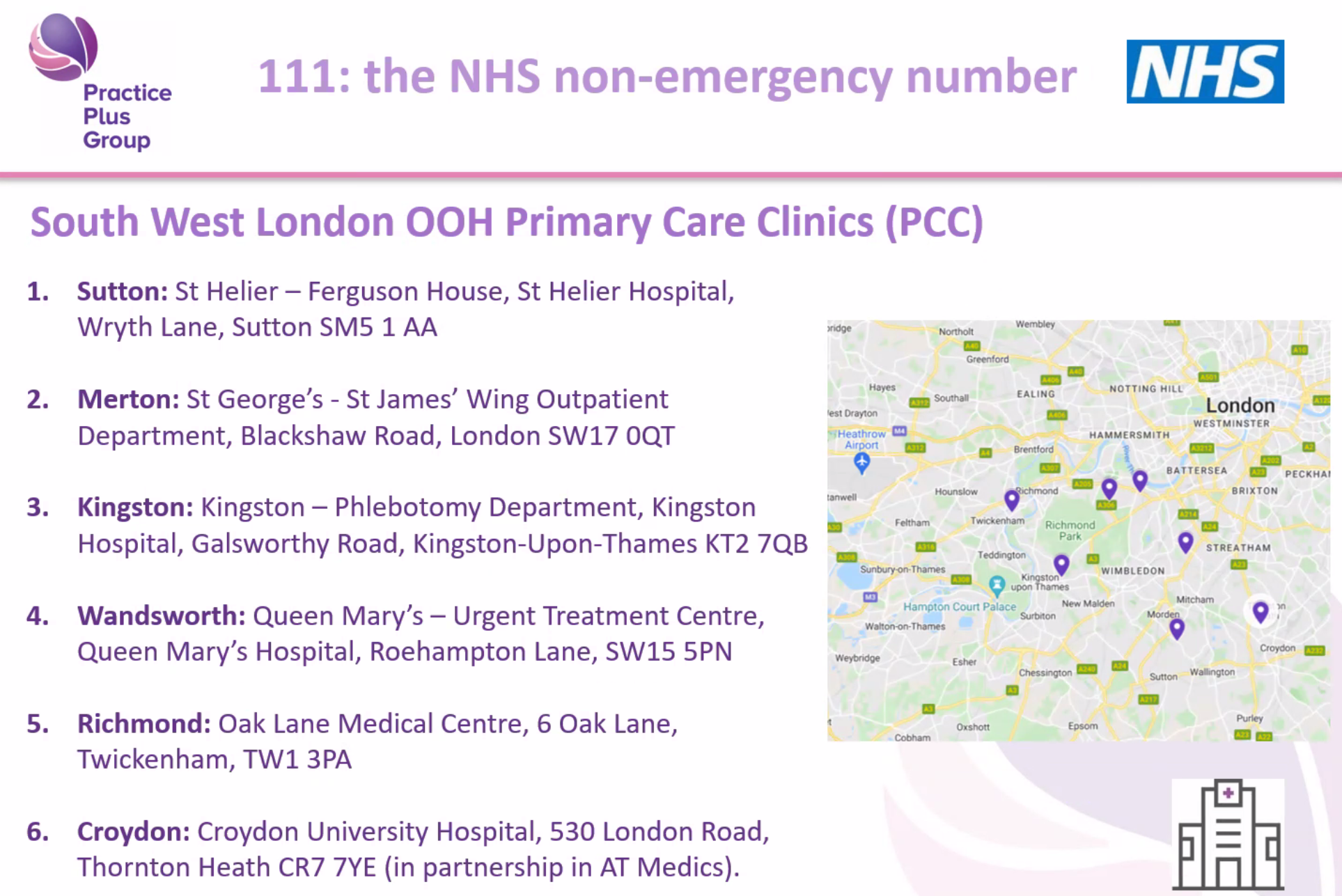
Carers asked about response times and geographical limits.

Dal explained that SW London is fully covered, though travel times vary depending on the area and how busy the service is. Home visiting is evenings, nights, and weekends only.

4. Staffing Levels and Training

One question focused on whether call handlers are medically trained.

Dal shared that 111 employs 180 health advisors in SW London—non-clinical staff who have completed an intensive six-week training program. They follow the NHS Pathways system and are supported by clinical advisors (GPs, nurses, paramedics) who can join or take over calls when needed.

5. Using 111 When Travelling

A carer asked about getting medication while away from home.

Dal explained that 111 can arrange for prescription collections at pharmacies in another part of England, which has helped many travellers who forget medication.

6. Hearing Impairment and Accessibility

There was interest in support for people who cannot make phone calls.

Dal confirmed services such as text relay, online 111, and the NHS App, all of which improve accessibility for carers and patients with additional needs.


Carer Reflections and Experiences

Several carers shared personal experiences both positive and challenging. One described how 111 triage was vital when they urgently needed treatment for a severe infection, while another discussed difficulties when GP surgeries didn’t always respond quickly to reports sent by 111.
These real stories helped emphasise how important it is for carers to know when and how to use the service, and how essential accurate information is during triage.


Key Tips Dal Shared for Carers

  • Give as much information as possible, including social factors such as caring responsibilities, mobility challenges, or inability to travel.
  • Stay with the person you’re calling about, as the call handler will ask you to check symptoms in real time.
  • Tell 111 if symptoms change—this can alter the urgency and outcome.
  • Always keep your phone nearby when waiting for a callback; 111 will try only three times.
  • Don’t hesitate to call again if you’re unsure or worried.

Closing Thoughts

The session was incredibly well-received. Many carers said they learned things they never knew, even though they had used 111 before. Dal’s openness and honesty—both about what the service can do and what its limitations are—made his presentation especially valuable.

As co-facilitator, I (Matthew McKenzie) will continue to share information like this to help carers navigate local health services more confidently. We hope to invite Dal back once the evaluation of 111 Option 2 (mental health) is published, we also have a keen interest on what the ICB is doing especially regarding carer involvement.
South West London Mental Health carers group update for June 2025

A Space to Share, a Space to Be Heard

The session opened with updates and heartfelt check-ins. One of our carer members, shared a deeply personal and challenging situation regarding her loved ones declining mental and physical health. Despite strained family dynamics and the emotional burden of caring, a carer is courageously advocating for her loved one and seeking support through nursing services and assessments.

Peer Support: Insights from Experience

Long-time members offered valuable perspectives from their own journeys. A carer shared their struggle supporting individuals, which showed a stark reminder of the emotional and logistical toll caring can take. Another carer encouraged fellow carers to prioritise their own well-being, even in small ways a cup of tea, a short walk, a moment to breathe.

Continue reading

South West London Mental Health carers group update for March 2025

Celebrating Mental Health Carers: Building Stronger Connections in Southwest London

By Matthew McKenzie | April 2025

Mental health carers play a vital, often unseen role in supporting loved ones through some of life’s most difficult challenges. At the SW London Mental Health Carer’s Group, we’re creating a space where carers can connect, learn, and feel empowered.

The forum is faciliated by Matthew McKenzie and Ava, although members of the group are encouraged to facilitate to develop carer empowerment.

Continue reading

South West London Mental Health carers group update for January 2025

Here is a brief update to the SW London carers group facilitated by Matthew McKenzie and Ava.

Matthew discussed the importance of engaging with Patient Advice and Liaison Service (PALS) for carers, emphasizing its role in providing support, advice, and information to patients and their families. The group also shared their experiences with PALS and other healthcare services, highlighting the need for transparency, accountability, and effective complaint resolution. Plans were made for upcoming meetings, including a speaker on PALS and discussions on expanding membership and increasing attendance.

Continue reading

South West London Mental Health carers October 2024 update

Here is a brief update of the South West London mental health carers forum. The runs once a month. The group starts with a carer peer support session run by Ava.

The meeting introduced Rosetta Life, an arts and health charity that creates accessible creative projects for carers and those with life-altering illnesses. Attendees discussed the organization’s various initiatives, including poetry workshops, dance programs, and digital projections, as well as their funding sources and collaboration with other charities and healthcare providers. The group also explored potential future projects, challenges in engaging participants, and the importance of offering clear benefits to encourage involvement in their programs.

Introducing Rosetta Life’s Carer Projects

In the meeting, Matthew and Ava introduced Lucinda, the creative director of Rosetta Life, an arts and health charity that aims to make creativity accessible to those living with life-altering illnesses or caring for someone with such illnesses. Lucinda shared the charity’s work with carers, including a project called “The Heart of Care” that began in lockdown. This project involved creating a carer’s chorus, online poetry workshops, and dance workshops to explore the anatomy of caring. The project culminated in digital projections onto public spaces in Kingston, Newcastle, Bristol, and Delhi, aiming to raise awareness of the challenges faced by carers. Lucinda also mentioned an upcoming 360 immersive film and animation project to further raise awareness of the lives of unpaid carers. The attendees expressed their appreciation for the initiative and its potential impact.

Carer Support Across Life Stages

A carer and Lucinda discussed the organization’s work with carers across various life stages, including young carers, parent carers, and grandparent carers. Lucinda explained that they work with a network of freelance artists and a core team, and are funded by the Arts Council, City Bridge Trust, and other trusts and foundations. The organization’s services are free at the point of access, and they align themselves with the NHS. Lucinda also mentioned that they work with charities to ensure safeguarding and referral safety. A carer asked about the organization’s outreach methods and whether they work with carers supporting those with dementia. Lucinda confirmed that they do work with such carers, but rely on charities for referrals and safeguarding. The carer member suggested that the organization could work with NHS trusts to provide carer support, which Lucinda agreed was a good point.

New Carer Program and Animation

The carer group discussed a new program for carers, which will be online and tailored to their needs. Lucinda showed a short film related to the program, which Matthew has shared in this blog post. Lucinda also mentioned a new animation project for the program. A carer expressed interest in the program and asked for more information. Matthew offered to write a blog post about the session for those who couldn’t attend.

Kingston Marketplace and International Poetry

Matthew expressed his delight at seeing the work that was created projected in Kingston Marketplace. Lucinda discussed the work they do with carers, including a peer support exchange with India and South Africa, and the possibility of running an online platform with poetry prompts for carers. She also offered to send the full film to Matthew for sharing. Other carer members showed interest in the international poetry workshops and the potential for a poetry workshop for their group. Lucinda agreed to consider their ideas for future projects.

This concludes a brief update of the SW mental health carer forum.

South West London Mental Health carers September 2024 update

Here is a brief update of the South West London mental health carers forum. The runs once a month.

Quick recap

The South West London Mental Health Carers Forum was established as a carer-led group for connection and learning, the group is co-facilitated by Ava. We also had two speakers for the month of September. The meeting covered various topics such as the role of administrators in mental health services, the importance of involving carers in patient care, the Patient Care Race Equality Framework, and the impact of the cost of living crisis on mental health. The meeting also discussed the work of organizations like Power2Connect and Simple, which focus on digital exclusion and providing access to technology for those who cannot afford it.

South West London Mental Health Carers Forum Meeting

Matthew McKenzie welcomed everyone to the South West London Mental Health Carers Forum, emphasizing its purpose as a carer-led group for connection and learning. He introduced the speakers and encouraged attendees to introduce themselves. A fellow carer member expressed her intention to invite her other carer group members to join the platform. One carer shared her experience on involvement for West London. As the group sometimes connects to the other carer groups matthew runs.

Matthew then introduced the first speaker, Laura McCoy, who was to discuss her role and experiences working in the mental health services.

Administrator’s Experiences and Responsibilities at Psychiatric Ward

Laura, an administrator at Springfield Hospital’s all-female psychiatric ward, shared her experiences and responsibilities. She emphasized the importance of involving carers in the patient’s care from the moment of admission and the need to recognize unpaid carers. Laura also discussed the ward’s unique specifications, such as accommodating Muslim patients and managing bed allocation. She highlighted the importance of understanding the different sections of the admission process for patients and their next of kin, and the need for consent to share information. Laura also noted the distinction between a patient’s next of kin and their nearest relative under the Mental Health Act. She expressed her passion for providing support to carers and acknowledged the need for further work in raising awareness about available support

Addressing Family Pack, Book Availability, and Notice Boards

Ava who runs the peer section of the SW London carers group, expressed interest in seeing a complete family or Carers pack, and Laura agreed to share a some of the contents. Ava raised concerns about the availability of books and the maintenance of notice boards on hospital wards. Laura confirmed they have a bookshelf with around 30 to 40 books and that she maintains the notice boards for patients, mentioning they also have an Independent Domestic Violence Advisor on the ward every Monday. Laura and Ava discussed the importance of addressing issues promptly, with Ava sharing a personal experience that Laura provided some answers. Laura explained her approach to handling such issues, emphasizing direct involvement and follow-up for timely resolution.

Expanding Services, Template Integration, and Lobbying

A carer proposed expanding ideas and information to West London, which matthew agreed could be beneficial. Laura discussed her ongoing talks with the communications team about integrating their family pack into their new template, which might cause a slight delay. Matthew McKenzie suggested Laura send the pack to him for his mailing list. The group also discussed comparing their service with West London trust and potentially testing for improvements. Matthew and another carer discussed their involvement in various groups and events, with the carer expressing her ability to attend these events remotely. The carer also mentioned her participation in various carer support groups, including one led by Gillian Kelly.

Support Groups and Carer-Led Initiatives Discussion

Matthew and another carer discussed the importance of support groups for carers, with the carer emphasizing the need for carers to have a voice and share their experiences. Matthew suggested the possibility of hosting carer-led groups, which the carer agreed was a good idea. Laura, who focuses on contacting carers regardless of their ethnicity, mentioned that she has had her family pack translated into different languages.

Matthew then introduced the topic of the Patient Care Race Equality Framework (PCREF) and encouraged Laura to attend the National Ethnic Carers Forum to learn more about it. However, the other speaker Dominc suggested that Laura could also liaise with Mdad, who is leading on the PCREF initiative at South West London & St Georges. The conversation ended with matthew expressing his focus on families and carers, and Laura’s willingness to share information about the carer-led group.

Improving Mental Health Services and Support

Dominic, a mental project manager for Once of Care Alliance, discussed his role in shaping mental health services based on community input and collaborations. He highlighted his work with the BME mental health forum, supporting the Black and Global Majority Ethnic community, and his efforts to improve support for ex-offenders through drug and alcohol services. Dominic also mentioned collaborations with St. George’s Hospital to enhance perinatal mental health support for the BME community. He stressed the importance of gathering and reporting patient care feedback to improve services. Additionally, Dominc emphasized the significance of addressing mental health and homelessness issues, sharing a personal story about a long-term friend’s relapse of mental health and subsequent homelessness over the past four years.

Addressing Cost of Living Crisis and Mental Health

Dominc discussed the impact of the cost of living crisis on the population, emphasizing that it affects everyone regardless of class or color. He shared personal experiences and statistics to highlight the severity of the issue, noting that a number participants felt sad or depressed due to financial uncertainty. Dominic also pointed out that mental health both contributes to and can be worsened by homelessness, citing statistics from Crisis and Homeless Link. He concluded by discussing the challenges faced in providing mental health support, his involvement in the Mental Health Transformation Group, and his work with the community voices steering group. Dominc also provided guidance on recruitment strategies for mental health services.

Digital Exclusion and Access to Technology Discussion

Dominic provided an overview of his work and introduced two organizations, Power2Connect and Simple, which focus on digital exclusion and providing access to technology for those who cannot afford it. Ava sought clarification on certain terms and mentioned she was awaiting a certificate from an entrance view training. Dominic agreed to send a paragraph about an upcoming event over in Wandsworth.

The event, part of the drug and alcohol service and mental health services open day, aimed to provide support for carers with lived experience of mental health. Dominic promised to send the information about the event to members.

This then lead on to a peer group discussion with fellow carer members. This part was led by Ava.

This concludes the update for the month of September 2024

South West London Mental Health carers January 2024 update

Welcome to the first SW London Mental Health carers forum for the year 2024. This group is aimed at those caring for someone with mental ill health within SW London. The group aligns itself with the same areas the mental health trust South West London & St George’s covers.

Our members are from the boroughs of Merton, Sutton, Kingston, Richmond and Wandsworth. The carers forum is co-facilitated by Ava who is also a carer. Ava focuses on the carer peer aspect in the group. She is also a strong member of the Kingston Carers Network and on involvement at SWLSTG.

The speaker requested by the SW London MH carers group was Stamatia Filippou. Stamatia is the Wellbeing Practitioner of the Wellbeing Team, NHS Merton Talking Therapies. She is based at SWLSTG. Members wanted to hear what services were provided by Merton Uplift.

Merton Uplift Presentation

Stamatia talked about the following.

On how NHS Merton Talking Therapies is a free service for anyone in Merton who has a mental health or wellbeing need, whether this is due to emotional difficulties or life stressors (low mood, feeling stressed or worried, stressful family situations, financial worries, parents who are worried about their children or feeling overwhelmed, life changing events).
The service is accessible to anyone living in the borough of Merton or registered with a Merton GP who are 18 years and over.

Stamatia also mentioned that they are an integrated service which consists of the following teams; Talking Therapies: Offering a range of psychological therapies, CBT (cognitive-behavioural therapy), IPT (interpersonal therapy), EMDR (eye movement desensitisation and reprocessing), Mindfulness based therapies, online, over the phone or face-to-face, self-guided, in groups or one-to-one.

There is also support for Wellbeing, where this helps individuals connect and access activities and resources to meet their physical, social and emotional needs. Their outreach work focuses on engaging with individuals who have historically not fully accessed talking therapies. Merton Uplift run a variety of wellbeing workshops e.g., Coping with Stress, Food and Mood, Living Well with Chronic Pain, Managing Anger, Managing Sleep, Self-care and Relaxation, Understanding Anxiety, Reaching your potential, Work, stress and burnout plus Wellbeing for carers.

After the presentation, there was a Q & A session where carers can feedback or query what was on offer.

For Talking Therapies referrals:
Phone: 020 3513 5888
Referral Email: mertonupliftreferrals@swlstg.nhs.uk
Via the website: Referral Form (mayden.co.uk)
The service’s admin team will register your referral and book you in for an assessment.

For Wellbeing workshop referrals:
Wellbeing Email: MertonWellbeing@swlstg.nhs.uk
Book directly on Eventbrite: https://mertonuplift.eventbrite.co.uk

April Carer Forum Updates 2023

Welcome back to a quick update of my carer groups and forums. I have resorted to doing a brief update due my current projects raising carer awareness. As of this moment, I am writting fiction carer stories. You can check out my YouTube channel to view those stories. I have around 13 more stories focusing on caring for someone with mental illness, I will then work on stories focusing on caring for someone with cancer and follow that up with a book.

Until then, here are my updates below.

Lewisham Mental Health carer forum

For my Lewisham MH carers forum we had engagement from Mina Hadi who have lived experience of mental health. She is the service user representative for the Patient Carer Race Equality Framework over at East London NHS Foundation Trust.

Mina would have attended my ethnic carer forum, but there was a clash, so we agreed she can present at my Lewisham carer forum. I often say to members of my carer group to network. This is vitally important if carer members are involved in a community project. This is why I try to link up with other groups involved in increasing equity for ethnic minorities using mental health services.

Mina talked about the importance of PCREF and how East London NHS FT is working towards reaching out to marginalised groups. These being diverse ethnic groups, refugees, asylum seekers, the homeless and the LGBTQ community. All are vulnerable to mental illness due to discrimination, stigma and lack of support. Mina talked about what needs to be done and work in progress.

The next speaker was Dr Georgina Charlesworth from University College London.

She is the Associate Professor in Research Department of Clinical, Educational and Health Psychology.

Her main focus is on dementia where she has wrote a number of papers. Some are shown below

  • Living alone and risk of dementia: A systematic review and meta-analysis
  • Befriending carers of people with dementia: randomised controlled trial
  • Peer support and reminiscence therapy for people with dementia and their family carers: a factorial pragmatic randomised trial.
  • Examining the Lancet Commission risk factors for dementia using Mendelian randomisation

Dr Georgina was joined by another researcher linked to North East London NHS Foundation Trust. Dr Georgina spoke heavily on the importance of dementia carers. She was impressed that such a carer forum existed and felt that we as a group set an example. Dr Georgina spoke about the problems of stigma and she talked about one of her projects, which was the Carer Supporter Programme within Prof Martin Orrell’s NIHR-funded programme entitled “Support at Home: Interventions to Enhance Life in Dementia”.

The new Alzheimer’s Society service manager for South East London was also due to join us, but were unavailable and I am hoping they will be free next time.

Ethnic mental Health carer forum

This is a forum not bound to a specific area. There should be places for minority ethnic carers to attend, so I often advertise the group to other NHS mental health trusts. The main group members are usually from South London.

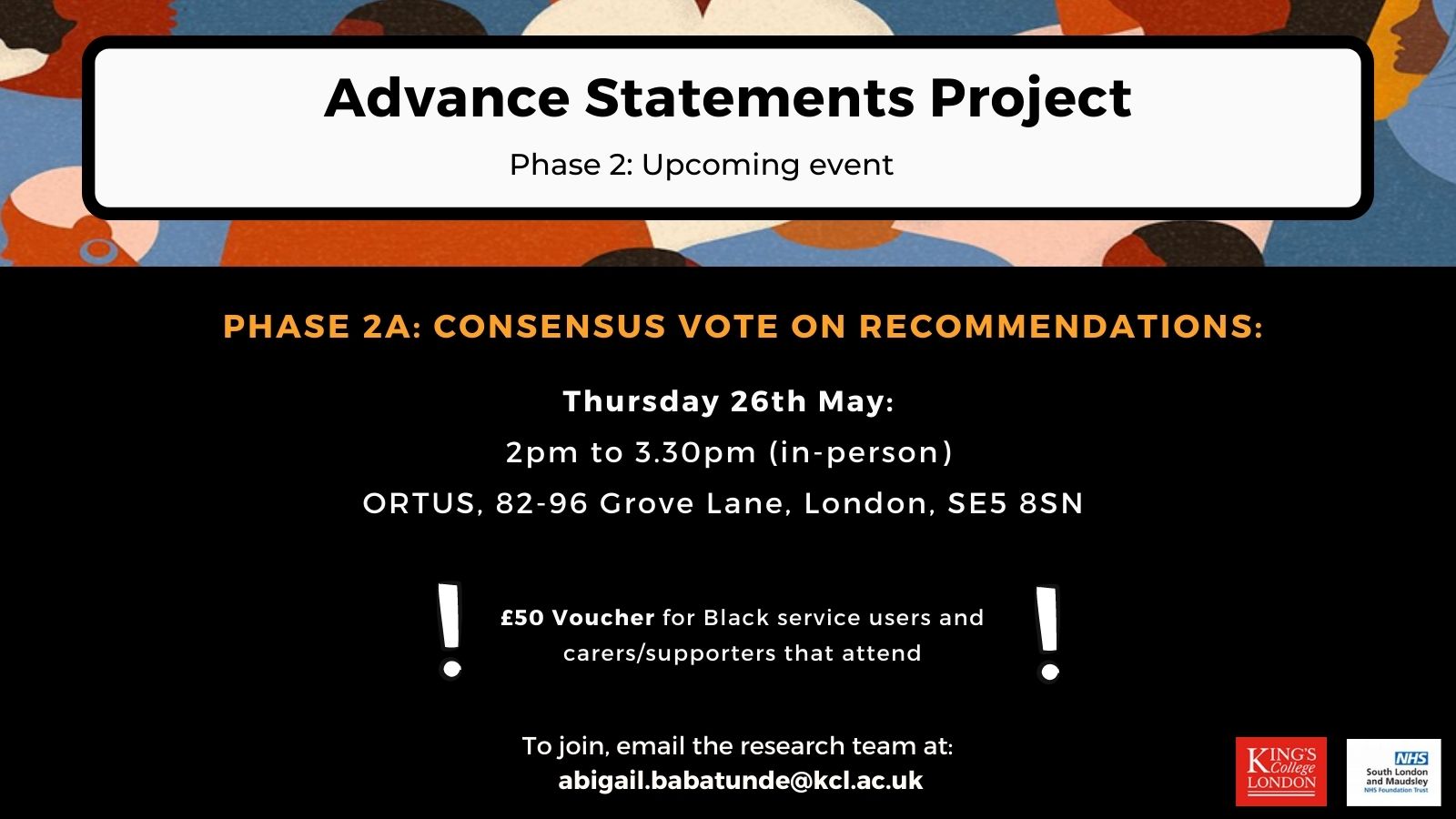
The first speaker for this carer group was Abigail Babatunde from Kings College London. She spoke on updates for the project advanced directives black people.

The Advance Statements Project is a research project on getting advance statements – also known as advance choice documents or advance directives – to work for Black African and Caribbean service users who have previously been detained under the Mental Health Act, their carers, and mental health staff.

The goal of the research is to:

  • Help reduce detention under the Mental Health Act for Black service users,
    Support, hear and understand Black service users and their carers/supporters,
  • Know and further understand the issues surrounding using advance choice documents and why staff members may not follow them,
  • Reduce coercive care in mental health care, and to better the relationships between Black service users, their carers/supporters and staff/professionals.

There is a follow up event at the Ortus (Maudsley NHS) below.

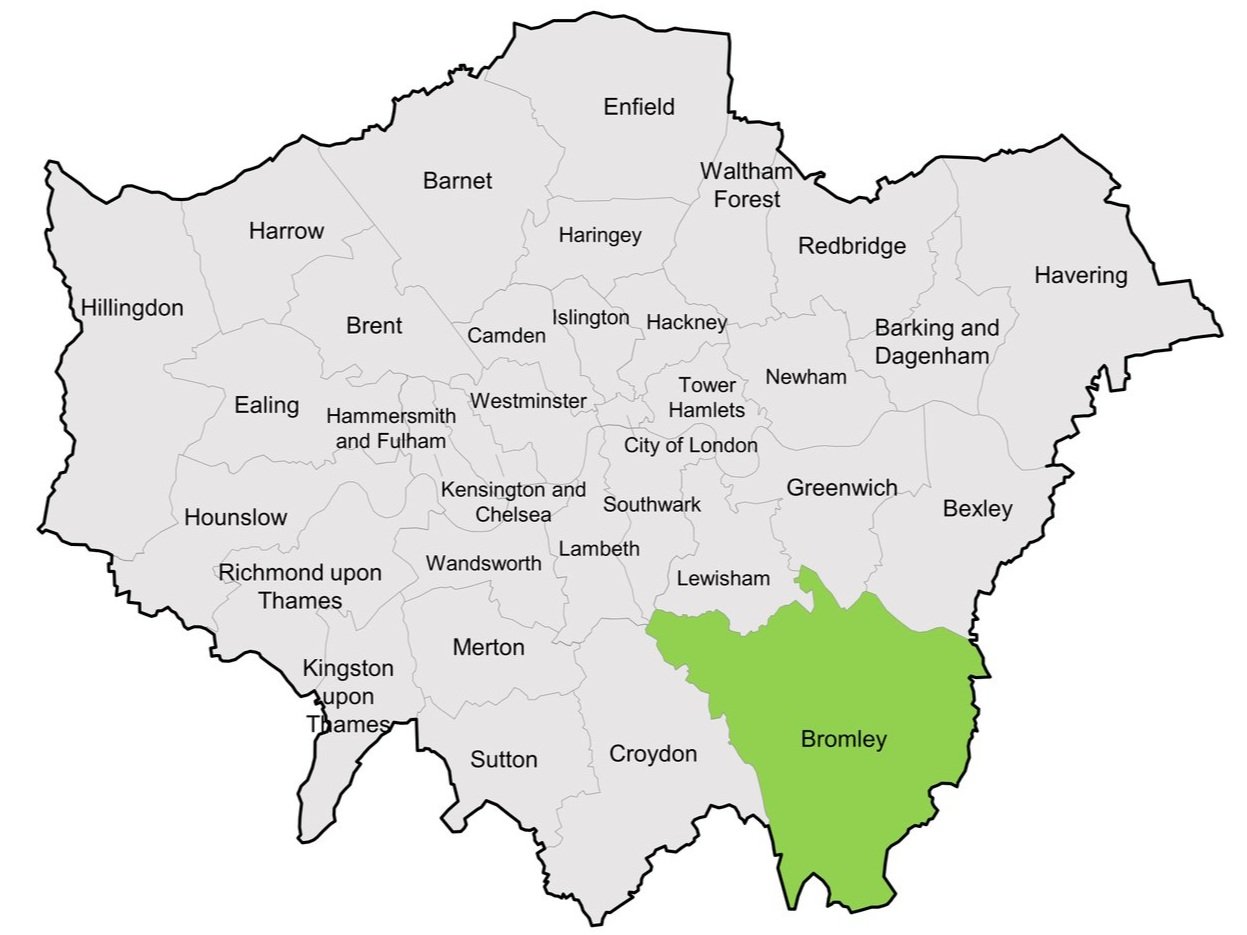
The next speaker was Denise Mantell from Bromley council. Bromley Council is currently developing its Carers Strategy and would like to hear from as many carers as possible. Since Oxleas mental health services covers Bromley, it was a chance carers could get to be involved. It would help if the carers strategy involve those caring for someone with mental illness.

Talking about Oxleas NHS Foundation trust, we were joined by Japleen Kaur and Marie-france mutti. They spoke about the new Funding scheme – Improving patient and carer experience grants.

If those within Oxleas have an idea that will improve patient or carer experience, they can bid for funding (up to £750) from our charitable funds. The project ideas need to be developed jointly between members of staff and people who use Oxleas services or care for people who use Oxleas services.

Stages

  1. Application form completed and sent to our Involved Network
  2. Applicant informed of bid outcome
  3. Transfer of funding arranged
  4. Activity takes place
  5. Bidder shares photos/feedback on how funds have been used.

Scheme criteria

• The grant should be spent on enhancing the experience of people using our services and their families
• It should be used for activities/items that are not funded by trust services.
• It should benefit at least three service users.
• All bids need to developed joined with people using our services and staff members.

The first application period for the Improve Fund is open now until 31 May 2023.

If you have a query about the fund, please email: oxl-tr.involved@nhs.net.

Joint Southwark and Lambeth Mental Health Carers forum

Here are the update’s for my other carer forum I run in the afternoon for the last friday of the month. I used to run these forums seperately, but due to covering a lot. I have decided to merge them.

We were delighted to be joined by another speaker from University College London. This was Dr Rebecca Lacey who talked about her study on Young Adult carers in the UK.

This was following off from Carers Trust “Young Carers Action Day”, but unfortunately it was too late for Dr Lacey to attend in March.

Staff from Lambeth Carers Hub attended to hear more on her research.

You can read Dr Lacey’s paper on the link below.

https://www.mdpi.com/1660-4601/19/21/14076

The next speaker was Sarah Allen who is the Head of Patient Experience at Guys & St Thomas NHS FT. The hospital trust is currently working on their Carers Strategy. I often to say to all carers that it is very important to engage with hospital service carers strategy.

It is not enough for a carers strategy to exist, but to be used to hold services to account as in “You Say We did” focus.

GSTT want to involve families and carers in all aspects of their services.

They aim to recognise, value, include and respect carers. Plus treat them as expert partners at the heart of decision making for the person they care for.

I also presented the new NHS England hospital discharge toolkit to the group, there was a bit of confusion as some felt the toolkit was for triangle of care.

https://www.england.nhs.uk/london/our-work/carers-and-hospital-discharge/

In the end I pointed that this was for acute hospital services in London.

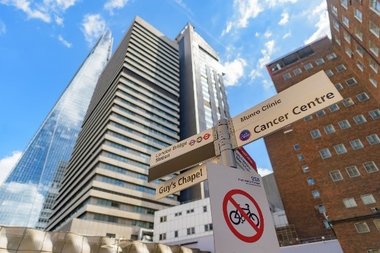
I am also pushing to engage with GSTT Cancer and Surgery Clinical Group to raise the profile of cancer carers. Once I have built a group of cancer carers, I am hoping for engagement for that hospital trust especially regarding the cancer group. I am also getting support from Kings NHS and eventually will expand to other hospital trusts.

South West London MH carers group

This group is a hybrid as there is a carer-led peer focus for the first part of the group. The next part is finding out about services and how they are supporting carers.

The group is strictly carer-led and co-facilitated by SW London carer Ava. She does the peer group section, while I will focus on speakers and engagement.

We had a great turnout as all 5 carer centre’s help promote the group, but we can out of time for the peer support section. The group seeks engagement from the local mental health trust South West London & St George, but this can be difficult, probably lack of staff maybe? Still we got engagement from Kingston Hospital who have a strong carer focus.

We where joined by Beth Mburu who is one of the Clinical Liaison Practitioners. Kingston Hospital is working on their carers focus and Beth talked about the following

  • Hosp. Discharge Planning Toolkit (aimed at staff)
  • Carers’ Needs Assessment Template (augmenting and embedding the Carers’ Agreement)
  • Carers’ Passport
  • Triangle of Care – hospital self-assessment tool and lessons learned/embedded
  • Resource for first time Carers / people who give their time to support a vulnerable person
  • National resources -already in existence from Carers’ UK – communicate and disseminate to the right people
  • Live/real-time digital tool aimed at Carers’ drawing together local provision and resources
  • Safe Transitions of Care – checklist for front-line staff
  • Hospital checklist / advice and Information

Kingston hospital NHS FT also had a carers event on the 4th of May to engage with carers and let them know about the work they are doing to support carers.

Again I am also focusing on engagement from the hospital’s cancer services to prepare for my cancer carer group. It is important to know who does what and how they focus on cancer carers.

February carer forum updates 2023

Hello carers, here is another update from most of my carer forums. Usually I try to update on each of the forums, but due to spending time writing books and raising carer awareness, it is not always possible to update each forum page.

  • Lewisham Mental Health Carer forum update

For my Lewisham group, South London & Maudsley want to engage with the London borough of Lewisham to explain new ideas for mental health services. There will possibly be a revamp of the Ladywell Unit that is based at Lewisham Hospital.

The speakers who looked to engage with carers were Sir Norman Lamb and Bobby Pretap, but unfortunately the meeting had to be cancelled.

The other speaker Angela Brient who is a PhD Researcher in Public Health spoke about the Impact of trauma. Angela spoke about her lived experience, which comes from caring for her husband who sustained a spinal injury whilst on deployment with the Australian Air Force in the Middle East. She was his primary carer for over a year, but ultimately, her husband took his own life.

The carer’s group were grateful for Angela’s insight and we learnt more of the Impact of Trauma course that Dr Julie Langan Martin mentioned to me a while back. Dr Julie is the Senior Lecturer in Psychiatry at the University of Glasgow. We are hoping to hear more updates on the Impact of Trauma course at a later date.

  • Joint Southwark & Lambeth Carer forum update

For my joint mental health carer forum over in Southwark and Lambeth. Carers were delighted to get engagement from Helen Hayes MP for Dulwich and West Norwood. Carers spoke about their past experiences of providing unpaid care, but the main topic was the progress of the new Mental Health Act. Members of the group are very keen to observe the debate in Parliment.

Other carers were interested to speak to Richard Okolo on how a mental health solicitor could help someone who has been sectioned. Richard could not make the forum, but we hope to hear from him in March.

  • Ethnic Mental Health Carers forum Update

This carers forum specifically focuses on the experience of ethnic and diverse carers. Our first speaker was a carer on involvement at South London & Maudsley. Currently Maudsley NHS is an anti-racist organisation and seeks to increase health equity. South London & Maudsley NHS is signed up to the Patient Carer Race Equality Framework (PCREF). PCREF exists to eliminate the unacceptable racial disparity in the Access, Experience and Outcomes of Black communities and significantly improve their trust and confidence in our mental health services.

Annette Davis who is the Chair of the PCREF Service Users and Carers Group then gave updates to members. Annette mentioned that PCREF is a UK wide NHS initiative and South London and Maudsley are one of the first Trusts in the country to address institutionalised racism in the NHS. We heard updates on new flyers to advertise to the community on how they can hear updates or get involved in being an activist.

The next speaker Dr Brenda Hayanga spoke about her new research “Ethnic inequalities in multiple long-term health conditions in the United Kingdom: a systematic review and narrative synthesis”. Yes, I know it is a long title, but I do not know many research papers that have short titles.

Still, the importance of this research cannot be underestimated as I had just published my 4th book regarding health inequalities.

Dr Brenda will be speaking at an exciting event in april. The event focuses on Ethnic inequalities in healthcare for people with multiple conditions.

At the event there will be the following speakers

  • Katherine Merrifield from the Health Foundation
  • Dr Habib Naqvi who is Chief Executive of the NHS Race and Health Observatory
  • Dr Jayati Das Munshi who is a Clinical Reader in Social and Psychiatric Epidemiology at KCL.
  • Eve Riley who is based at Macmillan Cancer Support
  • Jabeer Butt OBE whose work looks into tackling discrimination and disadvantage.
  • Dr Brenda Hayanga who is a Research Fellow at the Department of Global Health and Social Medicine, King’s College London

The final update at the ethnic MH carers group was from Carers UK Melanie Crew. Melanie is the Senior Policy and Research Officer at Carers UK. Melanie talked about the new initiative on Good practice guide on supporting ethnic minority carers. The briefing follows Carers UK’s landmark report examining Black, Asian and minority ethnic carers’ experiences of the pandemic.

You can find out more from the link below.

https://www.carersuk.org/press-releases/carers-uk-releases-good-practice-briefing-for-supporting-black-asian-and-minority-ethnic-carers/

  • South West London Mental Health Carers group.

Obviously my 3rd biggest group, which covers 5 london boroughs. The group is co-facilitated by Ava who is involved at Kingston Carers Network and SWLSTG. The group is getting lots of support from the 5 carer centres.

We had a visit from Kirsty McLachlan who is based at Richmond Borough Mind. Kirsty is the Carers and Parents in Mind Manager and is very keen to promote the forum in our Carers in Mind monthly newsletter. It is great to see support and promotion about unpaid carers.

Our 2nd speaker was Chloe Smith who is the Healthy Communities Builder from Kingston Voluntary Action. She was joined by BBC MultiAward winning Poet, Michael Groce. They are working on a set of poetry workshops aimed Black, African and Caribbean Communities over in Kingston. There will be guest poets that will come and inspire people’s work throughout the weeks ahead by sharing their own stories and work. I was the guest poet for week 2 (more on that later).

You can watch a promotional video below

The third speaker was Wendy Doyle who is the Head of Patient Experience St Georges university hospital. This is one of the hospitals were I run a carer’s stall. Wendy updated our group on the carer’s focus the hospital is planning. Wendy also updated us on a healthwatch report.

January carer forum updates 2023

Hello fellow unpaid carers. I am doing a quick update of most of my carer forums that I facilitate in London. These groups focus on mental health carers. Basically people who are caring for someone going through mental illness.

LEWISHAM MENTAL HEALTH CARER FORUM UPDATE

Members of the Lewisham group were interested in how the Ladywell Unit was performing for unpaid carers. The Ladywell mental health unit has several wards. The unit is based at Lewisham & Greenwich NHS trust. We were joined by Inpatient carer engagement Eunice Adeshokan who gave us an update. We were also joined by Cath Collins who leads on engaging carers in the community.

The next speaker was Caroline Norrie who is a research fellow at Kings College London. She spoke about research regarding addictions and the gambling industry.

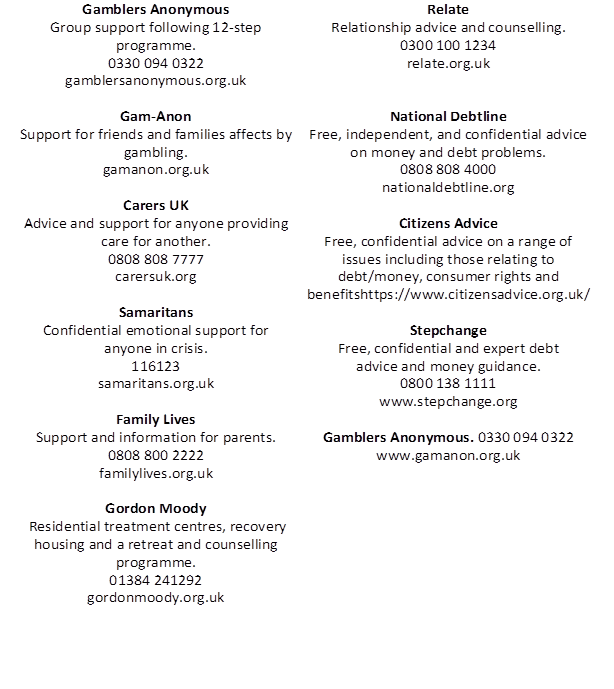
She kindly passed on details on support services

Online gambling: GamStop is a free scheme that can be used to allow gamblers to self-exclude from online gambling websites and apps run by companies licensed in Great Britain. http://www.gamstop.co.uk

Blocking software: A GamBan software licence enables people to block access to online gambling apps and websites. The licence can be obtained for free if it is requested through the National Gambling Helpline.
https://gamban.com

Blocking gambling banking transactions: Some banks offer blocks on gambling transactions, with some having a 48-hour cooling off period before it can be removed which may help to prevent relapse. For information about which banks offer a gambling blocking service go to: https://www.gamblingcommission.gov.uk/public-and-players/page/i-want-to-know-how-to-block-gambling-transactions

It is worth noting that people can no longer use credit cards to pay for gambling.

Betting shops, casinos, arcades and bingo halls:

All gambling premises such as arcades, bingo halls and casinos must be part of a multi-operator self-exclusion scheme (MOSES). This allows a gambler to make a single request (by filling in a form) to self-exclude from all premises offering the same type of gambling, such as betting shops. Once a self-exclusion agreement is made, the gambling company must close the gambler’s account, return money in it, and remove personal details from their databases.

For betting shops see https://self-exclusion.co.uk/ or ring 0800 294 2060
For casinos see https://bettingandgamingcouncil.com/sense-self-exclusion-scheme
For arcades see https://bacta.org.uk/self-exclusion/

For bingo halls see https://www.bingo-association.co.uk/self-exclusionThe National Lottery Healthy Play | The National Lottery (national-lottery.co.uk)


JOINT SOUTHWARK & LAMBETH MH CARERS FORUM

For my Southwark & Lambeth mental health carers forum, we were joined by Toby Lee-Manning who is the Carers Development Lead for St Christopher’s Hospice.

St Christopher’s Hospice exists to promote and provide skilled and compassionate palliative care, but there also should be a focus on unpaid carers who are caring for someone end of life. The difficultly appears when people who are providing unpaid care are not sure what to do.

Luckily St Christopher’s Hospice have developed online courses aimed at carers, this is what Toby presented to our group.

Caring for Carers – online course
https://www.stchristophers.org.uk/timetable/event/caring-for-carers-drop-in-course/

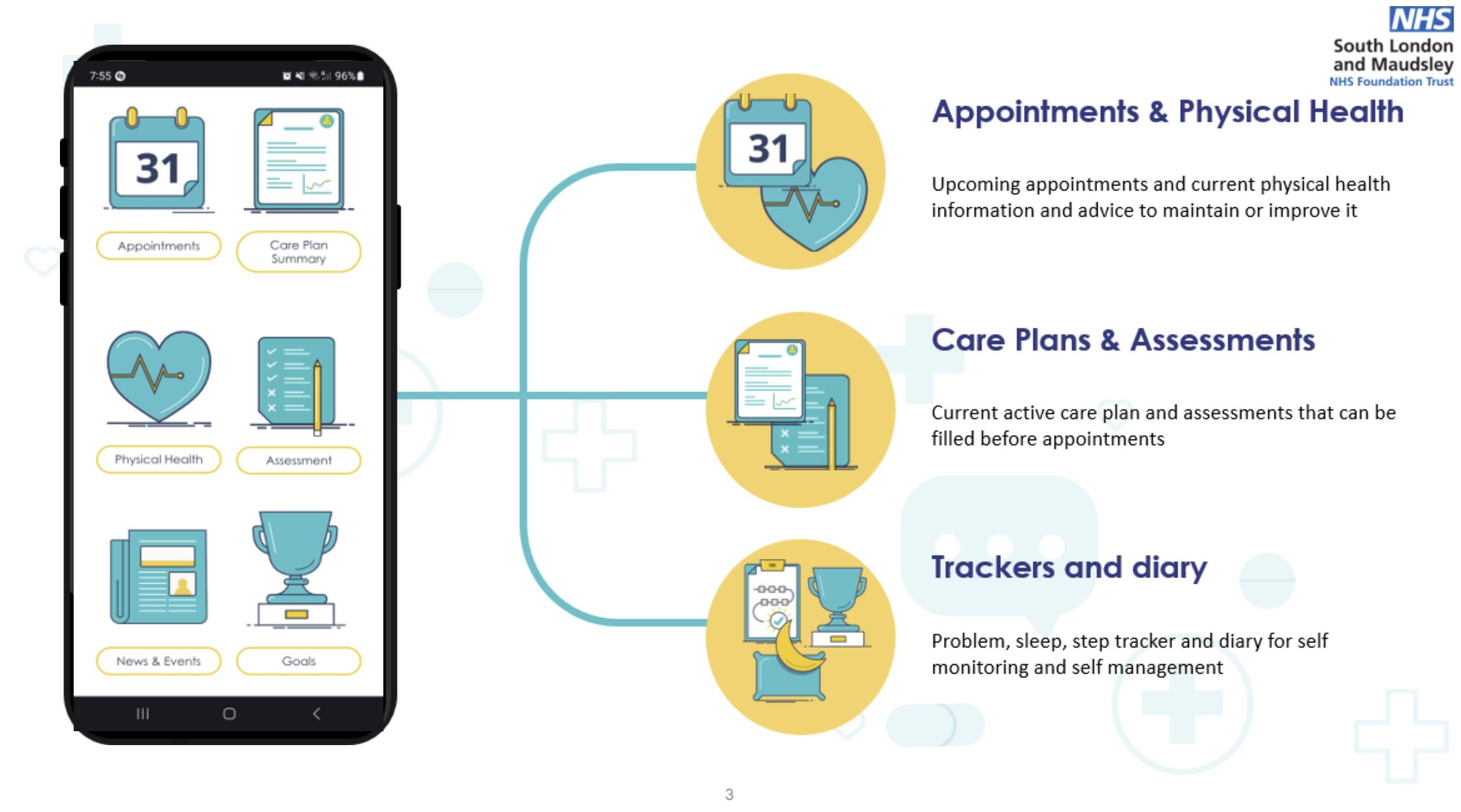
We were also joined by Damian Larkin who is the Digital Health Nurse Lead at South London & Maudsley NHS. Damian spoke about BETH. Basically Beth is a free and secure way for our patients and carers to stay connected with their care team.

If you are interested in BETH – please check out SLaM BETH site


ETHNIC MENTAL HEALTH CARER FORUM

For my ethnic carer forum we were joined by Carers UK. Patrick Knock presented a project where Carers UK is currently working a series of ‘Carers Active Stories’ videos to highlight to unpaid carers the benefits of being physically active from the perspective of a carer giving their firsthand experience.

Here is a video link below

Next was Simon Mayers who is the Equality, Diversity and Inclusion Lead for Maudsley covering the borough of Lewisham. Simon updated the group on how Lewisham is working with the new equality policy. This policy is called “Patient Carer Race Equality Framework”. This framework is aimed at mental health NHS trust across England and it is important carers get a chance to get updates and raise any queries.

We also had Tafadzwa Marapara from Oxleas NHS trust. Oxleas is also adopting PCFREF and it was only fair to hear what they plan on engaging black carers and patients using their services.

Kevlin one of our carer members is heavily involved in PCREF over at the maudsley, so I gave him a chance to update the group. Plus we also had Halima Ali join us to speak about her research project on What are the Occupational experiences of BAME unpaid mental health carers for people with a mental health diagnosis?”


SW LONDON MENTAL HEALTH CARER FORUM

This carer forum is slightly different from my other carer forums. This one covers multiple boroughs as we are developing a strong carers network. This group covers Richmond, Merton, Kingston, Wandsworth and Sutton. We get support from all 5 carer centres.

This group also spends a fair bit of time for carers to update how things have been progressing. We were also joined by Nicole Smith who is a Darzi Fellow in Integrated Medicine. She spoke to the group about Virtual Wards and how they are important regarding the NHS. She is also doing some research.

You can give feedback on her survey at the link below

Virtual Ward survey


GREENWICH MENTAL HEALTH CARER FORUM

This forum is slightly different as it is linked the the Greenwich carer peer group I facilitate for the borough. Greenwich Carers centre help me run the group. This forum runs every 2 months.

The forum was filled with a lot of speakers so I was glad that Oxleas work hard to engage with carers.

We were joined by Catherine Seabourne who is Oxleas Head of Nursing. She talked about her role and answered queries from carers. We were hoping to hear developments from Jason McCulloch who Service Manager regarding Greenwich Carers Strategy, Jason was unable to attend.

We were also joined by Ariane Zegarra and Janice Williamson. Janice is the new Carers Network Lead for Oxleas. We were given updates regarding social care.

This was the January update for most of my carer groups.