Embracing Stress Awareness Month by Matthew McKenzie
Stress Awareness Month, observed every April, serves as a powerful reminder to pause, reflect, and take charge of our well-being.
To watch the awareness video, click below.
In 2025, the theme for Stress Awareness Month is “Lead with Love,” which encourages us to approach both ourselves and others with kindness, compassion, and acceptance. This movement is orchestrated by the Stress Management Society, a nonprofit organization founded in 2003 dedicated to helping individuals and organizations manage stress, improve well-being, and build resilience.
Welcome to this blog by Cygnet Carer Ambassador Matthew McKenzie. As a carer ambassador, I strongly believe that those in similar roles who representing families and carers within healthcare and mental health services, should have maximum visibility and reach. This ensures that not only service users but also their carers receive the support and information they need.
On the 19th of March, I had the opportunity to visit Cygnet Millbank for a filming session where I shared my thoughts and messages aimed at families and carers with loved ones using Cygnet’s services. This initiative followed Cygnet’s Patient Carer Race Equality Framework event launch, a commendable effort to enhance outcomes for individuals from diverse communities.
During the filming, I was joined by fellow Carer Ambassador Julian de Takets. Together, we explored ways to strengthen the connection between families and carers and the services supporting their loved ones.
In my segment, I spoke about my role in representing, supporting, and advocating for carers. My work involves ensuring that carers’ voices are heard, offering guidance, and contributing to the development of inclusive, culturally competent services that genuinely address carers’ needs.
However, to make a real impact, it is vital that these messages reach the right audiences. Without effective promotion and engagement, our efforts as carer network ambassadors risk being limited in influence.
Families and carers play a fundamental role in supporting their loved ones’ recovery journeys, yet many feel overlooked or uncertain about how to navigate the mental health system. This is why mental health providers must actively promote and support the work of carer ambassadors. By amplifying our reach, healthcare organizations like Cygnet can ensure that carers feel seen, heard, and valued as equal partners in care.
As an ambassador, I see my role as a bridge between carers and mental health services, offering guidance and ensuring they have access to the right resources and support networks.
I look forward to seeing the completed videos off Cygnet’s website and hope that they serve as a valuable resource for families and carers. More broadly, I urge mental health services to not only establish ambassador programs but also to actively promote them, ensuring that Expert by Experience voices are at the heart of shaping and improving care services.
Carers and families deserve recognition, support, and inclusion in the mental health care process. By championing ambassadors and giving them a wider platform, we can create a more informed, connected, and supportive community for all involved.
On Thursday, 27th February, an impactful event titled “Making Time for Black Mental Health” took place at the Novotel Hotel in Greenwich.
The event aimed to provide a safe space for open discussions about black mental health, offering insights from experts, personal stories, and highlighting available support resources.
This event brought together professionals, community members, and individuals with lived experiences to share their thoughts on mental health in the black community, providing guidance on seeking help and breaking the stigma around mental well-being.
Here is a health and wellbeing blog by carer champion Matthew McKenzie. On this blog post, we can explore the significance of Health Information Week in providing reliable health information, empowering individuals to make informed decisions, and combating health misinformation online.
Learn how this annual campaign promotes health literacy and supports patients and carers in navigating complex health systems.
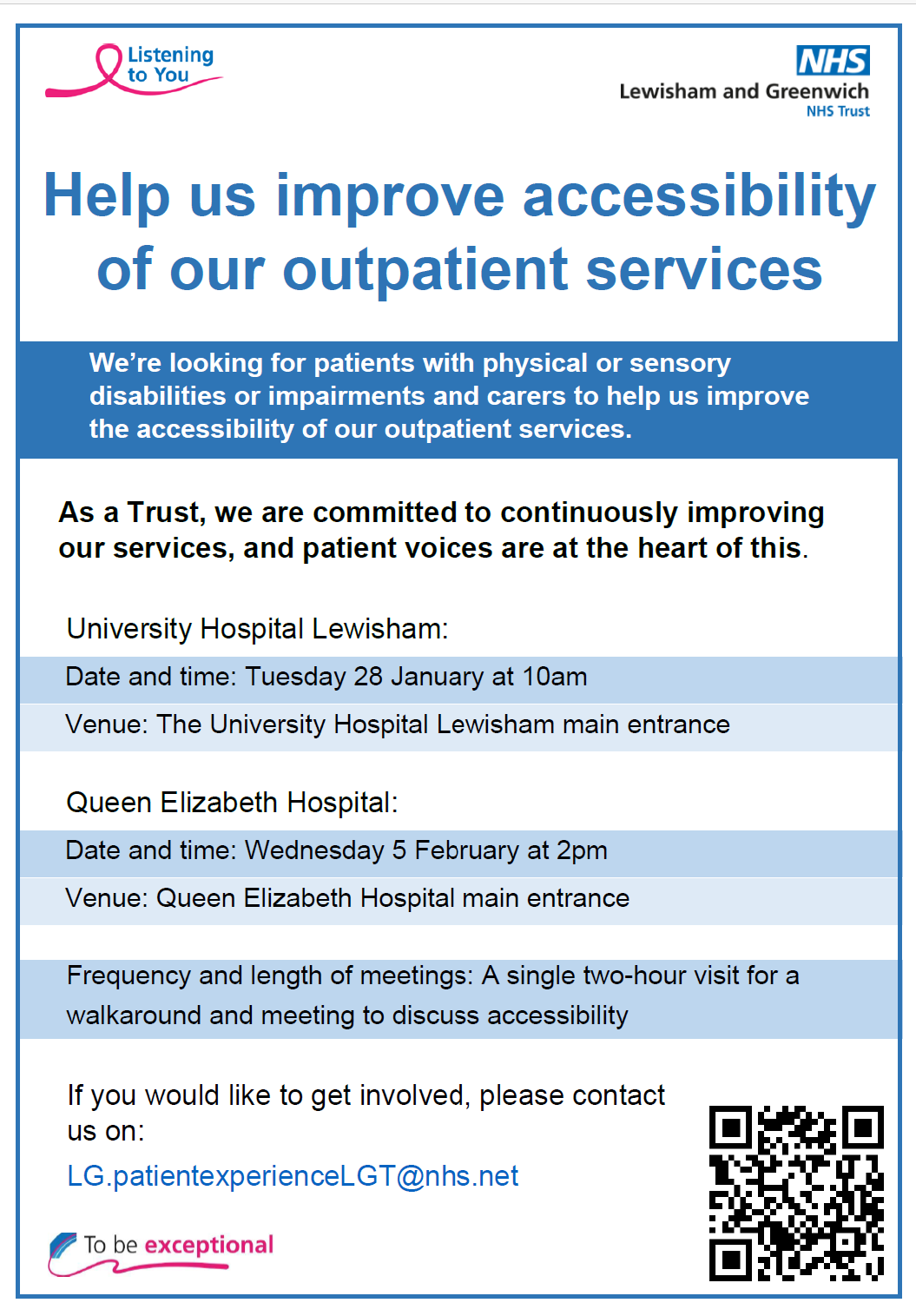
Are you passionate about making healthcare more accessible? We’re inviting patients with physical or sensory disabilities, impairments, and carers to share their experiences and help shape improvements to our outpatient services.
Take part in a two-hour walkaround and meeting at University Hospital Lewisham (Tuesday, 28 January at 10am) or Queen Elizabeth Hospital (Wednesday, 5 February at 2pm). Your insights will directly influence changes to ensure our services are inclusive and accessible for everyone.
This blog post and video is by carer activist Matthew McKenzie doing his bit to raise awareness of grief and wellbeing.
To watch the 2 minute video please click below.
Understanding the Importance of National Grief Awareness Week 2024
Grief can be an overwhelming and isolating experience, touching all aspects of a person’s life. In recognition of this, the UK observes National Grief Awareness Week from December 2nd to December 8th each year.
Another awareness video and blog by carer activist Matthew McKenzie. If you wish to watch the video. Please click below.
Understanding Addiction: Awareness and Recovery
Addiction is a powerful force affecting millions of lives around the globe. As we approach Addiction Awareness Week 2024, it’s essential to shine a spotlight on this critical issue, emphasizing that while addiction affects everyone, recovery is always possible.
In this blog post, if you are involved at your local mental health NHS trust as a carer or patient. This blog will help you learn about the crucial roles of key staff in implementing the Patient Care Race Quality Framework in Mental Health Trusts.
From leadership to community engagement, discover how systematic changes can address racial disparities and promote accountability.
If you want to watch the video, this please click on the item below.
Mental health services play a crucial role in supporting individuals through challenging periods in their lives. However, despite their importance, these services have often fallen short when it comes to providing equitable care to individuals from minority backgrounds.
Welcome back to a brief update of another group I chair with support of London Hospitals and the carer centres of London, along with carers who want the best service of those using the NHS.
The group is called the “Carers hospital discharge toolkit meeting”. This group runs every 2 months and follows off the work the previous NHS England carer lead for London developed.
The community deserves the best care possible from the NHS and that includes carers who support those they care for using the hospitals in London and beyond. This was taken up by NHS England Carer lead for London Debbie Hustings who worked very hard to produce the toolkit linked below.
Feeling passionate on continuing the work, Carer centres and hospital representatives came together to support me in driving this brilliant toolkit. The group has been running 2 years and developing rapidly.
Here is the update for November 2024
The meeting for November focused on the development and progress of various resources aimed at supporting carers and families during hospital discharge, including a comprehensive carers’ pack, a digital resource, and a new pilot project at the Carers Hub Lambeth. The group members discussed the importance of collaboration, sustainability, and language accessibility in these resources, with plans for further development and translation. The meeting also highlighted the challenges faced in hospital discharge and capacity, and the need for more integrated work with partners and other local authorities.
Matthew Mckenzie welcomed everyone to the London Hospital Discharge Toolkit group meeting. The meeting aimed to keep the momentum going on a resource that helps hospitals engage more families and carers, especially during discharge. Matthew encouraged participants to introduce themselves and share their experiences. The attendees included representatives from Tower Hamlet Carers, Barnet Carers, Sutton Carers Centre, Lewisham & Greenwich NHS Trust, Greenwich Council, Greenwich Carers Centre, St Georges University hospital trust or GESH, Lambeth Carers Hub, Bexley Carers Centre and unpaid carers. Each participant shared their roles and experiences in their respective organizations, with a focus on hospital discharge and carer support. The conversation ended with Matthew encouraging further participation and updates on the toolkit’s progress across the London hospitals in order to work with carer centres and local authorities.
Carers Hub Pilot Project Update Rachael discussed the progress of a new pilot project at the Carers Hub Lambeth, which involves a hospital discharge lead supporting carers and promoting carer awareness. She mentioned the introduction of an additional tier of service for registered carers and the need to join forces with other GSTT and Kings College NHS trust to support carers. Rachael also expressed interest in discussing the project developments further with Matthew and others in the New Year.
Greenwich Council then presented the Greenwich Carers Pack, a comprehensive information booklet developed in co-production with unpaid carers in Greenwich. The pack includes information about carers’ rights, assessments, and support, as well as details about local community resources. Greenwich council mentioned plans to translate the pack into Nepalese and distribute physical copies to hospitals, GP surgeries, and community centers.
Carers Pack Development and Resources Evie who chairs Greenwich Councils Carers Partnership board then discussed the development of a carers pack, which was designed to be interactive and easy to navigate. The pack covers various resources available to carers, including local and national ones, and provides bite-sized notes for carers to jot down important information. It also includes sections on employment rights, respite, legal responsibilities, financial support, home safety, and advocacy. The pack is designed to be a one-stop resource for carers, with links to all the resources mentioned. Evie also mentioned that the design team has done an excellent job, and the pack will be further developed as it goes to double pages. Matthew expressed his appreciation for the pack and requested the link to it when he runs his carer stall at the hospitals.
Digital Resource and Carer Navigation Greenwich Council thn discussed the development of a digital resource and physical copies for a project, with plans for posters featuring QR codes for easy access. The project was well-received, with a carer and Matthew expressing their appreciation and interest in using it for their respective areas. A carer also highlighted the importance of connection and navigation for carers, noting that many learn from other carers rather than official sources. The team agreed to continue developing the project and to share it with other local authorities.
Improving Carers’ Information Pack Development A carer expressed concerns about the lack of connection and input from various parts of the system in the development of the carers’ information pack. She highlighted the need for a more comprehensive approach, especially considering the cross-borough nature of some carers’ support. Greenwich council representive acknowledged these concerns and explained that the pack was developed by a different team, with input from Oxleas NHS trust and other organizations. She also mentioned that they are working on a more summary version and translations. The team agreed on the need for more integrated work with partners and other local authorities.
Comprehensive Carer Handbook Development Discussed Members continued to discuss the development of a comprehensive handbook for carers. The presenters clarified that they were not planning to create a smaller, bite-sized version of the handbook, but were open to feedback suggesting such a change. The handbook will be available in various locations, including GP practices, libraries, and community centers, and can be accessed digitally via QR codes. THey also mentioned the importance of keeping the information up to date and being mindful of sustainability policies. A hospital representative expressed interest in sharing the document with other boroughs and asked about contacts within the hospital for potential distribution of the handbook. They agreed to check with colleagues about existing contacts and welcomed any additional contacts. The group encouraged others to share relevant contacts.
Consistent Information for Carers Greenwich Council reps emphasized the importance of having consistent information spread across South East London, particularly for carers. Greenwich Carers representative praised the new greenwich council carers resource, noting its potential to be a valuable resource for carers. She also mentioned the commitment to keeping the information up-to-date, particularly on the digital portal. Evie added that they plan to translate the pack into Nepalese and other key languages for carers in the borough, and also consider developing an easy-read version. Matthew ended the conversation by noting the ease of language changes in a digital format.
St Georges Hospital NHS Trust Progress and Future Plans Wendy from St Georges hospital who shared her team’s achievements, including virtual training sessions, bespoke staff training, and the upcoming launch of a carers’ information section on the St. George’s website. Wendy also mentioned her goal for 2025: developing a carers’ charter and survey. The team expressed their anticipation for the upcoming carers’ forum, which Matthew will be attending.
Carer Support Challenges and Progress Tower Hamlet Carers Centre discussed the challenges and progress of their work in Tower Hamlets at royal london hospital which one of the 5 hospitals under Barts NHS Trust.
Tower Hamlet Carers centre representative is expressed her hope for having volunteers who were carers themselves to help provide the service. She also mentioned a plan to create a co-produced pack of resources for carers, which would be based at the hospital’s front desk. She highlighted the difficulty in discharge planning due to the pressures of the hospital system, which sometimes led to carers not being fully involved. Despite these challenges, Tower Hamlets Carers centre expressed optimism about the service’s progress and future plans, including the potential addition of more carer support workers. Wendy from St Georges offer her support, which I thought was very admirable.
Barnet Carers Centre update Matthew then handed over to Mike the CEO of Barnet Carers Centre, who presented a project aimed at directing carers to the right support organization through a portal. The portal, currently under development, would direct carers to the appropriate center based on their postcode. Mike also mentioned the project’s expansion to include mental health and allied health professionals this would be the merged Mental health trusts Camden & Islington and Barnet, Enfield & Haringey who have combined into north london mental health partnership.
A carer raised a question about identifying carers during pre-assessment, to which Wendy Doyle responded that their system includes a question about whether the patient is a carer. The possibility of discussing this further in a future meeting was left open.
This concludes the short update to continue progression of the excellent legacy Debbie husting has left for London hospitals and beyond.
The Race Equality Foundation, which is a UK-based organization that works to tackle racial inequalities in public services and improve outcomes for Black, Asian, and minority ethnic communities. Established in 1987, the foundation focuses on areas like health, housing, and social care, using evidence-based approaches to inform and influence policy, practice, and community initiatives.
The Race Equality Foundation are developing the Race Equity Maturity Index. The Race Equity Maturity Index is a tool developed by London Anti-Racism Collaboration for Health (LARCH) to support organisations in progressing race equity by enabling the tracking and improvement of race maturity levels. The index supports organisations in the actions they take to embed anti-racist practice.
Event has finished so no more bookings. There will be more events in future.