Tag Archives: National Ethnic Mental Health Carer Forum

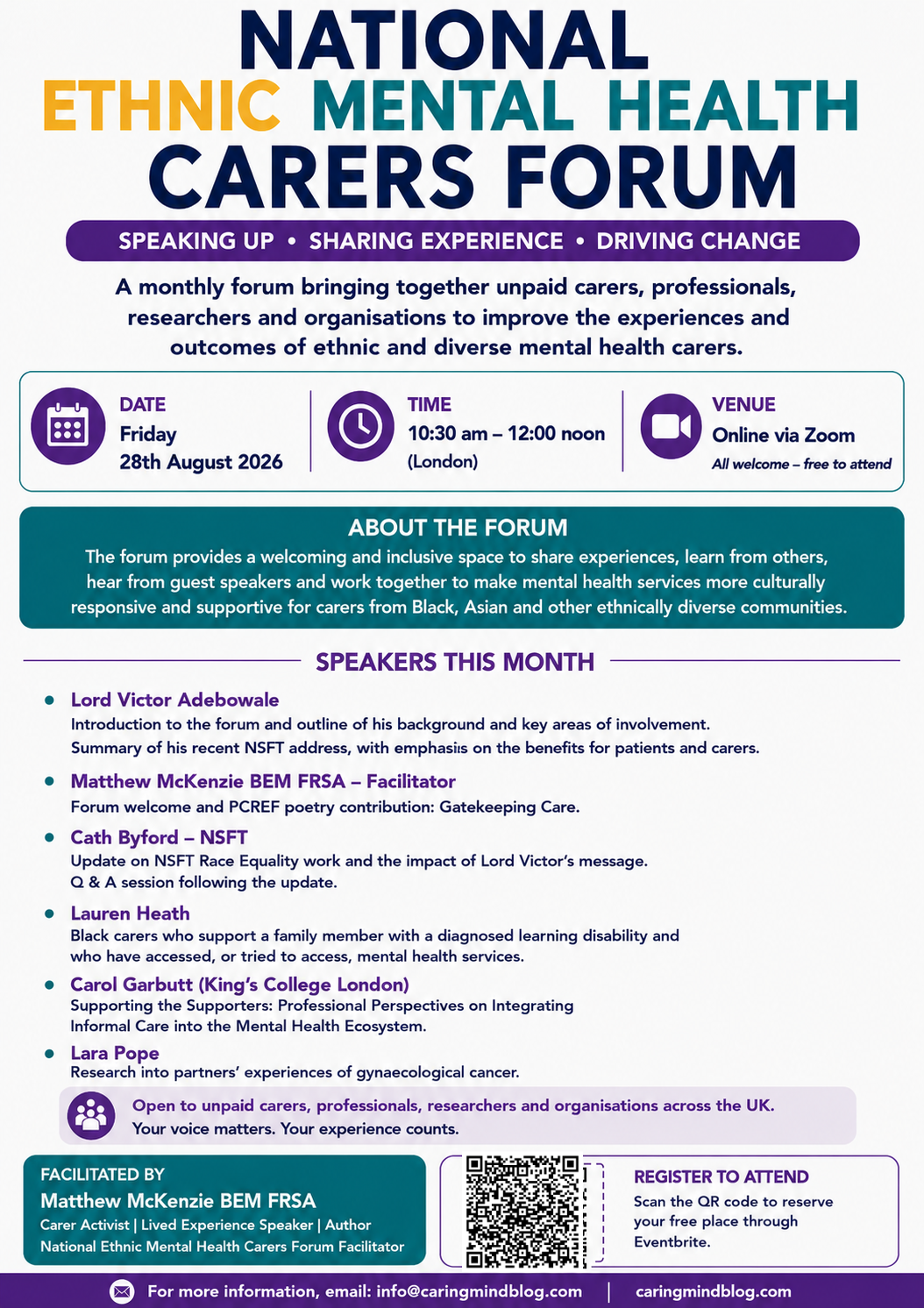
National Ethnic mental health Carer Forum : August Update 2026

By Matthew McKenzie – Chair, National Ethnic Mental Health Carers Forum

The August meeting of the National Ethnic Mental Health Carer Forum brought together unpaid carers, NHS leaders, healthcare professionals, academic researchers, and voluntary sector advocates from across the country. The session provided a vital space to address race equity, systemic racism, lived experience, and ongoing research into minoritised caring experiences.

Matthew McKenzie opened the meeting by welcoming attendees and reinforcing the core purpose of the national forum. He reflected on how the platform has grown into a crucial space where family carers can directly challenge health structures, influence decision-makers, and learn about national policy developments such as the Patient and Carer Race Equality Framework (PCREF). Matthew acknowledged that while discussions around institutional racism and health inequalities can be heavy and emotional, the forum remains a safe, respectful, and healing space dedicated to driving real, actionable change across the NHS.

Minute of Silence: Professor Jason Ardey

The forum opened with a poignant minute’s silence led by Debbie Best in honour of the life, legacy, and memory of Professor Jason Ardey following his passing.

Members paused to reflect on his landmark contributions to racial equality, education, and social justice. His legacy of challenging institutional barriers and amplifying minoritised voices continues to inspire the core work and mission of the forum.

Reflections on Race Equality: Norfolk and Suffolk NHS Foundation Trust (NSFT)

Speakers: Cath Byford (Deputy Chief Executive / Chief Nurse / Director of Patient Experience) & Annie (PCREF Carer Lead)

Cath Byford opened the trust’s update by offering an open and unvarnished reflection on NSFT’s ongoing race equity journey. Acknowledging that the trust has faced significant scrutiny and structural challenges over recent years, Cath emphasized that building genuine trust with minoritised communities requires moving beyond policy statements to deliver measurable, lasting systemic change. She explained that over the past 18 months, NSFT has embarked on a deliberate path to rebuild its patient experience framework, ensuring that health equity, anti-racism, and lived experience are embedded into every layer of clinical governance and strategic planning.

PCREF Carer lead Annie brought a vital lived-experience perspective to the presentation, sharing how the trust is working to bridge the gap between executive decision-making and the everyday realities of unpaid family carers. Together, they outlined the core pillars driving NSFT’s current equity transformation:

  • Dedicated Health Equity Team & Clinical Reform: The trust has invested heavily in establishing a specialist Health Equity team, created to audit clinical pathways and directly confront institutional disparities. The team’s operational focus is centered on dismantling disproportionate clinical interventions, specifically working to significantly reduce the use of physical and chemical restrictive practices, address the over-representation of Black and minority ethnic service users detained under the Mental Health Act, and monitor and reduce the disproportionate application of Community Treatment Orders (CTOs).
  • Diversifying Governance & Locality Councils: Cath shared candidly that an internal review of the trust’s governance structures revealed a stark under-representation of global majority voices across its five locality councils. Recognizing that local health strategies cannot succeed if key decision-making bodies remain ethnically unrepresentative, NSFT has launched targeted community outreach initiatives designed to recruit diverse community members, carers, and experts by experience onto these councils to ensure grassroot priorities shape service delivery.
  • Workforce Transformation & Reciprocal Mentorship: Highlighting broader organizational culture, Cath detailed how workforce race equity has been integrated into the trust’s 12 major transformation programmes. A central highlight of this work is the Transformational Reciprocal Mentorship Programme, coordinated by Ethan Charles, which was recently recognized nationally for healthcare excellence. The initiative pairs senior trust executives and board members with staff members from minoritised backgrounds in a reciprocal learning partnership, helping leadership understand systemic workplace barriers while creating clear pathways for career progression and equity across the trust.

Questions and Discussion

Q1. How is Norfolk and Suffolk NHS Foundation Trust embedding cultural awareness within service evaluation and PCREF implementation?

A question was raised regarding how patient and carer feedback is systematically captured, and whether cultural awareness is meaningfully integrated into trust surveys, service audits, and PCREF rollouts rather than treated as a tick-box exercise.

Response:

Cath Byford acknowledged that standard feedback mechanisms often fail to capture the nuanced experiences of minoritised communities. She explained that the trust is refining its data collection tools alongside its Health Equity team and local carers to ensure feedback loops directly inform clinical practice and PCREF operational plans.

Q2. How are intersectional barriers such as neurodivergence and criminal justice involvement being addressed for minoritised families?

A detailed discussion focused on the severe intersectional challenges faced by minoritised families, particularly where mental health conditions overlap with neurodivergence or involvement in the criminal justice system. Concerns were raised that carers face immense financial and logistical hurdles to attend meetings or advocate for relatives.

Response:

Cath and Annie agreed that intersectionality must be at the forefront of service design. The panel emphasized that research teams and trust steering groups must formally budget for carer access needs—including funding for sitters, respite, and transport—to enable equitable participation from grassroot carers.

Q3. How can NHS trusts move away from generic terminology like “BAME” to build trust with specific communities?

Contributors stressed the importance of discarding outdated, homogenized labels such as “BAME” in favor of recognizing specific ethnic and cultural identities. Members questioned how trusts plan to engage directly with local grassroot organizations rather than relying on top-down communications.

Response:

The presenters affirmed that language matters deeply in establishing trust. NSFT is focusing on direct partnerships with Voluntary, Community, and Social Enterprise (VCSE) sector organizations that already hold trusted relationships within specific cultural communities, ensuring engagement is authentic and localized.

Keynote Address: Competence, Leadership, and Race Equity

Speaker: Lord Victor Adebowale (Chair, NHS Confederation & Founder, NHS Race and Health Observatory)

Lord Victor Adebowale delivered a sweeping keynote address that fundamentally challenged traditional healthcare perspectives on race equity, anti-racism, and organizational accountability. Moving the discussion away from performative pledges and symbolic gestures, Lord Victor framed racial equity not as an optional moral, social, or political stance, but as a core requirement of clinical and operational competence.

He began by reframing the definition of leadership within the healthcare ecosystem, asserting that unpaid family carers act as leaders every single day. Through their daily advocacy, continuous care coordination, and tireless protection of vulnerable family members, carers demonstrate true leadership long before health systems officially acknowledge their presence.

Lord Victor drew stark attention to the persistent impact of the Inverse Care Law, illustrating how individuals from the global majority routinely receive poorer quality services and face worse health outcomes despite presenting with the highest levels of clinical need. He warned that system-wide failure to serve minoritised families cannot be viewed as an isolated issue; when a healthcare trust tolerates substandard, culturally unsafe care for Black and ethnic minority service users, the overall quality, safety, and effectiveness of care inevitably degrades for every patient using that service.

A central theme of his address focused on moving the national conversation away from an endless reliance on individual conscious or unconscious bias training. Lord Victor argued that over-emphasizing implicit bias often allows healthcare systems to evade operational accountability. Instead, anti-racism must be treated as a strict benchmark of professional capability. Leaders and clinicians who fail to deliver equitable care across diverse populations are not simply displaying personal bias they are actively choosing to operate incompetently. He insisted that health trust boards must begin holding executive leadership to the exact same rigorous accountability standards for race equity as they do for clinical safety and financial management.

Furthermore, Lord Victor emphasized that unpaid family carers represent the primary early-warning system within the entire healthcare structure. Carers are routinely the first to spot subtle signs of deterioration or service failure, often weeks before clinical teams become aware of an emerging crisis. He condemned the institutional practice of dismissing carer insights under the blanket rationale of “patient confidentiality,” warning that using information governance as an excuse to shut out family members discards the most valuable clinical intelligence available and actively compromises patient safety.

Four Rules for Authentic Community Engagement

To guide health trusts and Integrated Care Boards (ICBs) toward genuine structural reform, Lord Victor outlined four non-negotiable rules of engagement when working alongside minoritised communities and family carers:

  1. Listen with Evidence of Being Heard: Listening exercises and consultation events are entirely meaningless unless community members and carers are provided with clear, practical evidence showing exactly how their feedback altered decisions, policies, or service delivery.
  2. Transfer Real Power: Authentic engagement requires a fundamental shift in traditional power dynamics. Healthcare institutions must share authority and transfer tangible resources so that minoritised communities are empowered to act independently and lead changes themselves.
  3. Equal Partnership over Superficial Co-production: Health systems must move beyond tokenistic co-production exercises, which often amount to seeking quick feedback on pre-written plans—and commit to long-term, equal governance partnerships where carers sit at the decision-making table from inception to evaluation.
  4. Describable and Transparent Outcomes: Any service alteration or policy development resulting from community engagement must produce clear, tangible outcomes that are easily understood, described, and validated by the community itself, rather than hidden behind dense NHS jargon.

Matthew’s Question

Matthew raised concerns regarding the persistent barriers unpaid carers face—specifically questioning how health systems can stop excluding ethnic minority carers through medical jargon and information gatekeeping (such as using “confidentiality” as an excuse to exclude families), and how trusts can be held genuinely accountable under frameworks like the Patient and Carer Race Equality Framework (PCREF).

Lord Victor Adebowale’s Response

Lord Victor addressed this by framing race equity and carer involvement as a matter of operational and clinical competence rather than optional policy:

  • Reframing Carer Insights: He emphasized that family carers are the primary early-warning system in healthcare who spot signs of deterioration weeks before clinical teams. Dismissing carer insights using “confidentiality” throws away vital clinical data and actively compromises patient safety.
  • Competence over Bias: He stated that leaders who fail to provide equitable care to minoritised families or exclude carers are choosing to operate incompetently. Boards must hold executive leadership accountable for race equity to the exact same standards as clinical safety and financial management.
  • Rules of Engagement: He outlined that genuine engagement requires health trusts to listen with evidence of being heard, transfer real power to communities, build equal partnerships, and deliver transparent, describable outcomes that the community can easily see and verify.

Questions and Discussion

Q1. Why are Black men in mental health services disproportionately subjected to high doses of medication rather than holistic therapies?

A critical question was raised regarding why Black men entering acute mental health pathways are frequently managed through high-dose psychiatric medications and prolonged admissions rather than being offered timely talking therapies, early intervention, and holistic community support.

Response:

Lord Victor emphasized that over-reliance on medication and restrictive practices reflects systemic clinical failure and risk-averse institutional cultures. He stressed that true clinical competence requires services to offer culturally appropriate psychological interventions and preventative care early in the care pathway, rather than defaulting to chemical containment during crises.

Q2. How can healthcare systems better support the emotional, financial, and legal well-being of long-term family carers?

A forum contributor shared their personal experience as a sole carer managing a mother with vascular dementia and Alzheimer’s in rural Gloucestershire. They highlighted the severe isolation, legal hurdles, and financial exhaustion experienced by carers, asking directly: “Who is caring for the carer?”

Response:

Lord Victor and forum members acknowledged the systemic neglect of carer well-being. The discussion highlighted that supporting carers is a clinical necessity, not an optional luxury. Practical signposting was shared, pointing members toward specialist support networks and helplines, including Dementia UK, while calling on Integrated Care Boards (ICBs) to fund dedicated carer respite initiatives.

Research Updates: Amplifying Carer Voices

1. Black Carers and Learning Disability Services

Presenter: Lorraine Heath (Trainee Clinical Psychologist, University of Southampton)

Lorraine Heath introduced her doctoral research project exploring the complex, intersectional barriers that Black family carers encounter when navigating mental health and learning disability services on behalf of their relatives. Lorraine explained that while national policy increasingly highlights health equity, Black families caring for loved ones with learning disabilities continue to face profound structural, institutional, and cultural hurdles. These challenges frequently result in delayed access to vital support, misdiagnosis, or total exclusion from essential statutory services.

The research focuses on capturing the lived realities of Black carers across both child and adult services including Child and Adolescent Mental Health Services (CAMHS) and adult community mental health teams to understand how healthcare systems can better support families before crisis points occur. Lorraine emphasized that unpaid Black carers often have to act as fierce advocates, interpreters of complex care systems, and primary safety nets, often without receiving adequate recognition or formal support from service providers.

  • Research Objectives: The study aims to map out the specific diagnostic pathways, institutional barriers, and negative experiences that Black families face when seeking care. By identifying where services fail to provide culturally sensitive, timely support, the project seeks to build a robust evidence base to influence future clinical practice, service design, and commissioning standards across NHS mental health and learning disability teams.
  • Methodology & Care for Participants: Recognizing that discussing institutional barriers and negative service interactions can be emotionally draining, the study utilizes 90-minute flexible online interviews via Microsoft Teams, designed around the participant’s schedule and comfort. To ensure lived experience is meaningfully valued rather than exploited, all participants receive a £25 shopping voucher as a token of appreciation for their time and contribution. Furthermore, strict data protection protocols are embedded throughout the study to guarantee complete anonymity for all participating carers.

Lorraine invited members of the forum to share details of the study within their local networks, encouraging Black family carers with relevant lived experience to participate and ensure their voices shape future mental health provision.

Questions and Discussion

Q1. How will the study protect Black carers from re-traumatisation when discussing negative service experiences?

Forum members inquired about the safeguarding protocols in place for participants who may experience distress while recalling challenging interactions with health and social care services.

Response:

Lorraine confirmed that emotional safety is central to the study design. Pre-interview briefings, built-in debriefing sessions, and immediate signposting to culturally sensitive psychological support are provided to all participants.

2. Supporting the Supporters: Integrating Informal Carers

Presenter: Carol Garbutt (King’s College London)

Carol Garbutt introduced her master’s research project, Supporting the Supporters, which addresses the critical breakdown in communication and partnership between professional healthcare services and informal family carers. Carol explained that despite longstanding national directives highlighting the importance of involving family members, unpaid carers from minoritised backgrounds are routinely sidelined, excluded from decision-making, or left without basic support when supporting a relative through the mental health system.

The study explores the organizational culture, professional attitudes, and systemic practices that dictate how informal carers are treated across clinical settings. Carol highlighted that while professional staff often view safety and treatment solely through the lens of individual patient care, unpaid carers are the ones managing day-to-day crises, monitoring medication side effects, and providing essential emotional and practical stabilization at home. Failing to integrate these informal support networks into formal care planning not only places an overwhelming burden on family members, but actively compromises patient safety and recovery.

  • Research Scope & Focus: The study focuses on gathering perspectives from across the mental health ecosystem including professional healthcare workers, clinical staff, patient advocates, and voluntary sector leaders. By examining how professionals define, view, and interact with family carers, the research aims to pinpoint the precise organizational obstacles and misalignments that lead to carer exclusion.
  • Project Goals & Impact: The overarching objective is to build a robust, practice-informed evidence base that pushes mental health trusts to embed family carers into standard clinical workflows. Carol emphasized that true integration requires moving beyond informal signposting toward establishing clear communication protocols, ensuring carers are formally identified at the point of admission, and treating them as equal, valued partners in care planning and discharge processes.

Questions and Discussion

Q1. How does the research address instances where professionals hide behind confidentiality rules to exclude carers?

Members highlighted that staff frequently cite information governance to withhold basic care updates from family members.

Response:

Carol explained that her study specifically examines professional attitudes and organizational policies surrounding communication. The goal is to highlight best-practice frameworks that allow clinicians to share essential care planning details with families while respecting patient rights.

3. Partners’ Experiences of Gynaecological Cancer

Presenter: Lara (Trainee Clinical Psychologist, University of Hertfordshire)

Lara introduced her doctoral research exploring the lived experiences of partners supporting individuals diagnosed with gynaecological cancer.

  • Research Focus: Examining the complex emotional, physical, relational, and financial impacts on partners navigating a gynaecological cancer diagnosis.
  • Project Goal: Tackling cultural taboos and stigma surrounding gynaecological health, providing evidence to help cancer charities and NHS trusts design tailored psychological and practical support packages for partners.

Questions and Discussion

Q1. How does the study account for cultural stigmas surrounding gynaecological health within minoritised communities?

Carers noted that discussion of gynaecological health remains heavily stigmatized in many ethnic communities, which can prevent partners from seeking external help.

Response:

Lara acknowledged these cultural complexities, explaining that the interview frameworks are designed to be sensitive to diverse cultural norms, allowing participants to share their experiences in a safe, non-judgmental environment.

Creative Advocacy: Combatting Gatekeeping Through Poetry

Matthew McKenzie presented a video poem developed as part of his ongoing advocacy work surrounding the Patient and Carer Race Equality Framework (PCREF).

Using creative media and spoken word, the poem visually and emotionally illustrates the everyday barriers faced by ethnic minority carers including institutional gatekeeping, dense medical jargon, exclusion from multi-disciplinary team meetings, and the sensation of being rendered invisible by healthcare professionals.

Matthew emphasized that creative media and arts-based advocacy are powerful mechanisms for staff training. By translating complex policy frameworks like PCREF into lived emotional narratives, creative media helps NHS staff understand the human impact of structural exclusion and drives empathetic, anti-racist practice across clinical teams.

Key Takeaways and Next Steps

The August meeting highlighted several critical action points for the forum and its partner organizations:

  • Accountability over Intent: Moving beyond policies, anti-racism charters, and pledges to demand measurable, transparent outcomes in patient care and carer satisfaction.
  • Dismantling Institutional Gatekeeping: Working with NHS trusts to ensure family carers are identified and involved early in treatment pathways, dismantling the misuse of confidentiality as a barrier.
  • Embedding Co-Production: Supporting minoritised carers to join trust boards, steering groups, and PCREF advisory panels to ensure lived experience directly shapes local health delivery.

Looking Ahead to September:

The next national forum meeting will feature updates from Sheffield Health and Social Care NHS Foundation Trust, the Race Equality Foundation, Black Country Healthcare NHS Foundation Trust, and regional carer networks.

National Ethnic mental health Carer Forum : June Update 2026

By Matthew McKenzie – Carer & Chair of the National Ethnic MH carer Forum

The June 2026 National Ethnic Mental Health Carer Forum brought together carers, NHS Trusts, researchers, voluntary organisations and mental health professionals from across England to discuss one shared ambition improving mental health services through genuine co-production with ethnic minority carers.

Matthew reminded delegates that carers develop expertise through lived experience. Supporting a family member with severe mental illness means navigating NHS services, social care, benefits systems and advocacy. These experiences provide knowledge that cannot be learned through textbooks alone.

Opening Presentation

Matthew McKenzie

The Importance of Co-production

Forum Chair Matthew McKenzie opened the meeting by welcoming carers and professionals from across England and reflecting on more than a decade of leading the National Ethnic Mental Health Carer Forum.

He explained how the forum has evolved alongside the NHS Patient and Carer Race Equality Framework (PCREF), providing an increasingly important national platform for ethnic minority carers to influence mental health services.

A recurring theme throughout the presentation was the internationally recognised principle:

“Nothing About Us Without Us.”

He explained that this principle has guided disability rights and patient involvement movements for many years and remains just as relevant today for carers supporting loved ones with serious mental illness. Family carers often spend years navigating mental health services, social care systems and community support, developing valuable knowledge through lived experience that professionals alone cannot acquire. This expertise is especially important for carers from minority ethnic communities who may also encounter cultural misunderstandings, language barriers, discrimination or unequal access to services. Matthew argued that services cannot fully understand these challenges without involving the people who experience them every day. He encouraged carers to recognise that their experiences are not simply personal stories but a form of expertise that should be valued equally alongside professional knowledge when designing, reviewing and improving services.

The presentation concluded with a powerful call for organisations to move beyond consultation towards genuine partnership working. Matthew explained that when co-production is absent, services risk misunderstanding community needs, developing policies that fail to reflect lived experience and missing opportunities to reduce long-standing inequalities. Conversely, meaningful engagement enables carers to become active partners in service improvement, helping organisations build trust with communities, improve cultural responsiveness and design services that are accessible to everyone.

He also highlighted complementary approaches, including the Triangle of Care, Open Dialogue, cultural competence and shared decision-making, all of which reinforce the importance of collaboration between professionals, service users and carers. Matthew ended by encouraging every organisation represented at the forum to ensure that diverse voices are heard throughout the decision-making process, not simply those that are easiest to reach. His closing message resonated throughout the rest of the meeting: meaningful change begins by listening, respecting lived experience and ensuring that carers have a genuine seat at the table whenever mental health services are being designed or improved.


Q&A Highlights

Q: Why is co-production particularly important for ethnic minority carers?

Because carers from minority communities often experience additional barriers including discrimination, cultural misunderstandings and language challenges. Their lived experience helps services recognise issues that routine data alone cannot identify.

Q: What happens when services fail to co-produce?

Participants suggested services become “them and us” organisations where carers feel excluded, policies fail to meet community needs and trust declines.


Bradford District Care NHS Foundation Trust

Bronte Dines-Allen

Bronte Dines-Allen, Reducing Health Inequalities Lead at Bradford District Care NHS Foundation Trust, provided an inspiring overview of the Trust’s journey in implementing the Patient and Carer Race Equality Framework (PCREF). Introducing herself not only as a senior NHS leader but also as someone with lived experience as a family carer supporting her mother with mental ill health, Bronte spoke passionately about the importance of understanding services from both professional and personal perspectives.

She described Bradford as one of the most culturally diverse areas in England, with more than 150 languages spoken across the district and a population representing a wide range of ethnic communities. This rich diversity presents both opportunities and responsibilities for healthcare providers, requiring services to continually adapt, listen and ensure that care is culturally responsive and accessible to everyone. Bronte explained that Bradford’s approach to PCREF has been built around openness and transparency, with the Trust publishing annual progress reports and equality data to demonstrate both achievements and areas where further improvement is needed.

A major focus of Bronte’s presentation was the Trust’s recent “Amplifying Voices” event, which brought together NHS staff, voluntary and community organisations, chaplaincy services, neighbouring NHS Trusts and people with lived experience to discuss health inequalities and mental health care. Rather than concentrating solely on statistics, the event was designed to explore the stories behind the data, recognising that every figure represents a real person, family or community whose experiences deserve to be heard.

Participants shared personal accounts of navigating mental health services, building trust with professionals, overcoming barriers related to culture and language, and the importance of feeling genuinely listened to. Bronte stressed that collecting feedback is only meaningful if organisations demonstrate how that feedback influences future decision-making. One of the most encouraging outcomes of the event was the commitment from senior leaders that the experiences shared would directly inform the Trust’s refreshed organisational strategy, ensuring that health equity and reducing inequalities remain central to future service development.

Looking ahead, Bronte outlined several priorities that will continue to strengthen Bradford’s PCREF programme. These include expanding cultural competency training for staff, increasing awareness of PCREF throughout the organisation, developing educational resources that encourage conversations about race equality, and creating further opportunities for carers to contribute to service improvement.

She acknowledged that the Trust is still early in parts of its journey, particularly in strengthening engagement with carers and improving mechanisms for gathering feedback, but emphasised that genuine progress comes through honesty, collaboration and a willingness to learn from others. During the discussion that followed, delegates praised Bradford’s transparent approach and shared examples of similar work taking place across other NHS Trusts, reinforcing one of the key messages of the forum that improving mental health services is a shared national endeavour. Bronte concluded by reiterating that sustainable change depends upon building trusting relationships with communities, valuing lived experience as expertise and ensuring that carers remain active partners in shaping the future of mental health care.


Q&A Highlights

Q: What specific work is being undertaken with older adults?

Bronte acknowledged that Bradford is still developing this area and welcomed suggestions from carers and other Trusts, emphasising the importance of learning nationally.


Q: How is co-production influencing your work?

The event itself was co-designed with voluntary sector partners and accountability groups, ensuring community voices shaped both the programme and future priorities.


Q: How do you collect meaningful feedback?

Bradford continues improving its feedback systems following technical challenges and is exploring better ways of gathering and acting on carers’ experiences.


Research Presentation

Dr Meghana Kamble

Families of Children with Disabilities: Perspectives from South Asia

Dr M. Kamble from the University of East Anglia presented an insightful overview of an international research project exploring the experiences of South Asian families caring for children and adults with intellectual and developmental disabilities.

The study spans the United Kingdom, India, Sri Lanka and the United States, bringing together the voices of parents, siblings, carers, people with disabilities and professionals to better understand the challenges faced by families across different cultural settings. Dr Kamble explained that despite increasing awareness of health inequalities, the experiences of many ethnic minority families remain underrepresented in both research and service development. The project seeks to address this gap by examining not only access to services but also how cultural beliefs, family dynamics and lived experience influence the support that families receive. Underpinning the research is the principle of family-centred care, recognising that supporting one individual also means understanding and supporting the wider family network that cares for them.

Drawing on early findings from interviews, focus groups and surveys, Dr Kamble highlighted several recurring themes that resonated strongly with delegates at the forum. Families consistently reported difficulties accessing culturally appropriate services, navigating complex health and social care systems, and finding professionals who understood the realities of their lived experience. Stigma, social isolation and language barriers were frequently identified as obstacles that prevented families from seeking support at an early stage.

One particularly interesting finding challenged common assumptions about South Asian communities. While it is often believed that extended family networks naturally provide substantial support, many participants described relying far more heavily on peer support groups, community organisations and voluntary sector services than on relatives. Dr Kamble also observed that outside Europe many people do not identify themselves as “carers” in the formal sense; instead, they simply see themselves as sons, daughters, brothers or sisters fulfilling their family responsibilities. This distinction has important implications for how services identify and engage people who may be eligible for support but never recognise themselves under the label of “carer.”

The discussion following the presentation explored how research findings can influence future policy and practice. Delegates highlighted the need for clearer information about carers’ rights, improved communication with communities and greater transparency from statutory services about the support that is available. Several participants emphasised that trust can only be built when organisations consistently involve communities in decision-making and demonstrate that lived experience genuinely shapes service improvements. Dr Kamble agreed that while systems and policies are important, individual professionals often make the greatest difference by taking the time to guide families through complex services and helping them understand their rights. Looking ahead, the research team plans to share its findings through publications, webinars, community engagement events and partnerships with organisations across the UK and internationally. The presentation served as a powerful reminder that reducing inequalities requires not only better research but also culturally responsive services that recognise and value the diverse experiences of families from every community.


Q&A Highlights

Q: How will the research findings be shared?

The project plans to publish papers, webinars, newsletters and community engagement events, with researchers keen to work alongside carers in disseminating findings.


Q: How can services better reach ethnic minority carers?

Participants emphasised:

  • clearer information about rights
  • better community engagement
  • trusted local organisations
  • simpler access to support
  • transparent communication.

Q: Should organisations rethink the word “carer”?

Yes.

Several delegates suggested that many people never identify with the label “carer,” meaning they may never seek available support. Researchers agreed this requires further exploration.


Nottinghamshire Healthcare NHS Foundation Trust

Ashley Bertie

Accelerating PCREF Implementation

Ashley Bertie, Associate Director for Participation, Co-production and Patient Care Experience at Nottinghamshire Healthcare NHS Foundation Trust, provided an informative update on the Trust’s progress in implementing the Patient and Carer Race Equality Framework (PCREF). Ashley explained that although the Trust recognises there is still much work to do, PCREF has become a strategic priority across the organisation and is helping to drive meaningful cultural change.

Since taking up his role, one of his key objectives has been to accelerate implementation by embedding race equality, co-production and lived experience into the Trust’s everyday work. He described how the organisation has established a comprehensive governance structure, including a PCREF Steering Group chaired by the Chief Nurse, supported by specialist groups focusing on health inequalities, workforce development and lived experience. Importantly, carers, patients, Equality, Diversity and Inclusion (EDI) ambassadors and voluntary sector representatives are all involved in shaping the Trust’s work, demonstrating a commitment to partnership rather than top-down decision making.

Ashley emphasised that improving mental health services cannot be achieved by the NHS working in isolation. A significant part of Nottinghamshire Healthcare’s strategy involves developing strong partnerships with voluntary and community organisations, local authorities, Integrated Care Boards and other NHS Trusts.

He explained that many people from ethnic minority communities have longstanding relationships with trusted community organisations but may be reluctant to engage directly with statutory services due to previous negative experiences or cultural barriers. As a result, the Trust is increasingly taking its engagement activities into local communities, holding events in community centres, places of worship and neighbourhood venues where people already feel comfortable and supported. Alongside this community-based approach, the Trust is investing in cultural capability training for staff, improving transparency through publicly available equality dashboards and developing a new Lived Experience Advisory Group to ensure that carers and service users play a central role in monitoring progress and influencing future service improvements.

Looking ahead, Ashley outlined an ambitious programme of work designed to embed PCREF throughout the organisation over the coming years. Funding secured through NHS England will support a wide range of initiatives, including cultural awareness workshops, staff development programmes, community capacity-building projects and expanded opportunities for people with lived experience to influence recruitment, service design and quality improvement.

One of the Trust’s key ambitions is to ensure that at least 80 per cent of its workforce receives training on the principles of PCREF, helping staff to better understand health inequalities and deliver more culturally responsive care. Throughout his presentation, Ashley reinforced the importance of meeting communities where they are, listening carefully to lived experience and building relationships based on trust rather than assumptions. His presentation reflected the wider theme of the forum: that lasting improvements in mental health services depend upon genuine collaboration between professionals, carers, service users and the communities they serve.


Q&A Highlights

Q: Why are community partnerships so important?

Ashley explained that local organisations often have trusted relationships with communities that NHS services may not yet possess.


Q: How will Nottinghamshire involve carers?

Through a new Lived Experience Advisory Group, strengthened co-production arrangements and wider involvement in service design, recruitment and evaluation.


King’s College London

Ida Doherty

Supporting Ethnic Carers in South West London

Although this presentation formed part of the meeting agenda, discussion focused on ongoing work supporting ethnic carers across South West London through research and partnership working. The emphasis was on better understanding carers’ experiences and ensuring that future services are informed directly by those experiences.

More on her talk will be for the next forum due to time.


Looking Ahead

The National Ethnic Mental Health Carer Forum continues to provide a valuable national platform where carers, researchers, NHS Trusts and community organisations can learn from one another.

The discussions demonstrated that progress is being made through PCREF, research and community partnerships, but also recognised that significant challenges remain.

Moving forward, success will depend on maintaining the principles that underpinned every presentation:

  • listening before acting
  • valuing lived experience
  • strengthening trust
  • improving cultural responsiveness
  • ensuring carers remain genuine partners in shaping mental health services.

The forum closed with networking and an invitation for organisations across England to continue sharing good practice, supporting one another and working collectively to reduce inequalities in mental health care.

Date of Next forum – 31st of July 10:30 am


Power, Pride, Progress: A Celebration of Black History Month 2025

By Matthew McKenzie – Facilitator of national ethnic carer forum

Black History Month 2025 is not far behind, this blog celebrates the spirit of “Standing Firm in Power and Pride.” The video. hosted by Matthew McKenzie, founder of the National Ethnic Mental Health Carer Forum invites viewers on a reflective and inspiring journey through history, identity, and purpose.

Unpacking the Theme: Power and Pride

“Power” in Black History Month isn’t about titles, it’s about leadership that uplifts communities, resistance that shapes policy, and vision that transcends obstacles. From political trailblazers to artists and educators, Black leaders have transformed the narrative of equity.

“Pride” stands for cultural identity, heritage, and the vibrant legacy of Black excellence across generations. It pulses through art, storytelling, music, and traditions that echo forward. This month invites us to embrace that heritage without reservation or apology.

Call to Action: Watch, Reflect, and Share

We invite you to watch the video, reflect on its message, and share it widely. Encourage your community. friends, family, colleagues to stand firm in their own power and pride. Let’s amplify these voices and build bridges toward an inclusive future.

Commemorating Groundbreaking Milestones

This year holds special significance:

  • The 60th Anniversary of the Race Relations Act — a pivotal moment in Britain’s legislative effort to combat racial inequality.
  • Remembering Malcolm X — whose courage and conviction continue to inspire global movements for justice.
  • The 80th Anniversary of the Fifth Pan-African Congress — where visionaries like W. E. B. Du Bois, Kwame Nkrumah, and Amy Ashwood Garvey united to confront colonial oppression.
  • Honouring Paul Stephenson OBE — leader of the 1963 Bristol Bus Boycott.
  • Honouring Lord Herman Ouseley — instrumental in advancing Britain’s approach to institutional equality.

Their legacies reinforce that our present progress is rooted in collective courage and unwavering solidarity.

Why This Matters for Mental Health and Carers

At the core of the National Ethnic Mental Health Carer Forum’s mission is the recognition that cultural heritage and identity are integral to wellness and caregiving. It’s a call to action. It urges us to:

  • Break down barriers that impact mental health support.
  • Cultivate environments where cultural pride is part of healing.
  • Celebrate carers, families, and communities who carry resilience forward every day.

I hope the month brings us together, brings communities together to celebrate black history. Thanks for reading.