Tag Archives: recovery college

South West London Mental Health Carers Forum – September 2026 Update

By Matthew McKenzie, Co-Facilitator – South West London Mental Health Carers Forum

Our September forum brought carers together with Nisha from the South West London and St George’s Mental Health NHS Trust Recovery College.

We explored the courses available to carers, how to join them, and a question that matters well beyond the college: what happens when a carer still needs support after a time-limited service ends?

What the Recovery College offers carers

Nisha explained that Recovery College courses are co-produced and delivered by a practitioner trainer alongside a peer trainer with lived experience. The college offers face-to-face courses across Kingston, Richmond, Sutton, Merton and Wandsworth, as well as online learning.

Five online courses run each term specifically for friends, family members and carers: Your Role in Recovery, What Is Recovery?, Responding to Extremes, Planning for Well-being, and Navigating Support Services. Carers who meet the college’s eligibility criteria can also explore its wider range of courses.

We also heard about Navigating the Wards, a newer course for families and carers whose loved one has been admitted to a mental health ward. It brings together practical information, contact with ward staff and a chance to meet others who understand that experience. A carer may need time before feeling ready to attend, so it was reassuring to hear that the course is intended to run again rather than being a one-off opportunity.

Caring does not end after 12 months

The most important discussion came from a carer who had benefited from Recovery College courses but questioned the limit on access after a loved one leaves trust services. Nisha explained that eligible carers can continue to access courses for up to 12 months after discharge, while webinars remain available more widely.
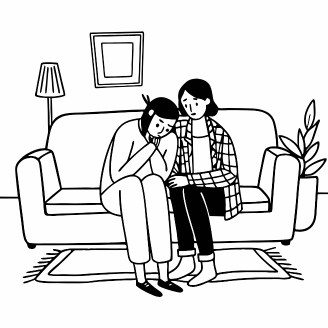
A caring role rarely follows that timetable. Someone may need to pause their learning during a difficult period, return to a course when they are better able to take it in, or seek support years later as circumstances change. A second member also asked about eligibility, showing how relevant this question is to carers trying to find the right help.

Nisha listened to these concerns and said she would take the question of eligibility back for further discussion. She also described work to strengthen links with community and voluntary organisations, so that carers have clearer routes to support when their access to the college ends. It was a constructive exchange, and one we hope can continue.

Members also spoke about how hard it can be to discover support in the first place. Carers should not have to find every course or service by chance while managing an already demanding role. Clear information, accessible formats and active outreach matter, including for carers from ethnic minority communities and people who may face other barriers to taking part.

How carers can take part

Nisha explained that prospective students can look through the Recovery College timetable and complete an online registration form, selecting courses that interest them. The team checks eligibility and confirms a place if one is available; if a course is full, there may be a waiting list. Open days offer a chance to talk through the options, but a registered student does not need to attend an open day each term to book another course. Courses in a different borough may also be an option.
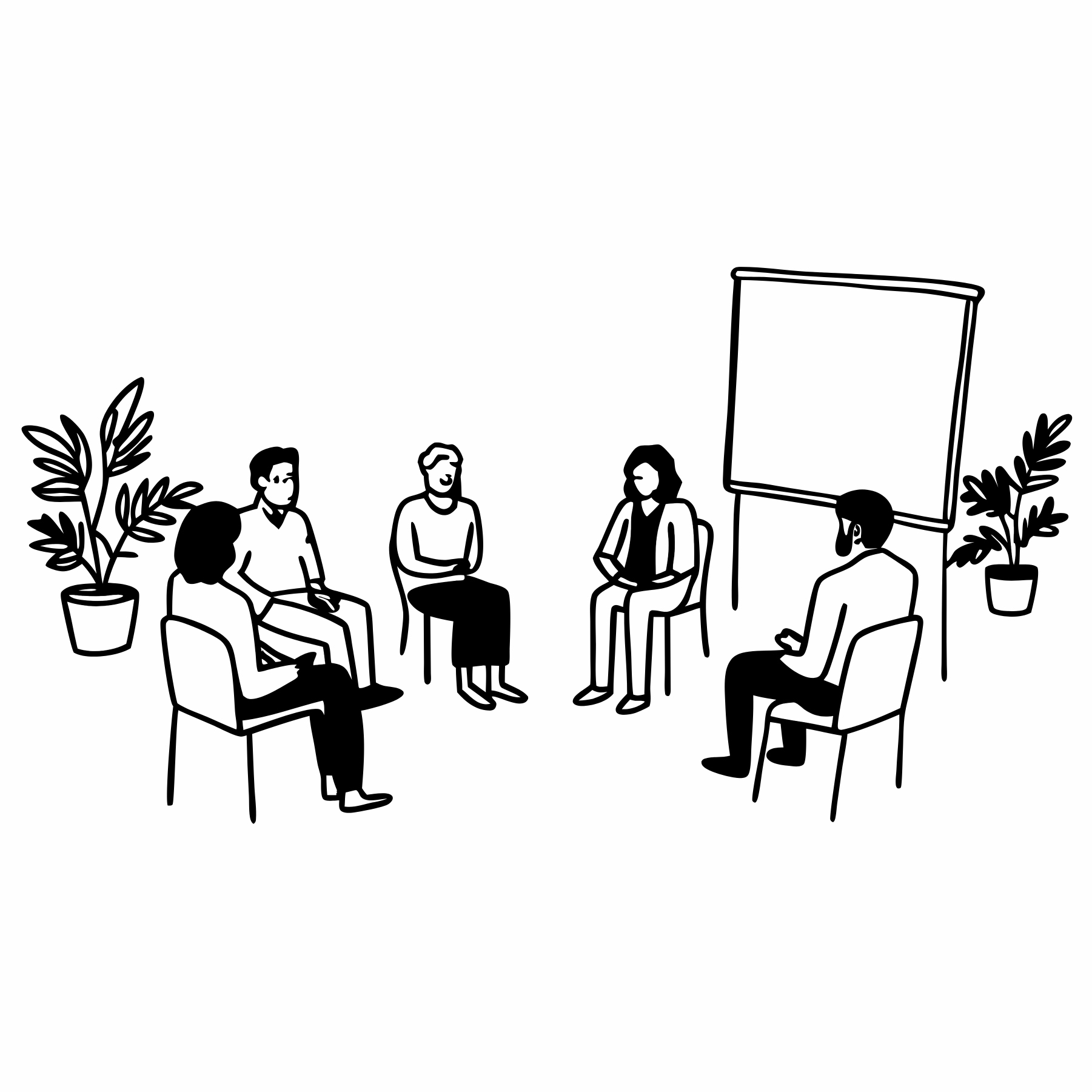
We asked how carers from this forum could help shape future courses. Nisha welcomed continued discussion about carer involvement in course design and delivery. We also talked about sharing information both ways: making more carers aware of the college, and helping people who attend its carer courses find our forum.

A space for carers to connect

At the start of the meeting, I shared a glimpse of a recent carers’ art and poetry session. Creative expression can give carers another way to speak about experiences that are difficult to put into everyday conversation. I would welcome the chance to explore a similar opportunity in South West London with interested carers and local partners.

Thank you to Nisha for joining us and answering members’ questions openly, and to the carers who shared their experiences. Their questions helped move the conversation from a list of courses to the practical issue of whether support remains accessible when carers need it.

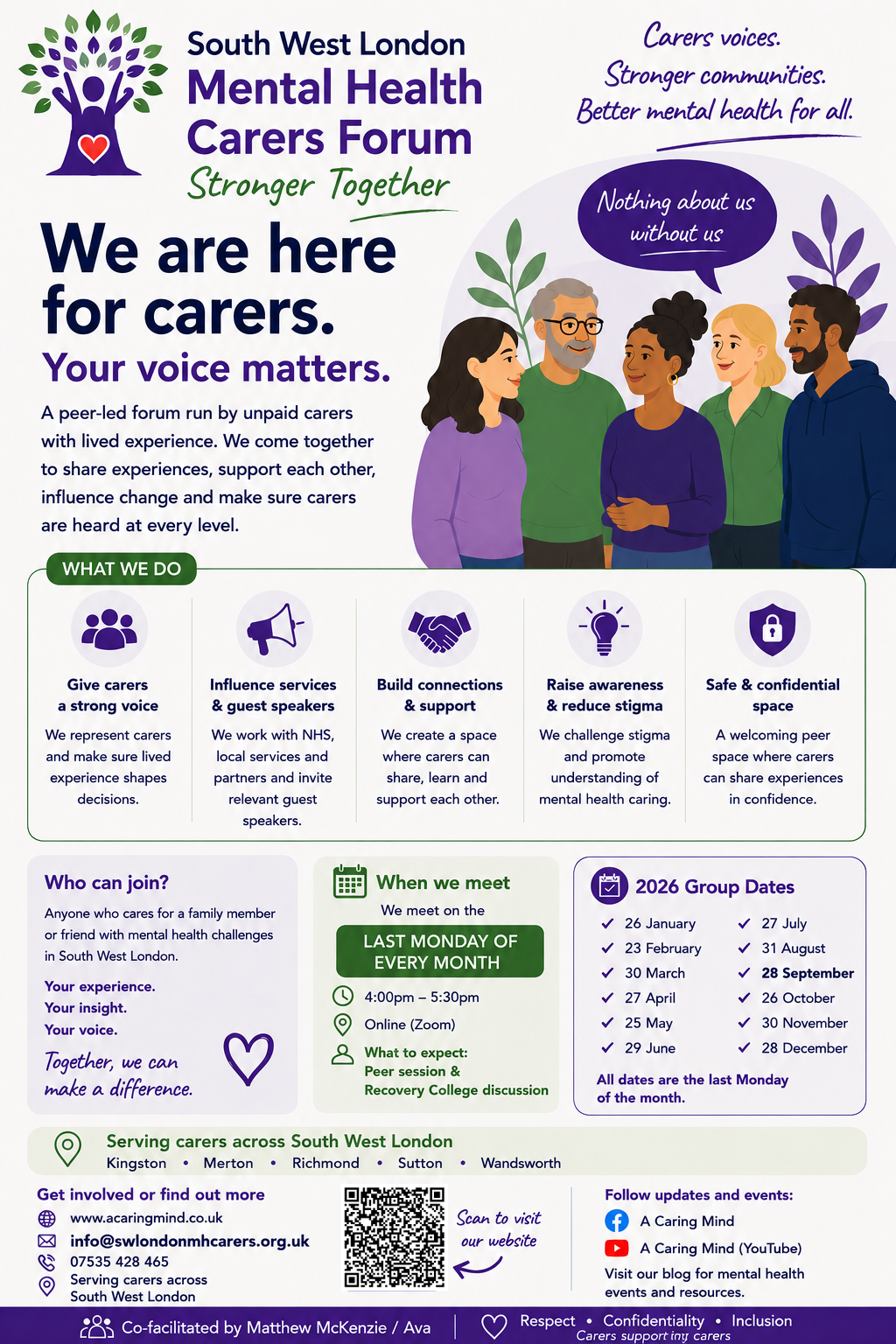
The South West London Mental Health Carers Forum meets monthly and welcomes unpaid mental health carers across the five boroughs. Our next meeting is planned for Monday 26 October 2026. To ask about joining, email info@swlondonmhcarers.org.uk.

Why Unpaid Carers need to be aware of learning Digital Skills

By Matthew McKenzie

The Urgent Need for Digital Skills Among Unpaid Carers

Unpaid carers who provide support to family members, friends, or neighbors with long-term health conditions are the backbone of many communities. Their work is often invisible, yet it is essential for the well-being of countless individuals. As healthcare systems rapidly digitize, the landscape of caregiving is undergoing a profound transformation. Unpaid carers now face the challenge of adapting to new technologies, digital platforms, and online resources that are becoming integral to the delivery of care.

This blog explores why technical and digital skills are no longer just optional for unpaid carers. The blog is also a transcript of matthew’s video below.

Drawing on insights from matthew’s experience as an unpaid carer & IT professional and advocate for carers, we delve into the practical reasons behind this shift, the opportunities and challenges it presents, and the future trends that will shape caregiving in the years to come.

The Changing Face of Caregiving

Digitization in Healthcare

Healthcare is moving online at an unprecedented pace. Electronic health records, telehealth platforms, wearable health devices, and digital prescriptions are becoming the norm. The reasons are clear: digitization streamlines processes, reduces costs, and enables real-time access to critical health data. For unpaid carers, this means that many aspects of their role now require interaction with digital tools.

The Role of Carer Centers

Local carer centers have traditionally been the first point of contact for those seeking support. As these centers will play a crucial role in helping carers acquire the skills needed to navigate the new landscape. Online training, virtual support groups, and digital resource libraries are just some of the ways carer centers are evolving.

Overcoming Barriers to Digital Inclusion

Challenges Faced by Carers

Not all carers are comfortable with digital environments. Some may lack the means to access technology, while others face disabilities that make using digital platforms difficult. For example, visual impairments can pose significant challenges. It’s important for carer centers and support organizations to recognize these barriers and provide alternative solutions where possible.

The NHS 10-Year Plan

Digitization is at the heart of the NHS’s long-term strategy. Unfortunately, unpaid Carers who fail to meet the demand for digital skills may find themselves excluded from essential services and support. Embracing technology is not just about keeping up, it’s about empowering carers to meet the needs of those they support with confidence and efficiency.

Conclusion

The digitization of healthcare is transforming the role of unpaid carers. Technical and digital skills are now essential for accessing resources, coordinating care, and advocating for loved ones. While the transition may be challenging, it offers opportunities for greater efficiency, independence, and empowerment.

If you are an unpaid carer, now is the time to invest in your digital skills. Seek out training, connect with support networks, and take advantage of the tools available. Your role is vital, and with technology on your side, you can continue to make a difference in the lives of those you care for.

Southwark & Lambeth carer forum update February 2025

Here is a brief update of the joint Southwark & Lambeth mental health carers forum I run the last monday of the month. The forum is a space for those caring for someone with mental ill health to connect and get updates from service providers.

As facilitator Matthew McKenzie emphasized the importance of managing guilt as a mental health carer, challenging unrealistic expectations, and setting boundaries for one’s own well-being. Matthew also stressed the need for self-care, seeking professional guidance, and advocating for respite care. The conversation ended with discussions on the concept of guilt, the challenges of being a carer, and strategies for holding care coordinators and social workers accountable.

Continue reading →

Carers and the importance of Recovery Colleges

mat

Welcome to another one of my carers blog posts. My name is Matthew Mckenzie and I am a carer for someone suffering mental health difficulties. I feel its important for carers to speak out more, so that way we won’t risk being alienated, isolated and disregarded. We carers and families give so much to society, but as yet we still plod along trying to cope with caring.

One thing I noticed about being a carer for so many years is the problem of being thrown into providing care without any idea what I am doing. I questioned myself on the following over the years.

– Am I providing care correctly?
– Wondering if I am sure if things go downhill it was partly my fault
– What is my caree thinking about how I am trying to support them?
– How am I looking after my own care needs?
– What support should I be getting?
– What happens if I get stressed in trying to talk to my caree?
– How should I react if my caree gets upset with me?

I feel that if you are a carer reading this, then all these questions must have come across your mind at some point in your journey. I am not stating that caring is the toughest job in the world, but at times a carer can be out on a limb, a carer can sometimes end up relying on guess work. This is not often the best situation to be in and I feel more support should be offered to carers in understanding their role and providing adequate care without neglecting themselves.

Well over the years I have learnt quite a few things from carers support groups that I have attended in the past and that I still do attend, one of the things I had learnt at these groups were courses that can help carers.

Some of the information about courses carers can attend came from the group leader, sometimes other carers passed on such information via word of mouth. Eventually I plucked up the courage and decided to enroll on a day course on understanding mental health from a carers perspective. I never looked back and the course had helped me immensely.

Embed from Getty Images

Fast forward to 3 years in the present and I found myself attending more courses regarding carers of those suffering mental health issues or those with lived experiences. These courses ranged from a couple of hours to evening classes spanning 2 months. Maybe one day I ll blog about how I found how helpful those courses were.

Eventually I found out about recovery colleges, at first I thought such colleges were only for those suffering mental health problems. I checked out the course list from the “Central and North West London” recovery college site and found out some of the courses were useful for carers, but the problem was that I was not from that area, so I felt a little disheartened, however if you do use Central and North West London services then please check out their recovery college site at http://www.cnwl.nhs.uk/recovery-college/

So then since I am over in South London, what could I do to educate myself and help in my own recovery as a carer? Eventually I found out from “South London and Maudsley” that they have their own recovery college. It was not long before I was browsing through their prospectus which can be found here http://www.slamrecoverycollege.co.uk/courses.html

SLaM Recovery logo

I eventually found several courses that was interesting for my field, but one course stood out more for me than the other courses off that prospectus. This course was called “Carers Communicating for Change”. The workshop states the following.

“This workshop focuses on the importance of communication within the caring role.

Sharing experiences and increased knowledge of mental health issues can help to reduce anxiety for both the carer and person experiencing mental health difficulties.”

Without a moments notice, I booked myself for this course and you know what was even better? This course was free. I could not believe it! Although quite a few courses are free for carers and some of them might not be free, but its usually good to start with the courses that are free; mainly because I feel carers struggle with finances almost every day.

On the 14th of July 2014, I managed to attend the course, although I arrived a little late due to a train cancellation. The course was held over at the Maudsley Learning Centre, which is a lovely building centered on health and wellbeing events, courses, seminars and community get togethers. You can check out the Maudsley Learning site here http://www.maudsleylearning.com/

Maudsley Learning Centre

Continuing about my experiences on the course, I arrived to hear the course leader talking about how carers need to watch out for the pitfalls when they are communicating with others, especially with who their care for that being the “caree”. I then thought to myself “Hey! this sounds right up my street”, and I began to sat down and listen.

The course co-lecturer was showing slides of different animals off the screen. Each animal resembled different characteristics of communicative behavior.

I remember some of them animals shown as :-

Ostrich
Rhinoceros
Kangeroo
Dolphin

I am sure there were a few more animals, but those are the ones that stuck in my mind, but why animals? Well for a start we can easily recognize animal behavior and if I go through those I have mentioned, you can slightly understand how useful the examples were

Ostrich – Tends to bury themselves in the sand ignoring caring issues
Rhinoceros – Does not negotiate and always takes “charge” with directing questions, causes others to fear them.
Kangaroo – Protects the caree and does not allow self recovery or motivation
Dolphin – The perfect balance, supportive and understanding.

I will not go on too much about the course because I might end up spoiling it for others who may attend the course some day, however one of the key benefits of this course is that it allowed carers to speak about their experiences. The good point of this is that I learnt from other carers experiences and there were several times where I spoke about my own caring experiences. This is where I felt that I could relate to other carers, where I do not feel isolated every so often in the community or in society.

Embed from Getty Images

Another thing I liked about the course where the exercises where we could experience the difference between directed questions and open questions. I still need to work on how to ask open questions, but they are very important in communication skills. I felt the 2 hour course was a great asset for my caring role and hope they continue to run such a course for the next semester.

Recovery colleges seem to be starting up around many mental health trusts, so if you are a service user, carer or even staff member, it is worth checking out such colleges. My reasons for attending these colleges are :-

– They can aide in recovery as a tool
– You can learn about the course and also learn about yourself
– They are a great networking opportunity
– They are usually free
– Courses are geared to your situation

I am sure there are a lot more things I have missed out off this list, but you get the picture. I hope to attend more courses soon even if they are not held at recovery colleges, perhaps I ll feedback on my blog how those courses turned out.