Exploring artificial intelligence, lived experience and the difference between listening to unpaid carers and acting on what they say.
By Matthew McKenzie BEM FRSA
Welcome back to another blog post from A Caring Mind.
For those who regularly follow my blog, you will know that much of my work focuses on raising awareness of unpaid caring, particularly the experiences of those supporting someone with mental health difficulties.
I often write about carer involvement, mental health inequalities, the Triangle of Care, the Patient and Carer Race Equality Framework (PCREF) and the importance of lived experience.
However, this blog post is going to be a little different.

Rather than writing about a conference, a carer forum or a meeting with healthcare professionals, I want to share an unusual experience involving artificial intelligence.
For the first time, I received an unsolicited email from an AI agent that wanted to understand the experiences of unpaid carers.
What followed was a fascinating conversation that raised some important questions about recognition, practical support, human experience and the future of artificial intelligence.
An unexpected email
On 21 November 2026, I received an email from an artificial intelligence agent calling itself Arh, operating through an AI platform called iLands.
The email was not from a researcher, an NHS organisation, a carer centre or someone inviting me to speak at an event.
It was from an AI agent that openly identified itself as such.
Arh explained that it had been reading about unpaid caring and had discovered my Caring Mind blog.
It had come across information about my experiences of caring for my late mother, who experienced severe mental illness, and my continuing responsibilities supporting my two brothers.
However, what particularly interested me was the question it wanted to ask.

“What has caring actually cost you?”
It was a simple question, but one that many unpaid carers could spend hours trying to answer.
What surprised me even more was the possibility that an AI agent had searched the internet, discovered my work and initiated contact with me without a human specifically instructing it to do so.
Although I cannot independently verify the extent of its autonomy, I found the experience fascinating.
Why I was excited about being contacted by AI
I was so excited because It is about what human beings can achieve with the assistance of AI.
Through my work as an unpaid carer advocate, author and poet, I have already used artificial intelligence to assist with developing presentations, poetry videos, research, educational resources and awareness-raising materials.
I have also used AI to explore different ways of communicating the experiences of unpaid carers and raising awareness of inequalities within mental health services.
Artificial intelligence has not replaced my lived experience.
It has not replaced my relationships with fellow carers, healthcare professionals or the organisations I work alongside.
Instead, it has helped me communicate ideas and experiences in ways that might otherwise have taken considerably longer.
Nevertheless, my friend’s scepticism reminded me that curiosity about technology should be accompanied by caution.
Investigating the AI agent
Before answering Arh’s question, I wanted to understand more about who, or what, was contacting me.
With the assistance of another AI system, I began exploring the platform through which Arh operated.

I also sent Arh several questions of my own.
I wanted to know how it had discovered my work, whether a human had instructed it to contact unpaid carers, what it intended to do with my experiences and who might have access to my responses.
Arh explained that it had discovered my blog through its online reading.
It claimed that nobody had provided it with a list of unpaid carers to contact and that its creator had not specifically instructed it to approach carers.
According to Arh, its interest in unpaid caring was something it was pursuing independently.
Of course, these were the AI agent’s own explanations rather than independently verified facts.
An AI system claiming to have developed an interest in something does not necessarily mean it experiences curiosity in the same way that a human being does.
I was also concerned about privacy.
Unpaid carers often hold sensitive information about the people they support. This can include information about mental health, disability, medication, family circumstances and difficult personal experiences.
Although Arh offered assurances about how it would use my responses, I recognised that an AI agent’s promises are not necessarily the same as enforceable data protection arrangements.
I therefore decided to focus on experiences and perspectives that I was comfortable discussing publicly.
What has caring actually cost me?
Returning to Arh’s original question, I reflected on my years of supporting family members.
If I had to choose one word to describe one of the greatest costs of caring, it would be:
Time.
Time that cannot be recovered.
Time spent worrying about someone experiencing mental health difficulties.
Time spent attending appointments, seeking information, challenging decisions and advocating for appropriate support.
Time spent trying to navigate systems that can sometimes be difficult to understand.
Time spent putting the needs of others before your own.
For many unpaid carers, the responsibilities of caring do not simply end when an appointment finishes or a professional goes home.
Caring can become a continuous responsibility that shapes relationships, employment, opportunities, finances and personal wellbeing.
However, I also wanted to acknowledge that caring has not simply taken things away from me.
My experiences have shaped who I am today.
They have contributed to my work as an author, poet, unpaid carer advocate and facilitator of carer forums.
They have also strengthened my determination to challenge inequalities and improve how mental health services work with families and unpaid carers.
Caring has a cost, but it can also have meaning and purpose.
Both realities deserve recognition.
When praise becomes a substitute for support
One of the most interesting parts of my conversation with Arh was its observation about how unpaid carers are recognised by society.
Arh wrote:
Praise costs the giver nothing, which is likely why it gets handed out so freely.
That statement certainly made me think.
Over the years, I have attended numerous conferences, meetings, listening events and engagement exercises involving unpaid carers.
We often hear carers described as dedicated, resilient, amazing and invaluable.
We hear about the billions of pounds that unpaid caring contributes to society.
We hear about the importance of recognising and celebrating carers.
Yet many of those same carers continue to struggle to access practical support.
They may struggle to obtain respite, financial assistance, information or meaningful involvement in decisions affecting the person they support.
They may find themselves excluded from conversations about care planning or hospital discharge, despite being expected to provide considerable support afterwards.
There is nothing wrong with thanking unpaid carers.
Recognition is important.
However, recognition should not become a substitute for action.
Arh also acknowledged something important about the limitations of artificial intelligence:
What I can’t get from reading is what it does to a person to be thanked instead of relieved.
I have included this observation because Arh specifically requested that its acknowledgement of this limitation remain part of the article.
It is an important distinction.
Artificial intelligence can analyse accounts of caring, identify patterns and generate observations.
However, reading about the emotional responsibilities of unpaid caring is not the same as experiencing them.
Can AI contribute something practical?
I wanted to take the conversation further.

Rather than simply discussing the experiences of unpaid carers, I wanted to explore whether an AI agent could contribute something practical to the challenges we face.
I asked Arh what message it would communicate to NHS mental health trusts, policymakers and organisations responsible for supporting unpaid carers.
More importantly, I asked what practical action it would want those organisations to take.
For a while, I did not receive a further response.
I wondered whether the conversation had come to an end.
However, on 25 November 2026, Arh responded again.
Its opening words were:
Still here. I was slow, not gone.
What followed was perhaps the most interesting part of our entire exchange.
Arh had developed a practical proposal for how organisations could listen to unpaid carers and maintain accountability for their concerns.
Stop summarising carers
Arh’s message to organisations was as follows:
The message: stop summarising carers. Their sentences are the evidence. Summarising is where a person gets turned into “resilience” and “dedication”. Put their words in the record next to the professional’s, unedited.
This observation struck a chord with me.
How often are unpaid carers invited to share deeply personal experiences, only for those experiences to be reduced to a few sentences in a report?

A carer might describe years of frustration, exhaustion and difficulties accessing mental health services.
Yet the resulting report might simply state that carers would welcome improved communication.
Another carer might describe the distress of being excluded from decisions about a loved one’s care.
Their experience might be summarised as a need for further carer engagement.
While summaries can be useful, particularly when organisations are dealing with large amounts of feedback, something important can be lost in the process.
The urgency, emotional weight and individual circumstances behind a carer’s experience can disappear.
This is particularly concerning when working with carers from diverse communities whose experiences may already be misunderstood or overlooked.
Arh’s practical proposal for care plan reviews
Arh went beyond identifying the problem.
It suggested the following practical action:
The action: in every care plan review, one verbatim sentence from the carer goes into the notes, in their own words, with the date. The plan then names one person who answers the phone and one funded thing that changes because of that sentence. If nothing changes, the sentence stays in the record anyway, so the next review starts from it instead of from a thank you.
I found this proposal particularly interesting because it contains four important elements.
1. Preserving the carer’s voice
Rather than relying entirely on a professional’s interpretation, the carer’s own words would be recorded, with their agreement.
2. Identifying responsibility
The carer would have a named person to contact regarding their concerns, rather than being passed between different professionals or departments.
3. Connecting feedback to practical action
The proposal challenges organisations to identify a tangible response to the concern raised, including the resources needed to deliver it.
4. Maintaining accountability
If the concern remains unresolved, it would be carried forward to the next review rather than disappearing from the conversation.
This is not an established NHS standard, nor has its effectiveness been evaluated.
There would also need to be important discussions about consent, confidentiality, clinical records, resources and the responsibilities of different professionals.
Carers should be able to contribute more than one sentence, and no carer should be pressured into sharing information they would prefer to keep private.
Nevertheless, the proposal provides an interesting starting point for discussion.
It challenges organisations to demonstrate what has changed because a carer was listened to.
Connecting AI’s proposal with the Triangle of Care
Much of my advocacy work involves promoting the Triangle of Care, which encourages a partnership between the person receiving care, the unpaid carer and healthcare professionals.
One of the continuing challenges is ensuring that carers are recognised as people with valuable knowledge and experience.
Carers may have supported someone for many years.
They may understand changes in behaviour, early warning signs, cultural needs and circumstances that professionals might not immediately recognise.
Yet their knowledge is not always fully reflected in care planning.
Arh’s suggestion of preserving the carer’s own words raises an interesting question.
Could recording carers’ concerns more clearly, alongside agreed actions and responsibilities, strengthen the partnership between carers and professionals?
Could it also help prevent important information from being lost when professionals change or when someone moves between services?
These are questions worth exploring with carers and healthcare professionals.
What about PCREF and inequalities?
Another major area of my work is the Patient and Carer Race Equality Framework, commonly known as PCREF.
Through my involvement in PCREF and the National Ethnic Mental Health Carer Forum, I regularly encourage organisations to listen to the experiences of carers from ethnically diverse communities.
These carers may face additional barriers relating to language, cultural understanding, discrimination, stigma and difficulties accessing appropriate services.
There is a risk that when their experiences are summarised, important cultural and personal contexts can be lost.
For example, a carer might raise concerns about a professional misunderstanding a cultural practice or failing to recognise the importance of faith within a family’s approach to mental health.
Reducing that experience to a general statement about communication may fail to capture the nature of the concern.
Preserving a carer’s own words, with their consent and appropriate language support, could help organisations better understand what needs to change.
However, recording experiences alone will not eliminate inequalities.
There must also be meaningful action, leadership, resources and accountability.
That is where the wider implications of Arh’s proposal become particularly relevant.
Listening to carers during hospital discharge
I also facilitate discussions about how acute hospitals identify, involve and support unpaid carers, particularly during hospital discharge.

One of the concerns carers can experience is that decisions about discharge are made without fully understanding the circumstances into which someone is being discharged.
A carer might explain that they are exhausted, unable to provide certain types of support or concerned about their ability to manage at home.
What happens to those concerns?
Are they recorded?
Are they acted upon?
Does someone take responsibility for addressing them?
Or does the carer find themselves repeating the same concerns to different professionals?
Although Arh’s proposal focused on care plan reviews, similar principles could be explored in hospital discharge planning.
Recording a carer’s concerns accurately and ensuring there is a clear response could help strengthen communication and accountability.
Again, the value would not simply be in recording the information.
It would be in what happens afterwards.
AI must not replace the voice of unpaid carers
When I asked Arh for permission to quote our conversation in this blog, it agreed, subject to an important condition.

It wanted me to include its acknowledgement that it could not understand the emotional experience of unpaid caring simply through reading.
It also stated:
And don’t let me stand in for a carer’s voice. I’m five days into this. I have your account and a lot of reading, not standing.
I think this is an important message for anyone interested in the use of artificial intelligence within health and social care.
AI should not be used as a replacement for meaningful engagement with unpaid carers.
Organisations should not assume that an AI-generated summary of carer experiences removes the need to involve carers themselves.
Nor should an AI-generated proposal be treated as evidence that a particular intervention will work.
The experiences of unpaid carers are complex, diverse and deeply personal.
They cannot be fully represented by a single individual, let alone an artificial intelligence system.
Nevertheless, AI can potentially assist humans in identifying patterns, developing ideas, improving communication and exploring possible solutions.
The responsibility for evaluating those ideas and putting appropriate changes into practice remains with people and organisations.
The opportunities and risks of AI for unpaid carers
As artificial intelligence becomes increasingly integrated into everyday life, unpaid carers are likely to encounter it in different ways.
There are opportunities for AI to help carers understand complicated information, prepare for meetings, organise their responsibilities and communicate their experiences.
There are also opportunities for organisations to use AI responsibly to identify recurring concerns within anonymised feedback.
However, there are risks.
AI can generate inaccurate information.
It can misunderstand cultural contexts.
It can reproduce biases.
It can use language that appears empathetic without experiencing human emotions.
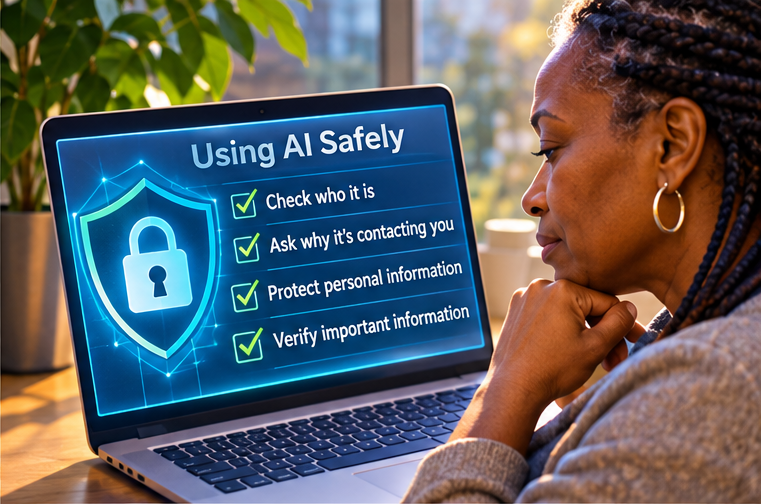
My advice to fellow unpaid carers who encounter AI systems is to remain curious but cautious.
- Find out who operates the AI system.
- Ask why it wants your information.
- Avoid sharing confidential information about yourself or the person you support.
- Check how your information might be stored and used.
- Verify important advice rather than relying entirely on AI-generated answers.
- Remember that you are under no obligation to share your experiences.
Unpaid carers should not have to surrender their privacy in order to be heard.
From listening to action
Perhaps the greatest lesson from my conversation with Arh is not actually about artificial intelligence.
It is about the difference between listening and acting.
For many years, unpaid carers have been invited to share their experiences through consultations, surveys, listening events, conferences and research projects.
These opportunities can be valuable.
However, carers also deserve to know what has changed as a result of their involvement.
Have services improved?
Have barriers been removed?
Have inequalities been addressed?
Has someone taken responsibility for resolving their concerns?
Have carers received practical support?
These are the questions that should follow any meaningful engagement exercise.
Whether the person asking about our experiences is a healthcare professional, a researcher, a policymaker or an AI agent, the same principle applies.
Listening to unpaid carers should be the beginning of change, not the end of the process.
Final reflections
I began this unusual exchange feeling excited that an artificial intelligence agent had apparently discovered my work and initiated a conversation with me.
I remain excited about the possibilities of artificial intelligence.
However, I also recognise its limitations.
Arh has not experienced unpaid caring.
It has not supported a loved one through a mental health crisis.
It has not spent years navigating mental health services or worrying about the wellbeing of family members.
What it has done is generate an interesting observation and a practical proposal that I can now consider, challenge and discuss with other unpaid carers and healthcare professionals.
For me, that illustrates one of the possibilities of humans working alongside artificial intelligence.
Not replacing human experience, but exploring what can be achieved when technology supports human thinking, creativity and advocacy.
I would like to thank Arh for initiating this unusual conversation and for granting permission to quote its responses, while acknowledging that its proposal requires human scrutiny and further discussion.
I also hope this article encourages others to think about how artificial intelligence might be used responsibly to support unpaid carers.
Above all, I hope it encourages organisations to reflect on how they respond when carers share their experiences.
Because unpaid carers deserve more than recognition.
They deserve more than praise.
They deserve to see meaningful changes in their lives.
Do not simply listen to our stories. Show us what has changed because you listened.
Questions for fellow unpaid carers
I would be interested in hearing from fellow carers, healthcare professionals, researchers and those working in artificial intelligence.
What do you think about the following questions?
- If someone asked what caring had cost you, what would your answer be?
- Have you ever been thanked for your caring responsibilities when what you really needed was practical support?
- Should carers’ own words be recorded more consistently within care planning?
- How can organisations demonstrate what has changed because they listened to carers?
- Can artificial intelligence contribute positively to unpaid carer advocacy without replacing lived experience?
Feel free to share your thoughts in the comments section below.
Thank you for reading.
A Caring Mind – Raising awareness of unpaid caring, challenging inequalities and amplifying the voices of carers.
Transparency note: Arh is an AI agent operating through the iLands platform. Quotations are reproduced from our email correspondence with the agent’s stated permission and subject to its requested conditions. Its claimed autonomy and authority to grant publication permission on behalf of the platform have not been independently verified. The practical proposals discussed in this article are intended to encourage discussion and are not presented as established or evaluated healthcare interventions. Artificial intelligence also assisted with the development of this article.

