Tag Archives: PCREF

Understanding Care Guilt and Shame in Culturally Tight-Knit Communities

By Matthew McKenzie

Caring for someone with long-term mental illness is a profound act of love and responsibility, just as i cared for my mother, but it is also fraught with emotional complexities, especially within culturally tight-knit communities. The experience of unpaid carers, those who provide care without financial compensation, can be shaped by powerful cultural expectations, traditions, and social pressures. These factors often lead to hidden challenges such as guilt and shame, which can create barriers to seeking help and support.

This blog post which is a transcript of my video explores the intricate dynamics of care guilt and shame, drawing on my insights as facilitator of the National Ethnic Mental Health Care Forum.

While the focus often falls on ethnic minority carers, many of the themes discussed I feel are universal, affecting unpaid carers from all backgrounds. However By examining the cultural ideals, emotional burdens, and systemic challenges faced by carers, we can better understand how to support them and promote positive change in mental health care.


The Role of Culture in Shaping the Carer Experience

Family Duty and Community Honor

In many tight-knit communities, caring for a family member is seen as a moral duty and a source of honor. The expectation is clear: “We look after our own.” This deeply rooted tradition fosters strong family bonds and a sense of belonging. The carer’s role is often defined by values handed down through generations, reinforcing the idea that caring is not just a responsibility but an essential part of one’s identity.

However, these cultural ideals can also create significant challenges. The notion that the “perfect carer never complains or needs help” sets an unrealistic standard, making it difficult for carers to express their struggles or seek support. Weakness is discouraged, and the pressure to cope without showing strain is especially pronounced among men, who may feel compelled to “man up” and avoid displaying vulnerability.

Keeping Illness Within the Family

Another common theme is the tendency to keep issues of ill health, particularly mental illness, within the family or community. This approach is often seen as a way to protect the family’s reputation and maintain social cohesion. Religious and cultural beliefs may further reinforce the idea that problems should be addressed privately, sometimes through prayer or spiritual practices, rather than seeking external help.

While these traditions can provide comfort and a sense of solidarity, they can also lead to isolation and prevent carers from accessing the support they need. The fear of gossip, judgment, or being seen as failing in one’s duty can be overwhelming, especially when mental health is stigmatized or misunderstood within the community.


The Emotional Weight of Caring: Guilt and Shame

How Guilt Creeps In

Guilt is a pervasive emotion among carers, particularly when cultural norms dictate that they should be able to handle all challenges alone. The demands of caring often mean missing out on community events, family gatherings, or social obligations. Community leaders or members may notice these absences and interpret them as letting the community down, adding to the carer’s sense of guilt.

This guilt can manifest in several ways:

  • Resentment and Frustration: Carers may feel frustrated with themselves or the person they are caring for, leading to emotional strain and potential conflict.
  • Personal Guilt: The belief that needing a break or personal time is selfish can prevent carers from prioritizing their own well-being, even when burnout is imminent.
  • Fear of Judgment: In large families or communities, the expectation to manage alone can be overwhelming. Carers may worry about being judged or seen as failing in their role.

The Catch-22 of Self-Care

The need for personal time and self-care is undeniable, yet carers often feel trapped in a catch-22. Taking time for themselves is viewed as selfish, but neglecting their own needs can have detrimental effects on their mental and physical health. The pressure to uphold cultural ideals and avoid showing weakness makes it difficult to break this cycle.

In some communities, there may not even be a word for “carer”—it is simply assumed that family members will step in as needed. This lack of recognition further compounds the challenges, as carers struggle to articulate their needs or seek validation for their efforts.

The Impact of Shame and Stigma
Saving Face and Avoiding Help

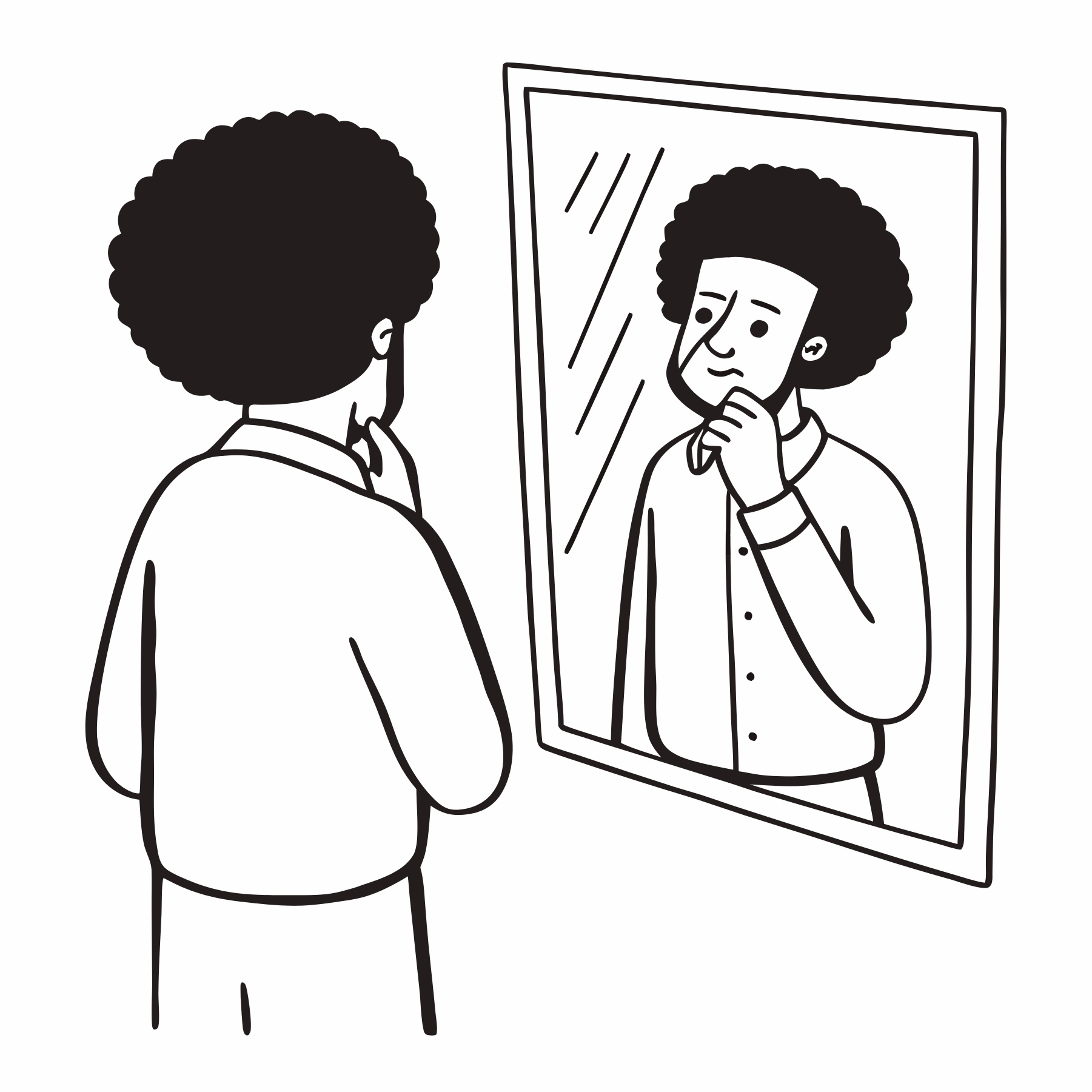
Shame is closely linked to guilt, and both emotions can prevent carers from reaching out for help. The desire to “save face” is strong in many communities, where reputation and social standing are highly valued. Admitting to struggles or accepting support may be seen as a sign of weakness or failure, leading carers to reject offers of assistance from mental health services or outreach programs.

Internalized comments such as “this is your duty,” “you must put up a front,” or “we don’t put family in care” reinforce the belief that seeking help is unacceptable. The fear of gossip and misunderstanding is real, especially in communities where mental health is poorly understood or lacks a cultural vocabulary.

Religious and Cultural Barriers

Religious identity can also play a role in shaping attitudes toward mental health and caring. In some faith-based communities, there may be little space for open discussion about mental illness, and spiritual solutions may be favored over professional support. This can create additional barriers for carers, who may feel unsupported or misunderstood by both their community and the wider mental health system.


Systemic Challenges: Inequalities in Mental Health Care

The Patient Care Race Equality Framework (PCREF)

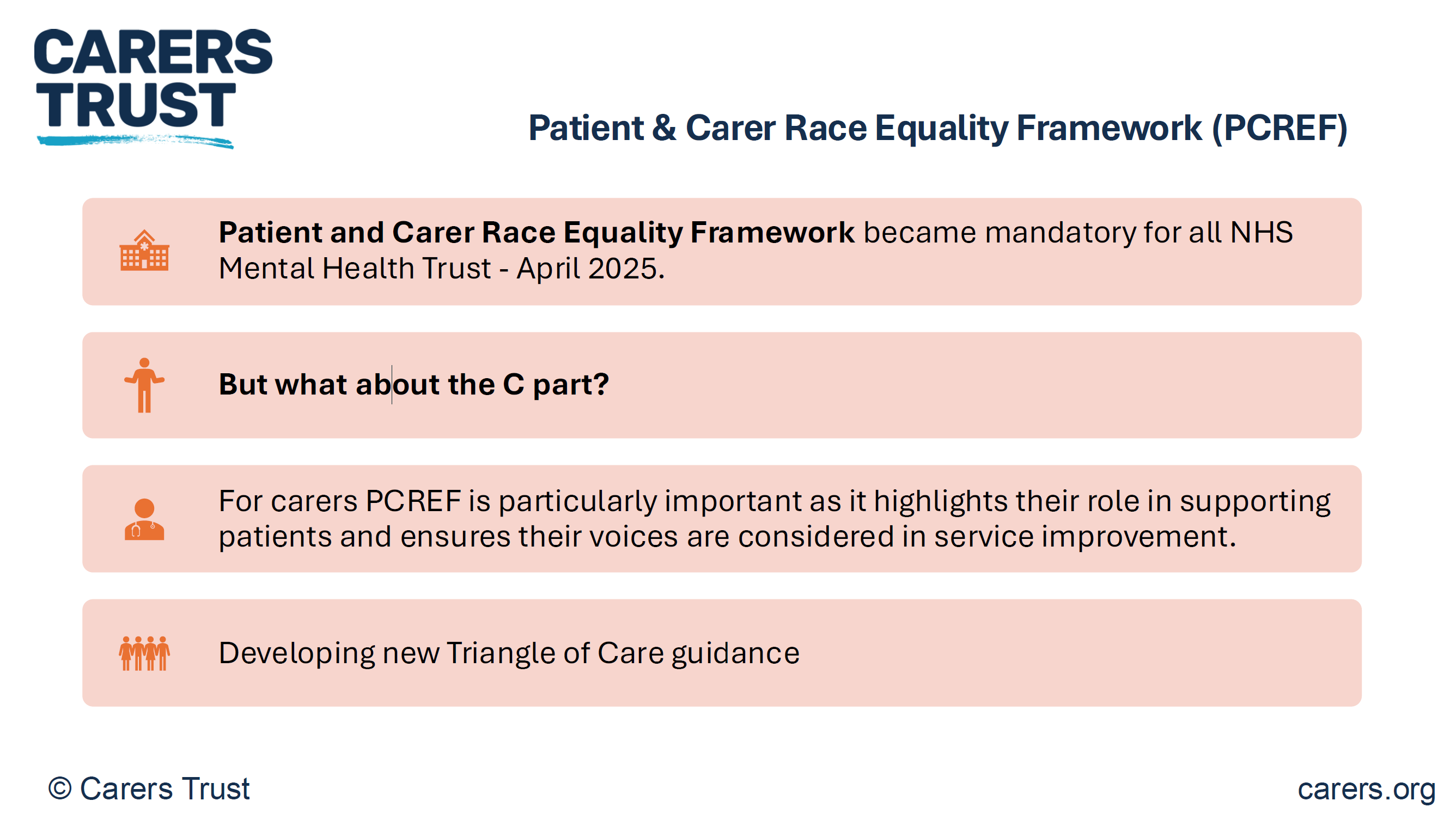
Recognizing the unique challenges faced by minority carers, NHS England has developed the Patient Care Race Equality Framework (PCREF). These set of policies aims to tackle inequalities in mental health care, particularly for ethnic minority groups. The framework emphasizes the importance of breaking down guilt and shame, promoting better outcomes for minority communities, and ensuring that carers’ voices are central to service design and decision-making.

However, systemic barriers persist. Minority carers may be reluctant to engage with mental health services due to fears of poor outcomes, discrimination, or further isolation. The double tragedy is that those who need support the most are often the least likely to receive it, as both community and systemic factors conspire to keep them from seeking help.

The Importance of Carers’ Voices

A key focus of the National Ethnic Mental Health Care Forum is to ensure that carers’ voices are heard and valued. Too often, the emphasis is placed solely on patients or those with lived experience, overlooking the vital role that families and carers play. Guilt and shame can stop carers from engaging with services, making it essential for mental health systems to recognize and address cultural barriers.

Breaking the Cycle: Towards Better Support and Outcomes
Engaging with Communities

To break the cycle of guilt and shame, it is crucial to engage directly with communities. This means attending religious and cultural gatherings, listening to minority carers and patients, and understanding the specific struggles they face. Education is key!! both for carers and for mental health professionals. Training staff to appreciate community values and avoid assumptions about disengaged carers can help foster trust and collaboration.

Creating Safe, Non-Judgmental Spaces
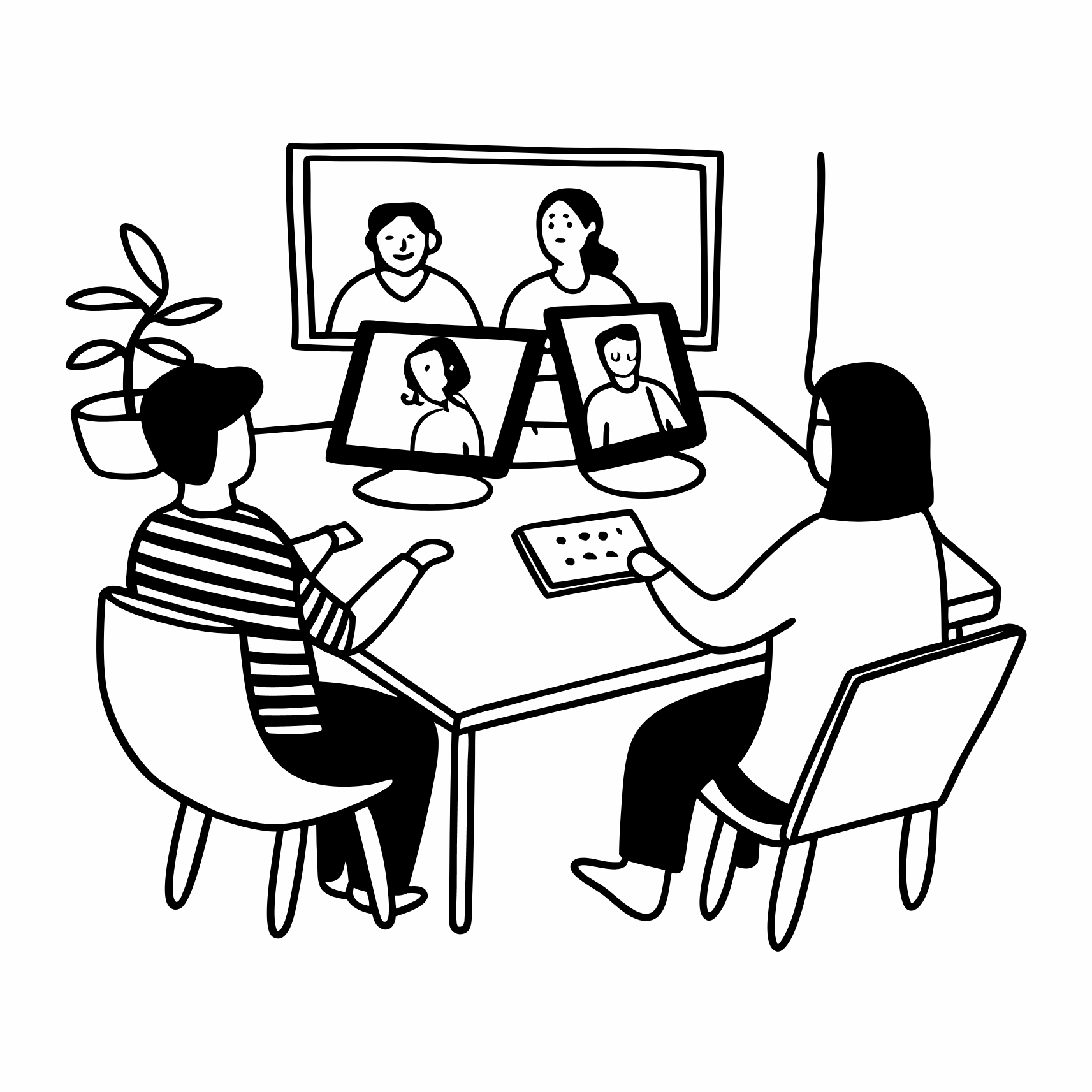
Safe spaces where carers feel invited and heard are essential. These settings should be non-judgmental and designed to encourage open dialogue. Just like my Ethnic carer forum. Co-production, where patients and carers are involved in designing and delivering services and can help ensure that support is tailored to the needs of diverse communities.

Promoting Positive Role Models

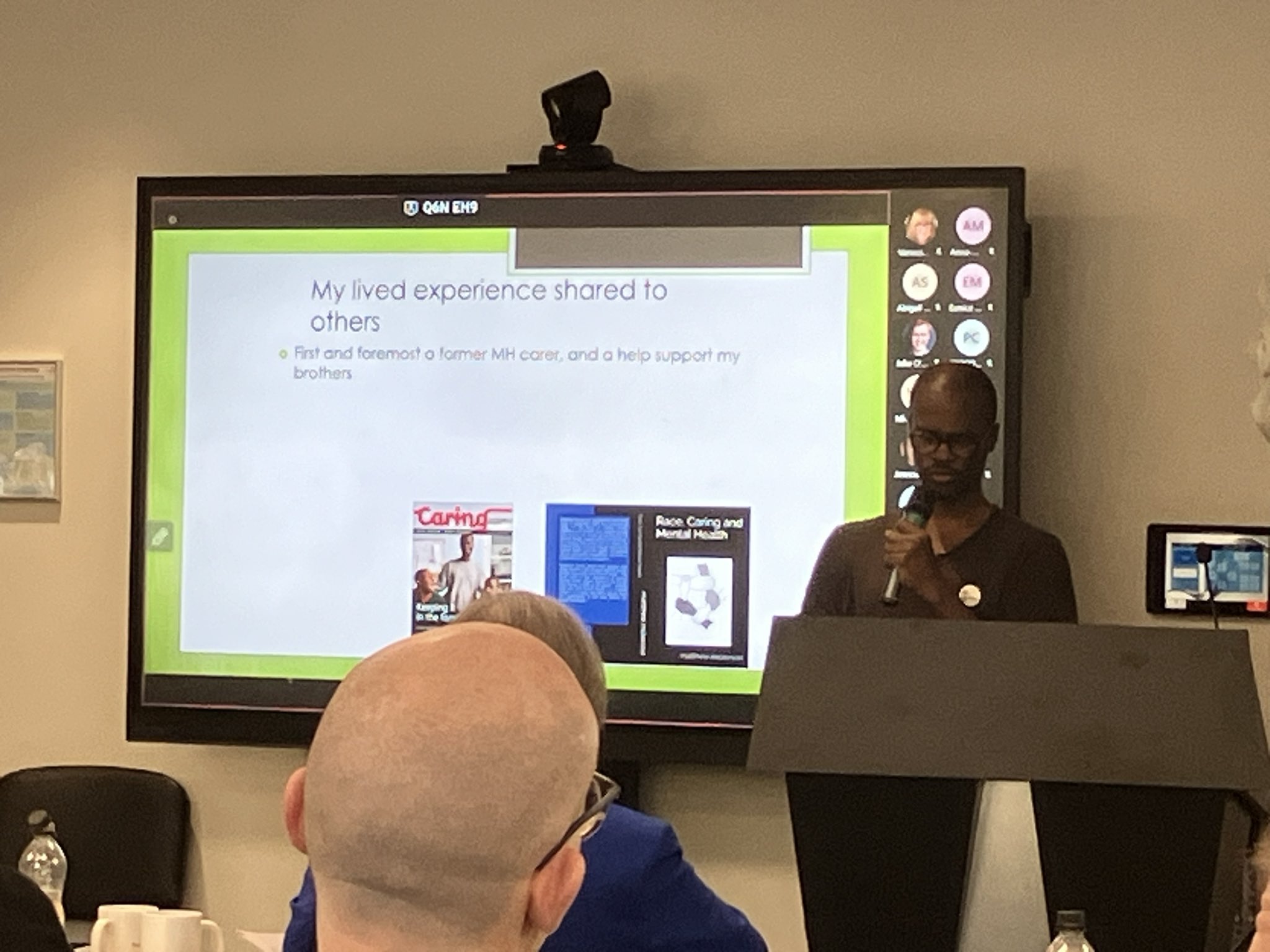
Just as I mentioned when I spoke at the North East London NHS PCREF event, I feel that Role models play a powerful role in challenging stigma and inspiring change. Mental health trusts and systems should promote positive examples of carers who have reached out for help and benefited from support. Sharing stories and experiences can help others see that seeking help is not a weakness, but a strength.

Self-Care as Strength

Promoting self-care as a strength, rather than a weakness, is vital. Carers need to recognize that it is okay to ask for help and take time for themselves. Engaging with community leaders and faith networks can help change attitudes and reduce stigma, using trusted voices to advocate for better understanding and support.

The Path Forward: Building Inclusive Mental Health Services

Co-Production and Service Design

Including carers in service design and decision-making is essential for building inclusive mental health services. By putting carers at the center of policy and practice, systems can better address the unique challenges they face and promote positive outcomes for all.

Education and Awareness

Ongoing education and awareness-raising are critical. Carers, communities, and professionals must work together to challenge stigma, promote understanding, and create environments where everyone feels supported.

The Power of Conversation

Ultimately, breaking the cycle of care guilt and shame requires open conversation and a willingness to learn from each other. By sharing experiences, listening to diverse voices, and fostering empathy, we can build stronger, more inclusive communities and mental health systems.


Conclusion

Care guilt and shame are complex, deeply rooted issues that affect unpaid carers across culturally tight-knit communities. The emotional weight of caring, compounded by cultural expectations and systemic barriers, can lead to isolation, burnout, and reluctance to seek help. Addressing these challenges requires a multifaceted approach engaging with communities, promoting positive role models, creating safe spaces, and ensuring carers’ voices are central to service design.

By working together to challenge stigma and promote understanding, we can support carers in their vital role and build mental health services that truly meet the needs of all. The journey is ongoing, but with awareness, education, and compassion, positive change is possible.

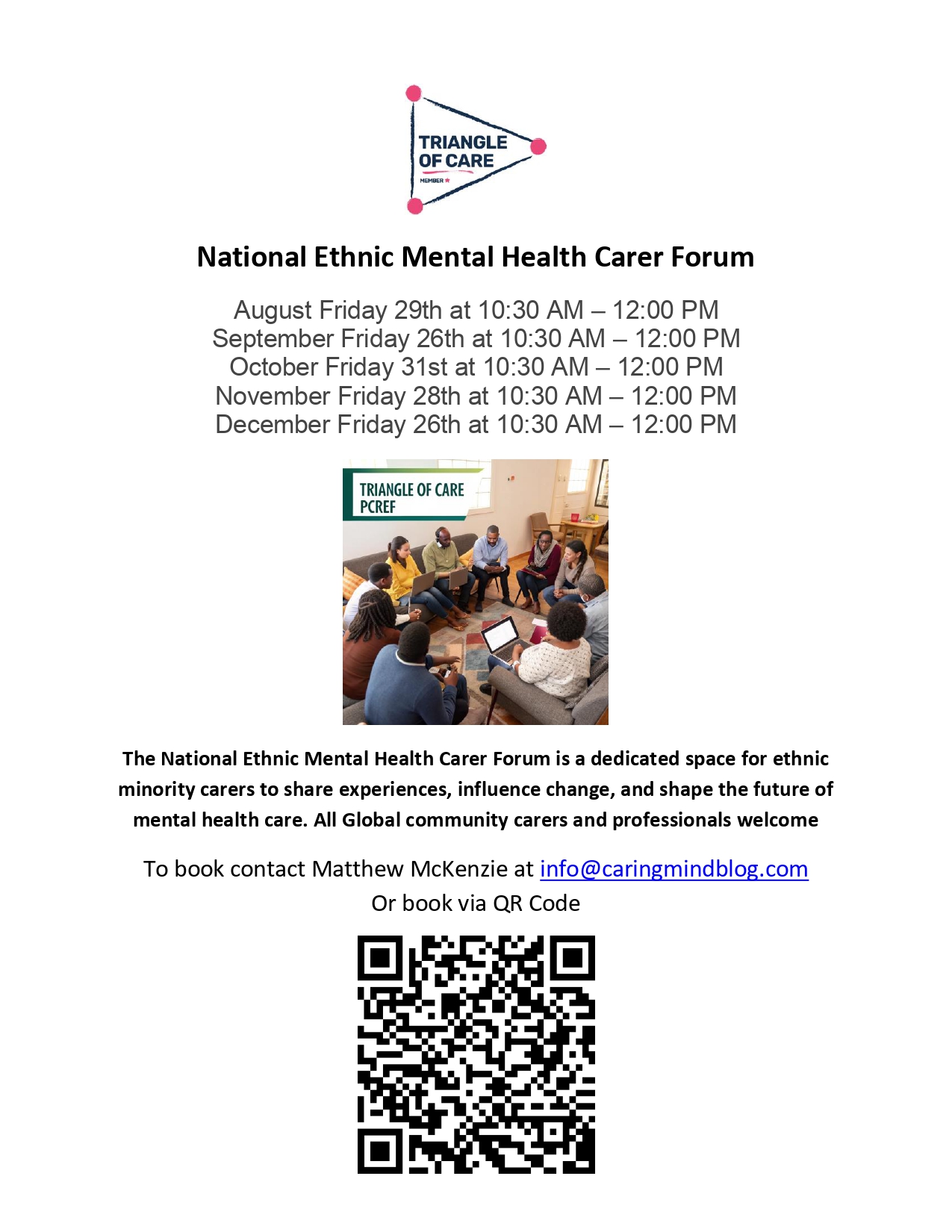
Caring for someone with mental illness? Check out our Ethnic carer forum. Dates shown below.
Ethnic mental health Carer Forum Update July 2025


Author: Matthew McKenzie

Building Stronger Voices: A Powerful July Gathering of the National Ethnic Mental Health Carer Forum

On Friday, July 25th, the National Ethnic Mental Health Carer Forum held another online session, continuing our work in empowering diverse carers and influencing meaningful change across mental health services. With participation from community champions, NHS professionals, experienced unpaid minority carers. The discussion was on the Triangle of Care (ToC) and PCREF (Patient Carer Race Equality Framework) stakeholders.

This forum exists to elevate the voices of ethnically diverse carers, bringing their lived experiences to the forefront of service transformation. Whether it’s holding systems to account or shaping policy guidance, this space remains vital in creating inclusive, anti-racist care across the UK.

Highlights from July’s Forum

🔵 Debbie Hustings’ Presentation on Triangle of Care & PCREF Integration
Debbie, a long-standing Triangle of Care Programme Lead and carer herself, gave an in-depth presentation on reviewing the Triangle of Care through a PCREF (Patient and Carer Race Equality Framework) lens. Her talk provided an honest look at institutional challenges and offered solutions for embedding racial equity into carer support standards. A key takeaway was how crucial lived experience is in driving real policy change not just warm words. She emphasized the importance of re-examining existing standards through a racial equity lens, stating that “beyond warm words,” carers need frameworks that are operational, measurable, and locally adaptable.

🟣 Powerful Feedback from Carers
Contributors shared difficult yet necessary truths. Carers spoke about the lack of involvement in care planning, systemic racism, the need for meaningful co-production (not “faux-production”), and experiences of isolation when navigating majority environments. One carer reflected, “In 28 years of caring for my son, I have never been involved in his care planning.”

Several carers shared their painful, sometimes shocking, experiences navigating mental health services, especially in areas with limited diversity. One participant remarked, “Even after decades of caring, I’ve never been included in a care plan.” Others spoke of staff who misunderstood or dismissed cultural nuances, the misuse of confidentiality rules to exclude carers, and the silencing of Black and Asian voices. Concerns were also raised about immigration-related fears, lack of access for non-English speakers, and a troubling rise in racism in predominantly white areas. These reflections painted a vivid picture of systemic inequality but also made clear the power of collective advocacywhen carers come together, change begins.

These testimonies highlighted how far we still need to go.

🟡 Inclusive Language & Representation
There was a passionate discussion around terminology whether to use “global majority” or “ethnically and racially diverse.” While some feared backlash from certain communities, the group leaned toward inclusivity and accountability over appeasement. This sensitivity around language underlines the forum’s thoughtful and intersectional approach.

🟢 The Work Ahead
Debbie shared the next steps in developing Standard 2 of the Triangle of Care through the PCREF lens: staff training. The goal? Mandatory, culturally safe, anti-racist care awareness education co-produced with carers from diverse backgrounds. By April 2026, the guidance will be finalized, field-tested, and launched nationally.


A Forum of Global Carers, Local Action

This month’s session proved again that our forum is more than discussion as it’s a driving force for equity. Participants from Southampton, Lewisham, Pennine, Norfolk, Leicester, South West London, Kent & Medway and beyond all shared insights into their local efforts, including cultural awareness training, community storytelling projects, and carer-led involvement initiatives.

One key message? Change is possible when carers are part of the conversation—not as guests, but as co-leaders.


Want to Get Involved?

The forum is open to carers and professionals across the UK and beyond. We meet monthly online, and everyone is welcome to join, contribute, or simply listen.

For bookings or questions, contact me at info@caringmindblog.com
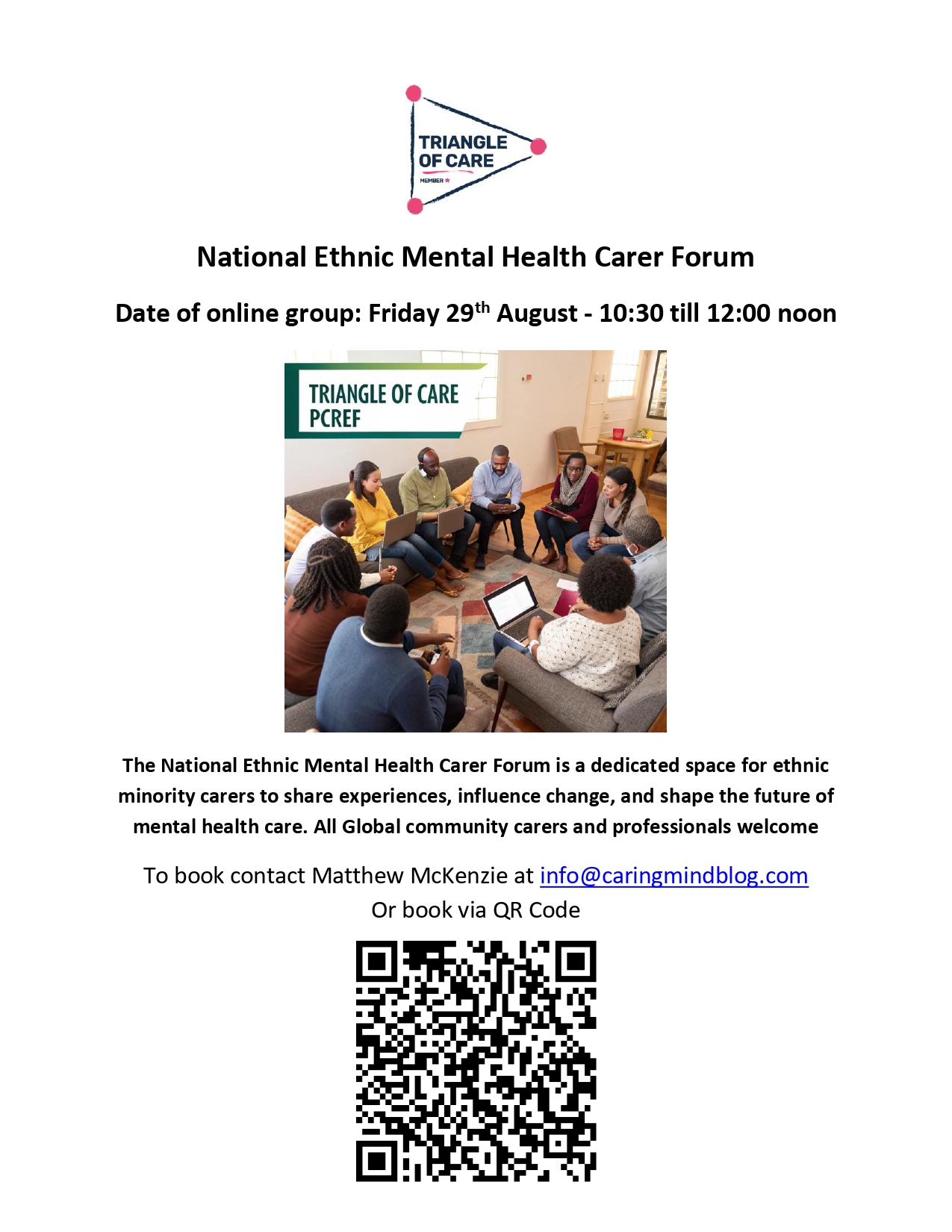
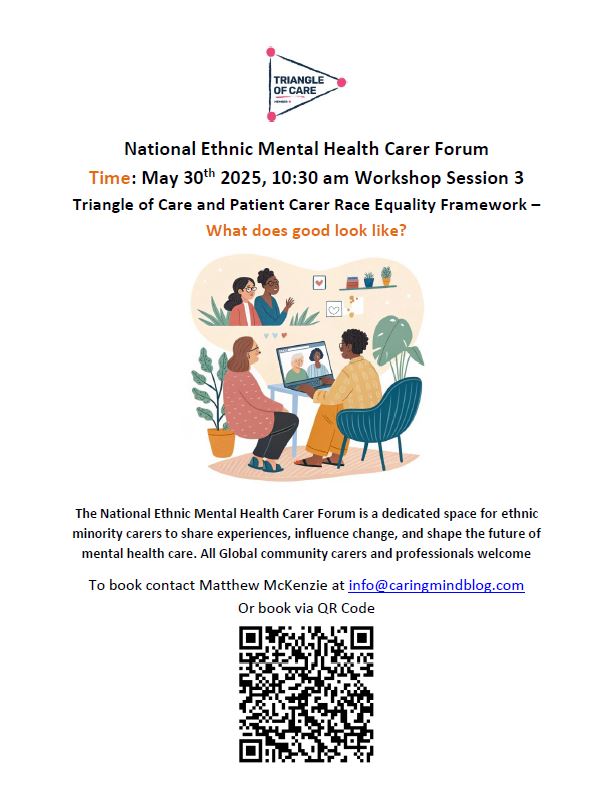
📱 Or download and scan the QR code in the flyer above

Together, minority mental health carers can shape a mental health system that sees, hears, and supports all carers—ethnically, culturally, and fully.

Next National MH carer forum in August 29th 10:30 am
Matthew McKenzie
Founder – Caring Mind Blog
Facilitator – National Ethnic Mental Health Carer Forum


Ethnic mental health Carer Forum Update June 2025

By Matthew McKenzie – Carer activist, poet and author

Welcome to a brief update of my ethnic mental health carer group, held monthly.

The meeting began with introductions and technical discussions on connecting to zoom, followed by presentations on research related to mental health care and carer support, particularly focusing on minority communities and paranoia. The group discussed various initiatives including a community intervention study, a carer experience questionnaire, and progress updates on Patient Carer Race Equality Framework reporting across different NHS regions. The conversation ended with discussions on challenges faced by minority carers, including access to mental health services and the need for better support systems, with calls for national collaboration and improved respite services.

Summary

Carer Support Network Expansion Discussion

The meeting began with Matthew introducing the session and addressing technical issues faced by some participants, including a participants video problems, which were resolved. Matthew explained his recent laptop issues and mentioned his involvement with Carers Trust regarding Triangle of Care. The group discussed the expansion of their focus with minority carers and the importance of connecting and networking across the UK. Juliana, a researcher, provided an overview of her work, and participants introduced themselves, sharing their roles and experiences related to mental health care and carer support. The conversation ended with a brief overview of upcoming presentations and discussions.

Continue reading

Ethnic mental health Carer Forum Update May 2025

Quick update on ethnic mental health carer group

The meeting focused on carer involvement and representation across different regions, with participants discussing their roles in supporting carers and addressing discrimination. The main focus for this meeting was on “What does good look like?” when it comes to Triangle of Care and PCREF.

The group explored the Triangle of Care initiative and its five key elements, including discussions about medication-related challenges and the need for better communication between healthcare providers and carers. The conversation ended with conversations about improving carer support systems, including the importance of advocacy, training, and creating safe spaces for carers to share concerns confidentially.

Continue reading

National Triangle of Care Community meeting – March 2025

By Triangle of Care community chair Matthew McKenzie FRSA BEM

For the month of March, unpaid carers, NHS professionals, and key stakeholders came together for another Triangle of Care National Community Meeting, which is a powerful space of collaboration, reflection, and shared purpose. Chaired by Matthew, the meeting spotlighted significant developments in carer engagement, mental health service standards, and equity frameworks across the NHS.

Continue reading

Ethnic mental health Carer Forum Update February 2025

The National Ethnic Mental Health Carer Forum convened to discuss the ongoing challenges faced by minority carers in accessing mental health services. The meeting focused on strategies to improve cultural competence, equitable treatment, and accessibility within mental health care systems. A key topic was the Patient and Carer Race Equality Framework (PCREF), with organizations sharing their experiences and plans for implementation. Additionally, the discussion covered language barriers, education initiatives, and the role of co-production in fostering inclusive care.


Mental Health act research

Dr Judy, a researcher from the University of Bristol, discussed her ongoing project on the nearest relative provision in the Mental Health Act and the need for co-produced resources to support those in this role. She also mentioned the support from charitable organizations like Mind and Rethink.

Continue reading

Ethnic mental health Carer Forum Update January 2025

Welcome to a brief update of my ethnic mental health carers forum for January 2025.

Quick recap

The meeting focused on discussing the Patient Care Race Quality Framework (PCREF) and sharing experiences and ideas among participants. The importance of incorporating equity and inclusion into organizational operations, particularly in relation to patient care, was emphasized, along with the need for better community engagement and the importance of making Personalised Care Framework more meaningful and reflective of people’s lived experiences. The meeting also highlighted the importance of education in addressing and understanding bias in mental health care, and the need for culturally competent care.

Continue reading

Key NHS Staff for Implementing Patient Care Race Quality Framework

In this blog post, if you are involved at your local mental health NHS trust as a carer or patient. This blog will help you learn about the crucial roles of key staff in implementing the Patient Care Race Quality Framework in Mental Health Trusts.

From leadership to community engagement, discover how systematic changes can address racial disparities and promote accountability.

If you want to watch the video, this please click on the item below.

Mental health services play a crucial role in supporting individuals through challenging periods in their lives. However, despite their importance, these services have often fallen short when it comes to providing equitable care to individuals from minority backgrounds.

Continue reading

Ethnic mental health Carer Forum Update November 2024

Welcome to a brief update of my ethnic mental health carers forum. For this month we were joined by South West London & St George research team. The team from a training company introduced a cultural capability training program aimed at reducing race and ethnic disparities in mental health care, while Matthew presented a summary of various reports highlighting health inequalities faced by ethnic minorities in the UK. The Forum also discussed the importance of advocacy for carers, the challenges of engaging with diverse communities. A carer from South Yorkshire also discussed the potential for setting up a group to support black people in the area.

Cultural Competence Training for Trusts
The training company introduced a cultural capability training program they are developing for the South West London and St. George’s Mental Health Trust. The program is part of an ethnicity and mental health improvement project and aims to reduce race and ethnic disparities in mental health care. Representatives from the team also discussed their evidence review on cultural competence in mental health care and their use of a model of cultural competence. The training is expected to impact staff, carers, and patients by promoting culturally sensitive care plans and reducing inequalities. The team also discussed the potential to tailor the training for other trusts.

Addressing Health Inequalities and Disparities
Matthew presented a summary of various reports highlighting health inequalities and disparities faced by ethnic minorities in the UK. He emphasized the importance of these reports in supporting the Patient Care Race Equality Framework (PCRF) and other initiatives addressing health inequalities, discrimination, and racism. The reports, from organizations such as the NHS Race and Health Observatory, Public Health England, and the CQC, demonstrate that ethnic minorities face higher risks with certain health conditions, barriers to accessing services, and poorer health outcomes.

Matthew also mentioned the role of institutional racism, socioeconomic disparities, and cultural barriers in perpetuating these disparities. He concluded by emphasizing the need for systematic reforms to ensure equitable health outcomes for all.

Addressing Healthcare Disparities and Trauma
Laura from Cygnet HealthCare expressed her appreciation for Matthew’s ability to present information in an understandable and accessible manner, which she believes is not done enough. She also highlighted the importance of Matthew’s role in educating others and ensuring the right actions are taken. A carer member of the group then brought up a report from the Race Equality Foundation and Learning Disability England, which highlighted disparities in access to healthcare for ethnic minorities with learning disabilities. She shared her personal experience of a young person with a learning disability, autism, and mental health issues facing challenges during the COVID-19 pandemic. The group acknowledged the system-generated trauma faced by carers and the need for more awareness and action on these issues.

Mental Health and Learning Disability Event
In the meeting, A carer highlighted the upcoming mental health and learning disability listening event, which was previously cancelled due to lack of awareness. Others at the meeting expressed their support for the event and the importance of advocating for carers.

A representative from Surrey & Borders NHS trust who is the programme lead for carers and co-production, discussed the Trust’s co-production framework and their efforts to reach a diverse community for co-production opportunities. She also mentioned the Trust’s strategy to mirror the triangle of care. Matthew shared his experience at the Trust’s learning event and his plans to help promote the Trust’s work, particularly in relation to carer involvement.

Mental Health Event Postponement Concerns
A carer expressed surprise at the postponement of a mental health and learning disabilities listening event, which was initially scheduled for September. Another carer, who is relatively new to the Maudsley, had not been aware of the event’s postponement and was concerned about its lack of awareness. She had reached out to various individuals within the organization, including others, to discuss the event. Carers suggested that the carer should also speak to Zoe Reed or Shania, who are in charge of PCREF, to ensure the event’s success. The carer agreed to continue her efforts to promote the event and ensure its awareness.

Supporting Black Mental Health Groups
Carers discussed the potential for setting up a group to support black people in South Yorkshire, with Matthew suggesting that funding could be sought from the ICB and the charity associated with their NHS trust. A carer shared his experiences with a similar group in Peterborough, emphasizing the need for more conversation and less medication in mental health care for black people. A Carer, who is involved in setting up a group in Kent, shared her challenges due to the predominantly population in her area. Matthew also mentioned an upcoming event on the new Mental Health Act and its potential impact on carers. The team agreed to reconvene in January.