Race Equality Week 2026 and Black History Month 2026 (US) is at a time when conversations about inclusion feel more important and more urgent than ever.
I have created a short video to explore why this week matters, what this year’s theme #ChangeNeedsAllOfUs represents, and how each of us can play a role in building fairer workplaces and communities. Rather than focusing on awareness alone, the aim is to encourage honest reflection and meaningful action that lasts beyond a single week.
Recent events have reminded us why race equality cannot be taken for granted. Incidents circulating online including a widely criticised video that portrayed the Obamas using racist imagery highlight how harmful stereotypes and dehumanising narratives still appear in public discourse. Moments like this reinforce why challenging racism, promoting respectful representation, and standing up for equality remain essential.
Race equality is not about blame or division. It’s about recognising lived experiences, understanding that fairness is not the same as sameness, and ensuring everyone feels valued, respected, and safe.
Real change doesn’t happen because of one campaign or one voice. It happens when many people take small, consistent steps listening more closely, questioning assumptions, and choosing inclusion in everyday decisions.
Because progress must be driven by all of us doing something, not just the few.
Every year on 4 February, World Cancer Day brings people together to raise awareness, inspire action, and support everyone affected by cancer. This year’s theme, United By Unique, reminds us that every cancer experience is different yet no one should face it alone.
Behind many cancer journeys are unpaid caregivers. They are partners, friends, parents and family members who provide emotional support, organise appointments, manage daily routines, and help loved ones navigate some of life’s most difficult moments. Their contribution is invaluable, but too often it goes unseen.
To mark World Cancer Day 2026, I have created a short video highlighting the vital role of unpaid cancer caregivers and the importance of fair, person-centred care across the UK. The video also reflects key messages from Macmillan Cancer Support, including the urgent need to address inequalities in cancer care and ensure that everyone receives the support they need, when they need it most.
Also for World Cancer day 2026comes alongside the newly released National Cancer Plan for England, which outlines ambitions to improve early diagnosis, treatment and personalised support so more people can live well with and beyond cancer. You can read more about the Plan here: https://www.gov.uk/government/publications/national-cancer-plan-for-england
At least every 75 seconds, someone in the UK is diagnosed with cancer. In that moment, lives change not only for the person diagnosed, but also for those who step into caregiving roles. By recognising caregivers and amplifying their voices, we can help build a more compassionate and supportive future for everyone affected by cancer.
This World Cancer Day, we invite you to take a moment to reflect, learn, and share. By raising awareness and working together, we can support unpaid caregivers, challenge inequalities in care, and help create a future where no one feels lost or alone.
brief update By Matthew McKenzie – Chair of the National ethnic mental health carer forum
The January 2026 Ethnic Carer Forum brought together carers, people with lived experience, NHS trusts, community leaders, and national partners to reflect honestly on racial inequalities in health and social care, and to explore how systems can move from good intentions to real change.
The forum continues to act as a safe and challenging space for ethnically diverse and marginalised carers, including Black, Asian, Traveller, LGBTQ+ and other communities, to share experiences, influence policy, and hold organisations to account .
Opening the session, Matthew McKenzie (mental health carer and forum founder) reflected on long-standing inequalities faced by minority carers. He highlighted:
Persistent mistrust of mental health systems, rooted in lived experience and historical harm
Patchy engagement by services, despite strong national rhetoric
Power imbalances that leave carers feeling unheard or excluded
The forum was originally created simply to connect marginalised carers with one another. Today, it also plays a vital role in scrutinising national frameworks, such as the Patient and Carer Race Equality Framework (PCREF), and ensuring carers’ voices shape implementation rather than being added as an afterthought.
Community Voice and National Influence
Race and Health Observatory
Bren, a community volunteer and member of the NHS Race and Health Observatory stakeholder engagement group, shared insights into national efforts to address racial health inequalities.
The NHS Race and Health Observatory: Purpose and Limits
Turning to his national role, Bren explained that the NHS Race and Health Observatory was established in 2021 and funded by the NHS until at least 2027. Its purpose is to:
Examine racial inequalities affecting both communities and the NHS workforce
Operate independently, rather than as an internal NHS programme
Focus on solutions, not just reports and data
He outlined several key areas of current work:
Small Grants Pilot – supporting community-led initiatives, while acknowledging that funding levels are modest and only a starting point
Community Participation and Co-production Resource – aimed at helping organisations engage communities more meaningfully and consistently
Action Resource Platform – an emerging online space intended to bring together data, case studies, and learning in one place
However, Bren was clear that these initiatives are still evolving and must be continuously shaped by lived experience, not institutional convenience.
A Critical Question: Where Are Carers?
One of the most important moments in Bren’s update came when he openly questioned whether carers’ voices are adequately represented within national stakeholder structures including the Observatory itself.
He noted that while there is growing representation from professionals, young people, and community organisations, carers can easily be overlooked unless explicitly prioritised. Bren committed to:
Reviewing current stakeholder representation
Raising the absence of carer voices within the Observatory
Feeding back to the forum on what action is taken
This moment strongly aligned with the forum’s wider purpose: holding national bodies to account while remaining constructively engaged.
Listening as an Act of Power-Sharing
Throughout his update, Bren returned repeatedly to the theme of listening not as a soft skill, but as a deliberate act of power-sharing. He challenged NHS leaders and organisations to move beyond engagement that is performative or extractive.
He stressed that real accountability means:
Showing communities what has changed as a result of their input
Being honest when progress is slow or blocked
Measuring impact through people’s lived experience, not just organisational metrics
As Bren put it, communities do not just want to be consulted they want to see evidence that their voices matter.
Local NHS Action: Gloucestershire Health and Care NHS Foundation Trust
Gloucestershire Health and Care NHS Foundation Trust: Refreshing PCREF with Honesty and Challenge
The update from Gloucestershire Health and Care NHS Foundation Trust offered a candid and important snapshot of what it looks like when an NHS trust acknowledges where progress has stalled and begins the difficult work of rebuilding momentum around race equality and co-production.
Delivered by Ruth, who joined the Trust’s Quality Assurance Directorate in late 2024, the presentation focused on the reinvigoration of the Patient and Carer Race Equality Framework (PCREF) after a period where activity had slowed due to leadership changes and competing pressures.
A central part of the Trust’s renewed PCREF work was a recent Gloucestershire engagement event, which brought together NHS leaders, community members, carers, and national partners to openly explore race inequality, power, and accountability in mental health services.
The event included a powerful contribution from Matthew McKenzie, who presented on how carers should be important to PCREF and the long-term impact this has on trust between services and communities. His contribution was not framed as abstract theory, but rooted in lived experience as a mental health carer and long-standing advocate.
PCREF Matters in Gloucestershire
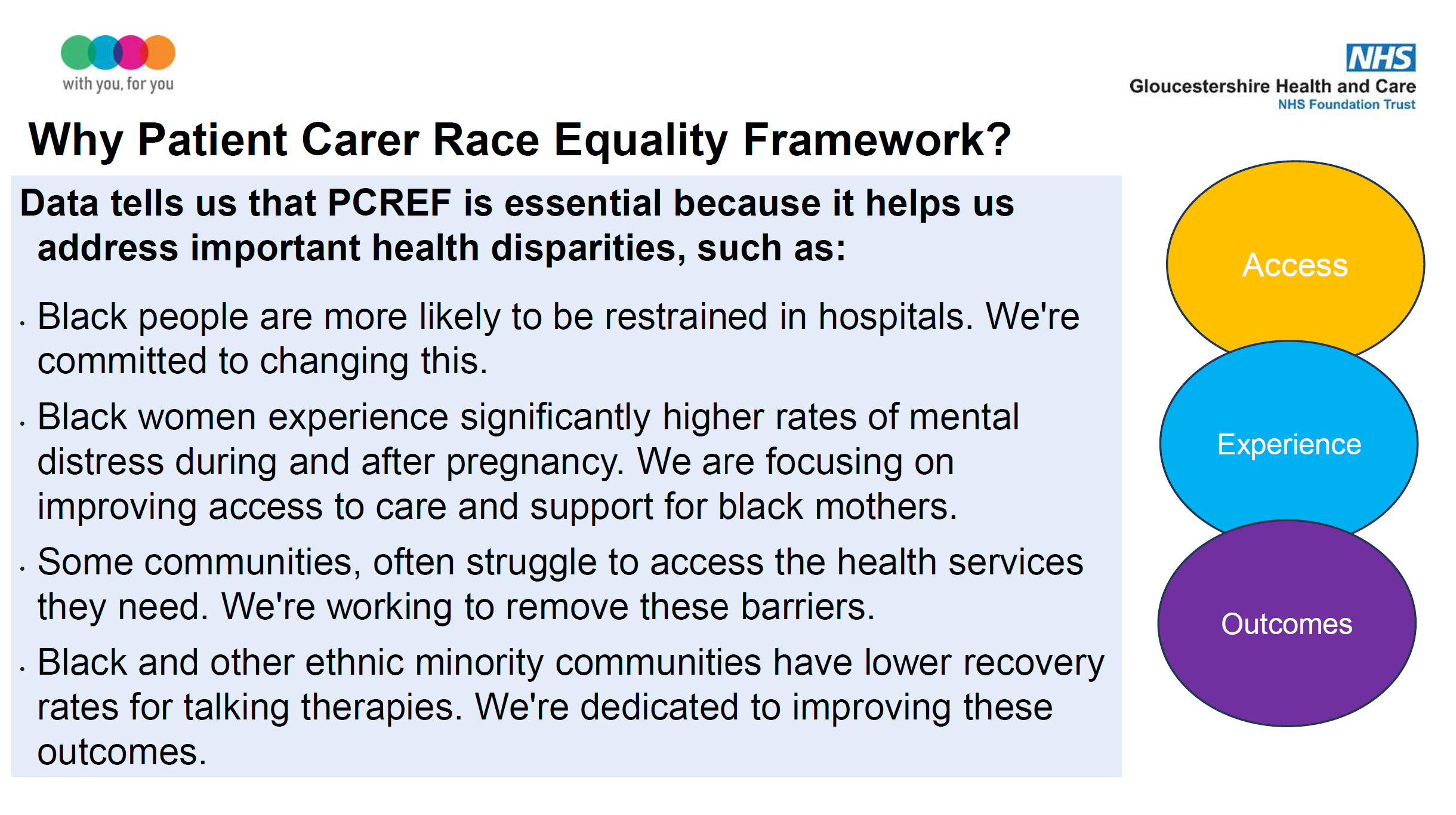
Ruth began by grounding the discussion in national and local evidence. Despite higher prevalence of mental health need, people from Black and ethnically diverse backgrounds continue to experience:
Lower access to mental health treatment
Poorer recovery rates from talking therapies
Higher likelihood of restrictive practices, including restraint
Greater mistrust of services, particularly among families and carers
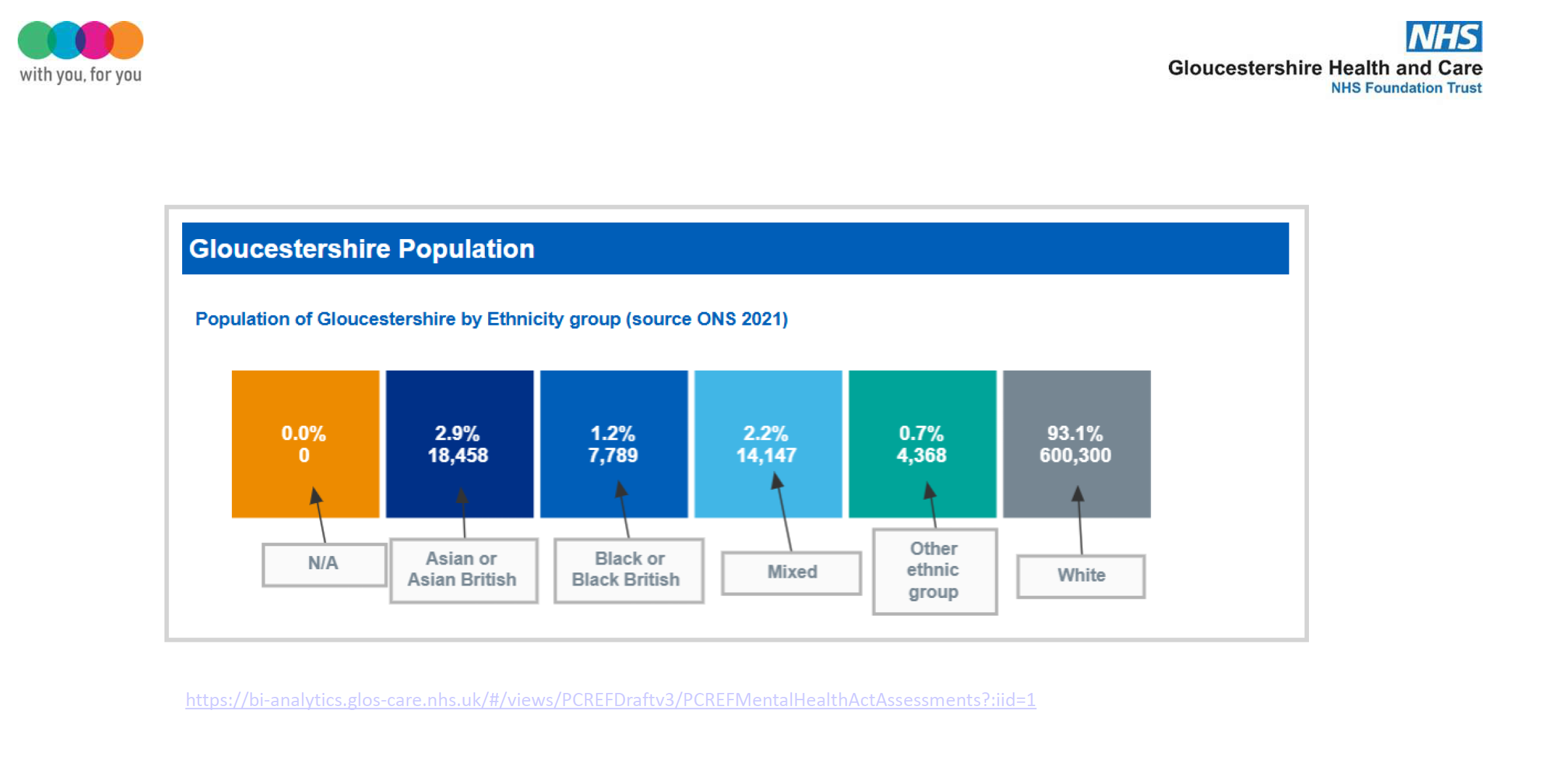
In Gloucestershire, these national patterns sit alongside a population that is predominantly white, which can make racial inequalities easier to overlook or minimise. Ruth was clear that small numbers do not reduce responsibility in fact, they increase the risk that minority experiences become invisible in data and decision-making..
Data: Necessary but Not Sufficient
Data featured heavily in the update and in the discussion that followed. The Trust is working to improve:
Ethnicity recording, including challenging the routine use of “not known”
Disaggregation of data on restrictive practices
Understanding access, experience, and outcomes across services
However, Ruth was clear that data alone does not tell the full story. She spoke about the need to “scratch beneath the surface” and combine quantitative data with lived experience, narrative, and community insight, particularly where numbers are small but impact is significant.
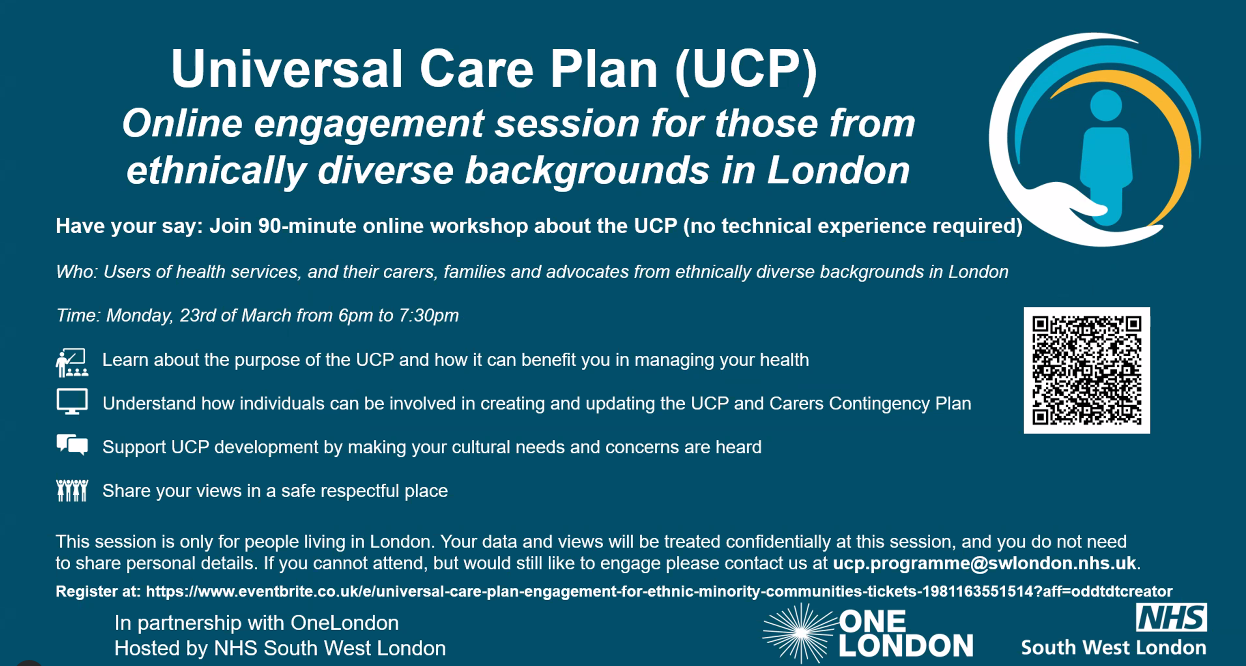
Universal Care Plan (London)
Universal Care Plan (UCP): Promise, Possibility and Carer Challenge
Hayley Blanchard introduced the Universal Care Plan (UCP), currently being rolled out across London as a shared digital record enabling people to document what matters most to them in health and care.
The session on the Universal Care Plan (UCP) was one of the most interactive, challenging, and emotionally charged discussions of the Ethnic Carer Forum. While the tool was presented as a positive step towards personalised and joined-up care, carers and community representatives were clear that digital innovation must not repeat old inequalities in a new format.
The update was delivered by Hayley, a community nurse by background and consultant supporting the UCP programme in London. Her presentation outlined the intention behind the tool but it was the questions from carers that shaped the real substance of the discussion.
What Is the Universal Care Plan?
The Universal Care Plan is a shared digital record, currently available across London, designed to bring together key information about a person’s health, care, and what matters to them all in one place.
Reduce the need for people to repeat their story to multiple professionals
Capture personal, cultural, and practical information alongside clinical needs
Support more joined-up decision-making across services
Improve coordination in urgent situations (e.g. ambulance or hospital admission)
It is intended for people of all ages and conditions, including those with mental health needs, long-term conditions, and caring responsibilities.
Why the UCP Was Brought to the Forum
Hayley explained that the UCP team is running targeted engagement with ethnically diverse communities, recognising that digital tools often fail those who already experience exclusion, mistrust, or barriers to access.
Below You can book for the event to submit your views, its Free to book.
Scrutinise the UCP from a carer and lived-experience perspective
Identify cultural, ethical, and safeguarding concerns early
Influence how the tool develops, rather than responding once it is fully embedded
This framing was welcomed but it did not shield the UCP from robust challenging questions shown below.
1. “Who was this tool designed for clinicians or communities?”
Several carers questioned whether the UCP had been designed primarily from a medical lens, rather than co-produced with people who use services and those who care for them.
2. “Where is co-production and when does it actually start?”
Carers asked whether engagement was happening after development, rather than alongside it.
Key concerns included:
Whether carers and service users had shaped the structure, language, and assumptions of the UCP
Whether feedback would lead to real changes, or simply be “noted”
How communities would know what had changed as a result of their input
3. “What about people who don’t have insight?”
One of the most important safeguarding questions came from carers supporting people with serious mental illness or fluctuating capacity.
Carers asked:
What happens if someone records decisions that do not reflect their best interests during periods of poor insight?
How are carers expected to raise concerns if they cannot view or edit the care plan?
What safeguards exist to prevent harm when information is inaccurate or incomplete?
5. “Who sees this information and where does it go?”
Trust and data sharing were major concerns, particularly for communities with a history of surveillance, discrimination, or misuse of information.
Carers asked directly:
Which professionals can access the UCP?
Can information be shared beyond the NHS?
How is consent managed and reviewed over time?
For some participants, uncertainty around data use undermined confidence in the tool, even if its intentions were positive.
West London NHS Trust: PCREF in Practice
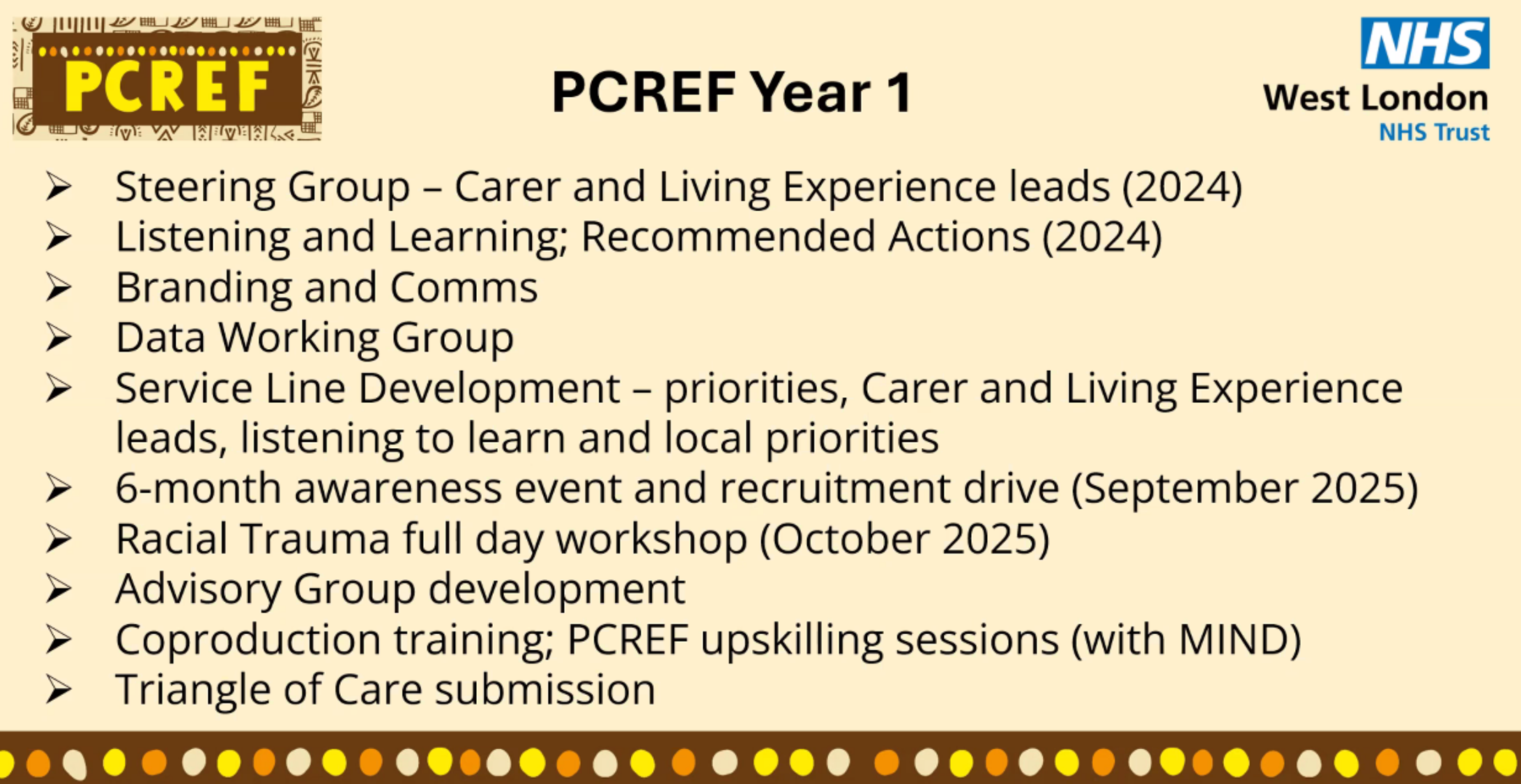
The update from West London NHS Trust offered one of the most honest and grounded reflections of the day on what it actually takes to implement the Patient and Carer Race Equality Framework (PCREF) in a large, complex mental health organisation.
Presented jointly by Linda and pcref carer lead, the update stood out because it did not present PCREF as a finished product. Instead, it described PCREF as ongoing, difficult work, shaped by challenge, learning, and persistence — particularly from carers and people with lived experience.
Building PCREF With Carers and Lived Experience From the Start
Linda explained that West London’s PCREF journey began before her arrival at the Trust, with an intentional decision to embed carers and people with lived experience at leadership level, not just in consultation roles.
From the outset, the Trust established:
A PCREF steering group with a dedicated carer lead (Debbie)
A lived experience lead, ensuring parity of voice
A commitment to co-produce priorities, not simply validate pre-written plans
This early structural choice shaped everything that followed — particularly the Trust’s willingness to sit with discomfort and challenge.
Listening to Learn: Turning Experience Into Action
Throughout 2024, the Trust undertook extensive “listening to learn” work across services. These sessions gathered feedback from carers, patients, and communities about their experiences of mental health care, racism, and exclusion.
Rather than treating this feedback as anecdotal, West London used it to co-produce:
A PCREF action plan
Identified priorities for change
A shared understanding of where harm was occurring — not just where policy said it shouldn’t
This process also highlighted how often data already existed, but had not been meaningfully used or shared.
Data: Knowing the Problem Is Not the Same as Acting on It
West London were open about one of the Trust’s biggest challenges: data transparency and usability.
They acknowledged that:
The Trust knows Black, African Caribbean and South Asian communities have poorer outcomes and higher drop-out rates, particularly in talking therapies
Despite this, creating a clear, accessible PCREF dashboard has been slow and frustrating
Without visible data, communities cannot effectively hold the Trust to account
This honesty resonated strongly with carers, many of whom noted that “knowing the data exists” is not the same as being able to see or use it.
Racial Trauma: Naming the History Behind Mistrust
One of the most powerful elements of the West London update came from the PCREF carer lead account of the racial trauma workshops, which she co-designed and delivered with Linda and colleagues.
These sessions did not begin with policy or frameworks. Instead, they began with history acknowledging the deep roots of mistrust in health systems.
Debbie described how the workshops explored:
The legacy of slavery and colonial medicine
Unethical medical experiments on Black and South Asian communities
How generational trauma shapes present-day interactions with services
Examples such as the Tuskegee experiments and other lesser-known abuses were used not to shock, but to contextualise fear, resistance, and disengagement often labelled as “non-compliance”.
Planning Meaningful Speaker Engagement for 2026
Matthew McKenzie on Shaping the Ethnic Carer Forum Programme
As part of planning for the Ethnic Carer Forum in 2026, Matthew McKenzie presented a structured proposal focused on how speakers and themes should be selected, and why this matters for ethnic minority carers
Matthew explained that the forum’s strength lies in its ability to bring together carers, lived experience voices, community organisations, and systems leaders in a way that feels meaningful rather than tokenistic.
Key Themes Proposed for 2026
Matthew’s presentation outlined 15 proposed themes for the year to invite speakers to the forum for engagement, each linked to clear reasons why they matter to ethnic minority carers. These include:
Racism and mental health beyond surface-level conversations
PCREF in practice, focusing on what has actually changed for carers
Regulation, inspection, and accountability, including complaints processes
Police involvement, crisis response, and Section 136
Black mental health and carer experience
South Asian, Muslim and faith-context carers
Older adults and intergenerational trauma
Children, young people, and parent carers
Carers, poverty, and the benefits system
Immigration status, NRPF, and mental health
Co-production: when it works and when it doesn’t
Workforce racism and its impact on carers
Alternatives to crisis and coercive care
Complaints, justice, and redress
Examples of “what good looks like” — models that have delivered real change
As one participant reflected: “If people can’t see the change, they won’t believe it’s happening
I chaired this meeting to bring together carers’ organisations, hospital representatives, commissioners, and system partners to share updates on how unpaid carers are being identified, supported, and involved in acute hospital settings. While hospital discharge was a central theme, I emphasised that meaningful carer involvement must begin at admission and continue throughout a person’s hospital journey and transition back into the community.
Representative, North Central London Carers Project
Representative, Local Authority Commissioning
Representative, Hospital Patient Experience Lead
(Apologies were received from additional ICB and system partners.)
Unpaid Carer / Healthwatch Representative
The unpaid carer representative shared lived experience insights highlighting that carers are still inconsistently identified across primary care and hospital settings. While there are pilots, policies and system intentions in place, carers frequently report feeling excluded from discussions about care and discharge planning.
They described how carers often struggle to obtain timely and accurate information, particularly during periods of crisis. Many carers are left unsure who to contact within hospitals, and communication is often fragmented or reactive rather than planned.
The representative also noted that progress frequently depends on individual staff champions rather than embedded systems. Without consistent hospital-based carer support, carers are left to advocate for themselves at times when they are already under significant emotional strain.
Lambeth Carers Hub
Lambeth Carers Hub provided a detailed update on their hospital-based carers support service operating across King’s College Hospital and Guy’s & St Thomas’. Their work focuses on identifying unpaid carers early, offering emotional and practical support, and ensuring carers are meaningfully involved in discharge planning and decision-making. Key activities include ward rounds, attendance at discharge and multidisciplinary meetings, safeguarding support, advocacy, and referrals into adult social care and community-based services.
They emphasised that having a consistent physical presence within hospitals has been critical to building trust with both carers and clinical staff. This approach has led to increased referrals, earlier engagement with carers, and improved communication between carers and hospital teams. The Hub also delivers carers awareness training to hospital staff, helping professionals better understand carers’ rights and roles, and creating internal champions within teams.
Despite strong outcomes, ICB working with Lambeth carers hub raised serious concerns about sustainability. Current funding for the hospital-based service is due to end in March, with no guarantee of continuation. They stressed that losing this service would represent a significant step backwards for carer involvement in hospitals, particularly given the clear evidence that early identification and support reduce carer stress and improve discharge outcomes.
Richmond Carers Centre
The Richmond Carers Centre representative explained that their service currently operates in a largely reactive capacity, with referrals typically received at or near the point of discharge. Support includes emotional support, carers’ rights workshops, dementia-focused information sessions, carers assessments and financial guidance.
They noted that carers often approach the service feeling overwhelmed following discharge, having had limited involvement in planning while their loved one was in hospital. This can increase pressure on carers once the person returns home.
The representative acknowledged that the absence of a regular hospital presence limits early engagement with carers. Opportunities were identified to strengthen strategic links with the Integrated Care Board and learn from boroughs where hospital-based models are already established.
Greenwich Carers Centre
The Greenwich Carers Centre representative reported that while carers often experience poor communication from hospital staff and feel excluded from discharge planning, the Centre plays a key role in supporting carers through these challenges. Many carers approach Greenwich Carers feeling anxious or overwhelmed after receiving late or unclear information about discharge, and the service works quickly to help them understand their rights and options.
As a small organisation without a permanent hospital presence, Greenwich Carers is frequently brought in once situations have already escalated. Despite this, the team provides strong advocacy and practical support, including contacting hospital staff on carers’ behalf, helping carers articulate concerns, and ensuring their voices are heard wherever possible.
The representative also highlighted the Centre’s commitment to empowering carers by supporting them to prepare questions, understand processes, and engage more confidently with professionals. While acknowledging that carers should not have to carry this burden alone, Greenwich Carers continues to offer reassurance, guidance and emotional support at some of the most stressful points in a carer’s journey.
Greenwich Council – Commissioning
The Greenwich commissioning representative provided a detailed update on current and planned work to review and re-commission carers support services, with contracts due to end in 2027. A central aim of this work is to gain a much clearer understanding of carers’ lived experiences across the whole system, including primary care, hospitals, discharge pathways and support once people return home. Hospital engagement and discharge were identified as critical pressure points for carers and a priority area for learning.
The representative emphasised that carers’ voices must shape future commissioning decisions, not just through surveys but via direct engagement with carers in existing groups, forums, workshops and one-to-one conversations. There was a clear call-out to partners to help identify opportunities to meet carers where they already are, including within community groups, peer support spaces and carers organisations. This engagement will help commissioners understand what is and is not working, and where carers experience the greatest barriers.
An update was also provided on work relating to the hospital discharge standard operating procedure developed across South East London. While Greenwich did not take part in earlier pilots, the commissioning team is now exploring how this resource can be implemented locally in a way that is meaningful and realistic within busy acute settings. This includes building on existing initiatives, such as carers charters and specialist nursing roles, and avoiding approaches that become tokenistic or are not properly embedded.
The representative acknowledged the challenges of engaging hospitals at pace, particularly given operational pressures, workforce constraints and wider system reform. However, they stressed that commissioning has a key role in creating the conditions for improvement by setting clear expectations, supporting partnership working, and ensuring carers are explicitly considered in pathways and service design rather than treated as an afterthought.
Harrow Carers
The Harrow Carers representative shared the impact of losing funding for a dedicated hospital carer support role. When the role existed, there had been strong engagement with discharge teams and improved staff awareness of carers’ rights and needs. Since the funding ended, there is no longer a consistent carer presence within the hospital. This has resulted in reduced engagement with carers and fewer opportunities to influence discharge planning.
The representative stressed that carers value continuity of support from hospital into the community. Without hospital-based roles, carers often experience a sudden and unsupported transition once their loved one is discharged.
Camden Carers
The Camden Carers representative confirmed there is currently no dedicated hospital engagement or discharge support service due to funding constraints. Previous hospital awareness work had to stop, limiting opportunities to identify carers early.
Camden Carers now focuses on community-based support, including carers assessments, information and advice, counselling, employment support and wellbeing services. These services remain well-used and valued by carers.
Attending the meeting was described as helpful for learning about hospital-based models in other boroughs. The representative expressed interest in exploring whether similar approaches could be developed in the future if funding allows.
Imago Carers Services
Imago provided a detailed update on their work supporting unpaid carers across multiple boroughs, with a strong focus on hospital navigation and safe discharge. They currently deliver carers services in Lewisham and the City of London, and are expanding work in other areas, including Havering. In the City of London, Imago works closely with adult social care and hospital discharge teams across several acute trusts, supporting carers whose loved ones are admitted outside their home borough.
A key strength of Imago’s model is their close operational relationship with hospital discharge teams, which allows carers to be identified earlier and supported more consistently through the transition from hospital to home. This includes practical guidance, emotional support, referrals for carers assessments, and rapid follow-up once someone is discharged. Imago highlighted that where they are embedded in discharge pathways, carers experience fewer delays, clearer communication and improved continuity of support into the community.
Imago also reflected on ongoing challenges, particularly that carers are still too often signposted rather than formally referred by hospitals. They are working with commissioners and hospital partners to address this by improving referral processes and developing clearer information for professionals. This includes new resources aimed at hospitals and GP surgeries, focused on carers’ rights, identification, and support within the health system. While progress is being made, Imago stressed that sustainable funding and system-wide commitment are essential to move beyond short-term pilots and ensure carers are consistently recognised as key partners in care.
North Central London Carers Project
The North Central London Carers Project representative provided an update on work taking place across Barnet, Camden, Enfield, Haringey and Islington. The project focuses on improving referral pathways from hospitals and health services into local carers organisations, particularly where staff are unsure which carers service covers which borough.
They described the development of a single referral route designed to make it easier for hospital professionals to connect carers with the correct local support quickly and accurately. This work is intended to address one of the most common barriers carers face: delays and confusion caused by fragmented systems across borough boundaries.
The representative acknowledged that progress is being made in a very challenging environment, with significant pressures on NHS and local authority partners. However, there have been positive developments, including growing engagement from patient experience teams and plans to showcase collaborative work with NHS colleagues at London-wide events, demonstrating that sustained partnership working can lead to meaningful change for carers. This work involves close engagement with hospitals across North Central London, including the Royal Free London Trust (covering sites such as Royal Free Hospital, Whittington Hospital and Barnet Hospital), to strengthen referral pathways and improve carers’ access to local support.
Hospital Patient Experience Representative
The hospital patient experience representative from George’s, Epsom and St Helier Hospitals (GESH) provided a detailed update on progress within their trust to improve identification and support for unpaid carers. This includes the co-production of a carers charter, developed directly with carers, setting out clear expectations for how carers should be recognised and supported.
They outlined the development of a carers policy and standard operating procedures, alongside staff training and e-learning. Carer identification and recording are being embedded into routine hospital audits, helping ensure carers are consistently recognised across services.
Further work includes carer surveys, dedicated carer forums, information boards, and plans to link carer identification to accreditation processes. This approach is intended to move carer involvement into business-as-usual practice and reduce reliance on individual champions alone.
Events and Shared Information
During the meeting, there was shared information about upcoming London-wide events focused on unpaid carers, particularly those aimed at influencing system change and strengthening collaboration between carers organisations and NHS partners. An upcoming Caring Across London event organised through Carers Trust was highlighted as an important opportunity to showcase good practice, hear directly from carers organisations and NHS colleagues, and raise issues around hospital engagement and discharge at a strategic level. Several attendees confirmed they would be attending or were interested in receiving further details.
It was also noted that colleagues from North Central London will be presenting jointly with NHS patient experience representatives at a London-wide carers event, demonstrating collaborative working between carers organisations and hospital trusts. This was shared as a positive example of how partnership approaches can influence wider system thinking and raise the profile of carers within acute settings.
In addition, links and information were shared relating to carers charters, standard operating procedures, hospital discharge toolkits, and evidence submitted to London-level discussions on unpaid carers. I encouraged attendees to review and share these resources within their own organisations and networks, as they provide practical examples that can be adapted locally. I also confirmed that I am happy to circulate any event details, articles or resources discussed so that those unable to attend meetings or events can remain informed and connected.
Adult and Young Carers Charter (GESH – George’s, Epsom & St Helier Hospitals) (Shared in the meeting by the hospital patient experience representative) 📄 Adult-and-Young-Carers-Charter-2025.pdf
If you’re an unpaid carer in Southwark, chances are you’re used to putting everyone else first. You support a loved one day in, day out, emotionally, practically, often invisibly. And too often, decisions about “support” for carers are made without carers truly being heard.
Southwark Council is developing its Unpaid Carers Strategy, and they are inviting unpaid carers to take part in upcoming focus groups to share real experiences, which are your lived reality.
As an unpaid carer myself, I know how rare and valuable this opportunity is.
Why having your say is important because
Policies and strategies shape:
What support is available
How easy (or hard) it is to access help
Whether carers feel recognised, supported, and understood
When carers don’t speak up, systems are built around us, not with us. When we do speak up, its a chance to make change becomes possible.
This isn’t about complaining. It’s about being honest: what works, what doesn’t, and what would genuinely make life easier for carers in Southwark.
Your voice could help shape:
Better access to information and services
More flexible, carer-friendly support
A strategy that reflects the real pressures carers face
A safe, non-judgemental space
One of the most important things about these focus groups is that they are designed to be:
Non-judgemental
Inclusive
Open to carers with any level of responsibility
You don’t need to have all the answers. You don’t need to be an “expert”. You just need your experience.
Whether you care full-time, part-time, occasionally, or don’t even label yourself as a “carer” your perspective still counts.
Focus group dates and details
In-person focus groups 📅 24th February ⏰ 11am – 1pmand2pm – 4pm 📍 Harriet Hardy Community Centre Harriet-Hardy Building, Aylesbury Estate, Albany Road, Walworth SE5 0AH
Online focus group 📅 25th February ⏰ 7pm 💻 Virtual session via Microsoft Teams
How to get involved
You can:
Scan the QR code on the flyer shown above my blog to register your interest
By Matthew McKenzie, A Caring Mind (Carers UK Ambassador)
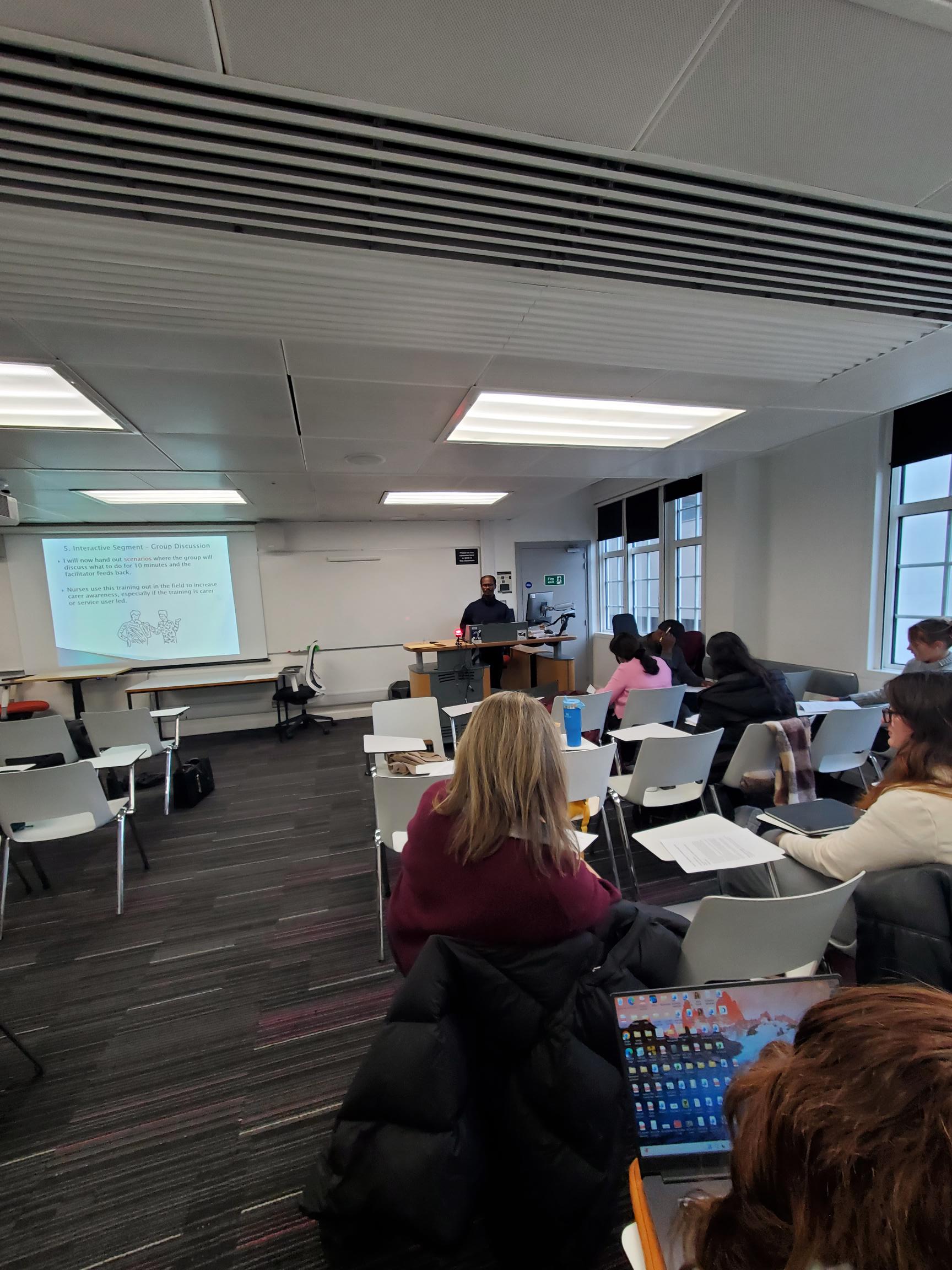
As an unpaid mental health carer, I have spent years navigating hospital corridors, GP practices, care plans, juggling crises, and long silences where carers are too often left out. I am sure unpaid carers are expected to hold families together, while notice early warning signs, and keep loved ones safe. Still I always mention most of us receive no formal training, and our knowledge is rarely recognised as expertise.
That is why recently teaching a module for the Masters course to mental health nursing students at King’s College London felt so important. Not after they qualify. Not once they are overwhelmed in practice. But before they step out into the field. The session took place 15th of January.
Why carer-led teaching matters
Unpaid carers sit at the sharp edge of the mental health system. We see what works, what harms, and what gets missed when professionals don’t fully understand the family context. When students hear directly from carers, learning moves beyond textbooks into real life into the emotional, practical, and ethical realities of care.
Training mental health professionals without carer voices is like teaching navigation without a map.
What I taught: lived experience as learning
The session I delivered was built entirely from a carer’s perspective and centred on one core message: you cannot deliver effective mental health care without working with carers.
The module covered:
My lived experience as an unpaid mental health carer How I became a carer, the emotional impact, the daily responsibilities, and the toll caring can take on mental and physical health.
The hidden impact on carers Burnout, stigma, isolation, guilt, and the reality that many carers are supporting professionals while receiving little support themselves.
Carers as partners, not problems Exploring what happens when carers are ignored – and how outcomes improve when they are listened to, informed, and included.
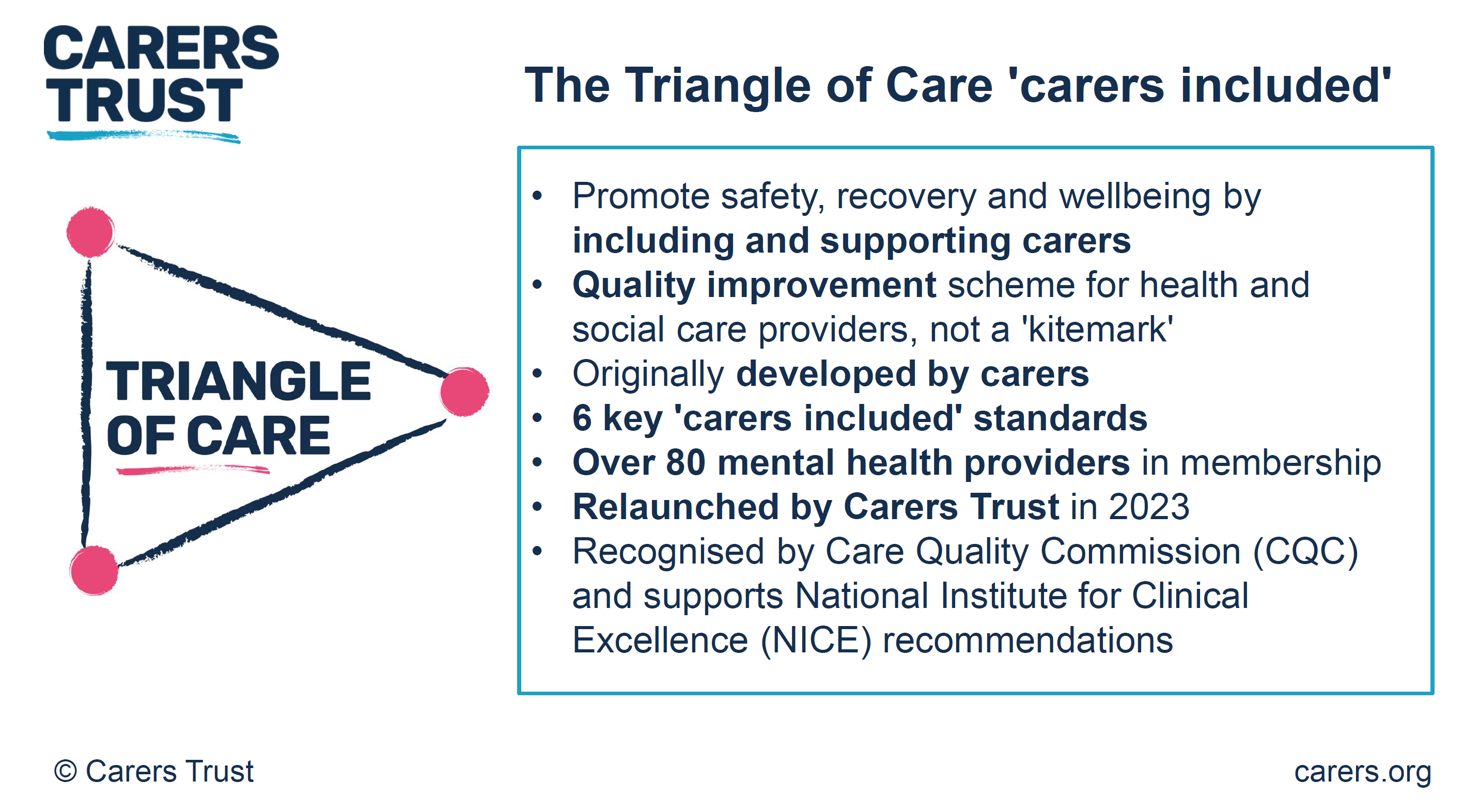
The Triangle of Care A strong emphasis on the Triangle of Care framework: the partnership between service user, carer, and professional. I challenged students to see carers as a vital link in the chain, not an optional extra.
Carers UK and carer identification Highlighting the role of Carers UK in advocacy, rights, resources, and why professionals must help carers identify themselves early so they can access support.
Practical skills for future nurses Listening without defensiveness, sharing information appropriately, involving carers in care planning, and understanding when carers need support themselves.
Interactive discussion and reflection Students worked through real-life scenarios, asking: What would I do differently now that I understand the carer experience?
The shift we need in education
Most unpaid carers are not trained for their role. We learn through crisis, exhaustion, and trial and error. Mental health professionals, however, are trained, which means universities have a responsibility to ensure that training includes those of us living this reality every day.
Carer-led teaching builds empathy, improves communication, and ultimately leads to safer, more effective care. When students learn early that carers matter, they carry that mindset into practice.
A final thought
Unpaid carers are already part of the mental health workforce, it’s just the title unpaid, unsupported, and often unheard. So I feel bringing carers into universities is not a “nice extra”. It is absolutely essential.
If we want a mental health system that truly works, we must start by listening to those who never clock off.
By Matthew McKenzie – Triangle of Care Community Chair.
The meeting opened with a welcome to carers, professionals, and partner organisations, reinforcing the importance of the Community Group as a collaborative and inclusive space. The Chair highlighted the ongoing commitment to co-production, ensuring that lived experience remains central to all Triangle of Care development and decision-making.
The purpose of the meeting was outlined, with emphasis on shared learning, constructive challenge, and influencing national work. Members were reminded that discussions within the group directly inform improvements to Triangle of Care standards, guidance, and implementation across services.
2. Triangle of Care Update (with Q&A)
Mary Patel – Carers Trust
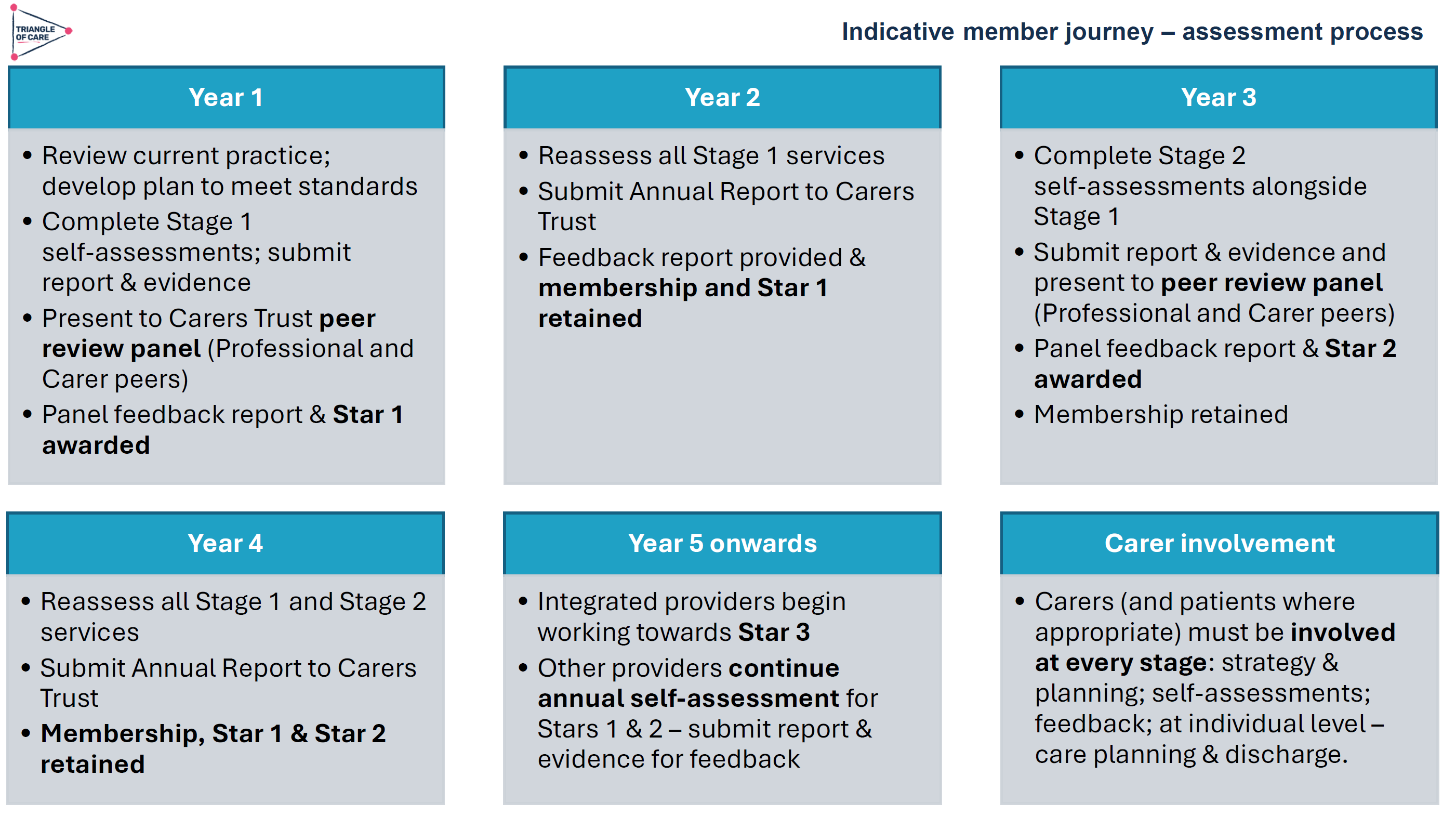
The Triangle of Care update focused on how the programme continues to evolve as a learning-led, improvement-focused framework rather than a compliance or inspection tool. Members were reminded that the Triangle of Care is designed to support services to reflect honestly on how well carers are recognised, involved, and supported, and to identify practical actions for improvement.
The update highlighted the growing maturity of the self-assessment and peer review process. Increasingly, organisations are using the framework not only to evidence good practice but to challenge themselves, learn from others, and embed carer partnership more consistently across teams and pathways.
Self-Assessment and Peer Review: What’s Working Well
The self-assessment process continues to be a key entry point for organisations engaging with the Triangle of Care. Where we were updated on how self-assessment encourages teams to pause and reflect on everyday practice, policies, and culture, rather than relying solely on written procedures. When combined with peer review, this reflection is strengthened by external challenge and lived-experience insight.
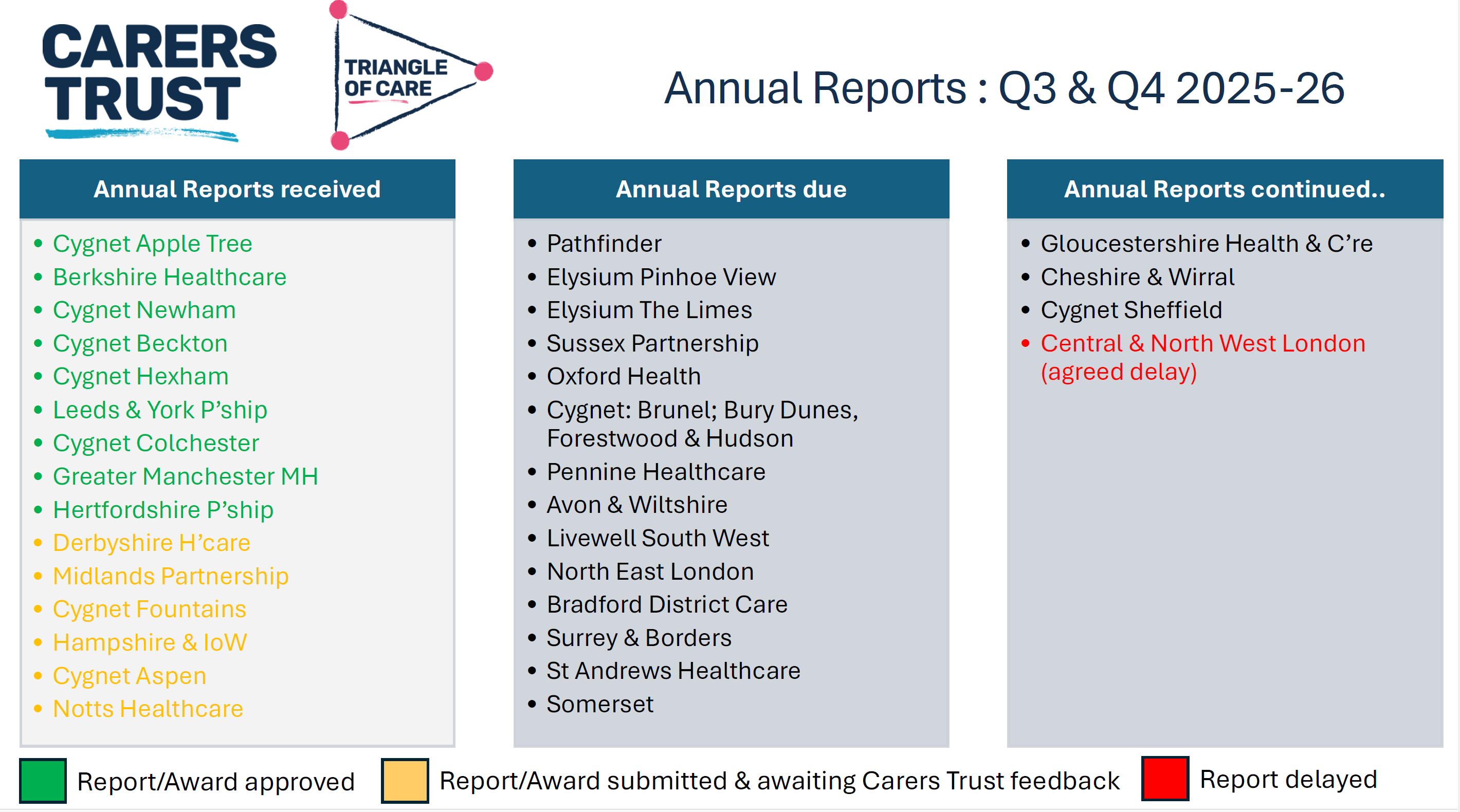
As part of the update, members were updated on emerging learning from Triangle of Care reports, including self-assessment submissions and peer review feedback. These reports were described as an important source of insight into how carer involvement is experienced on the ground, highlighting both areas of strong practice and recurring challenges across services
NOTE: These include reports going back 6 months, so not all NHS trusts listed
Peer review was described as most effective when organisations approach it with openness and curiosity. Lived-experience peer reviewers play a crucial role in asking different questions, highlighting blind spots, and grounding discussions in real-world carer experience.
A key discussion point was how to balance national consistency with local flexibility. Members acknowledged that while the Triangle of Care provides a shared framework and standards, services operate within different contexts, populations, and resource constraints.
Triangle of care and Patient Carer Race Equality Framework updates
The Triangle of Care and PCREF Phase 2 pilot will be launched in April 2026, to test co-produced specialist guidance to support integration of carers from racially marginalised communities into the Triangle of Care.
Alignment with Wider System Priorities
Members discussed how Triangle of Care activity aligns with broader system developments, including Mental Health Act reform, integrated care, and equality frameworks. There was strong agreement that Triangle of Care should not sit in isolation but be embedded within wider quality improvement, safeguarding, and workforce development agendas.
The need to visibly align Triangle of Care with the Patient and Carer Race Equality Framework was reiterated. Members emphasised that carers must be able to see how equality commitments translate into tangible actions within standards, training, and evidence.
Key points
Aligning Triangle of Care with Mental Health Act reform
Embedding within wider system and quality frameworks
Stronger visibility of equality and race equity
Carer Voice and Evidence of Impact
A recurring theme was the importance of demonstrating impact. Members discussed how services can better evidence carer involvement and experience beyond policies and training records. This includes qualitative feedback, lived-experience insight, and examples of how carer input has influenced service design and delivery.
Emerging Challenges and Areas for Development
The update also acknowledged ongoing challenges, including workforce pressures, digital transformation, and uneven awareness of the Triangle of Care across organisations. Members noted that carer involvement can become fragile during periods of change unless it is firmly embedded in systems and culture.
Summary: Where the Programme Is Heading
The Triangle of Care update concluded with a shared understanding that the programme is well-established but still evolving. The focus for the next phase is on deepening impact, strengthening alignment with equality and legislative change, and supporting services to move from intention to consistent, inclusive practice.
Key discussion points
Peer review as a developmental, learning-focused process
Balancing national consistency with local flexibility
Alignment with Mental Health Act reform and equality frameworks
Keeping carer voices central to assessment and review
3. Sharing Experiences as a Peer Reviewer
Carer involved with Avon & whitlshire
A carer presented from her involvement at Avon and Wiltshire Mental Health Partnership NHS Trust, where she is involved as a lived-experience peer reviewer contributing to Triangle of Care.
She shared reflections from her role as a lived-experience peer reviewer. She spoke about the importance of authenticity, trust, and transparency in the peer review process, and how lived experience strengthens both credibility and impact. Her contribution reinforced the value of co-production and highlighted how peer review can challenge assumptions, surface good practice, and promote more carer-inclusive cultures within organisations.
The discussion reinforced that organisational openness and leadership engagement are critical to turning peer review feedback into real change. Members reflected on how hearing directly from peer reviewers deepens understanding of the practical impact of policies on carers.
Q&A / Discussion
Members asked how organisations typically respond to lived-experience feedback.
The involved carer noted that openness and leadership support were key factors in whether reviews led to meaningful change.
Discussion reinforced the importance of preparing services for peer review so that carers feel genuinely welcomed and listened to.
4. Carer Contingency Planning – Presentation and Local Practice
Mary Patel Local example: Carly Driscoll – Bradford District Care
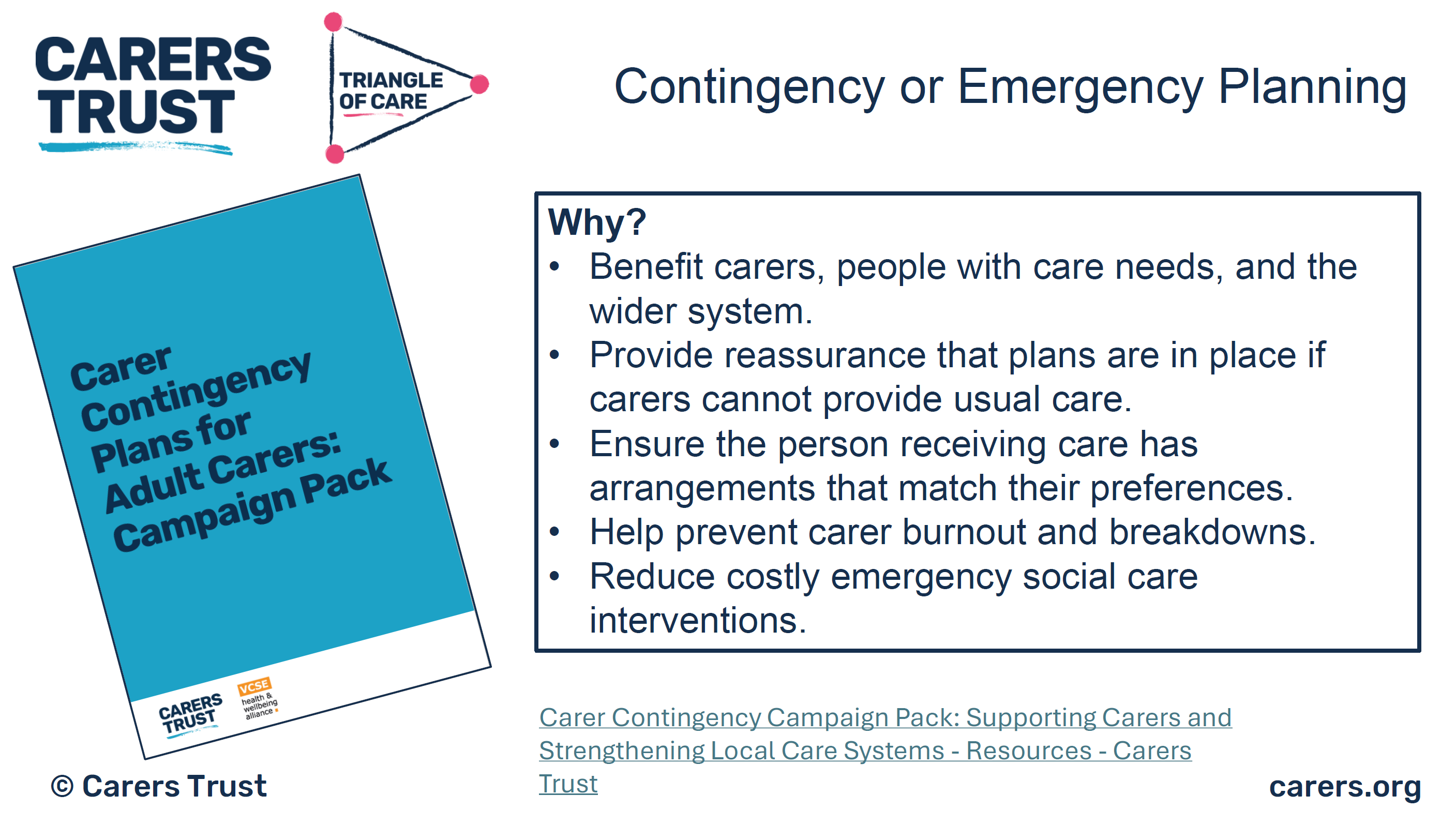
This session focused on carer contingency planning as a key element of carer support and crisis prevention. The presentation outlined why contingency planning is critical in reducing carer anxiety, preventing emergency admissions, and ensuring continuity of care when carers are unable to continue their role.
Carer Contingency Planning (CCP), as championed by Carers Trust, is designed to support carers by planning ahead for times when they might suddenly be unable to continue caring. This might include illness, emergencies, hospitalisation, or other crises. CCP shifts the focus from reactive support during crisis moments to proactive planning that reduces anxiety and prevents avoidable breakdowns in care.
Carers Trust emphasises that CCP is a conversational, personalised process where the carer’s expertise is central. Carers know the routines, preferences, and cues that matter for the person they care for; the goal of CCP is to capture that knowledge in a way that can be shared quickly and effectively with services, families, and emergency responders when needed.
A local practice example from Bradford District Care demonstrated how contingency planning can work in practice, highlighting practical tools, partnership working, and engagement with carers. Discussion explored the benefits of clear, accessible plans, while also acknowledging challenges around awareness, consistency, and uptake
The local practice example demonstrated how contingency planning can be embedded into routine work through partnership approaches and proactive engagement with carers. Members discussed the importance of introducing plans early and reviewing them regularly.
Key features of the Bradford approach
Routine integration: CCP discussions happen early, not just in crisis moments
Partnership working: Health, social care, and voluntary sector staff work in concert
Accessible documentation: Plans are shared in forms that carers can use and update
Support for carers: Carers are supported to lead the planning, not be passive recipients
Ongoing review: Plans are revisited as needs and circumstances evolve
Benefits seen locally
Carers report feeling more confident and less anxious
Greater clarity across professionals when carers are unavailable
Fewer last-minute, unplanned crises or service escalations
Better use of local support networks when official services are stretched
Q&A / Discussion
Questions focused on how contingency plans are introduced to carers and reviewed over time.
Members raised concerns about low awareness of contingency planning among carers not already engaged with services.
Discussion highlighted the need for flexibility, recognising that carers’ circumstances can change rapidly.
5. Carer Contingency Planning – System Perspective
Sara Lewis – SW London ICB
Sara Lewis’s session focused on Carer Contingency Planning (CCP) as a core, preventative element of carer support rather than a reactive or optional add-on. CCP is a structured way of planning for what should happen if a carer is suddenly unable to continue caring due to illness, crisis, exhaustion, or an emergency. At its heart, CCP is about reducing uncertainty and anxiety for carers while ensuring continuity and safety for the person they support.
Sara emphasised that effective CCP recognises carers as partners with expert knowledge of the person they care for. The process supports carers to articulate what matters most, what routines and support are essential, and who needs to be contacted in an emergency. When done well, CCP helps prevent avoidable crises, emergency admissions, and breakdowns in care by making plans visible, accessible, and shared across relevant services.
Accessibility was a major theme, particularly the risks of digital exclusion. While digital tools can be effective, members stressed the need for non-digital options, language support, and culturally appropriate approaches to ensure equity.
Key Takeaways from Sara Lewis’s Session
Carer Contingency Planning is preventative, not reactive
CCP is built on early, ongoing conversations with carers
Plans should reflect what matters to carers and the cared-for person
CCP must be accessible, inclusive, and culturally appropriate
Digital tools can help, but must not increase exclusion
Successful CCP requires shared ownership across services
When embedded well, CCP reduces crisis, anxiety, and system pressure
Q&A / Discussion
Members questioned how to balance digital innovation with the risk of digital exclusion.
Language barriers and accessibility for carers with different communication needs were highlighted.
Discussion emphasised that contingency planning must be embedded into standard care planning processes, not treated as optional or additional.
6. Looking Ahead: Priorities for the Community Group
The “Looking Ahead” discussion focused on how the Triangle of Care Community Group can continue to influence meaningful change for carers in an evolving policy and practice landscape. Members reflected on the increasing complexity of health and care systems and the importance of ensuring that carers are not left behind as reforms, digital transformation, and workforce pressures accelerate.
A strong theme throughout the discussion was visibility, making carer involvement, equality, and partnership explicit in practice, evidence, and outcomes. Participants emphasised that carers must not only be recognised in principle but experience consistent involvement and support in real-world settings. The group agreed that the next phase of work should strengthen both strategic influence and practical implementation.
Mental Health Act Reform and Carer Involvement
Members discussed the implications of upcoming Mental Health Act reform, particularly around carers’ rights, information-sharing, and involvement in decision-making. There was recognition that Triangle of Care principles provide a strong foundation for supporting services to meet new expectations, but that further work will be needed to translate legislation into everyday practice.
The group highlighted the risk that carers could be inconsistently involved if workforce understanding is weak or if systems focus narrowly on legal compliance. Proactive guidance, training, and examples of good practice were seen as essential to ensure carers are meaningfully included rather than consulted as an afterthought.
Equality, Race Equity, and Inclusion
A central priority looking ahead is ensuring that Triangle of Care activity visibly aligns with the Patient and Carer Race Equality Framework (PCREF). Members stressed that carers from racialised and marginalised communities often face additional barriers to involvement, including mistrust, cultural misunderstandings, and unequal access to support.
The group agreed that equality must be embedded into standards, peer review evidence, and training—not treated as a parallel or optional agenda. This includes capturing meaningful data, listening to diverse carer voices, and ensuring culturally responsive practice is clearly demonstrated.
Workforce Training and Education
Workforce development was identified as a critical lever for long-term change. Members highlighted the need to strengthen carer awareness training across all roles, particularly for staff new to mental health and social care settings. Without this foundation, carer involvement remains inconsistent and dependent on individual attitudes rather than organisational culture.
There was strong support for influencing pre-registration education, including universities and training providers, to embed carer awareness earlier. This was seen as an opportunity to normalise partnership with carers from the start of professional careers rather than trying to retrofit it later.
Key points
Strengthening carer awareness across the workforce
Embedding Triangle of Care principles early in training
Influencing universities and pre-registration pathways
Moving from individual goodwill to system-wide culture change
Digital, Data, and Accessibility
Digital transformation featured prominently in the discussion, with members acknowledging both its potential and its risks. While improved data systems and digital tools can support information-sharing and coordination, there was concern that carers without digital access or confidence may be excluded.
Participants emphasised that digital solutions must be designed inclusively, with non-digital alternatives always available. Data collection should support understanding of carer experience and inequality, not become a barrier to support.
Key points
Digital tools should support, not replace, relationships
Risk of digital exclusion for some carers
Importance of non-digital alternatives
Using data to improve equity, not reinforce gaps
Young Carers and Marginalised Groups
Supporting young carers and carers from marginalised communities was highlighted as a continuing priority. Members noted that these groups are often under-identified and less likely to be involved in care planning or decision-making, despite carrying significant caring responsibilities.
The group agreed that future work should focus on visibility, early identification, and tailored approaches that recognise the specific needs and challenges faced by these carers. Partnership with education, community, and voluntary sector organisations was seen as essential.
Key points
Improving identification of young carers
Addressing barriers faced by marginalised carers
Tailored, age-appropriate and culturally sensitive support
Stronger partnership working beyond health services
Collective Commitment Moving Forward
The discussion concluded with a shared commitment to using the Community Group as a platform for influence, learning, and accountability. Members recognised the value of continuing to share practical examples alongside strategic discussion, ensuring that Triangle of Care principles are translated into everyday practice.
Looking ahead, the group aims to remain proactive, inclusive, and responsive—supporting services to recognise carers as equal partners and ensuring that no carer is left unseen or unsupported as systems evolve.
Key discussion points
Preparing for Mental Health Act reform
Embedding the Patient and Carer Race Equality Framework
Improving workforce training and education pathways
Supporting young carers and marginalised communities
Improving data and digital systems without exclusion
As Chair I thanked contributors and reaffirmed the importance of continued collaboration to ensure carers are recognised as equal partners in care, with Triangle of Care principles translated into meaningful practice across services.
For those interested to hear more about triangle of care, see details below
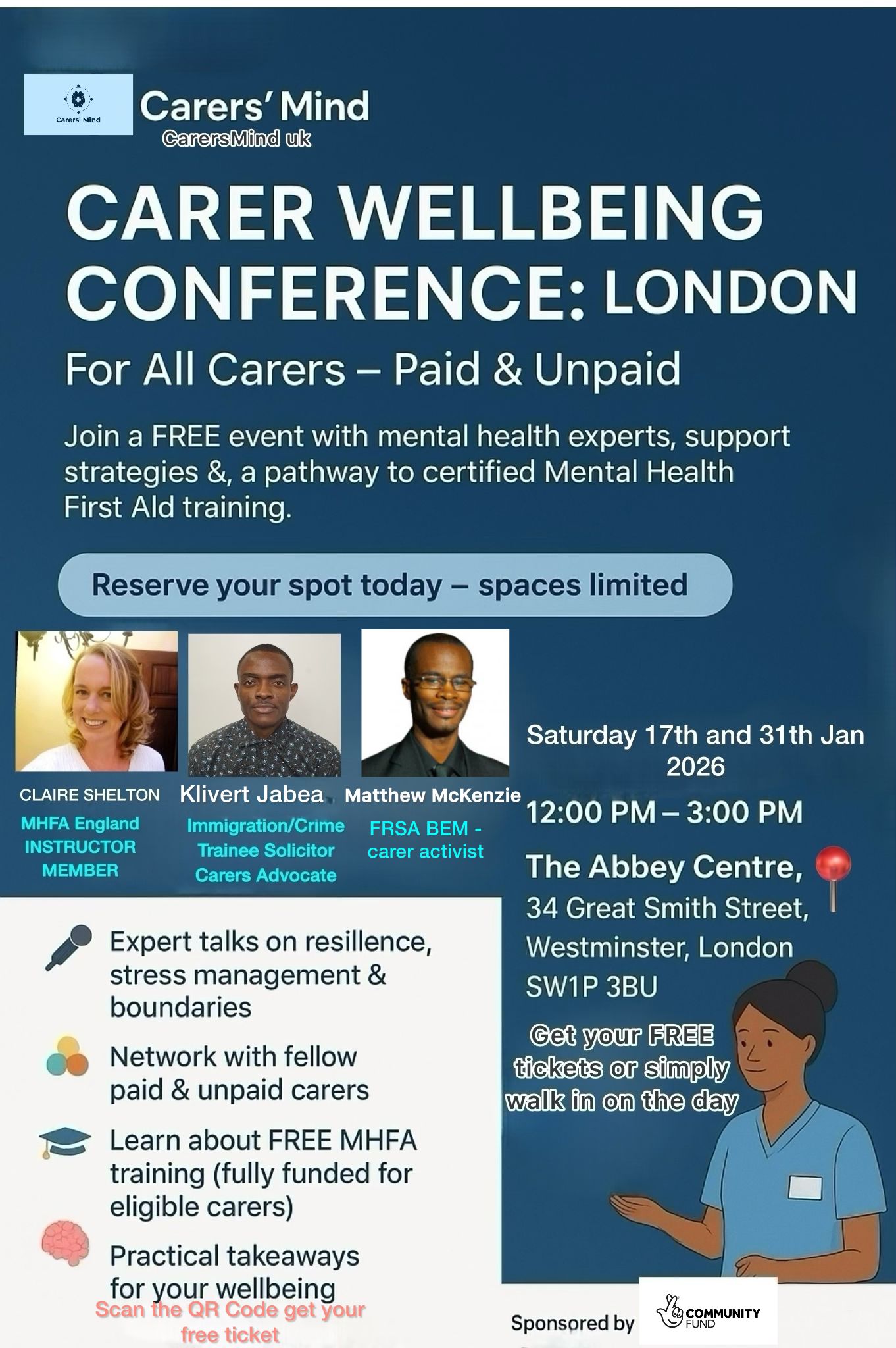
I’ve spoken at many events over the years, but standing in a room full of carers always is a great experince differently. The room filled with lived experience, this time paid and unpaid carers carrying invisible weight of caring stories that rarely get space.
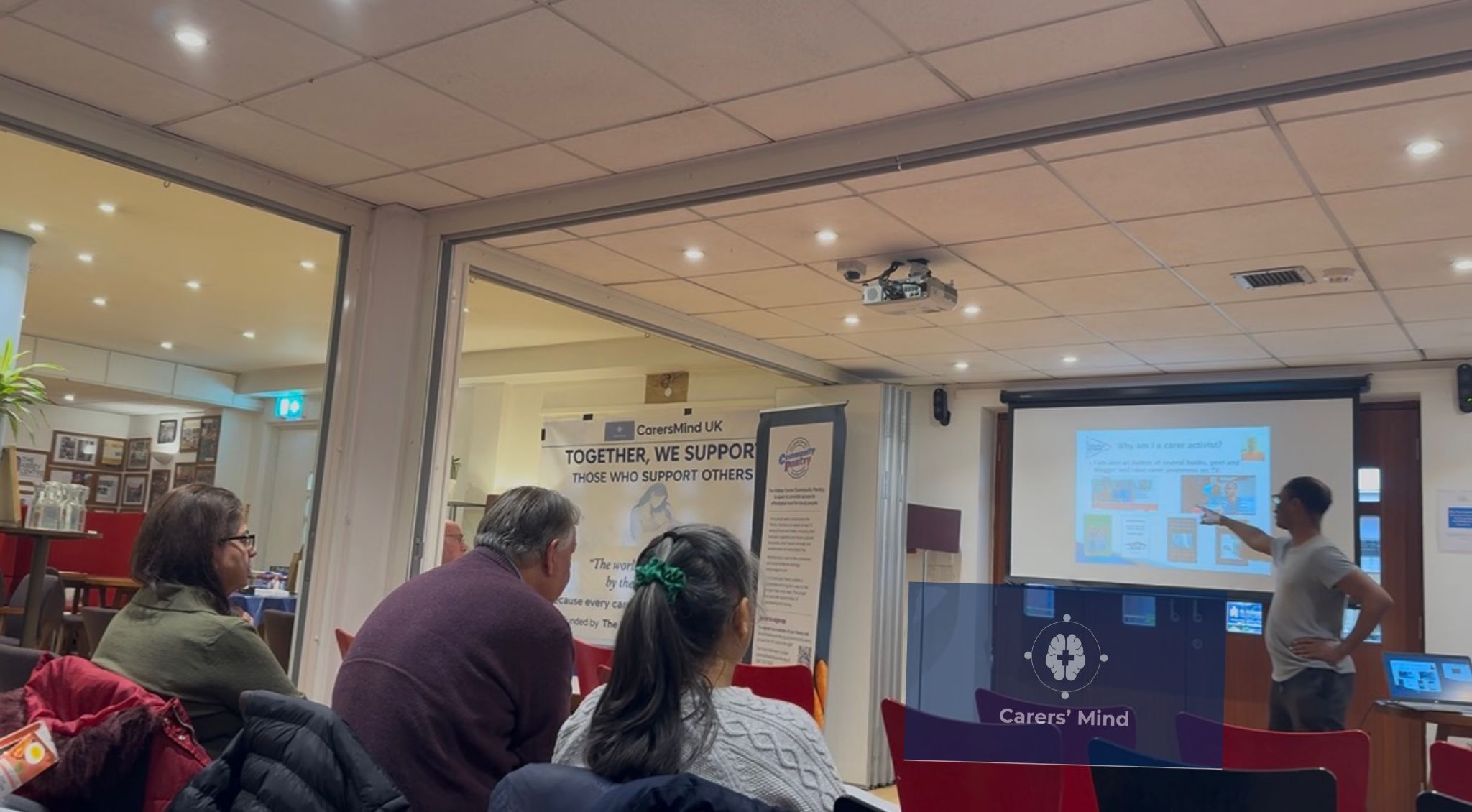
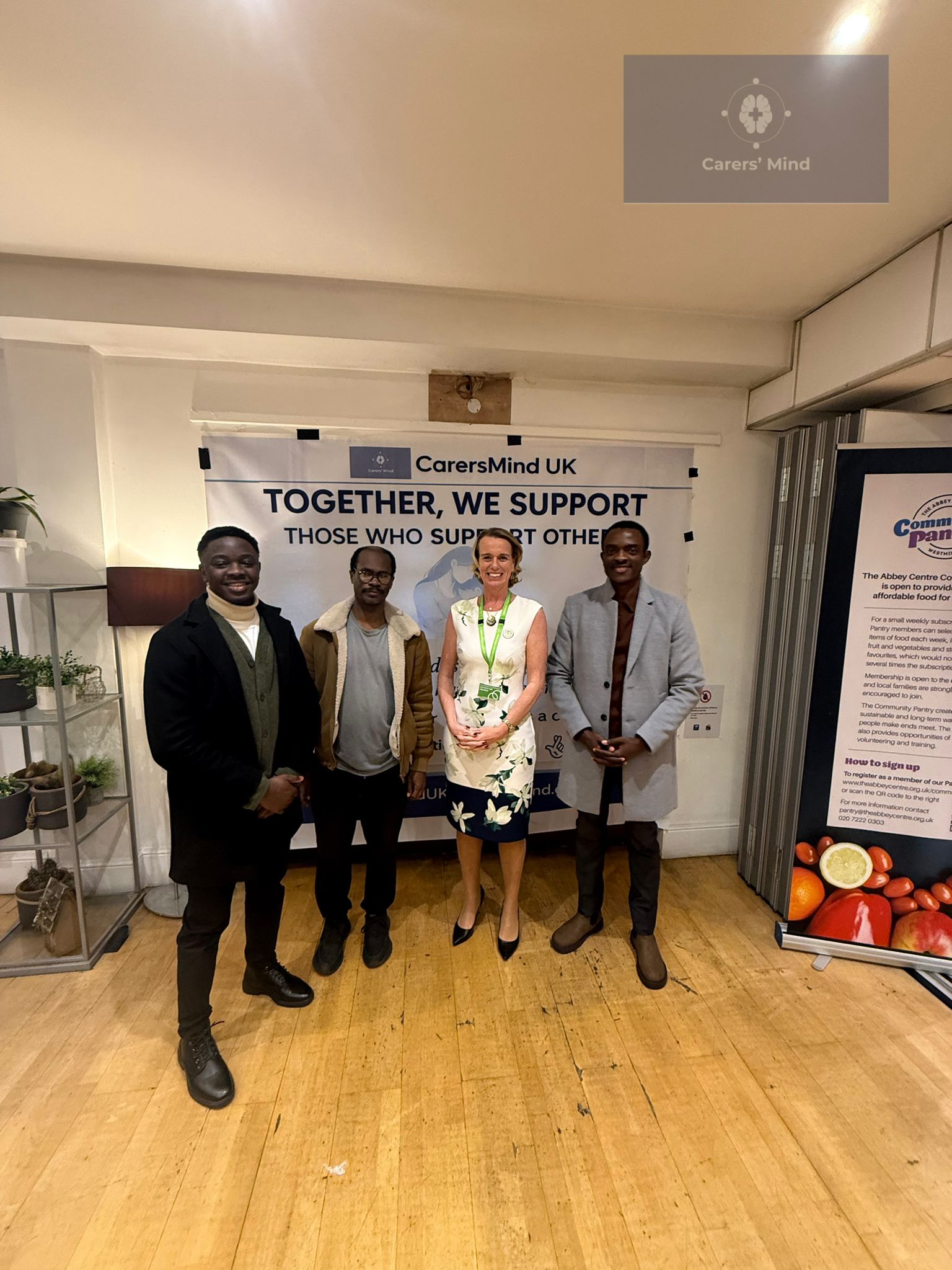
The Carers’ Wellbeing Conference in London, organised by Carers’ Mind CIC, was a moment where carers were allowed to be people first.
The event was hosted at The Abbey Centre, a welcoming community venue in Westminster that provides vital space for local groups, charities, and events focused on wellbeing, inclusion, and social support.
CarersMind CIC is a community-interest organisation dedicated to improving the wellbeing, visibility, and support of both paid and unpaid carers. Through accessible events, practical training, and open conversations about mental health, CarersMind CIC creates safe spaces where carers are recognised as individuals
The Impact of Caring on Mental Health
When I was invited to speak about “The Impact of Caring on Mental Health and What Actually Helps”, I didn’t hesitate. Caring has shaped every part of my adult life. It has taught me empathy, patience, advocacy, but it has also exposed me to burnout, trauma, guilt, and long stretches of isolation.
Too often, carers are spoken about rather than with. This conference made a conscious effort to centre carers’ voices, not as an afterthought, but as expertise.
The Room Told Its Own Story
At the conference, there was no pressure to “cope better” or “be more resilient” without acknowledging the cost. Instead, there was honesty.
Carers spoke about:
Burnout that creeps in quietly
Guilt for needing rest
The emotional toll of long-term responsibility
Feeling unseen by systems that rely on them
These were truths that deserved to be heard without judgement.
What Claire Shelton Shared at her session
Claire spoke openly about how caring impacts mental health carers over time, not just during moments of crisis. she talked about trauma that doesn’t announce itself, about stress containers that overflow slowly, and about how carers often normalise distress because “there’s no other option.”
Most importantly, she focused on what actually helps:
Being recognised as a carer both formally and emotionally
Access to peer support, not just professional services
Practical tools that reduce isolation
Boundaries that protect carers’ wellbeing without guilt
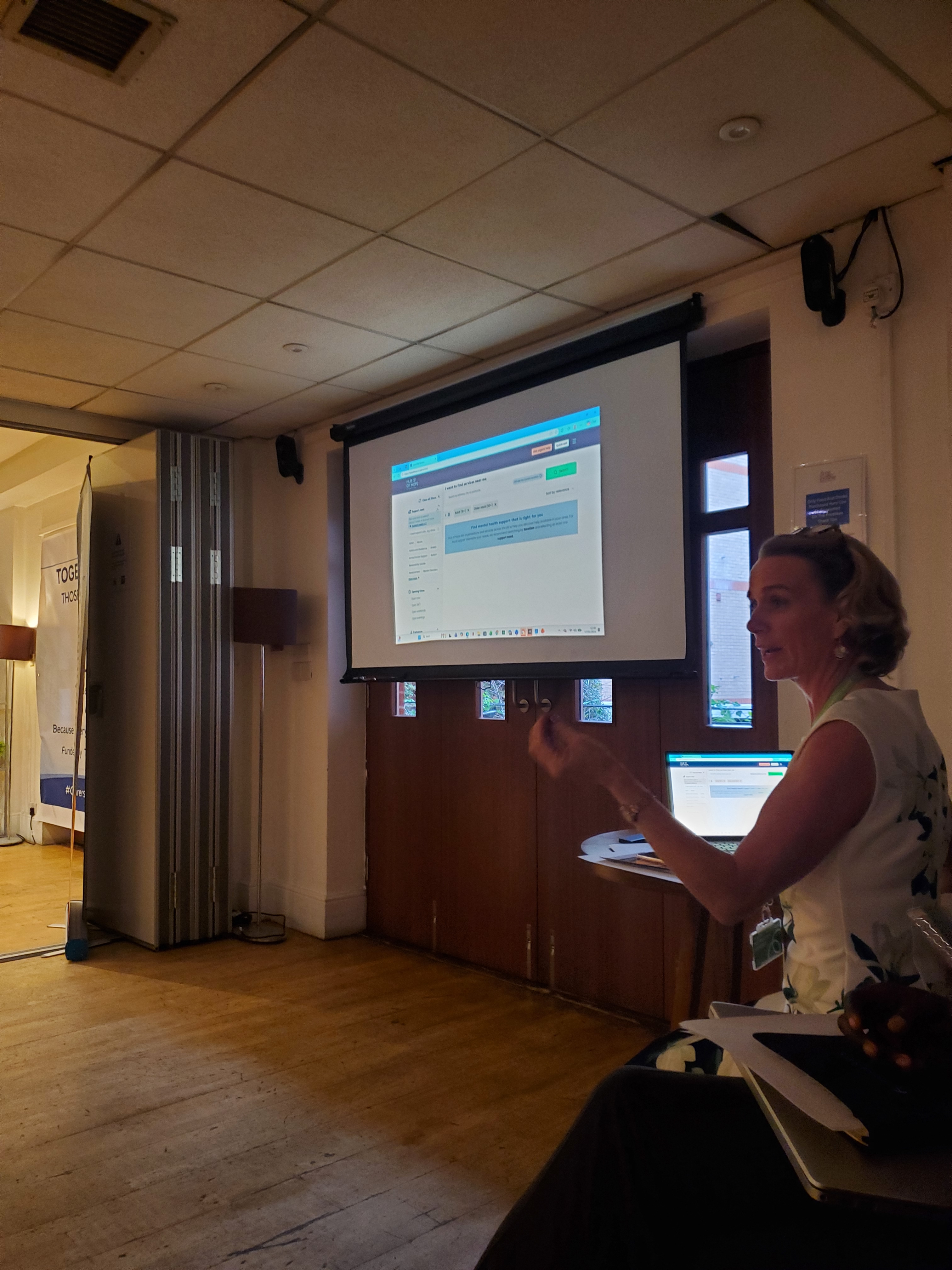
One resource Claire highlighted was the Hub of Hope, because carers need access to support that doesn’t require jumping through endless hoops. These matter not because they fix everything, but because they return a small amount of control to people who’ve lost a lot of it.
What I Shared in my session
In my session, I spoke from lived experience about the long-term impact of caring, shaped deeply by my role as a carer for my mother. I shared how caring is rarely defined by single moments of crisis, but by the gradual, cumulative pressure that builds over time. This includes the emotional labour, the constant vigilance, and the way stress and trauma often go unrecognised because caring simply becomes “what you do.”
I reflected on how caring for my mother affected my mental health, identity, and sense of self. This experience led me to speak about carers’ rights the right to be recognised as a carer, to be involved in decisions, to access support, and to protect one’s own wellbeing without guilt or fear of judgement.
Most importantly, I focused on what actually helps:
Being identified and recognised as a carer, both formally and emotionally
Understanding and exercising carers’ rights
Access to peer support grounded in shared lived experience, not only professional services
Practical tools that reduce isolation and complexity
The Power of Being in the Same Room
One of the most powerful moments wasn’t during my talk it was during the conversations that followed. Carers sharing strategies with each other. Nodding in recognition. Saying, “I thought it was just me.”
That’s the quiet power of events like this. They remind carers that their experiences are valid, shared, and worthy of space.
A Collective Effort
It was a privilege to share the day with:
Claire Shelton, who spoke with clarity and compassion about resilience, stress management, and boundaries
Klivert Jabea, who brought warmth, insight, and a strong message that self-care is not a luxury
The organisers at Carers’ Mind CIC, who created an environment that felt safe, inclusive, and genuinely carer-focused
This conference was about acknowledging reality and that’s where real wellbeing work begins.
Leaving with Hope and Responsibility
I left the Abbey Centre reminded of why this work matters. Carers are holding together families, communities, and systems often at great personal cost. Supporting carers isn’t optional. It’s essential.
Resources and Support for Carers
If you are a carer and are looking for support for your wellbeing, mental health, or caring role, the following resources were highlighted or reflected in discussions during the conference:
Hub of Hope — https://hubofhope.co.uk A free, UK-wide mental health support database that helps carers find local and national services quickly, without needing to navigate complex systems. It is particularly useful for carers who may not know where to start or who feel overwhelmed by traditional referral pathways.
CarersMind CIC — https://carersmind.co.uk/ A community interest company focused on improving carers’ mental health and wellbeing through events, training, and open conversations that centre lived experience. Their work creates spaces where carers feel recognised, heard, and supported.
Carers UK — https://www.carersuk.org/ Provides information on carers’ rights, benefits, assessments, and practical guidance for unpaid carers across the UK.
NHS Carers Support Local NHS and local authority carers services can offer carers’ assessments, signposting, and practical support. Availability varies by area, but carers have a right to request an assessment.
We all know how challenging the life of a carer can be, especially when it involves the emotional and physical toll of supporting a loved one through difficult health challenges. Christine’s powerful story of navigating her loved one’s mental health and recovery through the fears of mental health system discharge.
In Christine’s latest podcast, “From Carer to Mum” she opens up about her personal journey, sharing the challenges and triumphs of transitioning from the role of a carer back to simply being a mum. Over the course of two years, Christine witnessed her loved one’s growth and recovery, which was made possible through the right care, support, and therapy.
Christine’s story focuses about overcoming struggles; plus about rediscovering joy and a new sense of normalcy.
Now, Christine has taken the next step in sharing her journey. She’s launched her own podcast, where she’ll continue to inspire others by sharing her experiences, reflections, and insights into caregiving, recovery, and the journey of moving forward.
Tune into Christine’s new podcast channel, where you’ll hear more about the highs and lows of caring for a loved one, as well as the emotional lessons learned along the way. The first episode, titled “Christine’s Journey: From Carer to Mum,” is already live on SoundCloud and is ready for you to listen.
Caring for a child or young person can be incredibly rewarding – but it can also feel overwhelming, especially when you’re worried about their emotional wellbeing or safety. If you’re an unpaid carer in Ealing supporting a young person, you’re not alone, and there is local support available for you.
This spring, a new free online training opportunity is available for parents and unpaid carers in Ealing, designed to build confidence, understanding and hope when supporting young people who may be struggling.
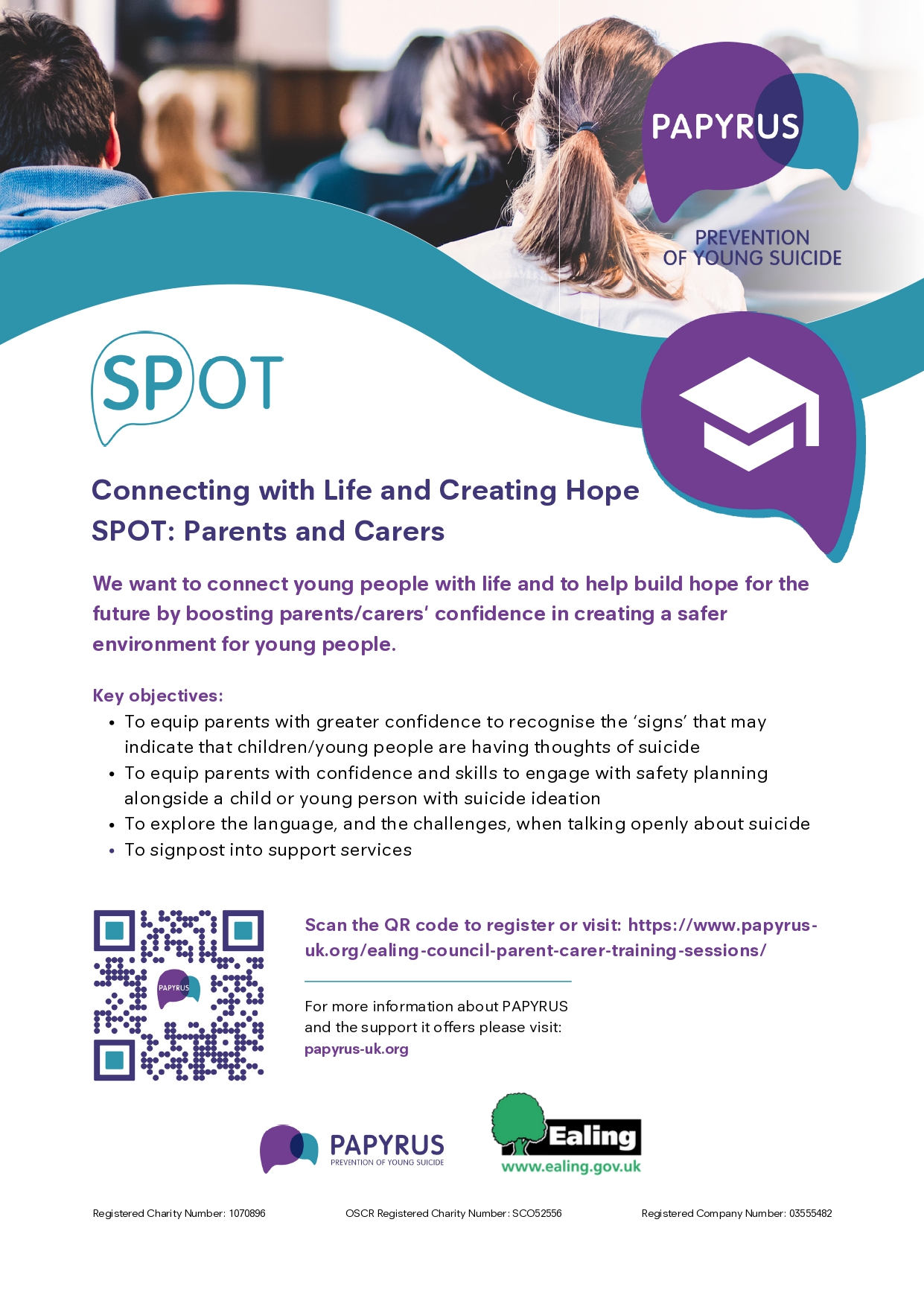
Free Online Training: SPOT – Parents and Carers
PAPYRUS, the national charity for the prevention of young suicide, has been funded by Ealing Council to deliver SPOT: Parents and Carers – Connecting with Life and Creating Hope.
This training is specifically designed to support parents and unpaid carers to feel more confident in helping young people stay safe.
The sessions focus on:
Recognising signs that a child or young person may be struggling or experiencing suicidal thoughts
Developing confidence to talk openly and safely about suicide
Learning how to support safety planning alongside a young person
Understanding helpful language and common challenges in these conversations
Knowing where and how to access further support
The overall aim is to help carers feel better equipped to create safer spaces for young people and to strengthen connection, hope and understanding .
Online Training Dates
The SPOT sessions are delivered online, making them easier to attend around caring responsibilities. You can choose the date and time that works best for you:
12 March 2026 – 7:00pm to 8:30pm
18 March 2026 – 6:30pm to 8:00pm
26 March 2026 – 1:00pm to 2:30pm
The sessions are free to attend, but booking is required.
You Don’t Have to Do This Alone: Ealing Carers Partnership
Alongside training opportunities like SPOT, unpaid carers in Ealing can access ongoing help through the Ealing Carers Partnership.
The partnership brings together local organisations to support unpaid carers of all ages, including parents and carers of children and young people. Support can include:
Information and advice
Emotional support and listening spaces
Help navigating services
Peer support and carer groups
Training and workshops to build skills and confidence
If you’re caring for someone without pay, whether that’s a child, young person, partner, friend or family member – you are recognised as an unpaid carer, and you are entitled to support.
The Ealing Carers Partnership works to make sure carers are seen, heard and supported across the borough, and can help you find the right service at the right time.
Many carers tell us that one of the hardest parts of supporting a young person is not knowing what to say, or worrying about saying the “wrong” thing. Training like SPOT is not about having all the answers, it’s about building confidence, understanding and connection.
If you are supporting a young person in Ealing and would like to strengthen your confidence, we strongly encourage you to take up this opportunity and to connect with the wider support available through the Ealing Carers Partnership.
If you have questions, need help accessing support, or would like to know more about what’s available for unpaid carers locally, please reach out on the link below

















 A Caring Mind