Tag Archives: King’s College London

Becoming a Human Book at the DUALITY Event – The Carer They Didn’t See

By Matthew McKenzie – Carer Activist and Carer Advocate

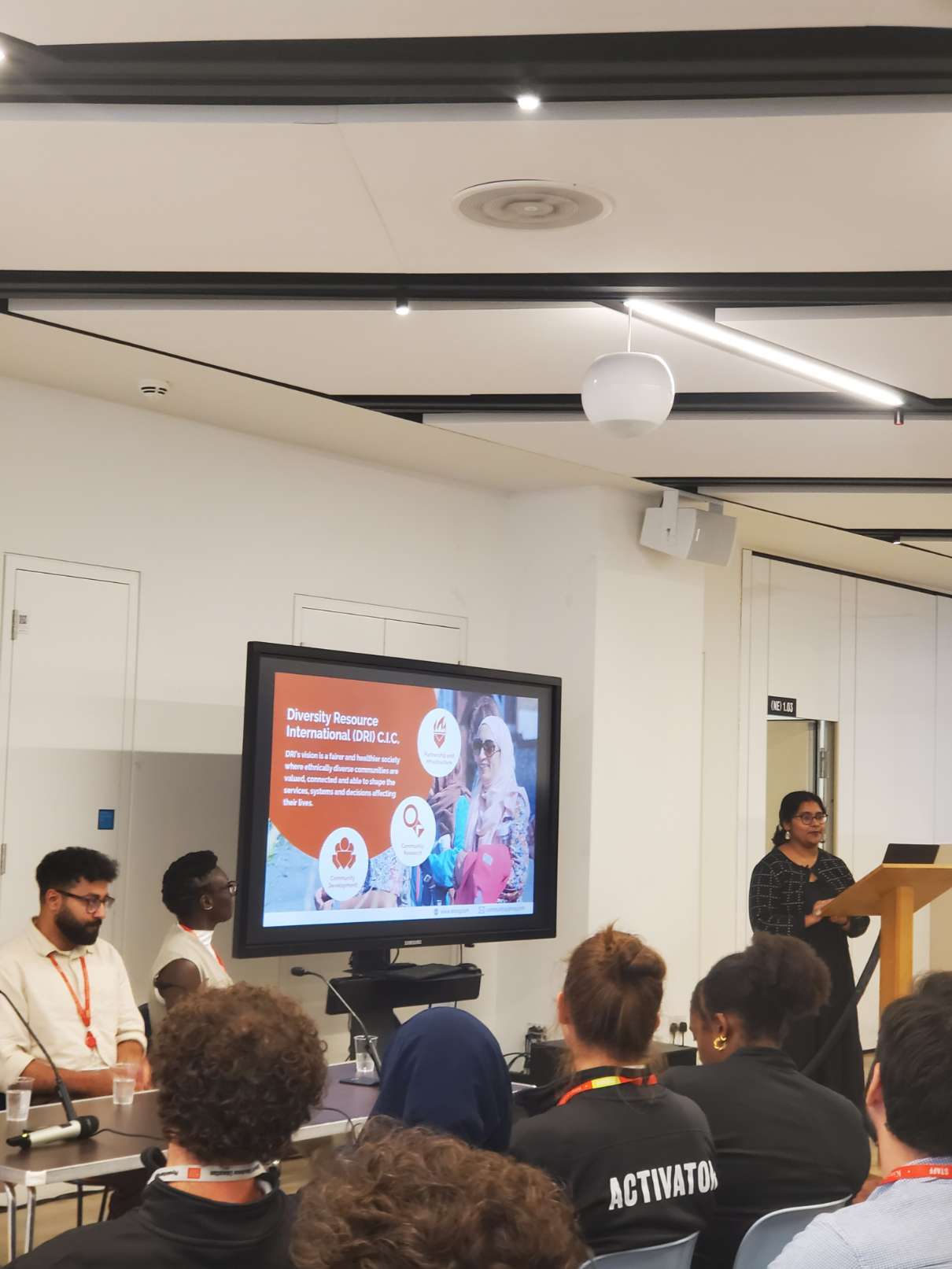
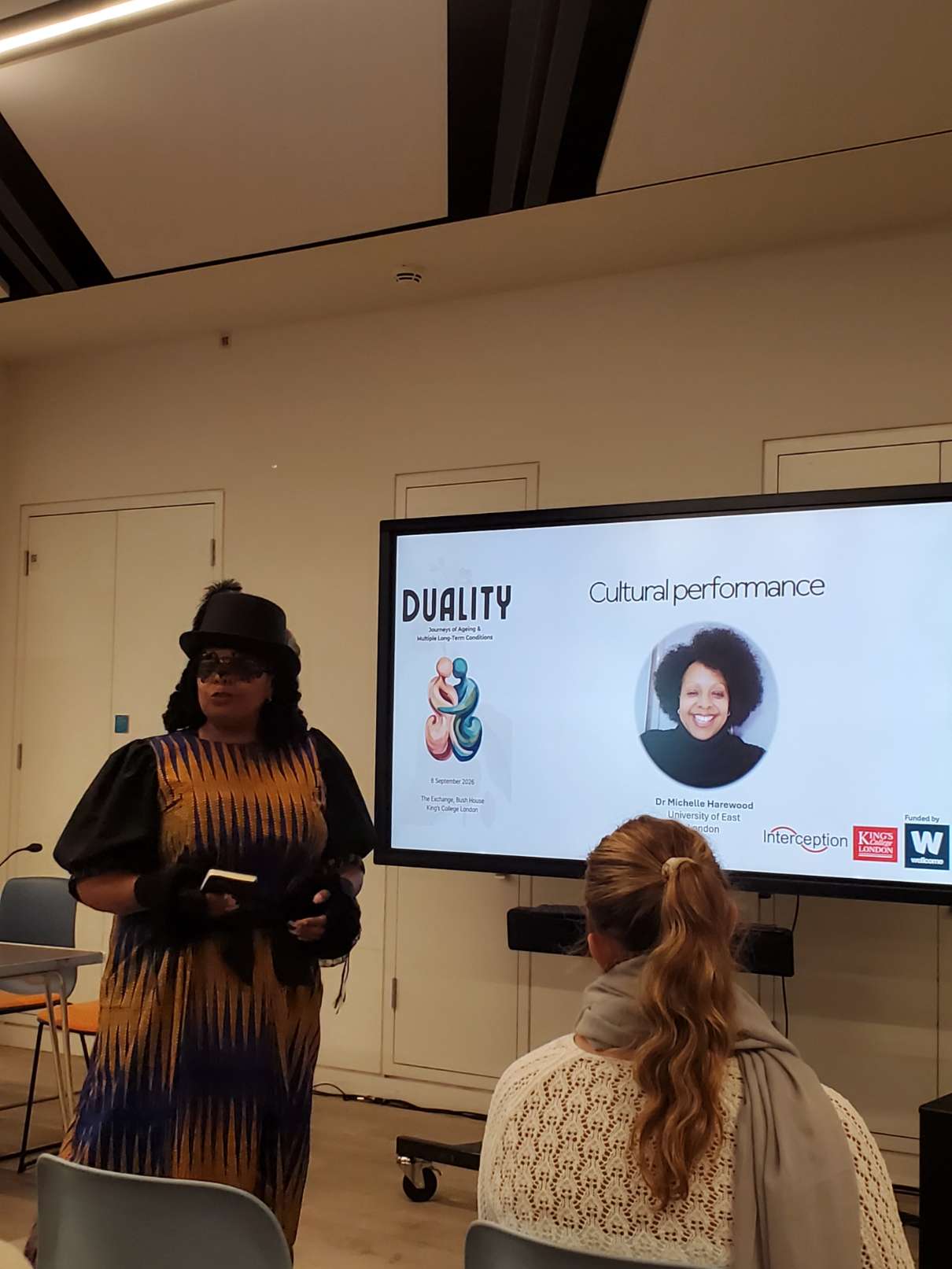
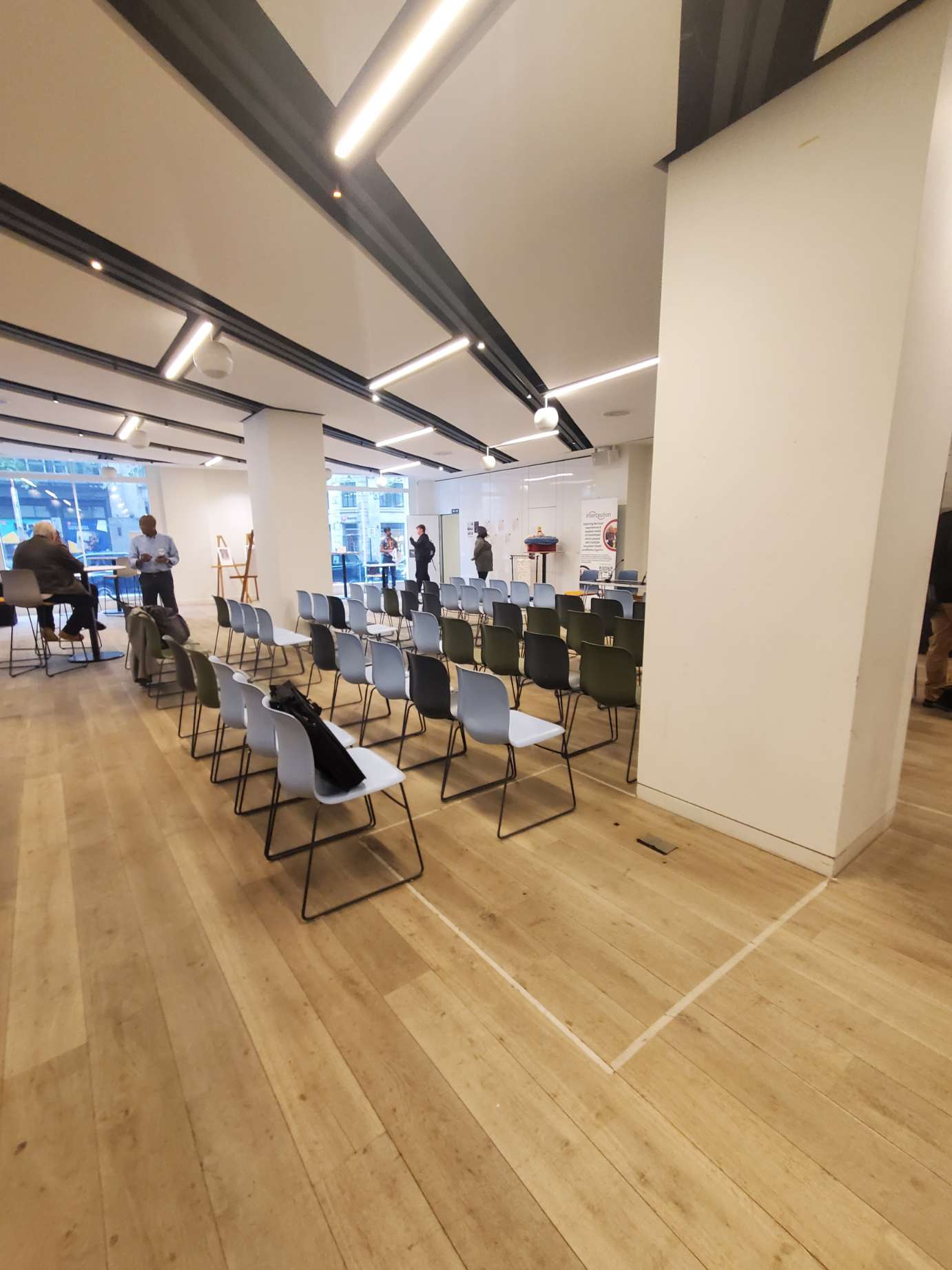
On 8 September 2026, I had the honour of attending the DUALITY event at King’s College London, held at Bush House.

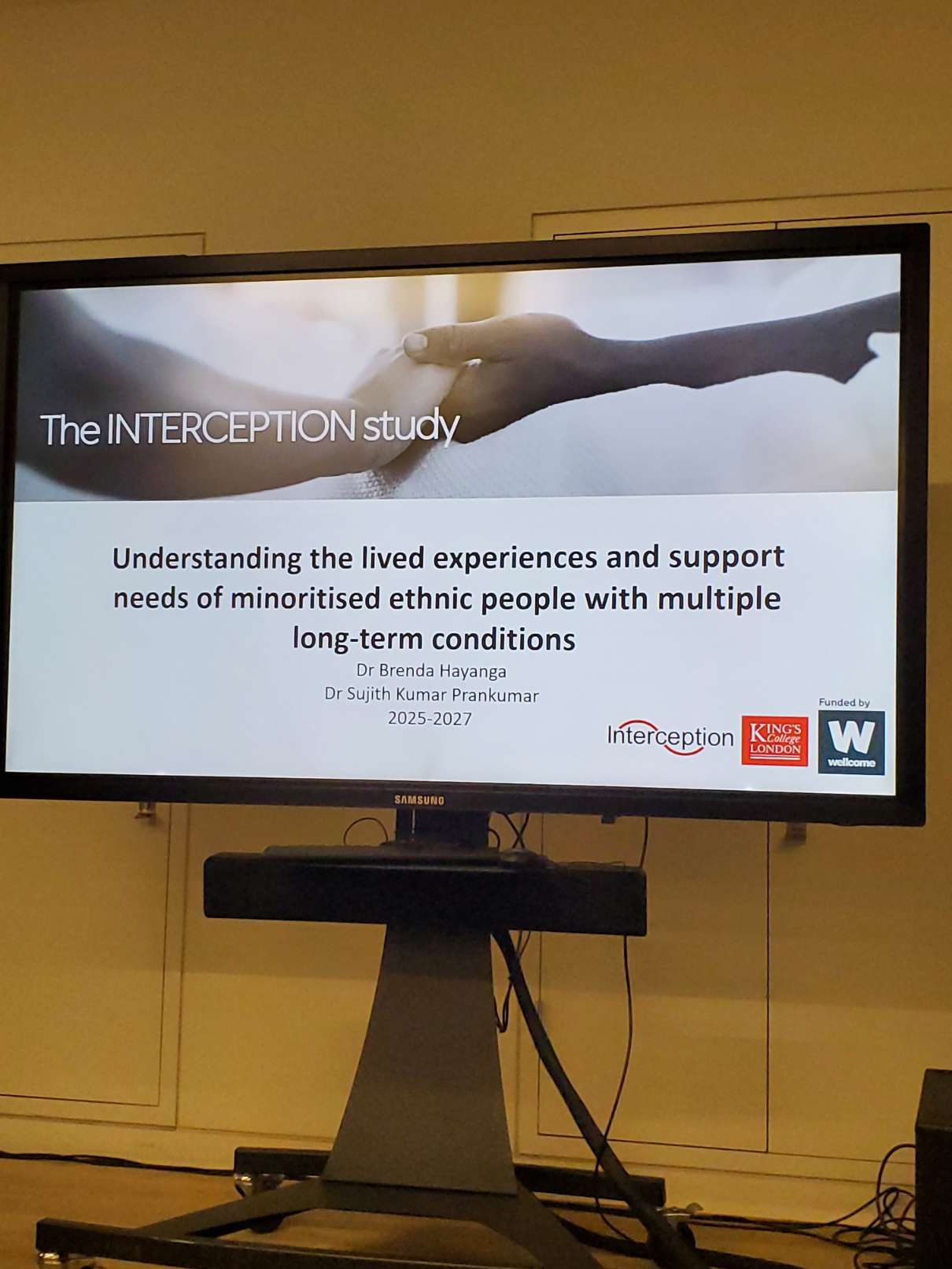
The event was a research and public/community engagement event connected to the INTERCEPTION study, based in King’s Department of Global Health & Social Medicine, within the School of Global Affairs / Faculty of Social Science & Public Policy.
There was a packed agenda, which I have shown below.

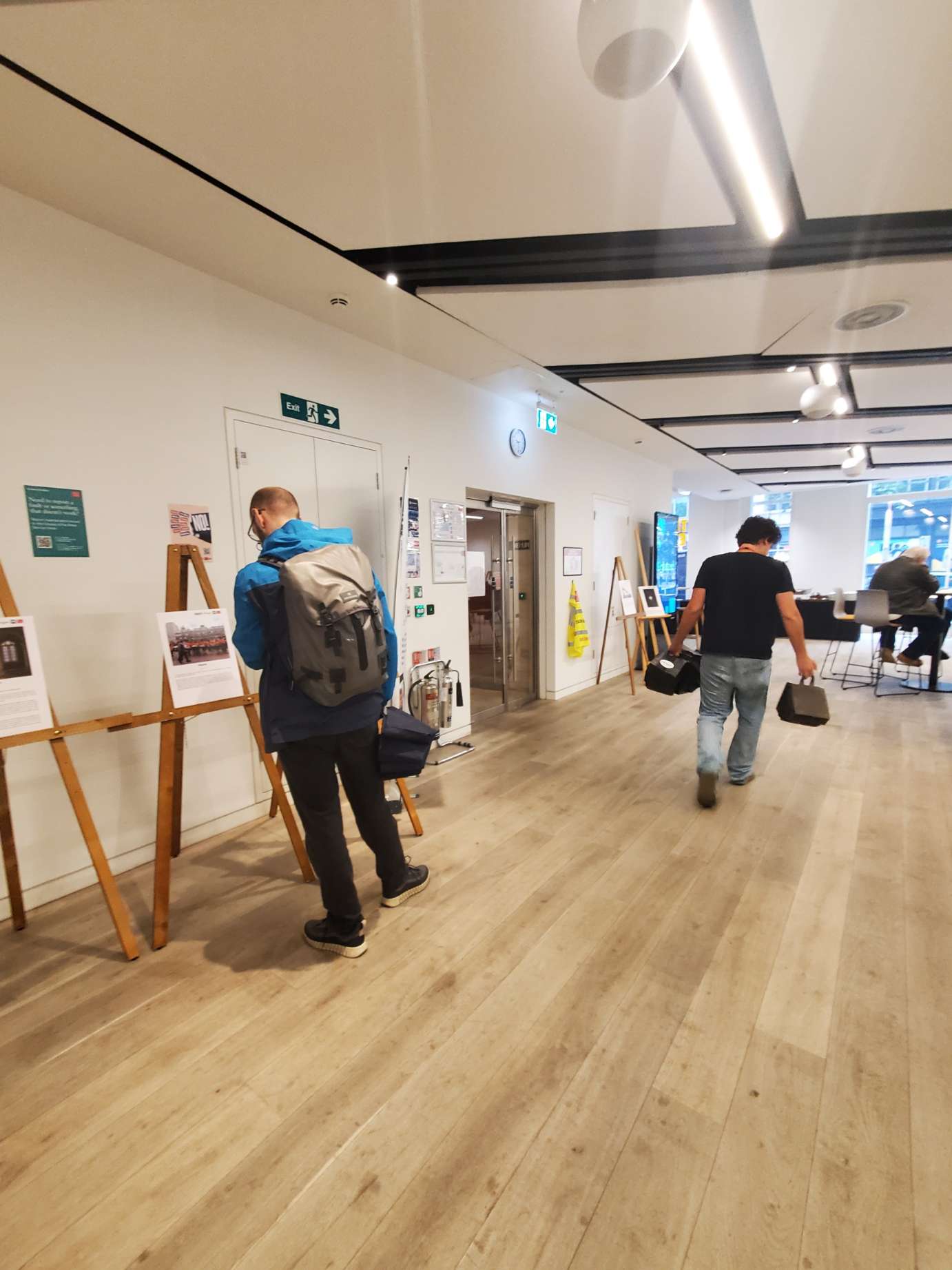
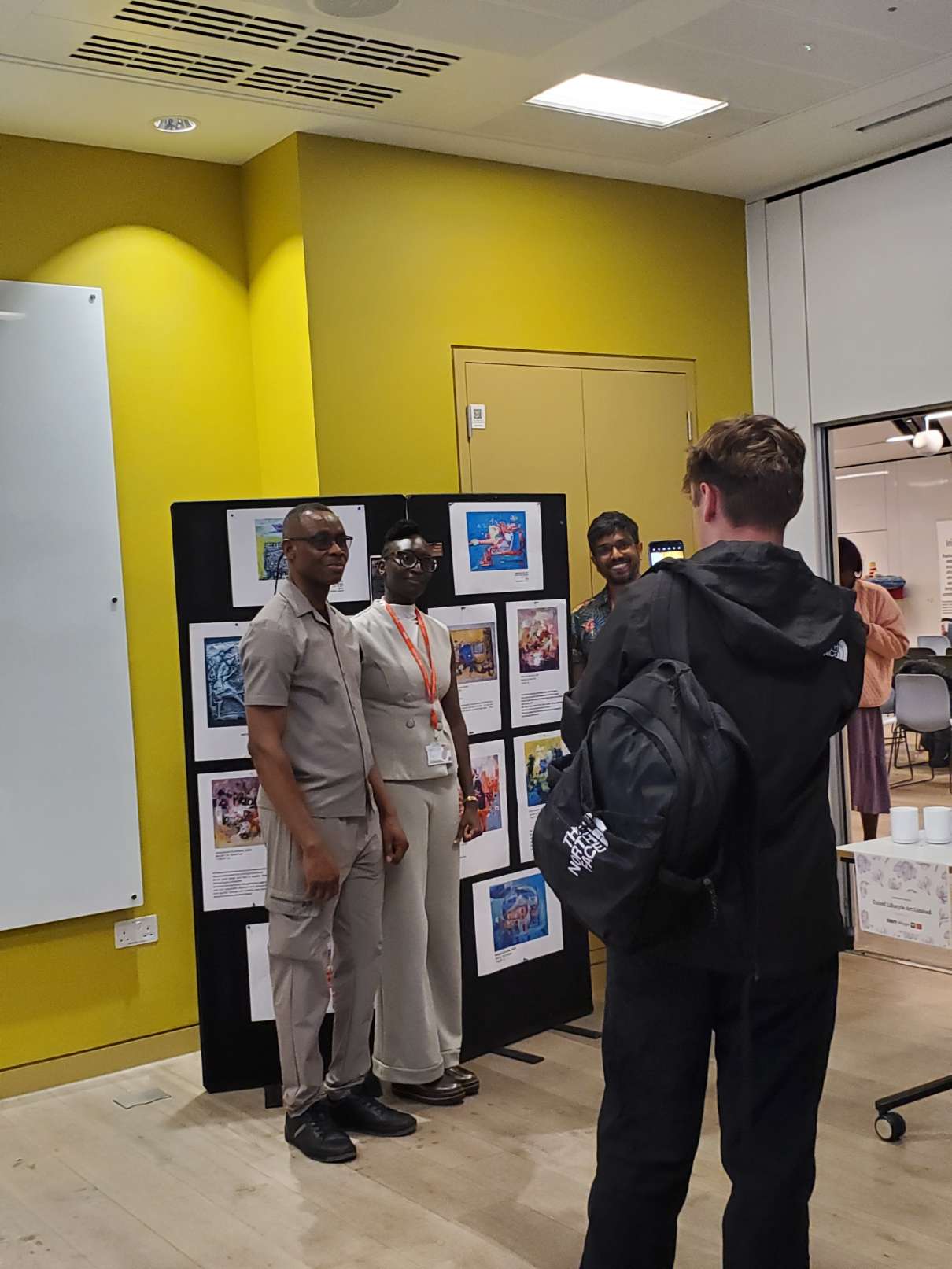
  • Registration, refreshments and photo exhibition — Attendees arrived, had refreshments and had an opportunity to look around the community photography exhibition.
  • Welcome and introduction to DUALITY — The organisers introduced the event and its focus on ageing, ethnicity, health and experiences of living with multiple long-term conditions.
  • Research Panel: Ethnicity, Ageing and Health — Researchers discussed work exploring inequalities and experiences at the intersection of ethnicity, ageing, health and multiple long-term conditions.
  • King’s Sport & Wellness energiser — Attendees were invited to take part in accessible seated stretches and movement exercises.
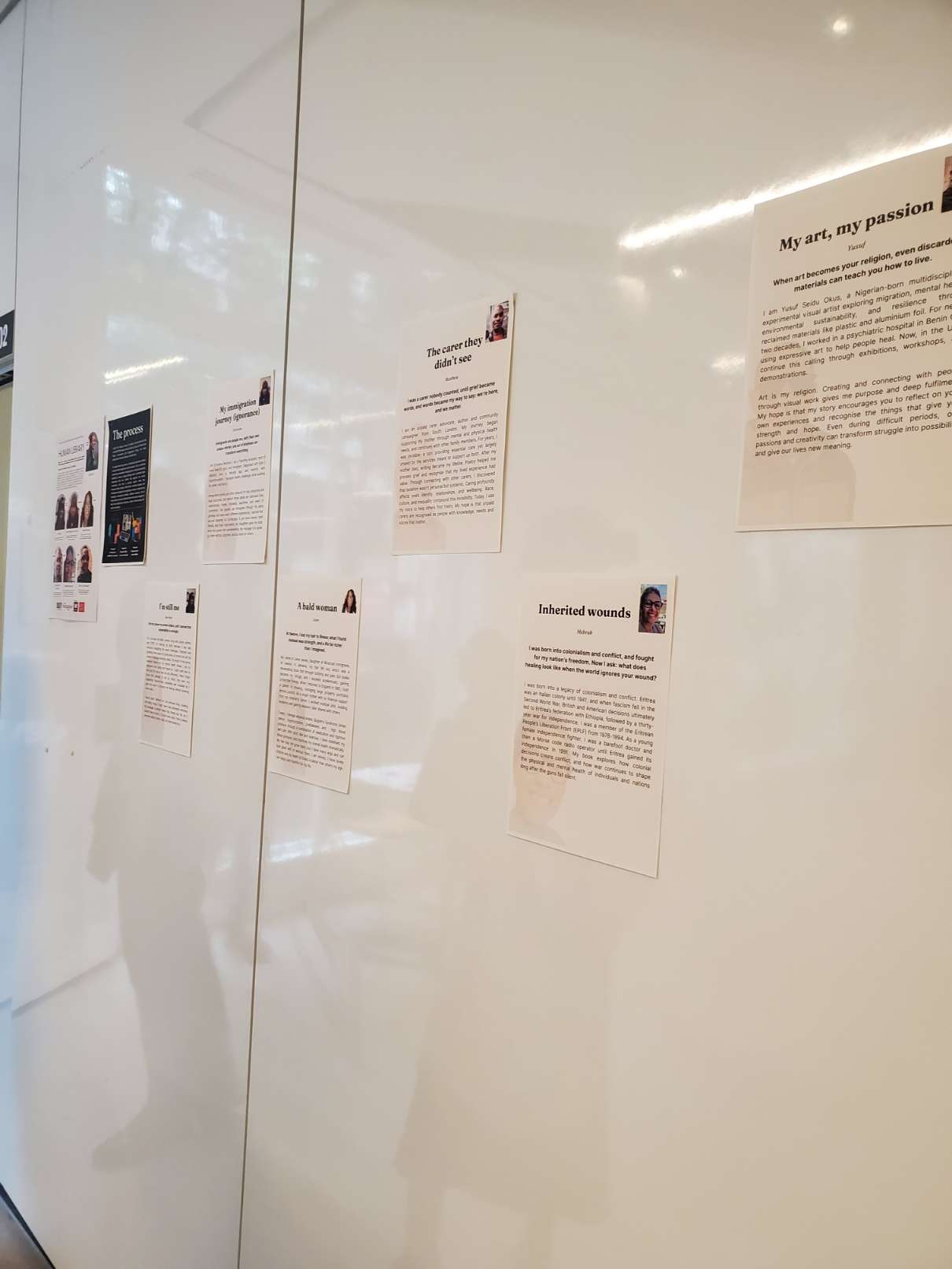
  • Human Library — Attendees could “borrow” Living Books for short conversations, hearing personal stories intended to build understanding, foster empathy and challenge assumptions. My Living Book was “The Carer They Didn’t See.”
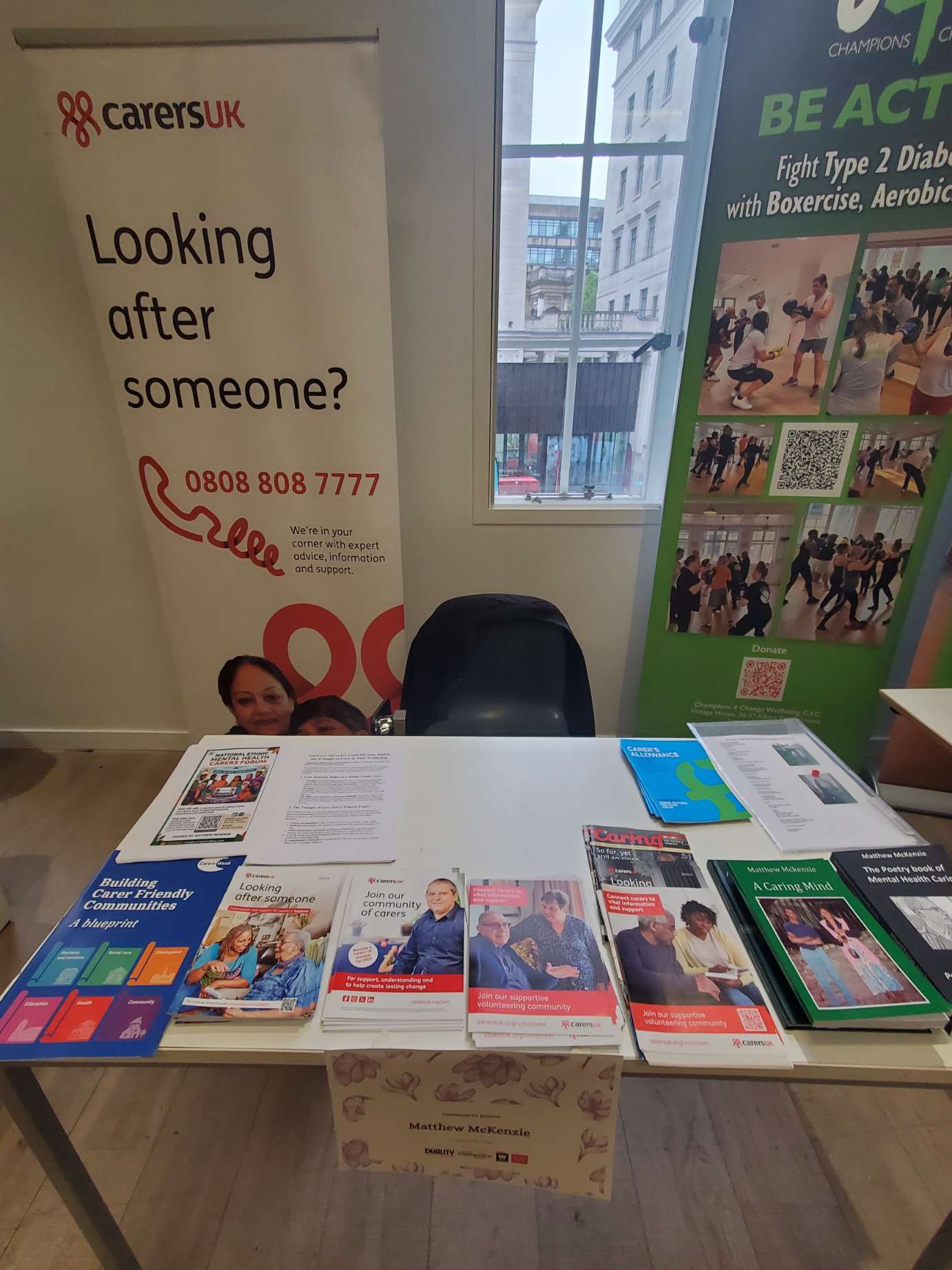
  • Community information booths — Organisations and community representatives provided information and resources. This was also where I supported the Carers UK stall.
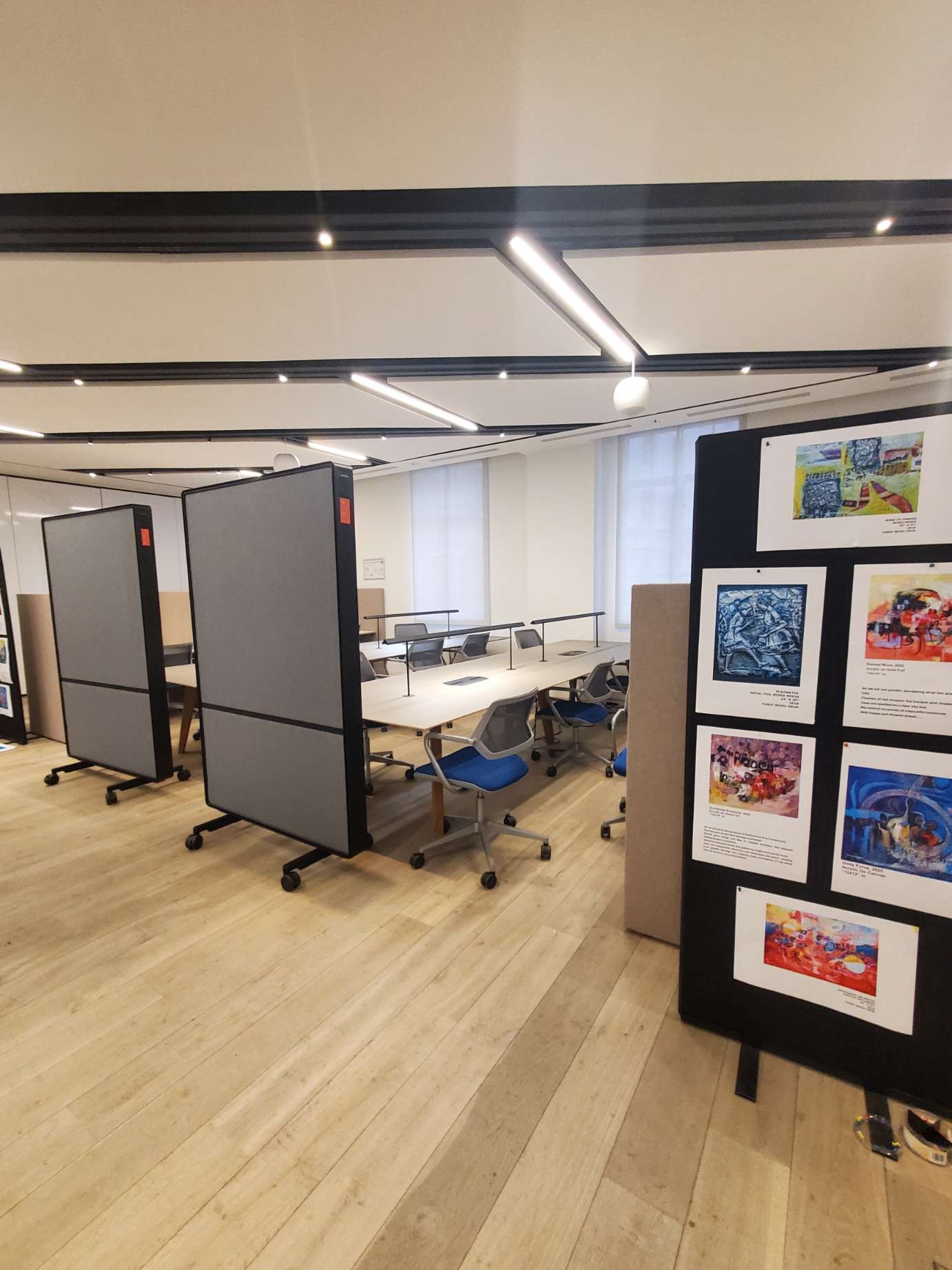
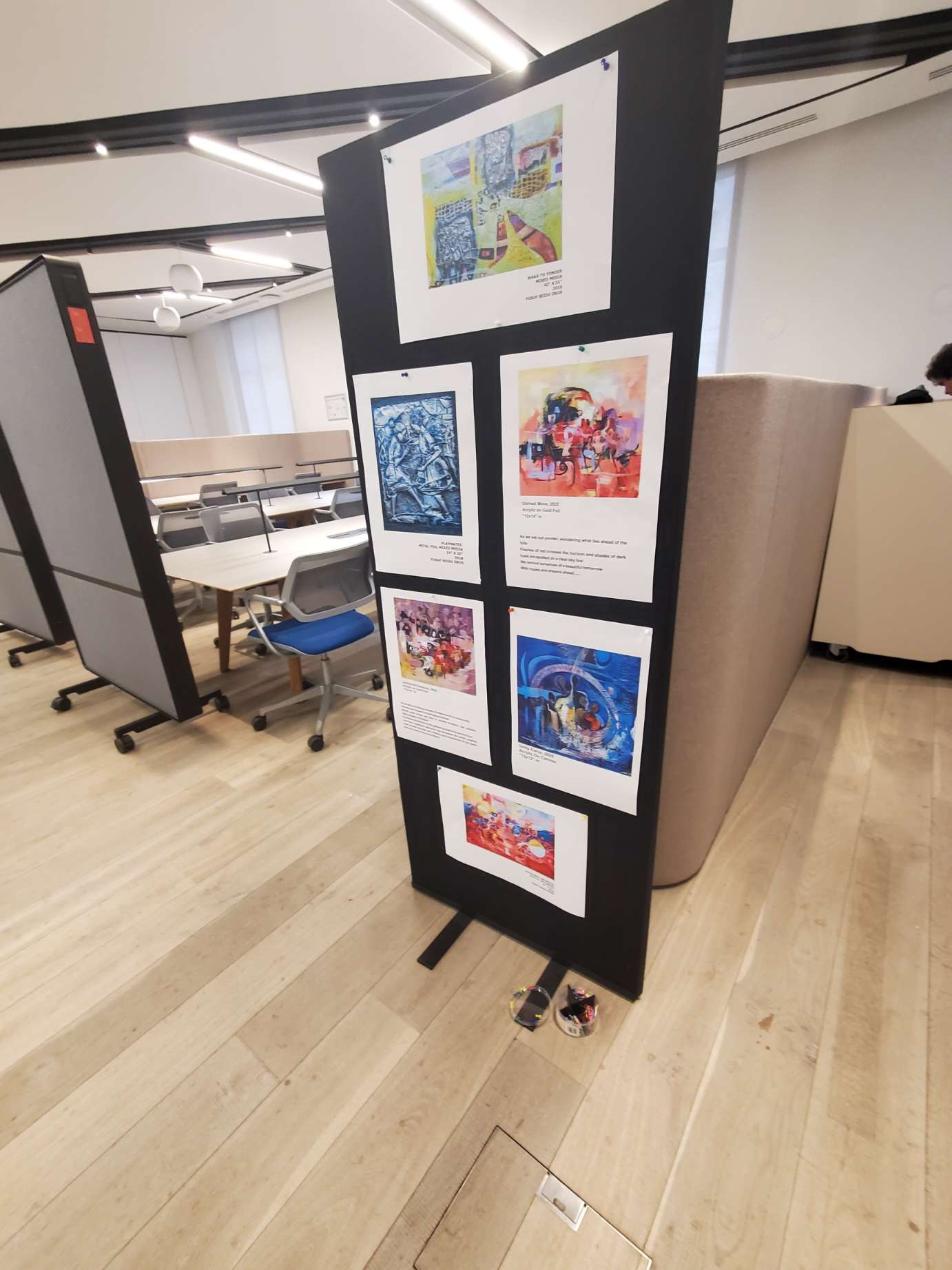
  • DUALITY Photography Exhibition — Photographs used visual storytelling to explore support, health, ageing and lived experience. My photograph “The Carer They Didn’t See” was included in the exhibition.
  • Photography Competition Awards — Winners of the DUALITY Photography Competition were announced, with “The Carer They Didn’t See” selected as one of the winning entries.
  • Creative performance — The programme included a creative lived-experience performance exploring identity, Caribbean heritage, racism, family, memory and culture.
  • Keeping Fit with Multiple Long-Term Conditions — This discussion brought professional and lived-experience perspectives together to explore chronic conditions, exercise, confidence and wellbeing.
  • Dinner and networking — The evening concluded with food and an opportunity for attendees, researchers, community groups and people with lived experience to connect.
This was quite a different event for me. I have attended many conferences, workshops and involvement events over the years as an unpaid carer, carer advocate and speaker. This time, however, I wasn’t simply attending or presenting.

I became a book.

More specifically, I became a Living Book as part of the event’s Human Library.

My title was:

The Carer They Didn’t See

And by the end of the evening, that title would take on another meaning I hadn’t expected.
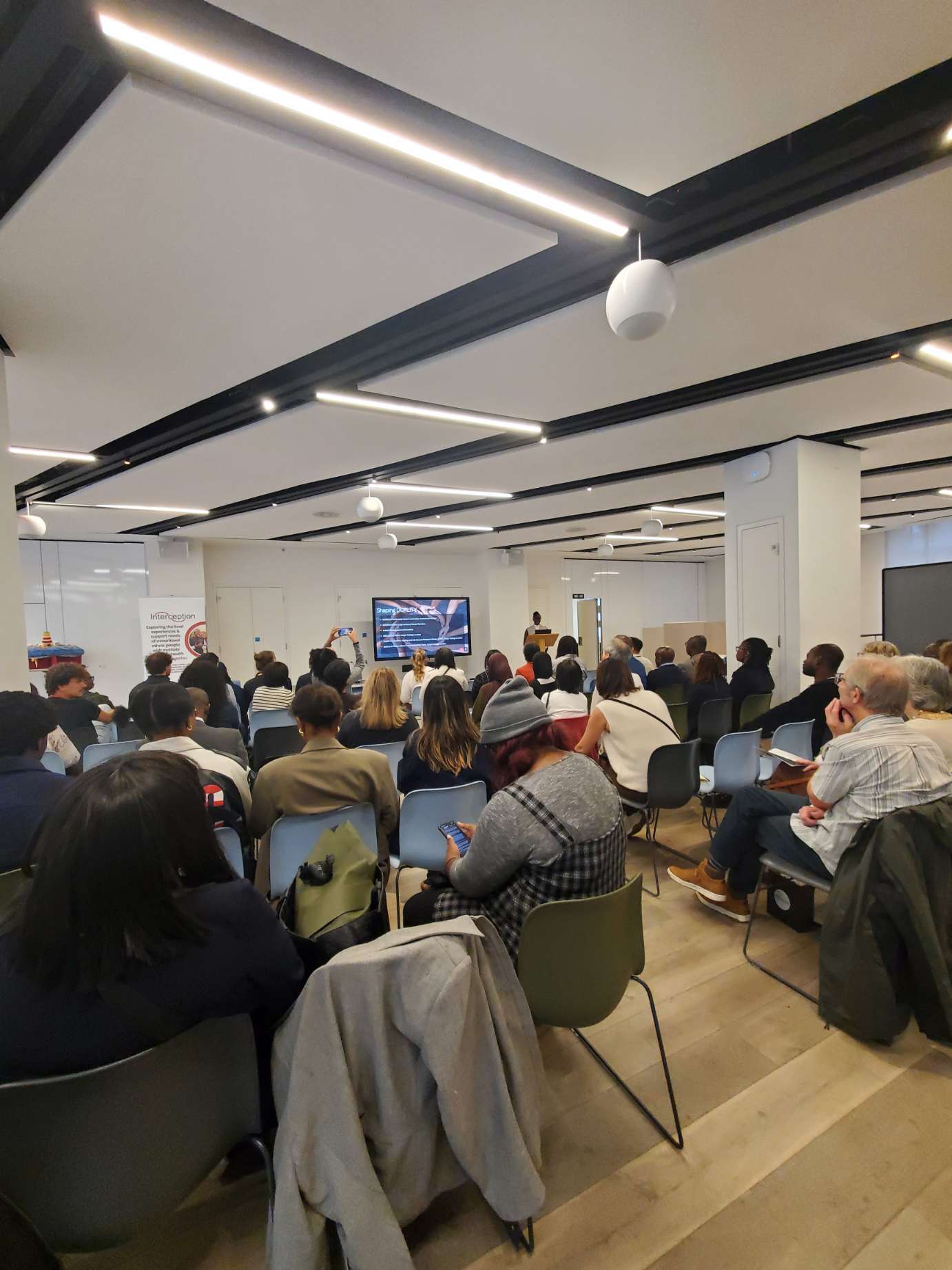
What was the DUALITY event?

DUALITY brought together research, lived experience, creativity, photography, health and conversations about ageing and multiple long-term conditions.

What I particularly appreciated was the emphasis on people’s experiences rather than simply presenting research about people.

Throughout the event there were presentations, discussions, creative displays and opportunities for people to connect with one another.

I also ran the Carers UK Stall along with other things I use to raise unpaid carer awareness
Photography was also an important part of the project. Participants from different parts of the world had taken part in workshops exploring photography as a way of capturing support, people’s inner and outer worlds, ageing and multiple long-term conditions.

But one of the most interesting parts for me was the Human Library.

When people become books
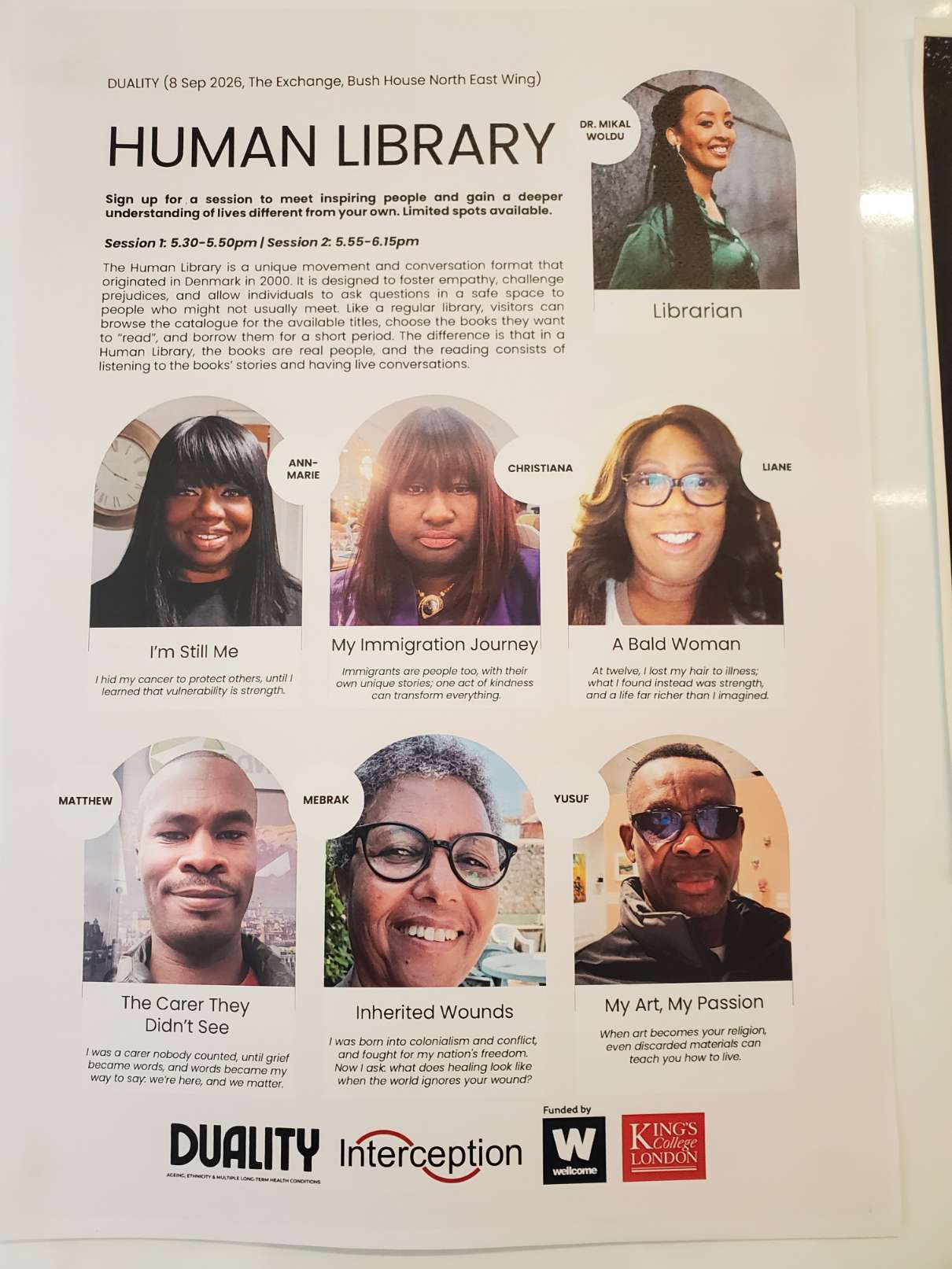
The Human Library turns the idea of a conventional library on its head.

Instead of borrowing a book from a shelf, you borrow a person.

The organisers explained that the Human Library is intended to foster empathy, challenge prejudice and provide a safe space in which people can ask questions of someone they might not ordinarily meet. Visitors browse the available titles and then spend a short period listening to that person’s story and having a conversation with them.

There were several Living Books available, each representing very different experiences.

My book was called The Carer They Didn’t See.

My short description read:

“I was a carer nobody counted, until grief became words, and words became my way to say: we’re here, and we matter.”
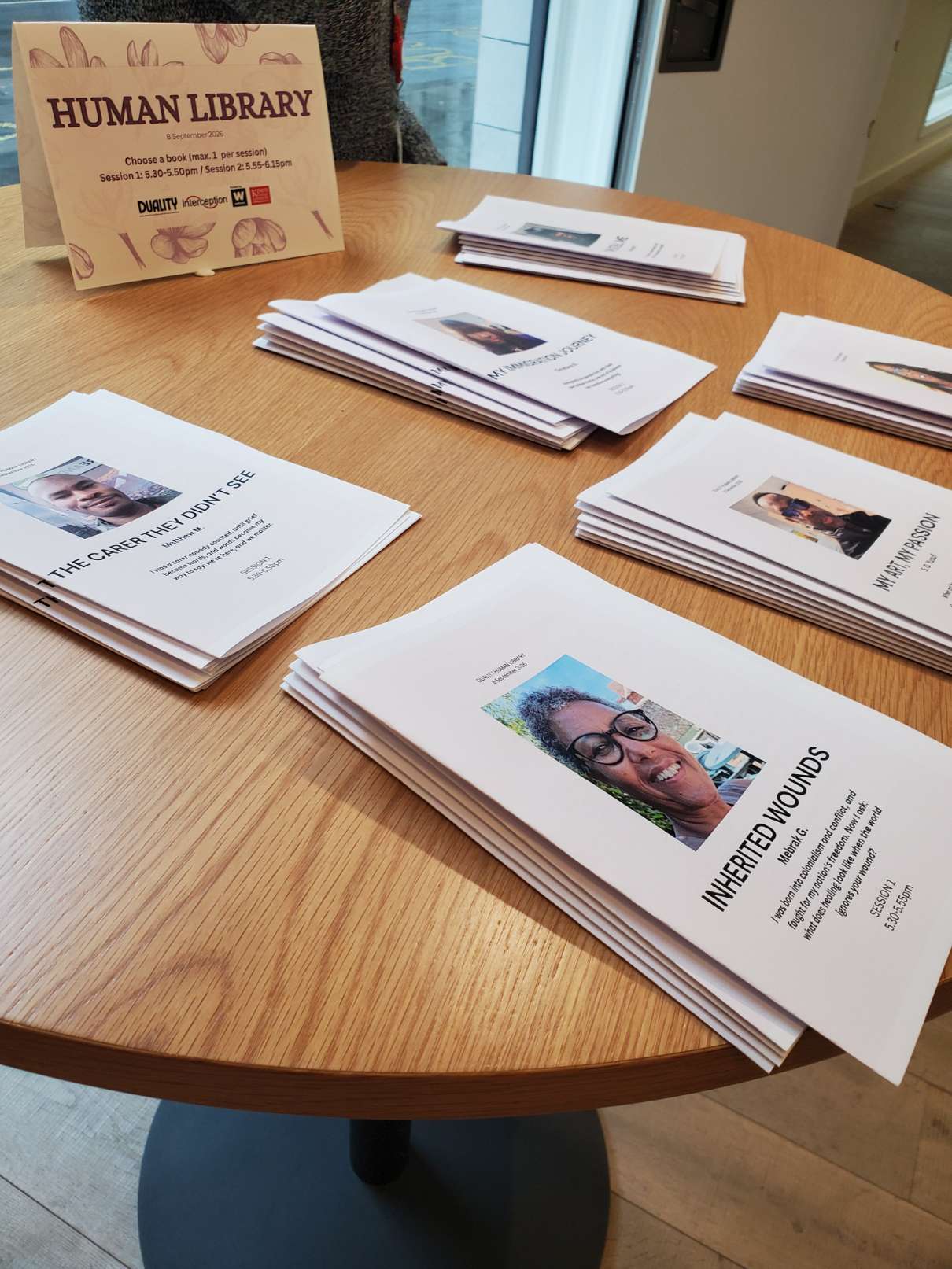
That sentence says a great deal about why I continue campaigning around unpaid carers.

For years I supported my mother, who lived with serious mental illness. Like many unpaid carers, much of what I did happened quietly and behind closed doors.

There was no uniform.

There was no job title.

Often there wasn’t even recognition that I was a carer.

Yet the responsibility was very real.

Being “read”

Being a Living Book is quite different from giving a presentation.

When presenting at a conference, I usually have slides, a topic and a limited amount of time in which to make particular points.

The Human Library was much more personal.

Someone chooses your “book” because something about its title interests them. They sit with you, listen and can ask questions.

That creates a different kind of conversation.

It also made me think about how powerful lived experience can be when people are given the space not merely to tell their story, but to have somebody genuinely listen to it.

The organisers themselves acknowledged that hearing stories we would not normally encounter can sometimes be challenging and thanked the Living Books for making the time and space for those conversations.

For unpaid carers, I think that is particularly important.

We spend a great deal of time discussing services, policies, strategies and systems. Those things matter enormously.

But behind every carer statistic is a human story.

The photograph of an unseen carer

There was another part of the event that became especially significant for me.

I had also entered a photograph into the DUALITY community photography competition.
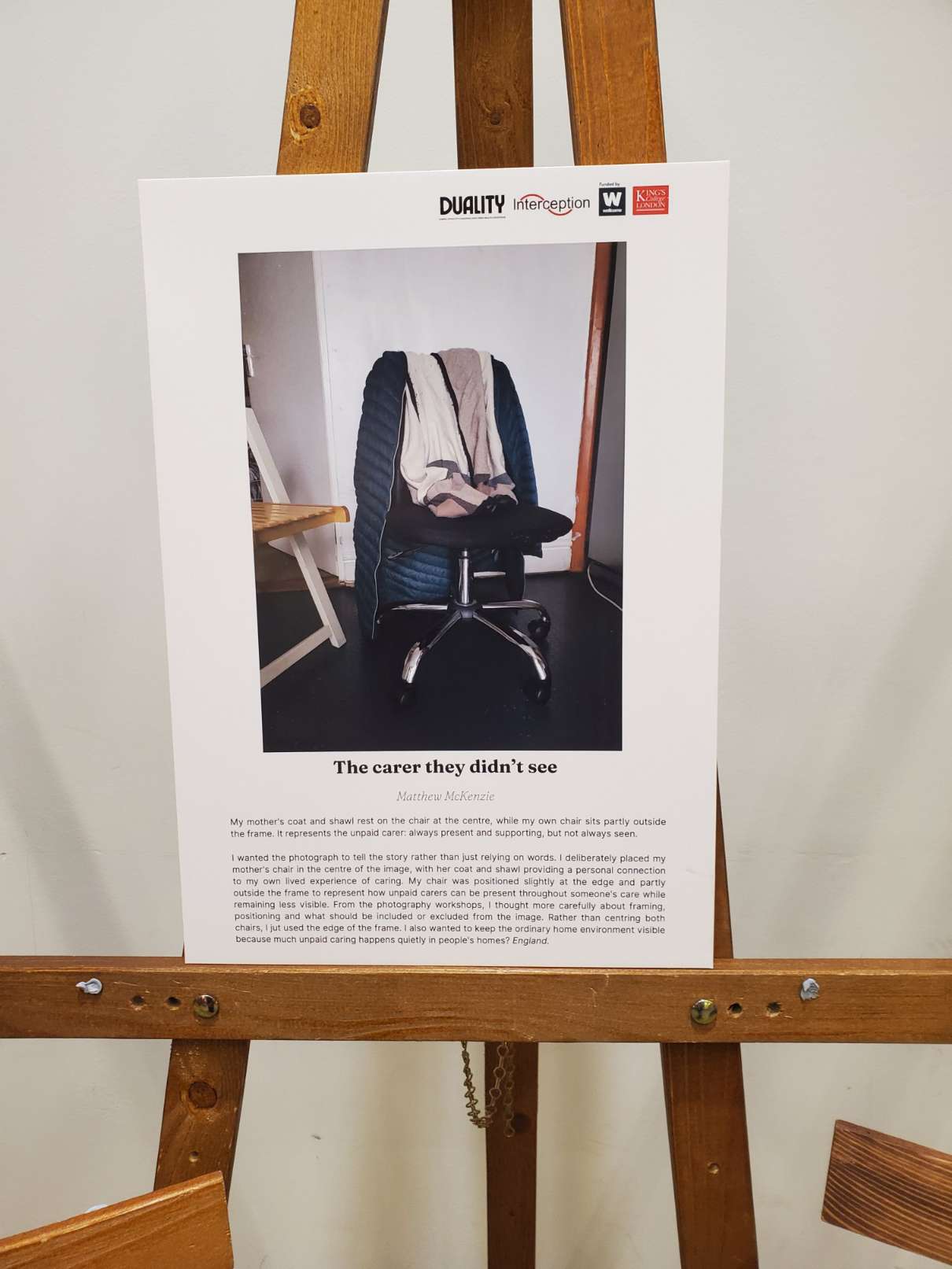
The photograph looks deceptively simple.

It shows my mother’s coat and shawl resting on a chair. My own chair sits partly outside the frame.

That positioning was deliberate.

My mother’s chair occupies the centre because she was the person receiving support. My own chair sits towards the edge because I wanted to represent something that many unpaid carers experience:

We are always there, but we are not always seen.

I also deliberately kept the ordinary home environment visible.

Caring doesn’t only happen in hospitals, clinics and professional environments.

A huge amount of caring happens quietly in people’s homes.

There may be no audience to see the difficult nights, the worry, advocacy, appointments, emotional support or constant vigilance.

But the carer is there.

When photography becomes lived experience

One thing I enjoyed about the photography project was learning that a powerful photograph doesn’t necessarily require expensive equipment or an elaborate setting.

The workshops explored techniques including framing, symbolic composition, symmetry, colour and other approaches to visual storytelling.

For me, however, the emotional meaning of the photograph mattered most.

The coat and shawl belonged to my mother.

The empty chair therefore represents much more than furniture.

It connects the photograph directly to my own experience of caring, bereavement and the work I now do to raise awareness of unpaid carers.

During the judging discussion, I was delighted to hear The Carer They Didn’t See specifically mentioned as one of the photographs demonstrating different dimensions of support.

I wasn’t expecting what happened next.

Winning the DUALITY Photography Competition

When the winners were announced, my name was called.

The Carer They Didn’t See had been selected as one of the winning entries.

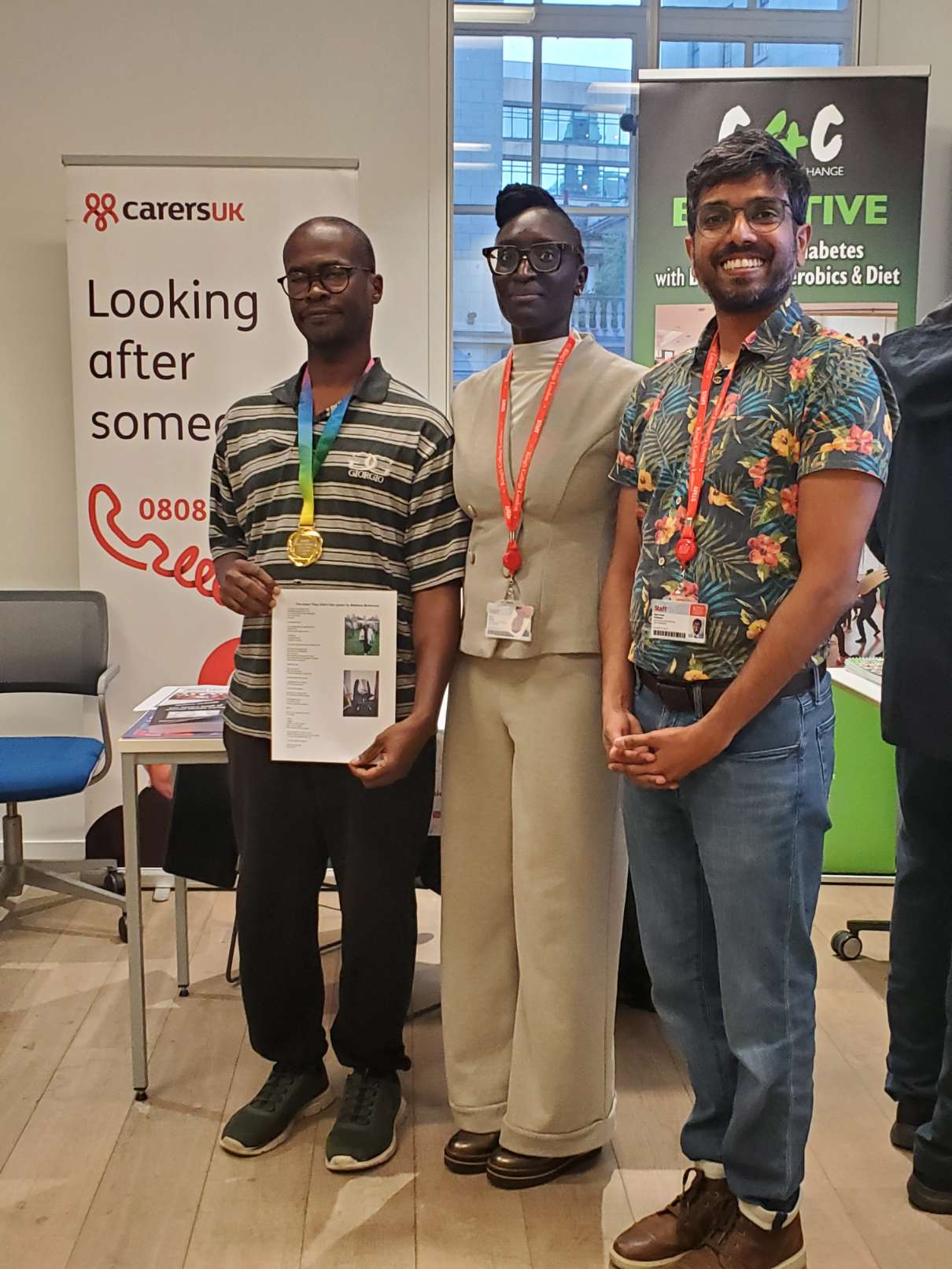
I received a medal engraved:

WINNER
Matthew McKenzie
Duality Photo Competition
2026

I was very surprised.

I won a four-week personal training block with a coach at the King’s Sports and Wellness Centre in Waterloo.

For me, though, the most meaningful prize was the recognition of the story behind the photograph.

It meant that an image representing an unpaid carer’s experience had been noticed.

And perhaps there is some irony in that.

I created a photograph called The Carer They Didn’t See.

And people saw it.
Listening to other lived experiences

The evening was certainly not only about my own story.

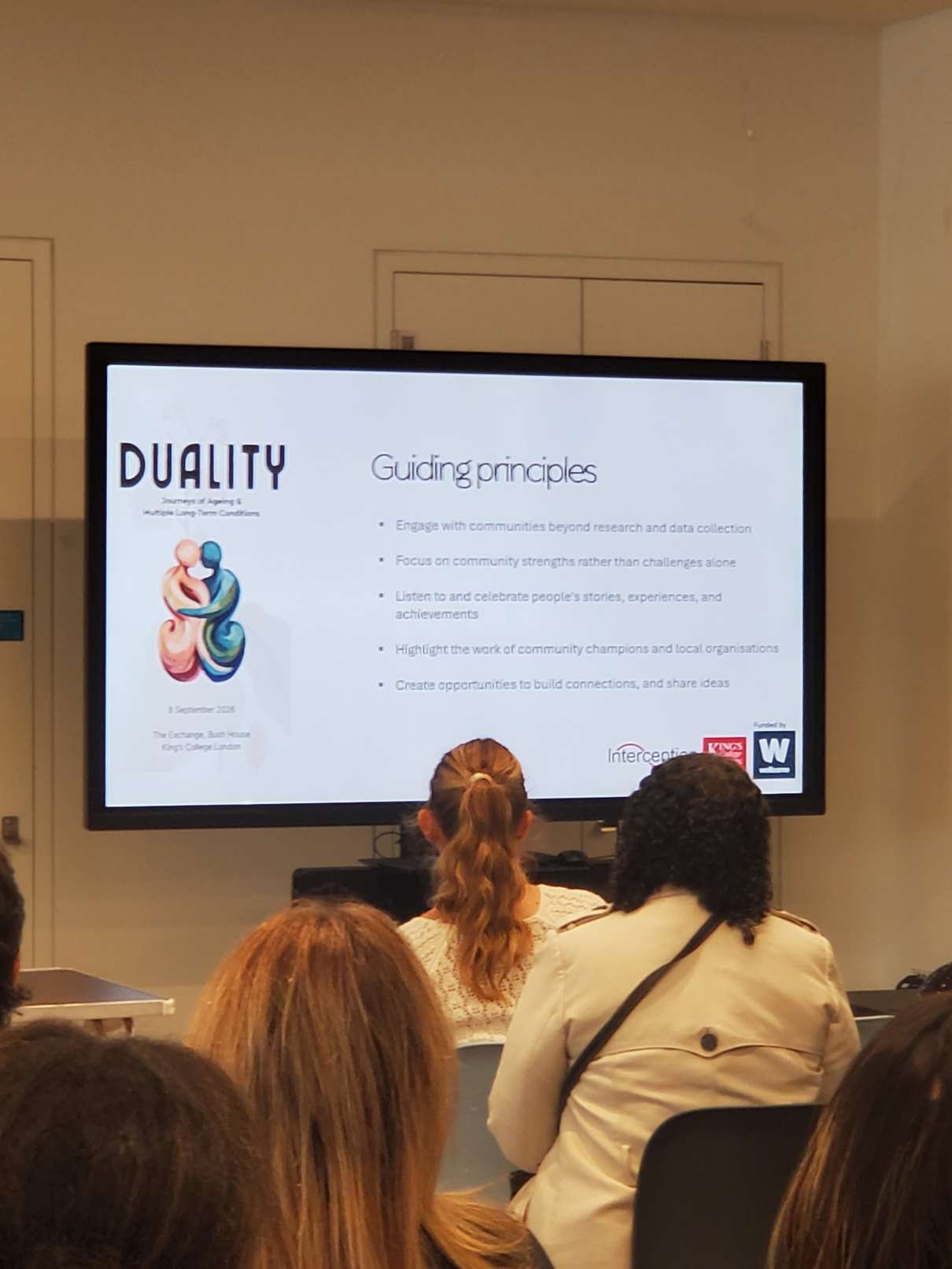
One of the strengths of DUALITY was hearing from people with very different experiences.

There was discussion about musculoskeletal conditions, multiple long-term conditions, physical activity, persistent pain and the importance of taking a more holistic approach to people’s health.
I was particularly struck by the lived-experience discussion about fibromyalgia.

One speaker described how developing chronic pain changed her life and even affected her sense of identity. She spoke about a long and frustrating journey through healthcare before receiving a diagnosis, and about sometimes feeling that her symptoms were being questioned or invalidated.

She also described how movement and supported exercise helped her reconnect with her body, understand her limits and rebuild confidence.

One comment particularly fitted the wider theme of the evening: we often cannot see what another person is experiencing.

Invisible conditions and invisible caring have something important in common.

Culture, identity and memory

Another powerful part of the evening explored culture, memory and identity.

We heard personal reflections on growing up in London’s East End, experiences of racism, Caribbean heritage, family, music and the ways culture can become a source of strength and protection.

That fitted beautifully with the idea of DUALITY.

From grief into creativity
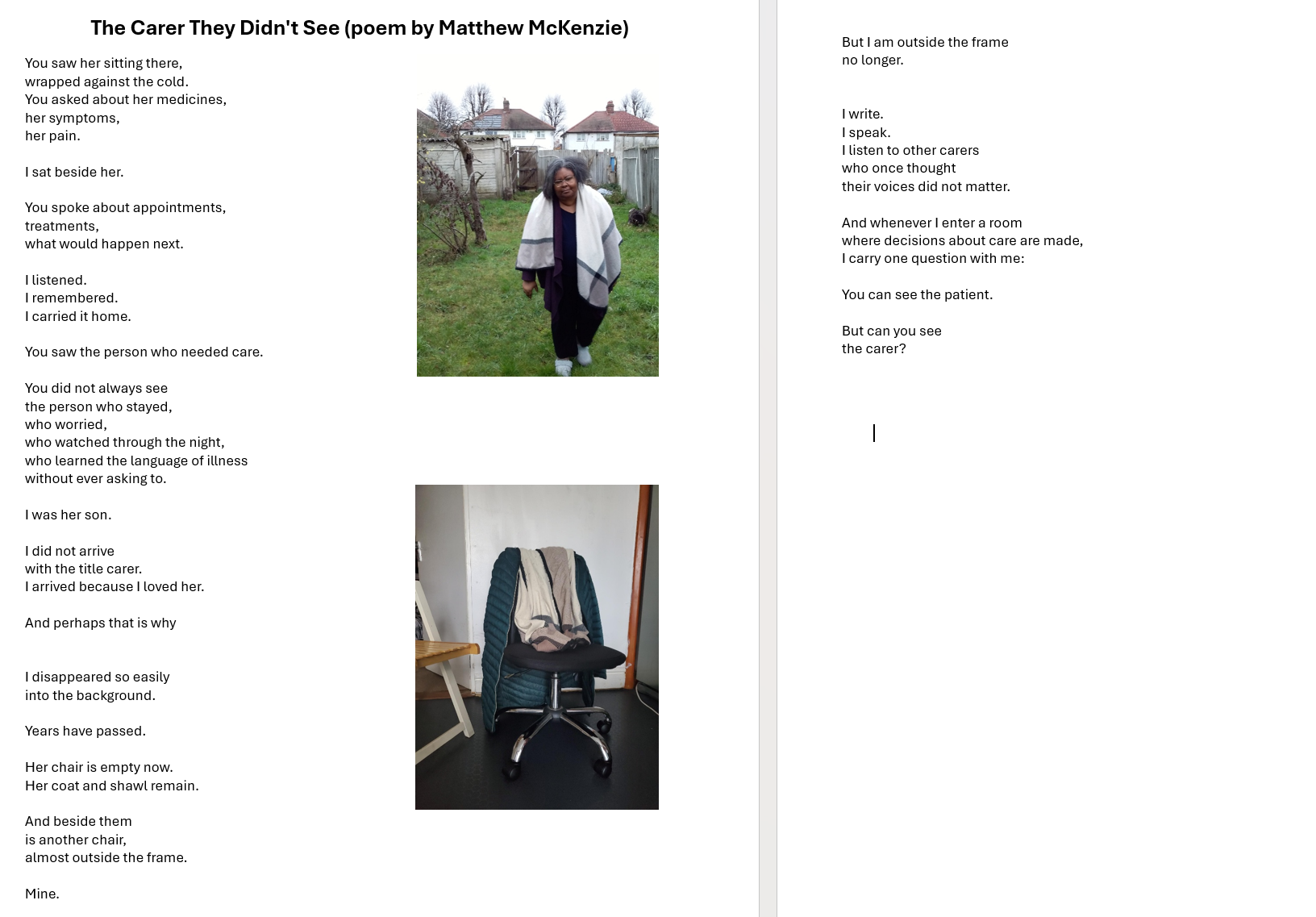
Since losing my mother, I have increasingly used writing, poetry, blogging and other creative approaches to explore my experiences of unpaid caring.

Creativity allows me to communicate things that sometimes don’t fit neatly into a presentation or policy document.

A photograph can do the same thing.

A chair.

A coat.

A shawl.

An empty space.
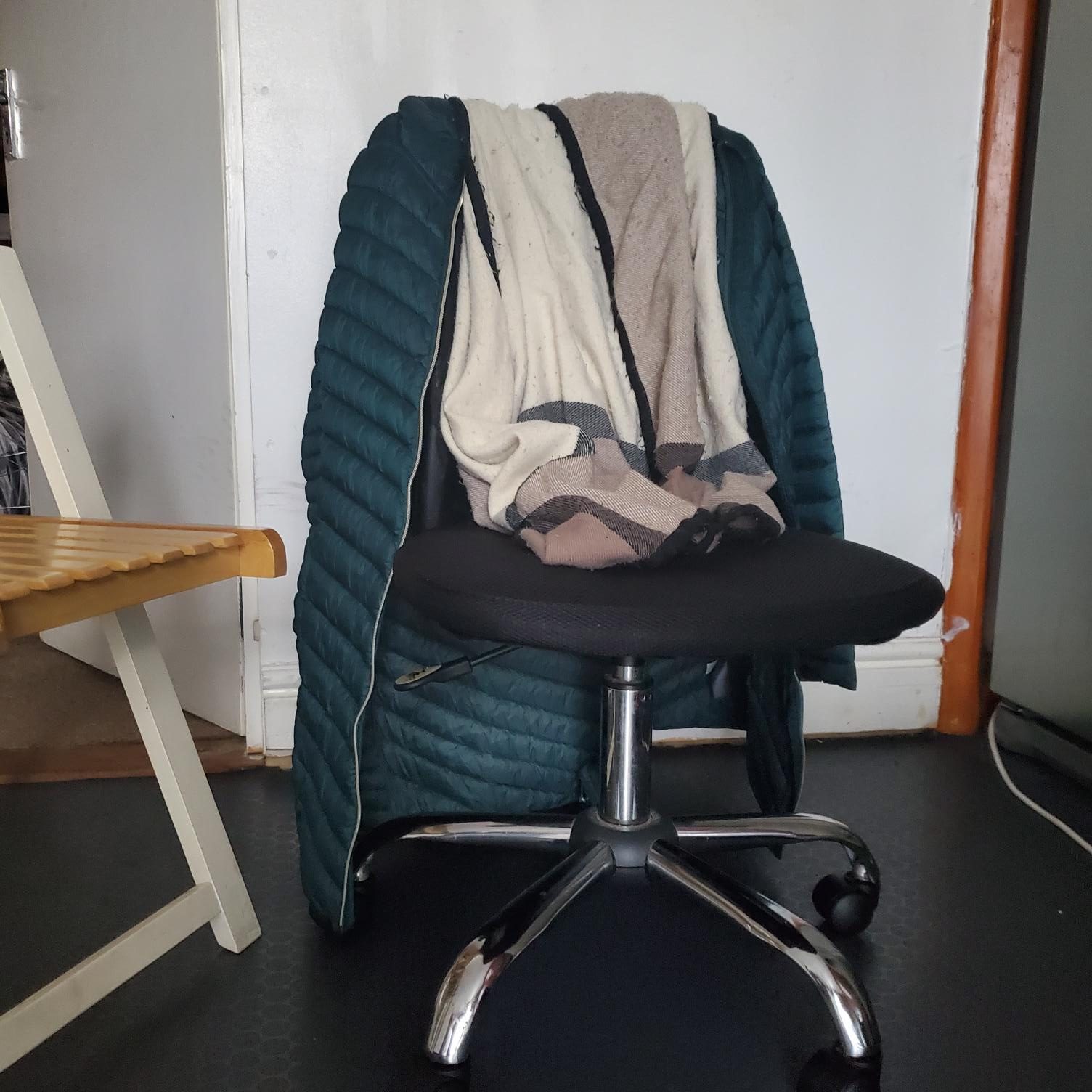
For somebody else, these may simply be everyday objects.

For me they contain memories of caring.

And when placed together within a frame, they say something about the millions of unpaid carers whose contribution can remain just outside society’s field of vision.

Recognition as a Living Book
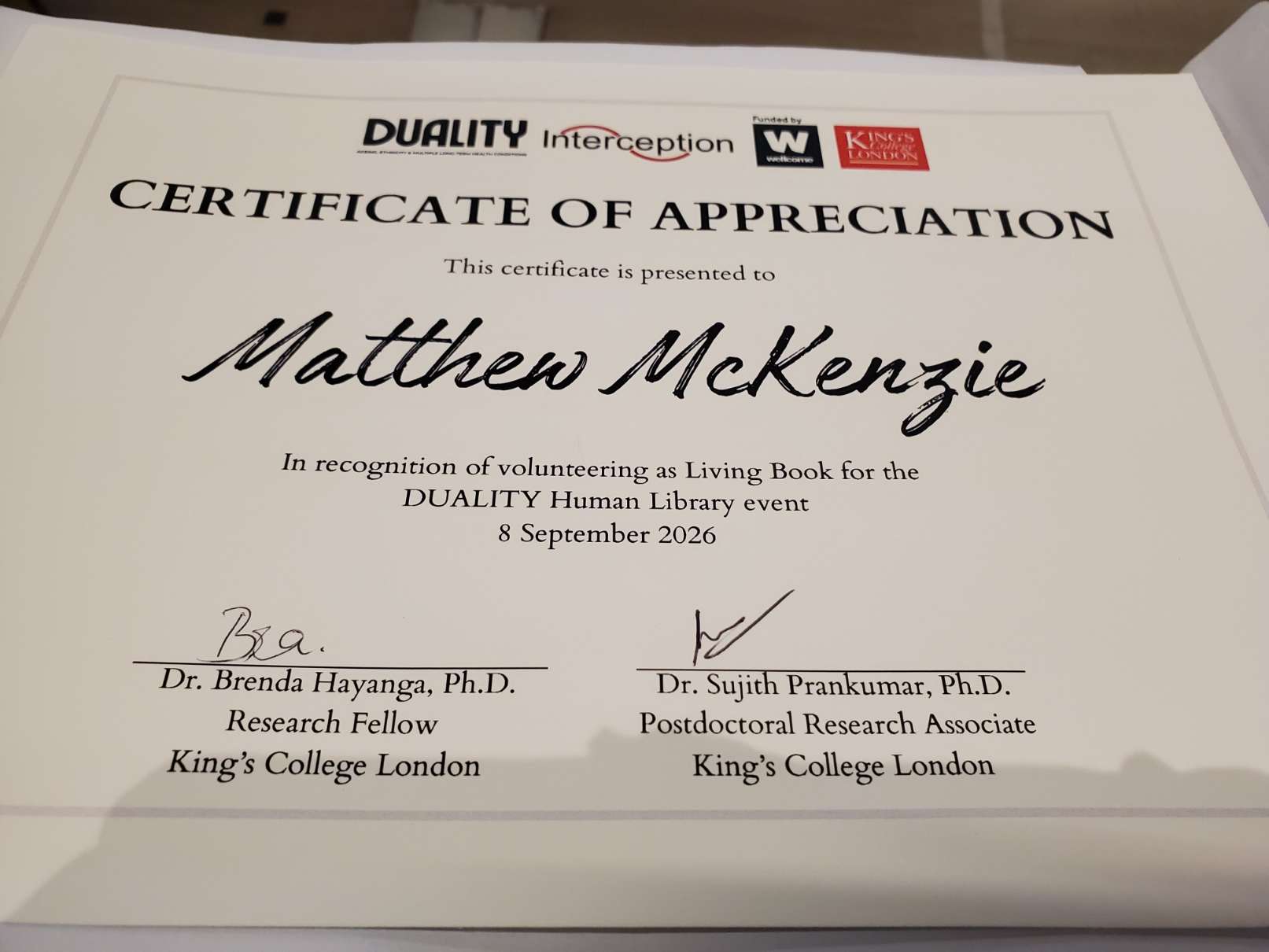
I was also very grateful to receive a Certificate of Appreciation recognising my contribution as a Living Book at the DUALITY Human Library.

That certificate and the photography medal represent two quite different parts of the same day.

One recognises telling a story.

The other recognises showing a story.

Both were ultimately about lived experience.

The carer they finally saw
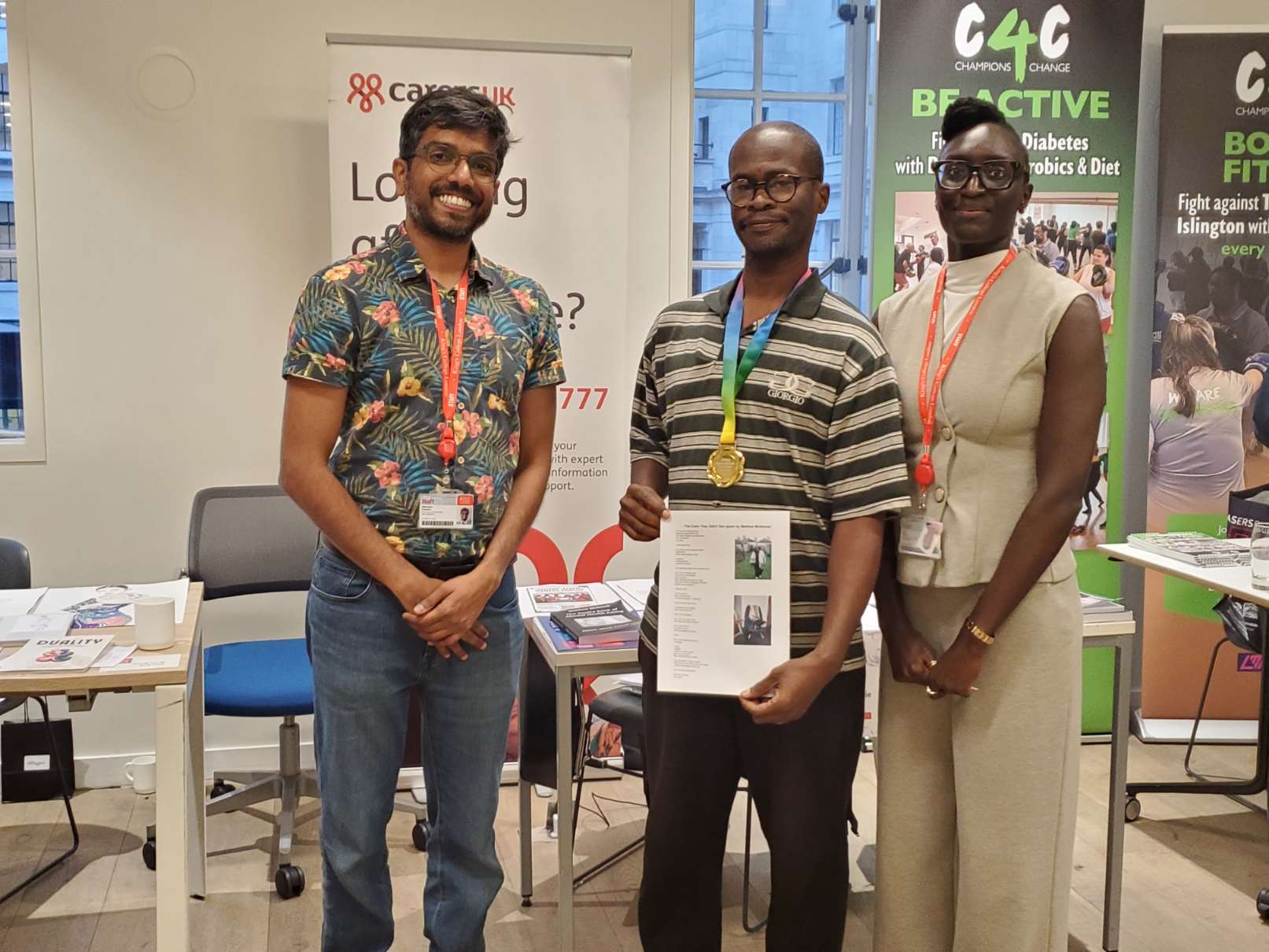
I left King’s College London thinking again about the title I had chosen:

The Carer They Didn’t See.

For many years, that description could have applied to me.

It could still apply to countless unpaid carers today.

They may be sitting beside someone in hospital.

They may be managing a crisis at home.

They may be trying to navigate mental health services.

They may be a son, daughter, parent, sibling, partner, friend or neighbour.

And sometimes they don’t even recognise themselves as carers.

Events such as DUALITY provide another way of making those experiences visible.

But people’s stories matter too.

I went to King’s College London expecting to share mine as a Human Book.

I didn’t expect to leave wearing a gold medal for a photograph inspired by that same caring journey.

Perhaps that is why the day meant so much to me.

For once, “The Carer They Didn’t See” was seen.

South London Mental Health Carers Forum – August 2026 Update

By Matthew McKenzie – Carer forum facilitator

On Monday 24 August, I facilitated another meeting of the South London Mental Health Carers Forum. The forum brings together unpaid carers and carer representatives from Lewisham, Lambeth, Southwark and Croydon, giving people a space to share experiences, learn about their rights and influence the development of local mental health services.

We welcomed carers with many different experiences, including parents supporting adult children with serious mental illness, autism and substance misuse, as well as people involved in advocacy, peer support, staff training and service development. Some members had been navigating the mental health system for many years, while others were newer to caring and looking for guidance.

A powerful message emerged from the introductions: even experienced carers can struggle to understand how different parts of the mental health system fit together. Services can feel fragmented, with carers passed between teams or excluded from discussions despite holding important information about their loved one’s history, warning signs and support needs.

Supporting the Supporters research

We were joined by Carol, an unpaid carer and postgraduate student studying psychology and neuroscience of mental health at King’s College London.

Carol introduced her research project, Supporting the Supporters: Professional Perspectives on Integrating Informal Care into the Mental Health Ecosystem. The study explores how professionals understand the contribution made by unpaid carers, how information and support could be improved, and how carers could be more meaningfully involved alongside mental health professionals.

As part of the research, Carol is interviewing people with professional or advocacy perspectives, including psychologists, psychiatrists, GPs, commissioners, teachers, service providers and carer advocates. I have already taken part in an interview, and several forum members expressed an interest in contributing.

The discussion highlighted why it is so important for carers’ experiences to be represented in academic research. Research can help shape future policy and practice, but carers also stressed that participants should be kept informed about what happens to the findings. Too often, people share deeply personal experiences with research projects and never hear about the outcome.

I also informed members about a separate University of Oxford study exploring wellbeing and social-group attendance among people caring for someone with a serious mental illness. We hope to hear more about this opportunity at a future meeting.

Triangle of Care: more than an accreditation badge

The main presentation focused on the Triangle of Care, a framework developed by Carers Trust to improve cooperation between the person receiving mental health services, the professionals supporting them and their unpaid carer.

As facilitator, I explained that the framework should be something carers experience in practice, not simply an accreditation badge displayed by an organisation.

South London and Maudsley NHS Foundation Trust has achieved Triangle of Care Star 1 for inpatient services and Star 2 for community services. With this work now being reviewed, there is an important opportunity for carers to help examine whether the standards are making a noticeable difference across local services.

Carers should be recognised and recorded, listened to when they provide relevant information, given clear explanations about confidentiality, offered appropriate information and support, and involved at important points in care and discharge planning. Staff should also understand that carers have needs and rights of their own.

Confidentiality should not become exclusion

Confidentiality produced one of the most detailed and passionate discussions of the meeting. Several carers described situations in which confidentiality had been used to shut down communication completely.

Respecting the service user’s privacy is essential, but confidentiality does not prevent professionals from listening to a carer’s concerns. A carer may hold vital information about changes in behaviour, medication, relapse indicators, risks or what the person is like when well.

Even when professionals cannot disclose personal clinical information, they can usually provide general information about how a service works, explain how a carer can submit concerns and signpost the carer towards available support. Carers should not simply be told, “We cannot speak to you,” and then left without guidance.

Members also discussed situations where a person experiencing a serious deterioration may withdraw consent for family involvement. These cases require careful professional judgement, particularly where there may be questions about safety, insight or decision-making ability. Carers felt that staff need more confidence and training to manage these situations without automatically treating the family as a problem.

Carers were encouraged to ask whether their role has been recorded, how they can share information with the clinical team, how they will be involved in care and discharge planning, and who they can approach if their perspective is being overlooked. Where serious concerns are ignored, carers should raise them in writing so there is a clear record.

Carer involvement in discharge

The discussion then moved to hospital discharge. Carers can sometimes be contacted shortly before someone returns home, without a proper conversation about whether they are able or prepared to provide the expected support.

A safer discharge should include an early discussion with the carer about the help they can realistically offer. Information about medication, warning signs, follow-up arrangements and points of contact should be explained clearly. Professionals should not assume that a family member can take on intensive caring responsibilities simply because they are related to the person.

Carers also need to know that they can request a carer’s assessment from their local authority. An assessment can help identify the effect caring is having on their own wellbeing and what support may be needed. Existing assessments should be reviewed when circumstances or caring responsibilities change.

What carers raised during the forum

A substantial part of the meeting was led by carers sharing what they had experienced while supporting relatives through mental health services. Although everyone’s circumstances were different, many common concerns emerged across Lewisham, Lambeth, Southwark and Croydon.

Several carers described the mental health system as fragmented and difficult to navigate. Families may deal with inpatient wards, community mental health teams, crisis services, supported accommodation, GPs and social care, but these services do not always appear to communicate effectively with one another. One carer reflected that even after years of involvement, it can still be difficult to know whom to contact when a new crisis develops. This raised concerns about how much harder the system must be for people who are new to caring.

Carers also felt that decisions made at senior levels do not always reflect what happens in practice. Policies, pathways and strategies may appear clear on paper, but families can experience delays, poor communication and a lack of coordination. Members wanted more people with direct experience of using or working within mental health services to influence decisions at the highest levels.

A major concern was the failure to listen when carers report early signs of deterioration. Carers often recognise changes in sleep, behaviour, medication use, substance misuse or communication long before a situation reaches crisis point. Some members described situations in which their warnings were overlooked, only for the person’s condition to worsen later. Carers felt that their observations should be recorded and considered as part of risk assessment and relapse prevention, even when professionals cannot share confidential clinical information in return.

Confidentiality was one of the most strongly debated issues. Carers understood that people using mental health services have a right to privacy. However, they felt that confidentiality is sometimes interpreted too rigidly and used to exclude families from almost every conversation.

The group stressed that professionals can still listen to information provided by a carer. They can also explain how the service operates, receive concerns, provide general guidance and direct the carer towards support. Saying “we cannot tell you anything” should not bring all communication to an end.

Some carers described being excluded after their relative had withdrawn consent for family involvement, sometimes during a period of serious illness or limited insight. Members questioned how consent is considered when someone’s mental state or decision-making ability may be changing. They felt staff should look carefully at the individual circumstances, risks and history instead of applying confidentiality as an automatic barrier.

The inconsistency between professionals was another concern. Some staff members communicate sensitively and recognise the value of family knowledge, while others refuse even to listen. Carers felt that the quality of their involvement should not depend on which professional happens to answer the telephone. Better training, management support and accountability are needed so that good carer practice becomes consistent across services.

There was also discussion about inaccurate or outdated information remaining in health records. Carers described how an early diagnosis, allegation or misunderstanding can continue to influence future treatment long after it has been challenged. Correcting such information can be extremely difficult, yet it may affect how professionals view both the person receiving care and their family. Members wanted clearer ways to challenge inaccuracies and ensure that corrections or alternative professional opinions are properly recorded.

Carers raised concerns about attitudes towards families. While relationships can sometimes be complicated, relatives should not automatically be viewed as interfering or obstructive. Where disagreements arise, members suggested that an independent person, advocate or senior professional could help everyone understand the different perspectives. Completely blocking communication can damage family relationships and may also undermine the person’s recovery and safety.

The experiences of carers from racialised communities were also recognised. One member spoke about the fear and mistrust that can develop when Black men repeatedly come into contact with mental health services or the criminal justice system. The forum acknowledged the importance of culturally responsive services that understand how race, stigma, previous experiences and unequal treatment can affect whether families feel safe seeking help.

Hospital discharge was another prominent concern. Some carers reported being contacted too late, with an expectation that they would immediately resume significant caring responsibilities. Members felt carers should be involved early enough to discuss what support they can realistically and safely provide. They should receive clear information about medication, warning signs, follow-up arrangements and who to contact if the person’s condition deteriorates.

Carers should not be treated as an unlimited resource. Being a parent, partner, sibling or other relative does not automatically mean someone is physically, emotionally or practically able to provide the level of support being assumed. The carer’s own health, employment, family responsibilities and wellbeing must be considered during care and discharge planning.

Members also discussed the importance of carer’s assessments. Some people had received very few assessments despite caring for many years. Carers were encouraged to request an assessment from their local authority and to seek a review when their responsibilities or personal circumstances change. An assessment creates a formal record of the caring situation and may identify support needed to protect the carer’s wellbeing.

Another recurring issue was accountability. Guidance about involving carers may exist, but families are not always sure what to do when services fail to follow it. Members were encouraged to put important concerns in writing, keep records of correspondence and ask for matters to be escalated when necessary. A clear written record can become particularly important if warnings have been ignored or a serious incident later occurs.

Despite these difficult experiences, the conversation also demonstrated the strength of peer support. Carers shared knowledge, validated one another’s concerns and helped newer members understand that they were not alone. The group strongly encouraged carers not to remain isolated, even when their loved one appears relatively well. Joining a carers’ centre, peer-support group or advocacy forum can provide information and connections before another crisis occurs.

The overall message from carers was clear: they are not asking to take over clinical decisions. They are asking to be recognised as people with valuable knowledge, their own support needs and an important role in safer care. The Triangle of Care will only have meaning if carers can see and feel these principles operating in their everyday contact with services.

Turning shared experience into influence

This meeting demonstrated why independent, carer-led forums remain so important. They reduce isolation, allow newer carers to learn from those with longer experience and help identify patterns that may otherwise be dismissed as individual incidents.

Members involved in SLaM meetings and the forthcoming carers’ listening event were encouraged to raise the Triangle of Care and ask how carers will contribute to its review. I will also seek to invite representatives leading this work at SLaM to a future forum so that they can update carers directly and respond to questions.

Our next South London Mental Health Carers Forum is due to take place on Monday 28 September 2026. We will continue examining the Triangle of Care, with a stronger focus on carers’ experiences and the practical changes they want to see across mental health services.

I would like to thank everyone who attended and spoke so openly. The experiences shared were sometimes difficult, but they reinforced an important principle: carers should not have to fight simply to be recognised, heard and supported.

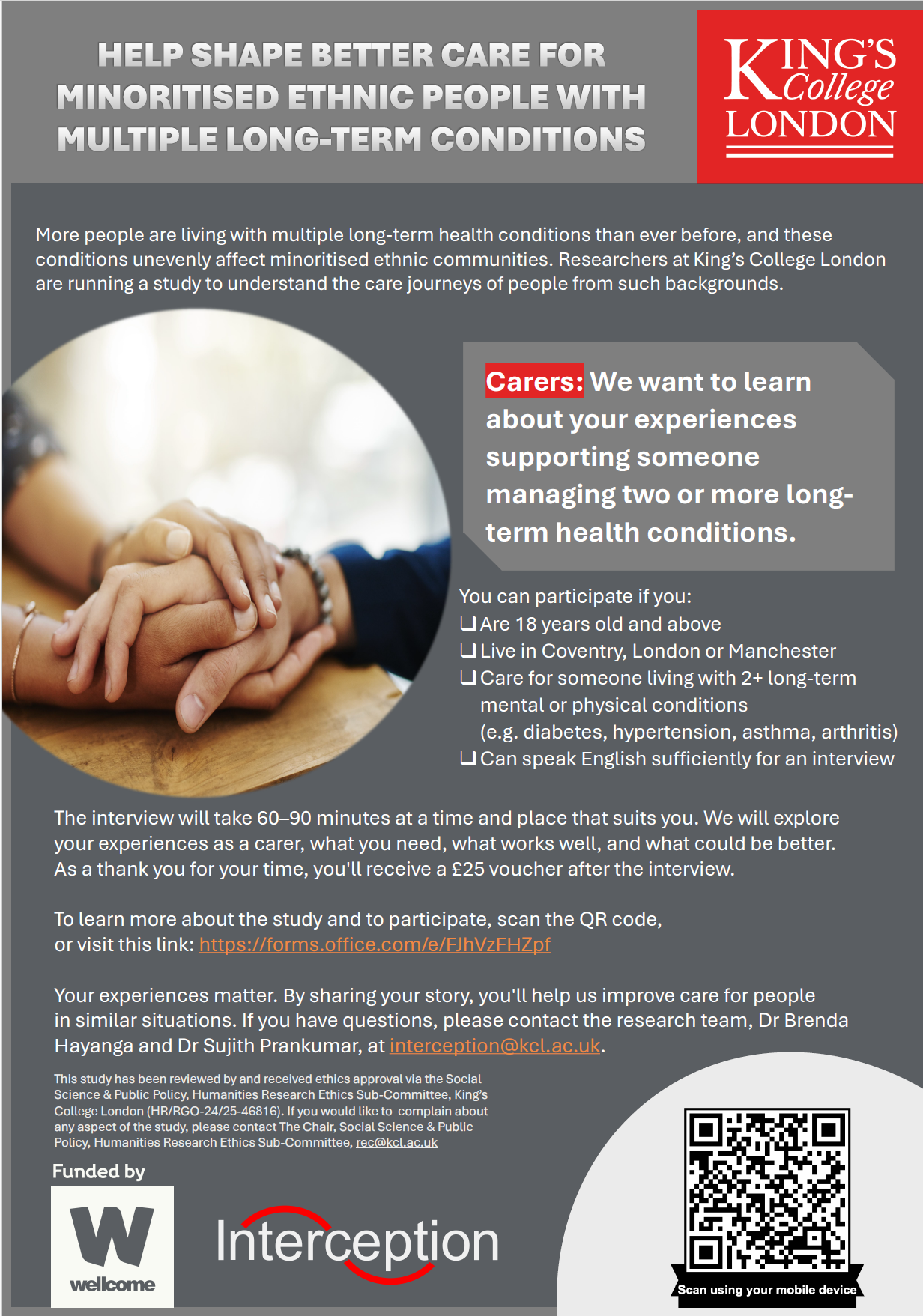
Help Shape Better Care for People with Multiple Long-Term Conditions

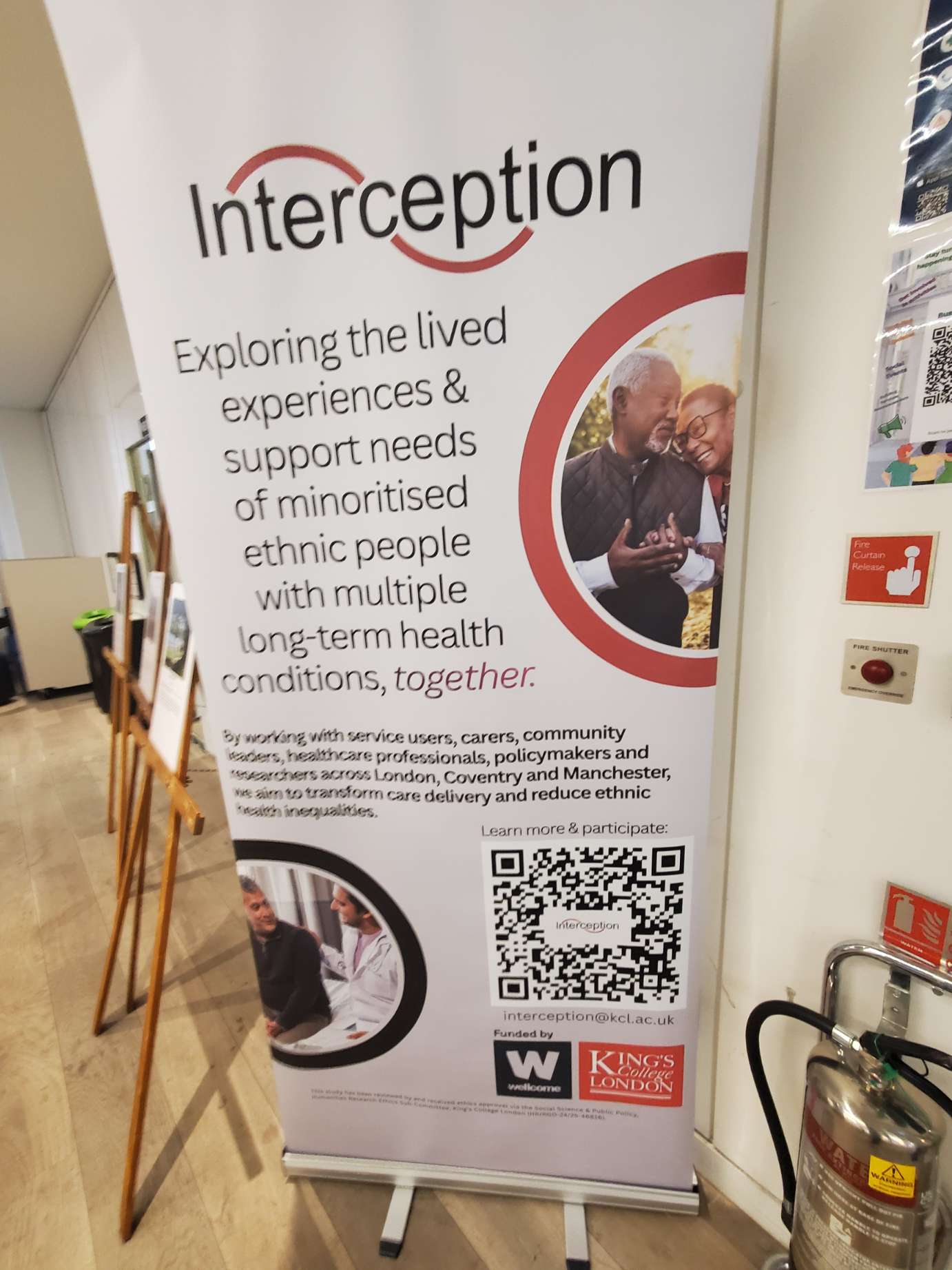
Caring for someone with multiple long-term health conditions can be both rewarding and challenging. More people than ever are living with conditions like diabetes, asthma, arthritis, or hypertension and these health challenges often affect minoritised ethnic communities disproportionately.

King’s College London is running the INTERCEPTION study to better understand the experiences of carers like you and the people you support. The goal is to improve how community leaders, healthcare professionals, and policymakers perceive and support those living with multiple conditions.

Your Voice Matters

Your experiences as a carer provide invaluable insights into what works, what could be better, and what support is most needed. By sharing your story, you help shape the future of care for people in similar situations, both locally and nationally.

Who Can Take Part

You can join the study if you:

  • Are 18 years old or above
  • Live in Coventry, London, or Manchester
  • Care for someone with two or more long-term physical or mental health conditions
  • Can communicate in English for an interview

What Participation Involves

The study involves a one-to-one interview lasting 60–90 minutes at a time and place that suits you. Everything you share will be kept confidential. As a thank you for your time, participants receive a £25 voucher.

How to Get Involved

To learn more or sign up, scan the QR code on the flyer or visit this link . If you have any questions, you can contact the research team, Dr Brenda Hayanga and Dr Sujith Prankumar, at interception@kcl.ac.uk.

Your experiences truly matter. By participating, you help researchers understand what carers need and influence better care for minoritised ethnic communities living with multiple long-term conditions.

Why Unpaid Carers Must Be in the Lecture Theatre – Not Just the Waiting Room

By Matthew McKenzie, A Caring Mind (Carers UK Ambassador)

As an unpaid mental health carer, I have spent years navigating hospital corridors, GP practices, care plans, juggling crises, and long silences where carers are too often left out. I am sure unpaid carers are expected to hold families together, while notice early warning signs, and keep loved ones safe. Still I always mention most of us receive no formal training, and our knowledge is rarely recognised as expertise.

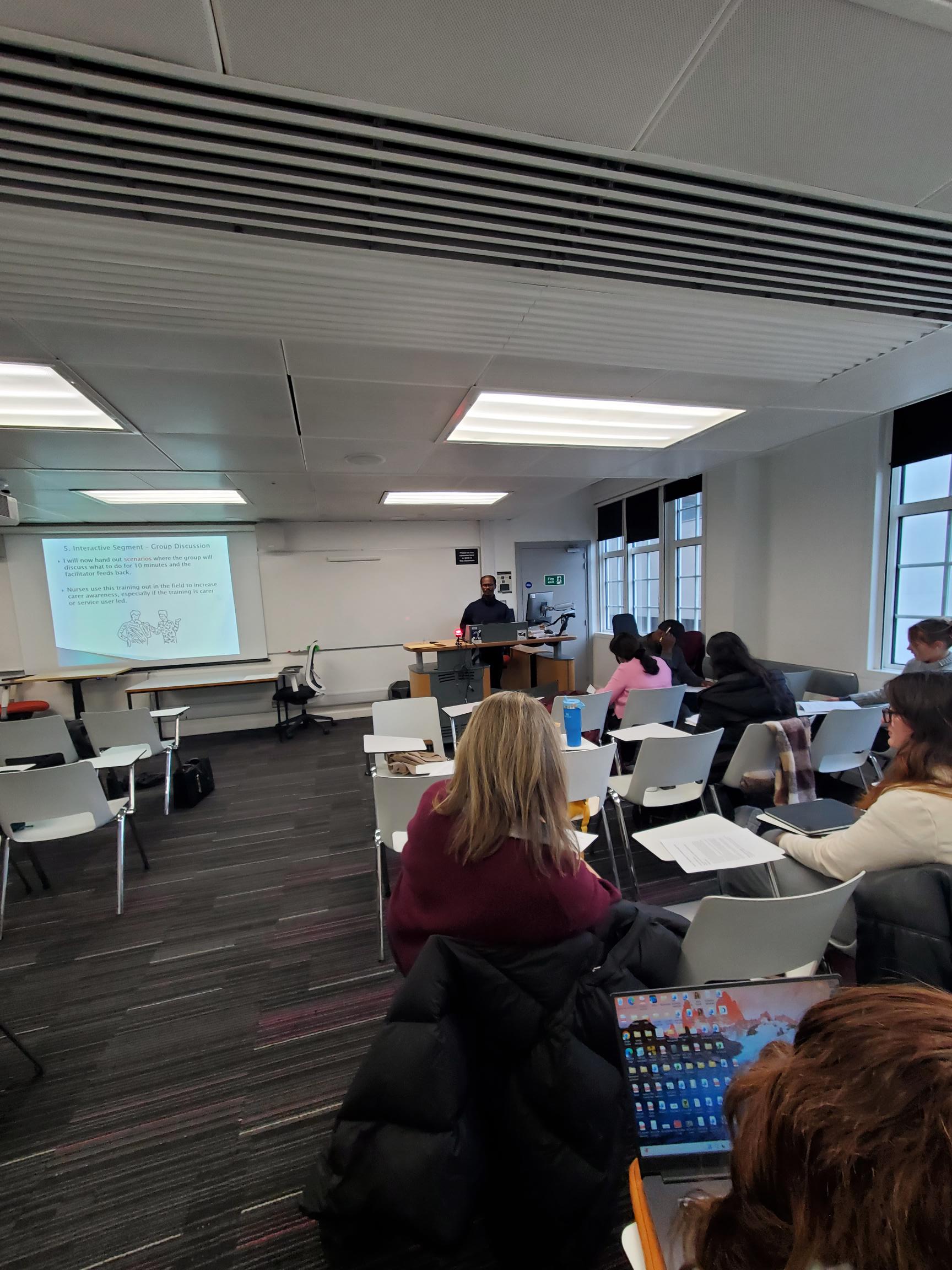
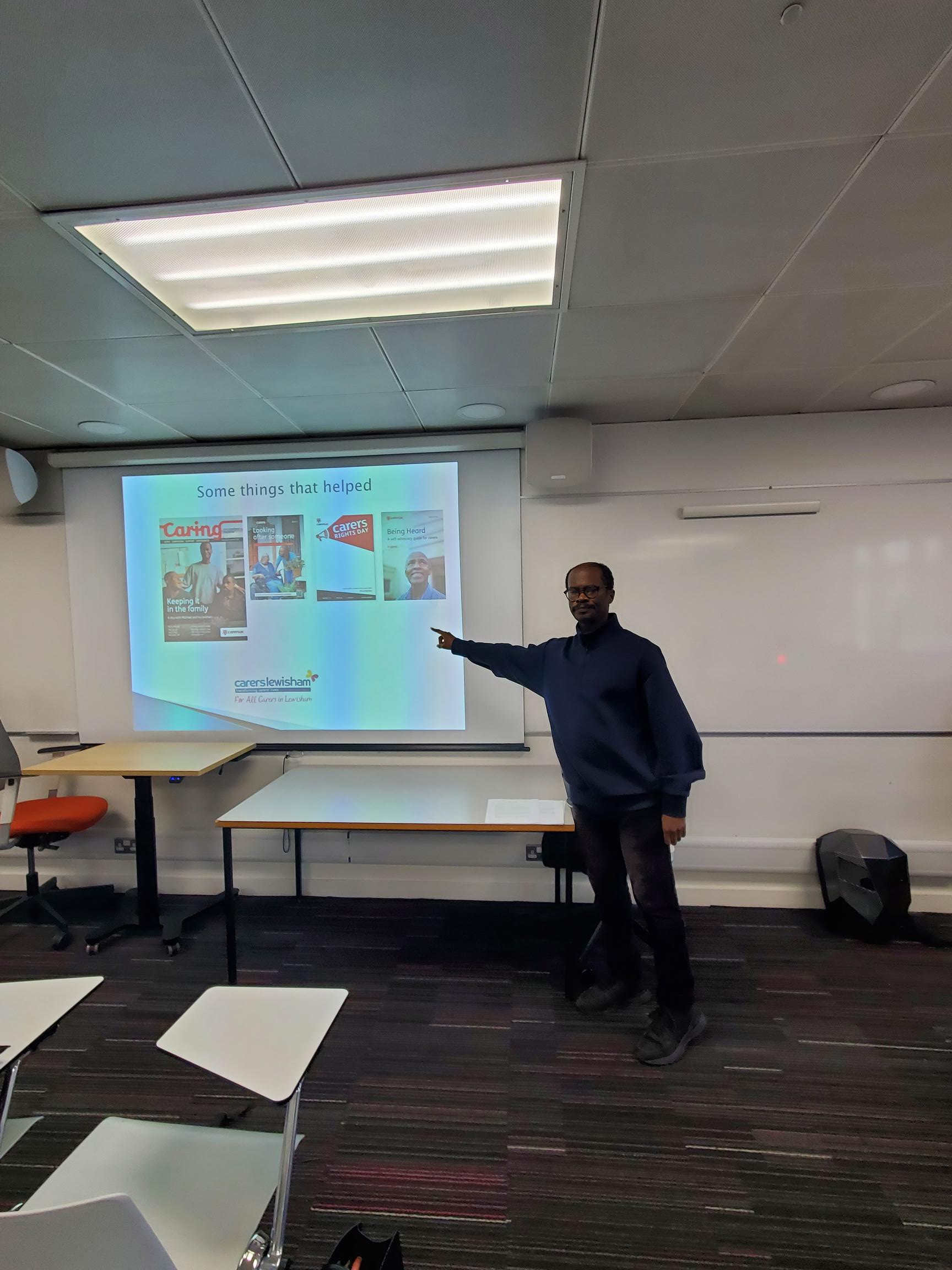
That is why recently teaching a module for the Masters course to mental health nursing students at King’s College London felt so important. Not after they qualify. Not once they are overwhelmed in practice. But before they step out into the field. The session took place 15th of January.

Why carer-led teaching matters

Unpaid carers sit at the sharp edge of the mental health system. We see what works, what harms, and what gets missed when professionals don’t fully understand the family context. When students hear directly from carers, learning moves beyond textbooks into real life into the emotional, practical, and ethical realities of care.

Training mental health professionals without carer voices is like teaching navigation without a map.

What I taught: lived experience as learning

The session I delivered was built entirely from a carer’s perspective and centred on one core message: you cannot deliver effective mental health care without working with carers.

The module covered:

  • My lived experience as an unpaid mental health carer
    How I became a carer, the emotional impact, the daily responsibilities, and the toll caring can take on mental and physical health.
  • The hidden impact on carers
    Burnout, stigma, isolation, guilt, and the reality that many carers are supporting professionals while receiving little support themselves.
  • Carers as partners, not problems
    Exploring what happens when carers are ignored – and how outcomes improve when they are listened to, informed, and included.
  • The Triangle of Care
    A strong emphasis on the Triangle of Care framework: the partnership between service user, carer, and professional. I challenged students to see carers as a vital link in the chain, not an optional extra.
  • Carers UK and carer identification
    Highlighting the role of Carers UK in advocacy, rights, resources, and why professionals must help carers identify themselves early so they can access support.
  • Practical skills for future nurses
    Listening without defensiveness, sharing information appropriately, involving carers in care planning, and understanding when carers need support themselves.
  • Interactive discussion and reflection
    Students worked through real-life scenarios, asking: What would I do differently now that I understand the carer experience?

The shift we need in education

Most unpaid carers are not trained for their role. We learn through crisis, exhaustion, and trial and error. Mental health professionals, however, are trained, which means universities have a responsibility to ensure that training includes those of us living this reality every day.

Carer-led teaching builds empathy, improves communication, and ultimately leads to safer, more effective care. When students learn early that carers matter, they carry that mindset into practice.

A final thought

Unpaid carers are already part of the mental health workforce, it’s just the title unpaid, unsupported, and often unheard. So I feel bringing carers into universities is not a “nice extra”. It is absolutely essential.

If we want a mental health system that truly works, we must start by listening to those who never clock off.