Tag Archives: NHS trusts

National Ethnic mental health Carer Forum : November Update 2025

Chaired by Matthew McKenzie, Lived-Experience Carer

The latest meeting of the National Ethnic Mental Health Carer Forum brought together unpaid minority carers, community partners and four NHS mental Trusts (Avon & Whiltshire were kind enough to be included to update) to explore progress toward the Patient & Carer Race Equality Framework (PCREF), share challenges, and elevate lived-experience voices. As always, I ensured the space remained honest, fast-paced and rooted in what truly matters to ethnic minority carers: being heard, understood and included.
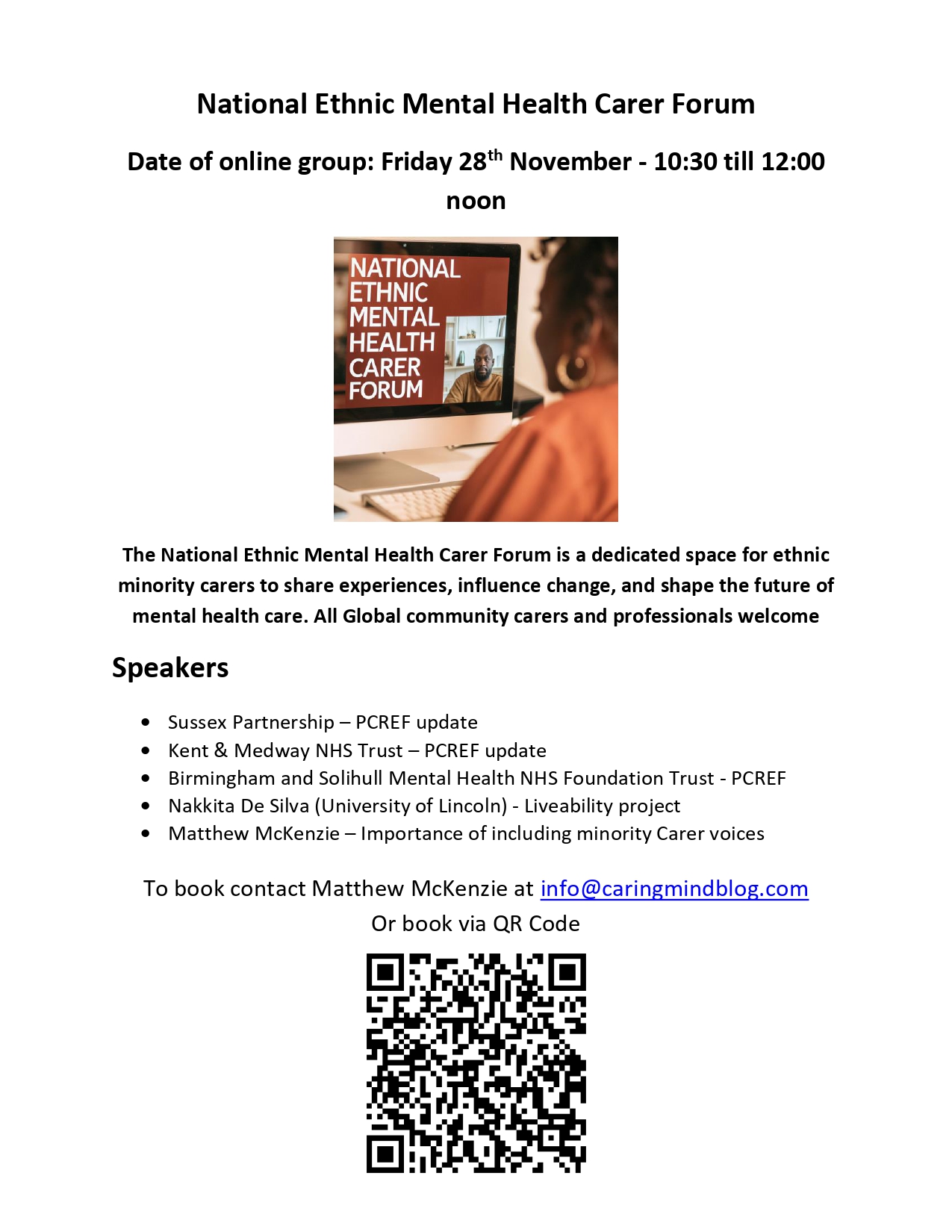
My latest blog for the November forum captures key highlights from each Trust, along with questions raised by attendees, reflecting the critical concerns and lived realities that continue to shape PCREF work across the country.


1. Avon & Wiltshire Mental Health Partnership Trust (AWP)

Focus: Triangle of Care, PCREF oversight, carer champion roles.

Avon & Wiltshire outlined how their PCREF programme is being driven through a clear governance structure, including a central Oversight Group and locality-based meetings. These layers ensure that learning from communities and staff filters upward and influences whole-trust priorities. Their collaboration with Nilaari (I think that is what their called), a long-standing community organisation supporting racially marginalised groups, has been key in grounding their PCREF work in authentic community voice.

A central pillar of their presentation was the strengthening of the Triangle of Care and carer-related PCREF oversight. They recognised that carer involvement cannot rely on goodwill or isolated champions; it requires structurally defined roles, written responsibilities, and consistent organisational expectations. The Trust is working on ensuring that every team and ward embeds a carer champion, whose purpose is not to “do everything for carers”, but to support cultural change within the workforce so that carers are recognised as equal partners.
They emphasised the importance of building staff capacity in cultural humility and safe conversations about race. AWP acknowledged that staff often feel unprepared to discuss ethnicity, discrimination or identity with carers. To address this, the Trust has created psychologically safe internal spaces, particularly for racially marginalised staff—to process experiences and explore how structural and interpersonal inequalities impact both staff wellbeing and patient care. This cultural environment is foundational to PCREF implementation because it shapes how confidently staff engage with diverse carers.

Key Points:

  • Carer champions must support, not replace, teams in working with carers.
  • Emphasis on psychological safety for racially marginalised staff and carers.
  • Encouraging honest conversations around race, trauma, and culture across staff teams.

Questions raised by attendees:

  1. How do you embed cultural awareness within staff teams, not just for carers?
    – Concern that staff dynamics and cultural differences must be addressed to create consistent culturally responsive care.
  2. How do staff and leaders hold ‘difficult conversations’ about race and safety?
    – Attendees wanted clarity on how psychological safety is practiced and how managers are supported.

🌟 2. Birmingham & Solihull Mental Health NHS FT

(Children & Young People’s Division – “Co-STARS” programme)

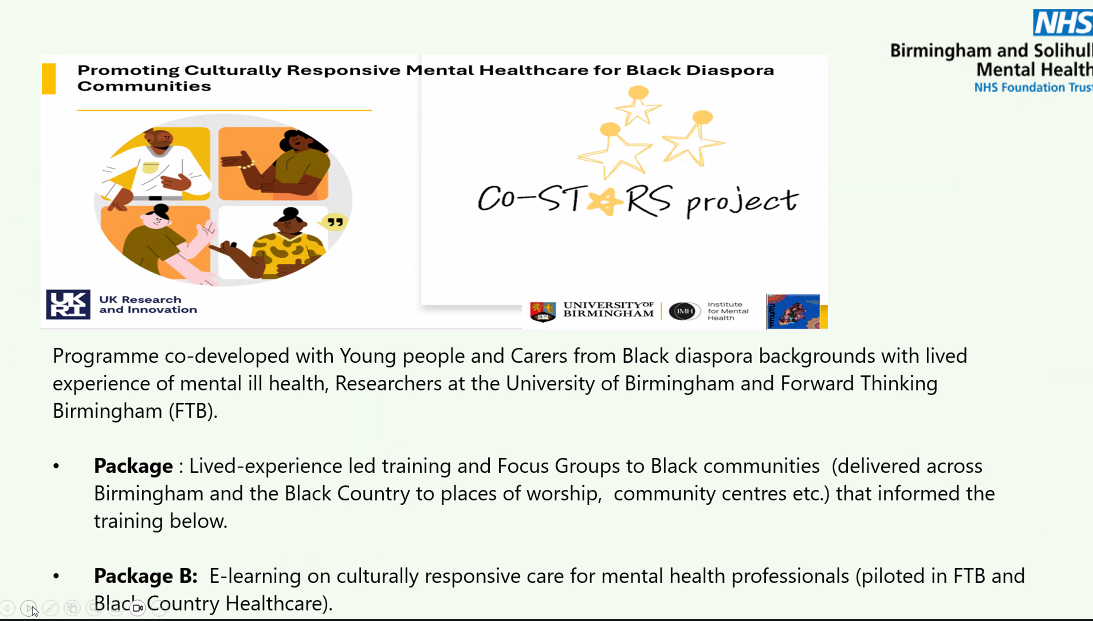
Birmingham & Solihull (CYP) presented one of the most detailed and emotionally grounded PCREF programmes, shaped heavily by lived-experience research with Black diaspora families. Their PCREF priorities, knowing our communities, transforming with communities, and delivering care that works reflect a commitment to embedding cultural responsiveness at every step. Their partnership with the University of Birmingham and Forward Thinking Birmingham has produced the Co-STARS project, a blend of lived-experience-led community work and staff training modules.
A major part of their PCREF advancement comes from working intensively with families to capture how racialised parents feel when using services. The Trust shared powerful testimonies from Black carers who described needing to “emotionally self-regulate” in meetings to avoid being labelled angry, unstable or cold. Parents also highlighted the emotional labour of protecting their children from stereotypes such as the “angry Black boy”, as well as fears of being adultified or dismissed. These insights have directly reshaped responses from clinical teams and informed the development of carers’ passports and safe spaces.

Birmingham & Solihull also emphasised building structures to ensure that their care pathways become culturally competent and adaptive. They are embedding PCREF champions across all clinical pathways, from eating disorders to psychosis and autism, ensuring diversity and inclusion principles shape every aspect of assessment, treatment and review. The Trust is also developing e-learning on culturally responsive practice, and expanding identity-specific support spaces (e.g., Black Carers Groups and new plans for Asian carers’ spaces). This multi-layered approach reflects a commitment to PCREF that is both structural and deeply relational.

Key Points:

  • Embedding culturally competent conversations within CYP teams.
  • Developing a Black Carers Group and safe spaces for racialised parent groups.
  • New e-learning on culturally responsive practice (from Co-STARS package).
  • Use of carer passports to ensure carers feel like equal partners.
  • Strong focus on how ethnic minority parents feel judged or misread by services (e.g., “angry Black woman,” “cold mother”) – themes drawn directly from carer focus groups.
  • Recognising adultification, stereotyping, and the emotional labour families perform.

Questions raised by attendees:

  1. What about older adult Black communities?
    – Carers questioned how older Black adults, shaped by decades of racism, would be included in PCREF work.
  2. Are you working with the police on cultural awareness?
    – Concerns around disproportionate use of Section 136 and stereotypes (e.g., assuming someone is “aggressive” because they speak loudly or gesture).
  3. How will parent–carer voices shape service pathways and outcomes across all diagnoses (e.g., autism, psychosis)?

3. Sussex Partnership NHS Foundation Trust

Sussex Partnership presented PCREF as a three-pillared programme: data, co-production & engagement, and workforce development. Their first priority is improving ethnicity and protected characteristics data, which they acknowledged has historically been inconsistent. Sussex is launching a behavioural-change campaign that involves interviewing service users from minority backgrounds about why they may decline to share ethnicity, alongside staff interviews to understand documentation issues. Their goal is a transparent baseline from which meaningful PCREF action can be driven.

The Trust also described significant investment in a new data infrastructure via Power BI dashboards. These tools will pull together real-time information on areas such as restraint, Section 132 rights, and involuntary detention by ethnicity. The Trust stressed that PCREF cannot function without high-quality data because inequalities must be clearly visible and accessible to teams at every level—from ward managers to executive boards. Their future ambition is to enable quicker identification of disparities and faster interventions that prevent harm.
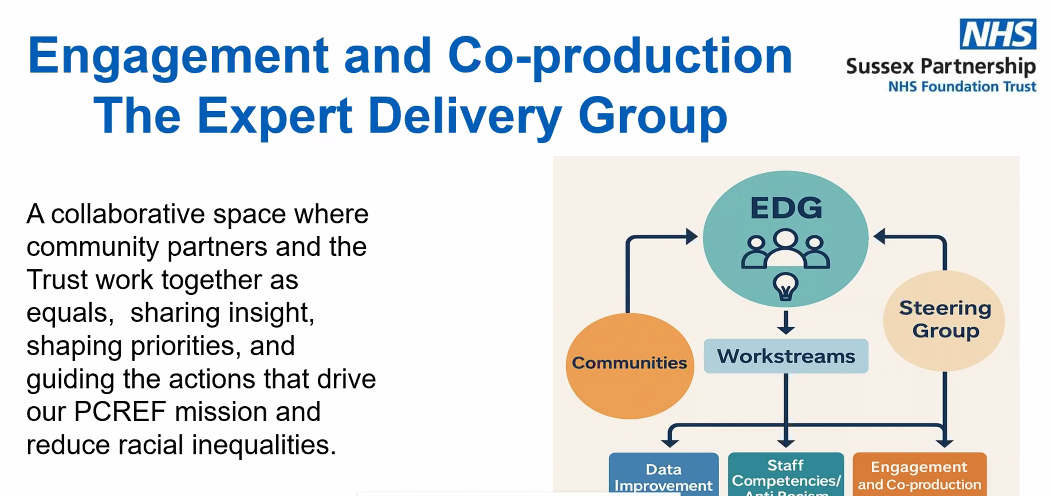
Sussex’s strongest focus was on building genuine co-production through their Expert Delivery Group (EDG). Unlike past approaches where community partners were only consulted, the EDG is designed as a collaborative decision-making space. Sussex acknowledged up front that phase 1 of PCREF planning did not fully embody equal partnership, and committed to ensuring that phase 2 will be co-produced from the ground up. The EDG will define what co-production means, co-design PCREF implementation plans, and shape updates that reflect community priorities, trust recovery, and anti-racist aspirations.

Key Points:

  • A behavioural-change campaign to improve ethnicity data recording (currently 65% compliance).
  • Development of Power BI dashboards for rapid inequality analysis.
  • Defining anti-racist and cultural competency skills for staff, tied to new EDI training.
  • Creation of the Expert Delivery Group (EDG) as a collaborative community–trust space.

Questions raised by attendees:

  1. Is this “real” co-production or consultation?
    – Attendees challenged Sussex on whether the initial plan was created with the community or presented to them.
  2. How will service users and carers hold equal power within co-production?
  3. How will your anti-racism ambitions be demonstrated externally to communities?
    – Attendees expressed concerns that staff training alone does not reassure communities.
  4. How will carers’ needs be embedded in PCREF (Triangle of Care)?

🌟 4. Kent & Medway Mental Health NHS Trust

Presenter: Kamellia (with contribution from Harriet – Lived Experience)
Kent & Medway showcased a comprehensive and governance-driven PCREF structure supported by their Equity for All Assurance Group. The Trust has embedded health inequalities into its broader strategy and is working to ensure that PCREF, protected characteristics data and health equity are woven into everyday practice. With the Trust’s newly updated name and identity, PCREF sits at the centre of a renewed commitment to equitable access, outcomes and patient experience across Kent and Medway.
Their PCREF progress includes delivering cultural competence training to 259 senior leaders, a significant investment in shifting leadership behaviour and expectations. They have also identified major data disparities in areas such as complaints, where ethnicity recording is only around 30%. To address this, they are rolling out the About Me form across their clinical system (Rio), which streamlines demographic and protected characteristics documentation for both carers and patients. This step is being supported by staff training designed to build confidence in discussing sensitive identity-related topics.

Kent & Medway also highlighted the expansion of their new Involvement & Engagement Team, which links directly with communities across East, West and North Kent. They are testing a Health Inequalities Toolkit, improving carer experience data collection, and creating new Family, Friends & Carers forms that capture protected characteristics, communication needs, and whether a carers pack was offered. The Trust’s approach is detailed, structural and long-term, aiming to embed PCREF as part of “business as usual” rather than a separate initiative.

Key Points:

  • 259 senior leaders trained in cultural competence.
  • New About Me demographic/protected characteristics form launching trust-wide.
  • Major data gaps identified (e.g., only 30% ethnicity data for complaints).
  • New Involvement & Engagement Team connecting with community groups.
  • Testing the Health Inequalities Toolkit .
  • New Family, Friends & Carers Information Form including carer-pack tracking.

Questions raised by attendees:

  1. Do you provide information in languages other than English?
    – Carers stressed that if translations don’t exist, PCREF is inaccessible from the start.
  2. How will carers be supported to attend meetings given their unpredictable caring responsibilities?
  3. How will you gather demographic data for carers when many do not have Rio records?
  4. How will minority groups be reached in areas where the Trust’s population is overwhelmingly White British?

5. Carer Support Organisation (Kent & Medway Carers Support)

Presenter: Donna Green (involve Kent)

Key Points:

  • They run trust-wide carer experience groups and targeted workshops.
  • Emphasised difficulty for carers to attend meetings due to constant demands.
  • Highlighted the need for multiple approaches, including creative well-being sessions.

Closing Reflections from the Forum

I wrapped up the session acknowledging:

  • The strong desire across Trusts to improve PCREF delivery.
  • The pressure to progress quickly without losing sight of lived experience leadership.
  • The need to bring CQC into future meetings for transparency around expectations.
  • The importance of ethnic minority carers having a forum that values honesty over polished presentations.

Final Thoughts

This month’s forum demonstrated that while progress continues nationally, there remain shared challenges across NHS Mental HealthTrusts:

  • Recording ethnicity and protected characteristics meaningfully
  • Embedding anti-racism beyond training modules
  • Meeting the needs of Black, Asian and other racialised carers
  • Co-production that is real, not rhetorical
  • Involving carers whose time and emotional capacity are already stretched
  • Ensuring safety, trust and humanity in every interaction.

Above all, the session showed that ethnic minority carers are not passive observers they’re leading, questioning, shaping and insisting on accountability at every step.


Hospital Carer Discharge Meeting – November Update 2025

Chaired by: Matthew McKenzie – Lived Experience Carer

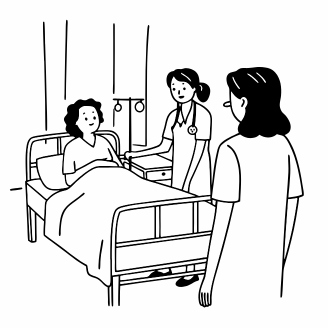
Welcome to the November 2025 update of the Hosptial Carer discharge group. The Hospital Carer Discharge Group is a collaborative network chaired by lived-experience carer Matthew McKenzie, bringing together unpaid carers, carer-centre teams, hospital staff and local authority representatives to improve how carers are identified, supported and involved throughout a patient’s hospital journey.

The group provides a space to share updates from hospitals and carers’ organisations, highlight challenges in discharge processes, strengthen links between community and acute services, and promote consistent carer-focused practices such as using the Carers Hospital Discharge Toolkit, developing standard operating procedures, and raising staff awareness.

The November meeting focused updates from the South East London Carer Standard Operating Procedure pilot, improving carer identification, strengthening links between community and hospital services, and practical challenges in engaging hospital teams.

For those who don’t know, In the context of the Hospital Carer Discharge an SOP is a step-by-step, structured process that hospital staff follow to ensure unpaid carers are identified, informed, supported and included consistently during a patient’s hospital stay and discharge.

It usually outlines:

  • How to record, communicate and follow up on carer involvement
  • Who is responsible at each stage (nurses, discharge teams, carer services)
  • What actions must be taken (e.g., asking about caring roles, sharing information, making referrals)
  • When these actions should happen (admission, treatment phase, discharge planning)

Who Attended

The session was well attended by a mix of carers, hospital representatives, and carer-centre staff, including:

Carer representatives

  • Matthew McKenzie – Chair; lived experience mental health carer; Carers UK, Carers Trust & NHS England Citizens Advisory Group volunteer.
  • Caroline – Lewisham carer, Healthwatch Lewisham member & Patient Experience Committee representative.
  • Various peer supporters, carers involved in local networks and PPGs.

Carer support organisations

  • Carers Hub Lambeth
  • Tower Hamlets Carer Centre
  • Wandsworth Carer Centre
  • North Central London Carers Support Project

Apologies

  • Sutton Carers Centre
  • Richmond Carers Centre
  • Greenwich Carers Centre
  • Harrow Carers Centre
  • Bromley Well
  • IMAGO – Lewisham carers Centre
  • Bexley Carers Support
  • Involve Kent

Hospitals & NHS staff

  • Queen Elizabeth Hospital (Lewisham & Greenwich NHS Trust)
  • Public Service Consultants (PSC)
  • Bromley, Lambeth, Lewisham, Greenwich council leads (mentioned in discussion)
  • St George’s Hospital (GESH) – references to staff

Meeting Overview

  • The growing importance of carer involvement in hospitals, especially with mental health pressures and changes to the Mental Health Act.
  • The group’s purpose: sharing updates, strengthening links between carers and hospitals, and improving the implementation of the Carers Hospital Discharge Toolkit.

Key Presentation – Update on the South East London Carer SOP Pilot

Speaker: Public Service Consultants (PSC)

The major portion of the meeting focused on the pilot testing of a new 11-step Standard Operating Procedure for identifying and supporting unpaid carers across hospitals in South East London.

🔹 Hospitals involved in the SOP pilot

  1. King’s College Hospital – Acute Medicine ward
  2. University Hospital Lewisham – Hawthorne (older patients) and Alder (specialty medicine) wards
  3. Princess Royal University Hospital (Bromley) – Frailty Unit via Transfer of Care Hub

🔹 Key outcomes

  • King’s College Hospital saw the strongest progress.
    • Nurses proactively engaged unpaid carers.
    • All leaflets and materials were distributed within weeks.
    • Carer details (with consent) were passed to Lambeth Carers Hub.
    • Nursing staff requested feedback loops to see the impact of referrals.
  • Lewisham Hospital
    • Progress slower initially; improved after site visits.
    • Ward managers highly supportive and embedding SOP practices.
    • Lewisham Council exploring funding for an in-hospital carers support team.
  • Princess Royal (Bromley)
    • SOP and leaflets now shared with the frailty unit.
    • Council to continue taking work forward.

🔹 Overall reflections

  • Hospitals still experience heavy winter pressures and staff capacity issues.
  • Engagement differs widely between NHS trusts.
  • Many ward teams had never seen the London Carers Toolkit, indicating a need for simplification.
  • Councils intend to continue cross-borough meetings after PSC’s involvement ends.

Issues & Discussion Points

1. Gaps in consistency across hospital sites

  • Queen Elizabeth Hospital (QEH) had not been part of the pilot, they have requested to be included
  • Staff expressed interest in adopting SOP materials and joining future rollout.

2. Carer diversity and training needs

Caroline highlighted the need for:

  • Training reflecting different care needs: LD, dementia, mental health, elderly carers.
  • Cultural diversity considerations in how carers interact with hospital teams.
  • Better alignment with Lewisham & Greenwich’s Compassion in Care programme.

3. Current SOP scope limitations

  • SOP starts at the ward stage, but carers need involvement pre-admission and post-discharge.
  • Best practice from NICE and the national toolkit emphasises whole-journey support.

4. Hospital culture & resistance

Carer-centre staff described feeling:

  • Like a “hindrance” in MDT or discharge meetings
  • Sometimes unwelcome or blocked from engaging on wards
  • Fighting clinical priorities vs. carer rights
  • Still needing major awareness-raising to reduce resistance

A carer noted power imbalances and the risk that carers are seen as “barriers to discharge” rather than essential partners.


Updates from Carer Centres & Hospital Teams

Carers Hub Lambeth

  • Significant increase in referrals, especially from King’s.
  • Engagement seems weaker at Guy’s & St Thomas’, it looks to be still pushing for a stronger carers strategy there, but hopeful the strategy should pick up.
  • Working with ward rounds and direct conversations with carers.

North Central London Carers Project

Working across 8 hospital sites, possilbly

  • Royal Free Hospital
  • Barnet Hospital
  • North Middlesex Hospital
  • Chase Farm Hospital
  • The Whittington Hospital
  • University College Hospital
  • St Pancras Rehabilitation (Camden and West London)
  • Community Central London Trust 
  • North London Foundation Trust (Mental Health)

Updates include:

  • A hospital “menu” to track progress across the toolkit (training, comms, discharge planning).
  • Embedding carers into induction programmes.
  • Co-authoring discharge documentation at St Pancras Rehab Centre with dedicated “carer sections”.
  • Upcoming use of Cerner electronic records system to automatically flag carers.

Tower Hamlets Carer Centre

Carer representative based at Royal London Hospital (east London)

Challenges include:

  • Slow referrals & reliance on staff awareness
  • Some carers only identified at crisis stage
  • Need to expand the carers passport across Royal London
  • Hackney pilot ends in March concerns about future funding

Wandsworth Carer Centre / St George’s

SONY DSC
  • Developing carer awareness training with Patient Experience Team
  • Growth in referrals after training sessions, though staff forget over time
  • Plan to expand ward coverage
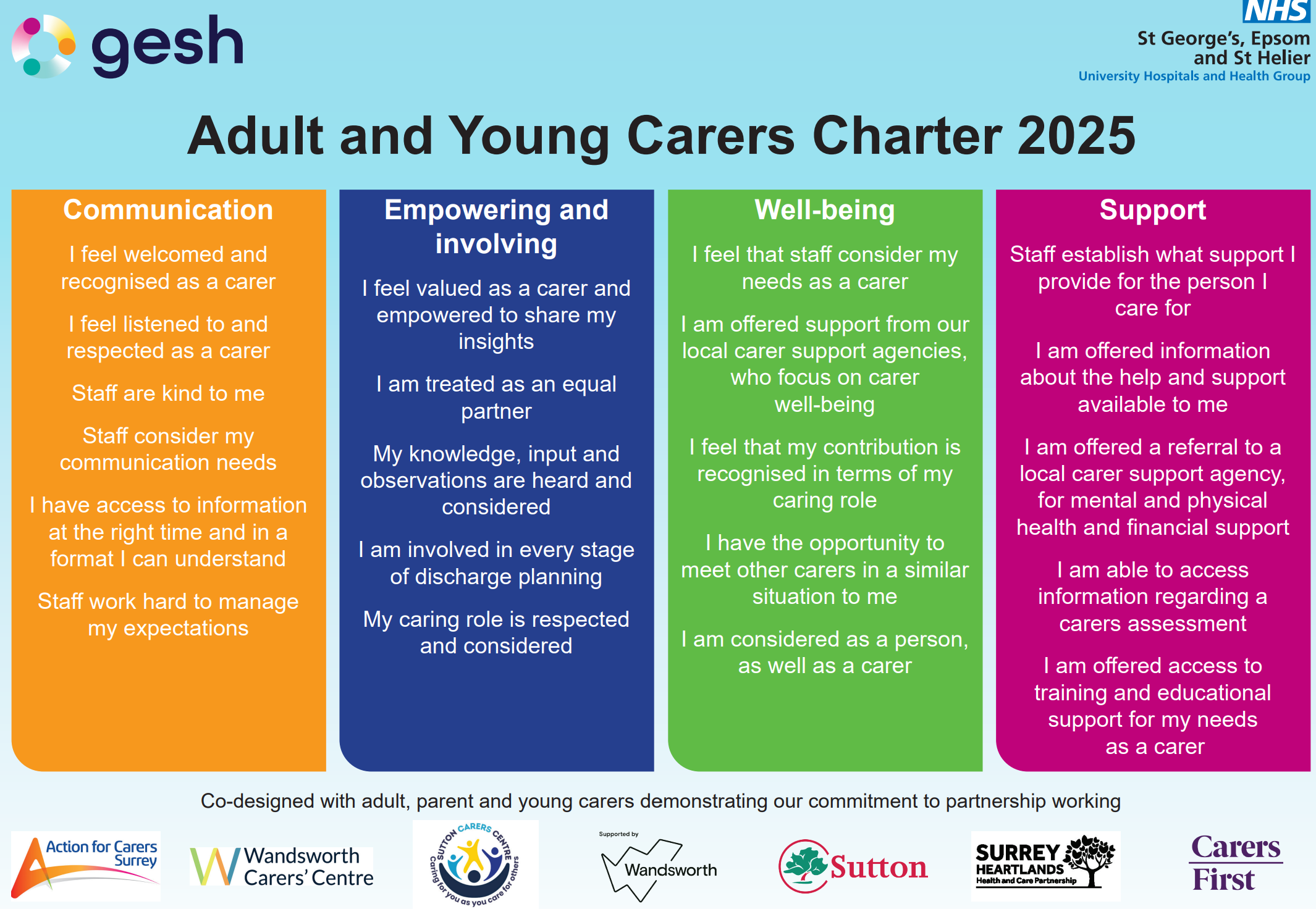
  • As chair I shared St George’s new Carers Charter as a tool for accountability

Carer-Led Developments in Primary Care

A group of Lewisham unpaid carers has begun major work with GP practices, including:

  • Creating a PCN-wide carers information pack
  • Ensuring carer champions in GP surgeries
  • Working with pharmacies to distribute information
  • Improving identification on GP systems
  • Exploring alignment with Lewisham’s new Carers Action Plan

Plans for the Future

  • More invitations to NHS carer strategy leads
  • Sharing SOP materials with non-pilot hospitals where possible.
  • Matthew to link contacts across councils and hospitals for ongoing monitoring, being the following boroughs e.g.

Lewisham

  • Assistant Director – Adult Mental Health & Wellbeing
  • Joint Commissioner – Adult Mental Health & Wellbeing

Greenwich

  • Strategic Commissioning Lead
  • Commissioning Lead for Carers

Bromley

  • Assistant Director – Commissioning
  • Commissioning Officer

Bexley

  • Service Manager – Adult Social Care

Lambeth

  • Integrated Commissioning Manager – Adults and Health

Southwark

  • Strategic Programmes Manager
  • Commissioning Manager

Medium-term aims

  • Push for in-hospital carer support teams in Lewisham & Greenwich.
  • Expand training and embed carers into staff induction.
  • Improve pre-admission and discharge-planning pathways on carer identification and involvement for familes and carers.
  • Stronger collaboration between LD nurses, dementia teams, and carers services.

Longer-term aspirations

  • Greater consistency across trusts
  • Unified carers strategy within each hospital
  • A system where carers are routinely recognised, supported, and involved in decisions

Closing Remarks

As cchair I closed the meeting by thanking attendees and acknowledging the collective effort to improve carers’ experiences across London hospitals. I reaffirmed the importance of:

  • Making carers visible
  • Ensuring rights are upheld
  • Strengthening trust–carer relationships
  • Carrying learning into the new year

The next meeting will be scheduled in January, with hopes of smoother cross-hospital collaboration in 2024.

What Makes for Meaningful Carer Involvement?

By Matthew McKenzie FRSA BEM, Chair, Triangle of Care Community Group

This week’s Triangle of Care Member Webinar, hosted by Carers Trust, which focused on a vital question: What makes for meaningful carer involvement?

We heard from across the Triangle of Care network, these being carers, professionals, and trust representatives coming together to share what genuine involvement looks like in practice.

I spoke about my own lived experience as a carer, supporting two non-verbal brothers with autism and my late mother with mental health challenges and how this journey has shaped my advocacy for stronger partnerships between carers and professionals.

Over the years, through the Triangle of Care, I’ve seen how much difference early and equal involvement can make.

Continue reading

Triangle of Care Community Meeting: July 2025 update

On 21st of July 2025, carers, professionals, and stakeholders from across the UK gathered virtually for the latest Triangle of Care (ToC) Community Meeting. Chaired by Matthew McKenzie, this session was packed with insight, action points, and open dialogue. Whether you were new to the group or a long-time contributor, there was something valuable for everyone.

This meeting was particularly significant as it marked a turning point for carer participation. The formal recognition of the community group in ToC’s national governance structure. It affirmed that carer lived experience should not be sidelined, and that carers must continue to shape mental health services from the inside out.

If you weren’t able to attend, this blog will bring you up to speed. As the ToC community group covered a wide range of topics, from updates on national strategy and governance, to inclusive language, carer-led training, and advocacy for better research funding. At the heart of it all was a single message: when carers unite, systems must listen.

Official Recognition and Governance Progress

We are delighted to announce that the Triangle of Care Community Group is now formally integrated into the Triangle of Care governance structure. This gives the group a direct route to influence national decisions. The community will now sit alongside steering and regional groups in shaping policy, reviewing practices, and helping determine what carer inclusion should look like across all participating trusts.

What this means practically is improved alignment and visibility. For years, many carers and grassroots contributors have worked tirelessly behind the scenes, often without formal platforms. This change allows community voices to be heard before decisions are made not just consulted afterwards. Matthew described this shift as “a recognition of the years of unpaid care, leadership, and advocacy carers have always provided.”

It also means that our meetings will align with national timelines and decisions, ensuring a timely flow of updates between local groups, regional networks, and national forums. This is a pivotal opportunity to embed carers more meaningfully into NHS structures and accountability.

New Mailing List & Sign-Up System

Mary Patel from Carers Trust announced the launch of a new centralised mailing list for Triangle of Care community members. This will make sure everyone receives meeting invites, resources, and updates reliably. Participants will soon be asked to complete a Microsoft sign-up form, which will securely transfer contact details onto the Carers Trust system for ongoing communications.

The form will include a few demographic questions to help build a picture of the diversity within the ToC community. These questions are entirely optional but are designed to help Carers Trust identify who is engaging, and where gaps might exist—ensuring outreach strategies reflect real needs. For example, better regional balance, or increased visibility for underrepresented carer groups.

There was also discussion about moving from Zoom to Microsoft Teams for future meetings. Teams offers benefits like attendance tracking, secure file sharing, and easier scheduling. However, this won’t be a forced change, Matthew and Mary invited feedback, emphasising that any transition would be made collaboratively with community input.

Stronger Carer Involvement

Carer involvement was at the heart of the meeting. Matthew shared a passionate update on the need for carers particularly those from minority backgrounds or marginalised communities to step forward and engage in all aspects of the Triangle of Care. This includes involvement in peer reviews, shaping surveys, and suggesting new training or webinar content that reflects their lived experience.

The community was reminded that leading change doesn’t require a title or formal position. Sharing your story, participating in surveys, or simply raising your hand during a meeting is a form of leadership. Matthew emphasised that carers hold the kind of insight that no policy or textbook can replicate. As he put it, “This community is only as strong as the carers who show up.”

Peer reviewing was especially encouraged. Carers can play a vital role in reviewing mental health trust practices and making sure those trusts aren’t just ticking boxes but are genuinely improving the carer experience. Anyone interested in joining these review panels was invited to contact Mary Patel directly. The experience is meaningful and empowering and it places carers right where they should be: in positions of influence.

CQC Expectations and Carer Experiences

A powerful part of the meeting focused on the role of the Care Quality Commission (CQC) and how effectively it monitors carer inclusion in mental health services. Several carers and professionals shared their experiences some positive, others deeply concerning about how the CQC engages (or fails to engage) with carers during inspections.

A senior experience lead from an acute trust, explained that when CQC inspectors review services, they typically look for a clear carers policy, systems for identifying and supporting carers, and evidence of staff training. However, the level of scrutiny and the quality of carer-related feedback can vary significantly between inspections. The experience lead noted that while policy is important, it’s the systems around those policies that really matter, things like whether staff actually follow them, and whether carers know where to go for help.

Carers in the meeting shared contrasting experiences. A carer described a disappointing CQC visit where the inspector seemed dismissive, rushed, and uninformed about carers’ rights. Her feedback about lack of communication and exclusion was barely acknowledged, leaving her feeling invalidated. In contrast, Another carer spoke of a more recent inspection where the CQC officer seemed empathetic, asked thoughtful questions, and even disclosed their own possible caring experience. These differing accounts highlighted a common theme: carers’ confidence in the CQC is mixed, and their approach to carers can sometimes feel inconsistent.

There was strong consensus that CQC needs better training in carer engagement and not just understanding legal frameworks like the Care Act 2014, but also how to meaningfully include carers in service reviews. Kelvin added that cultural competence should also be part of the equation, noting that carers from minority backgrounds are too often left out of consultations. Matthew urged carers not to wait for trusts to invite them to speak during inspections ask to be involved, request to meet inspectors, and use carers’ councils or governors to raise visibility. It was clear from this session that carers want the CQC to be more than a compliance body, they want it to be a true advocate for accountability and equity in care.

Confidentiality Roadshow by Donna Bradford

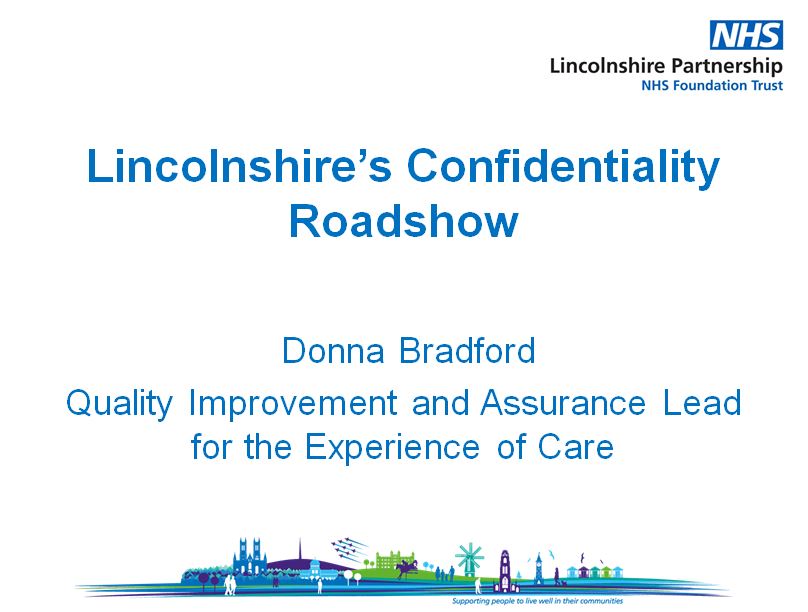
A standout session was led by Donna Bradford, who presented her team’s work on the Confidentiality Roadshow a training programme developed by Lincolnshire Partnership NHS Foundation Trust. Designed to upskill staff on consent, confidentiality, and communication, the roadshow is tailored around carer inclusion and co-produced with the Carers Council.

The training helps staff understand not only what they can share legally, but also how to navigate nuanced emotional and ethical situations with carers. Donna reminded attendees that sharing basic, non-confidential information, such as medication side effects, is not only lawful but essential. “If you can Google it, you can say it,” she noted, driving home the importance of clarity over confusion.

Over 550 staff have already received the training, with 100% reporting that it improved their confidence. The programme includes real-life carer scenarios, emotional video testimonials, and interactive quizzes to help reinforce learning.

Beyond the training content itself, what makes the Confidentiality Roadshow so impactful is its co-production with carers. Donna highlighted that every scenario used in the sessions came from real-life examples shared by carers and families. This ensures the training isn’t theoretical so it’s grounded in lived experience. The emotional and practical realities of caring for someone with mental health needs are at the heart of the learning, helping staff understand why clear, compassionate communication is so essential. The training also underscores the importance of listening to carers, not just as bystanders but as active contributors to a person’s care journey.

Several attendees raised the idea of incorporating this training into broader staff induction and continuing professional development programmes. Others asked about adapting it for use in different trust settings, such as acute hospitals or community services. Donna encouraged trusts to reach out if they’d like to adopt or customise the resource. The message was clear: confidentiality shouldn’t be a barrier, it should be a bridge, and with the right training and tools, staff can navigate those conversations with confidence, legality, and humanity.

Mental Health Research Petition

Irene Harris spoke passionately about a new parliamentary petition calling for improved research funding into serious mental illnesses (SMIs) like psychosis. The petition aims to shine a spotlight on how outdated treatments and under-researched conditions continue to place carers and their loved ones in difficult, often heartbreaking positions.

Here is the video about Psychosis medication and its impact by the Stockport carers forum.

She shared how mental health medications for SMIs haven’t evolved as rapidly as physical health treatments, and how this results in long-term side effects and compromised quality of life. Research is desperately needed, not only to improve diagnosis and treatment, but also to create support structures that ease the burden on unpaid carers.

Irene asked attendees to sign and circulate the petition widely, with a goal of hitting 10,000 signatures by November 15th.

https://petition.parliament.uk/petitions/725846

She also announced plans to launch new social media channels to raise awareness. This initiative is about more than funding it’s about giving carers and service users a louder voice in national healthcare priorities.

For more details feel free to visit https://www.mhcarersgroupstockport.co.uk

or contact Irene on irene@mhcarersgroupstockport.co.uk

Language, Inclusivity, PCREF & the ‘Global Majority’ Debate

Language and inclusivity were major themes of the meeting, particularly around the term “global majority.” Some attendees expressed concern that the phrase could be divisive or misinterpreted, particularly by politically sensitive audiences or media outlets. A carer shared a personal anecdote illustrating how words can carry unintended consequences.

Others responded by highlighting the intention behind the term to emphasise that those historically described as “minorities” are, in fact, the global majority in population terms. They called for continued use of the phrase in contexts that promote empowerment, equity, and lived experience.

The discussion didn’t produce a consensus, but it modelled what respectful disagreement and co-learning should look like. Matthew reinforced that ToC should be a space for constructive dialogue, not debate for its own sake. Ultimately, we are united in our aim to ensure no carer is left behind regardless of background, heritage, or identity.

Next Steps & Community Actions

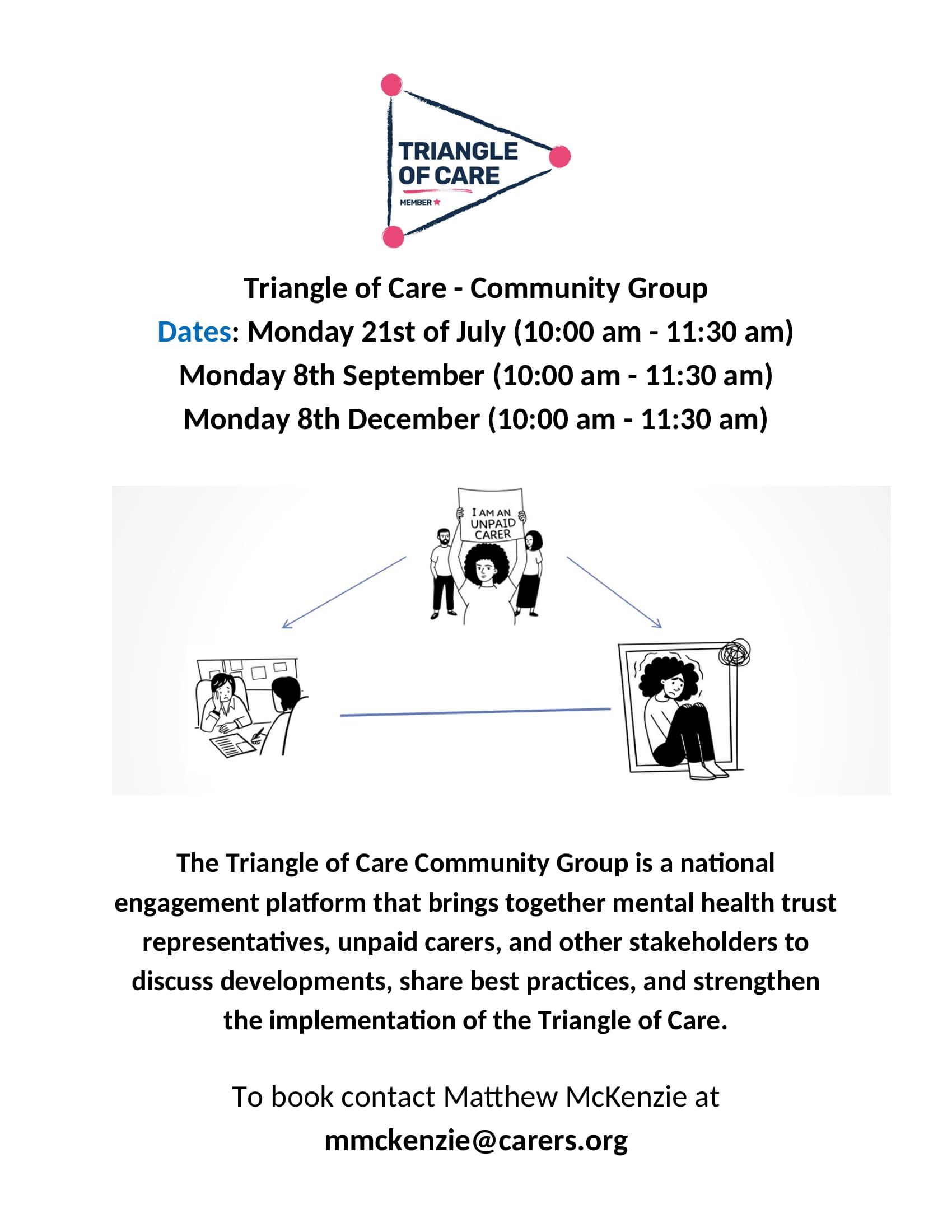
The session wrapped up with a summary of action points and responsibilities. Carers Trust will soon circulate the new mailing list sign-up form. Matthew will share updated meeting dates for 2026 once confirmed, and he will continue to distribute posters for the upcoming National Ethnic Carers Group, taking place on the last Friday of each month.

There will be support the rollout of the Confidentiality Roadshow materials and follow up with those interested in joining peer review panels. A reminder was issued for everyone to contribute to current surveys, share their feedback, and suggest future topics for community meetings.

Finally, participants were encouraged to stay connected beyond the meetings. Whether through peer networks, local carers centres, or email updates, the message was clear: carers must stay visible, vocal, and valued. You are the change-makers, and this group is your platform.

Final Thoughts: “Carers Are Not Just a Cog in the Wheel”

Matthew ended the session with a rallying call to action: “We’re not just a cog in the wheel as we are the energy behind it.” His words served as a reminder that carers are not passive recipients of services. They are drivers of quality, advocates for change, and protectors of dignity in the mental health system.

He also reminded everyone that systems often change slowly, but they do change when people keep showing up, keep speaking up, and keep sharing their truths. “This isn’t just about the Triangle of Care,” he said. “It’s about reshaping the whole narrative around mental health and care.”

If you missed the meeting and would like to receive the slides, recordings, or further resources, feel free to contact Matthew McKenzie directly:
📧 mmckenzie@carers.org

Thanks to to all who attended, contributed, and championed carers’ voices. The next meeting should in September where we hope to see you there.