Caring for someone affected by cancer can be deeply meaningful—and incredibly demanding. Between appointments, medications, emotional support, and everyday life, caregivers often put their own needs last. Yet caregivers need care too.
That’s why Coffee & Connection exists: a welcoming, gentle space where caregivers can pause, breathe, and connect with others who truly understand.
You Don’t Have to Carry It Alone
As a cancer caregiver, you may find yourself holding many emotions at once, these being love, worry, exhaustion, hope, frustration, and resilience. While friends and family may care deeply, it can be hard to explain the realities of caregiving to someone who hasn’t lived it.
Coffee & Connection brings together people who get it.
This is a place to:
Share how cancer has impacted your life as a caregiver
Listen to others’ stories without judgment or pressure
Feel seen, heard, and supported
Simply enjoy a cup of coffee in good company
There’s no expectation to talk if you don’t want to. Sometimes, just being in the room with others who understand is enough.
A Warm, Caring Environment
Set in a relaxed café-style space, Coffee & Connection is designed to feel calm and human and not clinical. Where Conversations unfold naturally over tea and coffee, surrounded by warmth, greenery, and kindness.
Whether you are caring for a partner, parent, child, sibling, or friend at any stage of the cancer journey, you are welcome to attend.
When and Where
Every first and last Tuesday of the month 10:00 AM – 12:00 PM
Clapham Park, Cube 116 Kings Avenue London, SW4 8EP
Want to Know More?
If you’d like more information or want to check in before attending, you can reach out to:
Caregiving can feel isolating, but connection has the power to lighten the load. Coffee & Connection offers a gentle reminder that you are not alone, and that your experiences matter too.
If you’re a cancer caregiver looking for understanding, support, or simply a moment of calm, consider joining us. The coffee will be warm, and so will the welcome.
By Matthew McKenzie, facilitator of National ethnic mental health carers forum
Welcome to my first blog for 2026.
I am working on a new poetry project linked to my forum and poetry groups. This poem turned into song is written from the perspective of an unpaid ethnic mental health carer, and explores identity, pride, self-worth, and refusing shame in systems that don’t always listen or recognise lived experience.
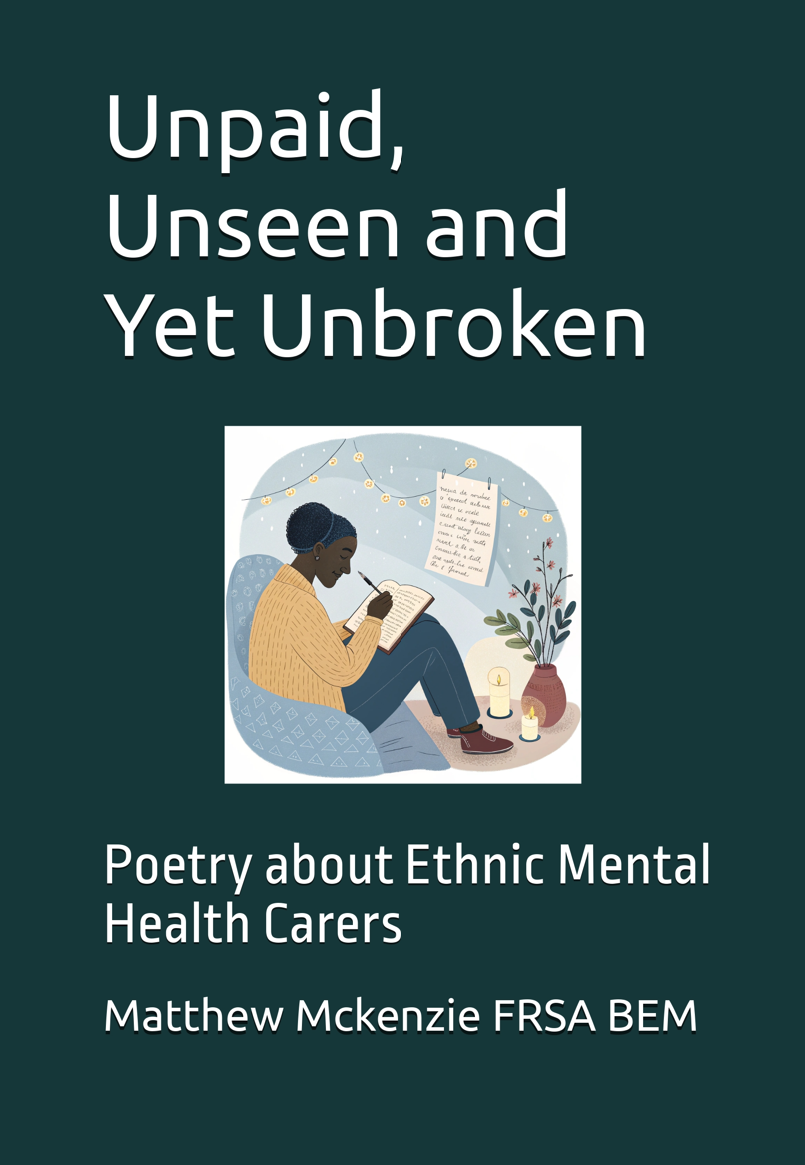
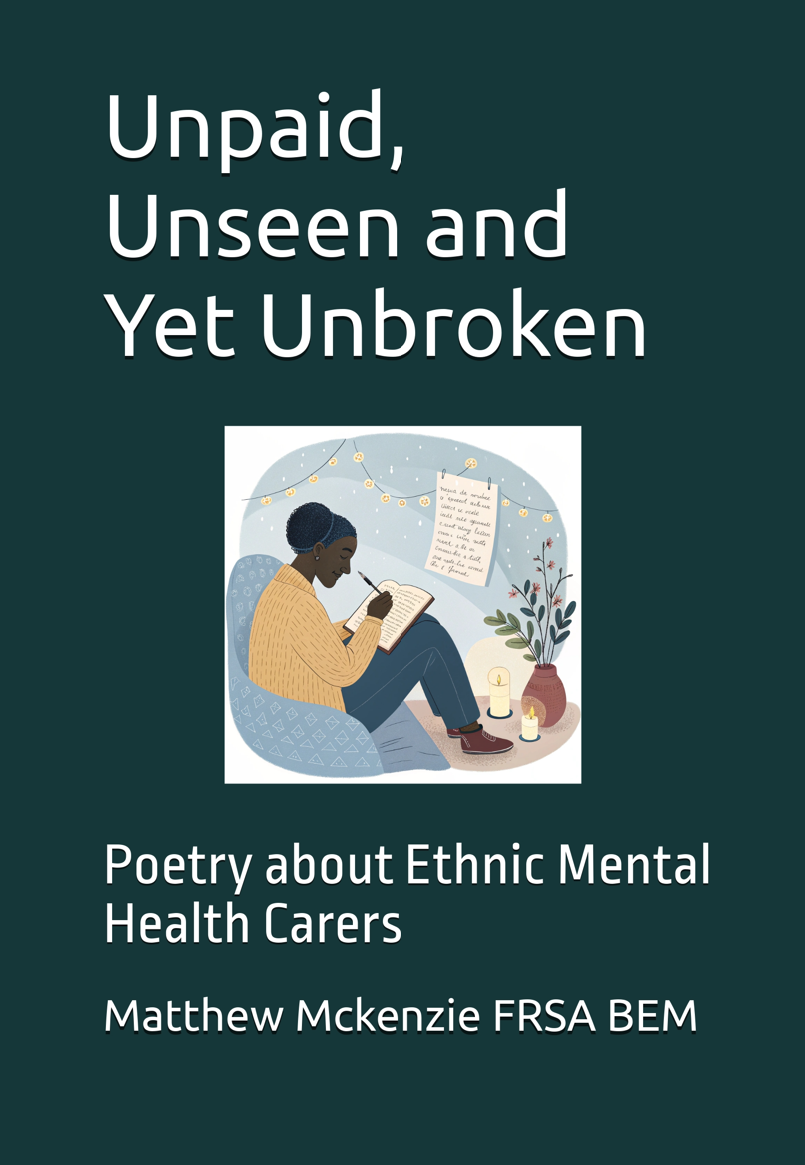
The poem is taken from my forthcoming poetry book in development, Unpaid, Unseen and Yet Unbroken (due 2026), which centres the voices of ethnic mental health carers and aligns closely with the aims of PCREF (Patient and Carer Race Equality Framework), particularly around listening, inclusion, and lived experience shaping systems.
I’m using poetry and creative formats as another way to:
amplify carer voices
explore race and care with honesty
support conversations about equity, culture, and confidence in mental health services
If this resonates with your work, community, or organisation, please feel free to share. Listening is an act of care.
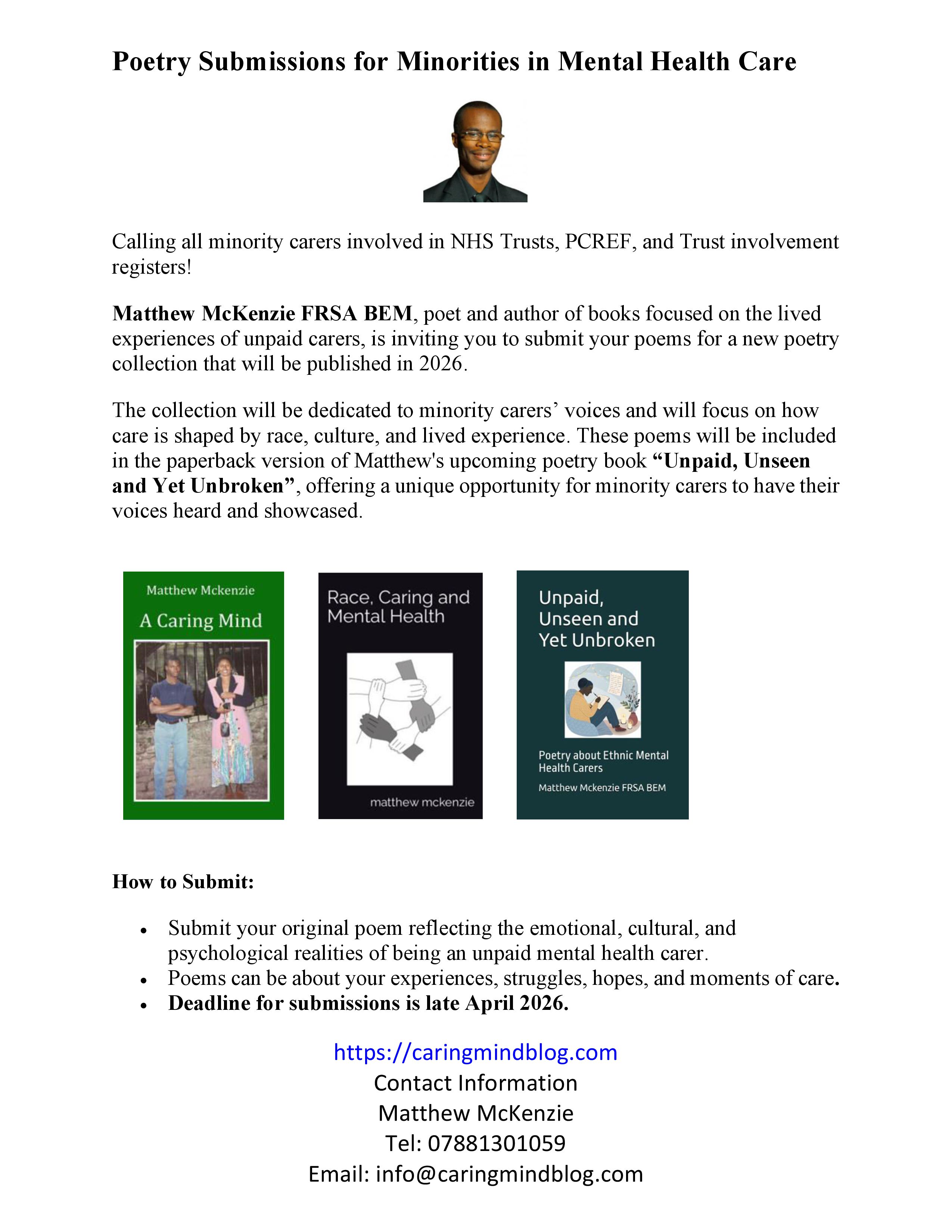
Matthew McKenzie FRSA BEM, poet and advocate for unpaid ethnic mental health carers, is inviting carers involved in NHS Trusts, PCREF (Patient and Carer Race Equality Framework), and Trust involvement registers to submit their poems for an upcoming 2026 poetry collection. This collection will spotlight minority carers’ voices and explore themes of race, culture, and lived experience in mental health care.
About the Poetry Collection
The collection will focus on amplifying minority carers’ experiences through poetry. It will be part of the paperback version of Matthew’s upcoming poetry book Unpaid, Unseen and Yet Unbroken and will include poems from carers all over the country. This is a unique opportunity for minority ethnic carers to have their voices heard and their stories shared on a national platform, contributing to the ongoing conversation about race equality, care, and mental health.
Why Should You Submit a Poem?
If you’re a minority carer or carers from underrepresented community, your voice matters. PCREF is committed to creating systemic change, and this collection will work alongside it to ensure that carers from minority communities are not left unheard. Submitting your poem gives you the chance to:
Raise awareness of the emotional, cultural, and psychological realities of being a carer.
Inspire others by sharing your lived experience.
Amplify minority voices within NHS Trusts, PCREF spaces, and mental health care systems.
Who Can Submit?
We welcome submissions from unpaid ethnic mental health carers who are:
Involved in NHS Trusts, PCREF, or trust involvement registers.
Attending ethnic mental health carer peer groups at carer centres
Interested in sharing their personal experiences and reflections through poetry.
How to Submit Your Poem:
Submit an original poem that reflects the emotional, cultural, and psychological realities of being an unpaid mental health carer.
Poems can focus on themes such as:
Emotional challenges of care
The hidden burden of caring
Resilience and survival
Navigating mental health services
Coping with racial and cultural barriers in care
Family dynamics in caregiving
Deadline for submissions is late April 2026.
Submission Guidelines:
Format: Poems can be submitted in Word, PDF, or plain text format.
Length: There is no strict length, but we recommend that submissions be no longer than 1 page.
Multiple submissions: You can submit more than one poem if desired.
Contact Information: Please include your full name, contact details along with your poem, so i can credit you. Unless you wish to be anonymous.
You can also reach out to Matthew directly if you have any questions about the submission process or the collection.
What Happens After You Submit?
Once submissions are received, I will review all entries and select poems that align with the themes of the collection. All selected poets will be notified and credited in the final publication.
Need Inspiration or Support?
If you’re unsure where to start or need some encouragement, consider reflecting on your personal journey as a carer. Think about moments where language failed to express your experience or times when your strength surprised you. Your story is valuable, and this collection is about lifting up voices that have often been overlooked.
Contact Information:
For any questions or additional information, please contact Matthew McKenzie:
This is your chance to raise awareness and inspire others by sharing your lived experiences through poetry. Help shape a future where minority carers are valued, heard, and recognized for the essential work they do. We look forward to reading your stories!
By Matthew Mckenzie – facilitator of national ethnic mental health carers forum
I’m pleased to share “Unpaid, Unseen and Yet Unbroken”, a spoken word poetry video that marks the first poem released from my forthcoming poetry collection of the same name.
This first poem speaks from within the lived reality of unpaid mental health carers, particularly those from ethnic and marginalised communities whose labour is often overlooked, misunderstood, or taken for granted. It reflects moments many carers will recognise: waiting rooms, misrecognition, quiet endurance, and the strength it takes to keep showing up without acknowledgement.
🎥 Watch the spoken word video here:
The wider collection I am currently working on brings together poems shaped by care, fatigue, love, resilience, and survival. It is a body of work rooted in lived experience and community voices, offering poetry not only as expression, but as witness and affirmation.
This first poem sets the tone for what is to come, promoting honest, reflective, and unapologetic in its call for carers to be seen, heard, and respected.
This work is part of my ongoing commitment through my A Caring Mind youtube channel to use creativity as a way to challenge stigma, amplify unheard voices, and centre care as a vital social contribution.
More poems from this collection will be shared in the coming months.
Caring for a loved one with a mental illness is a demanding, often under-recognized role. Many unpaid carers find themselves thrust into complex scenarios, navigating mental health crises, advocating for proper support, balancing their own wellbeing, and, too often, facing these challenges in isolation. While every carer’s journey is unique, a core set of resources can make a dramatic difference between feeling overwhelmed and finding sustainable ways to cope and thrive.
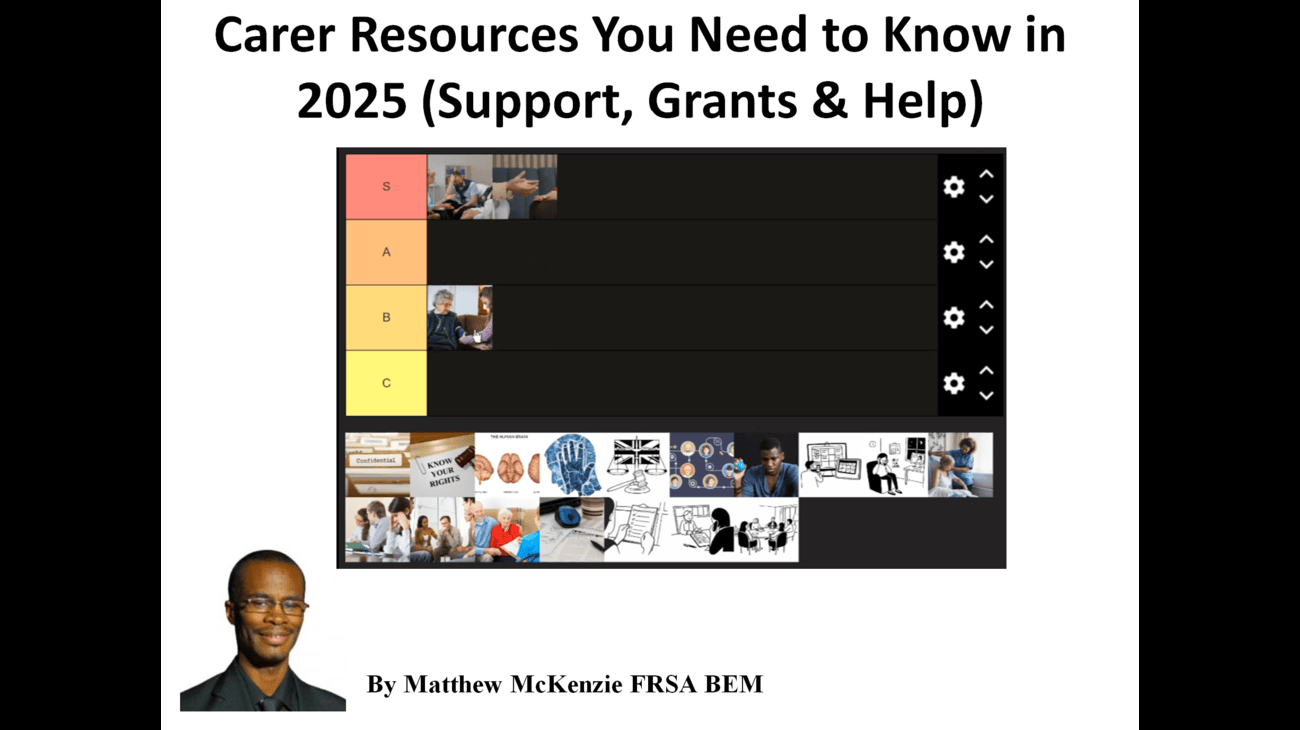
This article and video unpacks those essential resources through the lens of an experienced carer activist and carer, offering both a practical hierarchy of importance and actionable insights. Using a “tier list” as a framework, we’ll explore which resources are most urgent and why, how they fit together, and tips for navigating the labyrinth of mental health care.
To watch which resources are essential for mental health carers, watch the video below.
The Tiered Approach: Prioritizing Carers’ Needs
Resources for mental health carers can be overwhelming in scope from legal advice and crisis hotlines to financial support and practical training. To create clarity, resources are placed into four tiers:
S Tier (Essential): Survival-level supports; absolutely critical for continued caring and crisis management.
A Tier (Sustaining): Highly valuable resources that keep your caring role tenable in the long run.
B Tier (Enhancing): Important support systems that reduce daily strain and improve quality of life but aren’t as immediately pressing.
C Tier (Auxiliary): Long-term stability and planning; often overlooked but still necessary.
Let’s break down what falls into each tier and how you can access and leverage these resources effectively.
Carers: Unsung Heroes, Essential Supports
Mental health carers are the invisible backbone of the support system—shouldering enormous responsibility, often without recognition or adequate support. By focusing on these critical resources and prioritizing self-care as well as advocacy, carers can find greater resilience, confidence, and sustainability.
Remember, you are not alone. Whether you access support online, through local groups, or formal agencies, reach out, ask questions, and don’t accept “no” as the final answer when it comes to your rights and wellbeing. With the right resources and support system, caring for a loved one with mental illness can be not just a challenge to survive—but a journey where you both can thrive.
Our final Triangle of Care (ToC) Community Group meeting of the year brought together carers, professionals, and ToC members from across the UK to share updates, raise concerns, and discuss priorities for 2026 and beyond. Although Microsoft Teams provided some surprises, we made it work, thanks to teamwork and patience. The conversation was rich, heartfelt, and often very moving.
1. Opening & Agenda
As chair of the meeting, I acknowledged technical teething problems as the group used Teams for the first time in this format. Mary (ToC Programme Lead) welcomed attendees and explained the privacy-driven decision to hide email addresses, which also unfortunately hid attendees’ names. A fix will be implemented before the January meeting.
The agenda included:
Triangle of Care national updates (Mary)
Carer co-production and lived experience input (Matthew)
Surrey & Borders’ co-production example (postponed)
Research priority-setting presentation (Richard, University of Manchester)
Carer questions and discussion
2. Triangle of Care National Update (Mary)
Mary provided a comprehensive end-of-year update structured around ToC’s three priority areas for 2024–25.
2.1 Embedding the Relaunched Triangle of Care Framework
Growth & progress
16 new members have joined the scheme since April, bringing ToC membership to over 80.
The first Welsh hospital achieved a ToC Star Award, prompting the creation of a new Welsh-language logo and Welsh materials.
A social care pilot is underway with Livewell South West, with West Hertfordshire Teaching Hospital reviewing ToC criteria for an acute setting.
Nine Star Awards have been achieved this year, with a further 12 annual reviews approved. Many more annual reports are pending review before year-end.
Standardising data Mary emphasised the push for consistent reporting across Trusts, including:
numbers of carers identified
uptake of carer awareness training
numbers of carer champions
This will help build a national picture of impact.
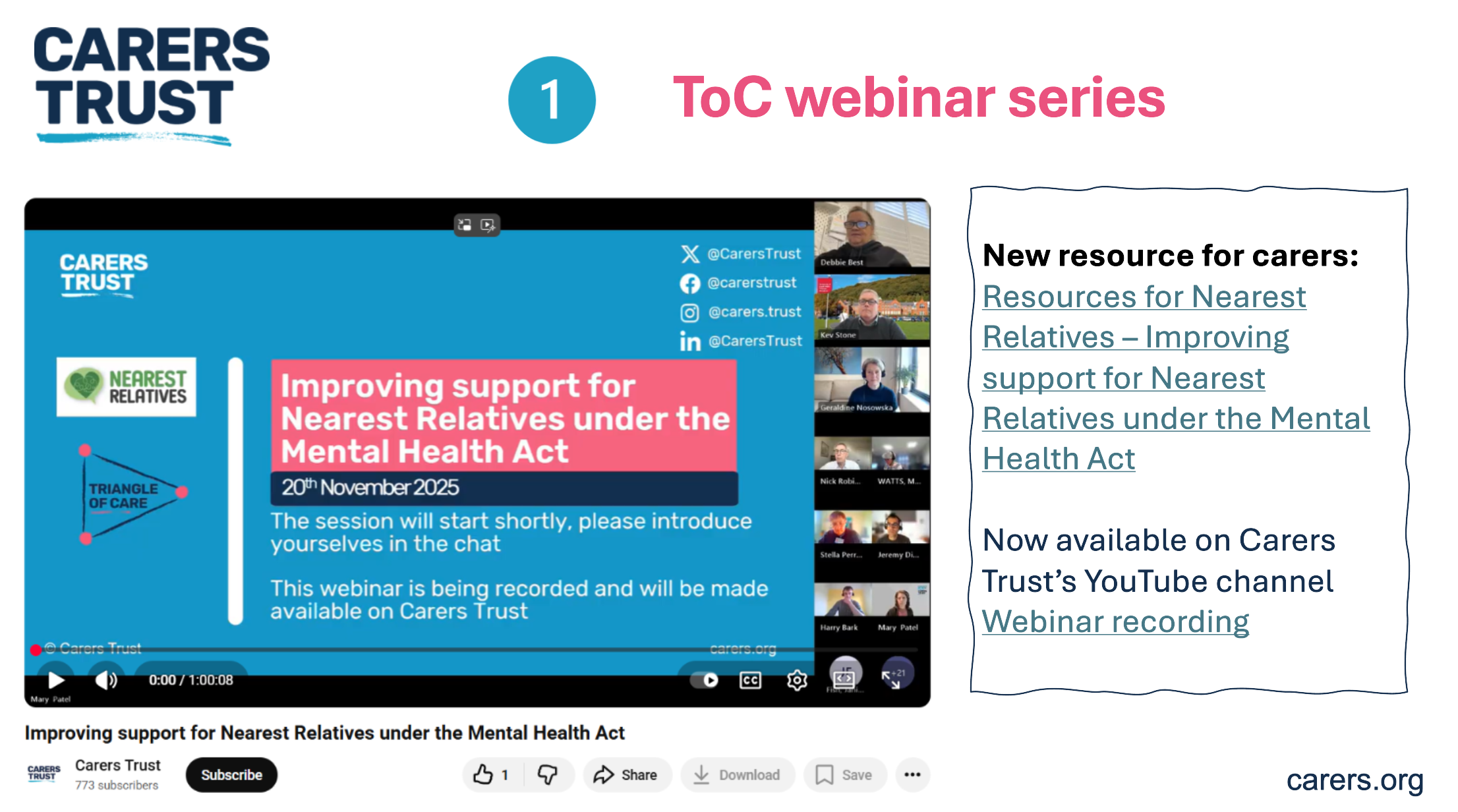
Webinars ToC’s Lunch & Learn series continues, with the recent Carers Rights Day webinar (in partnership with University of Bristol) focusing on the Nearest Relative role under the Mental Health Act (MHA). Resources are available via Carers Trust’s YouTube channel.
2.2 Young Carers: Identification & Support
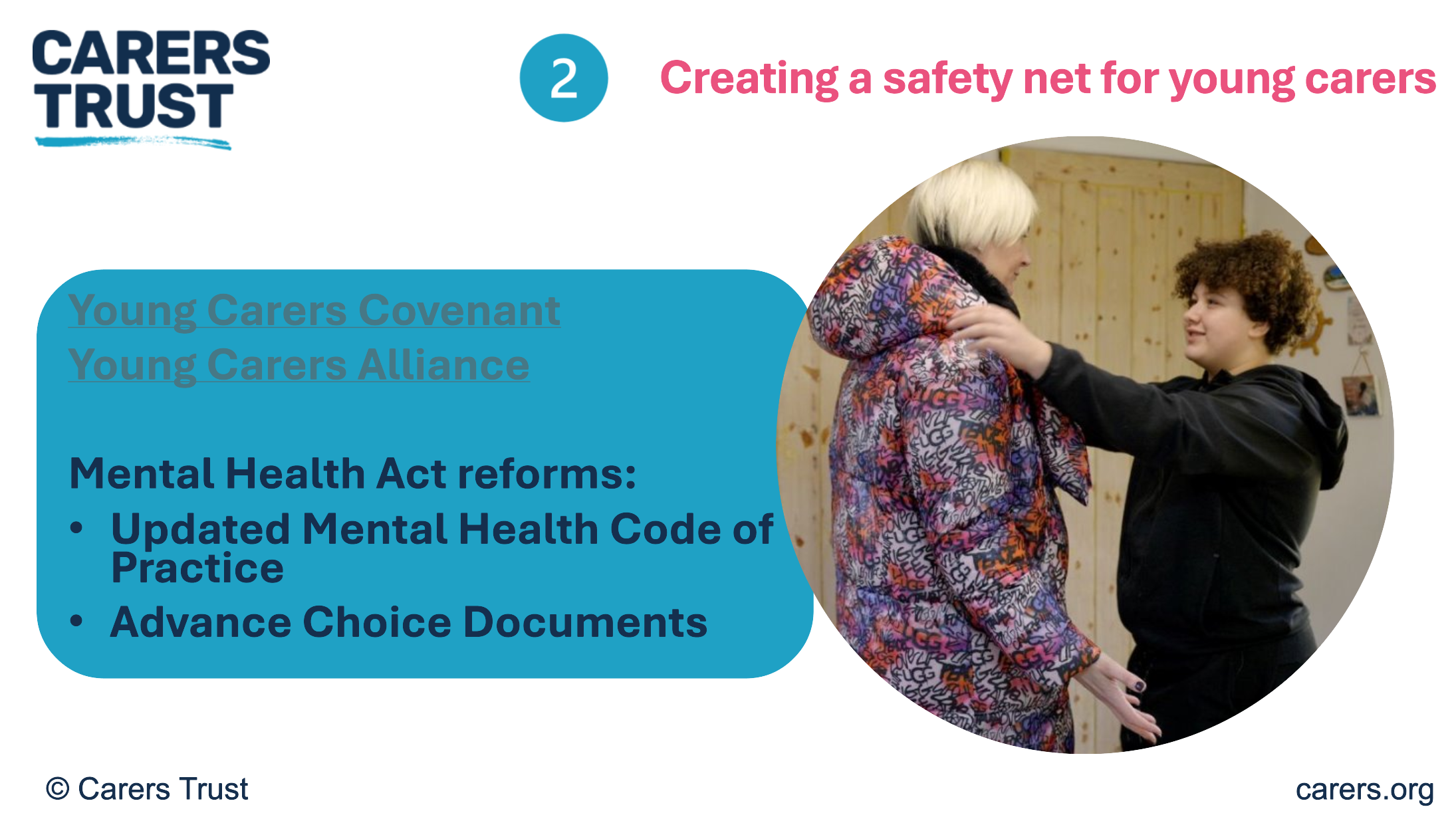
A major update was the successful national policy win relating to young carers and the Mental Health Act.
Mental Health Act Reform – Safety Net for Young Carers
Following campaigning by Carers Trust, the Young Carers Alliance, and ToC members who wrote to MPs:
Government has agreed to update the MHA Code of Practice to require:
identification of children when an adult is detained
sharing of information about available support
referrals for young carer needs assessments
Updates to advance choice documents will require practitioners to ask about dependent children.
Expected implementation: Summer 2026.
This win was warmly welcomed by the group.
2.3 Racially Minoritised Carers & PCREF
Mary updated members on ToC’s work to ensure carers are fully represented in the Patient & Carer Race Equality Framework (PCREF).
Key updates
A national Task & Finish Group has now completed its review of the first four ToC standards; the final standard is underway.
Piloting of new culturally sensitive criteria is planned with 10 NHS Trusts beginning April 2026.
Example of early good practice: Livewell South West is implementing a new “essential data template” that includes carers, enabling services to better identify and support racially minoritised carers.
Carers Trust is calling for a statutory duty for NHS mental health providers to implement PCREF in full, including community governance.
2.4 Changing the Narrative on Care – New Research
Mary introduced new research (supported by the Health Foundation and Oxfam GB) titled Changing the Narrative on Care, highlighting:
Although 80% of the public value unpaid care, this does not translate into policy action or investment.
Three recommended reframes:
Care is a universal experience, not a niche issue.
No care without support, make support visible and tangible.
Care is a partnership between families, communities and systems—not something families must do alone.
The full report is available on Carers Trust’s website.
I then presented an in-depth reflection on the value of authentic carer involvement, drawing on his lived experience and his role working with multiple NHS organisations.
Key points included:
Carers are not passive observers, they hold critical lived knowledge that improves services.
Real co-production goes beyond consultation; carers must be equal partners in shaping policy, documentation, training, and strategic decisions.
Examples Matthew gave from his own involvement:
redesigning welcome packs and leaflets
addressing confidentiality misapplication
involvement in recruitment panels
delivering training to staff at induction
reviewing complaints and compliments themes
advising on discharge processes and family-inclusive safety protocols
participating in research steering groups
Carers’ insight is especially essential in safeguarding, quality boards, and identifying service gaps often invisible to professionals.
4. Surrey & Borders Co-Production Example
A planned presentation from Surrey & Borders was postponed, as the relevant colleague could not attend with materials. They hope to present at a future meeting.
5. Research Priority Setting in Secure & Forensic Mental Health (Richard Kears)
Richard introduced a national project with the James Lind Alliance (JLA) aiming to identify the top 10 research priorities for secure and forensic mental health services across England, Scotland and Wales.
Who is the survey for?
Carers
People with lived experience of secure/forensic services
Staff working in these services
Anyone indirectly connected (victims, families)
Purpose
To ensure future mental health research is led by the real concerns of those most affected, not only by academics or pharmaceutical interests.
Process
National survey gathering research questions.
Analysis to identify common themes.
Second, more focused survey to refine priorities.
National workshops with carers, staff and people with lived experience to finalise the top 10.
A QR code and flyer were shared for distribution. The group expressed strong support.
6. Attendee Discussion & Questions
This was the richest section of the meeting, with many heartfelt contributions. The themes below reflect the key concerns raised.
6.1 Scotland & UK-wide ToC Alignment
A carer asked why Scotland’s ToC framework is separate and not integrated into the UK ToC accreditation model. Mary explained:
Scotland currently uses ToC only as a free policy framework.
Implementing the accreditation model in Scotland would require groundwork to assess willingness and ability of providers to fund membership.
Integration is being discussed but is not imminent.
6.2 Clarity on Co-Production
Several carers voiced concerns that:
“Co-production” is often used as a buzzword.
Some NHS Trusts label work as co-produced after completing it.
Carers need clarity on what ToC means when using the term.
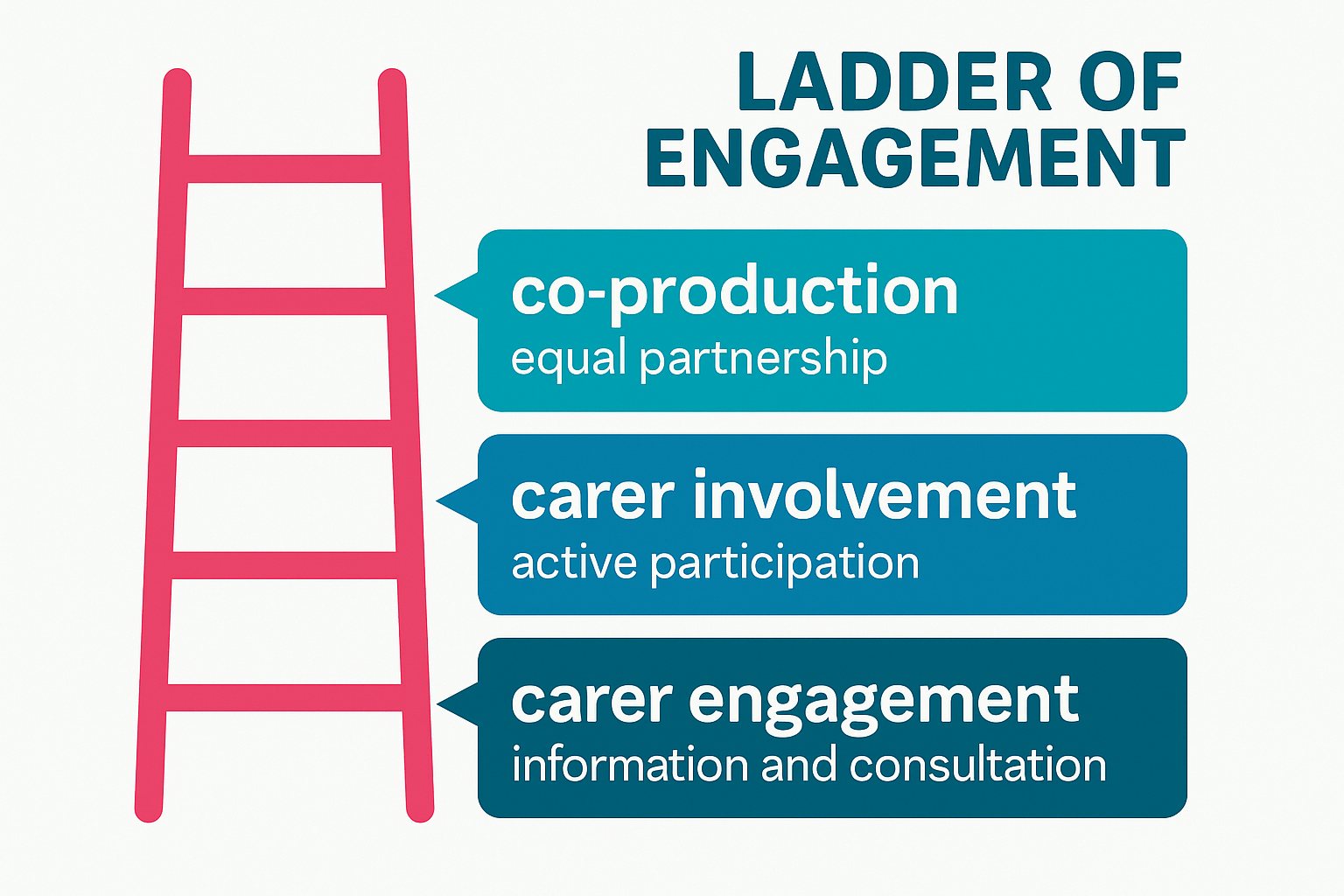
Mary responded that ToC uses a ladder of engagement, distinguishing:
carer engagement
carer involvement
full co-production
Carers Trust is developing a formal principles-based statement on involvement for future meetings.
6.3 Older Carers: Visibility, Support & Inequalities
The majority of carer questions focused on the unmet needs of older adult carers, many of whom are supporting people with severe mental illness—not dementia—and often have been caring 20–40 years.
Attendees reported:
Feeling “invisible” within both policy and services.
Being incorrectly grouped under “older carers = dementia”.
Their own poor health affecting their caring ability.
Increasing struggle to get responses from professionals.
Serious concerns about who will care for their loved ones when they die.
Feeling less heard as they age, compared with younger carers or newer voices.
One carer (age 78) shared:
“I can’t retire from caring. Benefits stop at 65, but the caring doesn’t.”
Another said:
“We have to shout louder as older women to be heard—and still we aren’t.”
Mary acknowledged the seriousness of these issues and committed to:
bringing older carers’ concerns into ongoing ToC work
exploring dedicated guidance and better mainstreaming within the ToC standards
sharing good practice on carer contingency planning in upcoming meetings
I also reiterated the group’s role in surfacing policy gaps and influencing future national lobbying.
6.4 Carer Registration & Meeting Access
Several carers raised issues with:
The length of the ToC sign-up form
Not receiving meeting links despite signing up
Verification barriers when joining Teams
Mary agreed to:
review and shorten the form
clarify which fields are optional
address email deliverability issues
adjust MS Teams settings to reduce joining friction while maintaining security
6.5 Concerns About Confidentiality Misuse
One carer reported that in a CQC meeting at an NHS Trust, raising questions about communication was dismissed as “confidentiality”, preventing meaningful dialogue. I then encouraged carers to bring such examples into:
ToC Star peer reviews
Carer involvement forums
Local advocacy routes
He noted that misuse of confidentiality is a common and unacceptable barrier and must be challenged.
6.6 Petition on Antipsychotic Medication Research
Carers highlighted concerns about:
long-term prescribing of antipsychotics
lack of regular medication review
inadequate research into long-term effects
A carer shared a petition calling for investigation of psychiatric medications. Richard noted that he had signed and shared it previously.
7. Closing Remarks
Matthew thanked all attendees for their honesty, passion and persistence:
“Carers’ voices shape policies and improve care. That is exactly what this group is here to do.”
Mary acknowledged:
the importance of every concern raised
the need to better support older carers
improvements to ToC communications and meeting accessibility
that the next meeting will be in January (provisionally 19th)
The meeting closed with gratitude from carers who said they felt heard, supported, and connected.
This week, we come together to recognise something deeply human, yet often hidden: grief and the people who carry it long after the world has moved on.
I’ve created a short video exploring the emotional reality of bereavement, with a special focus on unpaid carers. These are the people who quietly give their time, energy, and love to support someone through illness… and who are often left to grieve in silence when that journey ends.
My hope is that this helps spark conversations, reduce stigma, and remind anyone grieving that you are not alone.
If you or someone you know needs support, these organisations can help:
Let’s work together to make sure every bereaved person, especially unpaid carers so they is heard, supported, and understood. #GrowingWithGrief | #GriefSupport | #UnpaidCarers | #Wellbeing
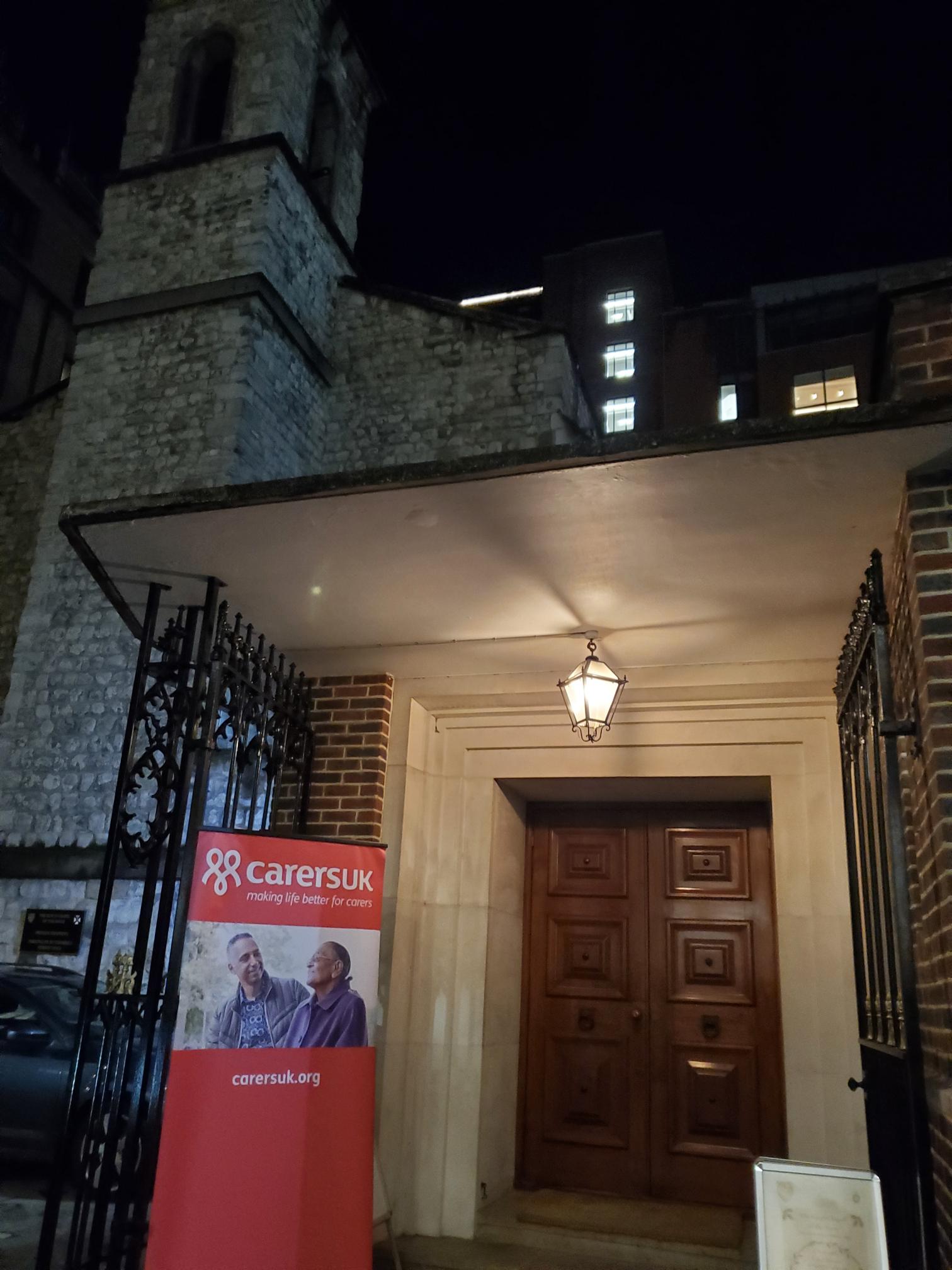
On 4th December 2025, I had the privilege of attending the Service of Christmas Carols and Readings for Carers UK (for their 60th anniversary) at The King’s Chapel of the Savoy.
As many will know, Carers UK is a national charity that offers advice, information, and advocacy for unpaid carers, people who look after a family member or friend due to illness, disability, mental health challenges or frailty.
Their work is vital and ranges from campaigning for carers’ rights, to shaping policy, to providing emotional and practical support.
As someone who has spent years amplifying carers’ voices, and as someone who has been a carer myself, I always find moments like this grounding. They remind me that carers are so often hidden and deserve spaces of recognition, reflection, and community.
I couldnt capture the whole event, so a lot of it is from memory,
The King’s Chapel of the Savoy, with its royal heritage and intimate atmosphere, felt like the perfect place for such a service. The carved wood, the vivid ceiling, the echo of voices old and new it all contributed to an environment where carers could feel honoured rather than overlooked.
A Service That Told carer Stories
The order of service blended scripture, poetry, classic carols, and carers’ own words. Each part spoke to a different dimension of caring, love, sacrifice, resilience, loss, hope.
Here is a clear, concise list of the Carers UK Christmas Carol Service Order, based on the programme you shared.
Some of the order of Service – Carers UK Christmas Carols and Readings
Carol – Once in Royal David’s City
Welcome & The Bidding Prayer by The Revd Canon Thomas Woodhouse MA
Welcome on Behalf of Carers UK by Helen Walker, Chief Executive
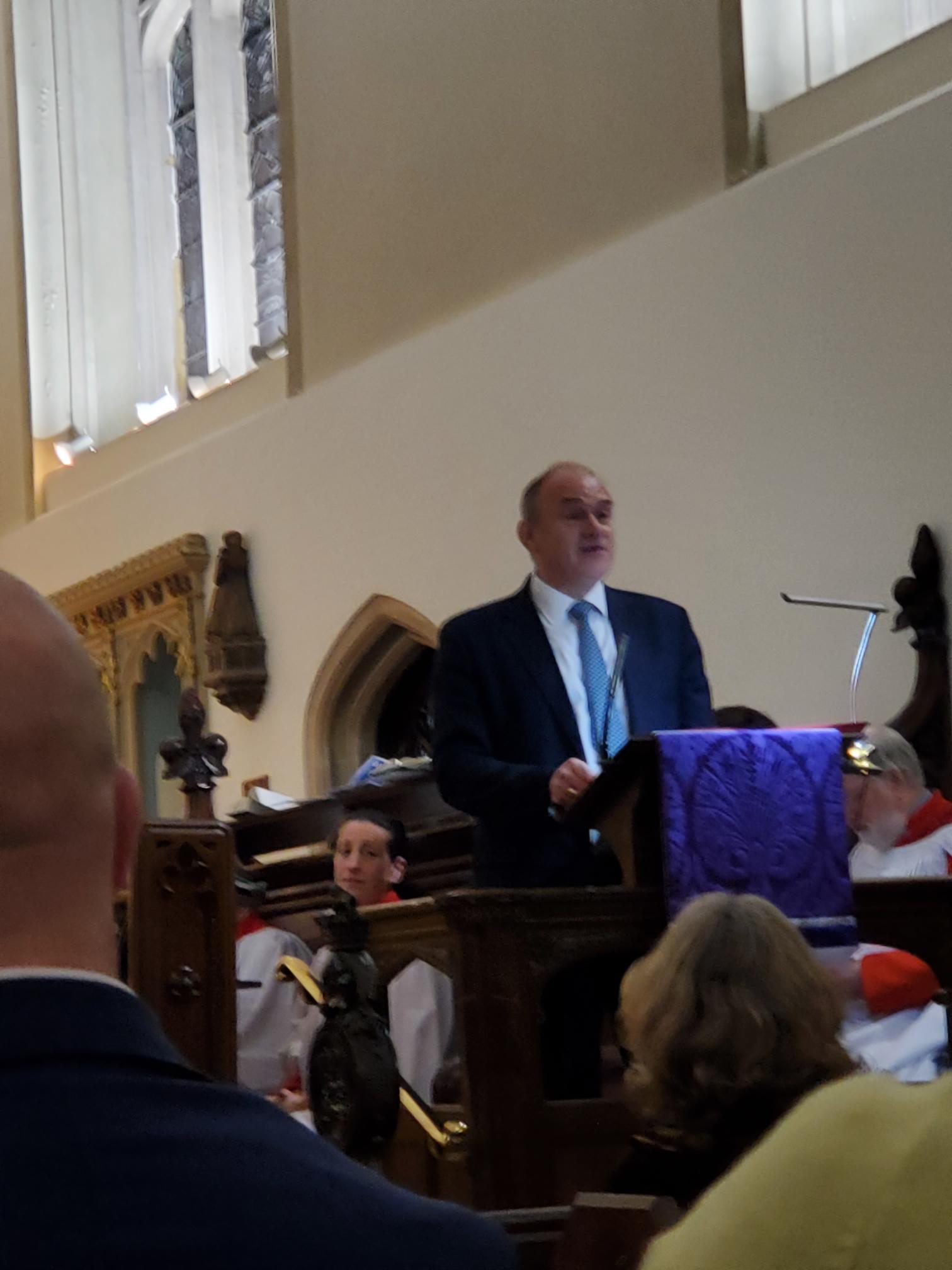
Gospel According to Luke, Chapter 2, Verses 8–20 Reader: Rt Hon Sir Ed Davey MP
Reading – Gospel According to Luke, Chapter 2, Verses 1–7, Reader: The Rt Rev Rob Wickham
Reading – Extract from A Christmas Carol, Reader: Jaycee La Bouche, a carer
The Blessing by The Revd Canon Thomas Woodhouse MA
Below are some reflections on the elements that struck me the most, based on the transcript provided.
I started noting down things when hearing the classic Clement Clarke Moore poem brought a sense of nostalgia and gentleness. For many carers, Christmas isn’t always restful, it can be emotionally heavy or practically demanding. Yet this reading reminded me of the grounding power of tradition.
There was also a Carer’s Poem – “I Carried Him” (Martin Seare), which was read by Tiggy Walker. The poem captured something familiar to many carers, which is the sense of being the energy source behind someone else’s survival. The feeling of being nurse, advocate, motivator, protector, and emotional anchor, all at once.
Jaycee’s reading from A Christmas Carol brought a heartfelt authenticity to the service, grounding Dickens’ message of compassion in real lived experience. Hearing a carer deliver those words reminded me how powerfully stories of renewal that echo the emotional journeys many carers navigate every day.
We also heard an extract from A Christmas Carol, where hearing Dickens’ words about Scrooge’s transformation felt fitting. Carers often live in a world full of systems that need to “wake up” to their realities, these systems overdue for compassion and change.
There was another Carer’s Poem – “Hands That Once Held Me” (Aaliyah O’Neill), which was read by Pippa Haywood. This poem honoured the emotional labour that accompanies caring, the grief, the patience, the love that persists through fading timelines and shifting identities.
Walking around after the service, we were provided with wine and mince pies (I could only handle one glass of mine), but ate a lot of mince pies. I also noticed on a nearby table, beautifully wrapped with red ribbon, were copies of books written by individuals deeply connected to the world of caring.
Tiggy Walker’s Both Sides Now offered a tender, candid exploration of love, loss, and the emotional realities of caring, while Why I Care highlighted personal reflections on the value and challenges of supporting others by Sir Ed Davy. Seeing these books at the event felt fitting, they extended the service’s message by giving carers stories they could see themselves in, learn from, and feel strengthened by.
Carols – Collective Voice, Collective Strength
Carols like “Once in Royal David’s City,” “O Little Town of Bethlehem,” “In the Bleak Midwinter,” “O Come All Ye Faithful,” and “Hark the Herald Angels Sing” took on added meaning.
Singing these in chapel reminded me that carers often feel alone, but they are part of a much larger story. Carols have always been about shared experience, hope, and unity. That unity was felt strongly throughout the chapel.
A Blessing for Carers
Towards the end, The Revd Canon Thomas Woodhouse offered prayers acknowledging:
those who care
those who are cared for
those who grieve
those who find joy in service
those who struggle silently
What the Service Meant to Me as a Carer
I left the event feeling the followng:
Being Seen
Carers rarely hear their stories reflected back to them with such respect. This service did that.
Connected
Being surrounded by fellow carers, supporters, faith leaders, and advocates reminded me that we are not navigating these challenges alone.
Renewed
Christmas can be difficult for many carers, i am running a few carer groups to reduce isolation, but this service offered a moment to pause, reflect, and recharge spiritually and emotionally.
Motivated
Each poem and reading reinforced why I continue to campaign and raise awareness: because carers’ lives, struggles, and contributions must be brought into public consciousness.
Final Thoughts
The Carers UK Christmas Service wasn’t just a festive gathering, it was a space that lifted the voices and experiences of carers into the light.
Carers UK continues to be a champion for those who give so much of themselves. And events like this remind us that recognition, community, and hope are powerful gifts.
I left the chapel gratefull for the stories shared, for the solidarity felt, and for the reminder that carers are, and always have been, at the heart of what makes our communities truly compassionate.
BONUS : A small tour of the chapel.
History in the Woodwork: Discovering the Stories Behind the Savoy Chapel’s Symbols
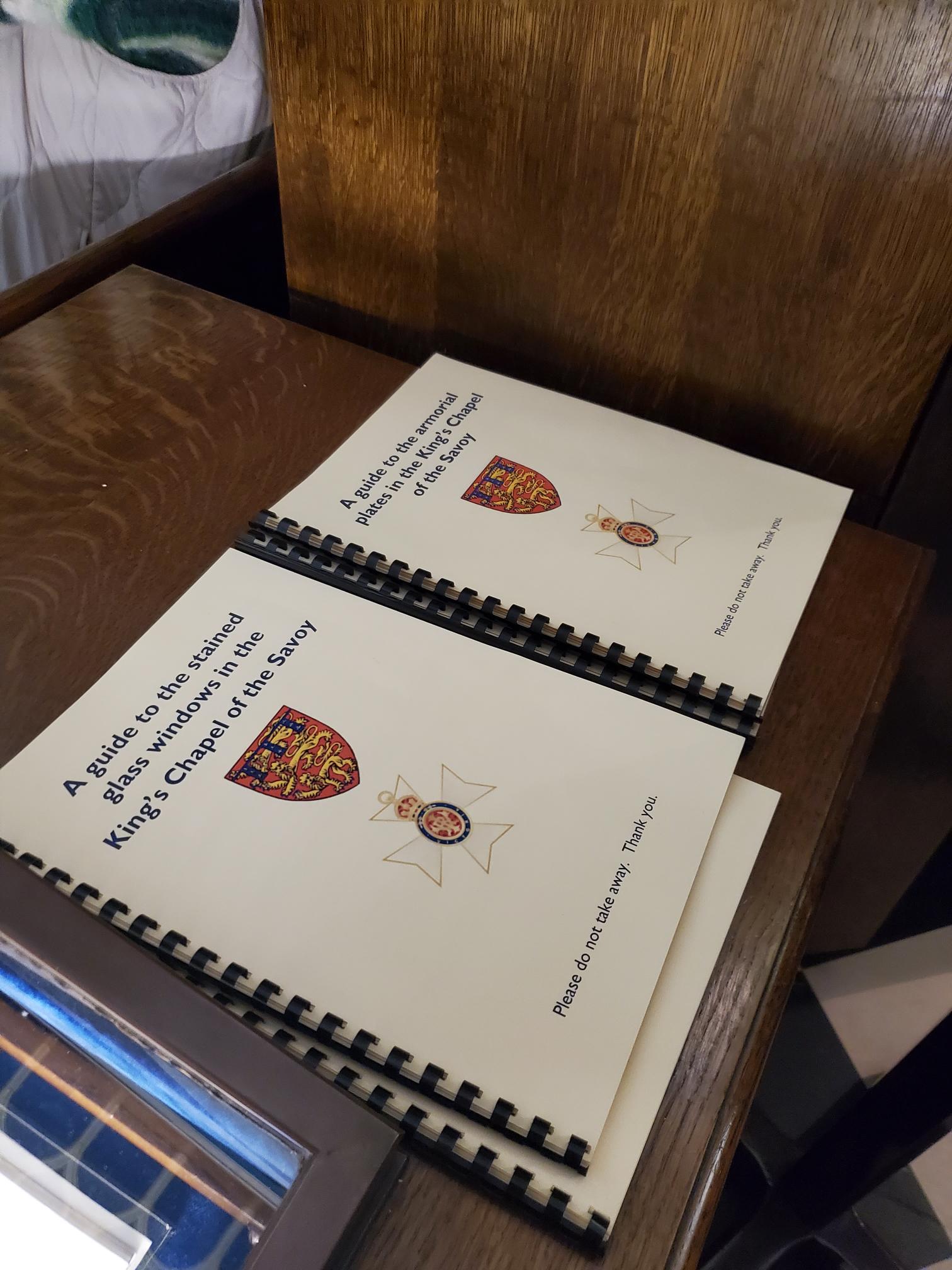
One unexpected part of attending the Carers UK Christmas Service at The King’s Chapel of the Savoy was the opportunity to explore some of the chapel’s remarkable historical artefacts. As a carer and someone who works in carer advocacy, I often reflect on continuity on how the past shapes the present. Walking around the chapel, I realised the walls were not just decorative; they were storytellers.
These objects and emblems remind us that the Savoy Chapel is a living part of royal, national, and personal history. And in many ways, the quiet endurance reflected in these items echoes the resilience of carers across the country.
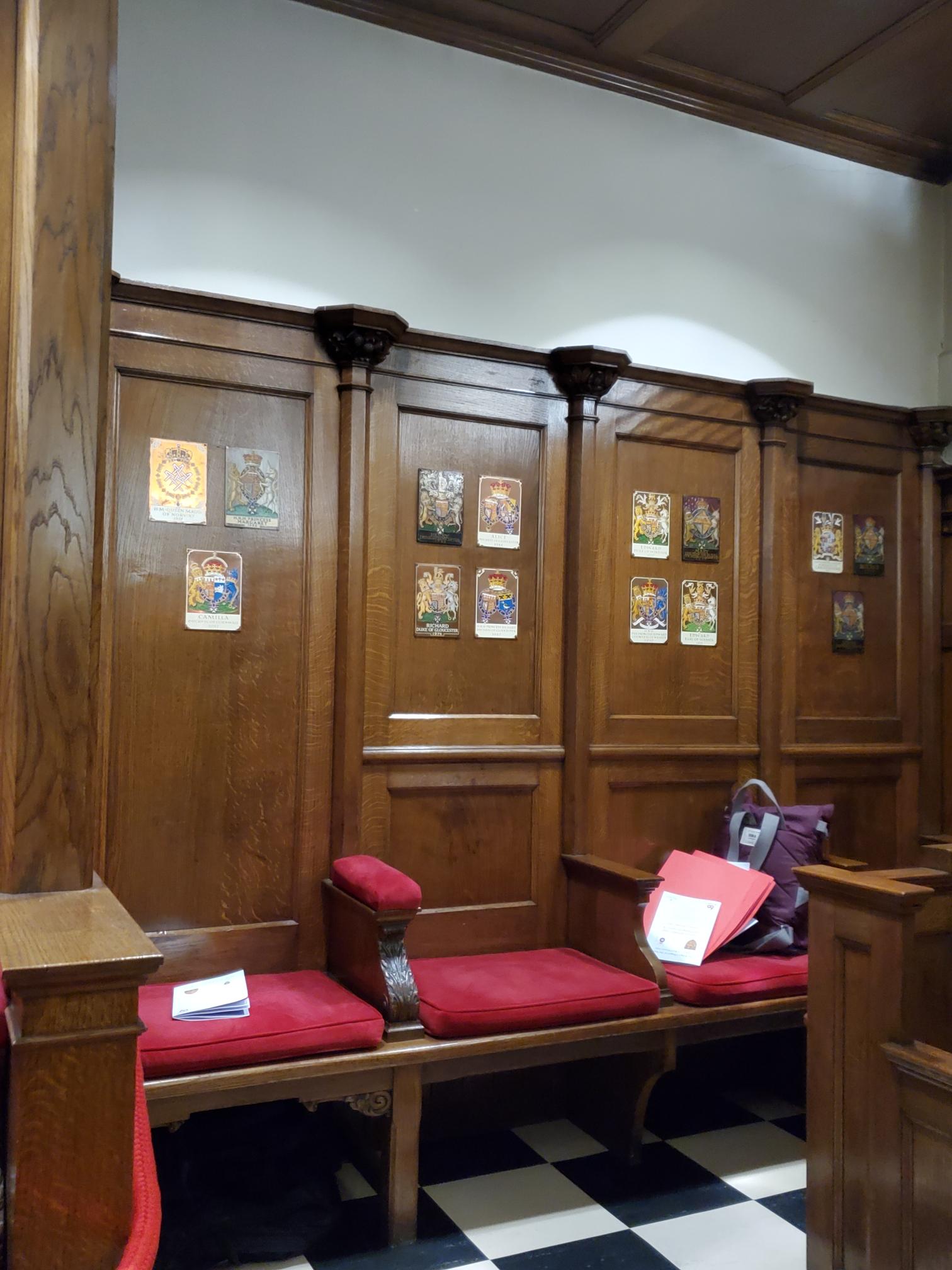
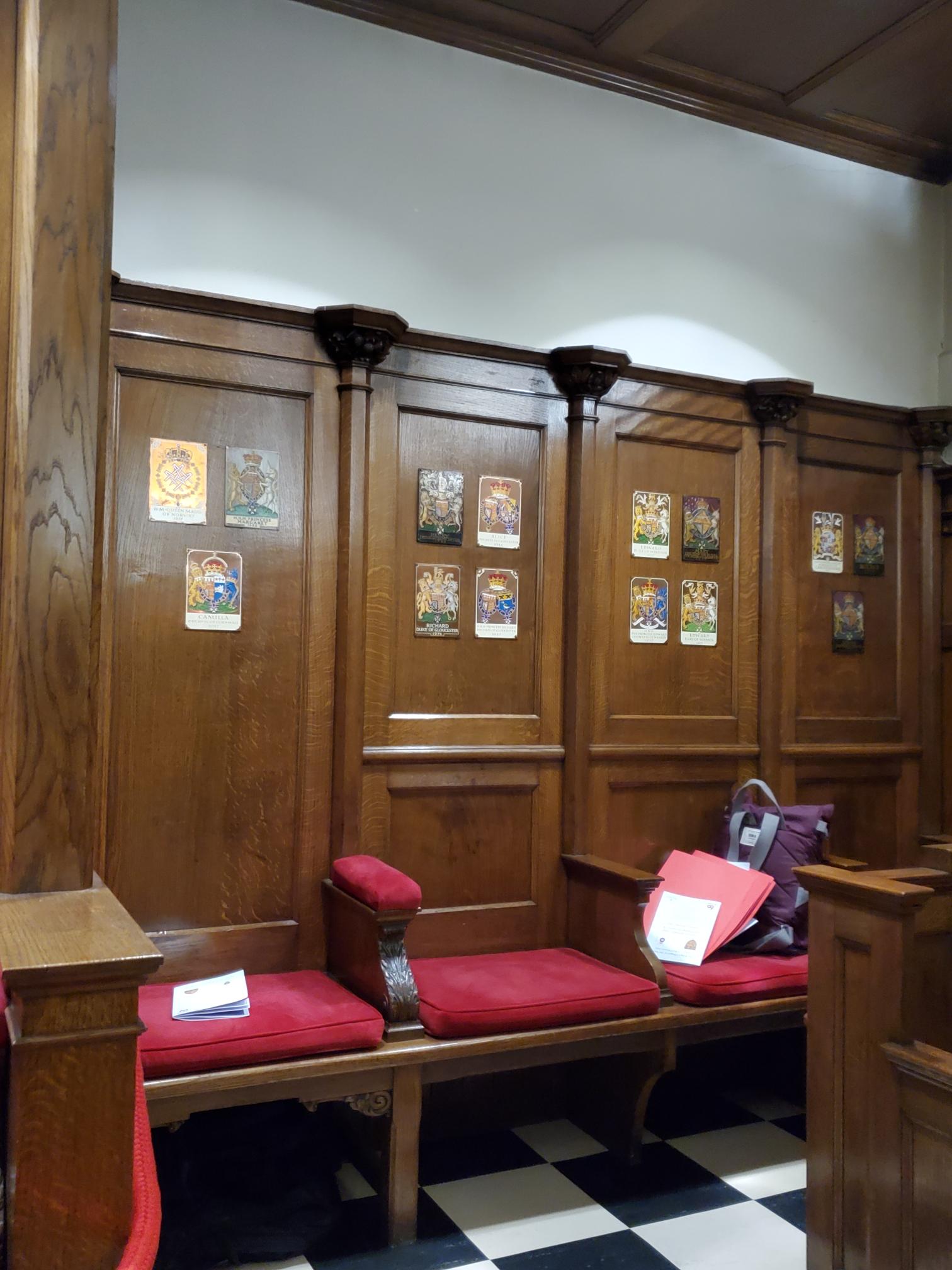
1. The Heraldic Plaques on the Chapel Walls
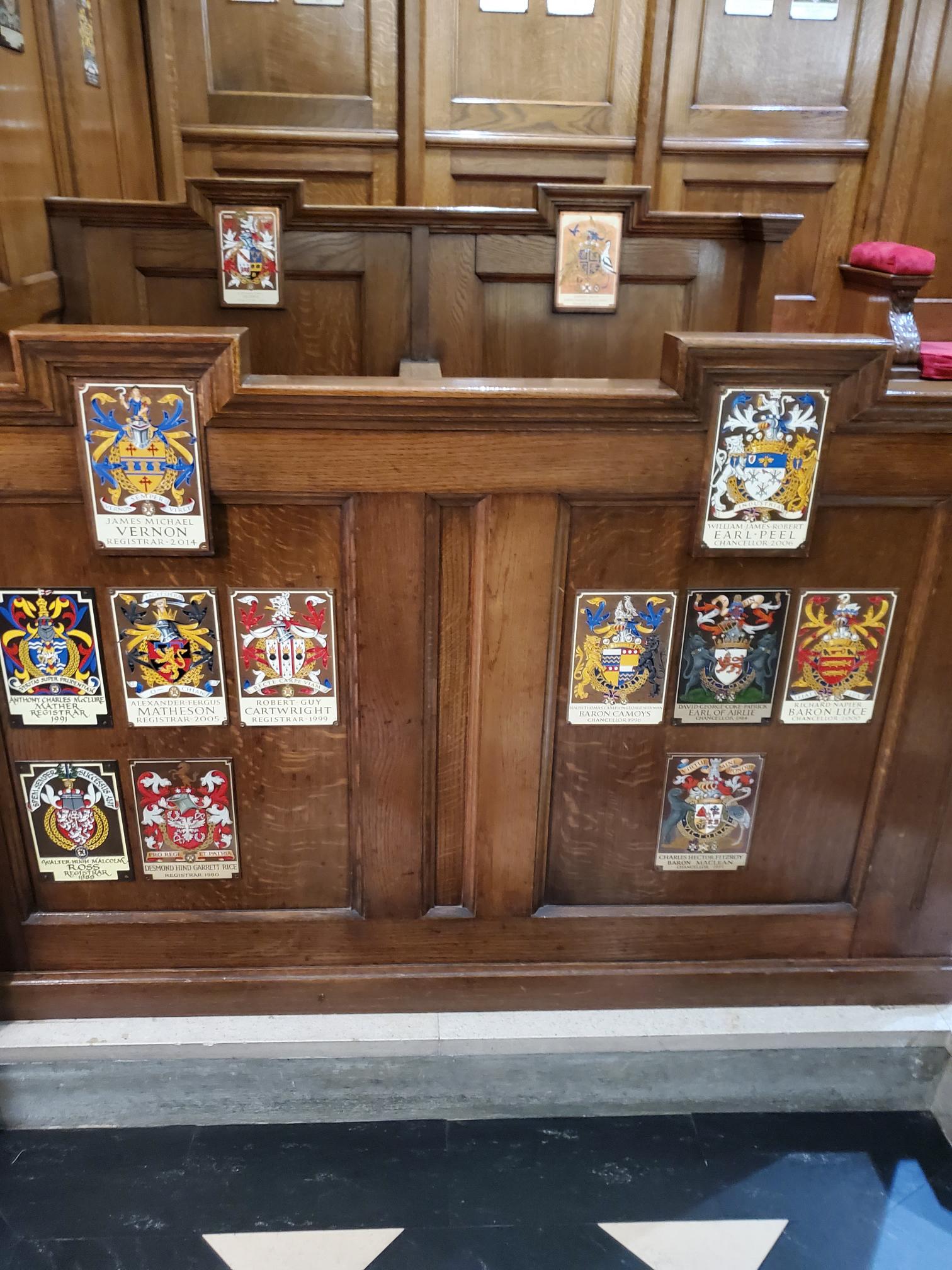
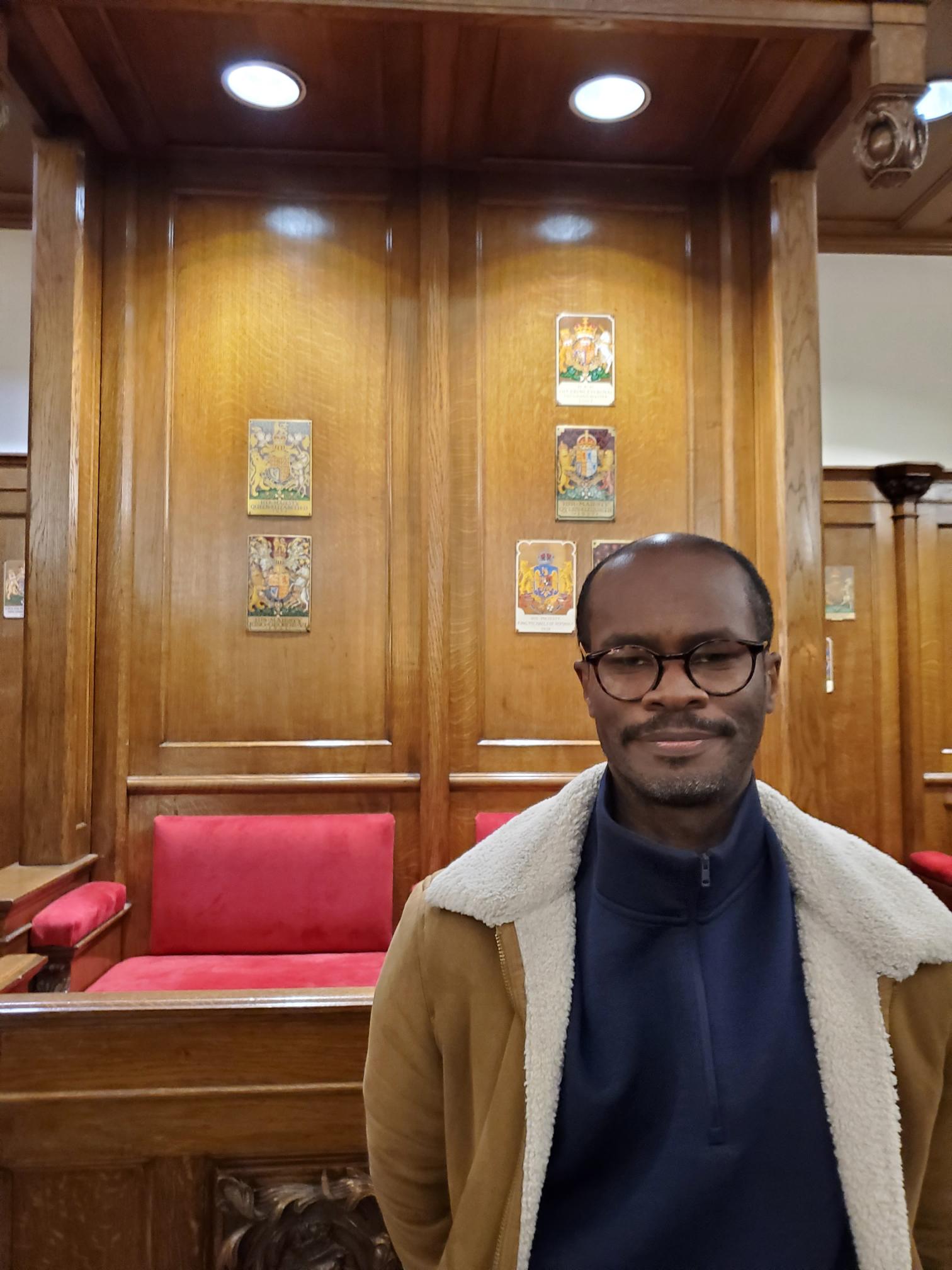
Along the wooden panelled walls were beautifully detailed heraldic plaques, each representing past members or senior figures associated with the Royal Victorian Order or individuals linked to the chapel’s long history of royal service.
The Royal Victorian Order was established in 1896 by Queen Victoria as a way of personally recognising service to the monarch. That personal element, service based on loyalty, commitment, and relationship. That i felt especially meaningful as someone attending the Carers UK event.
Each plaque typically includes:
A coat of arms, with symbols representing the individual’s heritage, achievements, or values.
A Latin motto, often referencing duty, honour, or faith.
A record of rank or title, showing how the person was tied to the Crown or Order.
Standing before these plaques, I was reminded that service, whether to the Crown or to a loved one is always part of a bigger human story.
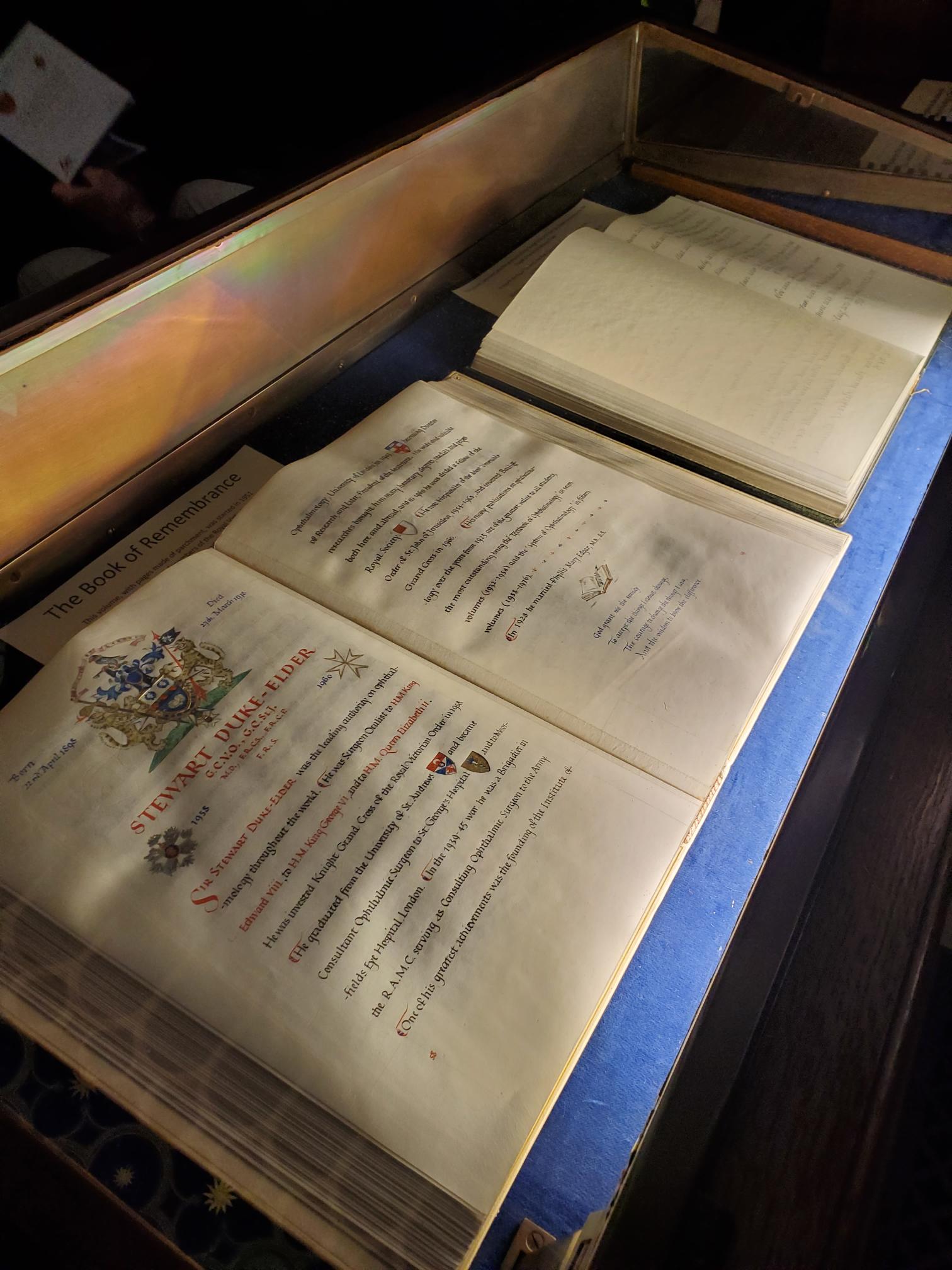
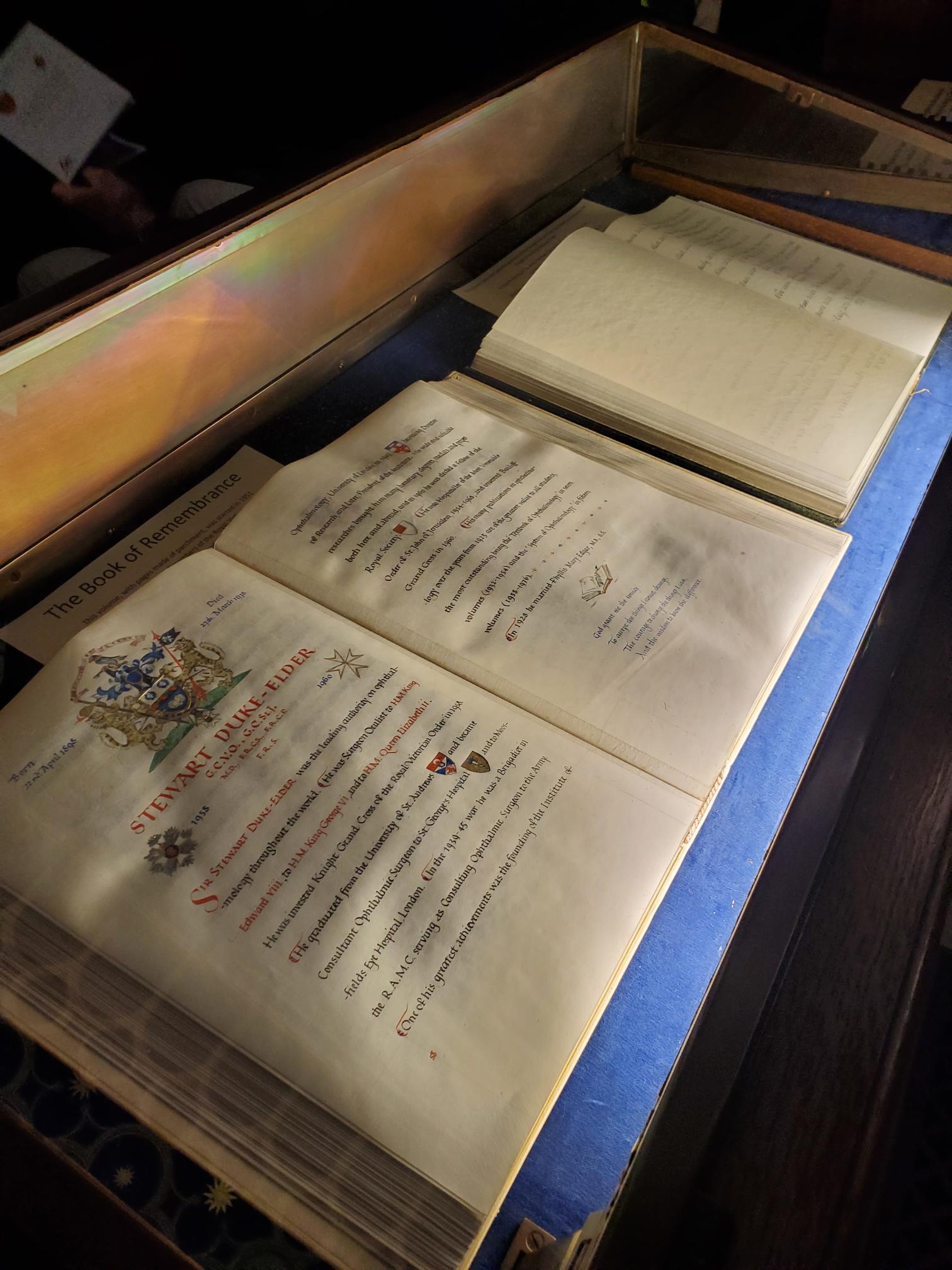
2. The Book of Remembrance
Displayed under protective glass, the Book of Remembrance is one of the most moving artefacts in the Savoy Chapel. It is handwritten and illuminated in a traditional style, much like medieval manuscripts.
The book honours individuals connected to the chapel, recording their names, contributions, and sometimes short dedications. Every entry is crafted with care, respecting the memory of those who served their communities or the Royal Household.
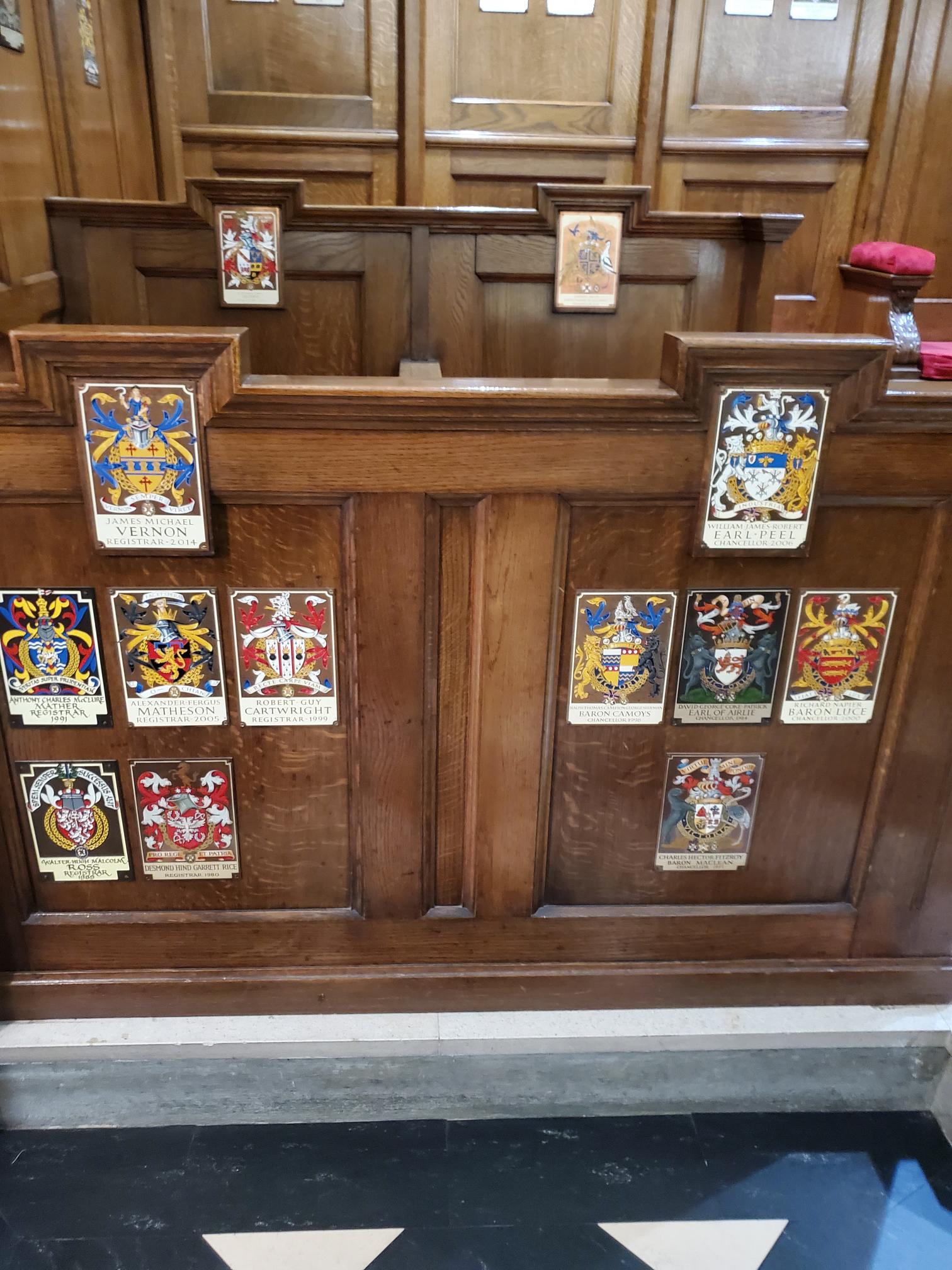
3. The Stalls with Coats of Arms of Officers and Servants of the Order
In the choir stalls, more coats of arms decorate the woodwork. These represent officers, registrars, chaplains, and others who have served the Royal Victorian Order over the decades.
Each shield is different, but together they form a visual tapestry of dedication. They signal continuity across generations much like how caring roles pass through families, communities, and time.
You can almost imagine the individuals who once occupied these seats, each carrying out their duties with diligence. Their heraldry remains here as a testament to lives spent in service.
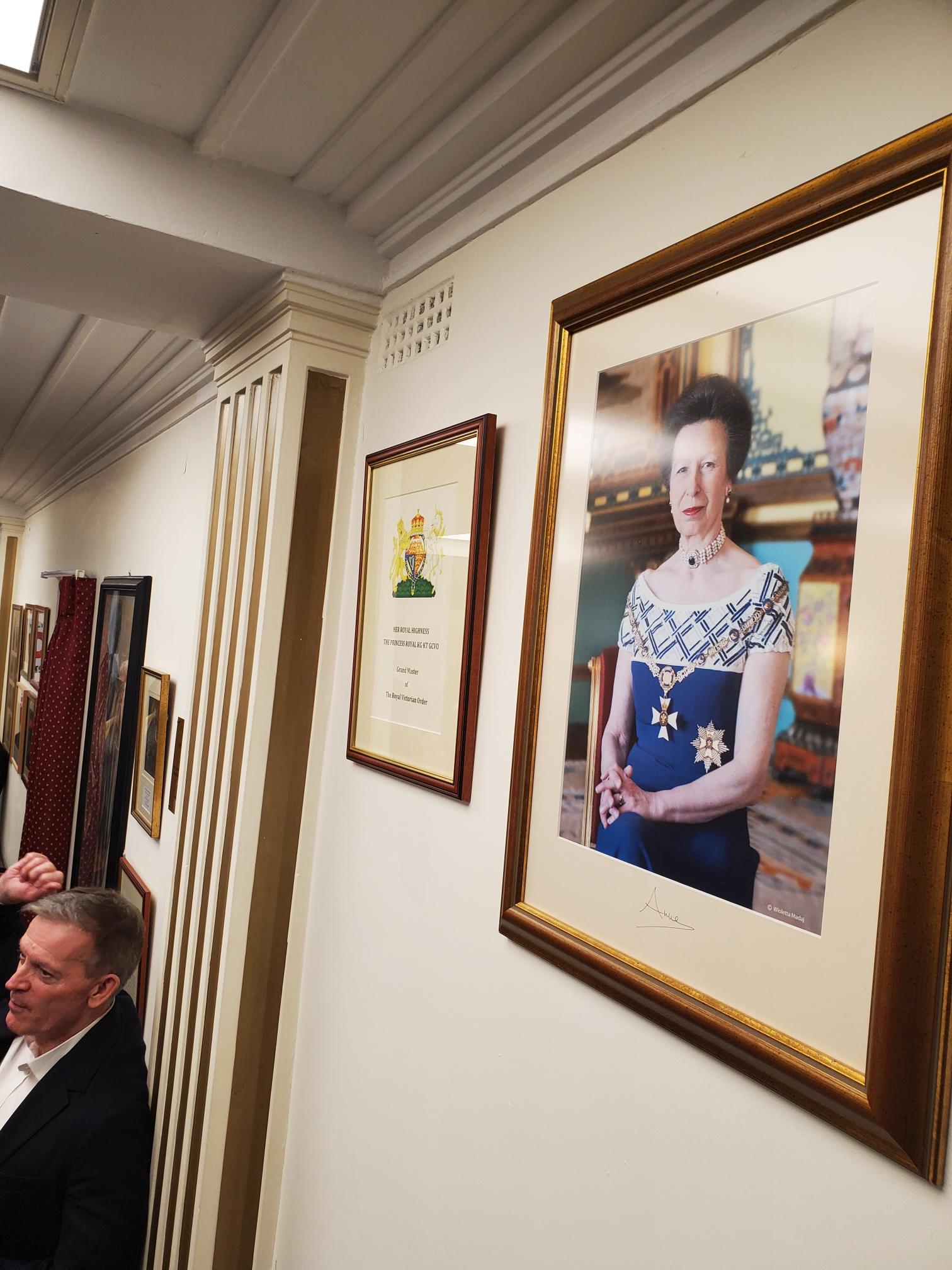
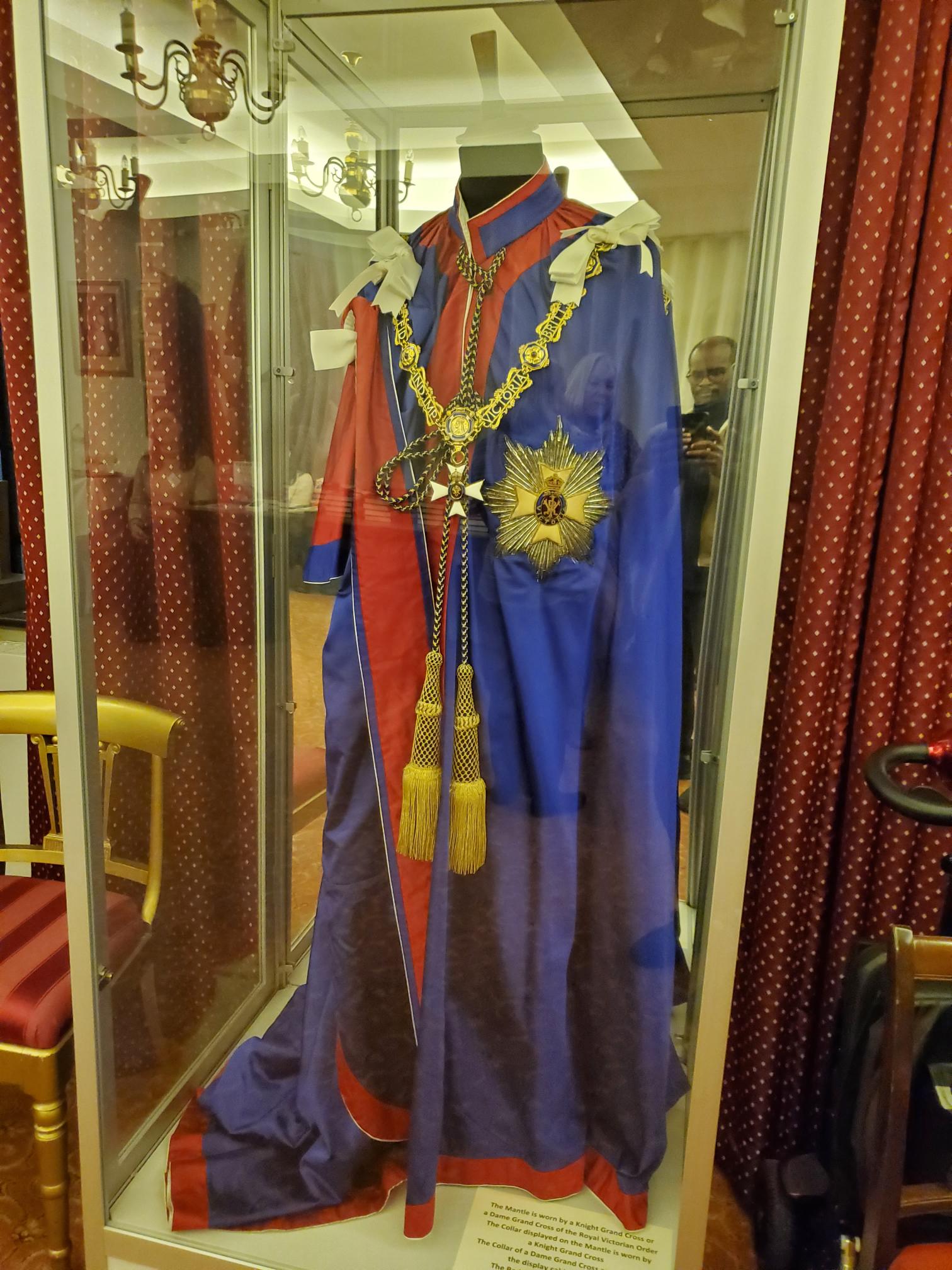
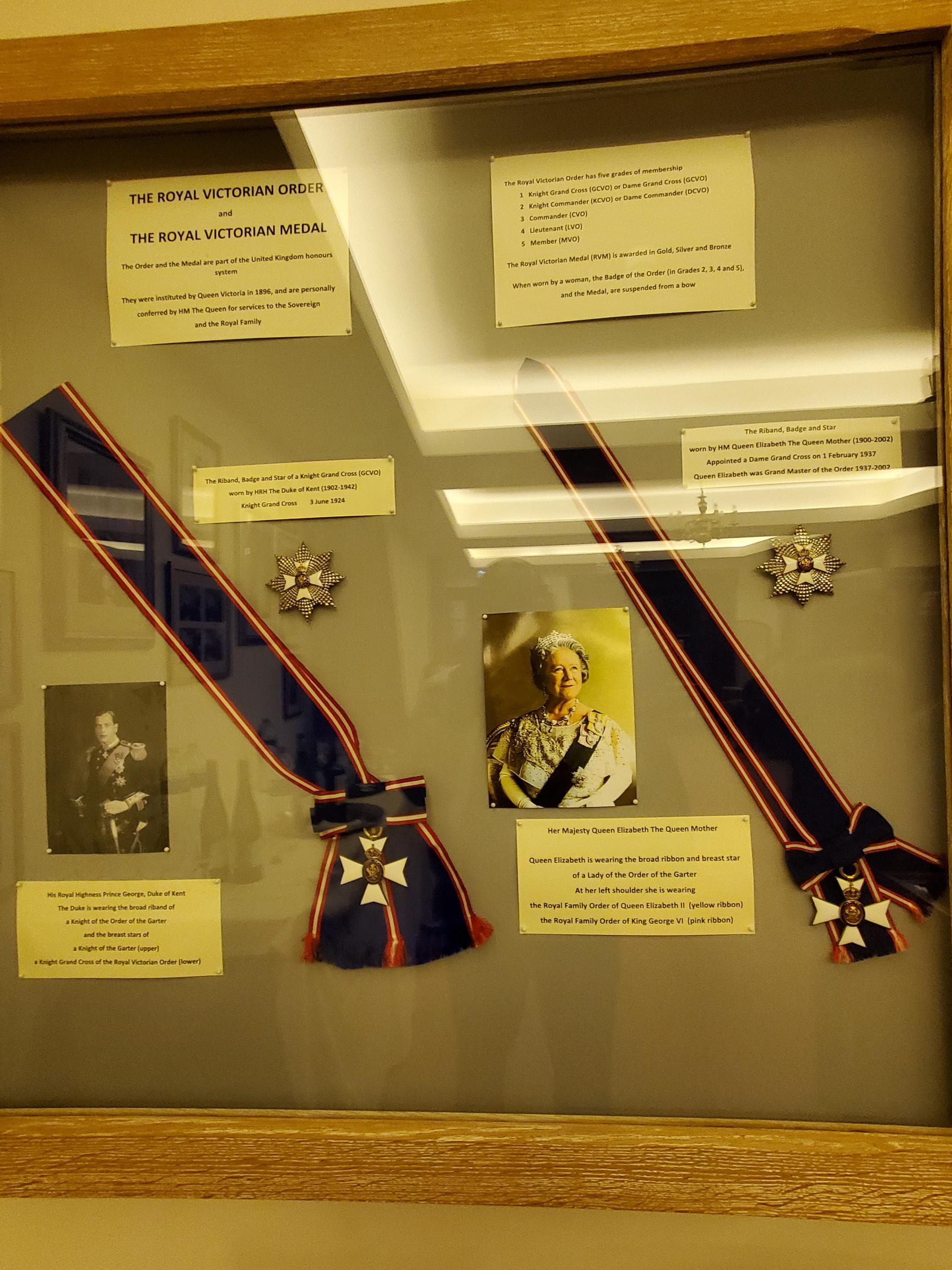
4. The Mantle and Insignia of a Knight Grand Cross of the Royal Victorian Order
One of the most striking displays was the ceremonial mantle worn by a Knight Grand Cross of the Royal Victorian Order (GCVO). The deep blue and crimson robe, gold tassels, and the star emblem reflect the highest grade of this honour.
The mantle’s presence is not merely decorative:
The GCVO is awarded personally by the monarch, not via government recommendation.
It recognises exceptional service to the Crown.
The Star, Badge, and Collar each represent centuries-old tradition.
5. The Royal Victorian Order and Medal Display
This framed display explains the different grades of the Royal Victorian Order (RVO) and shows examples of the insignia, including:
Knight/Dame Grand Cross (GCVO)
Knight/Dame Commander (KCVO/DCVO)
Commander (CVO)
Lieutenant (LVO)
Member (MVO)
Royal Victorian Medal (RVM) in Gold, Silver, and Bronze
The RVM is unique because it honours personal service by staff who support the Royal Household directly, often throughout a lifetime. The photos in the display include historical figures wearing the ribbons and badges, underscoring the order’s strong ties to loyalty and lifelong commitment.
Why These Artefacts Mattered at a Carers Event
These historical items weren’t just museum pieces; they told a story of service, loyalty, remembrance, and quiet strength. I think in that sense, they perfectly framed the Carers UK Christmas Service.
Chaired by Matthew McKenzie, Lived-Experience Carer
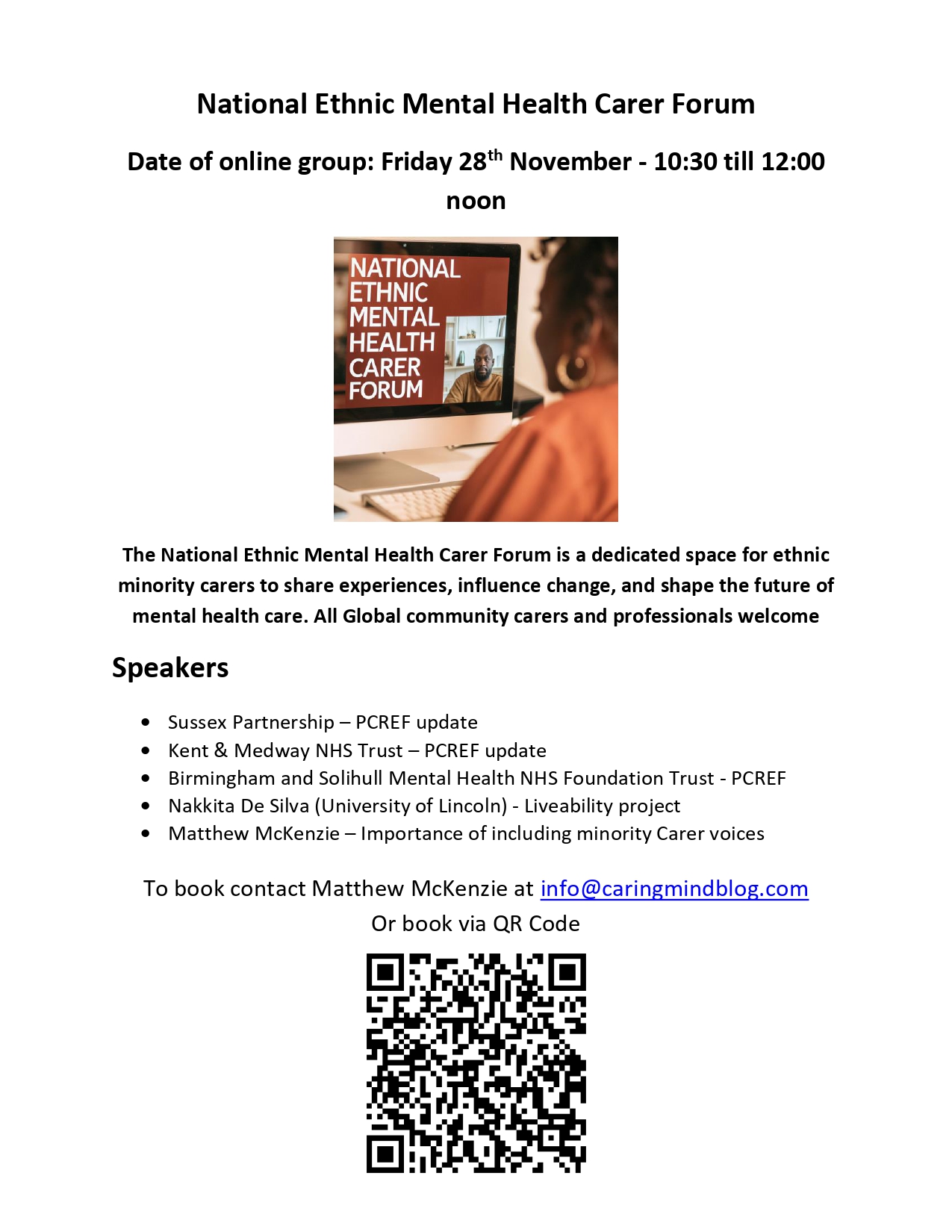
The latest meeting of the National Ethnic Mental Health Carer Forum brought together unpaid minority carers, community partners and four NHS mental Trusts (Avon & Whiltshire were kind enough to be included to update) to explore progress toward the Patient & Carer Race Equality Framework (PCREF), share challenges, and elevate lived-experience voices. As always, I ensured the space remained honest, fast-paced and rooted in what truly matters to ethnic minority carers: being heard, understood and included.
My latest blog for the November forum captures key highlights from each Trust, along with questions raised by attendees, reflecting the critical concerns and lived realities that continue to shape PCREF work across the country.
1. Avon & Wiltshire Mental Health Partnership Trust (AWP)
Focus: Triangle of Care, PCREF oversight, carer champion roles.
Avon & Wiltshire outlined how their PCREF programme is being driven through a clear governance structure, including a central Oversight Group and locality-based meetings. These layers ensure that learning from communities and staff filters upward and influences whole-trust priorities. Their collaboration with Nilaari (I think that is what their called), a long-standing community organisation supporting racially marginalised groups, has been key in grounding their PCREF work in authentic community voice.
A central pillar of their presentation was the strengthening of the Triangle of Care and carer-related PCREF oversight. They recognised that carer involvement cannot rely on goodwill or isolated champions; it requires structurally defined roles, written responsibilities, and consistent organisational expectations. The Trust is working on ensuring that every team and ward embeds a carer champion, whose purpose is not to “do everything for carers”, but to support cultural change within the workforce so that carers are recognised as equal partners.
They emphasised the importance of building staff capacity in cultural humility and safe conversations about race. AWP acknowledged that staff often feel unprepared to discuss ethnicity, discrimination or identity with carers. To address this, the Trust has created psychologically safe internal spaces, particularly for racially marginalised staff—to process experiences and explore how structural and interpersonal inequalities impact both staff wellbeing and patient care. This cultural environment is foundational to PCREF implementation because it shapes how confidently staff engage with diverse carers.
Key Points:
Carer champions must support, not replace, teams in working with carers.
Emphasis on psychological safety for racially marginalised staff and carers.
Encouraging honest conversations around race, trauma, and culture across staff teams.
Questions raised by attendees:
How do you embed cultural awareness within staff teams, not just for carers? – Concern that staff dynamics and cultural differences must be addressed to create consistent culturally responsive care.
How do staff and leaders hold ‘difficult conversations’ about race and safety? – Attendees wanted clarity on how psychological safety is practiced and how managers are supported.
🌟 2. Birmingham & Solihull Mental Health NHS FT
(Children & Young People’s Division – “Co-STARS” programme)
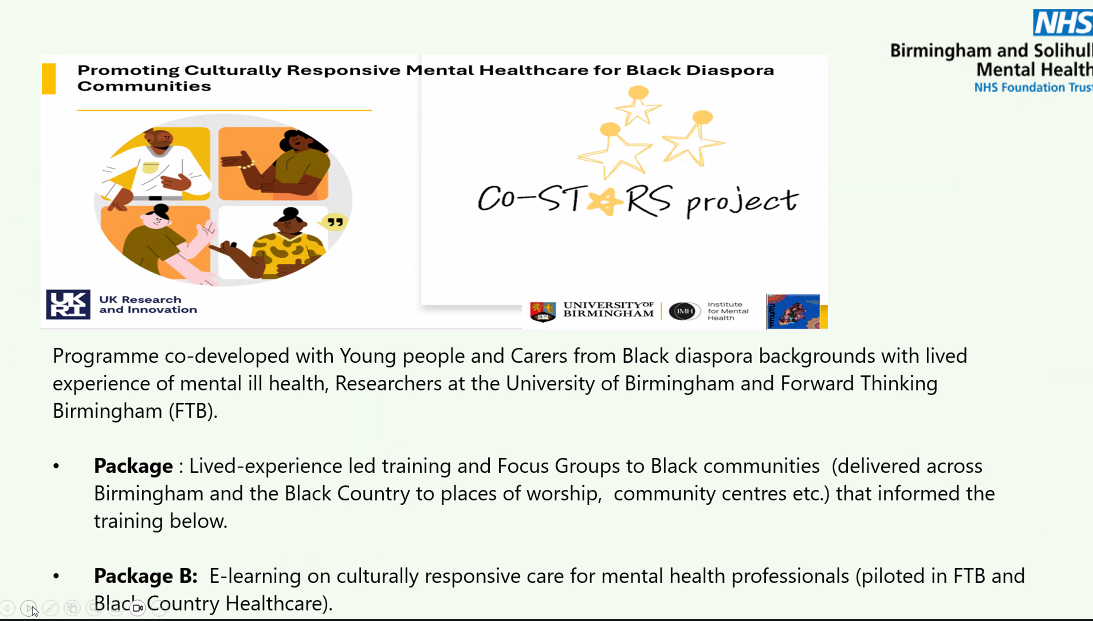
Birmingham & Solihull (CYP) presented one of the most detailed and emotionally grounded PCREF programmes, shaped heavily by lived-experience research with Black diaspora families. Their PCREF priorities, knowing our communities, transforming with communities, and delivering care that works reflect a commitment to embedding cultural responsiveness at every step. Their partnership with the University of Birmingham and Forward Thinking Birmingham has produced the Co-STARS project, a blend of lived-experience-led community work and staff training modules.
A major part of their PCREF advancement comes from working intensively with families to capture how racialised parents feel when using services. The Trust shared powerful testimonies from Black carers who described needing to “emotionally self-regulate” in meetings to avoid being labelled angry, unstable or cold. Parents also highlighted the emotional labour of protecting their children from stereotypes such as the “angry Black boy”, as well as fears of being adultified or dismissed. These insights have directly reshaped responses from clinical teams and informed the development of carers’ passports and safe spaces.
Birmingham & Solihull also emphasised building structures to ensure that their care pathways become culturally competent and adaptive. They are embedding PCREF champions across all clinical pathways, from eating disorders to psychosis and autism, ensuring diversity and inclusion principles shape every aspect of assessment, treatment and review. The Trust is also developing e-learning on culturally responsive practice, and expanding identity-specific support spaces (e.g., Black Carers Groups and new plans for Asian carers’ spaces). This multi-layered approach reflects a commitment to PCREF that is both structural and deeply relational.
Key Points:
Embedding culturally competent conversations within CYP teams.
Developing a Black Carers Group and safe spaces for racialised parent groups.
New e-learning on culturally responsive practice (from Co-STARS package).
Use of carer passports to ensure carers feel like equal partners.
Strong focus on how ethnic minority parents feel judged or misread by services (e.g., “angry Black woman,” “cold mother”) – themes drawn directly from carer focus groups.
Recognising adultification, stereotyping, and the emotional labour families perform.
Questions raised by attendees:
What about older adult Black communities? – Carers questioned how older Black adults, shaped by decades of racism, would be included in PCREF work.
Are you working with the police on cultural awareness? – Concerns around disproportionate use of Section 136 and stereotypes (e.g., assuming someone is “aggressive” because they speak loudly or gesture).
How will parent–carer voices shape service pathways and outcomes across all diagnoses (e.g., autism, psychosis)?
3. Sussex Partnership NHS Foundation Trust
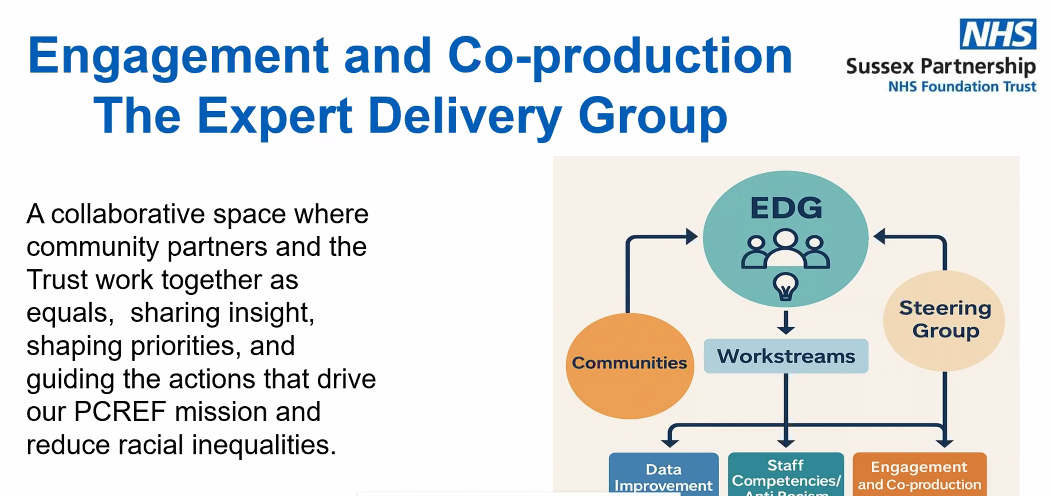
Sussex Partnership presented PCREF as a three-pillared programme: data, co-production & engagement, and workforce development. Their first priority is improving ethnicity and protected characteristics data, which they acknowledged has historically been inconsistent. Sussex is launching a behavioural-change campaign that involves interviewing service users from minority backgrounds about why they may decline to share ethnicity, alongside staff interviews to understand documentation issues. Their goal is a transparent baseline from which meaningful PCREF action can be driven.
The Trust also described significant investment in a new data infrastructure via Power BI dashboards. These tools will pull together real-time information on areas such as restraint, Section 132 rights, and involuntary detention by ethnicity. The Trust stressed that PCREF cannot function without high-quality data because inequalities must be clearly visible and accessible to teams at every level—from ward managers to executive boards. Their future ambition is to enable quicker identification of disparities and faster interventions that prevent harm.
Sussex’s strongest focus was on building genuine co-production through their Expert Delivery Group (EDG). Unlike past approaches where community partners were only consulted, the EDG is designed as a collaborative decision-making space. Sussex acknowledged up front that phase 1 of PCREF planning did not fully embody equal partnership, and committed to ensuring that phase 2 will be co-produced from the ground up. The EDG will define what co-production means, co-design PCREF implementation plans, and shape updates that reflect community priorities, trust recovery, and anti-racist aspirations.
Key Points:
A behavioural-change campaign to improve ethnicity data recording (currently 65% compliance).
Development of Power BI dashboards for rapid inequality analysis.
Defining anti-racist and cultural competency skills for staff, tied to new EDI training.
Creation of the Expert Delivery Group (EDG) as a collaborative community–trust space.
Questions raised by attendees:
Is this “real” co-production or consultation? – Attendees challenged Sussex on whether the initial plan was created with the community or presented to them.
How will service users and carers hold equal power within co-production?
How will your anti-racism ambitions be demonstrated externally to communities? – Attendees expressed concerns that staff training alone does not reassure communities.
How will carers’ needs be embedded in PCREF (Triangle of Care)?
🌟 4. Kent & Medway Mental Health NHS Trust
Presenter:Kamellia (with contribution from Harriet – Lived Experience)
Kent & Medway showcased a comprehensive and governance-driven PCREF structure supported by their Equity for All Assurance Group. The Trust has embedded health inequalities into its broader strategy and is working to ensure that PCREF, protected characteristics data and health equity are woven into everyday practice. With the Trust’s newly updated name and identity, PCREF sits at the centre of a renewed commitment to equitable access, outcomes and patient experience across Kent and Medway.
Their PCREF progress includes delivering cultural competence training to 259 senior leaders, a significant investment in shifting leadership behaviour and expectations. They have also identified major data disparities in areas such as complaints, where ethnicity recording is only around 30%. To address this, they are rolling out the About Me form across their clinical system (Rio), which streamlines demographic and protected characteristics documentation for both carers and patients. This step is being supported by staff training designed to build confidence in discussing sensitive identity-related topics.
Kent & Medway also highlighted the expansion of their new Involvement & Engagement Team, which links directly with communities across East, West and North Kent. They are testing a Health Inequalities Toolkit, improving carer experience data collection, and creating new Family, Friends & Carers forms that capture protected characteristics, communication needs, and whether a carers pack was offered. The Trust’s approach is detailed, structural and long-term, aiming to embed PCREF as part of “business as usual” rather than a separate initiative.
Key Points:
259 senior leaders trained in cultural competence.
New About Me demographic/protected characteristics form launching trust-wide.
Major data gaps identified (e.g., only 30% ethnicity data for complaints).
New Involvement & Engagement Team connecting with community groups.
Testing the Health Inequalities Toolkit .
New Family, Friends & Carers Information Form including carer-pack tracking.
Questions raised by attendees:
Do you provide information in languages other than English? – Carers stressed that if translations don’t exist, PCREF is inaccessible from the start.
How will carers be supported to attend meetings given their unpredictable caring responsibilities?
How will you gather demographic data for carers when many do not have Rio records?
How will minority groups be reached in areas where the Trust’s population is overwhelmingly White British?
5. Carer Support Organisation (Kent & Medway Carers Support)
Presenter:Donna Green (involve Kent)
Key Points:
They run trust-wide carer experience groups and targeted workshops.
Emphasised difficulty for carers to attend meetings due to constant demands.
Highlighted the need for multiple approaches, including creative well-being sessions.
Closing Reflections from the Forum
I wrapped up the session acknowledging:
The strong desire across Trusts to improve PCREF delivery.
The pressure to progress quickly without losing sight of lived experience leadership.
The need to bring CQC into future meetings for transparency around expectations.
The importance of ethnic minority carers having a forum that values honesty over polished presentations.
Final Thoughts
This month’s forum demonstrated that while progress continues nationally, there remain shared challenges across NHS Mental HealthTrusts:
Recording ethnicity and protected characteristics meaningfully
Embedding anti-racism beyond training modules
Meeting the needs of Black, Asian and other racialised carers
Co-production that is real, not rhetorical
Involving carers whose time and emotional capacity are already stretched
Ensuring safety, trust and humanity in every interaction.
Above all, the session showed that ethnic minority carers are not passive observers they’re leading, questioning, shaping and insisting on accountability at every step.
Chaired by: Matthew McKenzie – Lived Experience Carer
Welcome to the November 2025 update of the Hosptial Carer discharge group. The Hospital Carer Discharge Group is a collaborative network chaired by lived-experience carer Matthew McKenzie, bringing together unpaid carers, carer-centre teams, hospital staff and local authority representatives to improve how carers are identified, supported and involved throughout a patient’s hospital journey.
The group provides a space to share updates from hospitals and carers’ organisations, highlight challenges in discharge processes, strengthen links between community and acute services, and promote consistent carer-focused practices such as using the Carers Hospital Discharge Toolkit, developing standard operating procedures, and raising staff awareness.
The November meeting focused updates from the South East London Carer Standard Operating Procedure pilot, improving carer identification, strengthening links between community and hospital services, and practical challenges in engaging hospital teams.
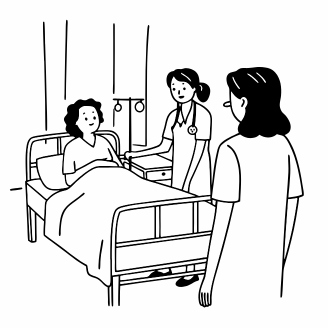
For those who don’t know, In the context of the Hospital Carer Discharge an SOP is a step-by-step, structured process that hospital staff follow to ensure unpaid carers are identified, informed, supported and included consistently during a patient’s hospital stay and discharge.
It usually outlines:
How to record, communicate and follow up on carer involvement
Who is responsible at each stage (nurses, discharge teams, carer services)
What actions must be taken (e.g., asking about caring roles, sharing information, making referrals)
When these actions should happen (admission, treatment phase, discharge planning)
Who Attended
The session was well attended by a mix of carers, hospital representatives, and carer-centre staff, including:
Carer representatives
Matthew McKenzie – Chair; lived experience mental health carer; Carers UK, Carers Trust & NHS England Citizens Advisory Group volunteer.
Various peer supporters, carers involved in local networks and PPGs.
Carer support organisations
Carers Hub Lambeth
Tower Hamlets Carer Centre
Wandsworth Carer Centre
North Central London Carers Support Project
Apologies
Sutton Carers Centre
Richmond Carers Centre
Greenwich Carers Centre
Harrow Carers Centre
Bromley Well
IMAGO – Lewisham carers Centre
Bexley Carers Support
Involve Kent
Hospitals & NHS staff
Queen Elizabeth Hospital (Lewisham & Greenwich NHS Trust)
Public Service Consultants (PSC)
Bromley, Lambeth, Lewisham, Greenwich council leads (mentioned in discussion)
St George’s Hospital (GESH) – references to staff
Meeting Overview
The growing importance of carer involvement in hospitals, especially with mental health pressures and changes to the Mental Health Act.
The group’s purpose: sharing updates, strengthening links between carers and hospitals, and improving the implementation of the Carers Hospital Discharge Toolkit.
Key Presentation – Update on the South East London Carer SOP Pilot
Speaker:Public Service Consultants (PSC)
The major portion of the meeting focused on the pilot testing of a new 11-step Standard Operating Procedure for identifying and supporting unpaid carers across hospitals in South East London.
🔹 Hospitals involved in the SOP pilot
King’s College Hospital – Acute Medicine ward
University Hospital Lewisham – Hawthorne (older patients) and Alder (specialty medicine) wards
Princess Royal University Hospital (Bromley) – Frailty Unit via Transfer of Care Hub
🔹 Key outcomes
King’s College Hospital saw the strongest progress.
Nurses proactively engaged unpaid carers.
All leaflets and materials were distributed within weeks.
Carer details (with consent) were passed to Lambeth Carers Hub.
Nursing staff requested feedback loops to see the impact of referrals.
Lewisham Hospital
Progress slower initially; improved after site visits.
Ward managers highly supportive and embedding SOP practices.
Lewisham Council exploring funding for an in-hospital carers support team.
Princess Royal (Bromley)
SOP and leaflets now shared with the frailty unit.
Council to continue taking work forward.
🔹 Overall reflections
Hospitals still experience heavy winter pressures and staff capacity issues.
Engagement differs widely between NHS trusts.
Many ward teams had never seen the London Carers Toolkit, indicating a need for simplification.
Councils intend to continue cross-borough meetings after PSC’s involvement ends.
Issues & Discussion Points
1. Gaps in consistency across hospital sites
Queen Elizabeth Hospital (QEH) had not been part of the pilot, they have requested to be included
Staff expressed interest in adopting SOP materials and joining future rollout.
2. Carer diversity and training needs
Caroline highlighted the need for:
Training reflecting different care needs: LD, dementia, mental health, elderly carers.
Cultural diversity considerations in how carers interact with hospital teams.
Better alignment with Lewisham & Greenwich’s Compassion in Care programme.
3. Current SOP scope limitations
SOP starts at the ward stage, but carers need involvement pre-admission and post-discharge.
Best practice from NICE and the national toolkit emphasises whole-journey support.
4. Hospital culture & resistance
Carer-centre staff described feeling:
Like a “hindrance” in MDT or discharge meetings
Sometimes unwelcome or blocked from engaging on wards
Fighting clinical priorities vs. carer rights
Still needing major awareness-raising to reduce resistance
A carer noted power imbalances and the risk that carers are seen as “barriers to discharge” rather than essential partners.
Updates from Carer Centres & Hospital Teams
Carers Hub Lambeth
Significant increase in referrals, especially from King’s.
Engagement seems weaker at Guy’s & St Thomas’, it looks to be still pushing for a stronger carers strategy there, but hopeful the strategy should pick up.
Working with ward rounds and direct conversations with carers.
North Central London Carers Project
Working across 8 hospital sites, possilbly
Royal Free Hospital
Barnet Hospital
North Middlesex Hospital
Chase Farm Hospital
The Whittington Hospital
University College Hospital
St Pancras Rehabilitation (Camden and West London)
Community Central London Trust
North London Foundation Trust (Mental Health)
Updates include:
A hospital “menu” to track progress across the toolkit (training, comms, discharge planning).
Embedding carers into induction programmes.
Co-authoring discharge documentation at St Pancras Rehab Centre with dedicated “carer sections”.
Upcoming use of Cerner electronic records system to automatically flag carers.
Tower Hamlets Carer Centre
Carer representative based at Royal London Hospital (east London)
Challenges include:
Slow referrals & reliance on staff awareness
Some carers only identified at crisis stage
Need to expand the carers passport across Royal London
Hackney pilot ends in March concerns about future funding
Wandsworth Carer Centre / St George’s
SONY DSC
Developing carer awareness training with Patient Experience Team
Growth in referrals after training sessions, though staff forget over time
Plan to expand ward coverage
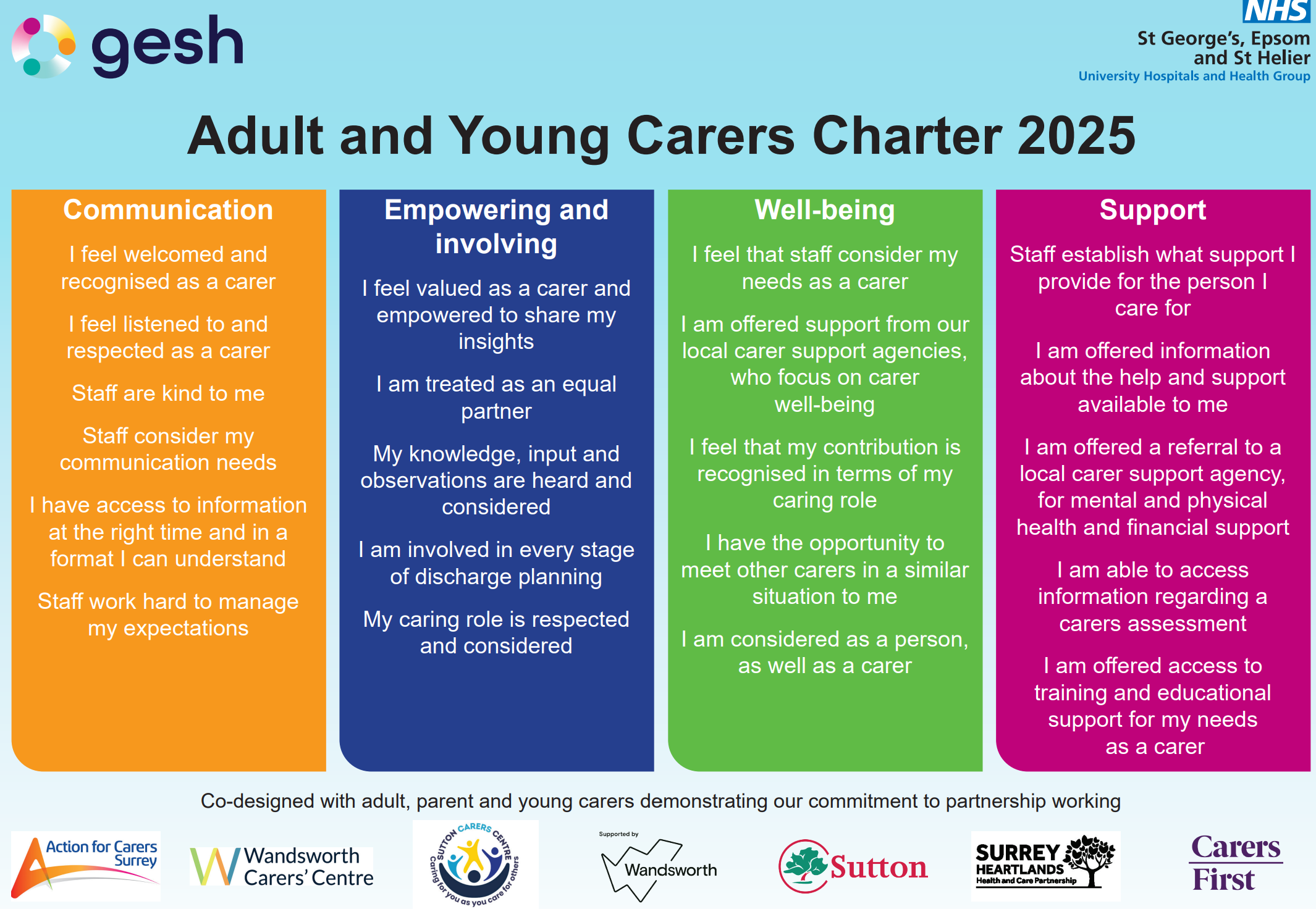
As chair I shared St George’s new Carers Charter as a tool for accountability
Carer-Led Developments in Primary Care
A group of Lewisham unpaid carers has begun major work with GP practices, including:
Creating a PCN-wide carers information pack
Ensuring carer champions in GP surgeries
Working with pharmacies to distribute information
Improving identification on GP systems
Exploring alignment with Lewisham’s new Carers Action Plan
Plans for the Future
More invitations to NHS carer strategy leads
Sharing SOP materials with non-pilot hospitals where possible.
Matthew to link contacts across councils and hospitals for ongoing monitoring, being the following boroughs e.g.
Lewisham
Assistant Director – Adult Mental Health & Wellbeing
Joint Commissioner – Adult Mental Health & Wellbeing
Greenwich
Strategic Commissioning Lead
Commissioning Lead for Carers
Bromley
Assistant Director – Commissioning
Commissioning Officer
Bexley
Service Manager – Adult Social Care
Lambeth
Integrated Commissioning Manager – Adults and Health
Southwark
Strategic Programmes Manager
Commissioning Manager
Medium-term aims
Push for in-hospital carer support teams in Lewisham & Greenwich.
Expand training and embed carers into staff induction.
Improve pre-admission and discharge-planning pathways on carer identification and involvement for familes and carers.
Stronger collaboration between LD nurses, dementia teams, and carers services.
Longer-term aspirations
Greater consistency across trusts
Unified carers strategy within each hospital
A system where carers are routinely recognised, supported, and involved in decisions
Closing Remarks
As cchair I closed the meeting by thanking attendees and acknowledging the collective effort to improve carers’ experiences across London hospitals. I reaffirmed the importance of:
Making carers visible
Ensuring rights are upheld
Strengthening trust–carer relationships
Carrying learning into the new year
The next meeting will be scheduled in January, with hopes of smoother cross-hospital collaboration in 2024.


























 A Caring Mind