By Matthew McKenzie – Carer activist and facilitator of the group
The group is a community of carers in Lambeth, Southwark and Lewisham that exists to provide support, advocacy, and connection for people looking after loved ones living with mental illness. It brings together unpaid carers of all ages and backgrounds to share experiences, learn from one another, and build confidence in dealing with health and social care professionals. A core part of its mission is reducing isolation by creating a safe space where carers can speak openly, develop skills, and access practical resources like advocacy services.
The meeting began with introductions and updates from various participants, including myselff where I discussed work with London Hospitals and the NHS app, while other carers introduced themselves to the group. In attendance was Tama from PohWer presented information about carer complaints and support services across different regions, including discussions about the potential impact of Healthwatch’s dissolution on patient and carer support services.
by Matthew McKenzie – National Ethnic Mental Health Carer Forum Chair
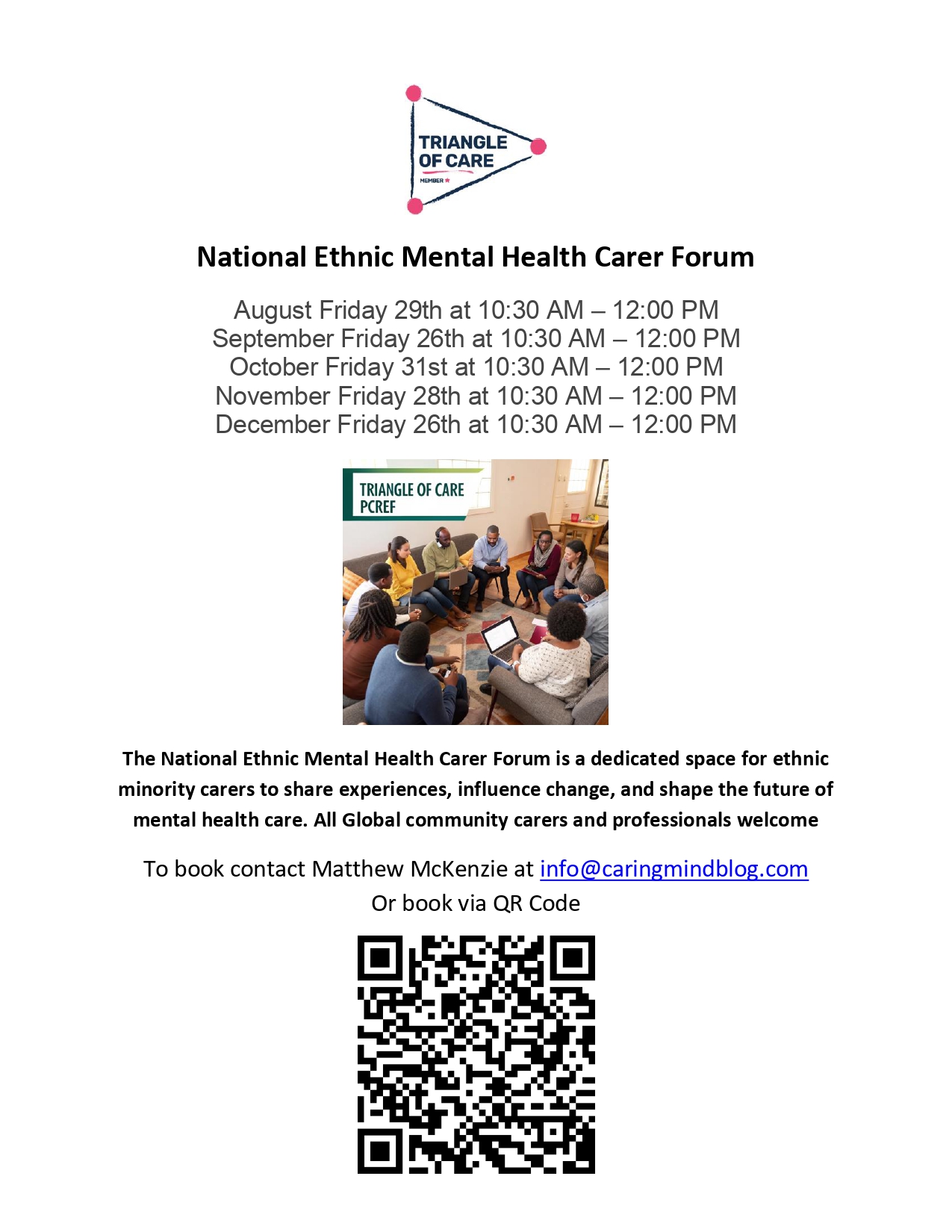
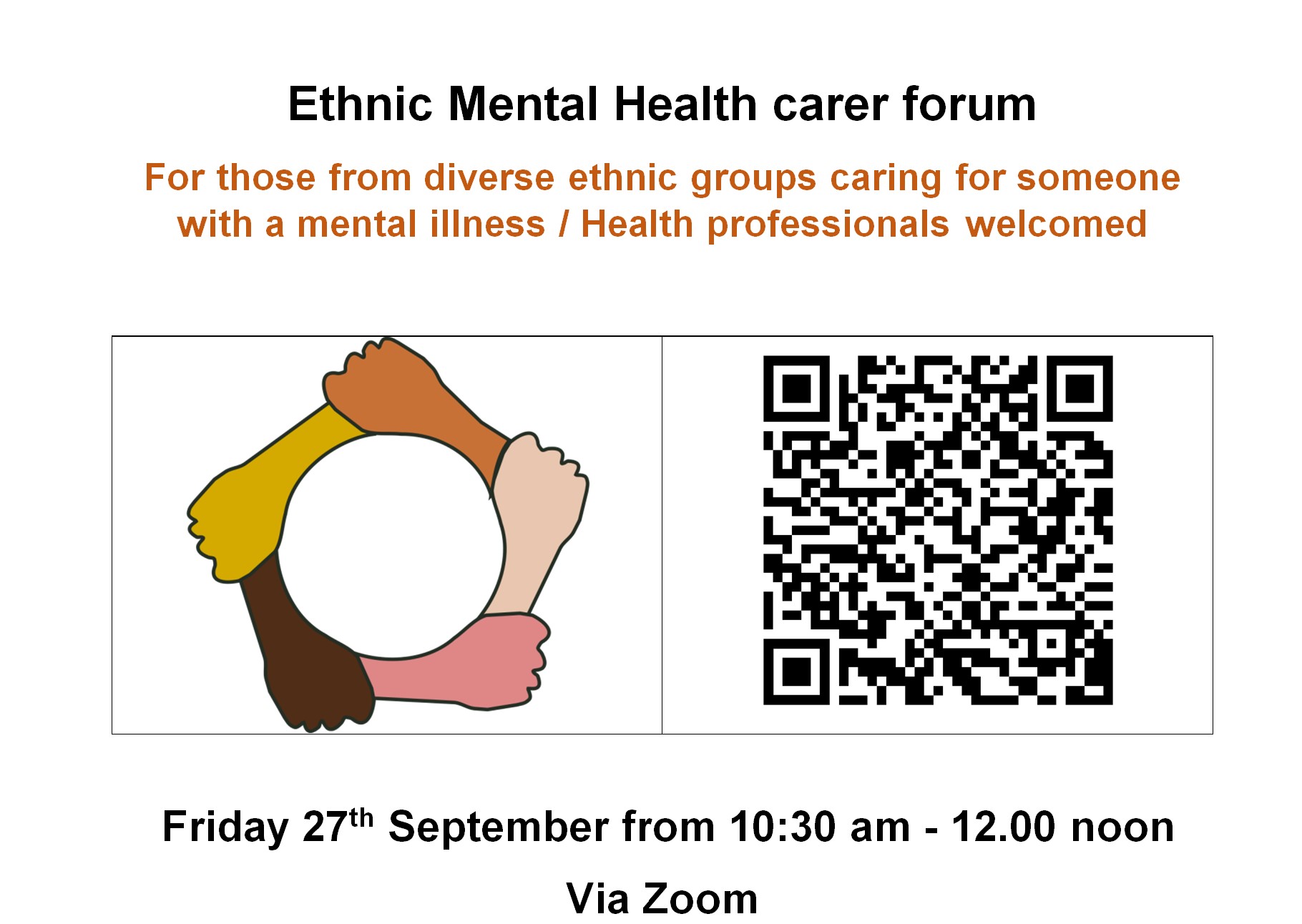
In August, the online National Ethnic Mental Health Carer Forum came together once again to confront difficult but necessary conversations about systemic racism, discrimination, and the experiences of ethnic minority carers within health and social care. The forum, hosted by Matthew McKenzie, provided a platform for carers, professionals, and researchers to share insights, frustrations, and plans for change.
Focus on Racism and Discrimination
This month’s forum was unflinching in its focus: racism in health and mental health systems. Attendees shared powerful testimonies of racial abuse and discrimination, highlighting how these experiences undermine trust in services and affect both carers and those they support. There was a clear call for honesty – participants stressed the importance of naming racism directly, rather than disguising it behind euphemisms.
The group also discussed the overrepresentation of Black and brown people in prisons, the lack of tailored initiatives for older Black carers, and the persistent inequalities faced by ethnic minority families trying to navigate mental health and social care support.
Research and Evidence from Carers Trust
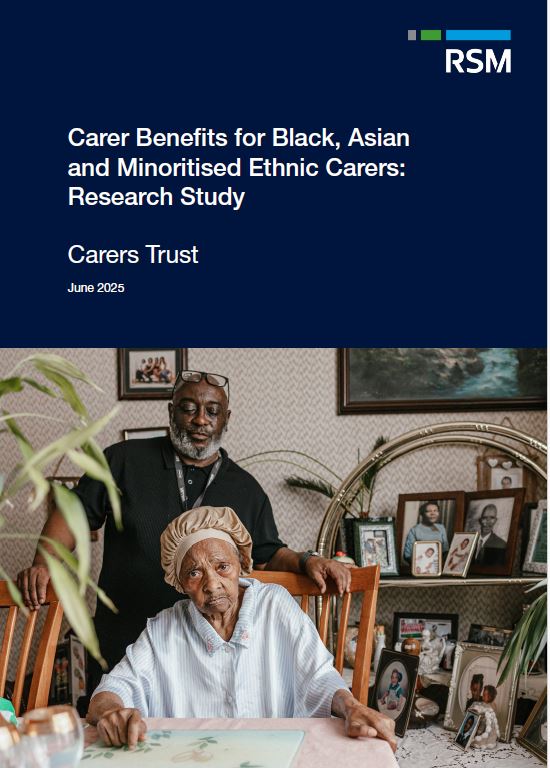
A key presentation came from Andrew of Carers Trust, who shared research into the barriers faced by Black, Asian, and minoritised ethnic carers. The findings highlighted widespread issues: discrimination, language barriers, lack of cultural competence, and difficulties in accessing benefits. Andrew emphasised the need for culturally inclusive services and stronger outreach strategies, while acknowledging feedback from the forum that research and advocacy must be explicit about racism rather than avoiding the term.
Andrew expanded on the importance of equity in benefit advice, pointing out that many carers miss out on their entitlements because information is inaccessible, overly complex, or not communicated in culturally relevant ways. He called for dedicated advice services that are not only multilingual but also sensitive to carers who may not self-identify as such.
He also spoke about the impact of social isolation on carers from ethnic minority backgrounds, who often have fewer support networks and face stigma within their own communities. Addressing this requires building trust with local organisations and ensuring carer support is visible in spaces where communities already gather, such as faith centres or community hubs.
Finally, Andrew outlined the Carers Trust’s national strategy, which involves working more closely with local carer organisations, producing research that amplifies marginalised voices, and lobbying for systemic reforms. He highlighted how this forum’s feedback directly shapes their advocacy, showing a real commitment to partnership.
Questions raised during Carers Trust’s presentation:
How can Carers Trust ensure its research explicitly names racism rather than using softer language?
What specific support can be offered to carers who do not self-identify as carers and miss out on benefits?
How can Carers Trust improve its complaints handling processes, particularly for carers facing racism and discrimination?
What role can MPs and lobbying groups play in supporting Carers Trust’s advocacy for ethnic minority carers?
How will Carers Trust ensure its multilingual materials are distributed widely enough to reach isolated communities?
Hampshire & Isle of Wight NHS Anti-Racism Initiatives
Usually NHS Mental Health trust representatives update on anti-racism initiatives at the forum. This time Hampshire and Isle of Wight engaged with minority carers.
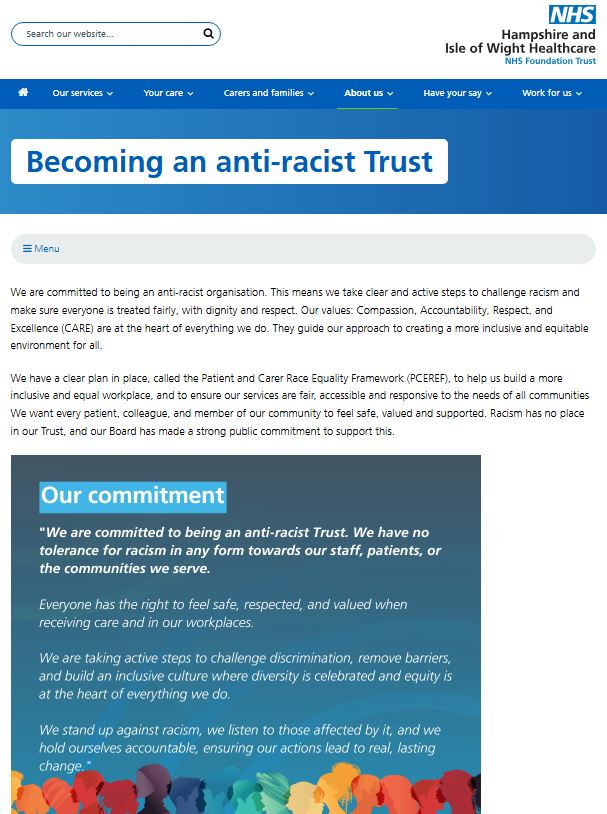
Elton who is the Diversity and Inclusion Partner from Hampshire and Isle of Wight NHS Trust provided an update on their anti-racist programmes, including the rollout of the Patient and Carer Race Equality Framework (PCREF). The trust has begun implementing cultural competence training, engaging with local communities, and embedding anti-racism into its wider mental health services. While early in its journey, the trust is already seeing changes in communication and engagement across different wards and services.
Elton shared that the trust is actively developing training modules on implicit bias, with the aim of reaching every staff member across its services. This training is intended not as a one-off exercise but as part of a sustained culture change programme. Early feedback from staff has been encouraging, with more frontline workers recognising how unconscious bias can influence treatment decisions.
He also described the trust’s efforts to engage directly with service users and carers, ensuring that their lived experiences feed into decision-making. Listening events, surveys, and advisory panels are being used to capture diverse perspectives, with a particular focus on groups who historically felt excluded from consultation.
In addition, Elton emphasised the need for transparency and accountability. The trust will publish regular updates on its PCREF action plan, allowing communities and stakeholders to scrutinise progress. He acknowledged that this is just the beginning, but stressed that embedding anti-racism into healthcare systems requires openness, humility, and sustained commitment.
Participants raised questions about how these initiatives address specific groups, such as older Black carers and prisoners’ families, as well as concerns about public misconceptions of anti-racism work. Elton acknowledged these challenges and committed to following up with colleagues on gaps raised during the discussion.
Questions raised during NHS Trust’s presentation:
How will PCREF specifically address the needs of older Black adults who often feel invisible in services?
What is being done to support the mental health of prisoners (e.g. Albany and Parkhurst prisons) and their families within this anti-racist framework?
How will the trust prevent the public misconception that PCREF “excludes” white people?
What mechanisms are in place to ensure transparency and accountability in publishing progress updates?
How will the trust measure the long-term impact of cultural competence and implicit bias training?
Academic Research Contributions
The forum also heard from Shylet, a PhD researcher from University of Glasgow, who is focusing on learning disabilities. She presented her work on the lived experiences of Black African families caring for adults with learning disabilities, and invited participants to take part in interviews. Their contributions highlighted the importance of academic research in documenting and amplifying carers’ lived realities.
Another important theme was the financial challenges facing carers. The group discussed the complexity of benefits like Carer’s Allowance and how misinformation or fear of losing other entitlements often deters carers from claiming support. A carer expressed reluctance to claim due to concerns about how it might affect their relative’s benefits, while another highlighted the importance of valuing one’s own contribution and recognising caring work. There was frustration with bureaucratic systems that seem designed to exclude, particularly when layered with the additional barriers of language, culture, and discrimination.
Carers also highlighted the immense value of unpaid care, with estimates placing its worth at over £180 billion per year if it were to be paid for by the NHS. This figure underscored the urgent need for better recognition and support of carers’ contributions.
Strengthening Complaints and Accountability
There was a debate around how carers can raise complaints when faced with racism or poor treatment. Many participants expressed a lack of trust in formal systems like the CQC or Ombudsman, feeling that complaints disappear into bureaucracy without change. Suggestions included working with MPs, lobbying groups, or the media to ensure voices are heard.
Final Reflections
The August forum showed once again how necessary it is to hold these difficult conversations. Carers spoke bravely about racism and exclusion, professionals shared updates on anti-racist strategies, and researchers sought to bring lived experience into policy. Yet the message was clear: systemic change requires more than frameworks and research reports. It requires honesty, collaboration, and persistence.
As host, I was encouraged by the passion and determination in the room. The forum continues to grow as a national voice for ethnic minority carers, and our commitment to addressing racism head-on remains at the heart of this work.
Another blog post by carer activist Matthew Mckenzie on how caregivers can engage with Integrated Care Systems to ensure their voices are heard and needs are met. A way to discover the power of feedback in improving local Health Services.
To watch the video version of my blog, click below
Integrated Care Systems (ICS) have been shaping the landscape of healthcare in the UK for several years now. These ICSs are designed to ensure that health services meet the unique needs of local communities, ICSs are evolving frameworks within the National Health Service (NHS). They aim to promote a more collaborative approach to healthcare by engaging with everyone involved in the health service delivery—including professionals, patients, and carers….yes, thats right! Unpaid carers, but how can unpaid carers get their voice heard?
Well if you are caring for someone unpaid with a long term illness, then understanding how these systems work is crucial for anyone reliant on or working within the NHS. This article delves into what ICSs are, their importance, and how carers can make their voices heard within these systems.
What is an Integrated Care System?
As noted in my video. An Integrated Care System (ICS) is essentially a model used within the UK’s NHS to better structure how health services are commissioned and provided. Before ICSs were implemented, health services were commissioned in a somewhat isolated manner, which often didn’t fully account for the comprehensive needs of the community. There were other reasons for the change to ICS, but that would be for another blog post.
The Need for Engagement
At the heart of an ICS is the concept of engagement. For an ICS to be effective, it must listen to the very people who use and provide the health services. This involves unpaid or informal carers, patients, and other healthcare providers all collaborating to ensure that the healthcare services are as effective and efficient as possible
The Role of Commissioning
Commissioning still plays a central role within ICSs. Commissioners work to ensure that the right health services are provided, but their decisions must be informed by feedback from carers as well. This is where the role of carers becomes critical. By participating in the engagement process, carers can help shape the nature and delivery of healthcare services to better meet their needs as well as those of the patients. Carers should have a seat at the table.
Local Healthwatch
One of the most effective ways to engage with an ICS is through your local Healthwatch. Healthwatch organizations are pivotal stakeholders within ICSs. They gather insights from patients, carers, and the general public to inform health service delivery.
Find Your Local Healthwatch: Simply type “Healthwatch” and your local area (e.g., Healthwatch Kent, Healthwatch Lambeth) into a search engine. This will provide you with details on meetings, agendas, and how to participate.
Attend Meetings: When possible, attend local Healthwatch meetings to stay informed and voice your concerns.
Provide Feedback: Whether through surveys, forums, or direct communication, your feedback is invaluable.
Speaking Up
Even if you can’t make it to meetings, there are other ways to ensure your carer voice is heard. It could be as simple as sending an email or filling out a survey provided by your local Healthwatch.
Importance of Feedback: Your insights are gold in terms of showing what works and what doesn’t within the current healthcare framework. Sharing your story—whether it’s good, bad, or ugly—can spotlight gaps and prompt necessary changes.
Advocating for Transparency
As mentioned in my video, one crucial area carers should focus on is advocating for transparency in the ICS decision-making process. Are carers and caregivers’ experiences included when tailoring health services?
Be Specific: When you provide feedback or attend meetings, be specific about what issues need addressing. Whether it’s concerning mental health services or care for chronic conditions, specificity helps stakeholders understand and prioritize your needs.
Persistent Engagement: Continuously engage with the system. Don’t just provide feedback once and assume your role is done. Keep track of the outcomes and ask for updates.
Building Alliances
Another vital strategy for making an impact in an ICS is building alliances. Networking with other carers, healthcare providers, and advocacy groups can amplify your voice.
Learn From Others
Engage with other carers and learn from their experiences. Information sharing can be incredibly powerful.
Caregiver Forums: Joining caregiver forums can be a great way to share information and strategies. These platforms often have tips on how to engage effectively with healthcare providers.
Collaborative Effort: Remember, you don’t have to do it all alone. Partnering with others in similar situations can be a massive force for change.
Continuous Learning
Attending meetings and reading through reports can seem daunting, but they offer a wealth of information. One thing noted about ICSs is the amount of reports. Those reports should be held to account regarding jargon, although being relistic, there is no quick escape from Jargon.
Stay Informed: Regularly check for any updates or meetings concerning your ICS.
Form Networks: Building a network of support can be incredibly beneficial. It not only alleviates the feeling of isolation but also helps in sharing the workload of participation.
The Importance of Carer Input
ICSs are designed to be collaborative, ensuring that health services are well-rounded and holistic. However, this is only possible if carers, who are often the hidden backbone of healthcare provision, speak up and engage.
Carers As a Link
Carers are the crucial link between the healthcare system and the person being cared for. Without their input, ICSs may second guess the needs of the community, leading to services that do not fully meet those needs.
Avoiding Isolation
One of the worst outcomes for any carer is isolation. Engaging with ICSs not only helps improve healthcare services but also connects carers with a supportive network of individuals who hopefully can understand their struggles.
The Bigger Picture
Beyond the immediate benefits, carer input helps create a more responsive and effective healthcare system. This leads to better outcomes for everyone involved, from the patients to the healthcare providers. Caring for someone should not always remain an isolating experience. As a carer use your experiences to ask for better support from the healthcare system.
In Summary
Integrated Care Systems represent a significant step towards more inclusive and comprehensive healthcare in the UK. They aim to mesh the various elements of health service provision into a coherent whole that genuinely meets the needs of the community. Carers have an indispensable role in making this vision a reality.
By engaging with local Healthwatch, providing persistent and specific feedback, advocating for transparency, building alliances, and staying continuously informed, carers can significantly influence the effectiveness of these healthcare systems. Remember, as a carer, your insights are invaluable.
So, don’t be silent. Speak up, engage, and help improve local health services today. Together, we can achieve more adaptive and efficient healthcare systems that better serve everyone.
Welcome to an update of my ethnic carer group. The group focuses discussions, updates and presentations regarding those who care for someone living with mental illness. The group has become national a while back due to supporting “Carers Trust” triangle of care and the new NHS England Patient Carer Race Equality Framework.
Here is a brief update of my national ethnic carer forum.
Quick recap
Linda From West London Health NHS Trust discussed PCREF updates, focusing on supporting patient care and amplifying the voice of service users, communities, and carers. We also was joined by DR Eula Miller a senior lecturer at Manchester Metropolitan University. She shared her two-year project exploring the experiences of minority families accessing and engaging with mental health services, and her work in engaging with black churches in the Greater Manchester area to address mental health issues and myths.
Lastly we were joined by Deepa presented a report on the work done from Healthwatch Greenwich, highlighting the need for culturally sensitive approaches to support carers from ethnic minority backgrounds and developing culturally relevant resources.
West London Trust Collaboration and Feedback
Linda discussed her work with the West London Trust, focusing on supporting patient care and amplifying the voice of service users, communities, and carers. She mentioned that they have been working together since February or March and have conducted several listening events. Linda also discussed the progress of the patient and carer race equality framework, emphasizing the need for better communication and feedback loops. She encouraged participants to share their thoughts or questions and proposed a separate meeting for those who wanted to be updated in detail. Linda agreed to work on improving the communication of updates and developments. Other members expressed enthusiasm for a recent presentation, describing it as “very, very, very riveting,” and requested a simplified version of Linda’s PowerPoint presentation.
South London NHS Trust Advisory Group Discussion
A carer member of the group expressed interest in the work of the South London and Maudsley NHS Trust’s Equality, Diversity, and Inclusion Advisory Group and requested Linda’s contact details for further conversation. Linda agreed to share her contact details and promised to have a separate conversation with the carer. As Chair of the forum, I then introduced an attendee from Oxford Health NHS trust who had missed the beginning of Linda’s presentation. I mentioned that I would send off any slides or handouts from the meeting for members to digest. The meeting then proceeded to the next speaker, Dr. Eula Miller, who discussed her interest in mental health care and her role as a nurse educator. Eula also mentioned her goal of influencing future practitioners to better engage with carers in the community.
Exploring Mental Health Service Experiences and Themes
Dr Eula discussed her two-year project exploring the experiences of families accessing and engaging with mental health services. The project involved individual conversations and focus groups, and was particularly relevant during the Covid-19 pandemic. The themes that emerged from the project were categorized into four areas: “If only someone had listened,” “Not knowing,” “Drowning in misunderstanding,” and “What can we do differently.” Dr Eula highlighted the consequences of not being heard, such as loved ones being admitted in crisis situations, and the impact on carers’ health and trust in services. She also noted the participants’ proactive response, forming a self-help group to share knowledge and support each other. Eula’s presentation was well-received, with several attendees expressing interest in her research and seeking further information.
Dr Eula shared her work in engaging with black churches in the Greater Manchester area to address mental health issues and myths. She has been visiting churches, providing information, and linking them to mental health workers. Eula also mentioned her work in educating future nurses on how to assess mental health issues. She offered to share her full report with attendees. I thanked Eula for her work and encouraged others to ask questions. A member from Integrated Care Board expressed interest in reading the full report and potentially replicating Eula’s work in Greenwich.
I also asked Shenade a Wandsworth Carers centre representative about her experiences with minority carers and mental health services. Shenade shared her experiences with the Bridging the Mind Project, highlighting the need for culturally appropriate information and support. A carer attendee of the group praised Eula’s presentation and emphasized the importance of collaboration and information sharing in providing effective care.
Building Cultural Sensitivities and Community Engagement
A carer attendee expressed her appreciation for Eula’s presentation and acknowledged its relevance to her upcoming work. Another attendee shared her experiences with strengthening cultural sensitivities and the importance of reaching out to diverse communities. She suggested using peer ambassadors and faith leaders to build trust and facilitate communication. Eula agreed, emphasizing the need for collaboration and understanding among different groups. Another professional shared a personal experience of a patient being misjudged due to her religious practices, highlighting the need for education and understanding among staff. The group agreed on the importance of educating staff and engaging with diverse communities to promote fairness and understanding.
Addressing Mental Health Challenges in Minority Carers
Matthew McKenzie then asked and Deepa from HealthWatch Greenwich to discuss the challenges faced by minority carers struggling with mental health issues. Deepa shared her team’s research findings, highlighting the need for culturally sensitive approaches to support carers from ethnic minority backgrounds. She noted the evolving role of carers, the challenges they face, and the importance of clear information about their rights and entitlements. Deepa concluded by presenting recommendations for improving support services for black and ethnic minority carers in Greenwich, including a comprehensive review of existing services, enhancing community engagement, and developing culturally relevant resources.
This concludes my update of the National ethnic mental health carer forum. See you next month. Please video my carer awareness video regarding minority carers.
Welcome to a brief update on the October Mental Health carers forum for Lewisham. I have been so busy of late, that I did not have much time to do any writing. For the carers forum, the guest presenters were Carol Burtt who is a Consultant Clinical Psychologist for Lewisham and she spoke more about IAPTs in Lewisham.
We also had Susan George from the CQC who inspects GP services in Lewisham engaging and updating carer members of the forum.
Going back to Carol, she spoke about how the service IAPTs provides are primary care where they essentially provide help for people with mild to moderate psychological difficulties such as mild to moderate depression and or anxiety. Anxiety might include panic attacks, or a state of worry. Carol talked the group through such symptoms like generalized anxiety disorder, social anxiety, health anxiety, some OCD, obsessive compulsive disorder, some relationship difficulties that might be leading to depression or anxiety.
Carol spoke about how mental health can cause some relationship difficulties that might be leading to depression or anxiety. So in fact, it might be more likely to be something that carers might experience themselves rather than the people that they are caring for. Carol then talked about how busy the service is, being that they had 880 referrals last month and they processed about 600 people who were seen last month.
For people to access IAPTs, you can get a telephone assessment within a few days, and this is what IAPTs is aiming for at the moment so that we can have a rapid response to people’s referrals. This is so people can get to speak to a clinician within a week, and a chance to talk about explaining the difficulties. People can get referred and then get directed to the most appropriate treatment.
Certainly last year, SLaM IAPTs did increase a lot of digital input so that people can actually have some treatments via online programs, which SLaM call computerized CBT, which could be an initial treatment. Carers can access that very quickly. So people can start such treatments within a week of having had your first telephone assessment with somebody. So that’s the benefit of that. Carol mentioned that IAPTs online is obviously not for everybody, some of the us know, that some people will want to have a direct face to face contact at the moment, obviously, with the COVID situation where SLaM working remotely.
Carol then explained more about the service as in how people are allocated to a psychological well being practitioner, SLaM have about 20 of those clinicians which Carol manages herself. These clinicians have had a training in a low intensity CBT cognitive behavioral therapy, so they’re trying to provide what we call Guided Self Help.
Carol then gave us an example of how people would have access to these different programs. One would be for depression. One would be for anxiety, one for social anxiety. The person would have some tasks and some information that they would have to deal with each week. Then each week, it finishes with checking in with person, either online or by telephone to see how you’re getting on.
Still, if people felt that their mental health was a bit more complicated, and SLaM felt that you need it, then any input with a psychologist or a cognitive behavioral therapist, or a counselor would be a three to four months, wait a moment.
Carol also explained that before the COVID situation, they were providing face to face workshops in groups where people actually attended their clinics, but since the pandemic has affected things, they are now looking at more online groups and workshops. Carol reminded us about our BAME forum where her colleague, Elaine presented and how she is leading on the development of some workshops, particularly for local communities in Lewisham.
QUESTIONS FROM THE CARER MEMBERS
A number of questions were asked of Carol from our members. One of the group members was interested in the following question on if the IAPTs service helps those with addictions when people have got the problems and they’re addicted smoking, drinking alcohol, or even taking illegal drugs?
Carol responded that they do is make an assessment as to whether addiction is a primary problem, or even if addiction is the biggest problem or there’s an element of depression and anxiety. For example, somebody who’s got a very serious drinking problem or significantly problem, then they would advise them to go to a specialist addiction service. Carol also repeated that they are trying to look at different ways in which people can access this help earlier, as soon as possible. They are looking at providing these online interventions, and online workshops as soon as possible so that people get some help. Very quickly, before I can say, for such problems develop further.
Another carer queried the struggles they have when the cared for has trouble accessing the service, especially from a mental health trust. The carer does not want to intervene, but notices how difficult it is for the caree to get lost in trying to access IAPT services. Carol mentioned that unfortunately, it’s the way things are organized. And they have a secondary care psychology that is very separate from primary care. So they don’t provide a service for people who’ve been admitted to secondary care psychology, which is a separate.
Another carer made a statement rather than a question and pointed out that she was referred to IAPTs on a series of six well-being workshops. She felt that the CBT there, she didn’t find that useful because it was too general.
CQC PRESENTS UPDATES
Susan from the CQC was listening closely to what carer members questioned or queried. Susan felt that its really important for representatives from CQC to hear our stories, and she really appreciates everything that was mentioned today. Susan continued that it’s also important because she is an inspector of GP Practices and part of her job is to ask providers what they’re doing in terms of providing care and support for carers. So it’s vitally important for her to hear carer members own experiences.
Susan mentioned that there was not too much time, but she would do just a quick summary of things she has been involved with, and what the CQC are doing at the moment. The CQC are looking around at communication with patients and patient populations, particularly with carers. The CQC are looking at a number of scenes of regarding the pandemic and how services have communicated with people.
Since the GP practices has started to shut their doors, the CQC are interested on what the GPs do to open up again, what are the GPs doing to tell people that they are open again, that they’re available for routine appointments? How are they telling people about the services that are available?
The CQC are also looking at sorts of communications, the CQC are looking at how GPS are maintaining equality of access or equity of access for people. There has been a huge change digitally in terms of the type of appointments and consultations that people will have. Not everybody is fluent in English or has access to digital means of equipment or resources.
Susan pointed out that some people who may find that trying to navigate their way through this new online world of appointments is baffling and terrifying. So the CQC are also looking at developing, how they talk to the GPs during inspections. The CQC are interested in what the GPs are doing to make sure that they’re communicating clearly with patient’s about the changes to appointments. Explaining to patients about the difference on treating for an emergency appointment, an urgent appointment, a routine appointment. There is a lot of assumptions that everybody knows all these phrases mean.
Susan updated us that the CQC have just published the “State of care 2019” for 2020. The report is available on the website, however Susan kindly sent us the link in the online zoom session.
The report is especially important because it pulls together some of the themes that the CQC have been looking at during COVID-19 and also pre COVID. The CQC are looking at some of the gaps in access to good quality care, especially mental health care. The CQC are also looking at the themes around system health inequalities around support and care for our better communities.
The CQC are also looking at communication and are interested in conflicting messages or conflicting nasty messages and guidance. It’s not always clear for patients and the CQC are interested in how GPs are engaging with their BAME communities.
Other things Susan pointed out was that the CQC have been working on questions about safe care and treatment and about the support for people living with mental health illness. The CQC are also asking providers specifically about how to be monitoring carers health and safety during the pandemic, have they been maintaining their registered unpaid carers and so what steps have the GPs taken to enhance the identification and management of the mental health issues of people living with mental health that includes people with dementia.
There were a lot of questions from the forum regarding the state of carer registers, some members are aware of the pressures GPs are under especially with new contracts, but others are keen to see where carers are being referred to and if social perscribers are doing their role.
HEALTHWATCH LEWISHAM ENGAGES WITH CARER MEMBERS
Healthwatch were there to listen to carer members regarding health services.
Healthwatch Lewisham are an independent charity. They are the patient champion for people who use health and social care services and so they listen to people on what’s going well on health services, what’s not going well.
Healthwatch Lewisham collect that feedback from patients and then at the end of every quarter they analyze and report back. Those reports are presented to sort of people in the borough of Lewisham that have the power to make change happen to like commissioners.
Healthwatch Lewisham also do project work and one of their recent projects was looking at the impact of the COVID-19 on Lewisham residents. That report has now been published. Healthwatch also has an advocacy service. So if anybody has complained about NHS service that they’ve used, and they can go through their advocacy service. So far healthwatch Lewisham have three advocates, and they basically help people through navigate the health system.
The reason Healthwatch Lewisham were at the forum was because they wanted to gather some feedback from people’s experiences with health and social care services. They were interested in feedback regarding GPs, hospitals, pharmacies, dentists, opticians, mental health services, Community Services, basically anything that carers and the person they care for has accessed.
Healthwatch Lewisham were kind enough to recognize that it’s a group environment and sometimes people don’t feel comfortable sharing their experiences. So even after the forum, members could feedback via the healthwatch email or site where they sent the link.
CARERS FEEDBACK TO HEALTHWATCH LEWISHAM.
Many of the group members fedback experiences on the following.
1) Lewisham Hospital 2) GP appointments 3) Positive aspects of using GPs 4) Dealing with receptionists 5) Dental appointments
This was the update for October at our Lewisham Mental Health carers forum.
Here is the brief update of the October Joint Southwark & Lambeth Mental Health carer forum. This is one of the five carer groups that I run per month. The carer forum is an engagement & empowerment group for carers to learn more about mental health services and at least query what is on offer.
SOUTHWARK HEALTHWATCH UPDATE
As usualy the group is supported by the local mental health trust South London & Maudsley, we also had southwark healthwatch in attendance as well as both Southwark Carers and also Lambeth Carers. Lastly both the engagement leads of Lambeth & Southwark CCG were to be in attendance, although only Southwark CCG could make it, due to Zoom blocking Lambeth CCG. It must be noted that the 6 CCGs are now merged into NHS southeast London clinical commissioning group, so its not always clear who is from what (more on that later).
The forum was co-chaired by carers Ann Morgan (Lambeth) and Annette Davis (Southwark). Our first update was from Southwark Healthwatch who are interested in the experience of those waiting for hospital treatments, like for surgery or chemotherapy, anything in a hospital. Southwark Healthwatch are doing that through phone interviews or online chats in a group, whichever people feel the most comfortable with. They just want to hear from as many people about how waiting times in hospital has impacted them, and what could be improved. Southwark Healthwatch are also interested in how the waiting times affect mental health and I suspect on how badly covid-19 is affecting waiting times in hospitals.
Members are very interested to see the outcome on feedback from Kings Hospital trust and Guys & St Thomas hospital trust on waiting times.
LAMBETH CARERS UPDATE
Ann morgan then introduce Josh Simpkins from Carers Hub Lambeth to talk more about the Lambeth Carers Card, which came from the Lambeth carer’s strategy. Josh mentioned that they made a recording of the launch, which is on their website, YouTube channel and facebook. Although at the joint forum he was going to do a bit of an introduction and background on the scheme itself.
The card scheme itself helps with emergency planning for carers, which is especially prevalent today due to the covid-19 situation. Josh also talked about how the schemes template on how a carer can use the template as a process to quickly make use of resources if the usual carer resources were unaccessible.
Josh talked more about the carer’s strategy, but members are hoping to hear from Polly on any developments for carers in Lambeth. There is still a hint of jelously from myself as I feel Lewisham has a way to catch up in regards to a carers strategy, what impressed me futher is the strategy is taking shape even during covid-19 as the Lambeth carers care helps protect against dwindling resources. A governor at the forum actually asked if the card was either Southwark and or Lewisham, but unfortunately its only for carers in Lambeth. We can only hope the other boroughs can emulate the successes for carers in Lambeth.
Ann Morgan queried if there will be a card for young carers, which was an excellent question since young carers can be forgotten when it comes to developments and projects. I personally think due to the lack of young carer empowerment groups, its harder for young carers to get a voice, so its often older carers who may try and speak up for young carers. Josh from Lambeth carers hub mentioned they were brain storming ideas to help young carers in Lambeth and so we should watch this space.
Josh did mention another thing regarding young carers is that when he went in with, with his colleagues into Lambeth schools. They found that young carers wanted space to get away from their peers and connect with other young carers in a different space, rather than just the other pupils in the school. There was more to this than connection purposes, but it certainly was a start on the needs of young carers. Josh mentioned there certainly was discrimination on young carers at school, which many at the joint forum were aware of.
It was also mentioned from the Southwark Carers inpatient lead that what strikes them is that the carers card links everything together. Although there will be times when obviously, the carer is overloaded and might not know where to look, but its really impressive as the Lambeth carers card puts everything together. He hopes we could do something similar in southwark because he feels there are lots of pockets where carers cannot find resources, so it would be great to get everything under one avenue.
SOUTHWARK CCG – South East London Clinical Commissioning Group UPDATE
Next we had Bola Olatunde from the Southwark CCG group engage with carers on how they were working to support mental health and carers in the 2 boroughs. Bola first explained that there is no Southwark CCG anymore. They became NHS SE London CCG from the 1st of April 2020. So they were Southwark CCG up until the 31st of March, then six independent CCGs came together and then joined as one NHS southeast London CCG from the first of April. Those were Southwark CCG, Lambeth CCG, Lewisham CCG, Greenwich CCG, Bromley CCG and Bexley CCG. As of the summer, the South East London Clinical Commissioning Group has been heavily supporting the carers groups since I am active in Lewisham, Greenwich, Southwark & Lambeth, although there are plans to expand BAME carers in boroughs I am not active in, depends on my time.
Bola explained the to carer forum that they are now borough teams, but we don’t have six CCGs anymore. So they are the southeast London CCG. Bola was here to just to let us know that the team is still here and if any updates or developments are taking place then they will seek to engage with us. Bola posted some information in the chat box of ZOOM to raise awareness for the flu vaccination if people are eligible and to to remind them to book their appointments with a GP practice or local pharmacy.
There were a lot of questions from the group members on the nature of the new CCG structure and who does what within the new development.
SOUTHWARK CARERS UPDATE
We had an update from Mary Jacob who is the chair of trustees from Southwark Carers and also a carer, she updated the joint Southwark & Lambeth carers forum on what Southwark Carers is doing. Mary mentioned that at the moment, Southwark Carers at looking at their premises and how they are going to continue giving the best services that they can under the restricted funding they are having. Southwark carers still need to get confirmation with Southwark about how much funding they are to receive and when they are going to be funded till.
Southwark carers
Southwark carers are at least very grateful for the support they are getting so far. Currently Southwark carers are continuing with their services to all ranges of carers in the borough. Southwark carers are in partnership with a fair shares Co-Op, so they are still providing food parcels to the carers who win the most who are in the most need. Southwark carers are also still providing online activities, including exercise classes, salsa classes and also a film club. The last film that was shown during Black History Month, was the film Black Panther. The Film Club not only provides the film a source of entertainment and social contact for carers.
They are also going to continue with their cultural events right the way through the year, not just in October, they have a program of events that’s now being finalized, including sharing different recipes from different countries and different festivals including celebrating Diwali, celebrating Hanukkah, celebrating all the different cultural festivals.
Southwark carers are also going to have mindfulness classes online and they are looking at how to reach carers that may be find it difficult to get onto zoom.
Another Southwark Carer trustee present at the Joint Southwark & Lambeth forum mentioned that lots of carers aren’t IT proficient and it is documented that carers are to face real challenges in regards to finding time for self care.
So with self care being much of a priority and looking at the 360 overview of carers responsibilities, southwark carers are having to look at how they are revising their service to actually be more accessible in light of covid-19.
UPDATE FROM SOUTHWARK INPATIENT CARERS LEAD
We then had an update from David Meyrick the inpatient ward carer lead for Southwark under South London & Maudsley. Currently he mentioned they have taken steps regarding wards and have revisiting them such distance measures. They have found that there was different arrangements across the wards that were visited and they were just concerned that might be a little bit inconsistent, especially if you had a loved one readmitted and found it difficult to visit the ward. So SLaM have taken the steps forwards across the five wards that obviously needs to be booked in this way, it makes things a lot safer. So the staff can facilitate two visits a time but in the same bubble, is keep it safe that way. David thinks it’s been working well, so far.
David is aware that some inpatient wards are reluctant to do this, because its not always possible to just spontaneously support the patient and the visitor. however he feels it’s just in the best interest of all. So crisis support is working well. Plus they have set up virtual cave surgeries towards information provision, inside work, and, and running cameras to support carers and patients. They have a monthly, a weekly support group that runs and I’m sure and that’s providing emotional support and peer support that carers need.
Annette co-chair of the joint forum and carer herself mentioned that since she started working with David carers attend the group regularly every week. Annette felt she can actually see the difference and what the most significant things for carers is they want to be heard.
UPDATE FROM LAMBETH HEALTHWATCH
Lastly we had an update from Lambeth Healthwatch in what they have been doing since the last meeting.
Mental health of young people
Transition of young people with mental health needs and learning disability. We are looking into the transition pathway for three cohorts of young people: young people known to Children and Adolescents Mental Health Services (CAMHS); young people who have complex needs known to SEN team; and young people who have social and emotional issues not meeting the criteria for secondary care or not accessing service. We will interview young people, their carers/parents, and health and social care professionals. We will also hold focus group discussions with different groups of young people.
Young people’s mental health and emotional wellbeing needs assessemnt – We are in the task and finish group of Lambeth Made. The group will investigate and analyse mental health needs of young people in Lambeth. This assessment will go beyond reviewing existing need but will also look at the protective and risk factors that influence mental health, modelled on a life course approach from maternity through to young adulthood. The findings of this assessment will feed into an overarching strategy to transform the offer of mental health and emotional wellbeing support we provide to CYP and their families; focusing on promotion and prevention, right through to specialist provision, seeking to uncover and address any unmet need. This needs assessment will replace the joint needs assessment carried out by Lambeth and Southwark Public Health Team in 2013/14 and will be informed by The Young Lambeth Emotional Wellbeing and Mental Health Strategy and Plan 2015-20.
Campaigns regarding world mental health day
Lambeth Healthwatch hosted an event to mark World Mental Health Day 2020 on 7th October which was well attended. They will be hosting more of these regular online events which are open for anyone to attend.
There will be a Webinar next week on Wednesday 4th to mark National Stress Awareness Day.
I asked if they was any updates from Lambeth HW MH lead.
Lambeth Healthwatch responded that there is ongoing work with Lambeth Hospital to support staff and service users with the move to DBH. Planning some remote engagement sessions in November. The sessions will be aimed at understanding the views of hospital staff and service users on the development of Lambeth Hospital.
Lambeth Healthwatch are also involved in several projects looking at maternal mental health and the impact of Covid pandemic. In particular, they are working with King’s College Hospital and partners from different organisations to access women who are expecting or have given birth during the pandemic.
Lambeth Healthwatch are supporting the Adults Safeguarding Board in planning a workshop to mark Adult Safeguarding Week 2020 on 19th November 2020. The event’s theme is Safeguarding in our Community and will explore how we assess safeguarding issues in a digital world.
The last update from Lambeth Healthwatch is that they are supporting the Care Quality Commission to promote its campaign. They will interview six service users (2 people with learning disability, 2 older people, and 2 carers) from which they will write case studies and record a short video of each service user’s experience. They will also ascertain the success of the campaign after publishing the videos.
This is the October update from my Joint Southwark & Lambeth MH carers forum. If you are caring for someone with mental ill health in Lambeth or Southwark, check out the next dates of this carer forum at the following page.
Welcome to another blog post by Matthew Mckenzie, a former carer and carer activist from South London. I usually focus on carers who care for someone with a mental illness, but at times I delve into health and mental health.
Never before has the healthcare system in the UK been under a spotlight due to the COVID-19 pandemic.
There are many organisations that request unpaid carers to share their opinions on healthcare. One of them being healthwatch.
You as a carer can experience what healthcare is like, when the person you care for receives that care from health or mental health services. If the patient’s care is poor from those services, then unpaid carers are forced to step in. If health services do well, then the burden on carers is lifted.
To watch a video blog of this post, click the video below.
It is so important carers of those using the health care system come together and submit their views on healthcare.
Top 10 reasons to put your views on healthcare as a carer
1. To provide feedback to improve health services.
– At Healthwatch engagement meetings, Healthwatch usually ask questions to participants on how do they think health services are doing? It is the best time for carers to report or feedback how services are affecting the person they care for. These views can go back to improving health and social carer services.
2. A fulfillment of changing something
– Although carers can get fed up of stating the obvious when health services continue to struggle. It can be a fulfilling experience to use the power of your voice to institute change.
Not many people have time for unpaid carers along with the ‘cared for’ to try and change things for the better. As a carer its a chance to change things, which is better than no chance at all.
3. A great way to network with like minded people
– At times, there might be other carers attending Healthwatch events or groups interested in how health and social care is affecting carers and their ‘loved ones’. The more you attend health engagement events, the more you can network with like minded people. It is in carer’s interests to network and understand the pressures on health systems.
4. Getting information on health services
– It is not always feeding back your opinion on health and social care. At Healthwatch events, there are often reports and updates to the community. As a carer you can get the chance to find out how services are doing.
You can even ask questions requesting reports and updates for particular services, it is your right to know and you should exercise that right.
5. Being part of the ‘health’ community
Without good health or good healthcare services then the community suffers. There are local and national drives to improve health for everyone and get people to understand the importance of health services. A community that is interested on how health services is performing is able to inspire others. It takes time, but it is worth it.
6. Making a change for the better
People can either wait around for health services to change or continue to complain. Carer’s can try to see the overall picture of what things could be like if they feedback on healthcare experiences.
Carers cannot always expect the person they are caring for to do this all the time, so carers must want to change things for the better. A better healthcare system supports everyone, health professional, patients and their carers.
7. The reward is greater than the risk
The risk of healthcare failing or not getting responses can be catastrophic for everyone. The more feedback a healthcare system gets, the more information that can be tailored to improve health services. If people do nothing then their is always that risk. The risk can cause health systems to not perform, causing more patients to be unwell and not get a good experience of care.
8. Know who is responsible for what
When attending Healthwatch meetings and engagement events, notice who also turns up. There might be health commissioners who are responsible for purchasing health services. There also might be those who run those health services. Just knowing who those people are can be a way of holding them to account on services. It is possible at these events to even ask them questions or queries.
9. Meeting the challenges
The health and social care system is under increasing pressure. If it was not for increasing budget problems to services, then the COVID-19 crisis has increased the strain on services. All these are challenges for the 21st century and carers should try and rise to meet those challenges.
10. Helping other carers in your field
Information, reports and surveys from Healthwatch should not just stop at the carer attending such events. Carers can take the lead and spread information to other carers, especially at carer support groups or carer forums. Not every carer can be everywhere at once, so veteran unpaid carer can help others become more aware on how services are doing.
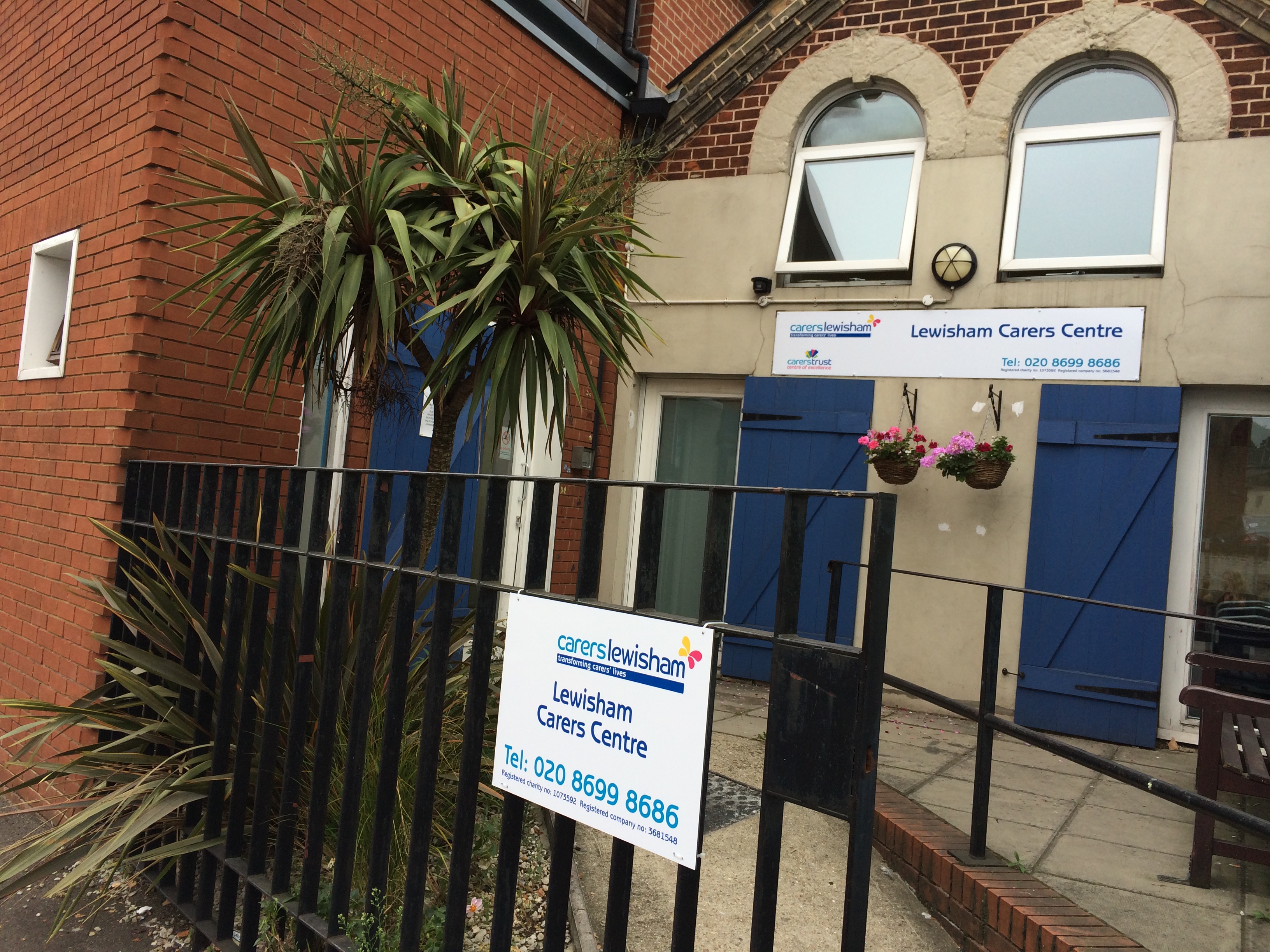
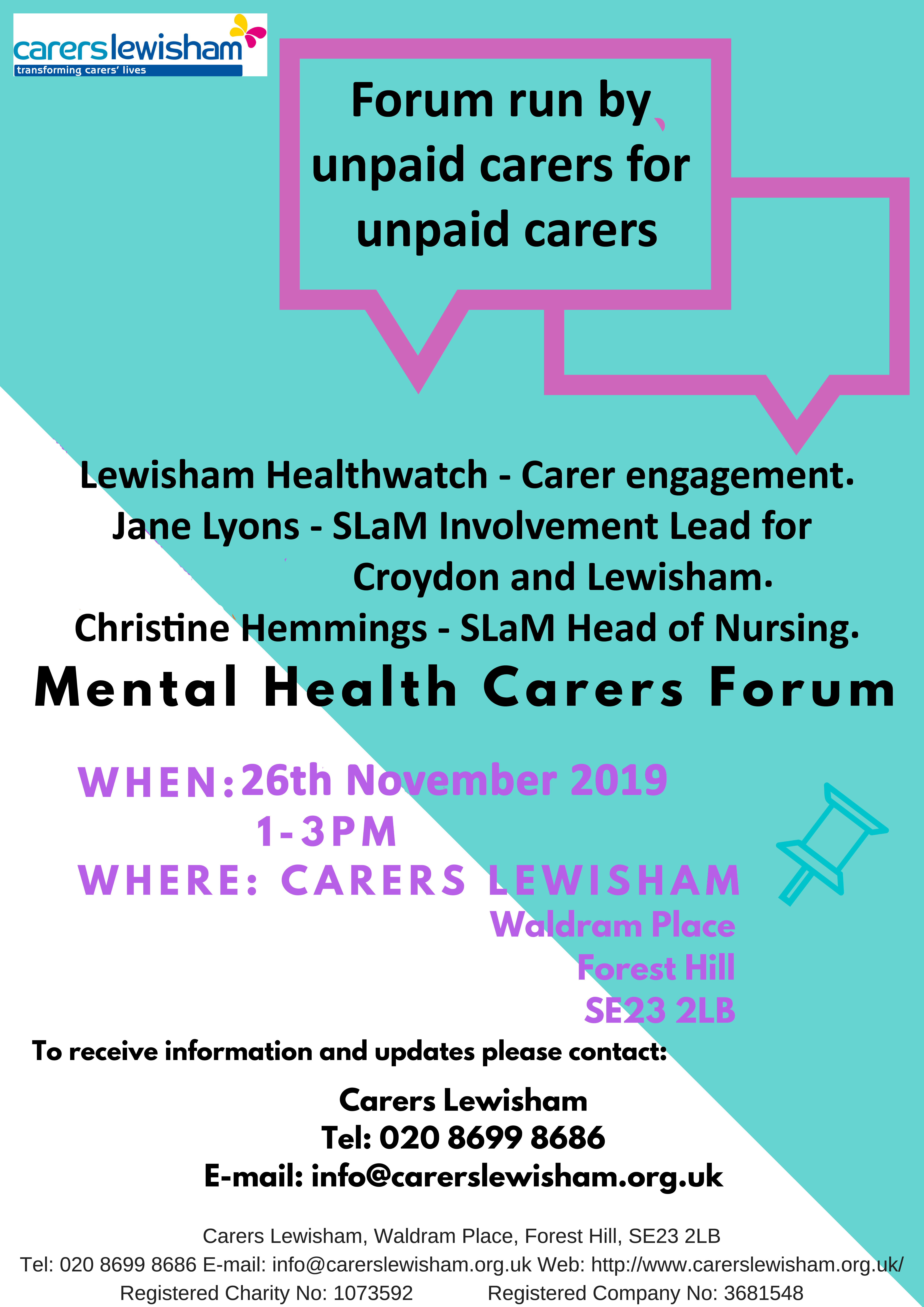
Welcome to my quick update of the Lewisham Mental Health Carers forum. This forum runs usually on the last Tuesday of the month and runs from Lewisham’s Carer’s centre. The forum looks at the issues affecting unpaid Mental Health carers in the borough of Lewisham and sometimes further beyond.
The forum does not look into the mental health of unpaid carers, but the situations of families and carers supporting someone with mental health needs. A bit more about the Charity ‘Carers Lewisham’. From their website.
Carers Lewisham provide a range of services including advice, information, emotional support, breaks, opportunities to meet other carers, relaxation days and well-being sessions, coping strategies, specialist support for parent carers, carers of people with dementia, carers of people with mental health problems, older carers and carers who are caring for someone nearing the end of their life.
As you can see, families can have complex relations and unpaid carers are no different, unpaid carers need that support, but they also need empowerment. This is what the Lewisham MH carers forum tries to provide.
The Lewisham Mental Health Carers forum runs once a month, just like the other 3 carer forums I try run. All MH Carer forums run in South London, but do not be fooled into thinking I just run forums since my activities spread much further than that, e.g. helping out Mental Health carers in other boroughs where mental health NHS Trusts have some idea of empowering unpaid carers in their area.
A first for the November forum was the use of a telecommunications application called Zoom, which allows unpaid carers to attend the forum via Video Chat. I am still trialing the device and checking out the hardware, but I have made it clear to members that I am happy to train them in usage.
Updates from Healthwatch Lewisham
For the November MH Carers forum, we were glad to welcome Healthwatch Lewisham.
Healthwatch Lewisham is the independent champion for people who use health and social care services. They exist to ensure that people are at the heart of care, and they listen to what people like about services, and what could be improved. Healthwatch Lewisham share their views with those with the power to make change happen, that being the Local Authority, CCG or those who provide services.
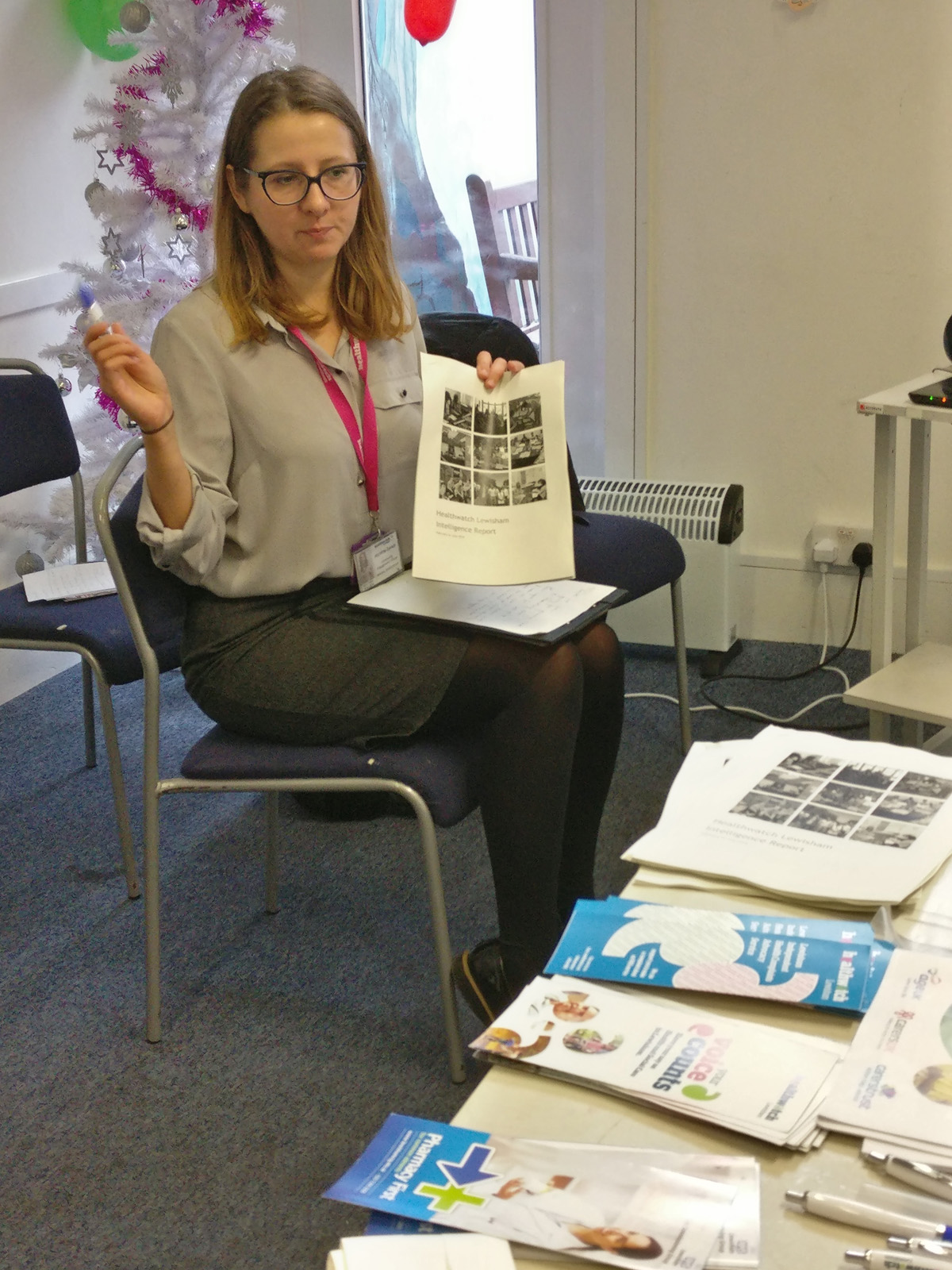
Marzena Zoladz who is Healthwatch Lewisham’s Involvement and Projects Manager has been actively engaging with both the Lewisham MH Carers forum and the Lewisham BAME MH Carers forum. She was there to update the members on Healthwatches Intelligence report, which is about a summary of reports and actions that have been undertaken by Healthwatch, including information on what they are currently working on, what work they are planning and updates on work they have previously undertaken.
Most of the members have already read some of the latest reports are queried Marzena on why some reports are not highlighting unpaid carers, but in the future Healthwatch wants to develop stronger links to families and carers. This is something the forum is looking forward to as many feel that those who they care for is at the mercy of the health services.
You can look at more reports from Healthwatch Lewisham show below.
Other queries from members were on the lack of figures and stats from the Local authority and from SLaM, many feel that SLaM Quality Improvement has a huge part to play in revealing statistics. A big query came from a member concerned that access to services via primary care is severly lacking. They feel secondary care focuses a lot more on those who have managed to use the mental health system, but those outside the system, it will be a hard struggle. There is dismay that Local Authority will be taking over more services in the area, which means it will be harder to raise queries to healthwatch.
Marzena was kind enough to give out information leaflets, booklets, forms, pens and hygiene kits. The forum members took a few forms to feedback information from other services.
Updates from SLaM
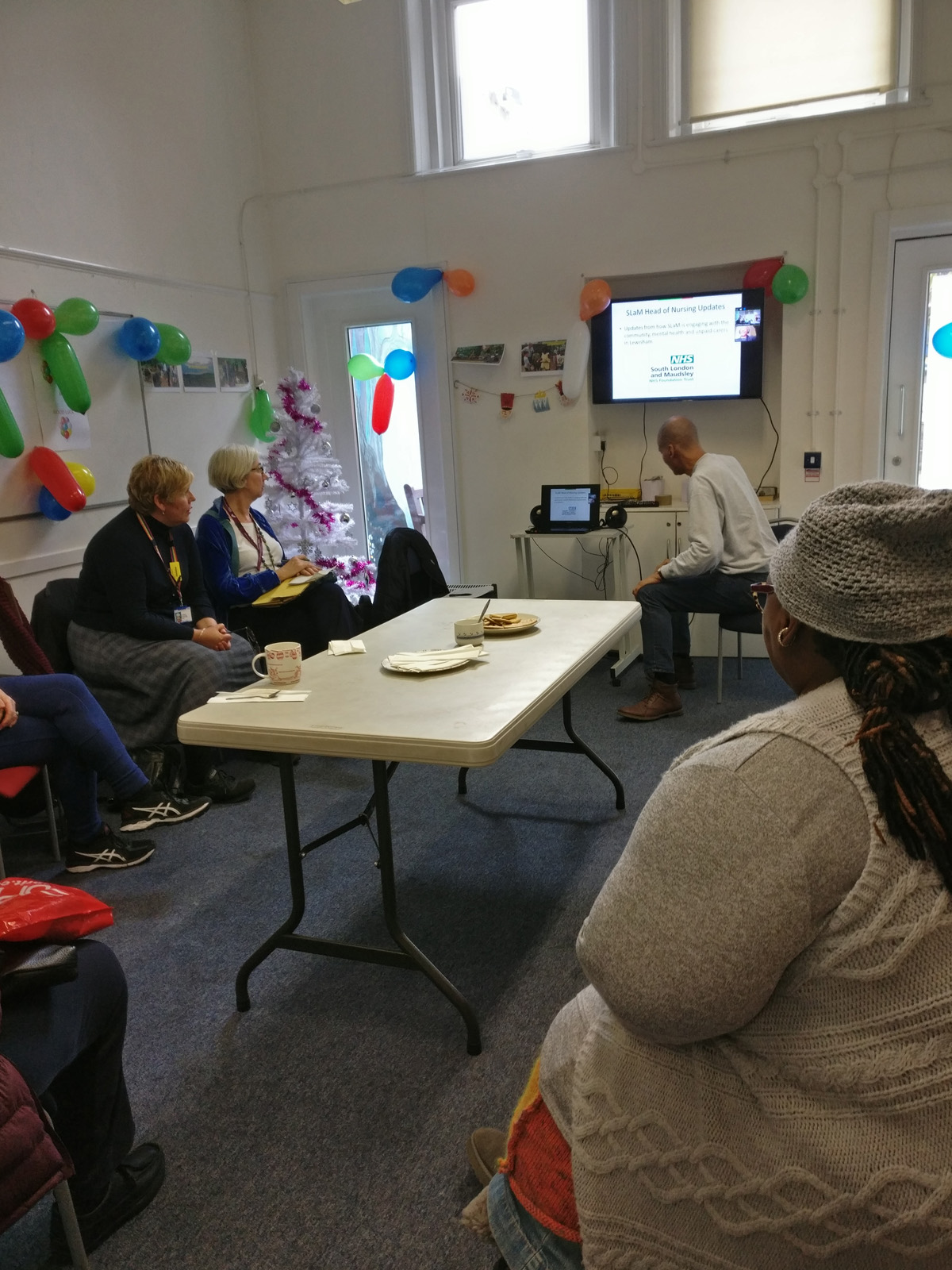
Also at the November forum, we were joined by South London & Maudsley NHS Foundation Trust’s (SLaM) Involvement lead for Croydon and Lewisham. Plus we were also joined by SLaM’s Head of Nursing. Before I continue, a bit of info about SLaM. Since some people think they are some trend for a basketball team.
South London and Maudsley NHS Foundation Trust provides the widest range of NHS mental health services in the UK.
They also provide substance misuse services for people who are addicted to drugs and alcohol. Their services include the Maudsley Hospital and Bethlem Royal Hospital. They also work closely with the Institute of Psychiatry, Psychology and Neuroscience and King’s College London.
They are supported by Maudsley Charity and are are part of King’s Health Partners Academic Health Sciences Centre. You might notice off my Southwark or Lambeth forums NHS Staff turn up from King’s NHS Trust or Guys & St Thomas Hospital to engage with unpaid carers.
We had some good news from SLaM’s involvement lead as they have a new inpatient Modern Matron, who I will be closely working with in the new year. There will also be a community carer’s lead for the borough, but again this might be something or the new year as a lot of carer issues are out in the community.
There is a plan for SLaM to set up a support group probably on the wards, which I feel would be great even though I am already setting up carer-led peer support groups in several boroughs. I really hope the development of the SLaM carer’s support group involves ideas from the Lewisham MH Carers forum.
This wraps up the brief update from November’s update of the Lewisham MH Carers forum. I can see Lewisham Carers becoming more festive as I await any Xmas party from the Carers centre.
The next Lewisham MH Carers forum will be in January for the new year.
This blog post is an update of September’s Lewisham BME carers forum. This is one of the four carer forums I am involved with and it is held over at a community centre called Family Health ISIS. The BME Carers forum was set up to provide a platform of engagement, empowerment, updates and issue raising out in the community.
It is important to note that the forum focuses on black African & Caribean carers who support/care for those suffering from mental illness. This is also one of the forums that has a mixture of carers and those with lived experience.
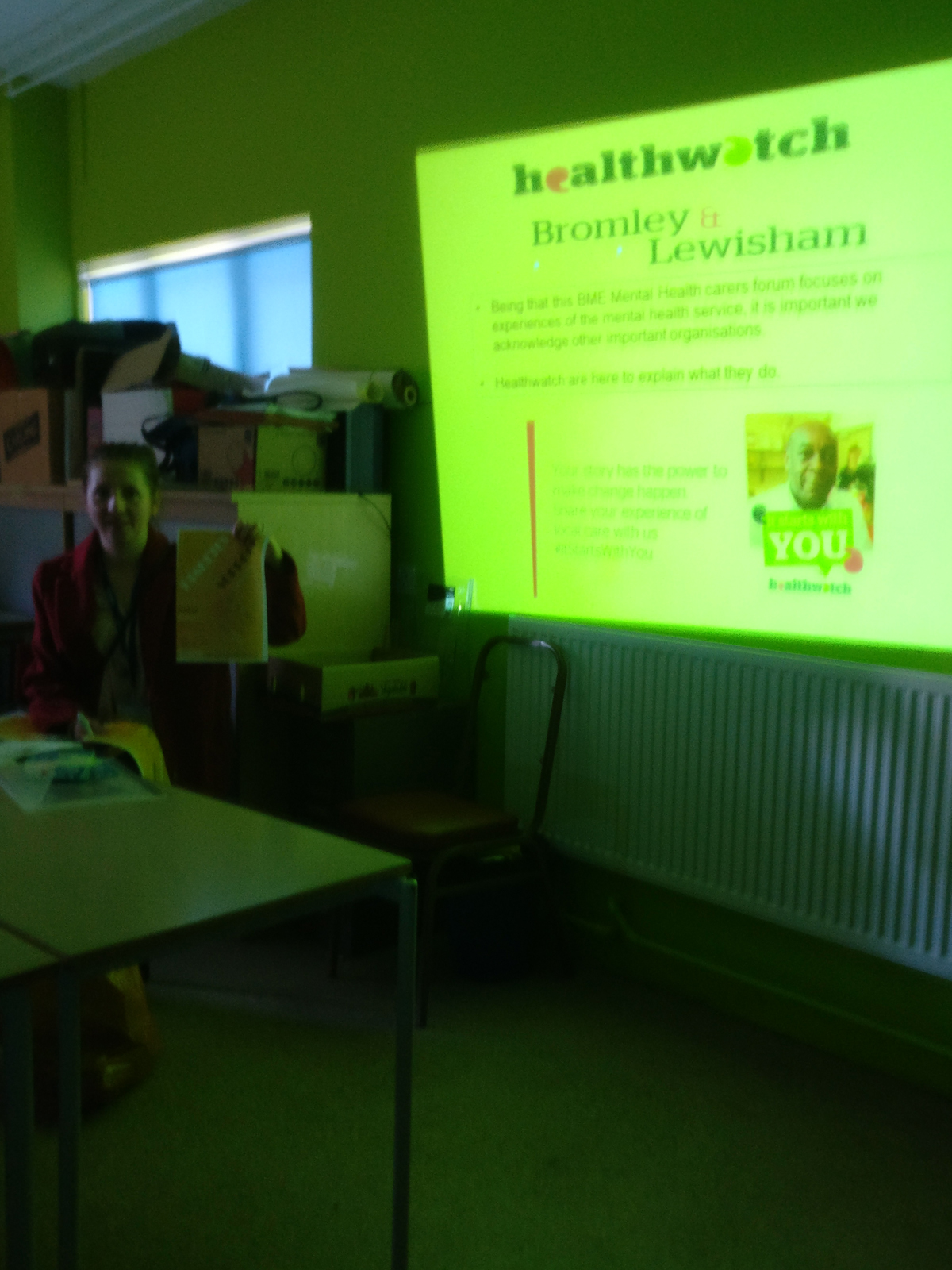
For September we were forunate enough to have engagement from Lewisham & Bromely Healthwatch. Marzena the community engagement officer came along to speak about what Healthwatch is all about and their mission to let others know about the health services available to them. Basically Healthwatch works to help local people get the best out of their local health and social care services.
As in the name, Lewisham & Bromely Healthwatch are covering two south east London boroughs, so they have a large area to cover.
I felt that it is important all four of the carer forums have a link to their local healthwatches because many issues raised in the forums can be of great importance to such community organisations. It is important to note not all healthwatches are alike and they tend to work differently in each borough.
Marzena updated the forum about health services in the borough of Lewisham, but also spoke about the duties of healthwatch and what meetings they attended. Healthwatch have stronger connections to the health commissioners and other health and wellbeing committees.
There was many passionate discussions about the issues members of family health ISIS are going through and I hope other guest speakers can work with the forum to tackle such problems.
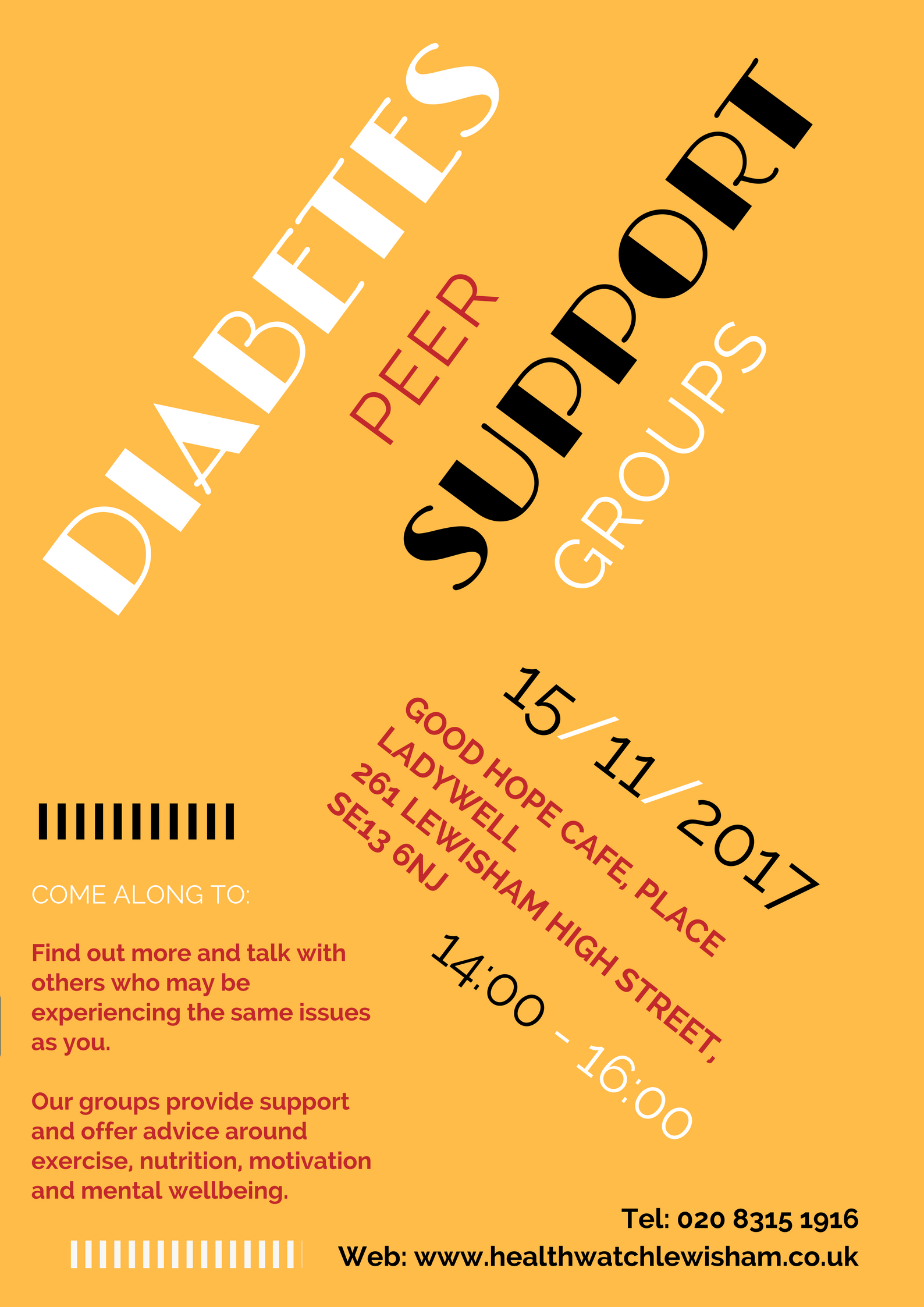
Marzena also spoke about looking after your health and mentioned diabetes groups and support. Healthwatch promoting diabetes peer support groups in the area. Healthwatch also gave away some free products such as pens and hand sanitizers.
I am grateful for Healthwatch for taking the time to engage with the BME mental health carer forum and hope they can attend the Lewisham Carers forum next year. Healthwatch also have offered to return to this forum in the new year.
Welcome back to another blog by Matthew Mckenzie, carer, carer rep and Governor for South London and Maudsley. I am also a member of the Lewisham Mental Health Connection and carer rep for Experts by Experience. I am a member of some other organisations and NHS Trusts, but one organisation that helps raise awareness and involvement for Health in the community is Healthwatch.
So on the 19th of March, I headed over to the London Borough of Southwark to attend the Healthwatch Southwark Event. This event took place at Walworth Methodist Church and started around 4:00 pm. Before I continue, what is Healthwatch all about?







 Welcome to another blog post by Matthew Mckenzie, a former carer and carer activist from South London. I usually focus on carers who care for someone with a mental illness, but at times I delve into health and mental health.
 Welcome to my quick update of the Lewisham Mental Health Carers forum. This forum runs usually on the last Tuesday of the month and runs from Lewisham’s Carer’s centre. The forum looks at the issues affecting unpaid Mental Health carers in the borough of Lewisham and sometimes further beyond.





 This blog post is an update of September’s Lewisham BME carers forum. This is one of the four carer forums I am involved with and it is held over at a community centre called Family Health ISIS. The BME Carers forum was set up to provide a platform of engagement, empowerment, updates and issue raising out in the community.
 A Caring Mind