Building Stronger Voices: A Powerful July Gathering of the National Ethnic Mental Health Carer Forum
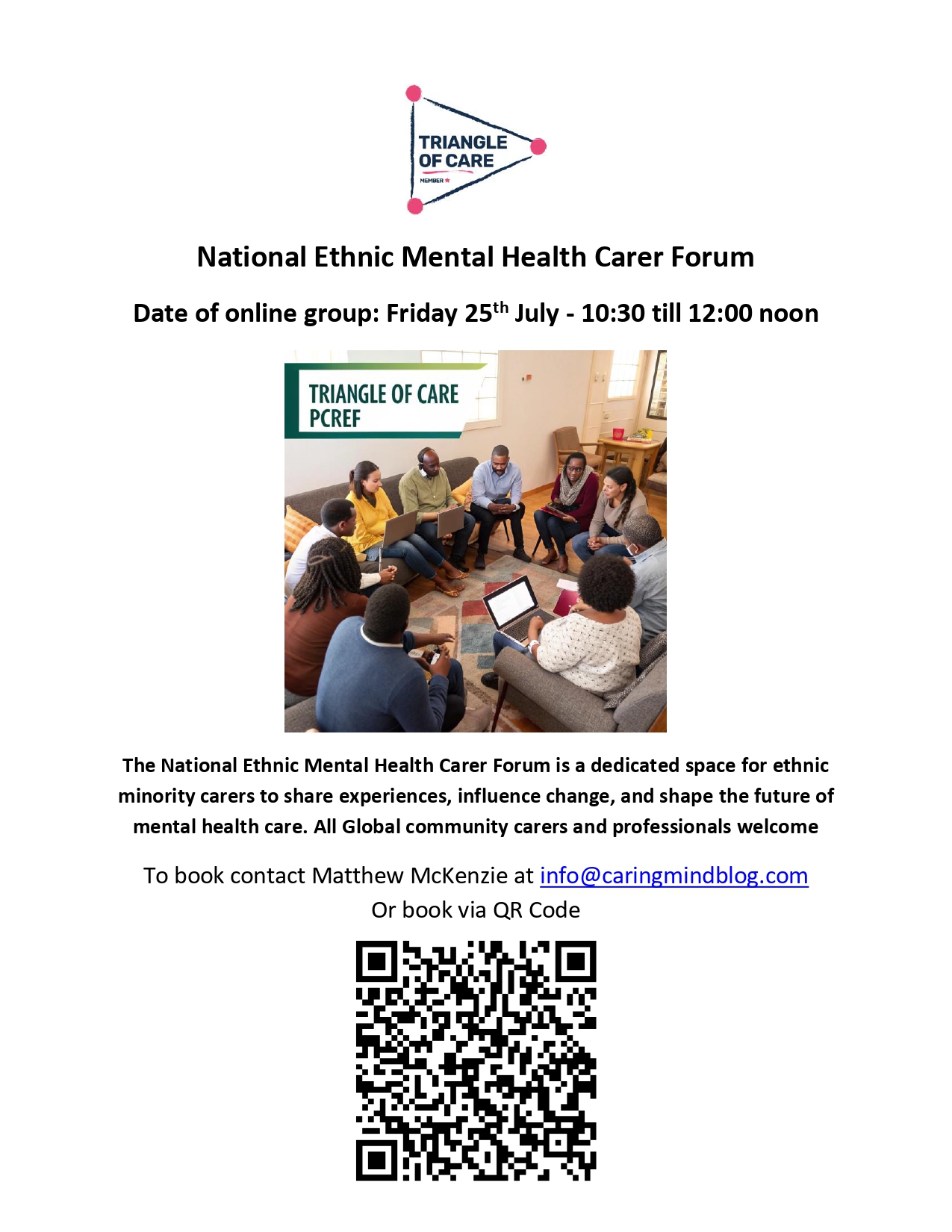
On Friday, July 25th, the National Ethnic Mental Health Carer Forum held another online session, continuing our work in empowering diverse carers and influencing meaningful change across mental health services. With participation from community champions, NHS professionals, experienced unpaid minority carers. The discussion was on the Triangle of Care (ToC) and PCREF (Patient Carer Race Equality Framework) stakeholders.
This forum exists to elevate the voices of ethnically diverse carers, bringing their lived experiences to the forefront of service transformation. Whether it’s holding systems to account or shaping policy guidance, this space remains vital in creating inclusive, anti-racist care across the UK.
Highlights from July’s Forum
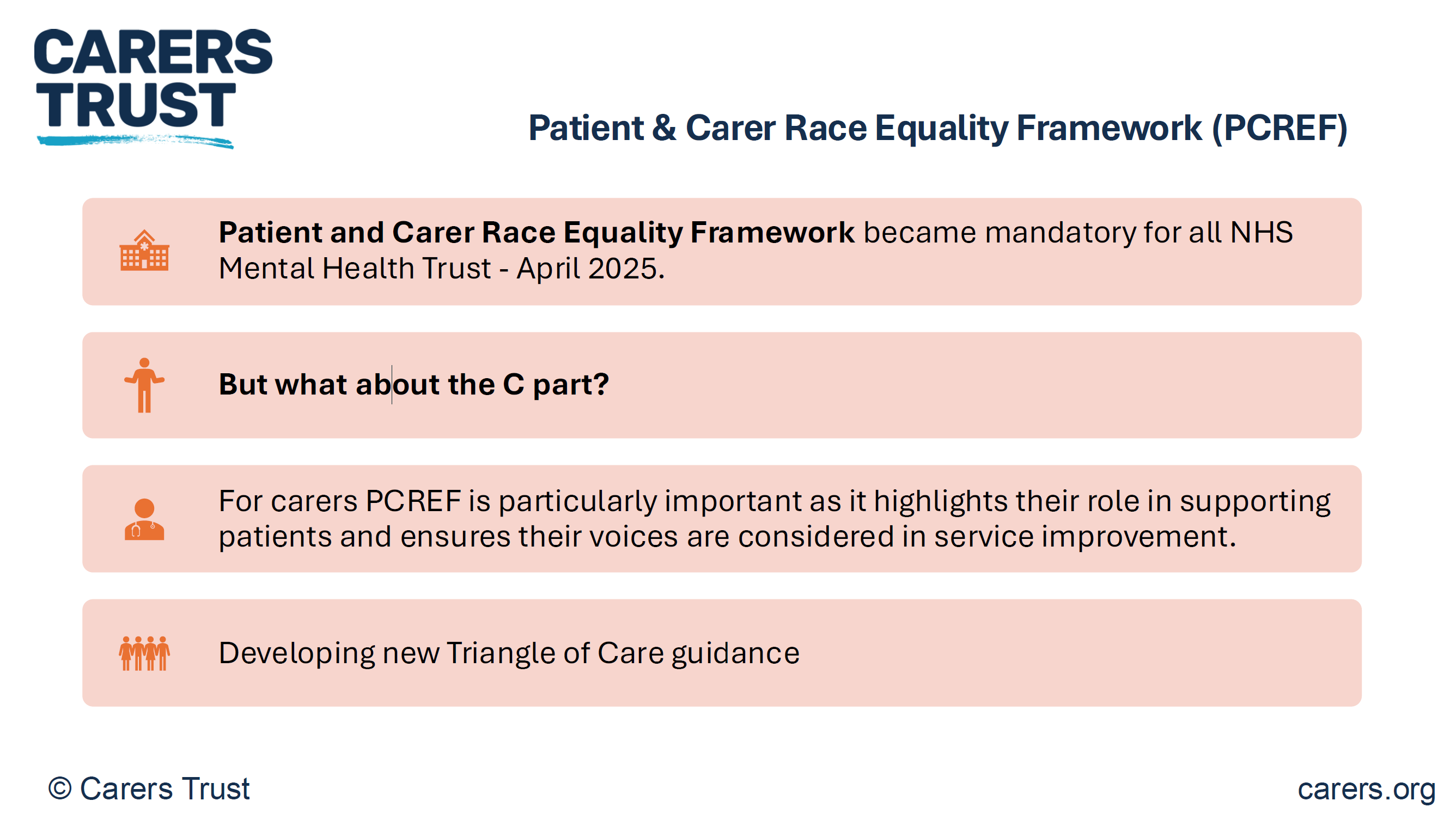
🔵 Debbie Hustings’ Presentation on Triangle of Care & PCREF Integration Debbie, a long-standing Triangle of Care Programme Lead and carer herself, gave an in-depth presentation on reviewing the Triangle of Care through a PCREF (Patient and Carer Race Equality Framework) lens. Her talk provided an honest look at institutional challenges and offered solutions for embedding racial equity into carer support standards. A key takeaway was how crucial lived experience is in driving real policy change not just warm words. She emphasized the importance of re-examining existing standards through a racial equity lens, stating that “beyond warm words,” carers need frameworks that are operational, measurable, and locally adaptable.
🟣 Powerful Feedback from Carers Contributors shared difficult yet necessary truths. Carers spoke about the lack of involvement in care planning, systemic racism, the need for meaningful co-production (not “faux-production”), and experiences of isolation when navigating majority environments. One carer reflected, “In 28 years of caring for my son, I have never been involved in his care planning.”
Several carers shared their painful, sometimes shocking, experiences navigating mental health services, especially in areas with limited diversity. One participant remarked, “Even after decades of caring, I’ve never been included in a care plan.” Others spoke of staff who misunderstood or dismissed cultural nuances, the misuse of confidentiality rules to exclude carers, and the silencing of Black and Asian voices. Concerns were also raised about immigration-related fears, lack of access for non-English speakers, and a troubling rise in racism in predominantly white areas. These reflections painted a vivid picture of systemic inequality but also made clear the power of collective advocacywhen carers come together, change begins.
These testimonies highlighted how far we still need to go.
🟡 Inclusive Language & Representation There was a passionate discussion around terminology whether to use “global majority” or “ethnically and racially diverse.” While some feared backlash from certain communities, the group leaned toward inclusivity and accountability over appeasement. This sensitivity around language underlines the forum’s thoughtful and intersectional approach.
🟢 The Work Ahead Debbie shared the next steps in developing Standard 2 of the Triangle of Care through the PCREF lens: staff training. The goal? Mandatory, culturally safe, anti-racist care awareness education co-produced with carers from diverse backgrounds. By April 2026, the guidance will be finalized, field-tested, and launched nationally.
A Forum of Global Carers, Local Action
This month’s session proved again that our forum is more than discussion as it’s a driving force for equity. Participants from Southampton, Lewisham, Pennine, Norfolk, Leicester, South West London, Kent & Medway and beyond all shared insights into their local efforts, including cultural awareness training, community storytelling projects, and carer-led involvement initiatives.
One key message? Change is possible when carers are part of the conversation—not as guests, but as co-leaders.
Want to Get Involved?
The forum is open to carers and professionals across the UK and beyond. We meet monthly online, and everyone is welcome to join, contribute, or simply listen.
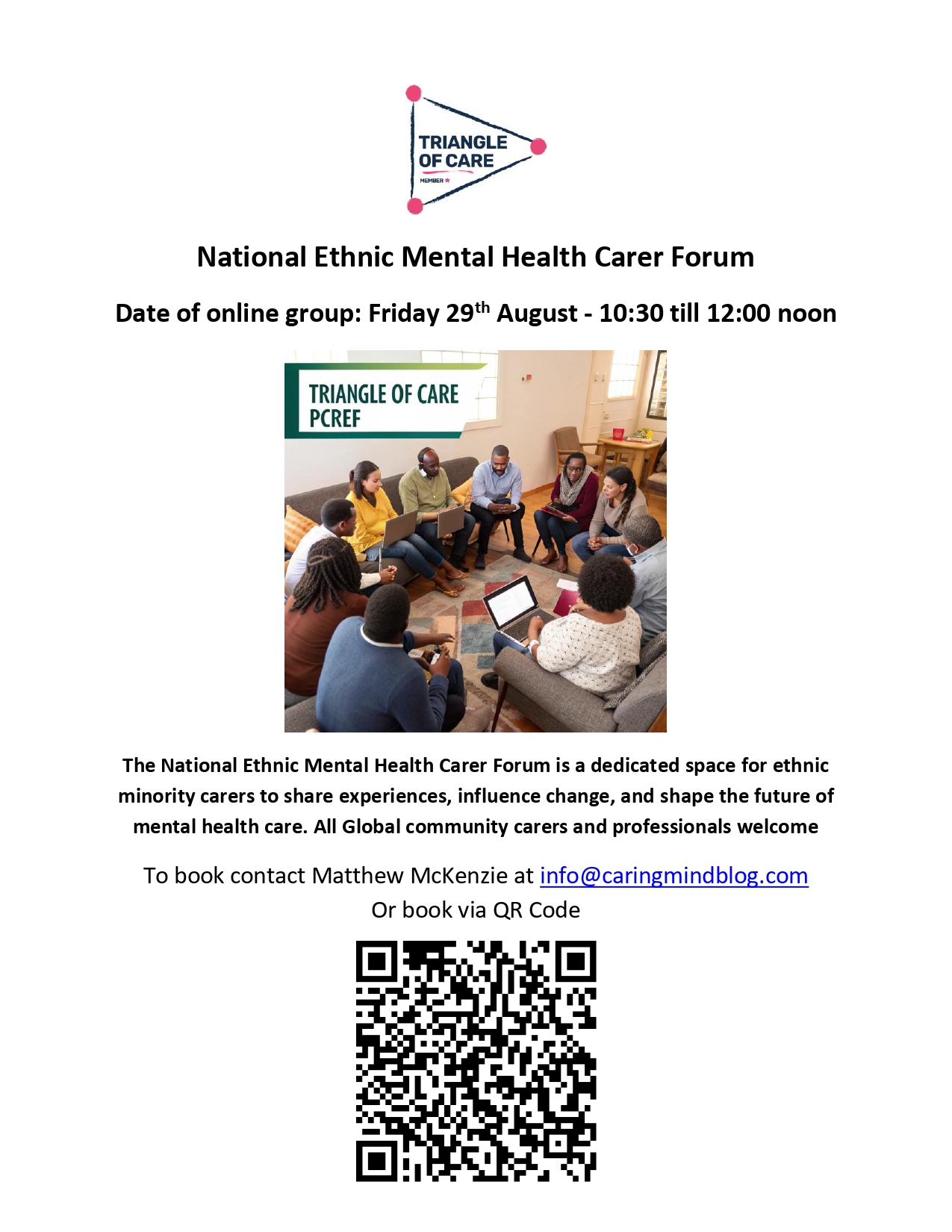
For bookings or questions, contact me at info@caringmindblog.com 📱 Or download and scan the QR code in the flyer above
Together, minority mental health carers can shape a mental health system that sees, hears, and supports all carers—ethnically, culturally, and fully.
Next National MH carer forum in August 29th 10:30 am Matthew McKenzie Founder – Caring Mind Blog Facilitator – National Ethnic Mental Health Carer Forum
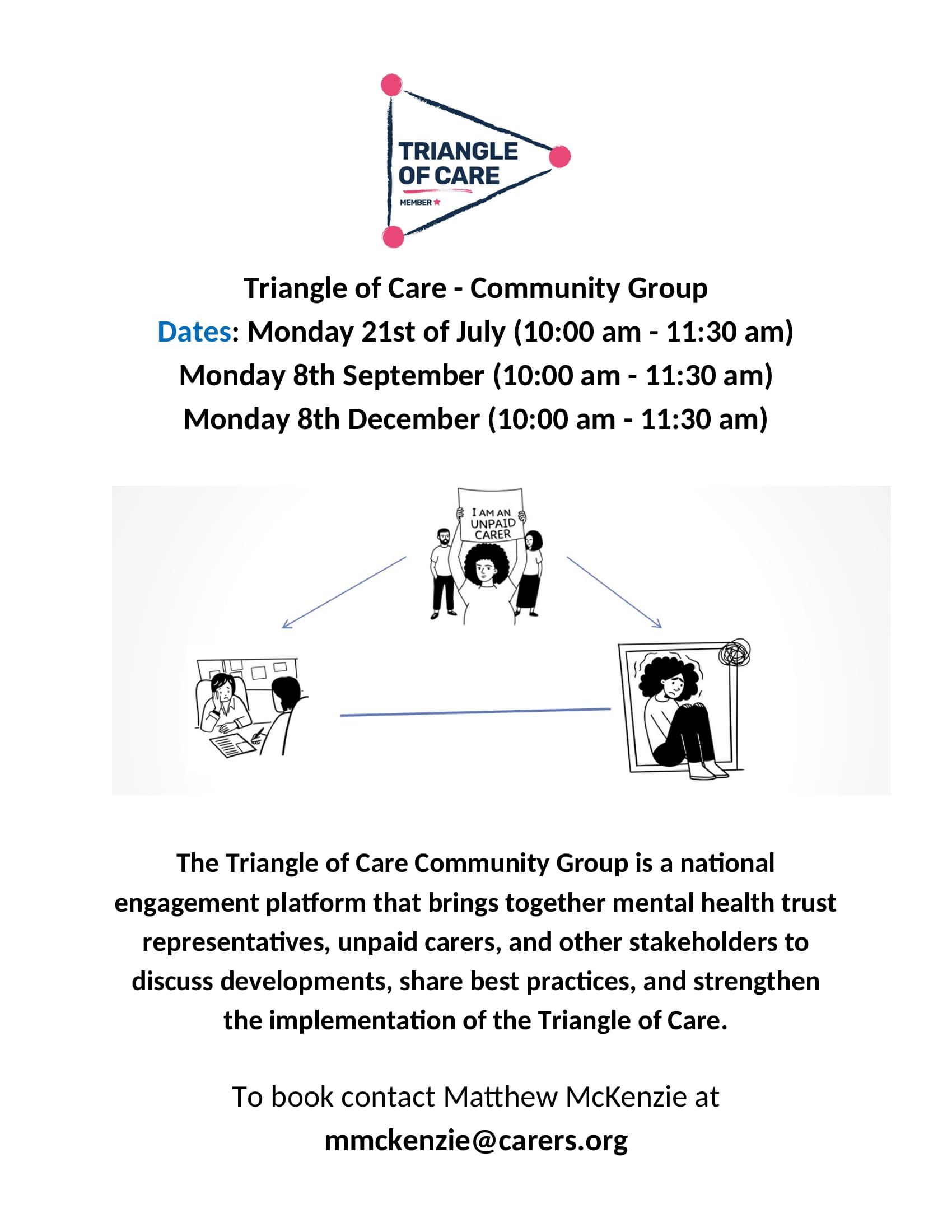
On 21st of July 2025, carers, professionals, and stakeholders from across the UK gathered virtually for the latest Triangle of Care (ToC) Community Meeting. Chaired by Matthew McKenzie, this session was packed with insight, action points, and open dialogue. Whether you were new to the group or a long-time contributor, there was something valuable for everyone.
This meeting was particularly significant as it marked a turning point for carer participation. The formal recognition of the community group in ToC’s national governance structure. It affirmed that carer lived experience should not be sidelined, and that carers must continue to shape mental health services from the inside out.
If you weren’t able to attend, this blog will bring you up to speed. As the ToC community group covered a wide range of topics, from updates on national strategy and governance, to inclusive language, carer-led training, and advocacy for better research funding. At the heart of it all was a single message: when carers unite, systems must listen.
Official Recognition and Governance Progress
We are delighted to announce that the Triangle of Care Community Group is now formally integrated into the Triangle of Care governance structure. This gives the group a direct route to influence national decisions. The community will now sit alongside steering and regional groups in shaping policy, reviewing practices, and helping determine what carer inclusion should look like across all participating trusts.
What this means practically is improved alignment and visibility. For years, many carers and grassroots contributors have worked tirelessly behind the scenes, often without formal platforms. This change allows community voices to be heard before decisions are made not just consulted afterwards. Matthew described this shift as “a recognition of the years of unpaid care, leadership, and advocacy carers have always provided.”
It also means that our meetings will align with national timelines and decisions, ensuring a timely flow of updates between local groups, regional networks, and national forums. This is a pivotal opportunity to embed carers more meaningfully into NHS structures and accountability.
New Mailing List & Sign-Up System
Mary Patel from Carers Trust announced the launch of a new centralised mailing list for Triangle of Care community members. This will make sure everyone receives meeting invites, resources, and updates reliably. Participants will soon be asked to complete a Microsoft sign-up form, which will securely transfer contact details onto the Carers Trust system for ongoing communications.
The form will include a few demographic questions to help build a picture of the diversity within the ToC community. These questions are entirely optional but are designed to help Carers Trust identify who is engaging, and where gaps might exist—ensuring outreach strategies reflect real needs. For example, better regional balance, or increased visibility for underrepresented carer groups.
There was also discussion about moving from Zoom to Microsoft Teams for future meetings. Teams offers benefits like attendance tracking, secure file sharing, and easier scheduling. However, this won’t be a forced change, Matthew and Mary invited feedback, emphasising that any transition would be made collaboratively with community input.
Stronger Carer Involvement
Carer involvement was at the heart of the meeting. Matthew shared a passionate update on the need for carers particularly those from minority backgrounds or marginalised communities to step forward and engage in all aspects of the Triangle of Care. This includes involvement in peer reviews, shaping surveys, and suggesting new training or webinar content that reflects their lived experience.
The community was reminded that leading change doesn’t require a title or formal position. Sharing your story, participating in surveys, or simply raising your hand during a meeting is a form of leadership. Matthew emphasised that carers hold the kind of insight that no policy or textbook can replicate. As he put it, “This community is only as strong as the carers who show up.”
Peer reviewing was especially encouraged. Carers can play a vital role in reviewing mental health trust practices and making sure those trusts aren’t just ticking boxes but are genuinely improving the carer experience. Anyone interested in joining these review panels was invited to contact Mary Patel directly. The experience is meaningful and empowering and it places carers right where they should be: in positions of influence.
CQC Expectations and Carer Experiences
A powerful part of the meeting focused on the role of the Care Quality Commission (CQC) and how effectively it monitors carer inclusion in mental health services. Several carers and professionals shared their experiences some positive, others deeply concerning about how the CQC engages (or fails to engage) with carers during inspections.
A senior experience lead from an acute trust, explained that when CQC inspectors review services, they typically look for a clear carers policy, systems for identifying and supporting carers, and evidence of staff training. However, the level of scrutiny and the quality of carer-related feedback can vary significantly between inspections. The experience lead noted that while policy is important, it’s the systems around those policies that really matter, things like whether staff actually follow them, and whether carers know where to go for help.
Carers in the meeting shared contrasting experiences. A carer described a disappointing CQC visit where the inspector seemed dismissive, rushed, and uninformed about carers’ rights. Her feedback about lack of communication and exclusion was barely acknowledged, leaving her feeling invalidated. In contrast, Another carer spoke of a more recent inspection where the CQC officer seemed empathetic, asked thoughtful questions, and even disclosed their own possible caring experience. These differing accounts highlighted a common theme: carers’ confidence in the CQC is mixed, and their approach to carers can sometimes feel inconsistent.
There was strong consensus that CQC needs better training in carer engagement and not just understanding legal frameworks like the Care Act 2014, but also how to meaningfully include carers in service reviews. Kelvin added that cultural competence should also be part of the equation, noting that carers from minority backgrounds are too often left out of consultations. Matthew urged carers not to wait for trusts to invite them to speak during inspections ask to be involved, request to meet inspectors, and use carers’ councils or governors to raise visibility. It was clear from this session that carers want the CQC to be more than a compliance body, they want it to be a true advocate for accountability and equity in care.
Confidentiality Roadshow by Donna Bradford
A standout session was led by Donna Bradford, who presented her team’s work on the Confidentiality Roadshow a training programme developed by Lincolnshire Partnership NHS Foundation Trust. Designed to upskill staff on consent, confidentiality, and communication, the roadshow is tailored around carer inclusion and co-produced with the Carers Council.
The training helps staff understand not only what they can share legally, but also how to navigate nuanced emotional and ethical situations with carers. Donna reminded attendees that sharing basic, non-confidential information, such as medication side effects, is not only lawful but essential. “If you can Google it, you can say it,” she noted, driving home the importance of clarity over confusion.
Over 550 staff have already received the training, with 100% reporting that it improved their confidence. The programme includes real-life carer scenarios, emotional video testimonials, and interactive quizzes to help reinforce learning.
Beyond the training content itself, what makes the Confidentiality Roadshow so impactful is its co-production with carers. Donna highlighted that every scenario used in the sessions came from real-life examples shared by carers and families. This ensures the training isn’t theoretical so it’s grounded in lived experience. The emotional and practical realities of caring for someone with mental health needs are at the heart of the learning, helping staff understand why clear, compassionate communication is so essential. The training also underscores the importance of listening to carers, not just as bystanders but as active contributors to a person’s care journey.
Several attendees raised the idea of incorporating this training into broader staff induction and continuing professional development programmes. Others asked about adapting it for use in different trust settings, such as acute hospitals or community services. Donna encouraged trusts to reach out if they’d like to adopt or customise the resource. The message was clear: confidentiality shouldn’t be a barrier, it should be a bridge, and with the right training and tools, staff can navigate those conversations with confidence, legality, and humanity.
Mental Health Research Petition
Irene Harris spoke passionately about a new parliamentary petition calling for improved research funding into serious mental illnesses (SMIs) like psychosis. The petition aims to shine a spotlight on how outdated treatments and under-researched conditions continue to place carers and their loved ones in difficult, often heartbreaking positions.
Here is the video about Psychosis medication and its impact by the Stockport carers forum.
She shared how mental health medications for SMIs haven’t evolved as rapidly as physical health treatments, and how this results in long-term side effects and compromised quality of life. Research is desperately needed, not only to improve diagnosis and treatment, but also to create support structures that ease the burden on unpaid carers.
Irene asked attendees to sign and circulate the petition widely, with a goal of hitting 10,000 signatures by November 15th.
She also announced plans to launch new social media channels to raise awareness. This initiative is about more than funding it’s about giving carers and service users a louder voice in national healthcare priorities.
or contact Irene on irene@mhcarersgroupstockport.co.uk
Language, Inclusivity, PCREF & the ‘Global Majority’ Debate
Language and inclusivity were major themes of the meeting, particularly around the term “global majority.” Some attendees expressed concern that the phrase could be divisive or misinterpreted, particularly by politically sensitive audiences or media outlets. A carer shared a personal anecdote illustrating how words can carry unintended consequences.
Others responded by highlighting the intention behind the term to emphasise that those historically described as “minorities” are, in fact, the global majority in population terms. They called for continued use of the phrase in contexts that promote empowerment, equity, and lived experience.
The discussion didn’t produce a consensus, but it modelled what respectful disagreement and co-learning should look like. Matthew reinforced that ToC should be a space for constructive dialogue, not debate for its own sake. Ultimately, we are united in our aim to ensure no carer is left behind regardless of background, heritage, or identity.
Next Steps & Community Actions
The session wrapped up with a summary of action points and responsibilities. Carers Trust will soon circulate the new mailing list sign-up form. Matthew will share updated meeting dates for 2026 once confirmed, and he will continue to distribute posters for the upcoming National Ethnic Carers Group, taking place on the last Friday of each month.
There will be support the rollout of the Confidentiality Roadshow materials and follow up with those interested in joining peer review panels. A reminder was issued for everyone to contribute to current surveys, share their feedback, and suggest future topics for community meetings.
Finally, participants were encouraged to stay connected beyond the meetings. Whether through peer networks, local carers centres, or email updates, the message was clear: carers must stay visible, vocal, and valued. You are the change-makers, and this group is your platform.
Final Thoughts: “Carers Are Not Just a Cog in the Wheel”
Matthew ended the session with a rallying call to action: “We’re not just a cog in the wheel as we are the energy behind it.” His words served as a reminder that carers are not passive recipients of services. They are drivers of quality, advocates for change, and protectors of dignity in the mental health system.
He also reminded everyone that systems often change slowly, but they do change when people keep showing up, keep speaking up, and keep sharing their truths. “This isn’t just about the Triangle of Care,” he said. “It’s about reshaping the whole narrative around mental health and care.”
If you missed the meeting and would like to receive the slides, recordings, or further resources, feel free to contact Matthew McKenzie directly: 📧 mmckenzie@carers.org
Thanks to to all who attended, contributed, and championed carers’ voices. The next meeting should in September where we hope to see you there.
Understanding the Hidden Struggles of Ethnic Minority Carers Caring for a loved one with mental illness can come with challenges, but for many ethnic minority carers, the journey is made more challenging by cultural stigma, language barriers, and a deep-rooted mistrust of formal health systems.
These carers often carry immense responsibility behind closed doors, with little recognition or support. Despite their dedication, many avoid reaching out to mental health services—not because they don’t care, but because past experiences have taught them to be cautious, even fearful.
What Is Institutional Distrust and Why Does It Matter? Institutional distrust refers to the lack of confidence in systems like healthcare, social care, or government services. For ethnic minority carers, this distrust is often grounded in real experiences of discrimination, cultural insensitivity, or the fear of losing control over a loved one’s care.
When services fail to understand or respect a carer’s background, the result is silence and isolation leaving carers to cope alone, without the help they may desperately need.
A Short Video Giving Voice to Unheard Stories To shed light on this important issue, I’ve created a short video presentation: “Institutional Distrust: Why Many Ethnic Carers Avoid Formal Services”
This video draws on the voices and lived experiences of unpaid carers, especially those from ethnic minority backgrounds. It explores the emotional weight they carry, the cultural barriers they navigate, and the urgent need for services to become more inclusive, respectful, and culturally aware.
Why Sharing These Stories Matters If we truly want to support carers from all backgrounds, we must first listen and really listen to what they’re telling us. By naming institutional distrust and understanding its roots, we can begin to rebuild trust and create spaces where carers feel safe to seek help.
Please watch and share the video, and let’s continue the conversation about what real support looks like for ethnic minority carers in mental health.
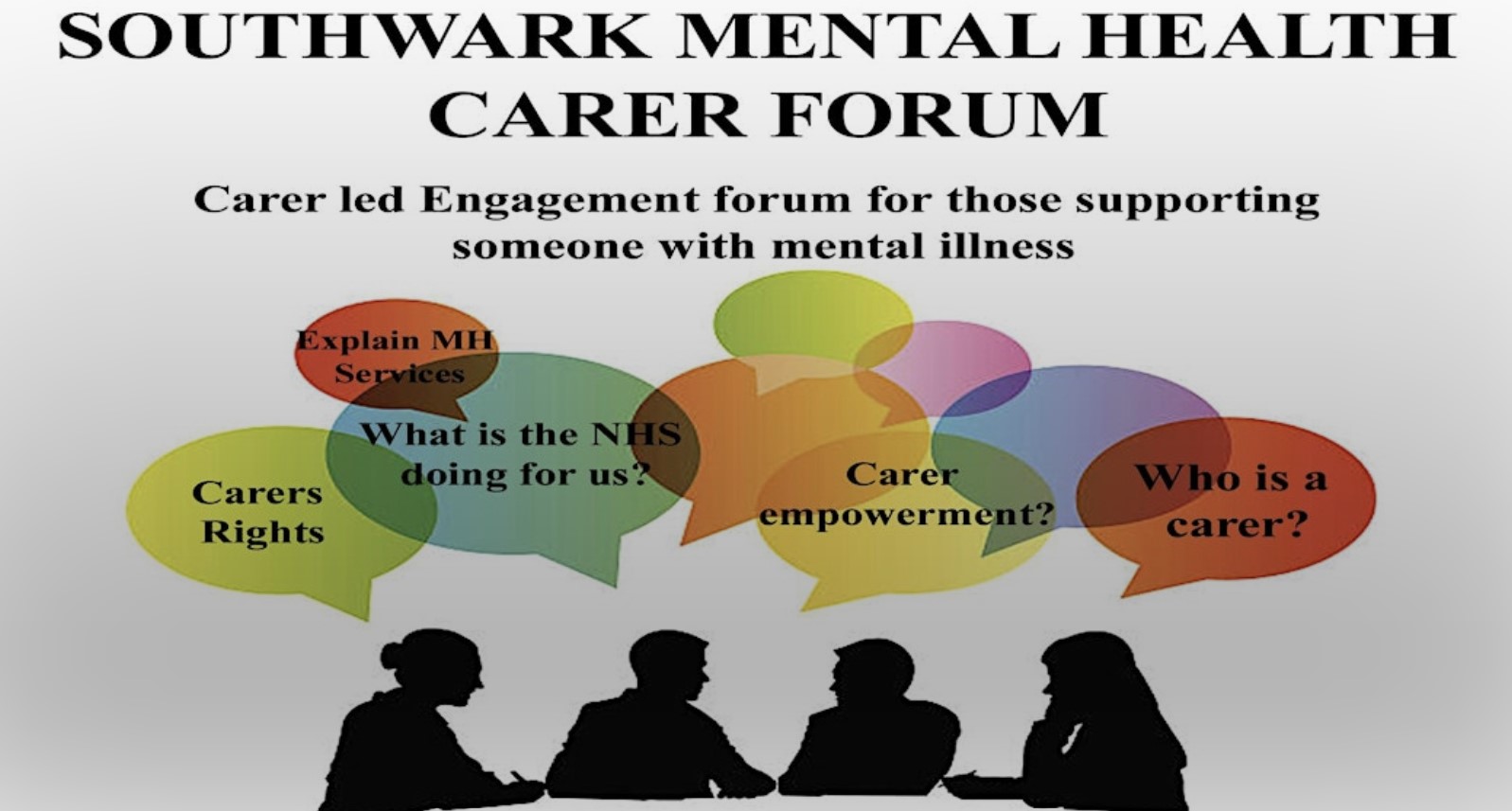
About the Forum: The Lewisham, Lambeth & Southwark Carers Forum is a collaborative online space that brings together unpaid carers, carer leads, mental health professionals, and support organizations to share experiences, raise concerns, and influence change. Focused primarily on mental health caregiving, the forum serves as a platform for peer support, policy updates, training insights, and service development. Led by carer advocate Matthew McKenzie, the group fosters empowerment through regular discussions, creative expression, and co-produced solutions, ensuring carers’ voices are heard across local systems and beyond.
Carers Week Collaboration Discussion
The meeting began with introductions from Matthew McKenzie, who leads a merged online carers group, and other participants including Yvonne, a carers navigator at Southwark Carers, and Margaret, a carer representative with the Royal College of Psychiatrists. The group discussed Carers Week activities and their various roles in supporting carers across different organizations. Karen Hooper, connected with the Lambeth Living Well Collaborative, while Lee Roach, the carers lead for South London & Maudsley in Lambeth, shared his involvement with the Trustwide Family and Carers Committee.
The Power of Poetry and Storytelling in the Lives of Carers
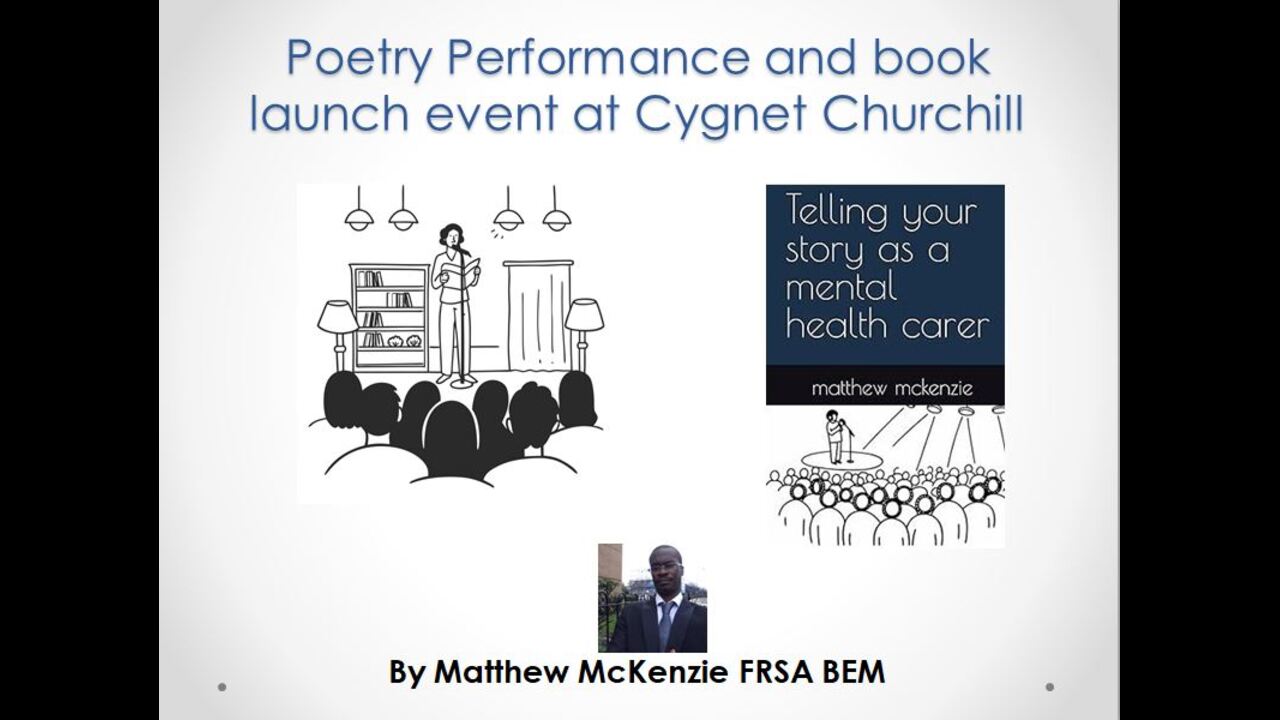
Caring for a loved one with mental health challenges or chronic illness is a journey marked by both hardship and hope. Too often, the voices of carers those who provide unpaid, tireless support are overlooked in the broader conversation about health and wellbeing. Yet, as this moving gathering of carers and poets reveals, storytelling and poetry can be transformative tools for connection, healing, and advocacy. So it was an honour to host our first poetry event at Cygnet Churchill for the 13th of June during Carers Week 2025
This Blog explores the themes, experiences, and creative expressions shared by carers, drawing from a vibrant community event centered on poetry, storytelling, and the lived realities of those who care. Through their words, we gain insight into the emotional landscape of caring, the challenges faced, and the resilience that emerges when stories are shared.
To watch the performance, please view the video below.
Giving Carers a Voice: The Motivation Behind the Book
The host of the event was myself (Matthew McKenzie), as a prolific author and advocate, where I have dedicated my eighth book to amplifying the voices of mental health carers. For me, books are more than just a means of communication they are a way to reach people who might otherwise remain unheard.
By Matthew McKenzie, Carer Ambassador, Cygnet Health Care
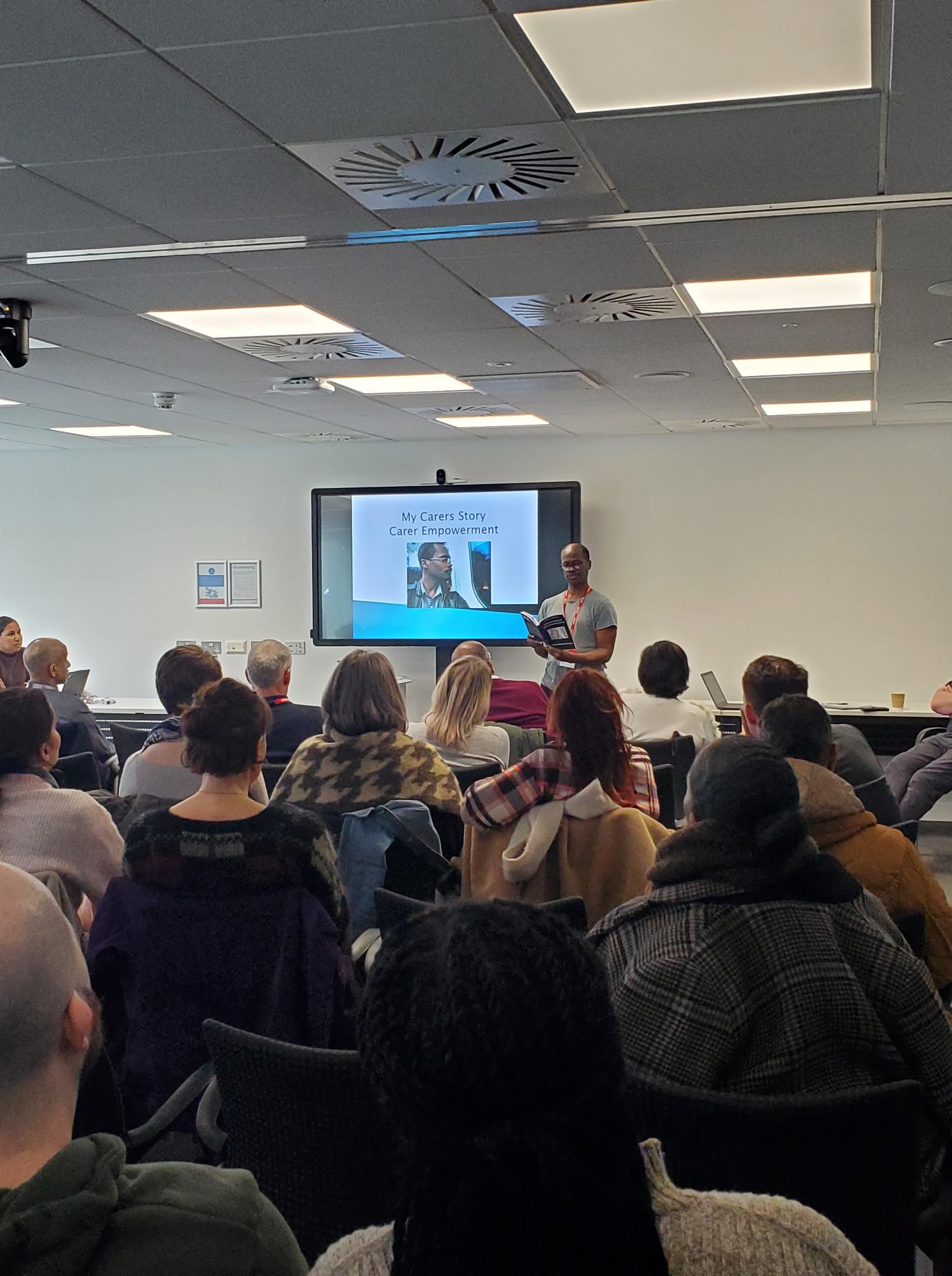
On Friday 13th June 2025, I had the privilege of attending and speaking at Cygnet Health Care’s National Carers Event, hosted at Cygnet Churchill in Lambeth, London. The event brought together carers, staff, professionals, and advocates to reflect on the vital role of unpaid carers who step up daily out of love, resilience, and responsibility, often with little recognition.
Carers Week is always a powerful reminder that caring touches us all – and Cygnet’s event this year was especially moving and informative. It offered a platform for carers to share their lived experience, influence policy, and strengthen our collective voice.
Agenda Highlights
The day opened with a warm welcome from Laura Sheridan & Shane Mills, setting the tone for a day grounded in empathy and collaboration. We heard from a range of speakers including:
Susan Hartnell-Beavis, sharing practical tools for supporting carers.
Kate Mercer and Carly Ellicott, who both championed carer involvement in care planning and research.
John Bangs OBE, who brought a national perspective on carer rights and policy.
Dr Angela Misra, who tackled the health implications of caregiving.
Julian de Takats and Matthew McKenzie (myself), focusing on empowering carers’ voices.
We also had insights from Dr Henk Swanepoel & Sophie Borg, who presented on collaborative approaches with carers in mental health services.
Help raise awareness for unpaid mental health carers during Carers Week 2025. Learn how to support and recognize their vital, often unseen role in society. To watch the video of this blog, click the video below
Recognizing the Unseen: The Vital Role of Unpaid Carers in Mental Health
Every year, Carers Week serves as a powerful reminder of the millions of individuals who dedicate their lives to supporting loved ones with health challenges often without recognition, compensation, or adequate support.
Understanding Over-Involvement as a Mental Health Carer
Welcome to another lecture taken off my YouTube channel. If you want to watch the lecture please see the video below.
Caring for a loved one with long-term mental ill health is a profound act of compassion, resilience, and often necessity. For countless unpaid carers, the daily reality involves advocating, supporting, and filling in the ever-widening gaps left by under-resourced mental health systems. But amid this dedication, a challenging reality emerges: what happens when you become “too involved” as a mental health carer?
Navigating the boundary between healthy support and over-involvement is fraught with emotional, social, and systemic complexities. For many carers, especially those without significant backup or support from services, over-involvement isn’t a deliberate choice. Rather, it’s a reaction to anxiety, lack of resources, unavailable respite, or a deep sense of responsibility, factors often compounded by the failures of the very systems meant to help.
This article explores the nuanced challenges of over-involvement, the psychological and social fallout for carers, the systemic pitfalls that fuel this cycle, and constructive pathways forward.
What Does It Mean to Be “Too Involved”?
Over-involvement as a mental health carer doesn’t refer to love or dedication, but to a state where healthy boundaries are blurred. It can look like:
Constantly monitoring or managing every decision or behavior: Driven by anxiety, the carer feels compelled to oversee every aspect of their loved one’s life.
Neglecting one’s own needs and identity: Support shifts from helping to living solely for the cared-for person, with carers sidelining their own health and well-being.
Becoming the sole or primary source of support with little to no backup: In the absence of adequate services, carers take on overwhelming responsibility.
Feeling unable to step away—even when necessary: Carers may feel there’s simply no option to rest, leading to chronic exhaustion.
While not every carer will experience all of these, most will likely encounter at least some, especially during crises or prolonged periods of under-resourcing.
The Emotional and Social Toll of Over-Involvement
Burnout and Fatigue
The most immediate impact of over-involvement is caregiver burnout. Continual vigilance, lack of sleep, and emotional strain take a heavy toll. Fatigue accumulates until carers can no longer function effectively, putting their own mental health at risk.
Guilt, Anxiety, and Isolation
Carers often wrestle with overwhelming guilt—fearful of not doing enough, or of something going wrong in their absence. Anxiety about possible crises or relapses becomes a constant presence. Over time, this anxiety, coupled with a lack of support, leads to profound isolation: friends, hobbies, and social ties erode under the relentless demands of caring.
Loss of Identity
Many carers experience a blurring, or even a loss, of their personal identity. They become “the carer,” subsuming roles as a partner, parent, sibling, or friend. The world shrinks to the immediate needs of the cared-for person, often at the expense of the carer’s own aspirations and selfhood.
Depression and Hopelessness
Without respite or validation, carers can slip into depression. Hopelessness stems from the sense that there is no help available and nobody understands the unrelenting emotional labor.
Neglect of Personal Health and Finances
Skipping one’s own medical appointments, neglecting health, and losing the ability to work full or even part-time are all too common. The financial strain can be devastating, adding yet another layer of stress.
Social Withdrawal and Relationship Strain
Over-involvement is a key driver of relationship breakdowns—not just with friends and work, but with the cared-for person. Overreliance on the carer can breed resentment on both sides, fueling conflicts, codependency, and, on the part of the cared-for person, a diminished sense of autonomy and independence.
Systemic Failures: Why Carers Become Over-Involved
Underfunded and Overstretched Services
The reality for many mental health carers is that the system simply doesn’t provide for the needs of those with mental health conditions—let alone their carers. Cuts to services, lack of staff, and waiting lists mean that carers are left to fill the gaps. They become, by necessity, the constant support, regardless of personal capacity.
Lack of Communication and Training
Poor communication from health or social services leaves carers in the dark. With no clear guidance or explanation of the cared-for person’s needs, diagnosis, or care plan, carers are left to guess, manage, and advocate alone. Often, vital training around role limitations or healthy boundaries is missing entirely.
Delayed or Insufficient Care Provision
When care is delayed or inadequate, carers are expected to step up, often without assessment or recognition. Insufficient professional support forces carers to take on roles they may not feel prepared for.
Weak Support and Community Networks
With respite care and carer centers decreasing in number and capacity, finding relief or support is increasingly difficult. Carers are isolated, unable to share experiences, access information, or receive the validation needed to carry on effectively.
The Double-Edged Sword of Professional Involvement
When Professionals Flag “Over-Involvement”
Health professionals may at times flag a carer as being “too involved” and, in some cases, limit or block their involvement in treatment or information sharing. While, in theory, this is a safeguard to protect the autonomy and recovery of the person with mental health needs, in practice it often plays out as a means of gatekeeping, especially in overburdened services.
Confidentiality laws may be invoked, sometimes rightly, sometimes in a blanket manner—leaving carers excluded from vital care discussions. “Gatekeeping” behaviors can include:
Restricting carers from meetings, updates, or ward visits
Using complex jargon to confuse or minimize a carer’s role
Citing a carer’s emotional state as evidence they may be a hindrance, thereby weaponizing carer fatigue
The Controversy: Persistence vs. Over-Involvement
A difficult question arises: when does persistence and advocacy for a loved one become “over-involvement”? Too often, carers asking difficult questions or pushing for better care are labeled obstructive or overbearing, sometimes as a way for professionals to deflect accountability for insufficient services or to reduce pressure on their own overstretched roles.
Yet, the very qualities needed in good carers—advocacy, persistence, commitment to high standards of care—may be used against them. Without structure, dialogue, and mutual respect, the risk is that carers are shut out, leaving both carer and cared-for at greater risk.
The Vicious Cycle: Carer Fatigue as a Reason for Exclusion
Systemic failure has a way of compounding itself. Carers are forced to step in because services are lacking. This necessary over-involvement leads to fatigue, stress, and sometimes mistakes or emotional responses. Professionals then point to this fatigue as a reason to exclude the carer or question their suitability—without offering alternatives or meaningful support. The end result: everyone loses, most of all the person in crisis.
Best Practices: Constructive Solutions and Support Strategies
Respite and Connection: The Need for Rest and Support Networks
Respite care, though increasingly scarce—is essential. Time off to rest, reset, and re-engage with passions outside the caring role is not a luxury but a lifeline.
Equally vital are carer support groups and centers, whether formal (hospital, community organizations) or informal (peer-organized). These provide:
Connection and reduced isolation
Information about navigating the mental health system
Validation and shared experience
Opportunities to strengthen one’s own identity
Many carers find that meeting others, even infrequently, offers practical ideas and emotional relief.
Learning to Set Healthy Boundaries
Establishing boundaries is crucial, but incredibly hard—especially when no backup options exist. Carers benefit greatly from structured education about:
The scope and limits of their role
When to step back, and how to do so without guilt
How to communicate their boundaries to professionals and family
Such education is often, unfortunately, lacking. Professional services have a duty to provide training and guidance, both for the carer’s health and for the relationship with the cared-for person.
Professional Education and Constructive Inclusion
Mental health professionals need ongoing training—not just on mental health conditions, but on carer engagement and support. Constructive inclusion means:
Sharing appropriate (non-confidential) information with carers
Involving carers in care planning and discussions
Recognizing their unique insights, without over-relying on them
Actively supporting carers to take breaks or step back as needed
Shared Responsibility, Not Transferred Responsibility
Mental health systems must prioritize shared responsibility. Carers should neither be left to do everything (“just get on with it”) nor shut out completely. Effective service provision means:
Joint care planning that integrates professionals, patients, and carers
Policies that match available resources—rather than just shifting risk onto families
Building a culture of respect and inclusion, not suspicion or blame
Carers’ Right to Step Back
Carers should feel empowered to step back from their role, even temporarily, without fear of catastrophe or overwhelming guilt. This is only possible in systems that provide meaningful support and backup—not merely moral encouragement.
Final Reflections: Moving Forward with Awareness and Compassion
The challenges of over-involvement as a mental health carer are not a sign of personal failure. More often, they reflect the shortcomings of a fragmented, under-resourced system that expects too much while providing too little.
No approach will be perfect. Sometimes, even with the best intentions, carers will cross the line into over-involvement. What’s essential is recognizing these moments not as failures, but as signals to seek connection, education, respite, or professional guidance.
For professionals, the task is to move beyond gatekeeping and work with carers as partners, acknowledging both their knowledge and their limits. For families, building peer support networks and for carers individually, permission to step back—are keys to sustainability.
Ultimately, meaningful mental health care must be rooted in shared responsibility, communal support, and flexible, compassionate boundaries. Only then can carers continue to support their loved ones not just out of necessity, but out of a place of balance, health, and hope.
Resources for Mental Health Carers
Carers UK: Offers a wide range of advice and community forums for carers.
Mind: Provides specific support on mental health caring, advocacy, and rights.
Rethink Mental Illness: Campaigning and advice for families and carers.
Local Carer Centers: Contact your local authority or NHS Trust for groups and training.
Peer Support Networks: Consider informal groups or online forums for shared experience and validation.
If you are a carer, professional, or someone with lived experience: remember, caring is both a gift and a challenge. Prioritize your own well-being as part of the journey. The health of the whole community depends on supporting you too.
Here is another blog post aimed at those caring for a loved one living with mental illness. If you want to see the video lecture of “Advocacy & Mental Health Care Top Questions Every Carer Should Ask”. Click on the video below.
Caring for someone with a long-term mental illness is both a noble and challenging task. In today’s society, unpaid carers, often family members or close friends, play a crucial role in supporting individuals with mental health needs. Despite their importance, unpaid carers frequently navigate a complex and overwhelming landscape of rights, services, and support systems.
On February 25th, 2025, carers, professionals, and support organizations gathered at Tooley Street for a Carers event provided by Southwark Council. The event was developed by Sarah Bullman, Senior Policy and Strategy Lead for Adult Social Care over in Southwark. The event, hosted by Simon Rayner, provided an opportunity to connect, share updates, and explore ways to support carers in the community.
Key Highlights from the Event:
🔹 Carefree – Presented by Salil Meech Mazumdar, Carefree shared their work in providing much-needed short breaks and respite opportunities for unpaid carers, ensuring they have time to rest and recharge.
🔹 Southwark Carers – Sarah Bullman introduced Southwark Carers including Verinder CEO of Southwark Carers, an essential organization offering tailored advice, practical support, and advocacy for carers in the borough of Southwark.
🔹 Mobilise – A digital-first platform supporting carers, Mobilise was discussed in depth, highlighting how online peer support and coaching can help carers navigate their roles more effectively.
🔹 Imago – Known for their work in youth and adult carer services, Imago shared updates on their projects that focus on young carers, connecting them with resources and professional guidance.
🔹 Carers Hub/Centre – Southwark council focus on a new Carers Hub set for next year, where updates on focus groups and workshops on how the carers centre will be used for supporting unpaid carers.
The last section of the event was below
🔹 Voice of the Carer & Carer Empowerment – Chloe Harvey and Sarah Bullman provided updates on Southwark’s Carers Strategy, reinforcing the importance of carer voices in shaping policy.
Plus Matthew McKenzie, a well-known carer advocate, spoke passionately about listening to carers, empowering them, and ensuring co-production in decision-making. He also read moving excerpts from his book, The Poetry of Mental Health Caring, which resonated deeply with attendees.
The event concluded with a networking lunch, allowing attendees to connect, share experiences, and strengthen their collective efforts in supporting carers.
This forum was a powerful reminder that carers should never feel alone—there is a strong and growing community dedicated to uplifting and advocating for them. 💙












 A Caring Mind