Tag Archives: unpaid carers

Hospital Carer Discharge Meeting – May Update 2026

By Matthew McKenzie – Chair of the Carers Hospital Discharge group
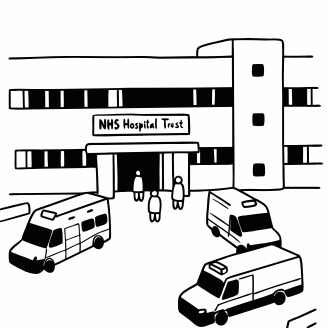
Hospital discharge remains one of the most critical and stressful moments for unpaid carers, patients and healthcare professionals alike. During the recent Carers Hospital Discharge Group meeting held in May 2026, professionals, carers, NHS leaders, hospital representatives and community organisations came together to discuss major developments affecting carers across London and beyond.

The Carers Hospital Discharge meeting runs every 2 months and for the month of May we discussed improving hospital discharge processes, strengthening carer identification, digital inclusion, community support and the growing role of technology in healthcare planning.

The blog update is for those unable to attend, here is a summary of the key discussions, presentations, questions and responses shared during the session.


Universal Care Plan Expansion Through the NHS App

One of the biggest updates came from NHS England, who shared exciting news about the expansion of the Universal Care Plan (UCP).

The new development allows patients and members of the public to begin creating their own Universal Care Plans directly through the NHS App. Previously, only clinicians could initiate many aspects of these plans.

NHS England explained that editable sections now include areas such as:

  • “What matters to me”
  • Communication preferences
  • Care and contingency plans
  • Personal support needs

Clinical sections, however, remain under healthcare professional control.

Updates described the project as a major milestone after years of discussion about allowing people greater control over their own care information.

Question from attendee:

“Will carers be able to input on behalf of their cared-for person?”

response from presenter:

At present, carers cannot directly complete plans on behalf of another person due to safeguarding and proxy access concerns. However, carers can still complete their own care contingency plans within the system.

It was explained that this means if a carer suddenly becomes unable to provide care, emergency services and healthcare providers would be alerted that a contingency plan exists.

They also noted that community organisations could potentially support individuals with completing plans, provided appropriate governance and data security arrangements are in place.

The discussion highlighted both the opportunities and challenges of balancing digital access with safeguarding responsibilities

*****

For more developments on the Universal Care PLan, I have provided the link below of the recent Webinar

UCP Webinar: Supporting Patient Editable Access to the Universal Care Plan – Guidance for Professionals (May 2026)
https://vimeo.com/1190395114/37af950076?share=copy&fl=sv&fe=ci


New Research on Social Networks and Healthcare Support

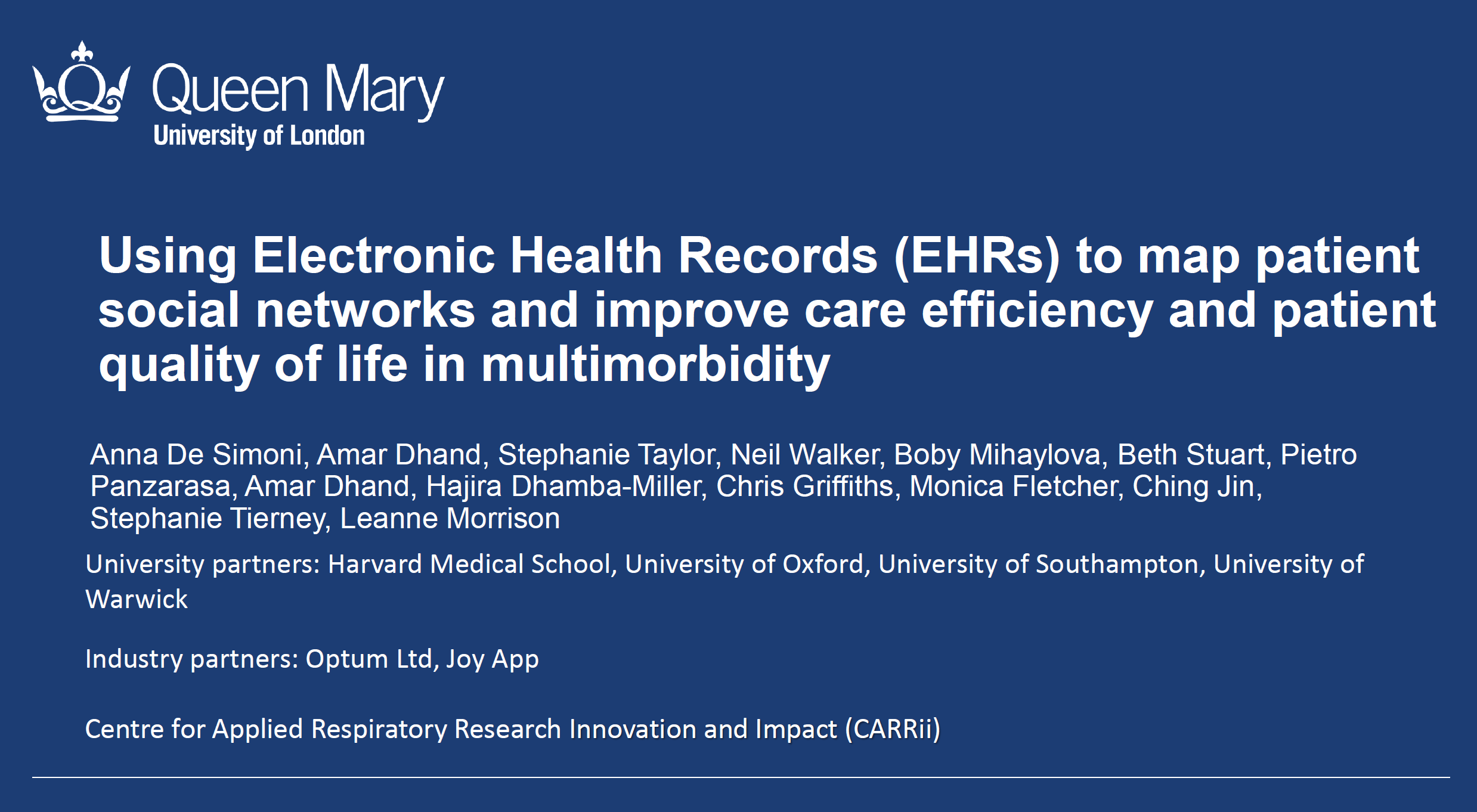
Matthew McKenzie introduced an emerging research project led by Queen Mary University of London alongside several major universities including Harvard, Oxford and Warwick.

The project aims to explore how patients’ social support networks influence health outcomes, hospital admissions and long-term wellbeing.

Researchers are developing tools to map patients’ support systems, including:

  • Family carers
  • Friends
  • Peer groups
  • Community support
  • Online social networks

The project seeks to better understand how strong support systems can improve self-management and reduce avoidable hospital admissions.

Matthew explained that researchers are particularly interested in understanding:

  • Whether support network mapping would feel helpful or intrusive
  • How carers should be recognised within healthcare systems
  • How cultural differences affect support networks
  • What safeguards around privacy and consent are needed

The proposal sparked interest among attendees because it reflects a wider NHS shift toward community-based care and prevention.

NHS England connected the project to wider work around “family group conferencing,” where whole-family approaches are used to plan care and support more collaboratively.


NHS England’s Urgent and Emergency Care Strategy 2025/26

A major section of the meeting focused on NHS England’s emerging Urgent and Emergency Care (UEC) Strategy.

Matthew presented some notes on NHS England UEC outlining plans to:

  • Reduce avoidable hospital admissions
  • Deliver more care within communities
  • Expand digital healthcare access
  • Improve hospital discharge pathways
  • Strengthen operational efficiency

Key proposals included:

  • AI-enabled triage systems
  • NHS App navigation tools
  • Digitally coordinated urgent care
  • Expanded community-based treatment
  • Greater use of early intervention models

However, the discussion quickly moved toward the potential risks associated with rapid digital transformation.

Participants concerns:

Representatives covering Hospitals, raised important concerns about how discharge pressures could negatively affect carers.:

“If somebody urgently needs that hospital bed, the pressure becomes getting people discharged quickly. That may not always leave enough time to identify carers properly.”

They stressed that carer identification should happen throughout the patient journey not only during discharge.

They highlighted opportunities for identification during:

  • Outpatient appointments
  • Pre-assessment clinics
  • Routine hospital interactions

Concerns About Digital Poverty

Another major concern involved digital exclusion.

Participants warned that:

  • Older people
  • People with dementia
  • Individuals without smartphones
  • People facing poverty
  • Non-English speakers
  • Neurodivergent individuals

could all struggle if urgent care becomes too dependent on digital systems.

It was mentioned that meeting carers who still rely entirely on phone calls rather than online platforms and stressed the need for alternative accessible routes into care.

Others agreed and referenced an Equality Impact Assessment linked to the NHS 10-Year Plan, which explores risks around digital inequality and vulnerable groups being left behind.

Equalities Impact Assessment – 10 Year Health Plan for England
https://www.gov.uk/government/publications/equalities-impact-assessment-10-year-health-plan-for-england/equalities-impact-assessment-10-year-health-plan-for-england

You can find out more about the UEC below

https://www.england.nhs.uk/publication/urgent-and-emergency-care-plan-2025-26


Carers Week Preparations Across London and Beyond
Many organisations shared updates on activities planned for Carers Week 2026

NHS England

NHS England Carers Week 2026 – ‘Building Carer Friendly Communities’

https://www.events.england.nhs.uk/nhs-england-carers-week-2026-building-carer-friendly-communities

Kingston Carers Network

KCNshared plans for:

  • Benefits advice sessions
  • Afternoon tea events
  • Mental health awareness activities
  • Community picnics
  • Outreach work with carers across Kingston

A major highlight will be the attendance of Sir Ed Davey, who is himself a well-known advocate for unpaid carers due to his own lived experience caring for family members. His involvement is expected to help raise awareness of the challenges carers face daily.

KCN also spoke about Kingston Carers Network’s ongoing efforts to strengthen links with Kingston Hospital. The organisation already receives referrals through the hospital’s carers liaison department, helping unpaid carers access emotional support, information and practical guidance following hospital admissions or discharge.

However, KCN is now trying to expand its presence inside the hospital itself through more direct face-to-face outreach work. Plans are being discussed to establish regular information stands within hospital settings so carers can receive support earlier and more proactively.

KCN explained that while these conversations are progressing, coordinating regular in-hospital outreach remains challenging due to logistical pressures and scheduling issues. Despite this, the organisation continues to work closely with hospital teams to improve visibility and engagement with carers.

Beyond hospital settings, Kingston Carers Network continues to deliver several outreach programmes throughout the borough. Staff regularly attend local groups, community spaces and events to identify carers who may not realise support is available to them.

North Central London Carers Support Project

Eleanor updated the group on work taking place across:

  • Barnet
  • Camden
  • Enfield
  • Haringey
  • Islington

The project works in partnership with multiple NHS trusts and carers organisations across North Central London with the aim of creating a more consistent and coordinated approach to identifying and supporting unpaid carers.

At the centre of the programme is the development of a standard operating procedure for carers within hospitals and healthcare settings. The goal is to ensure carers are recognised earlier, referred more efficiently and supported more consistently regardless of which hospital or borough they engage with.

One of the project’s biggest developments has been the creation of a dedicated carers referral website. Eleanor explained that the system is designed to simplify the referral process for healthcare professionals. When a referral is submitted through the portal, the system automatically directs the carer to the appropriate local carers organisation based on their postcode.

The intention is to remove confusion for hospital staff while helping carers access support much faster.

Eleanor described the project as an effort to make support pathways:

  • Easier for professionals to navigate
  • More accessible for carers
  • Better integrated across borough boundaries
  • Less dependent on individual staff knowledge

A major focus of the project continues to be embedding carer awareness into everyday hospital practice.

Carer Awareness Training Expanding Across Hospitals

The team has made significant progress with carer awareness training sessions delivered across several NHS trusts.

Regular drop-in training sessions are now taking place with:

  • The Whittington Trust
  • The Royal Free
  • North London Mental Health Trust services

Eleanor shared that attendance at some sessions has now exceeded 40 healthcare staff members, which she described as a major success.

The training focuses on:

  • Identifying unpaid carers earlier
  • Understanding carers’ rights and needs
  • Improving referral pathways
  • Increasing staff confidence when supporting carers
  • Embedding carer recognition into routine clinical practice

Importantly, the project measures the effectiveness of these sessions using confidence ratings before and after training. Eleanor reported that most staff attending show at least a one- or two-level increase in confidence around identifying and supporting carers after participating.

North Central London’s Focus on Carers Week and Community Engagement

Preparations for Carers Week are also a major priority for the project.

The team plans to host information stalls and awareness events at several hospitals including:

  • The Whittington Hospital
  • University College London Hospital (UCLH)
  • Barnet Hospital

These events aim to:

  • Raise awareness of unpaid carers
  • Promote available support services
  • Encourage hospital staff to make referrals
  • Help carers connect with local organisations

Lewisham Council Developments

Updates from Lewisham was on the ongoing work taking place across Lewisham to improve support for unpaid carers, particularly through closer collaboration between hospitals, carers organisations and local commissioners.

A major development has been Lewisham Hospital’s involvement in the South East London pilot programme focused on creating a standard operating procedure for carers across NHS trusts. The pilot aims to improve consistency in how carers are identified, supported and referred within hospital settings.

It was explained that Lewisham Hospital has been working closely with Imago, the borough’s commissioned carers support provider, to strengthen partnerships with hospital nursing teams and improve awareness of carers across wards and services.

Particular emphasis is now being placed on:

  • Increasing carer awareness training
  • Improving communication between services
  • Embedding carer identification into routine hospital practice
  • Strengthening links between healthcare and community support

Inspired by discussions during the meeting, it was also highlighted plans to explore integrating carer identification into regular auditing and review processes within hospital settings similar to initiatives already underway in other trusts.

Redesigning Lewisham’s Future Carers Service

One of the most significant updates involved the redesign of Lewisham’s carers support service model.

They shared that the current commissioned contract for carers services is due to end in January 2027, and work is already underway to shape the next phase of support provision.

Importantly, unpaid carers themselves are playing a central role in developing the new model.

A series of co-production sessions has been held with carers across the borough to ensure their lived experiences directly influence future service design. These discussions are helping shape priorities around:

  • Access to support
  • Communication with carers
  • Outreach and identification
  • Emotional wellbeing services
  • Practical support needs
  • Hospital discharge experiences

The borough hopes to move into procurement for the redesigned service later this year.

Carers Hub Lambeth

Carers Hub Lambeth shared an update on the organisation’s ongoing work supporting unpaid carers across King’s College Hospital and Guy’s and St Thomas’ NHS Foundation Trusts.

Although the current hospital carers project funding has been extended for an additional six months, Jen explained that the programme is now approaching its final phase, with funding currently due to end in September 2026.

As a result, the team’s main focus is now on ensuring hospitals become as self-sufficient as possible in identifying and supporting carers once the dedicated project ends.

Expanding Carer Awareness Training

A major priority for Lambeth Carers Hub is expanding carer awareness training for healthcare professionals.

It was explained that the organisation has:

  • Increased training sessions from once to twice monthly
  • Begun arranging bespoke sessions with individual hospital teams
  • Expanded engagement with primary care networks
  • Updated training materials to address barriers to carer identification

The training aims to help healthcare staff:

  • Recognise unpaid carers earlier
  • Understand carers’ support needs
  • Improve referral pathways
  • Build confidence in conversations with carers
  • Embed carers into routine healthcare practice

Carers Hub Lambeth acknowledged that while training sessions often generate an immediate increase in referrals, maintaining long-term momentum remains challenging.

It was mentioned that a familiar pattern where professionals attend training, referrals increase temporarily, and then gradually reduce again as competing clinical pressures take over.

Because of this, the organisation is now trying to better understand:

  • Why carers continue to be missed
  • What barriers staff face in identifying carers
  • How carer awareness can become part of everyday practice rather than an additional task

This reflects a wider challenge discussed throughout the meeting — ensuring carer support becomes embedded within healthcare systems rather than dependent on individual staff enthusiasm.


Embedding Carer Recognition Into Everyday Hospital Practice

One of the most practical discussions came from GESH update on integrating carers into routine hospital auditing processes.

St George’s and Epsom and St Helier Hospitals are now:

  • Adding carer identification questions into ward audits
  • Including carers within routine quality checks
  • Training volunteers to identify carers on wards
  • Embedding carers into “business as usual” practice

Wendy also spoke extensively about the NHS “Reasonable Adjustments Digital Flag,” a major NHS initiative designed to ensure patients’ accessibility needs are recognised across services.

The system aims to help hospitals and GP services better identify:

  • Communication needs
  • Disabilities
  • Neurodivergence
  • Mental health conditions
  • Carer-related support needs

The long-term goal is for healthcare systems to automatically recognise and share reasonable adjustment requirements across services.


Final Reflections

The meeting demonstrated both optimism and concern about the future direction of health and social care.

There was strong agreement that:

  • Community-based care is necessary
  • Earlier intervention can prevent hospital admissions
  • Carers must be identified earlier
  • Digital systems offer opportunities

However, participants repeatedly stressed that healthcare transformation must not leave vulnerable people behind.

Carers remain central to safe discharge, patient wellbeing and long-term community support. As NHS services increasingly move toward digital and community-led models, ensuring carers are recognised, supported and included will remain critical.

The next Carers Hospital Discharge Group meeting is expected to take place in July 2026.
Lewisham, Southwark & Lambeth carer forum update May 2026

Update by Matthew McKenzie – Chair of South London Mental Health Carers Forum

The South London Mental Health Carers Group met for the month of May for a wide-ranging and thoughtful discussion covering carers’ experiences, mental health support systems, involvement opportunities, and an important research presentation focused on support networks and long-term care.

The group covers areas of Lewisham, Southwark, Lambeth & Croydon, although Mental Health Carers from outside those areas are welcime to attend

The session brought together carers, advocates, involvement leads, and guest speaker Dr Anna De Simone from Queen Mary University of London. As always, the discussion highlighted both the challenges carers continue to face and the value of shared lived experience and peer support.

Opening Discussions: Challenges in Mental Health Care Systems

The meeting began with carers sharing experiences of navigating mental health services for loved ones with complex needs. There was extensive discussion around:

  • difficulties accessing appropriate placements,
  • safeguarding concerns,
  • discharge planning,
  • lack of continuity between NHS trusts and local authorities,
  • and ongoing challenges around funding responsibility between different services.

A recurring issue raised was the pressure on inpatient beds and the concern that discharge decisions can sometimes feel driven more by system pressures than by clinical readiness. Carers spoke openly about the emotional impact of repeatedly having to advocate for vulnerable loved ones while navigating fragmented systems.

There was also discussion around the importance of carers being recognised and included in communication and planning processes. Participants highlighted how carers are often the people most aware of deterioration, risks, or safeguarding concerns, and how vital it is that services engage meaningfully with families and informal supporters where appropriate.

Despite frustrations, carers also acknowledged examples of good practice and supportive professionals within mental health services. Several attendees noted that they had seen gradual improvements in carer involvement and listening exercises within parts of South London and Maudsley NHS Foundation Trust (SLAM), particularly in Lambeth.

Updates on Carer Involvement and Support Activities

The group received updates from carers and representatives involved in local mental health engagement work and carers’ organisations.

Carers Week Activities

Karen from Carers Hub Lambeth shared details of upcoming Carers Week activities, including:

  • outreach events,
  • wellbeing sessions,
  • information stalls,
  • and activities for both adult and young carers.

The events aim to provide carers with opportunities for support, networking, practical advice, and wellbeing activities.

Here is more info on Carers Week 2026

https://www.carersweek.org/about-carers-week/latest-news/posts-folder/2026/january/carers-week-dates-for-2026

SLAM and Carer Involvement

There was also discussion around changes and developments within SLAM involvement structures, including:

  • continuation of family and carers meetings,
  • changes to involvement leads,
  • and ongoing reviews of the involvement register.

Attendees reflected positively on the increasing recognition of carers’ voices in some forums and clinical meetings, while acknowledging that there is still much work to do to ensure consistent involvement across all boroughs and services.

Guest Presentation: Mapping Patient Support Networks

The second half of the meeting focused on a presentation from Dr Anna De Simone, GP and Associate Professor of Primary Care at Queen Mary University of London.

Anna introduced a proposed research project exploring how healthcare systems might better understand and map patients’ support networks using electronic health records and social network tools.

The research proposal focuses particularly on patients with long-term conditions such as COPD (Chronic Obstructive Pulmonary Disease), many of whom also experience multiple additional health conditions and varying levels of social isolation.

The Core Idea

Anna explained that while healthcare professionals can currently access limited information such as next of kin or household members, they often lack a fuller understanding of:

  • who actually supports the patient,
  • how reliable that support is,
  • whether support networks are connected or fragmented,
  • and how socially isolated a patient may be.

The proposed research would explore whether creating visual “maps” of support networks could help:

  • improve care planning,
  • reduce crises,
  • improve coordination between services,
  • and enhance patients’ quality of life.

The project would also examine how social prescribing, community services, online support groups, and carers fit into these wider support networks.

Carers’ Feedback on the Research Proposal

The discussion following Anna’s presentation was extremely rich and constructive, with carers offering both enthusiasm and important cautionary perspectives.

Strong Support for the Concept

Many attendees felt the project addressed an important gap in healthcare planning. Several carers spoke about how informal support networks had been essential to helping them or their loved ones survive periods of crisis.

Participants agreed that professionals often underestimate the role played by:

  • friends,
  • neighbours,
  • online communities,
  • peer groups,
  • and unpaid carers.

The ability to visualise these networks was seen as potentially valuable for both professionals and patients themselves.

Importance of Non-Traditional Support Networks

A strong theme throughout the discussion was that support does not always come from family.

Some carers explained that family relationships can sometimes be unsafe or abusive, and that support may instead come from trusted friends, neighbours, carers’ groups, or online communities.

The group stressed that any future system should avoid assuming that family automatically equals safety or support.

Online Communities and Digital Support

Participants also highlighted the increasing importance of online support systems.

Several carers explained that:

  • Zoom groups,
  • Facebook communities,
  • online peer support,
  • and digital communication
    can provide essential social connection, especially for disabled or isolated people.

One participant noted that online support networks had directly helped them access practical support and reduce isolation when physical mobility was limited.

At the same time, carers cautioned that not everyone has equal access to digital services. Concerns were raised about:

  • digital exclusion,
  • accessibility barriers,
  • lack of digital skills,
  • and the risk of widening inequalities.

The importance of offering both digital and non-digital forms of support was strongly emphasised.

Privacy, Consent, and Mental Health

Carers also discussed potential challenges around privacy and consent, particularly for people experiencing paranoia or severe mental illness.

Some attendees noted that patients may not always feel comfortable sharing details about their social networks, and that trust and safeguarding would need to be central to any future system.

There was discussion about the delicate balance between:

  • confidentiality,
  • safety,
  • carer involvement,
  • and patient autonomy.

Role of Social Prescribers

The group generally agreed that social prescribers could play an important role in helping patients map support networks, because they often have more time and a stronger focus on community support than standard GP appointments allow.

However, concerns were raised about long-term funding and sustainability for social prescribing services.

Looking Ahead

Anna thanked the group for their detailed feedback and explained that carers’ insights would help shape the next stage of the research proposal before submission later this year.

There was strong interest from attendees in remaining involved should the project move forward, particularly around future patient and public involvement opportunities.

The meeting once again demonstrated the depth of knowledge, experience, and expertise held by unpaid carers. The discussion reflected not only the challenges carers continue to face, but also the importance of ensuring carers are recognised as essential partners in both healthcare delivery and future research.

Who is – A Poem for Mental Health Carers by Matthew McKenzie

Mental health carers often navigate a system that feels fragmented, leaving them unheard and unseen. My new spoken word poem, “Who is”, explores this reality asking who is believed, listened to, supported, or left behind when the challenges of mental illness take hold.

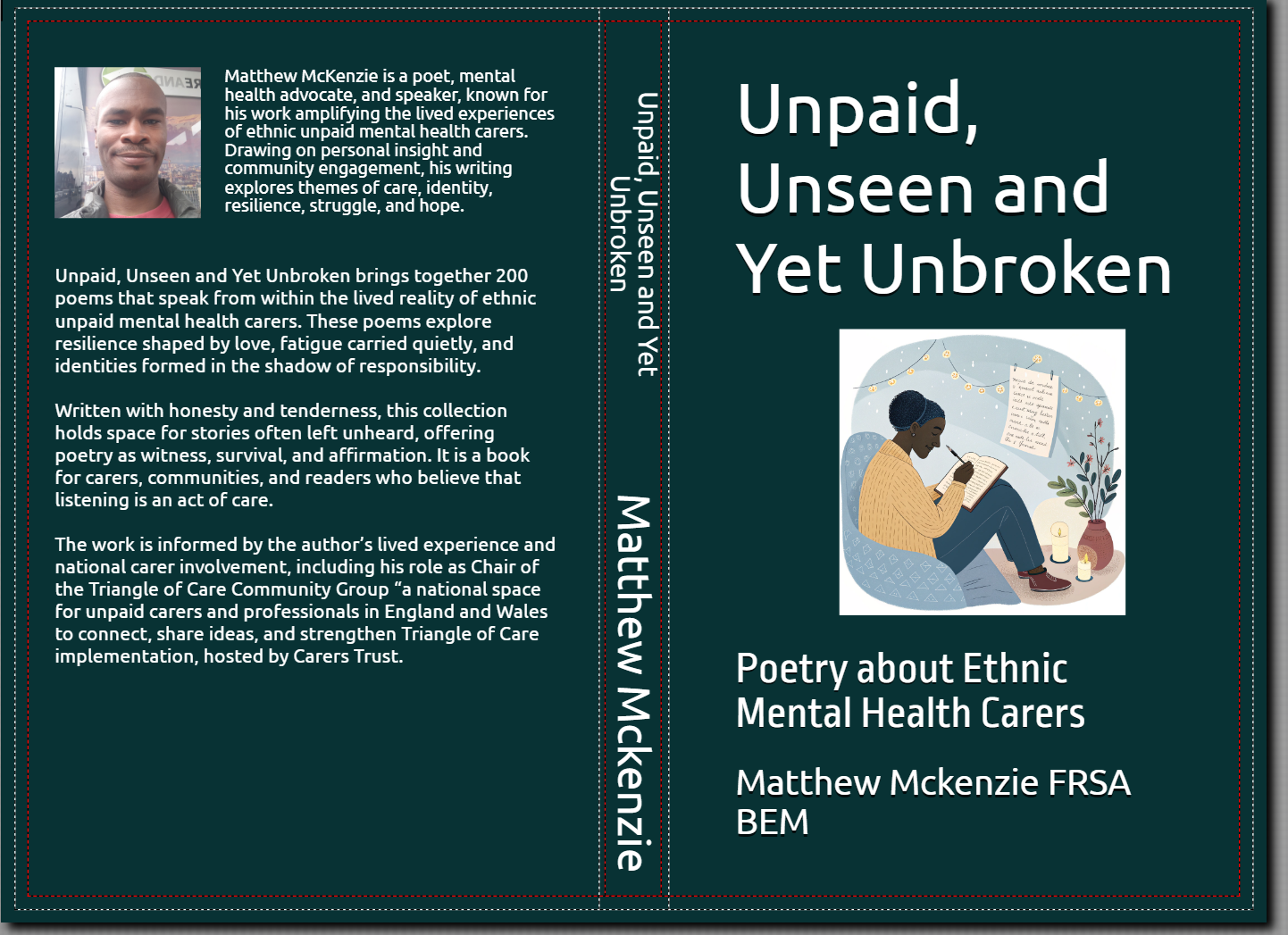
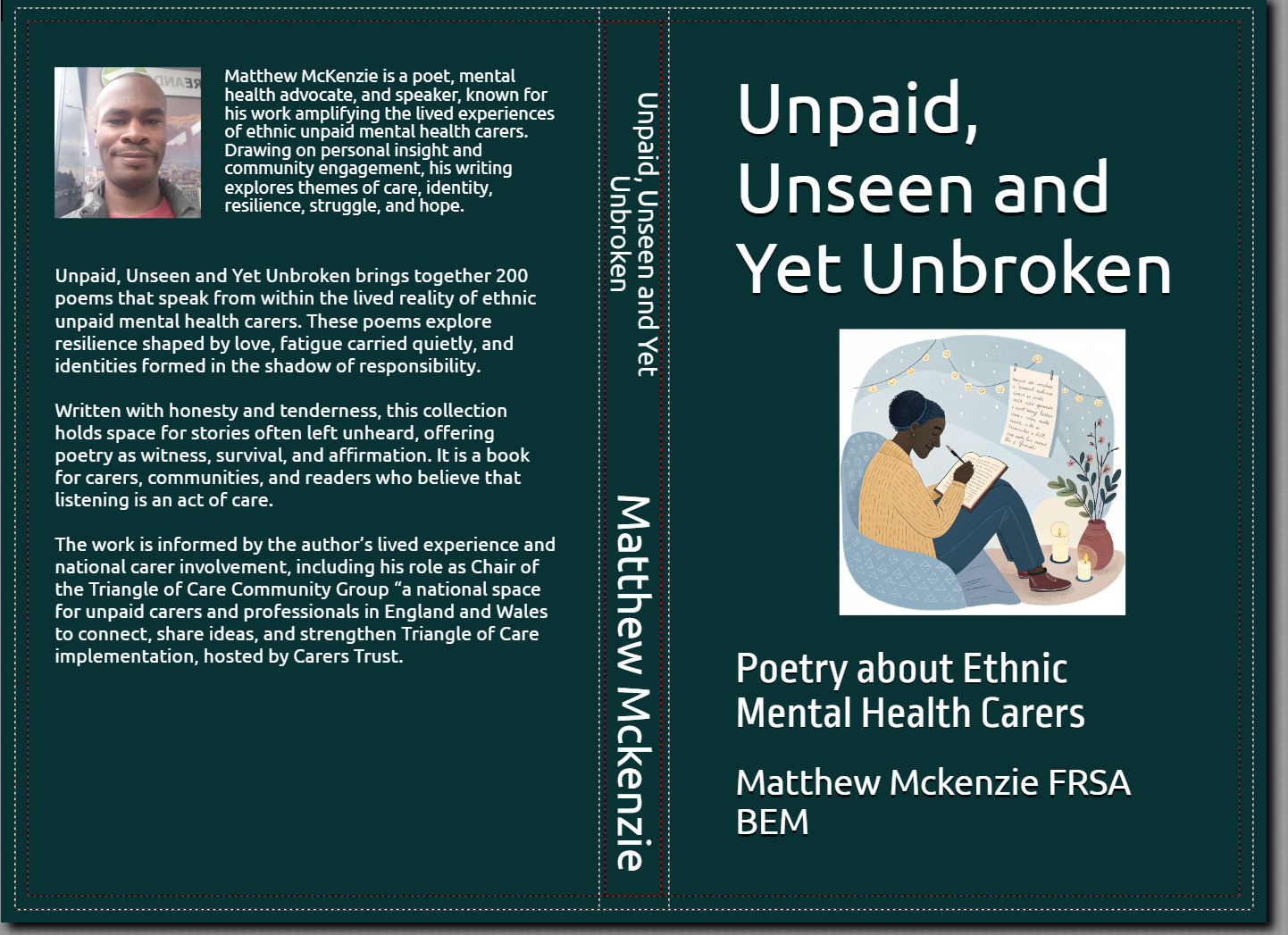
Taken from my upcoming poetry collection, Unpaid, Unseen and Yet Unbroken (launching 2026), this piece reflects the experiences of unpaid carers, particularly from ethnic minority communities, who face the added burden of navigating a system that often overlooks their voices.

Through poetry, I hope to open a conversation about the importance of listening, understanding, and valuing carers’ lived experiences.

🎥 Watch the full poem here: Who is – Spoken Word Poem

Mental Health Awareness Month 2026

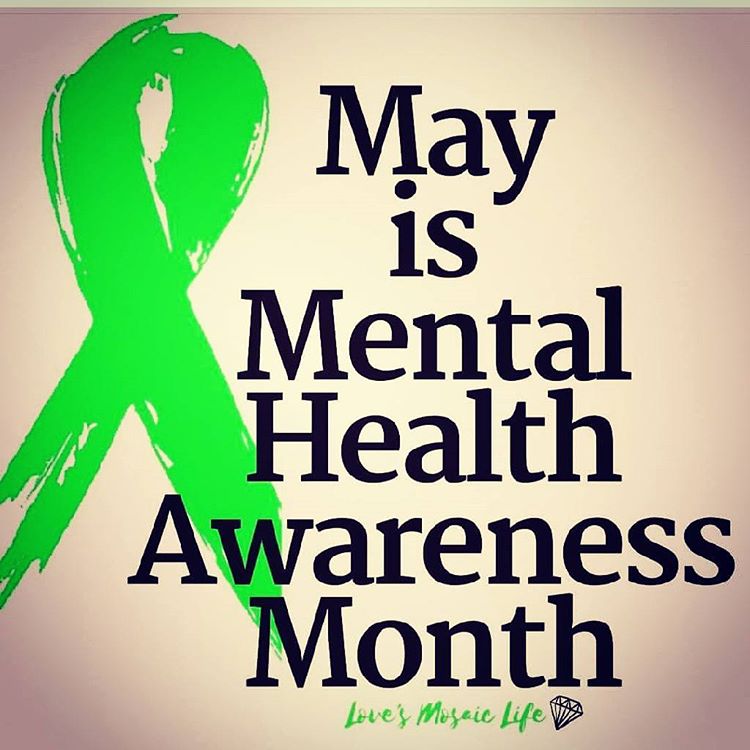
May is Mental Health Awareness Month 2026 over in the states, with this year’s theme, “More Good Days, Together”, encouraging communities to support mental well-being.

Unpaid carers and family caregivers often face unique challenges, and organizations like Mental Health America, National Alliance for Caregiving, Family Caregiver Alliance, AARP, and the American Association of Caregiving Youth provide valuable resources and guidance.

This month is a reminder that small acts of support and self-care can make a big difference in creating more good days for everyone.


Mental Health & Caregiver Resources (U.S. & UK)

United States

  1. Mental Health America (MHA)
  2. National Alliance for Caregiving (NAC)
  3. Family Caregiver Alliance (FCA)
  4. AARP Caregiving Resources
  5. American Association of Caregiving Youth (AACY)

United Kingdom

  1. Carers UK
  2. Mind (UK Mental Health Charity)
  3. The Mental Health Foundation
  4. Young Carers Action Day / Carers Trust (UK)

A New Study Giving Voice to Carers Experiencing Domestic Abuse

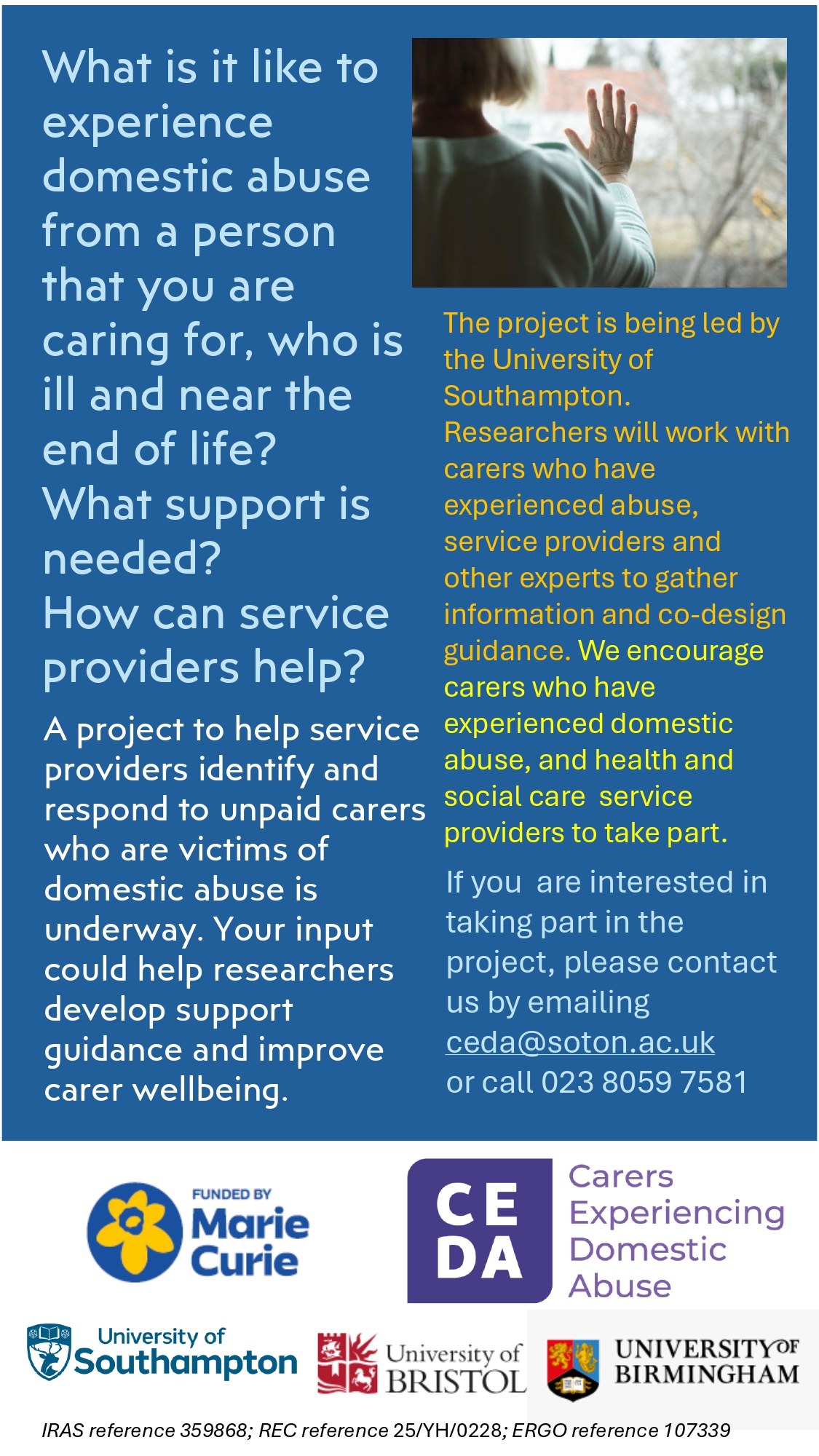
Caring for a loved one at the end of life is often described as an act of compassion and dedication. But for some carers, this role comes with a hidden and deeply challenging reality, experiencing domestic abuse from the very person they are supporting.

A new research project led by the University of Southampton is shining a light on this often overlooked issue. The study aims to understand what it is like to experience domestic abuse in a caring relationship, particularly when the person receiving care is seriously ill or nearing the end of life. It also seeks to explore what kinds of support carers need, and how health and social care services can respond more effectively.

This project brings together carers, professionals, and experts to share experiences and co-design practical guidance that could improve support systems and overall wellbeing for carers. By listening directly to those affected, researchers hope to create meaningful change in how services identify and respond to abuse in caregiving situations .

If you are a carer who has experienced domestic abuse or a professional working in health or social care, your insights could make a real difference. Taking part in the study is an opportunity to help shape better support for others facing similar challenges.

To learn more or get involved, you can contact the research team at ceda@soton.ac.uk or call 023 8059 7581.

Your voice matters. By sharing your experience, you can help build safer, more supportive care environments for everyone.

Our Stories Matter – Poem by Matthew McKenzie #PCREF

Stories are powerful. They carry memory, experience, and truth in ways that forms and systems often cannot. For unpaid minority carers, our stories are not just reflections, they are essential to understanding the full picture of care.

I’ve recently shared a poem, “Our Stories Matter,” from my upcoming poetry book. It explores the importance of lived experience, intergenerational memory, and the voices that are too often overlooked within health and social care systems.

While assessments, care plans, and clinical notes tell part of the story, they rarely capture the depth of what families and carers experience every day. Our stories provide context. They bring meaning and complete the picture.

This is especially important within the context of PCREF, where recognising lived experience and cultural understanding is key to improving care and addressing inequalities. When carers’ voices are not heard, something vital is missing.

This poem is a reminder that our stories are central.

🎥 Watch “Our Stories Matter” here:
https://www.youtube.com/watch?v=_sVie4YSdbc

Step Outside, Connect, and Recharge: Join Carers Active Together in Hyde Park

Taking time for yourself as a carer isn’t always easy. The daily responsibilities, emotional demands, and constant care for others can often mean your own wellbeing takes a back seat. That’s why initiatives like Carers Active Together matter more than ever.

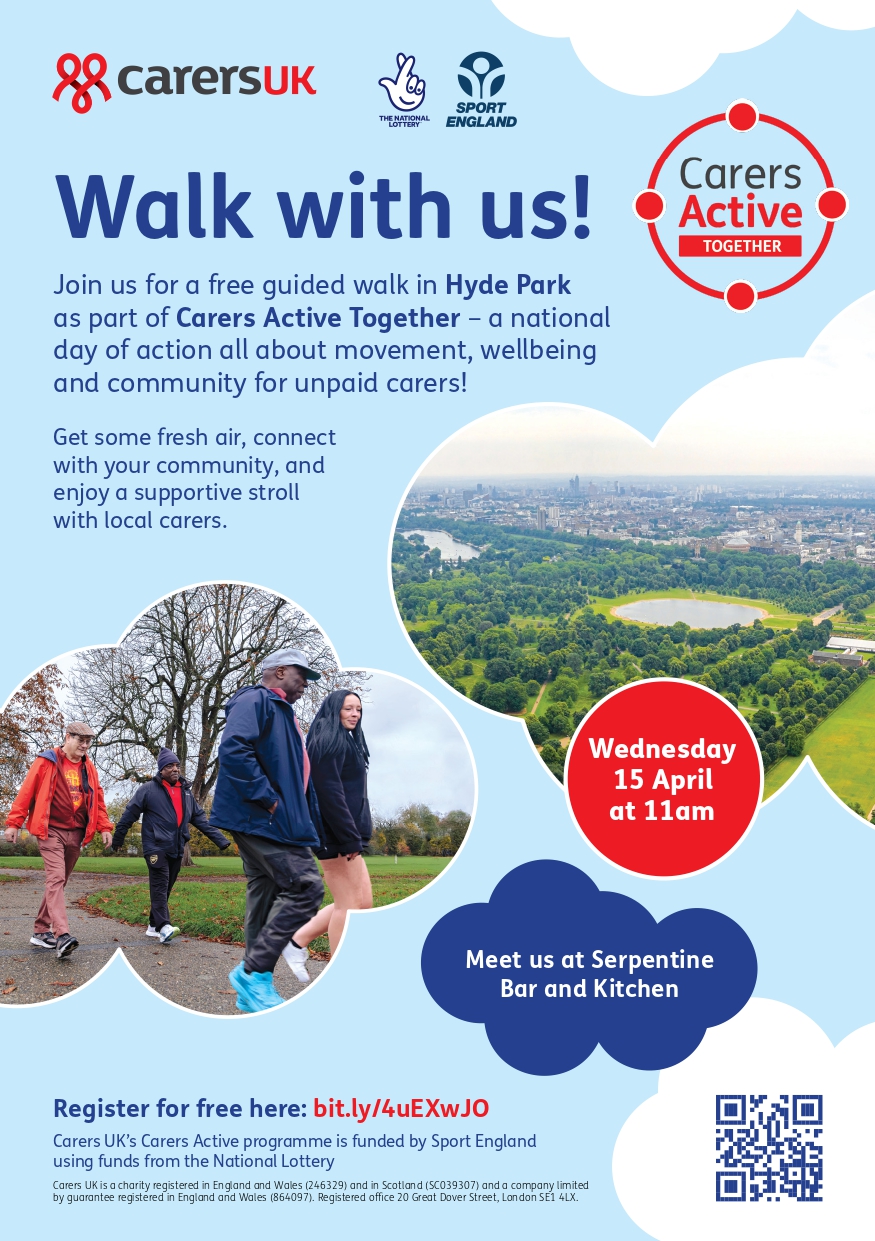
This Wednesday 15 April, a national day of action is bringing carers across the UK together to focus on movement, wellbeing, and community and you’re invited to be part of it.

A simple step that makes a difference

As part of the day, Carers UK is hosting a free, friendly wellbeing walk in Hyde Park, which is a chance to pause, breathe, and connect with others who understand the caring journey.

Whether you’re caring for a loved one full-time or supporting someone alongside work and life commitments, this walk is designed to be inclusive, relaxed, and welcoming. There’s no pressure, just an opportunity to enjoy fresh air, gentle movement, and good company.

Event details

  • Date: Wednesday 15 April
  • Time: 11:00am
  • Location: Meet at Serpentine Bar and Kitchen, Hyde Park
  • Cost: Free

As highlighted on the event flyer (page 1), the walk is all about giving carers a chance to “get some fresh air, connect with your community, and enjoy a supportive stroll with local carers.”

Why join the walk?

Sometimes the smallest actions like a walk in the park can have the biggest impact. Taking part in this event can help you:

  • Boost your physical and mental wellbeing
  • Meet other carers and share experiences
  • Feel part of a supportive community
  • Take a well-deserved break in a beautiful setting

You’re not alone

Carers play an essential role in our communities, often quietly and without recognition. Carers Active Together is a reminder that your wellbeing matters too and that support is out there.

If you know someone who is a carer, consider sharing this with them. A simple invitation could make a meaningful difference.

Register your place

Spaces are free, but registration is encouraged. You can sign up here:
👉 https://bit.ly/4uEXwJO

Bipolar Awareness Is More Than One Day – World Bipolar Day 2026

To mark World Bipolar Day 2026, I’ve created a short video highlighting the reality of living with bipolar and the vital role of unpaid carers, friends, and family. Awareness is important, but understanding and everyday support matter just as much.

In this video, I share reflections as a mental health carer and activist, focusing on the human side of bipolar and the people who often support quietly in the background.
👉 Watch the video here: https://www.youtube.com/watch?v=gnn0tfLs2z8

World Bipolar Day is supported globally by organisations including:

In the UK, Bipolar UK (https://www.bipolaruk.org) provides vital peer support for people affected by bipolar, including carers. Carer organisations also play a crucial role in supporting unpaid carers:

We Look After Each Other: A Poem of Care, Community, and Lived Experience

I’m proud to share “We Look After Each Other”.

The poem is a spoken word piece from my upcoming poetry collection Unpaid, Unseen and Yet Unbroken (launching 2026).

This poem centres the lived experiences of ethnic and minority mental health carers, where they continue to show up, often without recognition, navigating systems that can feel complex and unresponsive.

The poem focuses on the quiet strength, shared knowledge, and collective care that exist within our communities.

In the spirit of PCREF, this work highlights the importance of listening to lived experience, valuing cultural understanding, and recognising community as a source of resilience and healing

Hospital Carer Discharge Meeting – March Update 2026

By Matthew McKenzie (Chair)

I chaired our March hospital discharge network meeting with a real sense of momentum building across the system. What continues to strike me is the mix of voices in the room, commissioners, carers centres, hospital representatives, and grassroots advocates all trying to tackle the same persistent issue: how we properly involve and support unpaid carers during and after hospital discharge.

As someone with lived experience, particularly in mental health and complex care, I always come back to one key question:
Are carers being treated as partners, or are they still being treated as visitors?

This meeting gave us a very honest answer progress is happening, but there is still a long way to go.


Key Presentation: Derbyshire HConnect Project

Emma’s presentation was, for me, an important part of the meeting not because it introduced something completely new, but because it clearly articulated what many carers have been saying for years, and then actually did something about it.

What stood out immediately was that this wasn’t a project designed in isolation. It was built directly from carer voice and lived experience. The starting point wasn’t “how do we improve discharge?” it was “what are carers actually experiencing right now?”

And what carers described was difficult to hear, but not surprising.

Carers spoke about not being recognised at all. Some said no one had even asked if they were a carer. Others described situations where their knowledge of the person they care for was ignored, even when it was critical. One example that stayed with me was a carer describing their loved one being discharged in the middle of winter, late at night, without proper clothing or preparation.

There was a consistent feeling that once someone enters hospital, the carer’s role is almost paused or worse, dismissed entirely.

What the HConnect project does differently is acknowledge that this isn’t just a communication issue it’s a system and culture issue.

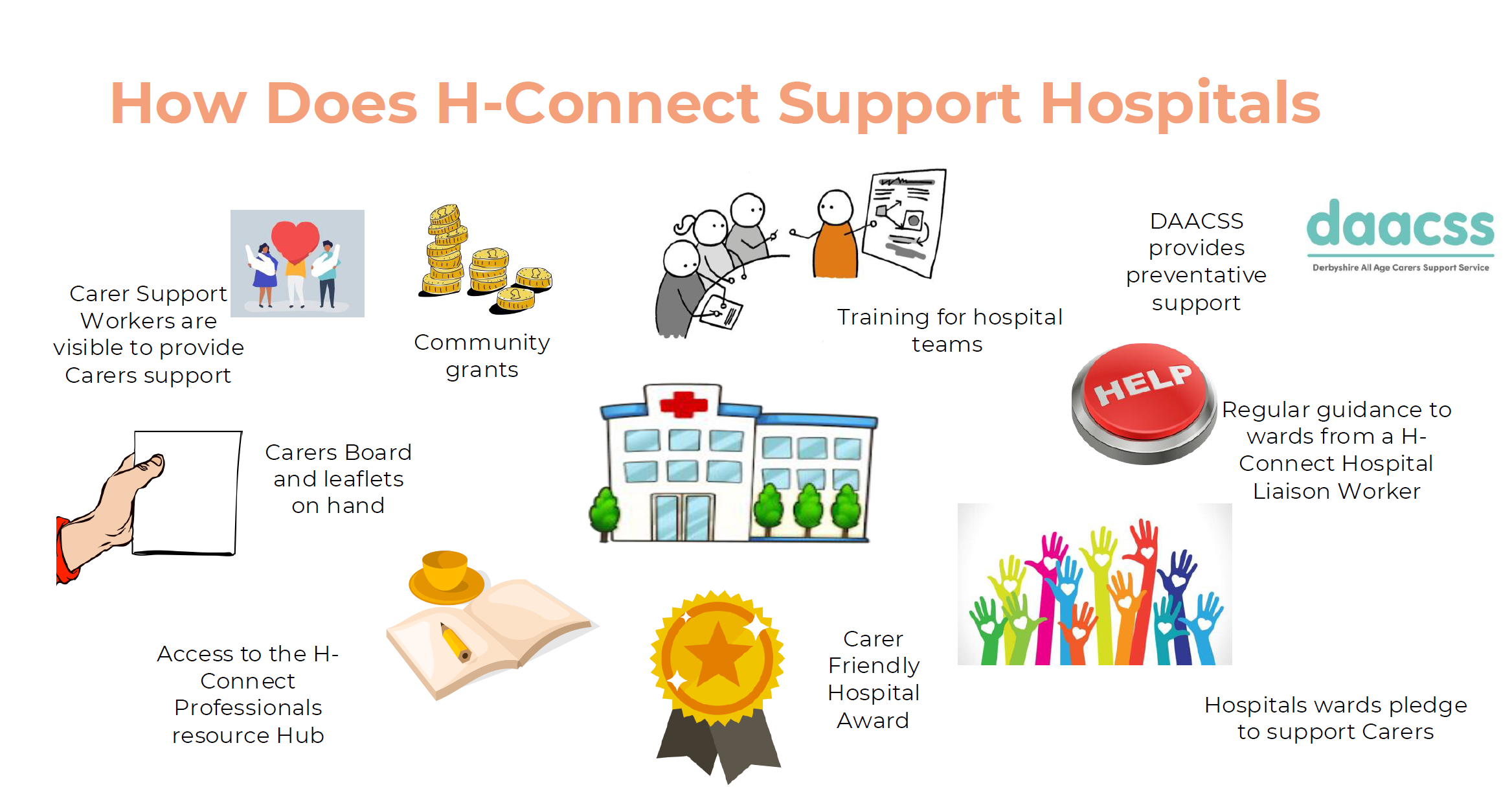
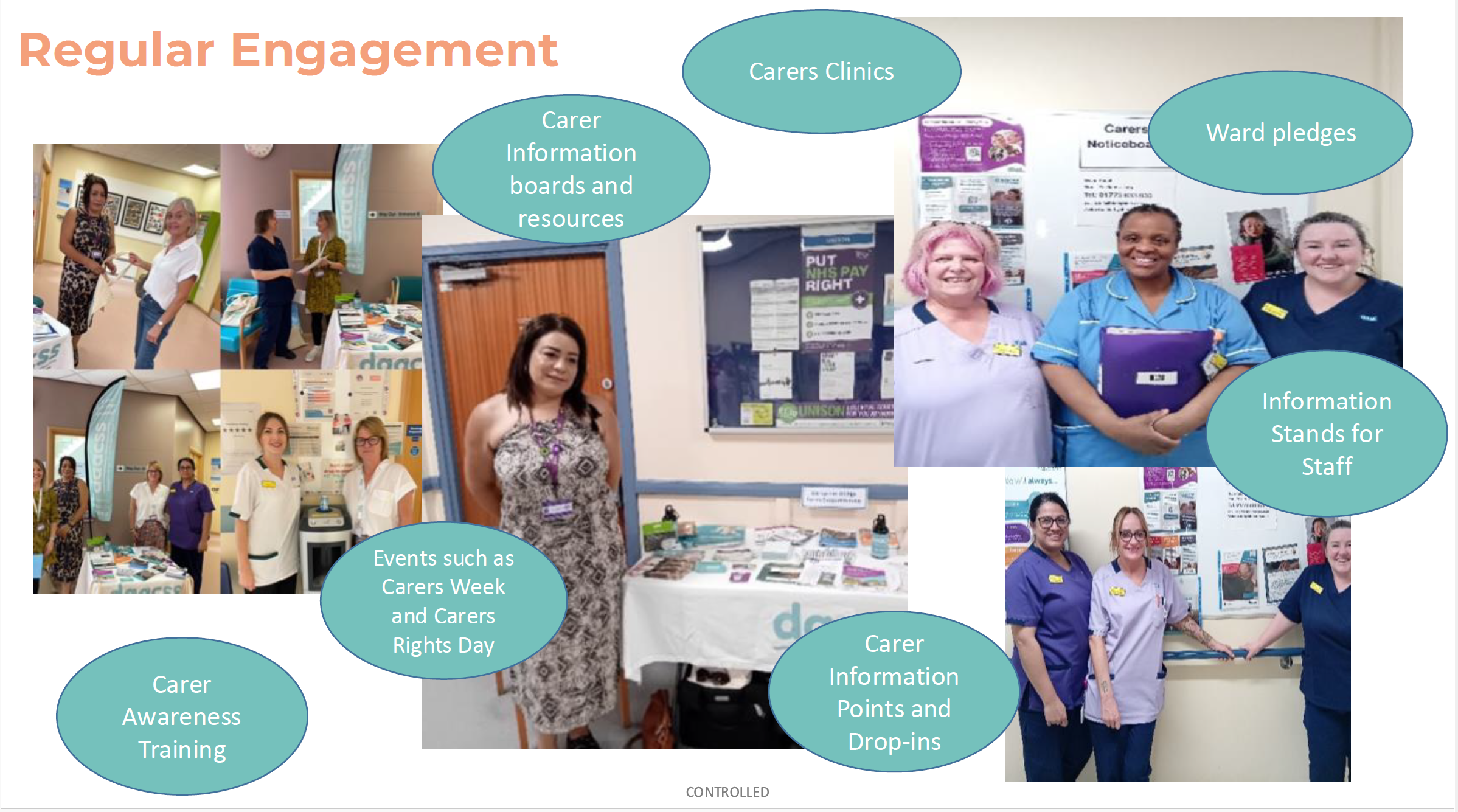
Instead of relying on one intervention, the model works across multiple layers of the hospital system. It introduces dedicated hospital liaison workers who build relationships with wards, while also ensuring carers themselves are visible and supported directly on-site. At the same time, it invests in staff through training, guidance, and practical tools so that engaging carers becomes part of everyday practice rather than an optional extra.

What I found particularly important is that the project doesn’t assume staff are unwilling—it recognises that many staff simply lack the confidence, knowledge, or structure to engage carers properly. In fact, the findings showed that many hospital teams had never received any formal carer awareness training and were often unaware that carers even have a legal right to be involved in discharge planning.

The research element of the project adds another layer of depth. Through interviews with carers, several consistent themes emerged.

Carers described feeling invisible—treated as visitors rather than partners in care. They talked about their expertise being dismissed, even when they knew the patient best. Communication was often unclear or inconsistent, and discharge frequently felt rushed, with little notice or preparation. In many cases, carers ended up acting as the safety net catching mistakes, coordinating care, and managing complex needs on their own once the person returned home.

What struck me most is that these issues aren’t just isolated incidents they are patterns.

But importantly, the presentation didn’t just focus on what’s going wrong. It also highlighted what good looks like. In situations where carers were listened to, involved early, and treated as equal partners, the entire experience changed for both the carer and the patient. The challenge now is making that level of practice consistent, not exceptional.

The project is already showing tangible impact. There has been a noticeable increase in carers being identified within hospital settings, more referrals coming directly from health professionals, and hundreds of carers receiving support through the programme.

For me, the biggest takeaway from this presentation is this:

This isn’t about adding more services it’s about changing behaviour across the system.

The HConnect model recognises that for carers to be properly involved, three things need to be in place: staff need the capability to identify carers, the opportunity within the system to engage them, and the motivation to see this as a core part of care. Without all three, change simply won’t stick.

And that’s why this work matters. Because until carers are consistently seen, heard, and included, we will continue to see the same issues repeating no matter how many initiatives we introduce.


Lewisham Commissioner Update

From Lewisham’s commissioning side, there were some strong practical developments.

A key initiative is the rollout of a carer welcome pack, designed to be:

  • Clearly visible in hospital settings
  • Easily accessible to carers at the point of need

This is being strengthened through:

  • Increased collaboration with hospital staff
  • Plans to expand distribution across wards

From Lewisham, we also received a really significant update around system-level change, particularly the development of a Standard Operating Procedure (SOP) for engaging unpaid carers in hospital settings.

This work has been led across South East London ICB, with an external partner supporting the design. The aim of the SOP is to provide:

  • Clear guidance to hospital wards
  • Practical prompts and questions for staff
  • A consistent approach to identifying and engaging carers during hospital stays

What stood out to me is that this isn’t just a document, it’s designed to change behaviour on the ground. It focuses on something simple but powerful:
how staff start conversations with carers and recognise the people already supporting patients.

In Lewisham, University Hospital Lewisham was selected as one of the pilot sites, with two wards testing the approach. The next stage is particularly important:

  • The SOP is being embedded into Trust templates
  • It is due to be presented to the Trust board for formal approval
  • There are plans to roll this out across Lewisham and Greenwich NHS Trust, including Queen Elizabeth Hospital (Woolwich)

What I found especially encouraging is that carers have been involved throughout:

  • Input gathered through workshops
  • Further feedback taken to the Lewisham Council’s Open Carers Forum
  • Ongoing opportunity for boroughs to adapt the SOP to local needs

Alongside this, Lewisham is continuing practical work on the ground:

  • Strengthening links between commissioned carers services and hospital staff
  • Expanding visibility through carer welcome packs and information points within the hospital

For me, this is one of the most important developments discussed in the meeting. If implemented properly, a shared SOP like this has the potential to:

  • Reduce inconsistency across wards
  • Embed carer identification into everyday practice
  • Move us closer to a system where carers are routinely recognised—not accidentally discovered

Hospital Update: Lewisham & Greenwich NHS Trust

A really important contribution came from the patient experience perspective at Lewisham and Greenwich NHS Trust, which covers University Hospital Lewisham and Queen Elizabeth Hospital (Woolwich).

From the Trust side, there was clear recognition that:

  • The work carers are doing is valuable and essential to patient outcomes
  • There is a need to improve physical visibility of carer support within hospital settings
  • Space and infrastructure need to better support engagement (for example, identifying a permanent location for carer engagement and resources)

There was also a willingness to:

  • Explore how carer-led engagement (including my own involvement) can be better embedded within the hospital environment
  • Strengthen links between patient experience teams and carers organisations

From my perspective, this was a positive and practical discussion. Too often we talk about engagement in theory—but here we were talking about where the table actually goes on the ward, and that level of detail matters.

Because if carers can’t see you, they can’t access you.


Greenwich (Commissioning & Mental Health)

Greenwich colleagues spoke about their broader system approach, particularly within mental health.

Their focus includes:

  • Identifying gaps in carer support across services
  • Embedding carers within commissioning priorities
  • Understanding what carers themselves want from local systems

They also posed an important question to the group:
What should local authorities prioritise for carers?

My answer was straightforward:
We need clear leadership and accountability, a named person or role responsible for carers across the system.

Without that, good work risks becoming fragmented.


Lambeth Carers Hub (King’s College Hospital & St Thomas’ Hospital)

Lambeth shared a detailed and honest update regarding their work across King’s College Hospital and Guys and St Thomas Hospital

Key points included:

  • Their hospital discharge project is continuing, but with reduced capacity due to funding constraints
  • They have secured a short-term extension, allowing work to continue until September
  • A major focus is now embedding carer awareness training into staff induction processes

Importantly, they raised a systemic issue:

  • The need to hold commissioned care agencies accountable, particularly when carers report poor-quality care after discharge

This is critical. Discharge doesn’t end at the hospital door—if the care package fails, the whole system fails.


Southwark Council Update

From Southwark, we heard about work being done at a system level, particularly linked to:

  • Development of discharge information resources across South East London
  • Collaboration across boroughs and NHS partners

The intention is for these resources to be:

  • Widely accessible and adaptable
  • Used across multiple organisations, rather than siloed locally

Given the proximity to major hospitals like King’s College Hospital and GSTT hosptal, this kind of coordinated approach is essential.


City & Hackney Carers Centre (Homerton Hospital)

A more concerning update came from City & Hackney, particularly regarding work linked to Homerton Hospital.

They reported:

  • The loss of a hospital discharge worker role
  • A significant drop in referrals to the carers centre as a result
  • Reduced presence within the hospital environment

This clearly demonstrates something we often say but don’t always quantify:

When you remove dedicated roles, you remove outcomes.

The worker’s presence had been directly contributing to engagement and referrals. Without that, carers are once again at risk of being missed.


Richmond Carers Centre (Kingston Hospital)

Updates from Richmond Carers Centre highlighted both strong engagement and opportunities to build further.

Positives:

  • Strong referral pathways coming through from Kingston Hospital, particularly linked to discharge activity
  • Ongoing professional awareness work, helping improve understanding of carers across services

There is a clear foundation here, with established relationships already supporting carers into services. The opportunity now is to build on that by increasing visibility and strengthening in-hospital engagement further.


Richmond Borough Mind (Springfield Hospital – SWLSTG)

From Richmond Borough Mind, the focus was more specifically on their work within South West London and St George’s Mental Health Trust (SWLSTG), particularly at Springfield Hospital.

Key challenges highlighted:

  • Difficulty accessing wards within Springfield Hospital, limiting direct engagement with carers
  • Limited contact with carers when based in general hospital areas rather than embedded on wards
  • Ongoing challenge in identifying where carers are most visible and reachable within mental health settings

What came through strongly is that, despite proactive efforts such as setting up stands and being present on-site, footfall from carers remains low unless services are embedded directly into ward environments.

This reinforces a key point for me:

In mental health settings especially, access is everything—if you’re not where carers are, you simply won’t reach them.


Bexley Carers (Post-Discharge & Reablement Focus)

Bexley brought an important perspective that often gets overlooked what happens after discharge.

Their work is focusing on:

  • Supporting carers once reablement packages end
  • Recognising that carers often deprioritise themselves during discharge, only to struggle later
  • Increasing concern around safeguarding and mental health, particularly in dementia care

This is where we need to shift thinking:
Discharge is not the endpoint—it’s the start of a new phase of care.


Cross-Cutting Reflections

Across all updates, several consistent themes emerged:

  • Inconsistent carer identification across wards and trusts
  • Funding fragility, with projects often short-term
  • Need for embedded training, not optional sessions
  • Importance of visibility within hospital environments
  • Gaps in post-discharge support, especially after reablement

My Closing Thoughts

Chairing this meeting, I was struck by both the progress and the gaps.

There is innovation happening in Derbyshire, in Lambeth, in Lewisham, across South East London. But it’s uneven. And carers feel that inconsistency every day.

For me, the priority remains clear:

  • Identify carers early
  • Involve them properly
  • Support them beyond discharge

Because when we get that right, everything else improves—outcomes, safety, and experience.

And until we get that right consistently, we still have work to do.